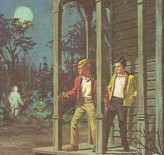
I've been promising this for a whole, and better do it - the holidays are coming fast (with the Oshima series in town, they're already here! that's pretty much my schedule for the next week...), and time is getting short... So, as noted in my Synecdoche NY post, there have been some interesting films this fall - here are a couple in particular I liked, a bit more than the Kaufman film... Namely, Rachel Getting Married and A Christmas Tale. [I noticed: there are spoilers below - I don't know if these films are still creeping around the country - they might be, and I imagine lots of people will only get the chance to see them on DVD; I'm not sure there's any way around this, though, not for me - I'm not much of a reviewer: I want to talk about their stories and story telling, and I am pretty sure that requires talking about some things that are revealed over time in the films - I don't know if I'd call them surprises, but, the revelation is part of the way the stories are told... so... be warned, I guess.]
These two films go together rather well - in both, a black sheep character turns up at a family gathering and raises hell - reopening old wounds and restarting old fights, by acting like a jerk, etc. Some resolutions are reached, though that isn't quite the point (Rachel ties everything up much neater than the Desplechin film - the dead child is her fault, the characters sort of work through things to something like peace, etc. - none of which happens, exactly, in A Christmas Tale)... The biggest differences are in the style - Demme adopts a cinema verite style, handheld camera, prowling about, the loose scripting and acting, and so on; and in the near total focus on the main character. Desplechin adopts more or less every style known to film, theater television and arts undiscovered, and hops around all over the place. That's where the main difference lies, though - in who the film follows.
Rachel Getting Married sticks pretty close to Anne Hathaway's Kym. The film follows her through the weekend, and gives what she sees. (This is one reason the criticism of the film for presenting a racial paradise are a bit off - everything we see, we see through Kym, and her personality - her solipsism, her own capacity for stirring up drama wherever she goes, tends to blot out other issues and contentions. Whatever racial tensions there might be at this wedding, we aren't going to see, because all we see is centered on Kym. Now this focus is, I think, both a strength and a weakness. One thing I like about it is that it runs counter to films like Synecdoche NY (with its self-pitying, self-destructive male lead character) - it's centered on a disruptive, not all sympathetic woman - a female anti-hero. This is rare - I am not sure how rare, but it is rare enough that it feels far less predictable (even when things are running pretty much to form) than the Kaufman film. Obnoxious guys are a dime a dozen; obnoxious (but charismatic) women are a bit of a novelty. It's enough, buy itself, to make a middle of the pack story seem a bit more important. The politics matters. The structural style - attaching the narrative point of view very closely to a character, like this, tends to run with that kind of character - whether the film filters the world through the character's eyes (as in most Kaufman films), or structures what it shows around the character, as in Rachel, it depends on the limited POV and the attitude of the character....
Which helps show what makes Arnaud Desplechin such a marvellous filmmaker. A Christmas Tale also features a disruptive character - like Synecdoche, a middle aged man, an artist - but unlike either of the American films, Desplechins does not stay there. The style, of course, is all over the place - there are handheld scenes, with plenty of camera prowling, but also plenty of more carefully composed shots, plenty of interruptions - Desplechin never lets things get too documentary like. You get direct addresses - sometimes to the camera, sometimes to a kind of implied audience, you get inserted speeches, you get puppet plays, you get diegetically inserted plays - you get the danmed works.
But it's the story telling that makes this such a delight. Desplechin does structure the story around Henri (Matthieu Amalric's madman) - his coming and going is where the film starts and stops. (It starts, in cold fact,with his birth, which coincides with the fatal illness of the missing brother; the action of the film proper is set up by his mother's illness, but really starts with his arrival at the house - everything else had been preparing for that, and of course he is linked as explicitly as such figures get, to her disease.) But Desplechin never gives the film completely to Henri - it constantly spins away from him, and not just toreturn. but it spends a great deal of time elsewhere. Most of the other characters get moments alone, with nothing to do with Henri; Elizabeth, Paul, Faunia all take over the narrative for stretches of time - and then, probably oddest of all, the last third is dominated by the story of Sylvia and Simon, a story line that has next to nothing to do with the main plot line (Junon's illness, Henri's place in the family) - it has nothing to do with Henri or Junon at all. Deplechins in always an adventurous story teller: he sometimes follows a single character, sometimes concentrates on one character over others, but sometimes, of course, heads off in all directions. Kings and Queen, say, among its many virtues, has this - a narrative divided between a man and woman who are no longer a couple, and not going to become a couple ever again. That is very strange: it is not about a breakup, it is not about forming a couple - it is about 2 people who were a couple, who have ties even now - but who are now living their separate lives, and are going to continue to live them. But the film follows both of them, as if both of them matter - how strange!
Anyway - A Christmas Tale is a marvel indeed. And Rachel Getting Married is no slouch. They are both far more satisfying that Synecdoche NY - just as ambitious and smart, and really a good deal less conventional. Rachel probably benefits as much from who it follows as from the material itself (and from the performances and Demme's direction, yes...); A Christmas Tale earns it on the merits. They've been bit of bright spot in what feels like a fairly dul year, so far... Though there havebeen other good films - if I were more ambitious I might poke into a couple of the other films I've liked this fall - Ballast was pretty inspiring as well. It's another film that seems to follow a fairly conventional pattern, but glides in different directions than you expect. Characters seem to be one thing and aren't - Lawrence particularly; scenes seem to be heading in one direction, but swerve... and - true to Lance Hammer's debt to the Dardennes brothers - the kind of film where heading off to work is made to seem heroic... as for the best (new) film I've seen this year - The Headless Woman - that I have to see it again to say anything coherent about it....
Showing posts with label Desplechin. Show all posts
Showing posts with label Desplechin. Show all posts
Thursday, December 11, 2008

Monday, December 01, 2008
Synecdoche Review (plus)
I need to get back to actually writing - and posting - about films. It has been a while. It's also been a somewhat more promising last couple months - over all, this has not been a very impressive year for films. I've liked a fair number of films, but haven't been blown away by much. (The Headless Woman, basically.) Maybe it's too soon - the best films tend to show up at the end of the year and the beginning of the new year - might happen this year. And - to some extent - it has been happening this year. Moving into fall, a number of interesting fiction films came out (most of the best films before that were non-fiction: My Winnipeg; Man on Wire) - moving into September, October, things got decidedly more appealing...
But it's not just quality of the films - it's the appearance of films that I want to write about. Films that do something interesting - even if I'm not convinced by it. Like Synecdoche, New York - pretty much the definition of a film that's more interesting to write about than watch. I don't mean I didn't enjoy it - it was amusing, sometimes moving, sometimes clever, and sometimes its cleverness clicked - especially the beginning, those slippery time frames... And it resonated - it happened that the poetry class I mentioned was reading The Love Song of J. Alfred Prufrock the week I saw the film: it's almost a blueprint. Kaufman has always packed in his literary allusions, almost as tight as Eliot and company. That might make a subject for a post... But not this one. No: because while I enjoyed the film enough, I didn't find it to be anything special - clever, a bit obvious, a bit of a gimmick. The odd thing is, the more praise I read for the film, the less I liked it. And I saw a lot more praise than abuse, from all over the place - Ebert, Walter Chaw - and most of all, Filmbrain - twice! Maybe that will change - the film will go into wider release and start pissing people off more visibly - I suspect when that happens I will change sides and start defending it. It's that kind of film.
But we're not there yet. It's hard to say what I don't like about it - how it fails. Or no - that's not it, that's not what I mean. It is, in fact very easy to say where it lost me: the question is whether it's a fair criticism. I mean - I suspect I may be condemning it for not being another movie. A very great offense. But what can you do?
I can single out what loses me: Catherine Keener. It has the same problem Hamlet 2 had - the film gives us a mopey middle aged guy main character, who, mopy or not, may be worth following - then we meet his wife: it's Catherine Keener! Who is (actress and character) funnier, cooler, sexier and more interesting than the main character - but the film keeps following the schlub! And then Keener runs off with the boarder! And we’re stuck with the schlub!
Now - Steve Coogan and Philip Seymour Hoffman are fantastic actors, and can carry this sort of thing as far as it is possible to go with it. But why on earth do we have to see another film about middle aged male self-pity? Or - why on earth should we treat another film about this very well covered field as though it were going to tell us anything new? or do anything unexpected or revealing or anything else? And especially why do we have to see this film, again, when we could be watching a film about Catherine Keener? Why can't we follow her instead? or even better - why can't we follow both? Is this an American thing? might be - though the best Americans managed to get out of it (Lynch; Altman; the young Americans are in danger of getting into it - Anderson and Anderson, though they haven't hit middle age yet - they also haven't quite succumbed to the utter identification with the self-pity of these characters... But that too is another post.)
I know it is a sin to complain that a film is not a different film, but it can't be helped. There are films that do this right - A Christmas Tale came out this month, and it is a fine example: it too is centered on a middle aged male loser, but it does not stay with him - it heads out in every direction away from him. [And deserves its own post: which will come (soon, I hope) after this one. Along with comments on another film, Rachel Getting Married - which basically does reverse the SNY pattern and follows a crazy woman instead of a crazy man. which by itself more than justifies its existence.] Actually, of Desplechin's films, Kings and Queen is a better comparison - same depressed, middle aged guy, a loser, though (like Hoffman and Coogan), talented and imaginative, in his weird way. But it gives us Emmanuelle Devos as well. That alone is enough to make it a better film - any film that puts her, or Catherine Keener, on screen for half its running time is going to be more than watchable by that fact alone. But the divided story creates something far more interesting - it breaks the self-pity of the men, opens the story up. Amalric and Devos both have their troubles - but they compliment each other, and complicate each other - the alternation keeps either his or her self-pity from taking over the film. We keep seeing them from a different angle. It cuts off their tendency to drown in their own vanities. That’s how Desplechin generally works: most of his films follow multiple characters, even if one is more important than the rest - there are always strong counterlines going on.
I admit, my prejudices are showing: subjectivity is not that interesting. The inside of someone's head is not that interesting. What goes on between people is interesting: intersubjectivity is interesting. Desplechin is hard to beat - but that's not the only way to get out of your character's heads: stick to Charlie Kaufman - take Eternal Sunshine of the Spotless Mind. This is a far more satisfying film - probably the only Kaufman film I think completely works. Why? I think the reason is clear enough: though the film is set in Jim Carrey’s head, what we see in Jim Carrey’s head is his relationship with Kate Winslet. So though it is solipsism incarnate, it is also not solipsistic - in story terms, this is because it is all about the intractability of relationships, of our connections to other people, in this case, about his connection to Winslet’s character. And in cinematic terms, it is because this structure keeps Kate Winslet on screen, and usually makes her resist the ways the film and story (and the SF device) reduce her to a function of his imagination. We shouldn't underestimate that - films giving us things to look at, things to listen to, things happening - and the value of contrast: Carrey and Winslet, Amalric and Devos, etc.
But it also does a better job, I think, of getting at the basic fact that human beings are not subjects, we are intersubjects. We exist through relationships to the world. And I admit: if and when I change my mind about Synecdoche NY it will be because I will be convinced by the ways Kaufman represents Cotard's subjective mind in objective terms: the signs and artifacts of his mind. Texts are made of other texts; minds are made of other minds - of words, memories of things, stories, images, sensations. And - that's here too. In the eruption of Cotard's body into his consciousness; in the way personality and consciousness, in this film, are brought into actuality - as theater, as sets and actors and roles, etc. The problem is - I see it now as being a film about the mind splitting off its signs: eliminating them, rather than - relating to them. It feels like a retreat from lived life toward felt life. I don't know if that makes sense quite. Maybe this: it seems that, for all the proliferation of characters and actors and signs and voices, they are all, in the end, inside Cotard's head.
It didn't have to be. It could have split the narrative - followed more than one character. Or split worlds, a la Inland Empire. Or just made the phantoms inside of Cotard's head seem more alive, independent. I don't know. Partly because I'm writing a thousand words explaining why I think a good film isn't a great film (the way Kings and Queen or Inland Empire are great films, and Eternal Sunshine and A Christmas Tale are almost great films.)
But it's not just quality of the films - it's the appearance of films that I want to write about. Films that do something interesting - even if I'm not convinced by it. Like Synecdoche, New York - pretty much the definition of a film that's more interesting to write about than watch. I don't mean I didn't enjoy it - it was amusing, sometimes moving, sometimes clever, and sometimes its cleverness clicked - especially the beginning, those slippery time frames... And it resonated - it happened that the poetry class I mentioned was reading The Love Song of J. Alfred Prufrock the week I saw the film: it's almost a blueprint. Kaufman has always packed in his literary allusions, almost as tight as Eliot and company. That might make a subject for a post... But not this one. No: because while I enjoyed the film enough, I didn't find it to be anything special - clever, a bit obvious, a bit of a gimmick. The odd thing is, the more praise I read for the film, the less I liked it. And I saw a lot more praise than abuse, from all over the place - Ebert, Walter Chaw - and most of all, Filmbrain - twice! Maybe that will change - the film will go into wider release and start pissing people off more visibly - I suspect when that happens I will change sides and start defending it. It's that kind of film.
But we're not there yet. It's hard to say what I don't like about it - how it fails. Or no - that's not it, that's not what I mean. It is, in fact very easy to say where it lost me: the question is whether it's a fair criticism. I mean - I suspect I may be condemning it for not being another movie. A very great offense. But what can you do?
I can single out what loses me: Catherine Keener. It has the same problem Hamlet 2 had - the film gives us a mopey middle aged guy main character, who, mopy or not, may be worth following - then we meet his wife: it's Catherine Keener! Who is (actress and character) funnier, cooler, sexier and more interesting than the main character - but the film keeps following the schlub! And then Keener runs off with the boarder! And we’re stuck with the schlub!
Now - Steve Coogan and Philip Seymour Hoffman are fantastic actors, and can carry this sort of thing as far as it is possible to go with it. But why on earth do we have to see another film about middle aged male self-pity? Or - why on earth should we treat another film about this very well covered field as though it were going to tell us anything new? or do anything unexpected or revealing or anything else? And especially why do we have to see this film, again, when we could be watching a film about Catherine Keener? Why can't we follow her instead? or even better - why can't we follow both? Is this an American thing? might be - though the best Americans managed to get out of it (Lynch; Altman; the young Americans are in danger of getting into it - Anderson and Anderson, though they haven't hit middle age yet - they also haven't quite succumbed to the utter identification with the self-pity of these characters... But that too is another post.)
I know it is a sin to complain that a film is not a different film, but it can't be helped. There are films that do this right - A Christmas Tale came out this month, and it is a fine example: it too is centered on a middle aged male loser, but it does not stay with him - it heads out in every direction away from him. [And deserves its own post: which will come (soon, I hope) after this one. Along with comments on another film, Rachel Getting Married - which basically does reverse the SNY pattern and follows a crazy woman instead of a crazy man. which by itself more than justifies its existence.] Actually, of Desplechin's films, Kings and Queen is a better comparison - same depressed, middle aged guy, a loser, though (like Hoffman and Coogan), talented and imaginative, in his weird way. But it gives us Emmanuelle Devos as well. That alone is enough to make it a better film - any film that puts her, or Catherine Keener, on screen for half its running time is going to be more than watchable by that fact alone. But the divided story creates something far more interesting - it breaks the self-pity of the men, opens the story up. Amalric and Devos both have their troubles - but they compliment each other, and complicate each other - the alternation keeps either his or her self-pity from taking over the film. We keep seeing them from a different angle. It cuts off their tendency to drown in their own vanities. That’s how Desplechin generally works: most of his films follow multiple characters, even if one is more important than the rest - there are always strong counterlines going on.
I admit, my prejudices are showing: subjectivity is not that interesting. The inside of someone's head is not that interesting. What goes on between people is interesting: intersubjectivity is interesting. Desplechin is hard to beat - but that's not the only way to get out of your character's heads: stick to Charlie Kaufman - take Eternal Sunshine of the Spotless Mind. This is a far more satisfying film - probably the only Kaufman film I think completely works. Why? I think the reason is clear enough: though the film is set in Jim Carrey’s head, what we see in Jim Carrey’s head is his relationship with Kate Winslet. So though it is solipsism incarnate, it is also not solipsistic - in story terms, this is because it is all about the intractability of relationships, of our connections to other people, in this case, about his connection to Winslet’s character. And in cinematic terms, it is because this structure keeps Kate Winslet on screen, and usually makes her resist the ways the film and story (and the SF device) reduce her to a function of his imagination. We shouldn't underestimate that - films giving us things to look at, things to listen to, things happening - and the value of contrast: Carrey and Winslet, Amalric and Devos, etc.
But it also does a better job, I think, of getting at the basic fact that human beings are not subjects, we are intersubjects. We exist through relationships to the world. And I admit: if and when I change my mind about Synecdoche NY it will be because I will be convinced by the ways Kaufman represents Cotard's subjective mind in objective terms: the signs and artifacts of his mind. Texts are made of other texts; minds are made of other minds - of words, memories of things, stories, images, sensations. And - that's here too. In the eruption of Cotard's body into his consciousness; in the way personality and consciousness, in this film, are brought into actuality - as theater, as sets and actors and roles, etc. The problem is - I see it now as being a film about the mind splitting off its signs: eliminating them, rather than - relating to them. It feels like a retreat from lived life toward felt life. I don't know if that makes sense quite. Maybe this: it seems that, for all the proliferation of characters and actors and signs and voices, they are all, in the end, inside Cotard's head.
It didn't have to be. It could have split the narrative - followed more than one character. Or split worlds, a la Inland Empire. Or just made the phantoms inside of Cotard's head seem more alive, independent. I don't know. Partly because I'm writing a thousand words explaining why I think a good film isn't a great film (the way Kings and Queen or Inland Empire are great films, and Eternal Sunshine and A Christmas Tale are almost great films.)
Subscribe to:
Posts (Atom)