Sunday, June 19, 2011

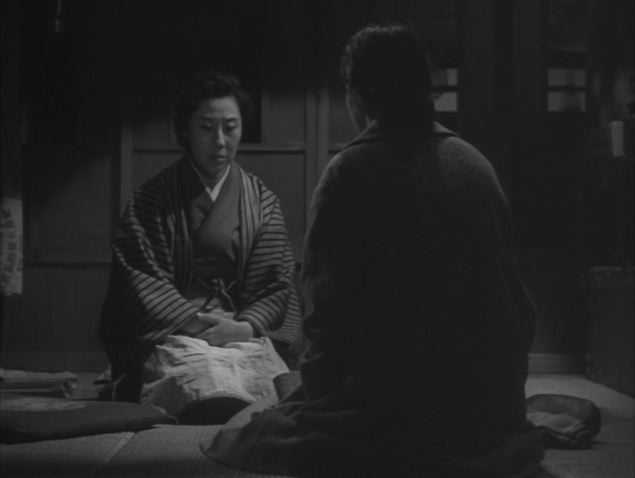
Father's Day Ozu Style


Of course he's no sentimentalist - father's can be monsters as easily as heroes.


...sometimes no better than kids themselves -


Families are trouble -


- but


Things do work out sometimes, whether you like it or not.


Happy father's day!

Saturday, June 18, 2011

Summer Quiz

Time for the latest quiz from Dennis Cozzalio - Professor Ed Avery's Cortizone-Fueled, Bigger than Life, Super Gulp-sized Summer Movie Quiz. ALways fun, and always a challenge - these things are harder than most class work I've had! This one has taken me an awful long time, thanks to my inherent sloth, the Bruins, the fact that it's summer and, you know - summer and stuff... But it's done, more or less... Here goes:

1) Depending on your mood, your favorite or least-loved movie cliché

I'm not sure - though in general - montage sequences, set to some pop song - are getting old, and are almost self-parody when they start... though when they work - they switch to one of the best. If they substitute for the plot...

2) Regardless of whether or not you eventually caught up with it, which film classic have you lied about seeing in the past?

I am sure I have done this, though I don't remember any specific instances. I think I did claim to see Paths of Glory for a while, when all I had seen was a kind of filmstrip version of the film... of course it was worse than that, since the history teacher that showed us the film strip claimed that it was All Quiet on the Western Front. I knew better, having already read the book...

3) Roland Young or Edward Everett Horton?

Horton, easily.

4) Second favorite Frank Tashlin movie

The Girl Can't Help It

5) Clockwork Orange-- yes or no?

I used to love it - now - I guess it’s still a pretty good piece of work. I have been coming back around toward Kubrick, after a long stretch of tending to look down on him. Though I can't really deny the entertainment value. I prefer the book, though, for whatever that is worth.

6) Best/favorite use of gender dysphoria in a horror film (Ariel Schudson)

I looked it up, of course - unease with ones gender. Well - this comes to mind:


But in a horror film? blimey... back to the drawing board. Where I feel guilty about just using the obvious - Psycho, Silence of the Lambs, that sort of thing. I could say Antichrist, I suppose...

7) Melanie Laurent or Blake Lively?

Hard to say I have an opinion, though I liked what I've seen of Melanie Laurent.

8) Best movie of 2011 (so far…)

Genuine new movies - Meek’s Cutoff; last year’s movies, released in 2011 - Uncle Boonmee, followed (not too far off) by Certified Copy and Le Quattro Volte

9) Favorite screen performer with a noticeable facial deformity (Peg Aloi)

interesting question, sort of. Does Peter Falk's glass eye count? though I only notice it when I am thinking about it. Let's see - Owen Wilson's nose? W. C. Fields' nose? Belmondo's nose? or maybe Denis Lavant's acne?

10) Lars von Trier: shithead or misunderstood comic savant? (Dean Treadway)

Are the two incompatible in some way? I didn't find his remarks at Cannes all that offensive, or even unusual. I suppose bad taste to joke about nazis, and probably a bad idea in general to use Hitler as a metaphor for something else (Hitler and Nazis as a matahphor for depression, right?) - but still... he does this all the time, of course - most of his public pronouncements seem calculated to confuse and annoy, and part f a more or less elaborate private joke. And usually in some strange way - funny, clever, worth considering.

11) Timothy Carey or Henry Silva?

They are both wonderful, but Carey is something else again.

12) Low-profile writer who deserves more attention from critics and /or audiences

I should be able to come up with an answer for this, but I can't.

13) Movie most recently viewed theatrically, and on DVD, Blu-ray or streaming

Theater = Nostalgia for the Light; DVD = You Can't Take it With You; Streaming = The Knack and How to Get It

14) Favorite film noir villain

There are too many choices... I think I'll go neo-noir, and, since I'm thinking about the Bruins and the Stanley Cup - go with Peter Boyle in The Friends of Eddie Coyle.

15) Best thing about streaming movies?

I don’t really like them, but they do let you make a decision on the spot, which can be nice.

16) Fay Spain or France Nuyen? (Peter Nellhaus)

I don't think I can answer this one. How about Marie-France Pisier instead?

17) Favorite Kirk Douglas that isn’t called Spartacus (Peter Nellhaus)

Ace in the Hole? though this could be the answer to 14 above too. (Out of the Past)

18) Favorite movie about cars

Two Lane Blacktop, probably.

19) Audrey Totter or Marie Windsor?

No idea

20) Existing Stephen King movie adaptation that could use an remake/reboot/overhaul

I don't think I care all that much. The ones I've liked, I've liked, and the ones I haven't I don't care about.

21) Low-profile director who deserves more attention from critics and/or audiences

I could probably come up with a lot of people, though this sort of thing usually comes to me after the fact.... But right now, I think I would say, Ira Sachs.

22) What actor that you previously enjoyed has become distracting or a self-parody? (Adam Ross)

I should be able to come up with a good answer for this. I don't know though - there seem to be a few actors I am tired of, but then they make a good film, or a film with someone who understands their talents, and all is forgiving. I don't know. I suppose there are obvious cases - Woody Allen, say... but that's boring, he barely acts anymore. Maybe Ellen Page? who does not seem to be going anywhere. Or even more depressing - Zooey Deschanel? I do not mind them, but they do not seem to progess much. I doubt either of those young women are to blame, though.

23) Best place in the world to see a movie

I don’t know. Anywhere that’s showing Ozu, I guess.

24) Charles McGraw or Sterling Hayden?

I always like Hayden

25) Second favorite Yasujiro Ozu film

Late Spring

26) Most memorable horror movie father figure

Has to be Dr. Pretorious in Bride of Frankenstein.

27) Name a non-action-oriented movie that would be fun to see in Sensurround

Another one I might think of over time.... How about Duck Soup?

28) Chris Evans or Ryan Reynolds?

Not sure, though Reynolds is usually watchable.

29) Favorite relatively unknown supporting player, from either or both the classic and the modern era

Modern - Garret Dillahunt usually makes me take notice... classic: there's nothing unknown about Dwight Frye, but boy, he was good...

30) Real-life movie location you most recently visited or saw

I walked by the Thirsty Scholar today, same as almost every day. Why would a Harvard kid and a BU kid go drinking in Somerville? no one has answered that question yet...

31) Second favorite Budd Boetticher movie

The Tall T

32) Mara Corday or Julie Adams?

I don't know...

33) Favorite Universal-International western

Winchester 73.

34) What's the biggest "gimmick" that's drawn you out to see a movie? (Sal Gomez)


If it counts, probably live music for silent films, including some odd mixes. (A DJ for shows of old Martial arts films - Red Knight Errant and Swordswoman of Huang jiang - which worked better than you might think...)

35) Favorite actress of the silent era

This is difficult - partly because I don't have quite the systematic experience with silent films I should. Lillian Gish has to rank high; or maybe Kinuyo Tanaka, who is in some fine early films, as well as having a big career in sound films.

36) Best Eugene Pallette performance (Larry Aydlette)

I'm going to say My Man Godfrey, though there are few more welcome presences in films...

37) Best/worst remake of the 21st century so far? (Dan Aloi)

The best, I suppose, is True Grit - the worst - I can't say I've sought out a lot of remakes... Planet of the Apes seemed particularly pointless, and I did see it, though not in a very conscious state...

38) What could multiplex owners do right now to improve the theatrical viewing experience for moviegoers? What could moviegoers do?

I am not sure. I think - keep projecting film is a big one. Similarly Moviegoers - show up on time? Though I have become more and more guilty of showing up in the middle of the trailers, so I shouldn't complain.

Friday, June 17, 2011

Icy Friday Music

In honor of the local http://sports.espn.go.com/boston/nhl/columns/story?columnist=mcdonald_joe&id=6671740 triumph:

1. Meat Puppets - Ice
2. Joy Division - Ice Age
3. Husker Du - Ice Cold Ice
4. Van Halen - Ice Cream Man
5. Pere Ubu - Ice Cream Truck
6. Ugly Casanova - Ice on the Streets
7. Wiley - Treddin on Thin Ice
8. Yoko Ono - Walking on Thin Ice
9. Clap Your Hands Say Yeah - In this Home on Ice
10. Cibo Matto - WHite Pepper Ice Cream

Video? Husker Du is always indicated:

Thursday, June 16, 2011

June 16

Hoopsa boyaboy hoopsa! Hoopsa boyaboy hoopsa! Hoopsa boyaboy hoopsa!

Happy Bloomsday!

UPDATE: for one single post to read on Ulysses and the joys of Joyce, I would recommend Sheila O'Malley...

Wednesday, June 15, 2011

Bruins!

Bruins win the Stanley cup!

That takes me back - I was a hockey fan, back in the day, the Don Cherry years, the Middleton/Pederson/early Bourque years especially - then sort of drifted away. it's nice to see.

Sunday, June 12, 2011

Sunday Screen Shots - Space


Posted without comment, today - mostly. A quiet weekend....


...and back to work in the morning:

Friday, June 10, 2011

Mid June Music

There could be a theme here:

1. Little Feat - Old Folk's Boogie
2. Captain Beefheart - Old Fart at Play
3. The Pogues - Old Man Drag
4. Richard and Linda Thompson - Old Man inside a Young Man
5. Neil Young - Old Man
6. The Pretty Things - Old Man Going
7. REM - Old Man Kensey
8. Modern Lovers - Old World
9. Scott Walker - the Old Man's Back Again (Dedicated to the Neo-Stalinist regime)
10. Volcano Suns - Old Paint

Any excuse to post the Pogues will do:


And I should really post this too - the Pretty Things, with Dave Gilmour:

Thursday, June 09, 2011

First in from Cannes

The first two films from this year's Cannes festival have made it to Boston, Midnight in Paris and Tree of Life. They may not seem to have much more than playing at Cannes in common, but to me, they are linked - films by auteurs I don't much like. I've written about my troubles with Woody Allen - I could say more. That I was once a fan; that I still love the early, funny ones; that I truly admire his work ethic - making a film a year is an achievement... I wish more of his films were better - though one of the advantages of knocking them out all the time is that you increase your chances of making something good. And so it happened, that breaking my one-every-seven-year pattern, I saw it, and was almost shocked to be rewarded with a perfectly enjoyable film. You've got Owen Wilson in Paris, with Rachel McAdams as his fiance, and her insufferable rich parents, and Michael Sheen in the person of an appalling pedant, and... so poor Gil (that's Wilson) starts wandering the streets alone and night and before long is pulled off into the 1920s to hobnob with his idols and romance imaginary art groupies. Lessons are learned and such (partly through the expedient of going even further back in time), decisions are made, work might be done... The lessons (You Can't Live in the Past, or some such) aren't particularly convincing - the Allen films I've seen lately all seem to be about some kind of renunciation of some kind of pleasure, and getting on with the life you have - but this time, the whole affair is light and off-hand enough to go down without any sourness... It is funny - the caricatures are great - Hemingway talking in Hemingway sentences about Love, and Death, and Honor, and Boxing; Bunuel looking confused and Dali acting the fool.... The modern parts are almost as good, at least when Paul (the pedant) is on screen - the character is very funny and Michael Sheen nails him... And Wilson is his usual enjoyable presence. It's not a great film, in any sense, but it's perfectly fine - funny, handsome looking, sharply performed across the board, a loose, clever, entertainment... I liked it without reservations.

That's not quite the case for Tree of Life. If Woody Allen is a problem (an established auteur with a certain ongoing reputation in some corners of the cinephilic world, who I find almost unwatchable at times), Malick - is a bigger problem. Allen is a bit past his prime - all those films, so many of them mediocre - a lot of people have given up on him. But Malick, knocking out a film every half decade or so (after taking almost 2 decades off), still seems to be the critics' darling. People I like and respect consider his films among the best of the decade! how does that happen?

I do not share that opinion, you may have guessed. And this film - I have been dreading for a long time. I dread it because of his last couple films, neither of which I find particularly good; but I know what he is capable of - and have no intention of risking missing another Badlands (or Days of Heaven, for that matter) - so I would see it, no matter what. And I dread it because it will inspire gushing reports all around the internet, and I was all too sure they would get under my skin - and maybe poison me against the film, more than it deserves. All that came before the film did - now that the film is out - well - no surprises anywhere. The reception, at least among the blogs and writers I tend to follow, is (mostly) rapturous - there are nay-sayers, though more than one of them seem to be aiming at targets beyond Mr. Malick... And the film itself? kind of a bore, really, though the middle part is quite good....

What I guess nags at me the most is the idea that this is some kind of masterpiece, some kind of experimental film - that's the gist of a lot of the praise and complaints. (It's worth noting just how many of the reviewers and commentators mention that Malick once lectured on philosophy (see? I did it too!), as if proving his intellectual bona fides.) But I don't see it - there's nothing experimental about the film, unless making a feature length movie that looks sounds and feels like a mashup of Levis, Louis Vuitton and Latter Day Saints ads is experimental. (And the sad fact is - the Levi's ad had freaking Walt Whitman himself doing the voiceovers! instead of Malick's banalities... it's an ad that couldn't exist without Terence Malick, and at this point, is - except for the quality of the poetry - almost indistinguishable from him.) That complaint, I will say, applies mostly to the frame story - the opening 20 minutes, the end, etc. - the Creation of the Universe stuff isn't quite so bad (it has its own problems, though, especially the nonsense with the dinosaurs) - and the middle part is quite good. It's nicely set up - after another montage of babies being born and growing up (an insurance ad?), Malick lands us at the dinner table one evening, and the plot kicks in and suddenly, you have something worth watching. Better than that, maybe.

It's still montage heavy, still occasionally marred by voiceover (and always stupid voiceover) - but this part is much more engaged - the people resemble human beings, the dialogue, though on the nose, feels closer to true - it feels like memory. The sequence plays as a kind of memory/dream, and is very effective at it. Does some interesting things - the Pitt character is something of a tyrant - or rather, the kids see him as a tyrant - he is strict, he occasionally gets mean (and he plays Bach on a pipe organ like a monster movie villain) - but it’s still odd; he never quite does anything wrong - he seems more sad than cruel. You wonder if Malick is deliberately undercutting the emotional core of the film - this is Jack’s movie - we see his reactions to his father the monster - but don’t see father quite as a monster. Even if it’s not meant quite to undercut the narrator (the implied POV), it certainly seems aimed at giving us a complicated view of the father. The grown son remembering, doubting himself, his memories, his emotions as a kid, and so on. The father emerges as the richest and most interesting character - I suspect that is intentional. (The flip side of this is that the mother never emerges as anything - she is a wet dream, there’s nothing else. She wafts around with no personality or self, just being ethereal and interacting with nature and such. She is more imaginary than the rest of the family.) Anyway - things happen - fights at home, playing with the brothers and other kids, kids die, kids get hurt... There are some key moments - the father going away and freeing the rest of the family for a day or so... Jack's sexual awakening (breaking into a lady's house to - well - masturbate onto her nightgown, right? Malick makes this look as ethereal as the rest - the kid looking to hide the nightgown, then throwing it into the river - but it shouldn't take too much imagination to figure out why he had to hide it....) Not surprisingly, Jack immediately transfers this business onto his mom... (About the only real complaint I have with this section is that it's basically acting out the monologue from "The End" - which Jim Morrison got through in a minute and a half, and it takes Malick an hour...) And then - Dad loses his job and the family has to move - and somewhere in the future, one of the boys dies, and the others suffer.... And Malick cuts away from this memoir to Sean Penn wandering around in deserts and beaches and salt flats to no good end.

So - I'm left with a very split opinion of the film. I wish it were all like the middle part; I found the opening and closing sections inane and dull. The creation stuff - nothing NatGeo doesn't go better... But the middle - isn't stylistically that different from the rest. It's elliptical, it's impressionistic, it's as aestheticized as the beginning and end - but hooking into the story, and into the subjectivity of its originating intelligence, and exploring the washes of memory and impression as it does - is fascinating, engaging, the seeds of a good film.

Monday, June 06, 2011

D-Day

This week's Sunday Screen Shots come a day late, to honor the history - D-Day, in one of the best war movies of them all. It's a marvel of low-budget filmmaking, and a marvel of efficiency - capturing the chaos, violence, then the blood-curdling heroism of battle, the matter of fact horror of counting off who gets to risk their life next...


Friday, June 03, 2011

Music Friday

Another simple random ten, this Friday. I have some new records I have to listen to, and maybe get around to writing about - but that is still to come... Right now - Friday 10:

1. You La Tengo - Lost in Bessemer
2. Richard Thompson - Burning Man
3. Pere Ubu - Synth Farm
4. John Hartford - I Am A Man of COnstant Sorrow (Instrumental)
5. Pere Ubu - Heart of Darkness [specifically, a demo from one of their collections, a rehearsal session, working out the pulse... Neu would be proud]
6. Richard & Linda Thompson - Hokey Pokey (live)
7. Rites of Spring - Drink Deep
8. Merle Haggard - Silver WIngs
9. Yoko Ono - Why Not
10. The Doors - Back Door Man

That was interesting. Here then - video? Rites of Spring thrashing in the dark might be a good place to start....


And while the video is just an odd piece of animation - one never goes wrong with Pere Ubu:

Thursday, June 02, 2011

John Doe Footnote

(A follow up to the previous post - expanding a bit on some of the remarks about Meet John Doe. This comes from the paper that belongs with the images in this post.)

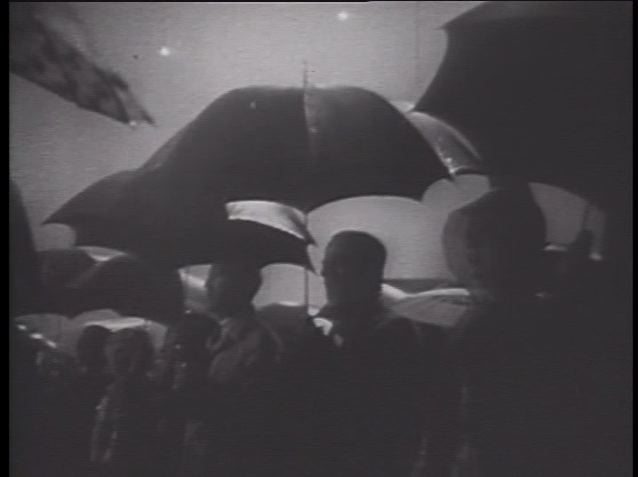
To quote the last post: "I think Capra tries to take a look at how fascism works. I think this is quite explicit at times - the big John Doe rally in the rain strikes me as a fairly deliberate parody of Triumph of the Will - or at least, of Nazi iconography" - here is what I mean:

The rally has all the trimmings of a big Nazi rally - huge crowds, radio mics and reporters, cameras and lights and hoopla - but all this imagery is undercut. The rally occurs in a torrential downpour - neither the bright daylight of the daytime scenes at Nuremburg, or the dramatic torchlight of the night scenes. John Doe arrives, passing like Hitler through the masses waiting for him, but unlike Hitler, with almost no fanfare. No one recognizes him as he passes through the crowd; Capra shoots his progress from a long distance in one shot, emphasizing his anonymity. Only when he reaches the stage does anyone recognize him. He then stands in front of the crowd, in front of a microphone, expected to speak; Capra frames him alone on the podium, in shots that do recall Riefenstahl’s shots of Hitler, but to opposite effect. Doe is alone, isolated (like Hitler in that, too), but with the opposite of Hitler’s commanding gaze and presence. He looks down, his face is desperate, and of course, he is sopping wet - a dripping, downcast man who doesn’t know what to say. The crowds are not arranged in ornaments, at least not in the lighting Capra provides - they are a sodden mass of people, obscured by umbrellas and hats and newspapers held over their heads, the whole thing swallowed up in mist and rain and darkness. The whole rally is a farce - the whole story a very complex mass of fraud and delusion, cynicism mixed with misapplied idealism, and this its point of collapse. Capra makes superb use of the imagery of Nazi propaganda, and of mass ornaments, undermining them, to expose the sordidness of the rally, not to mention the Nazis.


Tuesday, May 31, 2011

Mr. Deeds Goes to Town

This post started out as a Sunday Screen Shot post, but, well, I got a bit carried away... Actually - this comes from Sunday's double bill at the Brattle - Mr. Deeds Goes to Town and My Man Godfrey - between shows I scribbled down my thoughts on Mr. Deeds... when I got home, I set about making a post out of them, and - well, kept going...


So - Deeds strikes me as an odd film - it's right there in the middle of Capra's career, and it seems to wobble a bit. The tone is very uneven, the ideas sort of vague and half finished - the formula is a bit more obvious than in some of the other films. The opening sections are quite fine - but after Jean Arthur shows up, things start to go wrong. Deeds starts acting up, and the film goes a bit sour. Beating up the literati is a kind of turning point - Deeds stops looking like a yokel who happens to be smarter than the sophisticated New Yorkers and starts looking like a bully. The impression never entirely goes away, not until the end...


What’s worse is that in that middle part (and even through some of the end), the film starts to depend a bit too much on Deeds getting dumber when the plot requires it. That’s a problem with a lot of recent comedies - people get smarter or dumber depending on where they are in the plot. That afflicts this film - Deeds starts very smart - but starts to get weird - some of which is harmlessly weird, but a lot of it requires him to really behave - stupidly. (The Coen brothers, remaking this, got around it by letting Norville Barnes be an imbecile from the beginning.) This is, though, a danger Capra often runs up against - he’s responsible for some if it, I’m afraid. He (and Riskin and Swerling and their other writers) were always trying to play on this line - to make characters who are genuinely divided, complex, pulled by multiple forces - smart but naive; innocent but clever, or cynical but good-hearted, etc. - in stories that balance comedy, tragedy, melodrama, politics, farce, and so on - it’s a constant element in their work. And that division puts all their films in danger of doing what this one does - relying on a kind of inconsistency to work...

Mr. Deeds, I think, is less successful than most of their films - they usually pull off the balancing act. Mr. Smith also works the yokel in the big city angle for all it is worth - but it never requires Smith to be an idiot, or to become a different person from scene to scene. Ditto George Bailey - there, Stewart (and the script) always keep the division, the multiple forces pulling at him, always present, in every scene. Some of this, I think, is Jimmy Stewart - who always carries an air of barely suppressed psychosis in his films - he always plays multiple registers. But a lot of it is the script.

The fact is - Dr. Van Haller isn’t far off - Deeds does bounce all over the place. Granted - most of the time, Deeds has a sharp sense of where he is on the cycle - he rides the waves deliberately. That too depends on the actor - Cooper always seems cool and aware, in control of something - he can brood, but he always seems to know where he is. (Unlike Stewart, who can give the impression of barely holding it all back.) Unfortunately, this very quality - Cooper’s calm, his thoughtfulness, the impression of awareness he gives - confuses the meaning of the wilder scenes. When he starts taking swings at people - he comes off as too cool and deliberate to quite believe that he was losing his shit. It makes him a bully...

This is a minority position, I am sure, but I think Meet John Doe is actually a better film. It has more of the edge that Stewart’s films have - Cooper seems too grounded in Mr. Deeds. In John Doe, his character seems to work better - he comes off both as more of an innocent among the wolves, and as a bit of a wolf himself. I don’t ever believe that Mr. Deeds is in danger of cracking - but John Doe - yes, I can see that.

Still - I think Cooper is quite marvelous in Mr. Deeds - he has a way of conveying common sense - looking at things in a way that makes you see that he isn’t fooled. (Though when they need him to be fooled, they have him play dumb.) I think this works a bit better in John Doe, I admit - I think in Mr. Deeds, he’s supposed to be too much a yokel - in Doe, though he’s an innocent of sorts, he’s one who’s been around. His knowingness and his innocence both make more sense. Though as far as Cooper goes, he plays knowing innocence to perfection.


(I should say - though I think Meet John Doe is a more interesting, powerful film, Capra is more in control of Mr. Deeds. The politics in John Doe are a mess - Capra tries to do way too much. He's trying, at the same time, to champion something about America and its political life, while criticizing it - now, that's an important part of what makes Capra's films so powerful. He returns over and over to the ways what is good in true in American politics is co-opted by cynical politicians, newspapermen, businessmen [all professions he rather admires, though], who turn ideals into slogans to cover their own greed and quest for power. Anyone who tries to inject something innocent, pure, good - is soaked up into the system... Okay - and alongside this already dividedlook at American politics, I think Capra tries to take a look at how fascism works. I think this is quite explicit at times - the big John Doe rally in the rain strikes me as a fairly deliberate parody of Triumph of the Will - or at least, of Nazi iconography.... I suppose, if I wanted to write about John Doe, I should have written about John Doe, [UPDATED, with that link] though...)

So, to try to get to the end of this - what? I do think Mr. Deeds is a great film - just a bit squishy. There's so much right - funny lines and bits of business and people, a nice (complicated) love story, all those wonderful bit players Capra always featured - and - don't get me wrong, some real sting in the tail. The scene when the man breaks in on Deeds with a gun and a tale of woe is great stuff - Capra does desperation as well as anyone....


But it's not up with his best (before or after) - because - too much of the plot requires Deeds (and other people) to get smarter or dumber between scenes... Because Capra and his collaborators (Riskin etc.) were urban sophisticates playing up the small town yokel salt of the earth hokum. Capra can never quite lose his real abiding love for fast talking newspaper men and women - he’s never particularly convincing here. Jean Arthur too has to change for somewhat arbitrary plot reasons. (Unlike in Mr. Smith, where her evolution seems much more organic.) So - something of a lesser film from one of the giants of American cinema.... There are worse ways to spend a Sunday afternoon.

Monday, May 30, 2011

A Requiem for those We Love

Memorial Day, like Veteran's Day, has changed focus over the years- it began as Decoration Day, a memorial for the Union dead after the Civil War, and only later was extended to the more general remembrance it has today. I am, I suppose, a bit of a fundamentalist when it comes to holidays, and always like to go back to the source - though the broader remembrance is also a good thing.

In that spirit - both of going to the source and extending it - here is a link to Paul Hindemith's setting of Whitman's "When Lilacs Last in the Courtyard Bloom'd" - the poem written to commemorate Lincoln's death; the musical piece commissioned on the occasion of Roosevelt's death - both, of course, dating from the end of long wars.

Here is the opening - and the playlist, containing videos of the whole piece.

Friday, May 27, 2011

Simple Musical Post

AS we head into what I hope is a happy Memorial Day weekend for everyone, let's fire up the iPod and see what we can find...

1. Bob Dylan - You're Gonna Make me Lonesome When You Go - happy Birthday, Bob!
2. Naked CIty - Igneous Ejaculation [another data point against Jonah Weiner.]
3. Minutemen - This Road
4. The Strokes - Evening Sun
5. Decembrists - The Gymnast, High Above the Ground
6. Pere Ubu - Indiangiver
7. Muddy Waters - The Same Thing [I love Pete Cosey...]
8. John Lennon - Cold Turkey
9. Scott Walker - Such a Small Love
10. Fairport Convention - Staines Morris

And for video - let's try some live Naked City - John Zorn, Bill Frisell...


And their Batman theme:

Sunday, May 22, 2011

Syberberg Screen Shots

Well - for this week's installment of Sunday Screen Shots - let's follow up on Lars von Trier's (self-induced) misfortunes, with some shots from one of the more extraordinary attempts to address the legacy of Hitler and the Nazis, Hans-Jurgen Syberberg's Hitler: A Film From Germany.


I suspect von Trier has drawn an idea or two from Syberberg - the extreme stylization of his early films, especially, seems reminiscent of this film. And I suppose his willingness to dig into evil - and into his own possible sympathy for evil - is consonant with Syberberg's exploration of evil.


And I suspect, in his awkward and ill-advisedly flippant way, von Trier's larger point is that we can't simply expel Hitler and the Nazis from the human race. He didn't act alone, after all... how he got Germany to follow him, etc., remains a question, and how not to do it again remains a problem... I'm not sure declaring him off limits is the best answer to that problem. Mockery has great value.


Friday, May 20, 2011

Friday Movie Follies

I think I will keep it simple today - straight up random... though first - a film link - a Woody Allen Blogathon, starting, I think, today.... there's another Woody Allen film coming out, that, like most of his films, seems to be getting good notices before it's actually released - who knows, maybe this one really isn't all that bad. Glenn Kenny liked it! I don't know; the previews filled me with dread. The descriptions seem to indicate that it is against nostalgia - the reviews, on the other hand, like most of Allen's recent reviews, seem driven mainly by nostalgia - a desperate hope that this time he will give us what he gave us back when we loved Woody Allen. Still - I might break my once every 7 years Woody Allen film attendance record...

But now - music:

1. Danielson - Olympic Portions
2. Tool - Forty six & 2
3. Sunny Day Real Estate - Shadows
4. Loren Connors - Airs No. 7
5. Neutral Milk Hotel - Untitled
6. Billy Bragg & Wilco - Eisler On the Go
7. Decembrists - of Angels and Angles
8. MIA - Born Free
9. Kali Bahlu - A Game Called Who Am I [are you a leprechaun?]
10. Melt Banana - Slide Down

Nothing there demands a video - so in honor of the possibility of getting rid of a whole bunch of the more obnoxious Christians this weekend - here's Blondie:

Thursday, May 19, 2011

Film Festival Follies

I haven't been following the news from Cannes too closely this year - I was on vacation last week, up in the Northeast Kingdom and Upstate NY, with better things to use my spotty network reception for than reading about new Terence Malick films... But it's good to see that some auteurs can be counted on to deliver the goods. I mean of course, Lars von Trier - who made a fool of himself at a press conference (I like Emerson's post - he has video and some context) - though from a man who once cast himself as the "Schmuck of Ages", making a fool of himself seems pretty much standard operating procedure. Unfortunately, the Festival organizers proceeded to top him, making complete asses of themselves by banning him - my, my.

I'm not going to go into much depth on this, but - I'm not sure what of von Trier's remarks could be fairly called "unacceptable, intolerable, and contrary to the ideals of humanity and generosity" (as the festival's statement put it.) He used inflammatory words and images - you're always on thin ice cracking wise about Nazis and the holocaust [unless you're making shitty, anti-historical movies about it - fucking Life is Beautiful won a prize!] - but the actual content of what he said doesn't seem all that offensive. Something about discovering that his ancestors were Germans instead of Jews, and referring to Germans as Nazis... something about understanding what Hitler must have felt like in the bunker (related, I imagine, to the fact Von Trier's Melancholia is about the end of the world) - hardly offensive, a bit banal even - we all know Hitler loved dogs and kids!... By that time, (going by the video you can find at Scanners) he seems to have realized he was digging himself in a hole - you get some generalities about the evils of the holocaust, his support for Jews (though not for Israel), an aside on Albert Speer, and finally - well - probably the dumbest punch line you can come up with - "OK, I'm a Nazi." But still - it's a punch line, and bad taste, I'm afraid, isn't quite what I'd call "unacceptable, intolerable, and contrary to the ideals of humanity and generosity"....

It's not like he's alone in playing around with Nazi imagery - is there a punk rocker alive who didn't? There's just nothing there in what he said - provocation and posturing at most.... And on that note, I'll leave you with these nice American boys, doing a happy ditty about- something... about as seriously fascist as von Trier, to tell the truth...

Sunday, May 08, 2011

Mother's Day Nihon no Eiga Style

If I were going to start posting something like a Sunday Screen Shot, this would be the place to start - Happy Mother's Day! and if there's a richer source of mother's on film than Japanese film, I'm not sure what it is... there is no limit, I think, to the number of pictures I could fine here.


Friday, May 06, 2011

Another Musical Friday

Back to the randomizer today... I am rather amazed that I have managed this very modest goal of putting up a music post every Friday - and even managed to work in a few variations... I may have to look for some other ways to trick myself into a couple posts a week - maybe a Sunday Screen Shot, or something like that...

But now? Music - what will iTunes offer us today?

1. Pere Ubu - Kathleen
2. NIck Cave & Bad Seeds - Darker With the Day
3. Fire Theft - Summertime
4. Xela - Afraid of Monsters
5. Mark Stewart - Rise Again
6. Six Organs of Admittance - Close to the Sky
7. PJ Harvey - Down By the Water
8. Tool - WIngs for Marie (Part 1)
9. Foals - Tron
10. Pavement - Conduit for Sale

Well - that came out well... and video? a very familiar collection of groups, I fear - don't I get Nick Cave or Pere Ubuon here every couple weeks? Well - here's another favorite who've probably had their day a few times - Pavement, live in 1999...

Monday, May 02, 2011

Osama Bin Laden

I should probably note the end of Mr. Bin Laden. I can't say I have anything too profound to say about it. I will say that the best response to it I've seen is from low-tech cyclist at the Cogitamus blog. Not surprising that it's a Hammett quote (though straight from the movie - though the movie takes the speech almost straight from the novel.) I've long associated September 11th with the story of Flitcraft in the Maltese Falcon - the man who adjusted himself to beams falling, then adjusted himself to beams not falling - sometimes to explain how we can go back to our lives after something like that, sometimes to marvel about how some of us refuse to adjust to beams falling... But as for Bin Laden, and why getting him matters - this says it just about perfectly:

When a man's partner is killed, he's supposed to do something about it. It doesn't make any difference what you thought of him. He was your partner and you're supposed to do something about it. And it happens we're in the detective business. Well, when one of your organization gets killed, it's-it's bad business to let the killer get away with it, bad all around, bad for every detective everywhere.


That is just about how I feel about this. It has been too long to take an awful lot of satisfaction out of it - but given the enormity of his deeds, and the importance of being able to protect yourself, your citizens - it's very important that this be brought to a conclusion. I don't feel much like celebrating (it's not like this is the end of the war - VE or VJ days - those are days for parties in the streets), but I can't deny taking a powerful satisfaction in the end of a very bad man.

Sunday, May 01, 2011

Happy May Day!

Happy May Day! And in the interests of ecumenicalism - I will offer a choice of celebrations this year.

Chinese heavy metal?


Liars, celebrating Walpurgis night?


Morris dancers?


Whatever your preference - enjoy the day. Sunny enough to pass for spring here in Boston...

Friday, April 29, 2011

Friday Music, 1880 or So

Let's try something new - this Friday's musical post is devoted to one song, Television's 1880 or So.


I have fallen hopelessly in love with this song. For a long time I couldn't find it anywhere - I saw it on YouTube somewhere a couple years ago, and after that looked for it on records, but none of the records it is on showed up for sale, so I had to make do with occasionally watching the video. But - the last time I did that, it occurred to me to try iTunes - lots of stuff has been turning up there - and sure enough, there it was - a live version, Live at the Academy NYC 12.4.92. A glorious rendition of the song. (And a heck of a record too.)

But I'm hung up on 1880 or So. It's classic Television - pretty melody (deriving I suppose like much of the best American music of the last 40 years from the pretty Velvet Underground songs), with tight interlocking guitars and a throbbing motorik beat, Verlaine drawling the words, the two guitarists taking solo turns. Lloyd goes first - tight and fast, dense, a bit showy, with that gorgeous twangy stratocaster tone - Verlaine haunting the solo, keeping time, and starting to slip out of its shadows as Lloyd winds down... But first there's another verse - and it's Verlaine's turn. He plays a different kind of solo - one of the secrets to their sound, right? the way Loyd's style varies from Verlaines, complimenting each other... So Verlaine's solo is slower, spacier, built around simpler patterns, bending notes and tones, playing closer to the beats - staccato notes, and a way of slicing up the rhythms, speeding up, slowing down - the oft noted debt to 60s jazz, Coltrane and Dolphy, their way of making the rhythms of their solos as important as the notes. Verlaine, particularly, reminds me of Monk - solos that aren't hurried or forces, notes placed with precision, both as notes and as beats. Wandering the internet I found this review (at this site, devoted to the band) - I refer you here to the"two guys who can play rhythm guitar" line - that's another of their powers - the ease with which they slip from lead to rhythm. They never get lost, even when they are shredding - and they play around the beats, with it, against it, cutting it up, stretching it out, making the guitar lines percussive things, no matter how lovely the melodic and harmonic ideas may be.

Songs like this (1880 or So, Marquee Moon, etc.) put me in mind of Richard Thompson - I don't know if they were trying to play like him, but they sound like him. The clean guitar tones, and especially the way they build solos, always burrowing into the rhythms, always sliding the tone around, always surprising. Verlaine maybe more than Lloyd - Lloyd is great, but less surprising, more conventional - Verlaine, though, is mind boggling - his control over the machine, getting such a carefully controlled range of sound out of it, his mastery of time, his ability to make every sound beautiful. When they are right, there is almost nothing better. Maybe, maybe, there are bands that got it right more often, but we can leave them for another day.

Finally - like any great live band - always sounding different... take this version, from about the same time as the Later version above - the structure is the same, but the actual breaks are different - Lloyd, I think, a little more aggressive (than on the TV show, if not the record) - then Verlaine playing a much more minimal solo, manipulating the tone almost as much as playing - milking that beautiful guitar sound for itself....


Or this, from 2005 - a long intro, lovely twangy Lloyd solo that really lets fly, then a very minimal, but lovely, finale by Verlaine...

Saturday, April 23, 2011

Le Quattro Volte

Michelangelo Frammartino's Le Quattro Volte is the third great film I have seen this month. (After Certified Copy and Uncle Bonmee...) It is a simple seeming film, a beautifully shot meditation on the landscape of southern Italy and some of the people and animals living there. It's divided into four parts, following first a goatherd and his goats; then a new born kid; then a tree, which is cut down and used for a festival; finally, the same tree being used to build a kiln for making charcoal. All four segments are about death - and transformation - man to animal, animal to plant, plant to mineral (as Frammartino puts it in this interview). Reincarnation - or resurrection - and I'd say it is a very fine film to watch on Easter weekend. (Being itself set, in part, at Easter...) It is, throughout, slow, quiet, patient, beautifully shot, and - like the other two great films - gorgeous sounding. A good part of what I said about the sound design of Certified Copy is true here - Frammartino immerses us in the world of this film through its sound. It's like the photography - deep, rich, detailed, multi-layered... It's also almost as important as the images in telling the story.

Now: it might tempting to say that this is a film without a plot - or without much of a plot. It's probably more accurate to say it has an unusual plot - that progression of souls (as it were) is a clear enough story line, though it is unconventional. The actual progression of scenes can also seem eventless - but isn't, not at all. It's striking how much does, in fact, happen. Something happens in every scene - we learn something about the village, the people and animals, and so on, in every scene. And in the first section, especially, every scene, almost every detail, builds a very careful, subtle, structure, that gets paid off at the end in spectacular fashion. You can say quite accurately, I think, that the entire first part of the film (following the old man and his goats, and his dog) is an elaborate gag worthy of Tati. It all builds to an Easter procession past the old man's house and goat pens - the dog interferes, is chased off by the romans - then tries to bully a lone altar boy, who tricks him by throwing a fake rock - leading the dog to find a real rock, which just happens to be holding back a parked truck. It is a cinematic tour de force - all played out in one shot (itself rather astonishing when you remember that it is an impeccably timed gag starring - and completely dependent on - a dog), and carefully using sound and sight to create the scene... That is delightful, but there is more - as we have seen all the steps taking place to create this situation. Like how the rock got there... and so on. And - probably why the dog is so aggressive - the old man is nowhere to be seen in this scene - he should have had his goats out on the hillside by this time - that he doesn't is significant...

Over all - to me, this film played like a mix of Tati and Olmi - slow, quiet, patient, but carefully constructed, impeccably made, funny little humanist adventures, that, small as their scale might seem to be, feel perfectly epic in their conception. A joy, from top to bottom.

Friday, April 22, 2011

Earth Day Random Music

Friday music day, and earth day - reminding me that somehow I'd missed the fact that there is a new album out from Earth, the band... strange. Well - we will make up for that oversight by seeing what Genius offers us, starting from Earth - it's taken a couple tries, since Apple (or my music collection) only seems to notice Boris, SunnO))) and the Melvins as sounding like Earth - Peace in Mississippi yields a bit of variety...

1. Earth - Peace in Mississippi
2. SunnO))) & Boris - Etna [that was a shock, huh?]
3.Melvins - NIght Goat
4. Comets on Fire - Sour Smoke
5. the Warlocks - Slowly Disappearing
6. Espers - Children of Stone
7. Blue Cheer - Just a Little Bit - hey - let's give Genius Blue Cheer for a while...
8. 13th floor Elevators - Kingdom of Heaven
9. MC5 - COme Together
10. Earth - Tallahassee - that worked out!

For video - since every day should be a Good Earth Day, here is a song from The Good Earth....


And - Earth - doing Engine of Ruin - I suppose, between Glen Mercer and Dylan Carlson, I could just call this telecaster day...

Wednesday, April 20, 2011

Certified Copy

April is turning out to be quite a month for movies. Everything I have seen has been worth seeing - and I have managed to attend three pretty much great films as well.

Note the verb. In fact one of the strong ties between these three great films is that it would be an injustice to any of them to say I "saw" them. I did see them of course, but I also listened to them - they all make extraordinary use of sound. I will come back to the other two (which would be Uncle Boonmee Who Can Recall His Past Lives [which I need to see again] and Le Quattro Volte) - I'll start here with some thoughts about Kiarostami's Certified Copy.

Brief run through what happens: it's basically a two-hander for Juliette Binoche and William Shimell (an opera singer in his first film) - he plays a writer, doing a book tour - she owns an antique shop - they go out for a Sunday drive in the Tuscan countryside, talk about art and her sister, see some sights, then, when they are mistaken for a married couple by a woman in a coffee shop, start acting the part. They visit a church specializing in weddings, a museum with a famous copy, they look at sculptures and art, try to eat at a restaurant, visit the hotel where they spent their wedding night, all the while growing into their roles as husband and wife, in a marriage on the rocks... Along the way they interact with a few other people - her son, the woman at the cafe, newlyweds, an old couple (Jean-Claude Carrierre and Agathe Natanson, as it happens) by a fountain, and various passersby - as well as a few people who don't appear, but have substance - her sister and brother in law, the people on the other end of their phones.... The story, then, is Strange - they begin as strangers, they are recast (as it were) by the observer as a married couple, and they start playing the parts - getting more and more engaged by the roles. Maybe they are play-acting with each other - maybe they were married all along - maybe reality changes - it probably doesn't matter. It seems to me, it is as if they are enacting the entire course of a relationship in one afternoon, from flirtation to courtship to marriage and the decay of the marriage. Maybe. Whatever is happening, the film is beautiful looking, gorgeous sounding, and all of it is very clever. Binoche is magnificent, her character a strange, rather off-putting person, but a great performance; Shimell doesn't quite seem up to her level - he comes off like Jeremy Irons in Inland Empire - though that may be the point. The character is pretty loathsome (though he is given some interesting critical positions - the arguments aren't really unbalanced), selfish, solipsistic, rude, though with an odd, sad, charm - gentle and cold... And everything is combined into a magnificent piece of filmmaking.

I've written before about how Kiarostami's films sound - and it's the sound that was most dazzling about Certified Copy. Nothing sounds like Kiarostami. That isn't to slight the visuals - this is a ravishing looking film, and visually clever to boot - but it sounds like nothing else. HIs films remind you how much we take sound for granted in films - and how hard it is to talk about sound. What does sound do? Most films use sound very conventionally - ambient sound to create a sense of realism - more precisely determined sound to emphasize actions - the music to shape our reactions - and dialogue... sound, in most films, guides us to the meaning of the film, shapes our attention and signals the importance of things on screen. Sound, most of the time, is used in a very similar way to analytical editing - it guides our attention, focuses us on certain elements of the film, shapes the emotional impact of the film.

Kiarostami doesn't use sound this way. He does a couple characteristic things, both different from conventional sound design. First - he immerses us in the sonic world of his films. His soundtracks are dense with ambient sound - voices and machines and natural sounds, tires and footsteps and wind and doors opening and floors creaking and so on, and snatches of diegetic music, TV and radio, etc. The sound immerses us in the world of the film, surrounds us - If most films use sound to guide your attention to the important elements of the image, Kiarostami uses sound to fill in the world outside the image. His sound designs are analogous to his cinematography - the deep focus, the open spaces, the somewhat disordered and random backgrounds. His films give the impression of being free, outside the direct focus of the story - the story takes place in a world that is going about its business regardless of the story. It's hard to describe properly - because it is combining two ideas. The story - in this case, the interactions between Binoche and Shimell - are carefully shot, framed, lit - they are edited precisely, taking full advantage of all the resources of art cinema (mirrors and frames in the frames and all the rest).... But behind the main actors, the rest of the city seems to be going about its business, just there. The sound design works to the same ends - the careful control of the dialogue, clear and distinct - but against the background sounds of the rest of the world (a city, a town, going about its business). Now: it can probably go without saying that these things are very highly controlled - you don't get a soundtrack as precise and rich as this without a lot of work and artifice. I imagine the same is true of the people wandering around in the back of the shots. (And it's certainly true of the compositions, the lighting, the reflections on the car windshield in the driving sequences, etc.) It reproduces at a technical level the general shape of his films - that carefully balanced blend of artifice and realism.

The other characteristic device Kiarostami uses here is a kind of split of the image and sound. There is always a careful interplay between the image and sound, and very often, Kiarostami breaks them apart. He does this in quite a few of his films - most radically in Shirin, but it happens repeatedly. In Certified Copy, that is how the film begins - the image (a table set up for an author talk, but with no people) is broken from the sound (an crowd, gathering, murmuring, somewhere behind the camera.) This changes - a man appears (a translator, introducing Shimell's character, James Miller, a writer, who is late) - then Miller - who begins by repeating (with a variation) the translator's excuse for his tardiness... Meaning already we have themes we will see again: characters repeating one another, even if they don't know what the other have said; a distinct image of an audience and spectacle - we hear the audience, and indeed seem to be part of the audience ourselves (the camera is in their place) - a relationship (between the camera and actors) that will be repeated throughout the film. (Several head on shots of the actors - interacting, diegetically, with other characters - but literally, interacting directly with the camera...

Okay... back to sound and image - and as that first sequence continues, Kiarostami continues to play games with the sound and image - we see the crowd rather than Shimell as he starts to speak; we see the antics of Binoche's character and her son, while the speech is going on, see them talking to one another and the translator, without hearing what they say; then she leaves - and Kiarostami gets in one more joke, when a cel phone goes off, and we pause a second, not knowing whose it is. Then - of course it is Shimell's, and he answers it, and we get half the conversation... And throughout the film, similar patterns return. Several cel phone conversations that we only hear half of, if that - though sometimes, the character on the phone (usually Binoche) gives a running commentary about the call... Their conversations sometimes run into other conversations, or people interact with one of them at a time, and fill in the other half of a conversation. The moment when they are mistaken for a couple plays like this - everyone seems to be getting about half of the conversation, and end up filling in the other half on their own - making jokes with languages - does Miller speak Italian? French? sometimes yes, sometimes no...

More than one scene plays as a tour de force - take the museum scene, with its copies and discussion of copies, its signs and glass, reflecting cases, the retellings of the story - Binoche tells Shimell about the piece (a 200 year old copy of an ancient Roman painting); then the tour guide tells the same story in Italian (and Binoche repeats it - inaudibly - for Shimell, who in this scene does not seem to speak Italian or French), then in French.... Or the scene by the fountain, especially the meeting with Carrierre and Natanson. Binoche and Shimell have been quarreling about the meaning and value of a statue - she has gone to solicit opinions of some of the others people in the courtyard, while he watches her in a series of mirrors. He sees Carrierre and Natanson - and when they first appear, he (Carrierre) is shouting - Natanson is behind him, apparently the target of his annoyance - then they turn, and we see he's talking to someone on the phone (she has the phone, he has the earpiece) - a lovely bit of misdirection. Binoche approaches them, talks to them - we don't hear their conversation (we see her in the mirrors) - then Shimell joins them. Binoche tries to get them to repeat what they told her about the statue - they won't quite do it, they even say she is the one who said what she wants them to say... It's all dazzling - the play of sound, the doubling of the pairs of characters (with the statue, of a man and woman, another in the series), the way what people say isn't quite original, people repeating each other, or putting words in each other's mouths - even the ubiquitous cel phones... words breaking free from their speakers, images and sounds divided, images and sounds multiplying, languages multiplying... a tour de force.

Friday, April 15, 2011

Friday Music Day

I have been sick this week, which along with the Champion's League has kept me from finishing a couple pieces that I have, in fact, half written - it has been a nice couple weeks for new movies.... But here it is Friday again, and so time for another post that will write itself! Fire up the iPod and see what we get!

1. Pere Ubu - Something's Gotta Give [always a good sign when you start with Pere Ubu!]
2. Iron & Wine - Sunset Soon Forgotten
3. Fugazi - Song #1
4. Boredoms - Super Good
5. Bing Crosby - Away in a Manger [with the Norman Luboff choir!]
6. The Pop Group - Words Disobey Me
7. Sigur Rus - Fljotavik
8. The Chambers Brothers - In the Midnight Hour
9. Pere Ubu - Make Hay [I am almost cured already! 2 Pere Ubu songs on the random 10, including this, Tom Hermann at his bluesiest... where does the time go?]
10. Red Crayola - Place for Piano and Electric Bass Guitar [and Red Crayola! let's hope this is a sign.]

Video? Not the same song, but here's Red Crayola live (with George Hurley on drums, I believe!)

Tuesday, April 12, 2011

Civil War

Today, April 12, is the 150th anniversary of the beginning of the Civil, War, the firing on Fort Sumter. It was, as this post from the Britannica Blog points out, hardly the beginning of hostilities - the problem of slavery haunted the United States from its beginning - and more or less open warfare had been waged in the late 50s in Kansas - almost going national, when John Brown raided Harper's Ferry in 1859. But when the cannon balls started to fly in Charleston Harbor, there wasn't any going back....

The results of course - 4 years of warfare, 600,000 dead, massive destruction, and an imperfect but rather unmistakeable step closer to actual human decency. It is hard to say America saved its soul by fighting the Civil War - it took another 100 years for institutional racism to be eliminated (and even that, only in theory) - but it certainly helped. In some ways, it's taken even longer than that to acknowledge the basic facts of the war - the South managed to win the reconstruction, in the end - even 30 years ago, people who should know better could downplay the role of slavery in the war. Even now, there are plenty of folks who think they can pretend it was about state's rights or industrialization vs. agriculture or whatnot - a clash of cultures... It wasn't. It was Treason in defense of slavery. In the end, they didn't manage to destroy their country (in order to defend their right to own other human beings) - but they tried...

So to remember. And to remember what Confederacy stood for - slavery, racism, plutocracy, violence - and to note that, in the end, what we have is better than anything they could have given it.

Friday, April 08, 2011

Friday Random Music

Friday is here - and though I continue to fail to get anything else written (perhaps this time in utter despair at the misfortunes of the local 9 - though to those inclined too much to pessimism, let me commend the story of the 2001 Oakland A's, of the 2-10 start and the 102-60 finish - similar hype, similar beginnings...) - I can at least put together a music post in 15 minutes to - do something....

Here goes:

1. Frank Sinatra - My Funny Valentine (live in Paris)
2. Dungen - En Gang I Ar Kom Det En Tar
3. PJ Harvey - I Think I'm a Mother
4. Richard Thompson - Mr. Stupid
5. Earth - Rise to Glory
6. Buzzcocks - Promises
7. Isley Brothers - Footsteps in the Dark
8. Can - Spoon
9. Romeo Void - A GIrl in Trouble
10. Pere Ubu - Codex (Live - Mayo Thompson era)

Now - while I can't find anything better on the video front - here is the song, at least - The Isley Brothers...


and I probably post this every 6 months or so, but you can't have too much Can - this is Spoon:

Friday, April 01, 2011

Musical Foolishness

In honor of April Fools day (the weather is certainly foolish enough...) - let's run genius, starting with Frank Zappa's Dancin' Fool:

Starting point: Frank Zappa - Dancin' Fool

1.Devo - Jocko Homo
2. Captain Beefheart - ZIgzag Wanderer
3. Warren Zevon - Accidentally like a Martyr
4. Talking Heads - Crosseyed and Painless
5. Tom Waits - Singapore
6. Ian Dury & the Blockheads - Reasons to be Cheerful Part 3
7. Jane's Addiction - Ted Just Admit It
8. Nick Cave & Bad Seeds _ Hold on To Yourself
9. George Harrison - Apple Scruffs
10. The Mars Volta - Metatron

Here's Frank live:


And somehow, Ian Dury seems appropriate - since live footage of the song that came up seems rare - here's Hit Me With Your Rhythm Stick...


Though this - a Bollywood number cut to Reasons to be Cheerful, Part 3 - is too good to miss.