Sunday, October 23, 2011

Thirst

I guess I will continue this month's vampire theme with what is, I think, the best horror film of the century so far - Park Chan-wook's Thirst.


Combining, as it does, two 19th century texts - Stoker and Zola - from two great traditions, that don't necessarily seem to go together - but it works, mixing the mundane....


... and mordantly comic....


... with the gorgeous style of classic vampire films - in the same shot, sometimes (has anyone ever looked better going out a tiny bathroom window than Song Kang-ho?) - but always, hitting it's high points in style - the cool blue lighting alternating with murky darkness, the perfectly posed and shot scenes and decor...


- and - at least one character who knows how to act like a vampire...


Friday, October 21, 2011

No Rapture? Well - Music then!

Another slothful week, and another randomly generated list. I suppose I could have rooted around looking for topical connections - we have another dead dictator; the world has apparently not come to an end; the Rangers have tied the world series - well? Let's see what iTunes says.

1. Charlie Parker - Cheers
2. Charlie Parker - this is Always - with vocals by Earl Coleman [and again I ask - 13,000+ songs and 2 from the same record come up in a row? strange, though welcome.]
3. Glenn Gould - Piano Contrapunctus IV [iTunes is going high brow so far...]
4. Pere Ubu - Misery Goats [live, acoustic version, from Apocalypse Now - not that is timely!]
5. Waterboys - Upon the Wind and the Waves
6. Jim Reid - I'm Stranded
7. Young Marble Giants - Sporting Life [go Rangers!]
8. Pink Floyd - One of My Turns [if I did manage a theme, it would probably be to do with Pink Floyd, as I recently snagged a pile of their remastered music...]
9. Love - Orange Skies
10. Danielson Famille - Fathom the Nine Fruits Pie [from Fetch the Compass Kids, one of the many records better than This is It in 2001.]

Video? a Sax chorus playing Cheers.


And Glenn Gould himself:

Sunday, October 16, 2011

Let the Right One In

This week's screen shots come from Let the Right One In - one of the handful of outstanding vampire films in the 21st century (a decade of which has brought up more vampire films than you can shake a sharpened stake at.) It is a fine film, though one of it's unusual characteristics, among vampire books and films, is that the book is, in fact, even better than the movie. Stoker's Dracula is top shelf, and there are so many derived films, that a good number of them don't measure up - but Nosferatu is better (that actually true for either Murnau's or Herzog's version) - with lesser vampire books (which are legion), this is almost universal. I mean - even the Twilight movie - the first one anyway, the only one I have had to watch (and read) - is almost a decent film, at least to a point.... This goes pretty far - last year, in the vampire class I mentioned a couple times, the subject was broached from time to time - why (after Dracula, and with a few exceptions here and there along the way), are these books so bad? why are there no (or very few) vampire books that are really good? Unspoken in this question, though it certain occurred to me, is the corollary - why are there so few serious and ambitious vampire books - and so many serious ambitious vampire films? Murnau, Dreyer, Herzog, Denis, Park, Maddin, etc.? And why are the schlocky vampire books so bad, and even run of the mill vampire films seem to have a spark? I don't know if I have an answer - except that vampires look so good on screen - or that vampires are, like films, shadows on the wall - or maybe that filmmakers have to create striking imagery to be frightening, and books - I don't know...

But that aside - this time, the book Let the Right One In is better than the film - the book is simply outstanding. But the film is no slouch -handsome and understated, with a subtle touch for glorious horror imagery, tucking things into the backs and corners of the frame, like Eli climbing the wall in the back of this shot....


But one of it's best features is the use of spaces - the empty, stark, cold spaces of Blackeberg, a vision of Swedish hell, swallowing its inhabitants whole. The book (more than the movie, though some of this survives) seems to be explicitly about the return of a violent, pagan, past to the sterile, domesticated present - nature red in tooth and claw coming back to get its own. Though if Eli is a kind of hell visited on the modern world, the modern world is a kind of hell for her - and Tomas Alfredson shoots the suburb to make it look as horrifying as anything Eli might do.


Friday, October 14, 2011

Musical Friday

Well, I was thinking about possible themes for this Friday, but as usual, haven't done any prep work, so it's gonna be another randomizer day....

1. DNA - Surrender
2. Minor Threat - No Reason
3. Jimi Hendrix - Purple Haze (live at Winterland)
4. Naked CIty - Igneous Ejaculation
5. Mission of Burma - Academy Fight Song
6. Warlocks - Come Save Us
7. Times New Viking - No Time, No Hope
8. Rolling Stones - I am Waiting
9. Queen - Under Pressure
10. Otomo Yoshihide, Bill Laswell, Yoshida Tatsuya

There has been some chatter in the blogosphere about someone (Taylor Clark by name) at Slate declaring the Strokes' This is It the best record of the 00's - most of the chatter negative.... Amanda Marcotte noted something that may or may not have anything to do with the Slate writer, but is interesting anyway - that the Strokes are a bunch of straight white guys, and so they look like a rock band, in a way that - oh - the White Stripes or TV on the Radio don't. I've taken a stab at listing the best music of the 2000s (by which I mean, my favorite music of the decade, but that has to be obvious) - and she's right - the list (my list) is pretty thin on all straight white guy bands - Mercury Rev (though with their first album made without a regular female member), Liars, Grinderman, Radiohead, Gomez get in the top 25 - plus a couple solo artists - the rest are mixed... even with the near misses listed - only two or three more all straight white guys bands appear (Modest Mouse, Mission of Burma, Fire Theft...) Now - obviously I have somewhat idiosyncratic tastes, that tends not to encompass a lot of mainstream rock bands - but I think you can see something changing there. I'm still mostly listening to rock (with something of a jazz/avant garde flavor to it) - I'm not looking for groups with women or Black men in them (I am a big fan of Japanese rock, though - but most of those groups are mixed - my favorites - Boris, Acid Mothers Temple, Ghost, Boredoms, all feature women.) And yet... And Marcotte's list, quite different from mine - shows the same thing....

I couldn't do that in the 70s - a 10 best, 20 best of the 70s would be very heavy on straight white guys. 60s too, if I stuck to rock. (Though you'd get Mo Tucker up there at the top...) 80s - it starts to change - though mainly because of Husker Du and REM. In the 90s -a quick top 10 albums? would feature PJ Harvey, Pere Ubu, Yo La Tengo, REM, Sleater Kinney, Mercury Rev - all mixed - plus Pavement, Janes Addiction, Built to Spill, Nick Cave & the Bad Seeds - say... I think it is different. For whatever reasons, even within rock, "the image many people have in their heads about what a great band should look like" (as Marcotte puts it) isn't what it used to be. Neat.

Video? what a great band looks like - Times New Viking?


What great rock bands sometimes looked like in 1980 or so:


And sometimes in the 60s:

Wednesday, October 12, 2011

Recently Viewed New Films

We're moving into fall - the film choices ought to be getting better, it certainly feels like there are more and better films to choose from - though the results, the last couple weeks, aren't quite there. This is an odd run - some major filmmakers, doing good work, but with material that doesn't quite stack up...

Detective Dee and the Mystery of the Phantom Flame: 9/15 - Tsui Hark returns with a mostly ridiculous story set in Tang China. As work is completing on a massive Buddha, built in honor of the first Empress of China, about the take the throne - people start bursting into flame. Is it magic? is it murder? it's a mystery - so the empress brings back Detective Dee, languishing in prison all these years.... he sets out to find the killer, with the help of the Empress's pretty girl sidekick and an albino detective. Much plot ensues with plenty of action, lavish sets (real and CGI), and name actors (Andy Lau, Carina Lau, Tony Leung Ka-fei) carrying on. Being a Tsui Hark film, you know at least one of the main characters is going to switch genders somewhere in the middle - hell! maybe he/she will even switch species! All told, it's very silly, but very exciting - a weird blend of almost naturalistic detective story and supernatural woo - but who cares? Tsui Hark does what he does, and keeps it all moving, and keeps going for more spectacular imagery - as usual... fun stuff.

Restless - 9/15 - another major auteur returns, Gus Van Sant, with a strange little film. A boy (played by Henry Hopper) who attends the funerals of strangers in strange, hipster formal garb, meets a girl (Mia Wasikowska, looking altogether too cute to die) at one of these - she's impressed and turns up at a funeral herself, in time to rescue him from being run off by the funeral director... This leads to true love. Unfortunately, however, she was at that funeral because she was a patient in the cancer ward - and soon it's back, a brain tumor that will kill her in three months - giving their love affair a bit of urgency, and causing angst in poor Enoch (for that is his name), whose Problem is that he lost his parents in a car crash, and even, himself, seems to have Gone Over to the Other Side for a bit.... Add to this a ghost, a Kamikazi pilot who always wins at Battleship.... Anyway - the story succumbs to the expected amounts of sentimentality - indeed it is cloyingly twee - with its cutesy kids and their little characteristics - she loves Darwin, and birds! he throws rocks at trains and plays battleship with the ghost! oy... She dies, of course, very photogenically (pale and wistful and pure like a 19th century poet), and there are flashbacks at her funeral, where Enoch seems all too much at home... Jesus - it sounds horrible, describing it - and the script, I suppose, is every bit as bad as it sounds. But: Van Sant does not step wrong in all this - he and Harris Savides make it look as good as any of the other films they've done together, which is to say - ravishing to look at.... The stars are quite good - Wasikowska is lovely and smart and almost makes the character seem human - half ghost already, you might say, which doesn't hurt.... Young Hopper is more uneven, but has moments, and is equally lovely to look at, when you get down to it - and, Christ, but there are moments, he'll do something, turn, they'll catch him a certain way, and his father comes out, as if he's a ghost (young Dennis) haunting the boy.... It is a strange film - absurd story, but damned gorgeous looking, nicely acted, and put together with a very sure hand. And it is every inch a Gus Van Sant film - beautiful kids, Portland - and like almost all his films, an examination of death. It's not Elephant, but it's a good deal better than the story deserves.

Black Power Mix Tape 1967-1975 - 10/15 - fascinating documentary about black power leaders, through Swedish TV footage and interviews, plus contemporary commentary. Very interesting material, but very scattershot - a mix tape. A nice introduction to people like Stokely Carmichael, Angela Davis, the Black Panthers, and so on - as well as some nice interviews with less famous men and women, talking about conditions in the late 60s and 70s. It is probably less effective as a documentary than it is at whetting your appetite to find out more about the people and movements it shows - but not bad...

Ides of March - 8/15 - I feel a bit guilty about that rating - that's lower than Restless or Detective Dee - but it has a bit in common with those films.... It is a very handsome, well put together backstage political melodrama, featuring an all star cast who are all on their game, and a neat attention to the details of the campaign - that is betrayed by a very hackneyed plot, that as good as comes out from behind the filmmaking to wag fingers at you and explain the Moral of the Story. And - well, politically, it occurs in cloud cuckoo land - a politician who wants to ban the internal combustion engine!? bring back the draft!!?? who says he is not a Christian? on National TV?? the heck?... anyway - we're backstage on the eve of the Ohio primaries with George Clooney's candidate one big primary win from clinching the nomination - and if he can win the endorsement of Jeffrey Wright's senator (a failed candidate for president), he won't even need to win Ohio. But - over there, seething and glowering as only he can do - it's Paul Giamatti as the Other Candidate's Campaign Manager! will the tricks be dirty? will the crossing be double? Is there a pretty young intern with loose morals (played by Evan Rachel Wood)? Is Ryan Gosling playing the same character he played in Drive? Kinda wish he was - this could use some head stomping. Instead... I was distracted more than once by the casting, I have to say - there's Gosling, emoting like the Driver; there's Giamatti calling some situation a win win... there's Philip Seymour Hoffman and Marisa Tomei flirting - but no heads get stomped; no one gets naked, thought there's some sorta sex... I dunno. I was wishing the film could switch like that - they are the characters from Before the Devil Knows Your Dead! or Albert Brooks shows up with a fork - something. This became stronger once the Plot kicks in - I was not impressed by the Plot, nor the lessons it purports to teach.... I was also somewhat distracted by the thought that this would make a pretty good Columbo episode - the intern's fate begs for some dumpy policeman uncovering levels of not very carefully hidden plot devices. Hell, even something as simple as the cops subpoenaing her cel phone records - did you say cel phone? what cel phone? Anyway - that kind of thing (I mean, the lazy plotting, the very predictable melodrama) is very disappointing, and undermines the many virtues of the film. Clooney is becoming this generation's Clint Eastwood - actor turned director who has a fine touch as a maker of conventional, old fashioned Hollywood style films... it needs a better script, something a little less obvious - a lot less obvious... Or some honest to god sex and violence - if you're gonna do lurid melodrama, make it lurid!

Love Crime - 10/15 - speaking of films that should have been Columbo episodes! This is a handsome French office thriller directed by Alain Corneau, starring Kristin Scott Thomas as a truly horrifying boss, and Ludavine Sagnier as an underling who either loves or hates her.... well - Thomas steals credit for Sagnier's good work - so Sagnier pulls a fast one on her boss - so the boss uses their mutual lover (a seedy lawyer) and the office security system to humiliate poor Sagnier at a party - so Sagnier starts taking pills and twitching and buying knives and such, and then - well, it would be fun to see some French Peter Falk take this one apart! I don't think he'd have too much trouble - there's an elaborate plot hatched and executed but it seems a bit too easy.... But I don't really care. It's all great looking - the two actresses are magnificent, and that's more or less enough, especially since here, the Plot does not attempt to teach us something Important about - I dunno - Capitalism, maybe...

Sunday, October 09, 2011

Horror of Dracula

Though I do get a bit annoyed at the way October turns into horror month on so many blogs I read - I can't resist playing along, at least on Sundays.... After all, so many horror films look so good - they are an endless source of great looking screen captures. So here's Christopher Lee and company, looking very good.


Friday, October 07, 2011

What iTunes has Wrought

Can I find a musical tribute to Steve Jobs? Maybe - but when you get down to it, isn't every random ten a tribute to Steve Jobs? Sure sure, randomization existed before iTunes and in a lot of places besides iTunes, but it spread, and spread over everything, thanks to those little white boxes....

1. Keiji Haino - See that My Grave is Kept Clean [I see that iTunes knows what is expected of it...]
2. Spirit - Elijah
3. Dr. Nerve - Three Curiously Insubstantial Duets: II
4. Pylon - Italian Movie Theme
5. Charlie Parker - The Gypsy [one of the tunes from the breakdown session always a bit harrowing...]
6. Ella Fitzgerald - The Lady is a Tramp
7. Mono - Pure as Snow (Trails of the Winter Storm)
8. Shonen Knife - Cycling is Fun
9. Liars - Leather Prowler
10. Stephen Malkmus & The Jicks - Fall Away [evidence that I do still buy some records these days...]

Video? I think Kraftwerk is in order, don't you?


Of course - and even more appropriately - Heimcomputer!


But I do want to post that Keiji Haino song - two parts:


and

Thursday, October 06, 2011

Steve Jobs (And Me)

I know everyone else has written about Steve Jobs, but I have to too. I try not to be too in your face about it (with strangers anyway), but I am a complete Mac head, a fanatic, a 72 virgin iPods in heaven type, if such a thing made sense - they are the only computers I have ever used on my own dime, and I expect that won't change as long as there are Macs to be used. I am in the cult, and have been from the first time I used one - they have shaped my life, for better or worse.

20 odd years ago I was working part time in a law library (and full time at a book store), expecting to stay there until I'd paid enough of my debts to live on a bookseller's wage - when someone said they might have some work for me in the systems group if I wanted it, and gave me as SE/30. Here, they said, learn this. I sat down at the machine and started typing and was addicted. That is the best way I can describe it - like being given crack, and being addicted on the spot. I had used computers before - a vax in high school, my mother had a commodore, my brother (a few years younger) had an apple, I think (maybe a Franklin, something like that) - I'd poked around on DOS machines, or whatever they were at the time. I could see the use of these things - my brother wrote all his school papers on his computer, and you could see how much better it was than my method of going from longhand to hunt and peck to correction tape and white out - better, but the amount of work it would take to get there - and the amount of irritation and ugliness I would have to put up with, looking at those other screens.... But I sat in front of that little SE/30 - looked at the screen, the desktop, the little pictures you clicked on and they'd open up, the "folders" inside "folders", the way you never had to type a path, type the name of anything, you could se the names there - that made sense. And then I opened Word Perfect [yes - this was a very strange set up - that extreme rarity, a big corporation that used Macs - and a Mac shop that used WordPerfect; I don't know why, but they did...], started typing, and that was that. It was obvious that this is how computers should work. This is how writing should work - this was better than a typewriter could dream of being - this was better than pen and paper! It was easier to compose than on pen and paper - and you could fix your mistakes, change your mind, you could move stuff around, you could make words bigger, smaller, make the letters look any way you wanted - without hacking around with codes, without blocking text first - you just pointed the mouse, you clicked, you dragged, you did something on a menu, you clicked a button - it was right.

That was the end. I was doomed. I started working for systems instead of the library - eventually I did it full time - I am there to this day. It was thrilling for a year or two - the company put computers on everyone’s desk in the course of the next 2-3 years - and I found that that, setting up computers, getting to them to work, to connect to things, to print, showing people what they could do with WordPerfect (and eventually Word) - that was good, a challenge, kind of fun. That first couple years, I went to computer shows, I read MacWorld and MacUser and MacWeek faithfully, kept track of new developments (scanning and OCR! that was a big one, for a while), I got my own computer at home and obsessed over fonts and various word processors and page layout programs and graphics programs - I loved it. I didn't even mind the job.

All of that I can blame on Steve Jobs. If my company had been using PCs, this would not have happened. Some of it would - they probably would have invited me to work for systems, given me a PC to learn, and I probably would have taken it - better than doing pocket parts, after all - but move to full time? It was nice money (compared to selling books), but I liked my bookstore job - liked working in bookstores, liked the people, liked the location (Harvard Square), liked the customers, liked everything - nice as the money was working on computers for a big corporation, if I hadn't loved the computers, I don't think the money would have held me. For that matter, I don't think I would have bothered learning enough about a PC to have the option - I took to the Mac quickly, figured it out, its programs, started building stuff in Hypercard immediately - I made myself useful, because the machines were worth learning. I wouldn't have done that otherwise - I didn't care, really, about computers, in the abstract - I never bothered to learn any programming languages (other than hypercard, some macro languages, some VBA later, some html) - I certainly wouldn't have cared as much as I did on DOS machines.

And that, finally, is why I've written all this, and why it's relevant to Steve Jobs. I was never that interested in the technology - never saw the need to learn to program or put together computers out of old wires and shoeboxes. I was a user, when all was said and done, and almost defiantly so. I am probably pretty close to the consumer Steve Jobs imagined in his heart of hearts all these years - someone who wants to be able to get a machine that will let him do all the things he wants to do, and do them with style, without worrying too much about what's going on under the hood. I loved that SE/30 because I could use it to write, and it looked good on the screen while I was writing, and it created handsome pieces of paper... I could draw things with it - I could do math with it (I didn't have Excel at first, so I built spreadsheets in hypercard - I might have had a book for help, I don't remember) - I could make databases, do all kinds of things, without worrying about the code. That's what I wanted, and what I want - to write, to draw, the make databases and keep databases, to make pictures, look at pictures, look at cat videos, make cat videos - connect all this stuff to other people, argue with people, look at their pictures, find people who share my obsessions and hobby horses and curiosities. I don't care, really, about the machines, I care about what the machines get me to - but I want the machines to get me there without pissing me off. And - 20 years of Macs have managed that, even the Microsoft programs running on them. The Windows devices I'm stuck with at work - a different matter - even now. I like the first comment on Making Light's Jobs post - I too wanted to be a power user, not a programmer. And Macs made that possible - directly, and immediately, in ways (at least in 1990 or so) that were not conceivable on any other machines. It was possible to master the machines, most of the software, just by knowing what you wanted it to achieve and plugging away at it, and paying attention. I could teach myself what I needed - I was quite happy to be able to make a living guiding other people through their problems getting their computers to do what they want to do - so here I am....

The Macs are long gone at work - that experiment was killed off by the Apple's mid-90s woes - but by that time, Windows 95=Mac 89 - so most of the old principals apply. A lot of my experiences are very closely tied to their time and place - the fact that I hadn't been brought up on computers (as kids 5 or 6 years younger than me were) - the fact that the gap between Macs and PCs was still as dramatic as it was in 1990. 10 years later, it is hard to imagine getting a couple years out of college without significant time on a computer - and if it were possible, I'd probably have been as comfortable on a Win 95 or 98 machine as a Mac. But we're here to talk about Steve Jobs, his effects on the world - and those post Windows 95 machines are his babies (though rather ugly and misshapen brats) as much as the Macs are. Job's vision of how computers work spread out, from Apple to Microsoft, through the world - and not just in general terms - WIndows 95=Mac 89 is really not far from the truth.

One of the many things I read this morning about Jobs noted that he had been instrumental in 6 world changing things - Apple II, Macs, iPods, iPhones, iPads and Pixar - that's true, but I don't know if it does justice to his impact. You could put Mac on their twice - the original Macs, and the iMacs - that were almost as revolutionary. They saved the company, created the platform for the iPods and iPhones to follow - but they also changed the way the world looked; they changed the language. And it's hard to overestimate, really, just how important the Macintosh and it's OS really were. GUI's - and the nature of GUIs - icons, in space, clicks and folders and apps and documents, the whole arrangement of data - is the standard now. And then there is The Mouse. Reader - you can click on that blue underlined bit, and your computer will display a page explaining the history and nature of this device - and that - the fact that you go to that page by clicking on it, instead of typing it into a box - underlies another of the world's utterly transformative technological innovations - the World Wide Web, html. This is our world, and it looks the way it does, because Steve Jobs pushed for a particular kind of interface - one he did not invent, including many things like the mouse that other people made and used first - but he made them integral to his computers....

For me - and more or less by definition, anyone reading this - Steve Jobs has shaped the world we look at as much as anyone alive in the last century.

And I haven't even mentioned his effect on film...

Wednesday, October 05, 2011

Flann O'Brien Centennial

When money's tight and hard to get
And your horse has also ran,
When all you have is a heap of debt -
A PINT OF PLAIN IS YOUR ONLY MAN

Flann O'Brien - Brian O'Nolan (or perhaps more properly, Brian Ó Nualláin), to his mum - born 100 years ago today. I read At Swim-Two-Birds 20 odd years ago, probably at the prompting of Anthony Burgess, and have read it at regular intervals since; read, 20 years ago, everything else I could find by O'Brien (and Myles na Gopaleen), loving it all, though not returning so often. Not sure why, as The Third Policeman and The Dalkey Archive are nearly as entertaining as the first novel. I dip into the Best of Myles more often, though usually not at length - an essay here, a catechism there....

What, as to the quality of solidity, imperviousness, and firmness, are facts?
Hard.
And as to temperature?
Cold.
What with what do they share this quality of frigidity?
Print.
To what do hard facts belong?
The situation.
And to what does a cold fact belong?
The matter.
What must we do to the hard facts of the situation?
Face up to the hard facts of the situation.
WHat does a cold fact frequently still do?
Remain.
And what is notoriously useless as a means of altering the hard facts of the situation?
All the talk in the world.
Is this killing you?
It certainly is.

He was, his books are, truly delightful. All of them as funny as anything ever written, and just as clever - many a joke on novel making to be found. And could he turn a phrase - I could quote all his books whole, almost - though this bit, on drink, got me laughing hopelessly the first time I read it, and, well -
Innumerable persons with whom I had conversed had represented to me that spiritous liquors and intoxicants generally had an adverse effect on the senses and the body and that those who became addicted to stimulants in youth were unhappy throughout life and met with death at the end by a drunkard's fall, expiring ingloriously at the stair-bottom in a welter of blood and puke.
Ah, the musical flow of the language, the hint of parody (the language of temperance pamphlets and sermons), and that glorious swerve at the end. Beautiful, man. It'll live, Mr. Lamont, it'll live.

Sunday, October 02, 2011

Rio Lobo

Another lazy Sunday - and since I was watching this one... if I were called on to make some simple remarks, I might say how much it feels like a silent movie, with some interpolated sound scenes. The dialogue is very on the nose - all exposition and attempts at banter (whether the banter is lacking or the actors bantering aren't up to it, I'm not sure - some of both I guess) - but the imagery remains - delightful. Slyly delightful, I guess - efficient, effective action scenes - lots of nicely framed shots of people hanging around... a pleasure all around.

Loading the MacGuffin:


I will seldom miss the chance to post a picture of a train:


Here comes trouble, in the form of a woman:


Though it being Hawks, she will be soon be one of the boys:


Hanging around:


There is a plot, though, advancing in casually - but look how carefully! - composed and staged shots like this....


Amen.

Friday, September 30, 2011

Crash and Burn, Crimson Hose Department

Well, Terry Francona is gone. I suppose I should offer a post-mortem on the season. I don't know how Francona got to be the scapegoat for their collapse - I believe someone mentioned during their last game that the starters had averaged 4.2 innings a game in September - you aren't going to win doing that. ESPN collects some stats - 7.08 ERA, the worst month ever for their starters - Andrew Miller leading the way with a 11.70 ERA... right. There's a lot of sniping and backbiting going on - Francona complaining about the bums in his clubhouse, which I suppose the team will blame on him - lots of sniffing about conditioning and attitude - but the thing about those awful pitching numbers is that there was nothing surprising about them. The team ran Lackey, Wakefield and Miller out there all summer, and none of them were all that good to start with. Or - especially in Wake's case - they were clearly operating on borrowed time. You could see this coming - once Buchholz got hurt, you could see doom waiting on the horizon. I suspect a big part of the team's downfall was that the team kept winning through June and July - Lackey looked like he'd stabilized a bit; Wake was effective; Miller even had a couple decent starts. I suspect Epstein and company looked at them and thought they'd be okay - the team could slug its way out of any slumps it fell into, they were holding their own, they could tweak here or there, bring in Harden or Bedard and prop up the back of the rotation, and they'd be fine. Oh god.... Watching them - they did seem likely to hit their way to the post-season, and I could imagine Bedard getting hot (though I would hardly have bet anything on it) - but - I can't say I had many illusions about the post-season, by the middle of August. Wake, as is his habit, ran out of gas somewhere around 100-120 innings... Miller lost what little trace of effectiveness he had... Lackey appearances were a nightmare all year - Bedard was Bedard and kept the trainer busy... And so? when Beckett and Lester began to run down, it was over - the bullpen was run into the ground (and always overworked - the back of the rotation wasn't exactly soaking up innings before the collapse.) In the end - they crashed and burned, and frankly - other than the (worn out) bullpen, and the mediocrity from Lester and Beckett - nothing about it seems remotely out of order. The back end of the rotation performed exactly as I expected them to.

The thing is, they had nothing else to go to. They didn't have options in place of letting Wakefield try yet again for that 200th win - other than maybe putting Aceves in the rotation, though I don't know what that would have helped as it is, he threw the second most innings on the team (per that ESPN article.) And that ought to be a hint as to what I think about Francona leaving. The team didn't fail because he lost the clubhouse - the team failed because they had 2 major league starters. Now - Lackey has been good, and probably will be again - if Freddy Garcia and Bartolo Colon can rise from the dead, why not John Lackey? And Wake was, as usual, pretty good through about 120 innings. But past is past, and in the present, neither was worth a damn. Bedard was sort of okay for a while, but he's pitching with the same arm he's been occasionally pitching with all his career, so the results are predictable. Andrew Miller - may be a worthy project, but not one you put in a game when there's anything on the line. And again I say - none of this should have been surprising. And - something should have been done. And if it wasn't done - I kind of wish the team, or Epstein, would say, we ran out of pitching, we didn't have the arms to contend. Because that's the truth - even if they made the playoffs, they would be easy pickings, as things stand now.

So - I suppose it is obvious what I think they have to do in the post-season: they need to get a reliable starting pitcher. They probably should resign Papelbon and Ortiz - they should find a decent right fielder (better if they can, but that may be easier said than done) - but most of all, they need a proper starting pitcher. I do not think they can afford to assume, or hope, that Buchholz will be healthy (though I expect he will be) and Lackey will remember how to pitch (though I imagine he will, sooner or later). Even if they do - they need more assurance than that. Now - the real problem is that they need to start developing their own arms again - they seem to leave themselves short a few years in a row. They could use Justin Masterson right about now... But that aside - they need to have a lot more in reserve than they had this year.

And finally - losing Tito strikes me as being a very ominous sign. The sox went decades - I mean, decades - without keeping a manager more than 3-4 years at a time - including some very good ones. The job eats them alive, here in Boston, with its rabid sports press and fans and its sometimes - unrealistic management. In the old old days, they tried to do it on the cheap - in this brave new world, they try to spend like the Yankees - but the Yanks have managed to keep a remarkably stable organization over the last 15 years, with obvious results. I don't know. Tito gave them stability in the dugout, on the field - now that he's gone, I suspect they will soon have the managerial revolving doors spinning. They spend a lot of money - they won't have the loyalty and commitment to any new guy they had to him. This is going to become a habit, I fear. I've become a soccer fan in the last couple years and I dread that they will decide to adopt the Chelsea method - pour in the money, run out a new manager every couple years, watch Man U/New York run up 3 championships to every one of yours. Which, to be fair, has plenty of baseball precedent - the Mets, the Dodgers - I suppose it is not surprising that Bobby Valentine and JOe Torre - Mets and Dodger alums - are being touted for this job.

All right - that's enough of that. What about the playoffs, huh? the teams that are in are pretty interesting in themselves....

AL: I say - Tigers are going to beat the Yankees. Yanks are obviously a pretty good team but - Freddy Garcia? Bartolo Colon? Ivan Nova? Course I said the same thing at the beginning of the year and look where that got me... I do think the Tigers are going to win. In Texas? TB has pitching, yes, and a decent team, but Texas is really good - all over the place really good. They are, I think, the real team to beat in the AL - I don't think TB will do it.

NL: Should be the Phils in something like a walk - all that pitching, and some real hitters... the Cards aren't bad, have Pujols plus Berkman and Holliday - I don't know. I don't think they have shut down pitching, and the Phils do, so... The Brewers should beat Arizona, though it wouldn't be impossible for the Snakes to win. Just very unlikely. Then - The Brewers aren't too far off the Phils - offensive punch, very strong rotation, strong bullpen - just that - if the Phillies' pitchers are hot - and they usually are - they won 102 games for a reason.

A lot of neat World Series matchups can be generated by this - Phils over Texas is the most likely I think; Tigers over Brewers would be the most entertaining, I suspect. With the sox out, I find myself without too strong feelings - I rather like quite a few of these teams (Phils, Rangers, Tigers; the Brewers and Rays to some extent) - the Diamondbacks are a fun story. As always, though, I know who to root against - the Damned Yankees and Tony LaRussa. I haven't forgiven him for using 7 pitchers in a meaningless midsummer game I attended in Baltimore in 1994 - the damned idiot had to know the season was only going to run another week! it was 99 degrees of Baltimore heat - and he's running 7 pitchers out there? I will never forgive him.

Friday Random Ten

Pure Randomness!

1. The Pogues - The Gentleman Soldier
2. Little Feat - Crack in the Door
3. Omar Rodriguez-Lopez - If Gravity Lulls, I can Hear the World Pant
4. Pearl Jam - Release
5. Devo - Gates of Steel
6. Velvet Underground - The Murder Mystery
7. Heavens to Betsy - Paralyzed
8. Vernon Reid & Masque - Brilliant Corners
9. Beck, Bogert & Appice - Lady
10. Nick Cave & Bad Seeds - Darker with the Day

It must be said - the randomizer is doing it's job today - nice variety, some semi-obscurity, deep album tracks from the acts iTunes is full of (Velvets, Nick Cave, various incarnations of Omar Rodriguez-Lopez, who I think managed to release a record a week for a few years in the middle of the 00s, and anyone who can play guitar like that, I'm gonna buy all of it), and all of it interesting - it might prove a challenge to come up with video, though.

If I go with substitutes though - here's Vernon Reid playing with Jamaaladeen Tacuma and Calvin Weston, which should satisfy your free jazz/funk/fusion needs:


And why not - here's Omar Rodriguez-Lopez working the not-Mars Volta side of the house...


And I suppose, following through with the conceit - here's the other big guitar hero on the list, playing something not on the list - Jeff Beck doing his thing in 1999 for Conan, making a piece of completely generic boogie almost bearable:

Thursday, September 29, 2011

Rules of Threes

I have to take this as a sign - three stories in a row in my RSS feeder about the dangers of not paying enough (or the right kind) of attention to history.

Paul Krugman - History Roolz!

Tom the Dancing Bug - Fighting the Wrong Wars.

And the Onion Historians Politely Remind Nation To Check What's Happened In Past Before Making Any Big Decisions - via Lawyers, Guns and Money.

Monday, September 26, 2011

Belated Maddin Post


A very busy week and weekend has made me miss not only my usual Sunday screen shot post, but a Guy Maddin blogathon, hosted by Fandor. Alas! I can do no more than offer a partial atonement...


Friday, September 23, 2011

REM Retires

I suppose this should be a big deal for me. It may be true that they are a bit past their sell-by date, but in the 80s, they were the real deal. I spent the middle part of the decade obsessed by them, before my deeper exploration of all the underground, semi-marginal strands of rock scattered my attentions - I can concur with what Nancy Nall said about them - "They were my favorite band in the last time in my life when I thought I needed to make such a designation." I suppose that's roughly true for me (though probably a record or two later than for her. Fables of the Reconstruction was the one I wore out...) After U2, they were the band that marked the transition from the 70s to the 80s - from classic rock to contemporary - and more than U2, they steered me in the direction I would follow - forward - they got me into the Feelies and the Replacements and Husker Du, and into the Velvet Underground and Joy DIvision and the Byrds, the bands that inspired the bands I liked that were around at the time... They were significant - the first CD I bought was the Reckoning - Lifes Rich Pageant the first record I bought on vinyl, then bought on CD 2 weeks later - I was an enthusiast, for a while anyway.

But.... They faded after a while - how much was due to their changes and how much to mine, I'm not sure, but records like Green and Out of Time didn't do much - I shrugged them off - bought one fo them on vinyl and may never have listened to it - if I ever got them on CD, I didn't put them into the computer, the 21st century mark of whether I care or not... I loved Automatic for the People, though I thought it came out of nowhere - but it didn't reestablish them in the center of my passions - I never did buy Monster, and though I have a few of the later ones, I barely listen to them, and tend to hit the skip button when their songs come up... what can I say. None of that changes how good they were, and how much I worshipped them in the 80s, and I don't hit skip when those songs come up...

So for this Friday - here are my 10 favorite REM songs:

1. Driver 8
2. Little America
3. Try Not to Breath
4. Life and How to Live It
5. Pretty Persuasion
6. Catapult
7. 7 Chinese Brothers
8. Radio Free Europe
9. South Central Rain
10. Undertow [might as well at least acknowledge the later years, huh?]

Trains!


And - appropriately - leaving the stage, with Radio Free Europe and Little America.


Good bye, and thank you.

Wednesday, September 21, 2011

In The Theater Old and New

A couple weeks of viewing... some interesting films here, though nothing to measure up to the old timer of the bunch. (I should add - there's an undue number of action/suspense films here - I have made no effort to avoid giving away plot points... so perhaps, if you are planning to see some of these and don't want them spoiled - have a care. I don't think there are many mysteries revealed, but...)

Contagion - 10/15 - Steven Soderbergh's latest, an disaster movie about and epidemic, treated with a mixture of excitement and matter of fact. Starts with Gwyneth Paltrow coughing in an airport where she is waiting for a plane after a quickie with a man - she has just come from Hong Kong, and Soderbergh takes us there, to another sick man, then a man dying on a bus in Tokyo, then - a string of sickness and death and then - characters: a sleazy blogger, a doctors at the Center for Disease Control, GP's family (Matt Damon), etc. - they figure out what is happening and the story is on its way. The opening sequence might be the best - the quick cutting from runny noses to hands to doorknobs and credit cards and bus and subway poles to terrible painful death.... Once everyone figures out what is going on, they try to control it - Kate Winslet in MInnesota, Elliot Gould in San Francisco - and as it gets worse, the control becomes more desperate - panic in the streets of Chicago, Minneapolis, Hong Kong - society threatens to collapse, violence, disorder, kidnappings, careless use of social media, etc. - cures are promised, conspiracies mooted, money is made, experiments are performed, press conferences and TV shows go awry - and in the end? a doctor finds a vaccine, tries it on herself, it works, and the world begins to emerge again from this disaster.

Soderbergh takes an interesting approach - he uses horror and science fiction tropes, building tension, then sliding away from them - suggesting - is it a zombie picture? is it science fiction? is it terrorism? is it a government conspiracy? The evil blogger (Jude Law) plays an interesting part in this - the paranoid outsider - and Soderbergh plays with the character - is he right? does forsythia cure this? he seems to cure himself - but did he? did he just have a mild case? did he have something else? did he fake it all for the publicity? - Soderbergh holds off letting us know until the end. He knows this is a major archtype in disaster films - he knows government conspiracies are a major theme of these films - he knows science vs. money vs. power are fundamental conflicts in these films, and he keeps them all active as long as he can. Choosing among all the options only when he has to... This happens over and over - suggestions of terrorism raised and dropped; Gould's experiments, in an unsafe environment - that could make things worse, or better, and which it is we have to wait for... It's a fascinating exercise in film construction, really - a very nice film, overall.

The Guard - 10/15 - highly amusing if inconsequential cop buddy picture. Brendan Gleeson plays Boyle, a bad cop in Galway, who finds a man murdered in a holiday house - then at a meeting about a shipment of drugs coming in, sees the man as one of the gang. So he and Don Cheadle, playing an FBI agent, head back to the coast to work on the case - sort of. Cheadle gets hung out to dry for most of the film, since it's Gleeson's day off - alas, he spends the day getting his rocks off with a pair of whores - who turn out to be working for the drug smugglers and are bound on blackmail... etc. The crooks, inevitably, come to kill our man, but in the meanwhile he's found a stash of IRA guns, which prove useful when the time comes. It's all very neatly plotted, down to the convenience of the three guns he steals (a derringer, a glock and an AK-47) - sometimes, maybe, it's a bit too neat. The real pleasure is in the performances, and the material given tot he actors - Gleeson is glorious, Cheadle plays more of a straight man, but gets his moments - and the bad guys (Liam Cunningham, Mark Strong, David Wilmot) get to chew through some highly amusing, if improbable, dialogue. Like so many films, it plays halfway between an homage to Pulp Fiction and a parody - though here, it pushes the metafiction to 11, and makes no bones about its plain joy in the words and the way the men say them - the crooks arguing aboiut their favorite philosopher and quoting Nietzsche, that kind of thing. It's a load of fun.

World on a Wire - 13/15 - A wonderful science fiction film - actually a 2-part TV show - from Rainer Werner Fassbinder, in 1973. Virtual reality, with a strong PK Dick vibe... There is, apparently, a huge VR computer - the Simulacron - overseen by the government.... the film starts with its programmer going a bit crazy ont he government people, then, after making some obscure comments to the head of security - dying.... His replacement is Stiller - the security chief (Lause) tells him about Vollmer - but then - disappears, in the middle of a party. And then? Stiller sets out to run the project while worrying about these two mysteries (Vollmer's death and Lause's disappearance) - made worse by the fact that no one else can remember Lause at all. Uh oh. He is not the last person to disappear - or reappear, inside the simulacron. It is not too much a spoiler, I think, to say that by the end of part one, a character from the Simulacron tells Stiller that he is also part of a simulation program - another, bigger one. In Part 2, Stiller sets out to find out if this is true, and what you might do with the information if it was.

It's all handled quite well - the is-it-real-or-is-it-Simulacron business stays interesting - we may have a pretty clear idea what is going on, and by the middle of the film, so do the characters - but they still have to prove it, to themselves or anyone else, and how this goes remains interesting. But the plot is less thrilling than the filmmaking - Fassbinder is working his most Sirkean mode - gorgeous compositions, mirrors and balls and flowers and doors and screens, complex and gorgeous. The sound design, also typical for Fassbinder, is magnificent. And the lead - Klaus Lowitsch - is just great - giving a wild, athletic performance, like a mix of Mike Hammer and Jackie Chan. The film too draws on cinematic history - Sirk plus Alphaville plus Kiss Me Deadly plus god knows what - a brilliant piece of work.

Rapt - 11/15 - Strong french thriller, that reminds me, oddly, of Contagion - in the way it deals with genre conventions, it's way of slipping around obvious points, obvious emotions, and so on - its matter of fact depiction of a disaster. In this case - Yvan Attal plays a very rich businessman who we see working, meeting high government officials, fucking a mistress, playing poker, interacting with his wife and children, then getting kidnapped. He's hauled off to god knows where - abused - has a finger cut off and mailed to his family with a ransom note for 50 million Euros Is he worth it? will they pay? Well - they only have 20 million Euros to spare - his company surely isn't going to pay (though they could offer a loan) - then all his sins and misdemeanors start to be revealed and - well, the wife still wants to pay.... So - the crooks try different tactics, try to work with different parts of his family and entourage - his lawyer tries to pay, for example, thought he cops get wind of it and follow, queering that deal. And so it goes - and after another failure to get the money - the crooks turn him loose.... and now things get really difficult. Everyone distrusts everyone else - all his sins are in the open; he's a bit chuffed that no one bothers to ask him how he is doing, how he is holding up. He loses it all in the end, everything except the money - but the crooks send him a letter.... Throughout, the film maintains a great sense of multiple perspectives, and pays it off especially well at the end. The way he and his wife both seem to be right - and wrong; the way we don't really learn whether he is indispensable to his firm or just a figurehead; the way we see hints of deeper plots - who organized all this? is it just a bunch of smart crooks, or is there a conspiracy? These things aren't resolved - like Soderbergh, Lucas Belvaux plays with genre expectations, plays with possible plots and interpretations, but doesn't settle them. Another very fine film.

Drive - 10/15 - existential crime film, that taciturn 70s style, with an 80s look and feel - about a driver, who obviously never gets a name, who does stunts, works in a garage, and drives getaway cars.... Inevitably, after one job, he moves into a new building and meets a pretty girl with a cute kid - the kind of woman and kid who play games and cutesy jokes at the supermarket... her car breaks down and he helps and etc. He doesn't seem to fuck her though! Steve McQueen would have fucked her. Anyway - he has an old coot as a mentor, the mentor is trying to get him into the race car circuit, he's dealing with crooks to do it, the crooks are played by Albert Brooks and Ron Perlman, which seems important. (The diriver is Ryan Gosling, girl is Carey Mulligan, coot is Bryan Cranston).) The girl's husband gets out of jail, but he owes people money, so the driver offers to help, but alas - crosses are doubled and doubled again and before long the driver is on the warpath. This is, I'm afraid, one of those films where there are only about 12 people in the city of LA - so obviously the driver's own gangster friends are involved... Anyway. It's hard to describe the plot without getting a bit glib - to say it's been done before... it has moments - it builds to a certain amount of tension - the crooks, especially, are given scenery to chew, lines to linger over and such - there are a couple very nicely shot action sequences. But you know - it's nothing new, it's not all that interesting an old thing - at least - it something I have seen before, and don't feel any particular need to see it again. It's kind of the opposite of Contagion and Rapt - where they raise genre conventions then complicate or confound them, this one just ticks them off and delivers them, on cue. Without any sense of just how silly and sentimental it all is... It's still a fairly effective film - I mean - 10 is a good rating - there are parts of it I would watch any chance I got - I wish Albert Brooks could get a spinoff as this character - but.... it's the least interesting of this run of theatrical viewings, by a fair margin.

Sunday, September 18, 2011

Fassbinder - Capitalism, Violence, Media

I have watched a handful of Fassbinder films lately - World on a Wire most notably - but a couple other films on DVD as well.


It was hard not to think about this, from The Third Generation, during the 9/11 commemorations last week. One of the first things I thought after the towers were hit was, we are just like everyone else now - we will have to live with terrorism, the way they have in the rest of the world for decades. It's an odd thing to think, though - in the 90s, we had the first WTC attack, we had Oklahoma CIty, we had the Atlanta bombings, we had bombings and assassinations against abortion providers - we had plenty of terrorists and terrorism in the good old USA. Still - I thought it, and a lot of other people said something similar. But oddly - we didn't seem to think that maybe the rest of the world, so experienced in terrorism, might have already had a few things to say about it. We have never been so unique - we are not the first, nor the last, to deal with these things.


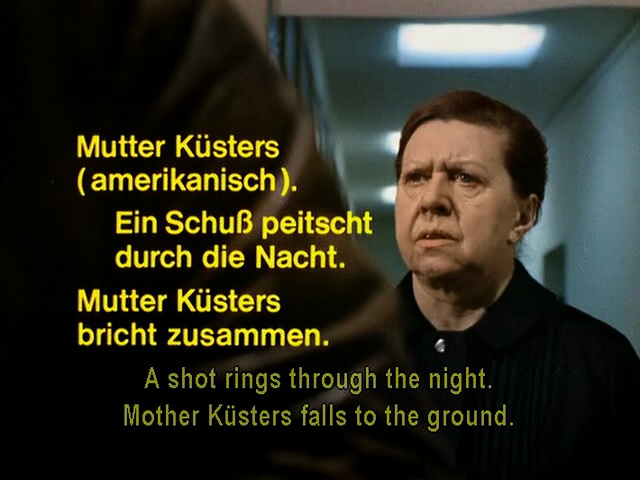
The three Fassbinders I watched last week - Third Generation, Mother Kusters Goes to Heaven, and World on a Wire - all deal with violence - with the intersection of power and resistance. And the intersection of the individual and society - society in all its forms, from families to political groups to, well - metaphysical ontology... How one man's possibly inexplicable act (Herman Kuster's murder suicide) is pulled into the web of human relations - how do you make sense of it? What do you do about it? Mother Kusters does this directly - it is her husband, after all, who did the deed. But she does this while the rest of society pulls at it themselves. The media, the politicians, pulling at the deed, and at her, from all directions, to put it (and her) to use...


The media is the other great theme of the three films - or I could say, mediation, through technology and the media. The ever-present television of the Third Generation; the press and its abuses in Mother Kusters; and - the very premise of World on a Wire. The question, I suppose, is one of representation, representation and power - explicitly in World on a Wire (how do you represent the real world in a computer, that you can control?), but just as clearly in the others. How do you represent the world? what happens? the people in it? how are those images controlled?


Third Generation stages this question - it is in the plot, in the ways the industrialists and police manipulate the terrorists, but also in the TV sets and cameras that pervade its world. The TV set always on, haunting every scene (visibly or audibly) - and then leading to the terrorists' attempt (rather absurd, really) to control the image themselves.


And in the films themselves - they are also representations, not reality. Fassbinder keeps that close at hand - the ending of Mother Kusters, with its frozen image and cold, fatalistic text, to pull us away from the direct reality, to acknowledge the representation:


...or endings - I am not entirely sure what the history of the 2 endings of Mother Kusters Goes to Heaven is - but they create a lovely effect: the harshness of the first, followed by a different kind of harshness in the second, as everyone just walks away:


And then - what I imagine is something of a take off on the end of The Last Laugh.... though why not give her a happy ending?

Friday, September 16, 2011

Guilty Pleasures

Another Friday, another music post, and this time (thanks to the iPod tossing up one of the songs below), about Guilty Pleasures. This is a hardy perennial on the internet, so I won't claim any originality... And I suppose there's not much originality in my opinion of the idea of guilty pleasures in the first place - I don't tend to feel guilty about my pleasures. But I won't deny, there are things I like that need a bit of explaining. Some of them things that shouldn't require too much justification - bands that get a bad reputation for some reason, that fall out of fashion, that are associated with values that are denigrated, etc. - but are in fact quite good. Light pop, cheesy metal, bloated bombast, singer-songwriters - that kind of thing - styles that manage to produce an inordinate amount of garbage - but when done well, are done very well indeed.

So - there are perhaps those who would think you should feel guilty for liking, oh - the Carpenters - the Steve Miller Band - Gordon Lightfoot - but not me. There are certainly bands that sneak up to the line - 70s Jefferson Starship, say - they were ready to topple over into the utter dreck they made in the 80s - but songs like Miracles or Caroline are better than good. (This may come down to the degree of involvement from Marty Balin - he seems to be the key to the good stuff...) But basically - these are very fine acts, working in styles that have passed out of (and into, and out again, every half a decade maybe) fashion - or who worked at a time, in a milieu that produced a kid of structural crappiness (the 1970s!), that the material still transcends. I will add - this sort of thing occasionally catches up bands that are indisputably great, but get missed, or dismissed for extraneous reasons. (I have treated this subject before.) There are people who would question ones devotion to Queen, or George Michael, or Elton John even, or maybe even the Go Gos or - is this possible? - Blue Oyster Cult... these are not guilty pleasures at all - and one must question the judgment of those who question yours...

Not guilty - pleasure:


But that's not what I'm here to write about. No. I mean, real guilt! Though this requires another distinction - because again, there are songs, acts, etc. that, well - they aren't so respectable, and maybe it's fair this time, maybe they aren't so respectable because they do tend to suck.... But not these songs. That is - these songs are as good as they are - but I still feel like I need to explain them, in ways I don't feel any need to explain liking "Freedom 90".

1. REO Speedwagon - Time for Me to Fly - REO became something evil in the 1980s (though still catchy enough) - and in the 70s - they were a bland, middle of the pack semi-arena band - along about the level of Journey or something... Though unlike Journey, they did not suck in the 70s. Unlike Journey, they do not make me want to break something when I hear them. And some of their songs - especially this one - are - heard later, all these years later - fucking great. I mean really - this is one of the best breakup songs ever, and I am not kidding.

Really:


2. Styx - Lady - cheesy 70s psudo-prog bullshit, but when you listen - well, all right, get past Dennis DeYoung's caterwaul, yes, and the tinkly piano, sure, and - the fucking bells... and then? The guitar riffs kick in - is it a bolero? I think it might be - but the way it plays against DeYoung's mewlings - I don't know - it's great, for all that. It feels - modern.

3. Fannypack - Cameltoe - songs like this - cutesy comic bubblegum - might be worth an eyeroll or two, but in the end - catchiness and comedy will carry the day. There's no point pretending to feel any guilt for liking this, done well.Which is good, because I don't feel guilty.

4. Blind Melon - No Rain - I know I probably should hate myself for liking this, but I can't; especially when the guitar solo kicks in.

5. Eddie Money - Two Tickets to Paradise - this has to be mentioned. Eddie Money sucks eggs, but something went wrong here - the song - you know, I'm tempted to dismiss it, but it's not half bad - catchy, nothing wrong with the lyrics, neat sound - and then.... It features a guitar solo that I am not alone is considering not just one of the best solos on a bad song, but one of the best guitar solos period - one of the most wonderful musical breaks in pop music. Seriously. On an Eddie Money song.

And so, after all that, we get to the Real Deal. You want guilty pleasures? here they are - songs that no decent person should be listening to, and no sane person should defend, but... Even here, I suppose this is a bit dishonest - I don't really feel guilty for liking all these songs - but I probably should. I shall Count Them Down, least to most guilt - because, by the end of it - yes - there are a ocuple songs here that, well - I hate the fact that I have ever heard these songs, let alone listened to them, let alone listened to them intentionally - and yet I have - and have perhaps paid the 99¢ for the privilege. Even added them to frequently played playlists. I may not be able to face myself if I admit this in public... but here goes. In reverse order, from least guilt to most:

5. Starland Vocal Band - Afternoon Delight - this is a close thing, really - for all that's wrong with it, it has to get some points for: A. being one hell of a catchy number; B. being unambiguously about fucking; C. Very close to being self-parody all by itself, even before Will Farrell got hold of it. So - the truth is, I don't feel very guilty about liking this at all - but I had to include it somewhere in this post, if it wasn't here I'd have to think of something to say about something by Yes or System of a Down, and I can't face that.

4. Bay City Rollers - Rock and Roll Love Letter - a lot of things I liked when I was a wee bairn, then decided were crap, I went back to as an old fart and realized, Dang! this is pretty good! The Bay City Rollers, alas, were not one of them. Most of their stuff turns out, in retrospect, to be utter crap... But not this song. It's almost cool enough to leave off, here, maybe in favor of Yesterday's Hero - but - Yesterday's Hero, despite having some merits, really isn't good enought o bear comparison to the likes of Afternoon Delight - so, Rock and Roll Love Letter stays...

Fake can be fun too!


3. Terry Jacks - Seasons in the Sun - here, we start moving into the self-loathing territory. Now, granted, this is a Jacques Brel song, and brings with it the merits of M. Brel - but given a wimpy, lachrymose reading and arrangement... I grew up listening to this song every frigging morning on AM radio and - couldn't help loving it almost as much as I hated it. Certainly couldn't get it out of my head.

2. Petra - The Coloring Song - Christian Rock is a reliable source of complete crap, and this is a fine example - awful, cheesy, MOR Christian Rock from the late 70s, complete with flutes or recorders or some shit like that - and gory lyrics ("red is the color of the blood that flowed" - why didn't Mel Gibson use this during the flogging scenes in his Jesus in bondage film?) - but damn, it's pretty...

These things exist!


1. Morningwood - Nth Degree - I hate myself for enjoying this song. It's from a fucking car ad! the song itself - is cheesy and fake (it sounds like it was written for a car ad, possibly by the car) - it has no lyrics - I do not believe there are any actual humans participating in the song. And yet, christ, isn't it catchy? It's horrible - it's embarrassing - it makes me want to kick a puppy - but I still can't help listening to it.

Unspeakably horrible, and irresistible. Thank Christ the video contains an ad.