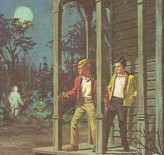
I may have missed the Friday Random ten (I was at Fenway, booing Manny*), but I can make my weekly movie post, I hope. Thisweek brings us a couple new films, a couple DVDs, and a gift from TMC...
5x2 - *** - moment to moment, shot by shot, Francois Ozon is one of the best directors in the world. He's not necessarily showy (though sometimes he is), but he makes everything he does seem right. This is the story of a marriage, told in reverse, from divorce to first attraction, in five discreet episodes. Critics have sniffed at the structure, and maybe they have a point - but it serves a couple purposes that can't quite be gainsaid: it keeps you from investing in the suspense of what will happen - you know what will happen - so you don't think about how it will turn out; because of this knowledge, Ozon is free to concentrate on the incidents in their isolation - and on those moment to moment, shot to shot details. And, it allows Ozon to pose other couples against the main pair, in a more interesting way than if he had told the story chronologically. This strikes me as more important than most of the reviews I've seen notice - that each section (except the first) brings on a different couple, who pose a kind of alternative to them.... I don't know if this is enough to make it really work - except that it does work, at least it kept me completely engrossed, in the fate of a pair of people who aren't really worth the trouble.
Wedding Crashers -*** - there seems to be a wide range of opinions about this, critics (kind of) hating it, loving it, everything in between: I'll have to come down on the liking end of the scale. It's funny; Vince Vaughn and Owen Wilson are both in great form... the story? it's got a couple wild boys settling down because of women - oldest plot in the book - except, the women here aren't exactly all that settling. True love, here, is finding someone who wants to join you in doing what you want to do anyway...
The Merry Widow - **** - Ernst Lubitsch directs Maurice Chevalier and Jeannette MacDonald - plus the requisite second bananas - Edward Everett Horton, Sterling Holloway, etc. - in a classic Viennese musical comedy. And who can resist? And what would possess anyone to resist?
42nd Street - **** - I see that look - yes, yes, more Berkeley. This one's on DVD so I can take another look... I've finally gotten around to reading Rick Altman (all that Berkeley adulation back in May and June was the start, not the end...), and am looking at 42nd Street in his terms. It's interesting - some of the elements he stresses are in full swing here (the modulation from real to ideal, the "audio dissolve") - others, such as the formation of the couple, are less clear. It would be interesting to spend some time on this film, in that context - I may, but not tonight. I will limit myself to this - the duality of work and art (real/ideal, inside the machine/above the machine, etc.) - the way the backstage part of the film builds toward the explosion of the Berkeley numbers, which themselves repeat the pattern, building from the stage possible to pure cinema - and maintaining the "real" (the real stage, I mean - the painted backgrounds in the 42nd Stret number, for instance) and the "ideal" (here, the illusionism of the cinema - the creation of depth and cinematic space during the number.) Etc. It is a glory of a film....
Showgirls - 0/inc. - ah. So lately I have been trying to track down crappy movies, and see if they really are crappy. This is an obvious candidate for that. Well - unfortunately, the DVD did not cooperate - giving up the ghost somewhere around the 52 minute mark. So now what? Is it fair to praise or trash it without seeing the rest? No, probably not - thus the "incomplete". But do I expect the rest of the film to change the impression of the first half? Not really. The odd thing is, it's actually rather difficult to attack it. Film Quarterly, for example, ran a roundtable discussion of it a couple issues back - the contributors ran off the predictable litany of its virtues - it is camp, it is satire, it comments, fairly meaningfully, on gender, race, class, sex, performance, drag, genre, movies, Las Vegas, etc., it establishes visual motifs of the double, the mirror, the whole nine yards. Al that is true - that stuff is all there. And it's probably supposed to be there a good deal of the style, feel, structure - good bad or indifferent - are pretty clearly intentional. So - why isn't it a neglected, misunderstood masterpiece? Well - partly because all of those things, whether they're in the film or not, are more interesting to talk about than to watch. They are in the film - usually in a bland, literal, calculated way - which it parodies, ironically.... The terrible sense one gets, in the end, is that Showgirls is to, oh, 42nd Street, what Creed is to The Ramones. Yeah - Creed is a rock group - look! they have a guitar player, he's got a leather jacket, they have a long haired singer, they sig songs! - it's rock, right? But it's just - just - just -
Zabriskie Point - ***1/2 - meanwhile: here's Antonioni trying to do a hippy flick. It's interesting, if never quite functional. Has some great shots of LA at the beginning - industrial wastelands, billboards, freeways... then heads out into the desert, where the boy and girl Antonioni has been somewhat aimlessly following meet. They go into the desert and flirt, and when the sex starts, Antonioni stages a very strange mass orgy in the dust - which now strikes me as a distant homage to The Merry Widow (or film like it) - in the Lubitsch film, there is a montage toward the end of Chevalier and MacDonald dancing - they dance alone in a room, then are joined by hundreds of dancers - Lubitsch cuts to another room, they dance alone, then hundreds of dancers come in - repeated a couple more ties... The Antonioni has the same effect - though it's silly rather than exhilarating. What is exhilarating, though, is the ending - ah, the redemptions of imaginary violence and Pink Floyd!
*I didn't boo Manny! the crowd did, and I don't blame them - but hey - he gets a big hit (like he did today), and all is forgiven.
Sunday, July 31, 2005

Sunday, July 24, 2005
Movies, Dully Listed and -
- I am going to try this. What does it look like? I don't know. This is just what I have seen since the last post about movies. I am going to adopt a shameless rating system, 1-4 stars, just like Roger Ebert! Sort of. Throwing in what commentary occurs to me. In an ideal world, something like this would become a weekly tradition, a Sunday night tradition, in the spirit of the Friday iMusic-blogging, and any other spirits I can conjure. I need some spirits if this blog is going to be anything other than a once a week music post...
Murderball ***
Youth of the Beast (DVD) ****
The Beat My Heart Skipped ***1/2
Batman and Robin (DVD) **1/2 - I have been trying to watch some crappy movies lately - to test myself, see if they are really all that crappy. This one, actually, crappy as it is, is not as crappy as it could be. Yes yes, the dialogue is appalling, the story is dim-witted, the spectacle is tiring and direction lacks any juice - for all that, it almost achieves the campiness it aims for - the spectacle here has slowed down from Batman Forever, and that makes it work better - the set design and colors and lighting - the whole works - works better slow - it looks more like a comic book or the TV show - and that is good, at least here. Uma Thurman in particular seems to get the idea, and camps it up with real gusto - she has the eye-rolling scene chewing absurdity of the TV villains; she's quite good. The rest... well... still... what can I say?
2046 (DVD) ***1/2 - I also saw a trailer for this at the movies - I am pleased. It is gorgeous indeed, even on DVD, but the TV cannot do justice to its widescreen, rich, lucious lighting... I shall reserve judgment on it until I see it in a proper setting - though it looks pretty good as is.
Happily Ever After - **1/2 - I was disappointed, somewhat to my surprise. A French ensemble comedy that didn't quite go anywhere.
Batman Forever - ** - I should hate it, but... it's passable, Carrey and Jones ham it up in fine style, and it almost manages... but in the end, this is probably the dregs of the franchise - that alone is perhaps a radical statement, given the usual reception of Batman and Robin - but I have to call what I see...
Me and You and Everyone We Know - *** - one of those films I couldn't help finding fault with, but that somehow adds up to more.... I think what it gets right - the kids, the performances (by John Hawkes and the kids playing his sons, especially), the structure - the loose arrangements of stories around a fairly convention romantic plot that it keeps in the background - outweighs what it gets wrong... some of the cutesier dialogue, some of the more overt symbol mongering, and anytime Miranda July herself appeared on screen - what an obnoxious character she played! On the whole then... I liked it. (This is one I may come back to when I have a chance.)
Mysterious Skin - **1/2 - billed as the Gregg Araki film that doesn't suck, it managed to reach that not very exalted level... ad maybe more. It started slow, but got better - Araki found a rhythm in the last third, and the characters seemed to outgrow the cliches they'd begun as... the acting is quite strong, and it ends on a powerful note.
Murderball ***
Youth of the Beast (DVD) ****
The Beat My Heart Skipped ***1/2
Batman and Robin (DVD) **1/2 - I have been trying to watch some crappy movies lately - to test myself, see if they are really all that crappy. This one, actually, crappy as it is, is not as crappy as it could be. Yes yes, the dialogue is appalling, the story is dim-witted, the spectacle is tiring and direction lacks any juice - for all that, it almost achieves the campiness it aims for - the spectacle here has slowed down from Batman Forever, and that makes it work better - the set design and colors and lighting - the whole works - works better slow - it looks more like a comic book or the TV show - and that is good, at least here. Uma Thurman in particular seems to get the idea, and camps it up with real gusto - she has the eye-rolling scene chewing absurdity of the TV villains; she's quite good. The rest... well... still... what can I say?
2046 (DVD) ***1/2 - I also saw a trailer for this at the movies - I am pleased. It is gorgeous indeed, even on DVD, but the TV cannot do justice to its widescreen, rich, lucious lighting... I shall reserve judgment on it until I see it in a proper setting - though it looks pretty good as is.
Happily Ever After - **1/2 - I was disappointed, somewhat to my surprise. A French ensemble comedy that didn't quite go anywhere.
Batman Forever - ** - I should hate it, but... it's passable, Carrey and Jones ham it up in fine style, and it almost manages... but in the end, this is probably the dregs of the franchise - that alone is perhaps a radical statement, given the usual reception of Batman and Robin - but I have to call what I see...
Me and You and Everyone We Know - *** - one of those films I couldn't help finding fault with, but that somehow adds up to more.... I think what it gets right - the kids, the performances (by John Hawkes and the kids playing his sons, especially), the structure - the loose arrangements of stories around a fairly convention romantic plot that it keeps in the background - outweighs what it gets wrong... some of the cutesier dialogue, some of the more overt symbol mongering, and anytime Miranda July herself appeared on screen - what an obnoxious character she played! On the whole then... I liked it. (This is one I may come back to when I have a chance.)
Mysterious Skin - **1/2 - billed as the Gregg Araki film that doesn't suck, it managed to reach that not very exalted level... ad maybe more. It started slow, but got better - Araki found a rhythm in the last third, and the characters seemed to outgrow the cliches they'd begun as... the acting is quite strong, and it ends on a powerful note.
Friday, July 22, 2005
In Memorial
...to an old friend - one of my brother's cats, Katrina. Aged - 14 plus - has expired of kidney failure, I believe. Poor old cat! She was a sweetheart...
In her memory - here she is. A kind of special Friday Cat Blog....

In her memory - here she is. A kind of special Friday Cat Blog....

And a close up, looking for some petting:

Friday Random 10, Again
And, another quick and simple one. One of these days....
1. Ramones - Blitzkreig Bop - where it all started
2. Sleater Kinney - Banned from the End of the World
3. 15.60.75 (The Numbers) - About the Eye Game - this band and this record (Jimmy Bell's Still in Town) probably are the most underrated band and record in history.
4. At The Drive In - Napoleon Solo
5. Bjork -Verandi
6. Velvets - Candy Says
7. U2 - The Fly
8. Sunny Da Real Estate - Grendel
9. Fugazi - Cassavetes
10. Donovan - Sunshine Superman
1. Ramones - Blitzkreig Bop - where it all started
2. Sleater Kinney - Banned from the End of the World
3. 15.60.75 (The Numbers) - About the Eye Game - this band and this record (Jimmy Bell's Still in Town) probably are the most underrated band and record in history.
4. At The Drive In - Napoleon Solo
5. Bjork -Verandi
6. Velvets - Candy Says
7. U2 - The Fly
8. Sunny Da Real Estate - Grendel
9. Fugazi - Cassavetes
10. Donovan - Sunshine Superman
Tuesday, July 19, 2005
iEulogy
This is a sad post. Not the end of the world - but the end of an iPod; and a couple weeks of irritation getting it replaced. It was working fine last week - thank god for that! This post documents its last triumph, 2 1/2 hours on the train, coming back from vacation. A couple days later - nada! woulnd't boot! (And bad timing too - a bunch of kids trying to sing on the subway - No! do not sing on the subway trains! even if you are moderately competent singers! do not do it! do not!) Anyway - this is a long post: I jotted stuff down while I was listening, and have added some since.. That (and inconsistent internet performance, oppressive heat and humidity, and sloth) have delayed the arrival of this post: but I hope it is worth waiting for! There are 35 songs here - that's a pretty good haul....
1) Que Vida- Love: this list was randomly generated, on the iPod, by opening the "Songs" list and starting at the beginning. This is the beginning, thanks to the spanish punctuation that marks the title. This never shows up on these lists since I always jump to the the next song. But this time, I'm leaving it in. It's a good song, after all - and it only seems right.
2) Red Morning Light - Kings of Leon: I don't have much to say, except it's a better song than I remembered - got this record, didn't listen to it all that much... but not bad.
3)Ye Olde Battlaxe - Danielson Famille: always welcome - "give it up for your momma!"
4) Exit Does Not Exist - Modest Mouse: lack of insightful comment does not imply comment. This is early MM, lots of guitars scratching each other like angry cats. Good stuff.
5) Walk on the Wild Side - Lou Reed:This song has a place - memories - I remember hearing it on the radio, when I was very young. I had no way to know what the lyrics were about. It sounded great and seductive and a bit scary, though. And the colored girls go do-de-do-de-do...
6) Everyday - Yo La Tengo: so far the iPod seems to be running a tribute to what I listened to from 1999-2001... right.
7) Marooned - Wire: no comment recorded...
8) Circles - Dag Nasty: uh oh! negativity! "Dull DC hardcore" says my notes... oops.
9) Electricity - Captain Beefheart: very cool; back to that 99-01 thing - a period where I started buying a lot of records again, concentrating on edgy, punky stuff - some contemporary, some classic - the Captain led the way, among the latter group...
10) Little Queen - Heart: the notes read, "better songs on here, but hey" - I think I was referring to Heart songs - should I admit to being a Heart fan? even just sort of a Heart fan? I should have pretended this was there for ironic or nostalgic reasons, but it really isn't...
11) Long Black Veil - Johnny Cash (live at Folsom): Stunningly beautiful song, with the bit where he almost breaks himself up ("I'd been in the arms of another man'swife") - then ends with the routine about a glass of water... the range Johnny Cash represented in everything he did...
12) Crown of Love - Arcade Fire: another good song, unglossed
13) I Think I Love You - The Partridge Family: oh, you mean this? but while this may be cheese, it's pretty cool cheese - goofy, but rather well constucted and written, and the kind of thing you turn up when you hear it on the radio, whether you're laughing at it or just digging it. Irony or pleasure you ask? both! sheesh!
14) Numb Erone - The Residents: I need more of their stuff. Odd, but fascinating tunage...
15) What's So Good About Goodbye? - Smokey Robinson and the Miracle: one of the greats here. Another of the greats, really - Lou Reed and Johnny Cash have come up, the Captain - Smokey is in that company.
16) One More Night - Can: cool quiet, understated, sexy stuff. Another band I went after when I started buying lots of records again... a bit later - 01-02... lots of Kraut rock and Japanese noise from that period.
17) Shakin' Through - REM:back when Michael Stipe refused to enunciate. God bless him.
18) Traveling Riverside Blues - Robert Johnson: "you know what I'm talking about" - go get em, Robert!
19) When My Baby's Beside Me - Big Star:god damn, what a gorgeous song! I went too long without listening to big star - a story of technology (the end of the LP)... I am very glad I found this CD, and stopped pretending I was going to set up the record player again...
20) Cortez The Killer - Neil Young (live) - very cool, but I have to admit, the Built to Spill version might have it beat.... if that had come up, this would have been a shorter list though!
21) A Second Life - Damon and Naomi (with Michio Kurihara): this comes up all the time - probably because I've added it to about 6 playlists. I'm not complaining. They are really good - this new record is really good... they are quiet, soothing, yes, but with a cool, sexy edge to them - and then Kurihara comes in, his solo (here) shocking, beautiful - top of the line song.
22) Embassy Row - Pavement: geez - this came up on the last one, didn't it?
23) Gravity Rides Everything - Modest Mouse: makes you want to buy a minivan! well, you know. That and a sexy soccer mom... Hey - I'm not complaining. A nice song - I'm not gonna begrudge Isaac and the boys getting a paycheck along the way.
24) Sad Eyed Lady of the Lowlands - Bob Dylan: a pretty song, this...
25) Breadcrumb Trail - Slint: this band grew out of squirrel bait, apparently - a band I never heard, but remember reading about back in the 80s, in Spin, for instance... Slint is interesting enough - got a nice slow burn about them... bought this because of the publicity about their "reunion" - pure curiosity...
26) Awaken - Six Organs of Admittance:
27) The Art of the Fugue: contra - Glenn Gould: um - what am I supposed to say about this? classical music (and a lot of jazz) doesn't make as much sense on the iPod as it could...
28) Light My Fire - Emma Franklin: from one of those Mojo compilations... this one sounds like the singer has, some time in her life, actually gotten laid. (The poor Lizard King - handsome to look at, in his youth, but about as sexy as a mangy rat.)
29) Return the Gift - Gang of Four: cool, cool, cool. Cool. Cool. Cool. "We'll send you an inside shower." Thanks! (They, on the other hand, are sexy as all fuck.)
30) One PM Again - Yo La Tengo: 30 songs in, te first band to repeat! pretty good, I have to say.
31) Pig's in Zen - Janes Addiction: nice to hear old friends... pig is nude, unashamed...
32) Till the Morning Comes - Grateful Dead: pretty sog - lots of them on that record - kind of dull, but great material.
33) Baby's on Fire - Eno: this isn't dull. Being a fan of guitar wannking, this will always be a classic - it's more interesting now, knowing that the guitar player has a name - Phil Manzanera, if I'm not mistaken. It's interesting, knowing it's someone I can trace to other records - listen for the similarities to something like "Gun" - it adds a dimension...
34) Motherbanger - Chris Morris:A very funny, and pretty damned good, Pixies parody - "I want to have sex with a mutant ibex"...
35) Remainder - Rites of Spring: and we're home....
Not a dog in the lot - not even any filler (since I'm not here to apologize for Heart or the Partridge Family). A very nice goodbye. I may do this again when the replacement comes in. Take a long train ride, just to get my money's worth from the toy...
1) Que Vida- Love: this list was randomly generated, on the iPod, by opening the "Songs" list and starting at the beginning. This is the beginning, thanks to the spanish punctuation that marks the title. This never shows up on these lists since I always jump to the the next song. But this time, I'm leaving it in. It's a good song, after all - and it only seems right.
2) Red Morning Light - Kings of Leon: I don't have much to say, except it's a better song than I remembered - got this record, didn't listen to it all that much... but not bad.
3)Ye Olde Battlaxe - Danielson Famille: always welcome - "give it up for your momma!"
4) Exit Does Not Exist - Modest Mouse: lack of insightful comment does not imply comment. This is early MM, lots of guitars scratching each other like angry cats. Good stuff.
5) Walk on the Wild Side - Lou Reed:This song has a place - memories - I remember hearing it on the radio, when I was very young. I had no way to know what the lyrics were about. It sounded great and seductive and a bit scary, though. And the colored girls go do-de-do-de-do...
6) Everyday - Yo La Tengo: so far the iPod seems to be running a tribute to what I listened to from 1999-2001... right.
7) Marooned - Wire: no comment recorded...
8) Circles - Dag Nasty: uh oh! negativity! "Dull DC hardcore" says my notes... oops.
9) Electricity - Captain Beefheart: very cool; back to that 99-01 thing - a period where I started buying a lot of records again, concentrating on edgy, punky stuff - some contemporary, some classic - the Captain led the way, among the latter group...
10) Little Queen - Heart: the notes read, "better songs on here, but hey" - I think I was referring to Heart songs - should I admit to being a Heart fan? even just sort of a Heart fan? I should have pretended this was there for ironic or nostalgic reasons, but it really isn't...
11) Long Black Veil - Johnny Cash (live at Folsom): Stunningly beautiful song, with the bit where he almost breaks himself up ("I'd been in the arms of another man'swife") - then ends with the routine about a glass of water... the range Johnny Cash represented in everything he did...
12) Crown of Love - Arcade Fire: another good song, unglossed
13) I Think I Love You - The Partridge Family: oh, you mean this? but while this may be cheese, it's pretty cool cheese - goofy, but rather well constucted and written, and the kind of thing you turn up when you hear it on the radio, whether you're laughing at it or just digging it. Irony or pleasure you ask? both! sheesh!
14) Numb Erone - The Residents: I need more of their stuff. Odd, but fascinating tunage...
15) What's So Good About Goodbye? - Smokey Robinson and the Miracle: one of the greats here. Another of the greats, really - Lou Reed and Johnny Cash have come up, the Captain - Smokey is in that company.
16) One More Night - Can: cool quiet, understated, sexy stuff. Another band I went after when I started buying lots of records again... a bit later - 01-02... lots of Kraut rock and Japanese noise from that period.
17) Shakin' Through - REM:back when Michael Stipe refused to enunciate. God bless him.
18) Traveling Riverside Blues - Robert Johnson: "you know what I'm talking about" - go get em, Robert!
19) When My Baby's Beside Me - Big Star:god damn, what a gorgeous song! I went too long without listening to big star - a story of technology (the end of the LP)... I am very glad I found this CD, and stopped pretending I was going to set up the record player again...
20) Cortez The Killer - Neil Young (live) - very cool, but I have to admit, the Built to Spill version might have it beat.... if that had come up, this would have been a shorter list though!
21) A Second Life - Damon and Naomi (with Michio Kurihara): this comes up all the time - probably because I've added it to about 6 playlists. I'm not complaining. They are really good - this new record is really good... they are quiet, soothing, yes, but with a cool, sexy edge to them - and then Kurihara comes in, his solo (here) shocking, beautiful - top of the line song.
22) Embassy Row - Pavement: geez - this came up on the last one, didn't it?
23) Gravity Rides Everything - Modest Mouse: makes you want to buy a minivan! well, you know. That and a sexy soccer mom... Hey - I'm not complaining. A nice song - I'm not gonna begrudge Isaac and the boys getting a paycheck along the way.
24) Sad Eyed Lady of the Lowlands - Bob Dylan: a pretty song, this...
25) Breadcrumb Trail - Slint: this band grew out of squirrel bait, apparently - a band I never heard, but remember reading about back in the 80s, in Spin, for instance... Slint is interesting enough - got a nice slow burn about them... bought this because of the publicity about their "reunion" - pure curiosity...
26) Awaken - Six Organs of Admittance:
27) The Art of the Fugue: contra - Glenn Gould: um - what am I supposed to say about this? classical music (and a lot of jazz) doesn't make as much sense on the iPod as it could...
28) Light My Fire - Emma Franklin: from one of those Mojo compilations... this one sounds like the singer has, some time in her life, actually gotten laid. (The poor Lizard King - handsome to look at, in his youth, but about as sexy as a mangy rat.)
29) Return the Gift - Gang of Four: cool, cool, cool. Cool. Cool. Cool. "We'll send you an inside shower." Thanks! (They, on the other hand, are sexy as all fuck.)
30) One PM Again - Yo La Tengo: 30 songs in, te first band to repeat! pretty good, I have to say.
31) Pig's in Zen - Janes Addiction: nice to hear old friends... pig is nude, unashamed...
32) Till the Morning Comes - Grateful Dead: pretty sog - lots of them on that record - kind of dull, but great material.
33) Baby's on Fire - Eno: this isn't dull. Being a fan of guitar wannking, this will always be a classic - it's more interesting now, knowing that the guitar player has a name - Phil Manzanera, if I'm not mistaken. It's interesting, knowing it's someone I can trace to other records - listen for the similarities to something like "Gun" - it adds a dimension...
34) Motherbanger - Chris Morris:A very funny, and pretty damned good, Pixies parody - "I want to have sex with a mutant ibex"...
35) Remainder - Rites of Spring: and we're home....
Not a dog in the lot - not even any filler (since I'm not here to apologize for Heart or the Partridge Family). A very nice goodbye. I may do this again when the replacement comes in. Take a long train ride, just to get my money's worth from the toy...
Saturday, July 16, 2005
Flickers of Life!
in the form of a (day late)Friday iPod post.... there may be another friday iPod post, last week's - in the form of a eulogy for my new iPod, which gave up the ghost, but not before providing 2 hours of train riding random entertainment - whch I am inclined to share.
But right now - just a random 10, from my old (though reloaded) iPod:
1 Stereo Sanctity - Sonic Youth
2 Tzomborgha - Ruins
3 Excitable Boy - Warren Zevon
4 Money Folder - Madvillain
5 Embssy Row - Pavement
6 Shelter from the Storm - Bob Dylan
7 D. Boon - Uncle Tupelo
8 Do It Clean - Echo and the Bunnymen
9 Sloth - Fairport Convention (live)
10 Bonnie and Clyde - Serge Gainsbourg
But right now - just a random 10, from my old (though reloaded) iPod:
1 Stereo Sanctity - Sonic Youth
2 Tzomborgha - Ruins
3 Excitable Boy - Warren Zevon
4 Money Folder - Madvillain
5 Embssy Row - Pavement
6 Shelter from the Storm - Bob Dylan
7 D. Boon - Uncle Tupelo
8 Do It Clean - Echo and the Bunnymen
9 Sloth - Fairport Convention (live)
10 Bonnie and Clyde - Serge Gainsbourg
Friday, July 01, 2005
Friday is iPod Day
and do we have a random 10 for you! yee haw! just barely, I have to admit - the battery was run down to its last gasp... just snuck this in there.
1 Dawn - Mahavishnu Orchestra
2 I threw it all away - Yo la tengo
3 Camel Backwards - Sunburned Hand of the Man
4 Lost in the Supermarket - the Clash
5 Ricky - Butthole Surfers
6 Change - Asian Dub Foundation
7 Tundra/Desert - Modest Mouse
8 When you're gone away - The Waterboys
9 Don't Worry - Pere Ubu
10 Blueprint - Fugazi
1 Dawn - Mahavishnu Orchestra
2 I threw it all away - Yo la tengo
3 Camel Backwards - Sunburned Hand of the Man
4 Lost in the Supermarket - the Clash
5 Ricky - Butthole Surfers
6 Change - Asian Dub Foundation
7 Tundra/Desert - Modest Mouse
8 When you're gone away - The Waterboys
9 Don't Worry - Pere Ubu
10 Blueprint - Fugazi
Tuesday, June 28, 2005
Mistakes were made
Well, updating last night's post on Nike's Minor Threat rip-off - apparently, Nike apologized some time yesterday - I guess you'd call it sincere. They blame the skateboarding team, not their advertising firm. Hey! they're probably telling the tuth! Still, it's nice and gutless... It's good that Nike didn't fight it, bad that Nike feels free to do this sort of thing.
Now - the truth of this is that I think copyright laws are too harsh - the Sonny Bono law strikes me as being utterly ridiculous and probably evil. It is telling, though, that these laws are used so blatantly to serve the powerful against the less powerful - to stop an individual artist, say, from appropriating Donald Duck, while leaving it very difficult (in some circumstances - not this one, apparently, which is a happy ending) for someone like Minor Threat or Dischord to stop Nike (or something like them) from doing the same. Anyway, it is good to see that this time, the bad guys backed off quickly.
Now - the truth of this is that I think copyright laws are too harsh - the Sonny Bono law strikes me as being utterly ridiculous and probably evil. It is telling, though, that these laws are used so blatantly to serve the powerful against the less powerful - to stop an individual artist, say, from appropriating Donald Duck, while leaving it very difficult (in some circumstances - not this one, apparently, which is a happy ending) for someone like Minor Threat or Dischord to stop Nike (or something like them) from doing the same. Anyway, it is good to see that this time, the bad guys backed off quickly.
Monday, June 27, 2005
Picked from a Hat?
Guardian - the 40 Best Directors - wow. 40 directors, though none of them Hou Hsiao Hsien, Edward Yang - and this isn't pure Hollywood-centric, either! I mean, Bela Tarr? It's nothing short of bizarre at ties - take the fact that Samira Makhmalbaf is on the list - and Mohsen is not. He is mentioned - her father, "one of Iran's greatest filmmakers" - though he is not named.
I can't imagine what criteria were used: living directors? Can't be that, not when Godard, Bergman, Antonioni, Altman, de Oliviera, Rohmer, Chabrol, Rivette, Resnais, Marker, Varda, Herzog are all alive. Active? Rohmer and Godard and Altman and Oliviera are all still banging them out. I don't know. They have David Lynch at #1 - which you can make a case for, though it's harder if you're factoring in the Godards and Bergmans of the world, or allowing consideration of the past achievements of Altman or Imamura, etc. - they have Scorsese at #2, which must mean they're willing to pay homage to the past. Anyway....
Found a link at A Girl and a Gun - a very nice looking movie site, linked to today by the aways interesting Lance Mannion. Today, he offers links to a bunch of movie related blogs - a type of blog I have long sought. Check it out, and check out the sites he links to.
I can't imagine what criteria were used: living directors? Can't be that, not when Godard, Bergman, Antonioni, Altman, de Oliviera, Rohmer, Chabrol, Rivette, Resnais, Marker, Varda, Herzog are all alive. Active? Rohmer and Godard and Altman and Oliviera are all still banging them out. I don't know. They have David Lynch at #1 - which you can make a case for, though it's harder if you're factoring in the Godards and Bergmans of the world, or allowing consideration of the past achievements of Altman or Imamura, etc. - they have Scorsese at #2, which must mean they're willing to pay homage to the past. Anyway....
Found a link at A Girl and a Gun - a very nice looking movie site, linked to today by the aways interesting Lance Mannion. Today, he offers links to a bunch of movie related blogs - a type of blog I have long sought. Check it out, and check out the sites he links to.
Major Threat is Right
This story - Nike stealing a Minor Threat album cover for a new ad campaign - is - unspeakable. One of the most breathtaking acts of pure contempt I have ever seen. I mean, no one really expects companies like Nike to be exactly moral or decent - but you do sort of hope that they will follow the laws that protect them. When they act with this amount of contempt - I don't know what to say. The only justice in the world would be to strip Nike of every trademark and copyright they own. But that won't happen.
Via Pandago.
Via Pandago.
Friday, June 24, 2005
Back to Frivolity
At the risk of pushing another vital, crucial political post down the page.... It's that Time of the Week again! You know what I mean - Friday, Random, Ten!
1. Somebody Might Wave Back - The Waterboys
2. That's Not Me - Beach Boys
3. A Second Life - Damon and Naomi
4. Green Mind - Dinosaur Jr.
5. One More Hour - Sleater Kinney
6. Dramamine - Modest Mouse
7. Karen Revisited - Sonic Youth
8. He'd Send in the Army - Gang of Four
9. Pop Sicle - High Rise
10. Gates of the Garden - Nick Cave and the Bad Seeds
1. Somebody Might Wave Back - The Waterboys
2. That's Not Me - Beach Boys
3. A Second Life - Damon and Naomi
4. Green Mind - Dinosaur Jr.
5. One More Hour - Sleater Kinney
6. Dramamine - Modest Mouse
7. Karen Revisited - Sonic Youth
8. He'd Send in the Army - Gang of Four
9. Pop Sicle - High Rise
10. Gates of the Garden - Nick Cave and the Bad Seeds
Rove Revisited
More politics, I know. Here's Steve Gilliard commenting on George Pataki's response to Karl Rove's provocation of a day or so ago. Quothe Pataki (blaming Hilary, as all Republicans must do):
In response, Pataki said Clinton hadn't voiced similar outrage over recent controversial comments from Democrats, including national chairman Howard Dean's disparaging remarks about Republicans and Illinois Sen. Dick Durbin's invocation of Nazis and Soviet gulags in a speech about the U.S. military installation at Guantanamo Bay.
Quothe Gilliard in return:
Rove who has never served anyone but his wallet, thinks its funny to mock American fighting men. We need to remind Mr. Rove and his bosses that an entire division of New Yorkers, democrats and republicans, independents and right to life, are serving in Iraq. I don't think the 9 men who died within a week in the 69th Regiment were thinking about politics. They were New York Guardsmen and they were serving their country.
Now then - admirable as Gilliard's comments are - this is pretty much exactly what Rove was after, I think. Get the democrats talking about their patriotism, instead of about torture and abuse of prisoners. Create dueling quotes - so that you can get the conversation to be about the dueling quotes, or, why what Durbin or Dean said isn't the same as what Rove said - instead of talking about the torture, or the fact that Iraq is still a disaster, and our disaster. Rove said what he said to make sure people talk about the conversation - and to get the democrats talking about themselves, rather than about the war as such.
This would be a good time for Howard Dean to go on the attack. At least - the dems should avoid playing Rove's game. If you have to talk about the conversation, start it by asking - "do you think torture and abuse of prisoners is acceptable for the United States?"
It might also be nice to have someone respond to Rove's claims that "Conservatives saw the savagery of 9/11 in the attacks and prepared for war" by noting that what he means is, Conservatives saw the savagery of 9/11 in the attacks and prepared for war with a country not involved in those attacks. That, basically, Tony Blair had to cut a deal with Bush to help him take out Saddam in order to get Bush and company to take on the people who attacked us. (Juan Cole has the story in Salon - also, see this story in the Guardian.) They might even note that they never did manage to catch the guy behind the attacks - he's still at large!
My point, I suspect, is this - Rove knows what he's doing. He's on the attack, because if you attack, you get people talking about what the other guy is doing, not what you have done. And if what you have done is a disaster....
Finally - this post from Billmon at Tom Tomorrow's blog raises some interesting points about Rove's speech. Billmon sees fear:
But, like fellow psychopath Mike Tyson, Rove isn't just telegraphing his punches, he's also displaying the depths of his fear. The rhetorical ear chewing and head butting is a clear sign the champ doesn't have the juice any more, and knows it. Rove is trying to get by on sheer intimidation. He's pushing as many primordial conservative buttons as he can -- leaning on them, in fact -- in hopes he can once again make the dreaded liberals the story, not the march of folly currently sinking into the Iraqi quicksands.
I think he's on to something - the White House has been losing on the facts since the beginning; they could carry things along on rhetoric for a while, but not forever. Facts have been battering them, and recent stories have been fought in their backyard, as it were, not ours. They need to get people arguing about what Liberals are up to, in a way that doesn't constantly remind people of our failures and sins. So you get this - an immediate counter-attack - by one of the big boys, and not the usual suspects (Cheney, Rummy) - Rove himself out there raving. It's a bluff. But you have to take the fight back to 'em to call it...
Thursday, June 23, 2005
Is Torture Anti-American?
I have avoided politics here for some time, though I have to put up something about Dick Durbin. A week or so ago he claimed that reports of American torture of prisoners at Guantánamo were the sort of thing one might hear out of Nazi Germany or some such awful place. This led to a week of shrieking from the aggrieved right - and that led to Durbin apologizing, which led to Karl Rove saying that liberals want to see American soldiers killed. (I quote: "Let me just put this in fairly simple terms: Al Jazeera now broadcasts the words of Senator Durbin to the Mideast, certainly putting our troops in greater danger. No more needs to be said about the motives of liberals." That's what he said, that's what the man said.)
But back to Durbin: It's hard to analyze what he said. Like the Amnesty International comparison of Gitmo to the Gulag, it is something of a dangerous metaphor - I myself have hammered people endlessly for comparing Saddam to Hitler, which so often proves to be their only talking point in arguments about Iraq - but the outrage Durbin kicked up is even harder to take. If style is more important than substance - what does it mean to argue against him? Doesn't that mean that you are more upset by someone comparing Gitmo to the Gulags than you are by Gitmo's abuses themselves? (See quote.) Alas - I can conclude nothing less. For while many lefties will, like I just did above, squirm a bit about Durbin or Amnesty's hyperbole and arguing by analogy, most righties do not bother to combine their stern (or foamy mouthed, depending) condemnations of Durbin with an analogous squirm about the fact that, yes, after all, we are torturing people in Gitmo, and, yes, after all, that's not something really compatible with the American Way.
But Durbin apologized (for reactions? Michael Berube is up in arms; very nice letter from Jeanne D'Arc on Tom Tomorrow's blog; the right (represented by, say, Powerline), huffs that he only apologized for a "poor choice of words". Which of pretty predictable - you'd think the dems would catch on to that trick by now.) So now what? Karl Rove - well - you read this, right?
It is hard not to fall into despair at this crap. It hurts to think that people who think they care about the United States are that willing to defend torture. Because, really - hammering on Durbin is nothing more or less than a defense of torture. His point - that countries that torture are evil - and evil countries torture - stands. He's right. How can you accuse him of attacking American troops? He is only attacking the American military is torture is the official policy of the United States. Is it? (One worries.) Still - there is something more to this, that may offer a little hope: it's that, after all, torture is Un-American. (I know that's an overused term - but shit, if torture isn't unAmerican, is anything?) And every time someone criticizes Durbin for saying so - they are reminding everyone what happens at Gitmo and Abu Ghraib. There is, just a little bit, something of the old, "when did you stop beating your wife?" routine going on. The defense - "we don't torture as many people as Stalin or Hitler or Pol Pot!" - doesn't exactly fly flags of glory for the country....
Which, undoubtedly, is why Rove went out and offered an explicit, divisive attack on liberals - there's no defense like a good offense. Especially when you're as unpolular and fucked up as the Bush White House is. They have to attack - they want the ball in our court - they want the talk shows to be arguing about whether Liberals hate America, not whether you can seriously compare American government facilities to Gulags. I am not convinced that the right can continue to brag about not being as bad as the commies without some of the fact that we are doing bad things getting through. Stories like this - however they are spun - are spun. Spin around the fact that we are torturing people long enough and people will notice it.
This is from the FBI report cited by Durbin:
But back to Durbin: It's hard to analyze what he said. Like the Amnesty International comparison of Gitmo to the Gulag, it is something of a dangerous metaphor - I myself have hammered people endlessly for comparing Saddam to Hitler, which so often proves to be their only talking point in arguments about Iraq - but the outrage Durbin kicked up is even harder to take. If style is more important than substance - what does it mean to argue against him? Doesn't that mean that you are more upset by someone comparing Gitmo to the Gulags than you are by Gitmo's abuses themselves? (See quote.) Alas - I can conclude nothing less. For while many lefties will, like I just did above, squirm a bit about Durbin or Amnesty's hyperbole and arguing by analogy, most righties do not bother to combine their stern (or foamy mouthed, depending) condemnations of Durbin with an analogous squirm about the fact that, yes, after all, we are torturing people in Gitmo, and, yes, after all, that's not something really compatible with the American Way.
But Durbin apologized (for reactions? Michael Berube is up in arms; very nice letter from Jeanne D'Arc on Tom Tomorrow's blog; the right (represented by, say, Powerline), huffs that he only apologized for a "poor choice of words". Which of pretty predictable - you'd think the dems would catch on to that trick by now.) So now what? Karl Rove - well - you read this, right?
It is hard not to fall into despair at this crap. It hurts to think that people who think they care about the United States are that willing to defend torture. Because, really - hammering on Durbin is nothing more or less than a defense of torture. His point - that countries that torture are evil - and evil countries torture - stands. He's right. How can you accuse him of attacking American troops? He is only attacking the American military is torture is the official policy of the United States. Is it? (One worries.) Still - there is something more to this, that may offer a little hope: it's that, after all, torture is Un-American. (I know that's an overused term - but shit, if torture isn't unAmerican, is anything?) And every time someone criticizes Durbin for saying so - they are reminding everyone what happens at Gitmo and Abu Ghraib. There is, just a little bit, something of the old, "when did you stop beating your wife?" routine going on. The defense - "we don't torture as many people as Stalin or Hitler or Pol Pot!" - doesn't exactly fly flags of glory for the country....
Which, undoubtedly, is why Rove went out and offered an explicit, divisive attack on liberals - there's no defense like a good offense. Especially when you're as unpolular and fucked up as the Bush White House is. They have to attack - they want the ball in our court - they want the talk shows to be arguing about whether Liberals hate America, not whether you can seriously compare American government facilities to Gulags. I am not convinced that the right can continue to brag about not being as bad as the commies without some of the fact that we are doing bad things getting through. Stories like this - however they are spun - are spun. Spin around the fact that we are torturing people long enough and people will notice it.
This is from the FBI report cited by Durbin:
On a couple of occasions, I entered interview rooms to find a detainee chained hand and foot in a fetal position to the floor, with no chair, food or water. Most times they urinated or defecated on themselves, and had been left there for 18-24 hours or more. On one occasion, the air conditioning had been turned down so far and the temperature was so cold in the room, that the barefooted detainee was shaking with cold. . . . On another occasion, the [air conditioner] had been turned off, making the temperature in the unventilated room well over 100 degrees. The detainee was almost unconscious on the floor, with a pile of hair next to him. He had apparently been literally pulling his hair out throughout the night. On another occasion, not only was the temperature unbearably hot, but extremely loud rap music was being played in the room, and had been since the day before, with the detainee chained hand and foot in the fetal position on the tile floor.
That is what Durbin could not believe was being done by Americans.
Wednesday, June 22, 2005
Midweek Harold Lloyd Update
Well - I have been having ongoing internet problems here, and haven't spent much time online this week. Plus, there's that Harold Lloyd series I mentioned. When I do get back online, I might try writing about Harold Lloyd - maybe. I'm not sure what to say about him - maybe I could try to write about his persona, style, and so on, especially as it compares to Chaplin and Keaton, but I doubt I have anything all that interesting to say. His films (Lloyd's) are very funny - they are also, I think, a lot lighter than the other two - which is part of why they are harder to talk about. They do what they do - the story, the style, the themes, are right there, on the surface - clean and direct, but lacking the resonances the other two had. I don't know where I am going with that, if I even believed it. One thing I might write about, since it's geeky enough for me, is how he relates to the physical world - objects in the world - compared to the other two. The best parts of Lloyd's films are usually the chases (or sometimes the fights, or things like the skyscraper stunt) - sequences where he takes on the world in a straight fight. Keaton and Chaplin do things like that as well, but for Lloyd, that often seems to be the core of his comedy. Anyway - anything like a long analysis of any of this stuff is going to have to wait at least until the Lloyd series is done. After that - maybe. I might have something to say about early sound pictures as well - Lloyd made a couple, which fail in some odd ways. So - we might be back to this subject in the coming days.
Friday, June 17, 2005
Random Friday X!
I'm having trouble coming up with titles. Man. Anyway, 10 songs off the i-pod:
1 High Tension Wire - Dead Boys
2 Starlings of the Slipstream - Pavement
3 You Made Me Love You - Louis Armstrong and Hot Fives
4 Clap Hands - Tom Waits
5 The Blimp (Mousetrapreplica) - Captain Beefheart
6 Didn't we deserve a look at you - Shellac
7 Meeting in the Air - Carter Family
8 Sunday Morning - Velvet Underground
9 The Biz vs. the Nuge - Beastie Boys
... Wait - that's 23 seconds long: Let's try that again:
9b. Ironclad - Sleater-Kinney
10 Spread - Outkast
1 High Tension Wire - Dead Boys
2 Starlings of the Slipstream - Pavement
3 You Made Me Love You - Louis Armstrong and Hot Fives
4 Clap Hands - Tom Waits
5 The Blimp (Mousetrapreplica) - Captain Beefheart
6 Didn't we deserve a look at you - Shellac
7 Meeting in the Air - Carter Family
8 Sunday Morning - Velvet Underground
9 The Biz vs. the Nuge - Beastie Boys
... Wait - that's 23 seconds long: Let's try that again:
9b. Ironclad - Sleater-Kinney
10 Spread - Outkast
Tuesday, June 14, 2005
Movies, Stars and Movie Stars
Lance Mannion has a post up about movie stars. I am not sure what to make of it. I quote:
Nobody's going to any movies, except Star Wars.
I haven't gone in a while. Except to see Star Wars.
Nothing else I've wanted to see. How about you?
Here's another problem I have. There's nobody I want to see either. There are no more movie stars.
This is a topic I have a hard time thinking about. I see too many foreign films, marginal films, old films, un-/half-released films to feel the angst that Hollywood feels, and apparently a lot of movie fans feel. The fact that nothing but Star Wars is making money this year means nothing to me - I have seen a reasonable compliment of films, some old, some new - and of the new films, they've been mostly quite satisfying, with a handful of masterpieces mixed in (I find to my shock that I have never posted aything about Arnaud Desplechins' Kings and Queens - that film deserves something. I will right that, in the coming days, I hope.). But other than Unleashed, Hitchhicker's Guide to the Galaxy and Crash - and Kung Fu Hustle, if that counts, I have not seen anything in really wide release. I expect that has something to do with my relatively satisfying year at the movies, compared, apparently, to the mainstream moviegoer.
Anyway: further down, Mannion asks his readers:
So, who do you go to the movies to see? Who would you call a movie star?
I'm not talking about who you think is a good actor. There is still a lot of good acting going on in Hollywood, but it takes place in out of the way corners.
Who do you think was a movie star in the last 30 or 40 years.
Who do you think could be a movie star if the powers that be in Hollywood knew anything about making movies?
Who are your favorite movie stars?
What was the last movie you saw (besides Star Wars)? What movies, in the theaters now or coming soon, do you really want to see?
What would I say? I go the movies to see Bill Murray, Johnny Depp, Nicole Kidman; Jackie Chan and Jet Li, with a good deal of trepidation... Denzel Washington, though he's in some boring films... Jim Carrey. Are they all movie stars? They might be. Gene Hackman? Clint Eastwood? Robert DeNiro? maybe - Eastwood anyway - not so much the other two - they strike me more as great actors...
Women in Hollywood are given a bum deal. Abroad, they get a better shake - though they are less active now than they were a few years ago, Maggie Cheung, Gong Li, and especially Bridget Lin were/are all movie stars in the old sense. As was Chow Yun Fat in Hong Kong, and Leslie Cheung. Going back - Gerard Depardieu of course in France. Kinski. Etc.
I'll skip to the end: last movie I saw - Howl's Moving Castle. Movies I want to see, soming soon - I'll see the Batman film... Though right now, what I'm really looking forward to is a Harold Lloyd series at the local rep house...
Monday, June 13, 2005
Some of What I've Lately Seen
This is kind of a boring post - just some quick notes on recent films:
Howl's Moving Castle is the new Hayao Miyazaki film. A girl working at a hat shop runs into a charming wizard, then runs afoul the "witch of the wastes" who turns her into an old woman. But she's a tough and resourceful old woman, and she sets out on her own, soon hooking up with Howl and his movie castle... Meanwhile, Howl is wanted by both sides of a war, and complications multiply, with somewhat diminishing dramatic impact. It is a gorgeous film, full of Miyazaki's wonderfully detailed art and machines and places, but the story bogs down - it's getting some bad reviews (See Roger Ebert, for example - a major Miyazaki booster in the past) - what he says - that fans will have to see it just to see it, others might be better off going elsewhere - isn't far off. As a fan, I enjoyed it - but got tired of the story somewhere in the middle. The art, though, holds your interest...
The Girl From Monday is a new Hal Hartley film. It's set in the near future, after the revolution - when a company called 3M took over the government, and learned to commodify sex and desire. Bill Sage stars as a declining adman (he came up with the idea for selling sexual desirability, but hasn't come up with anything new since) who happens to be running a counter-revolution at the same time. Somewhere in here, a woman from another planet - somewhere near the star system Monday - walks out of the ocean and he takes her home and teaches her to live on earth. Meanwhile, one of his colleagues has sex for pleasure and is arrested and sentenced to 2 years hard labor teaching high school. It's somewhat in the style of Book of Life - similar science fiction/end of the world/religious parable material, similar grainy video look, overtly arty photography. I don't like it as much - I love book of life, the way it looks, the performances (Thomas Jay Ryan as the devil!), the lighter touch - Polly Jean Harvey singing "To Sir WIth Love"... The new film is okay, it's clever enough, looks great )especially early), but tends to drag a bit.
Tell Them Who You Are - Mark Wexler makes a documentary about his father, the cinematographer, Haskell Wexler. Haskell is a great character for a film - a great artist, a smart, somewhat dominating presence, a political radical - Mark approaches him with some trepidation. The film covers Wexler's career and life, but it is mostly about the relationship of father and son. It is a difficult relationship - they have a difficult past, and they squabble and nag throughout the film as well - though a good deal of affection comes across. The complexity of their relationship is well conveyed.
Crash - this has garnered many a rave (here's Ebert giving it 4 stars), for reasons that I don't want to speculate about. (I'll let David Edelstein speculate I don't get it. The truth is, this is a pretty awful film. It's a string of cliches and ripoffs from better films - Magnolia and Short Cuts and Grand Canyon, and Do the Right Thing, and 21 Grams and Pulp Fiction and every fucking film where a cop has a gangbanger brother - make it fucking stop! The actors are good enough, but the dialogue is ludicris [oh! a pun!] and - damn - I had a bunch of neat Tom Servo and Crow style wisecracks stored up during the film - I've forgotten them all! Wait - Sandra Bullock is on the phone - "why am I angry all the time?" she whines to her friend, who immediately hangs up - oh, to have shouted out, "because you're in a bad film! watch your step on the stairs there - oh! too late!" Yikes... Perhaps I am overreacting - could I be? I doubt it. It's the kind of film where an insurance company can deny a claim on the spot with one phone call to an interested party - insurance companies may indeed be tool of satan, but if it were that easy, what would all the lawyers live on? It's the kind of film where a road can be deserted in the middle of the night and then full of traffic - later that same night. It's the kind of film that makes you think the entire population of LA is about 20. It's the kind of film where not every black person is a crack addict or criminal - but someone in their immediate family is! Somehow, its inanity has been mistaken for a serious meditation on race - it's inexplicable, and we mustn't let ourselves be fooled. Paul Haggis is riding high with this and Million Dollar Baby, but both of these scripts are seriously bad - cliched, hackneyed, sentimental, unbelievable. (To Counter Ebert - here's Slate's David Edelstein. That's more like it.)
Howl's Moving Castle is the new Hayao Miyazaki film. A girl working at a hat shop runs into a charming wizard, then runs afoul the "witch of the wastes" who turns her into an old woman. But she's a tough and resourceful old woman, and she sets out on her own, soon hooking up with Howl and his movie castle... Meanwhile, Howl is wanted by both sides of a war, and complications multiply, with somewhat diminishing dramatic impact. It is a gorgeous film, full of Miyazaki's wonderfully detailed art and machines and places, but the story bogs down - it's getting some bad reviews (See Roger Ebert, for example - a major Miyazaki booster in the past) - what he says - that fans will have to see it just to see it, others might be better off going elsewhere - isn't far off. As a fan, I enjoyed it - but got tired of the story somewhere in the middle. The art, though, holds your interest...
The Girl From Monday is a new Hal Hartley film. It's set in the near future, after the revolution - when a company called 3M took over the government, and learned to commodify sex and desire. Bill Sage stars as a declining adman (he came up with the idea for selling sexual desirability, but hasn't come up with anything new since) who happens to be running a counter-revolution at the same time. Somewhere in here, a woman from another planet - somewhere near the star system Monday - walks out of the ocean and he takes her home and teaches her to live on earth. Meanwhile, one of his colleagues has sex for pleasure and is arrested and sentenced to 2 years hard labor teaching high school. It's somewhat in the style of Book of Life - similar science fiction/end of the world/religious parable material, similar grainy video look, overtly arty photography. I don't like it as much - I love book of life, the way it looks, the performances (Thomas Jay Ryan as the devil!), the lighter touch - Polly Jean Harvey singing "To Sir WIth Love"... The new film is okay, it's clever enough, looks great )especially early), but tends to drag a bit.
Tell Them Who You Are - Mark Wexler makes a documentary about his father, the cinematographer, Haskell Wexler. Haskell is a great character for a film - a great artist, a smart, somewhat dominating presence, a political radical - Mark approaches him with some trepidation. The film covers Wexler's career and life, but it is mostly about the relationship of father and son. It is a difficult relationship - they have a difficult past, and they squabble and nag throughout the film as well - though a good deal of affection comes across. The complexity of their relationship is well conveyed.
Crash - this has garnered many a rave (here's Ebert giving it 4 stars), for reasons that I don't want to speculate about. (I'll let David Edelstein speculate I don't get it. The truth is, this is a pretty awful film. It's a string of cliches and ripoffs from better films - Magnolia and Short Cuts and Grand Canyon, and Do the Right Thing, and 21 Grams and Pulp Fiction and every fucking film where a cop has a gangbanger brother - make it fucking stop! The actors are good enough, but the dialogue is ludicris [oh! a pun!] and - damn - I had a bunch of neat Tom Servo and Crow style wisecracks stored up during the film - I've forgotten them all! Wait - Sandra Bullock is on the phone - "why am I angry all the time?" she whines to her friend, who immediately hangs up - oh, to have shouted out, "because you're in a bad film! watch your step on the stairs there - oh! too late!" Yikes... Perhaps I am overreacting - could I be? I doubt it. It's the kind of film where an insurance company can deny a claim on the spot with one phone call to an interested party - insurance companies may indeed be tool of satan, but if it were that easy, what would all the lawyers live on? It's the kind of film where a road can be deserted in the middle of the night and then full of traffic - later that same night. It's the kind of film that makes you think the entire population of LA is about 20. It's the kind of film where not every black person is a crack addict or criminal - but someone in their immediate family is! Somehow, its inanity has been mistaken for a serious meditation on race - it's inexplicable, and we mustn't let ourselves be fooled. Paul Haggis is riding high with this and Million Dollar Baby, but both of these scripts are seriously bad - cliched, hackneyed, sentimental, unbelievable. (To Counter Ebert - here's Slate's David Edelstein. That's more like it.)
Friday, June 10, 2005
Friday Routine Revisited
Yes, it's iPod Friday! No Busby Berkeley anywhere in sight! hooray!
1. Anesthesia (live) - Luna
2. Do you Realize? - The Flaming Lips
3. Songbird - Fleetwood Mac (holy crap - that's on here?)
4. Fake Contest - Minutemen (that'll counter Stevie Nix, nicely, thank you)
5. Sunrise - Magic Hour
6. Red Barchetta - Rush (uh oh)
7. Skip Steps 1&3 - Superchunk (this is such a great song; superchunk is okay overall, maybe no better than that - but this song belongs on the short list of whatever list you're making, especially the melodic puink lists...)
8. Helicopter - Bloc Party (these guys seem to have gotten to the "let's pretend it's 1981!" party a bit late - but I think I like them, more than Franz Ferdinand anyway... Maybe it's the cure influence - more cure, less gang of four helps, because - paradoxically - I worship Gang of Four and can take or leave the cure.)
9. Rat's Revenge Part 2 - The Rats (what is this? on one of Mojo free CDs, apparently the garage one - yeah...)
10. The Great Valerio - Richard and Linda Thompson (ah.) (if I were auditing myself, as Norbizness does, this would help the cause - any Richard Thompson will boost a rating of that sort, and when you get Linda's voice as clean and pure as it is here? gorgeousness and misery. I've kind of moved beyond the days I would go two weeks listening only to Richard Thompson (or Pere Ubu, or John Coltrane or Charlie Parker or the Velvet Underground or the Byrds - being some of the artists I got obsessive about at one point or another), but it's still one of the things it is necessary to hear regularly.)
1. Anesthesia (live) - Luna
2. Do you Realize? - The Flaming Lips
3. Songbird - Fleetwood Mac (holy crap - that's on here?)
4. Fake Contest - Minutemen (that'll counter Stevie Nix, nicely, thank you)
5. Sunrise - Magic Hour
6. Red Barchetta - Rush (uh oh)
7. Skip Steps 1&3 - Superchunk (this is such a great song; superchunk is okay overall, maybe no better than that - but this song belongs on the short list of whatever list you're making, especially the melodic puink lists...)
8. Helicopter - Bloc Party (these guys seem to have gotten to the "let's pretend it's 1981!" party a bit late - but I think I like them, more than Franz Ferdinand anyway... Maybe it's the cure influence - more cure, less gang of four helps, because - paradoxically - I worship Gang of Four and can take or leave the cure.)
9. Rat's Revenge Part 2 - The Rats (what is this? on one of Mojo free CDs, apparently the garage one - yeah...)
10. The Great Valerio - Richard and Linda Thompson (ah.) (if I were auditing myself, as Norbizness does, this would help the cause - any Richard Thompson will boost a rating of that sort, and when you get Linda's voice as clean and pure as it is here? gorgeousness and misery. I've kind of moved beyond the days I would go two weeks listening only to Richard Thompson (or Pere Ubu, or John Coltrane or Charlie Parker or the Velvet Underground or the Byrds - being some of the artists I got obsessive about at one point or another), but it's still one of the things it is necessary to hear regularly.)
Tuesday, June 07, 2005
Berkeley Postscript - politics
Well - I've said, mostly, what I have to say about Busby Berkeley. I can't deny it's been mostly just a straight dump from the old notebooks to the blog - but I'm not going to pretend this blog is anything but a trying ground... Anyway, I'll try to do some summing up in time, but right now I want to make a quick aside on the political implications of the 3 1933 Warner Brothers films.
Mark Roth writes about the WB's 3 musicals of 33 as homologies for the new deal. WE see a group of people coming together to make a show - all depending on everyone else, on lining up the fat cats, enough to make things move - everyone working together for the good of all... He emphasizes the role of the strong leader in 42nd Street and Footlight Parade especially - considering Marsh and Kent figures of Roosevelt. All of this makes sense - the connections might be even stronger than he puts it. The references to Roosevelt are pretty clear in many places, and all these films - maybe most especially Golddiggers of 1933 - make the depression a central fact of their world, and are quite explicit about the mutual dependencies amongt he people working on the shows. Roth singles out 42nd Street and Footlight Parade for the stength of the directors, the male leads, specifically preferring them to Golddiggers of 1933 - that, I think, is less convincing. On two levels. The first might be the "fascism" level, occasionally remarked upon - the "strong man" can be taken that way, especially when considered in relation to Berkeley's dances. The way his routines reduce people cogs in a machine, strip out their humanity, etc., has been remarked on - and it's a reasonable observation. Roth’s praise of the dances (and the shows) is couched in the same terms. To Roth’s credit, he realizes this, and says he can’t really answer why this is good and not bad - except tautologically - that FDR did not become Hitler, even though he could have. But whether it is praise or blame, the way the films swallow the individual into the mass is - questionable.... The second problem with Roth's position is is wrong is that Golddiggers of 1933 is better for more post-modern reasons. There’s no doubt that Marsh and Kent hold the other two films together - Golddiggers of 1933 is more diffuse; the energy, the plotline, slides around among the ensemble. For me - big Altman and Imamura and Ozu fan - that is not a bad thing. You could take that a bit farther, too - point to the importance of female desire and agency (however parodied) in Golddiggers - which contrasts nicely to the emphasis on male desire and agency in the other films.
I could add a third objection to Roth's argument - he puts Footlight Parade ahead of 42nd Street because it is more triumphant - Marsh at the end of 42nd Street is exhausted - he's held off his creditors and the day of reckoning for another year, but he has to do it again, or he'll be back where he started - the cycle of woes could start up again. Roth prefers Footlight Parade because it avoids this sense of the wheel of fortune - it is hopeful and optimistic, only. But this might be why 42nd Street is better known today, and why it might be the greater film - That might be why it is a greater film - because in fact, fortunes do rise and fall. Roth argues that these films form a kind of new myth - and myths are almost always cyclical. Years later, the film that keeps an awareness of the transience of life and fortune is almost certainly the one to seem deeper.
Mark Roth writes about the WB's 3 musicals of 33 as homologies for the new deal. WE see a group of people coming together to make a show - all depending on everyone else, on lining up the fat cats, enough to make things move - everyone working together for the good of all... He emphasizes the role of the strong leader in 42nd Street and Footlight Parade especially - considering Marsh and Kent figures of Roosevelt. All of this makes sense - the connections might be even stronger than he puts it. The references to Roosevelt are pretty clear in many places, and all these films - maybe most especially Golddiggers of 1933 - make the depression a central fact of their world, and are quite explicit about the mutual dependencies amongt he people working on the shows. Roth singles out 42nd Street and Footlight Parade for the stength of the directors, the male leads, specifically preferring them to Golddiggers of 1933 - that, I think, is less convincing. On two levels. The first might be the "fascism" level, occasionally remarked upon - the "strong man" can be taken that way, especially when considered in relation to Berkeley's dances. The way his routines reduce people cogs in a machine, strip out their humanity, etc., has been remarked on - and it's a reasonable observation. Roth’s praise of the dances (and the shows) is couched in the same terms. To Roth’s credit, he realizes this, and says he can’t really answer why this is good and not bad - except tautologically - that FDR did not become Hitler, even though he could have. But whether it is praise or blame, the way the films swallow the individual into the mass is - questionable.... The second problem with Roth's position is is wrong is that Golddiggers of 1933 is better for more post-modern reasons. There’s no doubt that Marsh and Kent hold the other two films together - Golddiggers of 1933 is more diffuse; the energy, the plotline, slides around among the ensemble. For me - big Altman and Imamura and Ozu fan - that is not a bad thing. You could take that a bit farther, too - point to the importance of female desire and agency (however parodied) in Golddiggers - which contrasts nicely to the emphasis on male desire and agency in the other films.
I could add a third objection to Roth's argument - he puts Footlight Parade ahead of 42nd Street because it is more triumphant - Marsh at the end of 42nd Street is exhausted - he's held off his creditors and the day of reckoning for another year, but he has to do it again, or he'll be back where he started - the cycle of woes could start up again. Roth prefers Footlight Parade because it avoids this sense of the wheel of fortune - it is hopeful and optimistic, only. But this might be why 42nd Street is better known today, and why it might be the greater film - That might be why it is a greater film - because in fact, fortunes do rise and fall. Roth argues that these films form a kind of new myth - and myths are almost always cyclical. Years later, the film that keeps an awareness of the transience of life and fortune is almost certainly the one to seem deeper.
Sunday, June 05, 2005
Berkeley - Welcome to the Machine
(Sorry for missing a couple days - Red Sox, sloth... but on we go.)
In our previous installment I offered some thoughts on Berkeley's big production numbers in the Warner's musicals - how they relate to the world of the film, some of their formal properties, what they look like. About the abstraction of those numbers - the way the content gives way to a pure play of line and motion. This post is about something else - it is about the mechanics of Berkeley's dance numbers - the work involved.
No matter how extravagant Berkeley's numbers get, he never lets you forget the work involved with putting these dances together. I could refer here to Jane Feuer - she argues (in the first chapter of The Hollywood Musical) that Hollywood musicals always aim to hide the work involved in making them; to create a sense of community between the audience and the performers, largely by making the performers seem to be amateurs - etc. There is merit in her argument - though I think it applies far more to later, MGM style musicals than to 30s musicals - especially the WB musicals. (A full discussion of what I think she gets wrong is a topic for another day. And the truth is, she tends to make exceptions for Berkeley's work - so using her as the departure point might be a bit of a cheat. But - for now...)
We can start to talk about Berkeley. Now - there’s no question that his musical numbers tend to efface the individual performer, in a host of ways. Many of the dances consist, more or less literally, of perfectly mundane movements - walking in circles - sprawling on your back scissoring your legs - floating in a pool: the "dance" is constructed out of the patterns formed by the dancers. His numbers often function much more as live action animation than as dance numbers. Even when the dancing is more complex, like the tap dancing in "Lullaby on Broadway," the dance steps are secondary to the overall pattern. (And in this case, as in others, the main affect is as much the sound of 100 tap dancers as the dancing.) But for all this, one of the striking things about Berkeley’s dance numbers is that you see how they work. You can see the patterns the dancers form - you see the things they represent - but you also almost always see the mechanisms, how they get there.
Take the dancing pianos in Golddiggers of 1935: on a black stage we see a host of white pianos played by women in white gowns. The pianos are moving - and under them, you can see men's legs, moving the pianos around the stage. The men are wearing black pants and black shoes - they are almost invisible on the black stage - but not invisible. It might be tempting (I don’t know if people do this or not - they didn't at the show I saw, but who knows) to mock - to think this is a continuity error - but that seems wrong. It would not have been hard to hide the legs - just drape something there... I think the legs are intentional - and that they add to the scene. One thing they add is an obvious sexual component to the scene - the pianos become men, the women playing them (and the men bent over, more or less into the girls' laps). They also emphasize the fact that the women are dancing with the pianos - you can see both partners. But I think beyond this, the legs are a reminder of the physicality of what you see - you see how things work, you see that these things are work, are being performed by people.
Something like this happens in too many of Berkeley's dances to ignore. I think this represents something of a fascination with machines, as machines. These numbers fetishize machines - they focus on the material, on the interlocking parts - it's reminiscent of 20s films, Vertov or Eisenstein or Lang, with their pumping pistons and such. But there’s also delight in how things work. Berkeley seems to want to go to some trouble to show you how the dancers are doing what they’re doing. The pool dance in Footlight Parade ("By A Waterfall") shows you the parts moving - you see the swimmers, but also the people supporting the swimmers. He tends, in many instances, to slow down the action enough that you can see the ways it is put together. And since he does not always do this - I think he is doing it deliberately.
Ultimately, this has three effects, I think. First - it shows the machinery, with a kind of pride, like an inventor showing off the way his stuff works - it has a Rube Goldberg quality to it. Second - I think it creates an interesting tension between the extreme abstraction of the dances - the way they are live action animation, the way they are so often reduced to patterns of color (black and white, in these films at least), to lines, shapes, plays of light, and so on - and the physicality of the dancing itself. And third, it creates a more abstract tension, between representation and abstraction itself. In this, it is similar to the way he shoots the city symphonies ("42nd Street" and "Lullaby of Broadway"), or big extravaganzas like "Shanghai Lil" or "Forgotten Man". There is always a stylization to these pieces - they are quite deliberate in maintaining a sense of irreality. They show realistic scenes, but in very abstract ways - they feel balletic. Partly, of course, because they are a clear precursor to Gene Kelly’s “ballet” sequences - which are also often meant to show simple enough things, but in an extremely stylized way. That’s here, too.
Berkeley’s habits of showing the machine - and the way, even in the most extravagantly impossible number, he will insert shots that refer back to the mechanics of a real stage production - seem to be meant to create the same feeling. I think that there is, in his work, a real sense of trying to transform the world. Getting back to Jane Feuer for a bit, she writes about the use of props in dancing (as well as the use of “natural” movements as dance) - these are both ubiquitous in Berkeley’s work. (The writers parody it in Footlight Parade - having Cagney complain that he’s made dances out of everything in the room). She emphasizes the way these devices are used to hide the technology required to make and film musical numbers - I don’t think that's quite what's going on in Berkeley's work. In his numbers, there is a clear sense that dance - and cinema - transforms the everyday. (Actually, I think that’s true of everyone who does this, actually - I think her argument about bricolage being part of the strategy to deny the difference between the everyday and Hollywood misses the point. First - the use of props in musical numbers derives at least as much from 20s silent comedy - Chaplin and Keaton - as from anything else; and second, I think the purpose of that kind of dancing in musicals is to imbue the everyday with the transcendent.) Berkeley’s dances routinely take everyday settings and actions and turn them into something extravagant - the sense of transformation is crucial - and it depends on the ties back to the mundane.
In our previous installment I offered some thoughts on Berkeley's big production numbers in the Warner's musicals - how they relate to the world of the film, some of their formal properties, what they look like. About the abstraction of those numbers - the way the content gives way to a pure play of line and motion. This post is about something else - it is about the mechanics of Berkeley's dance numbers - the work involved.
No matter how extravagant Berkeley's numbers get, he never lets you forget the work involved with putting these dances together. I could refer here to Jane Feuer - she argues (in the first chapter of The Hollywood Musical) that Hollywood musicals always aim to hide the work involved in making them; to create a sense of community between the audience and the performers, largely by making the performers seem to be amateurs - etc. There is merit in her argument - though I think it applies far more to later, MGM style musicals than to 30s musicals - especially the WB musicals. (A full discussion of what I think she gets wrong is a topic for another day. And the truth is, she tends to make exceptions for Berkeley's work - so using her as the departure point might be a bit of a cheat. But - for now...)
We can start to talk about Berkeley. Now - there’s no question that his musical numbers tend to efface the individual performer, in a host of ways. Many of the dances consist, more or less literally, of perfectly mundane movements - walking in circles - sprawling on your back scissoring your legs - floating in a pool: the "dance" is constructed out of the patterns formed by the dancers. His numbers often function much more as live action animation than as dance numbers. Even when the dancing is more complex, like the tap dancing in "Lullaby on Broadway," the dance steps are secondary to the overall pattern. (And in this case, as in others, the main affect is as much the sound of 100 tap dancers as the dancing.) But for all this, one of the striking things about Berkeley’s dance numbers is that you see how they work. You can see the patterns the dancers form - you see the things they represent - but you also almost always see the mechanisms, how they get there.
Take the dancing pianos in Golddiggers of 1935: on a black stage we see a host of white pianos played by women in white gowns. The pianos are moving - and under them, you can see men's legs, moving the pianos around the stage. The men are wearing black pants and black shoes - they are almost invisible on the black stage - but not invisible. It might be tempting (I don’t know if people do this or not - they didn't at the show I saw, but who knows) to mock - to think this is a continuity error - but that seems wrong. It would not have been hard to hide the legs - just drape something there... I think the legs are intentional - and that they add to the scene. One thing they add is an obvious sexual component to the scene - the pianos become men, the women playing them (and the men bent over, more or less into the girls' laps). They also emphasize the fact that the women are dancing with the pianos - you can see both partners. But I think beyond this, the legs are a reminder of the physicality of what you see - you see how things work, you see that these things are work, are being performed by people.
Something like this happens in too many of Berkeley's dances to ignore. I think this represents something of a fascination with machines, as machines. These numbers fetishize machines - they focus on the material, on the interlocking parts - it's reminiscent of 20s films, Vertov or Eisenstein or Lang, with their pumping pistons and such. But there’s also delight in how things work. Berkeley seems to want to go to some trouble to show you how the dancers are doing what they’re doing. The pool dance in Footlight Parade ("By A Waterfall") shows you the parts moving - you see the swimmers, but also the people supporting the swimmers. He tends, in many instances, to slow down the action enough that you can see the ways it is put together. And since he does not always do this - I think he is doing it deliberately.
Ultimately, this has three effects, I think. First - it shows the machinery, with a kind of pride, like an inventor showing off the way his stuff works - it has a Rube Goldberg quality to it. Second - I think it creates an interesting tension between the extreme abstraction of the dances - the way they are live action animation, the way they are so often reduced to patterns of color (black and white, in these films at least), to lines, shapes, plays of light, and so on - and the physicality of the dancing itself. And third, it creates a more abstract tension, between representation and abstraction itself. In this, it is similar to the way he shoots the city symphonies ("42nd Street" and "Lullaby of Broadway"), or big extravaganzas like "Shanghai Lil" or "Forgotten Man". There is always a stylization to these pieces - they are quite deliberate in maintaining a sense of irreality. They show realistic scenes, but in very abstract ways - they feel balletic. Partly, of course, because they are a clear precursor to Gene Kelly’s “ballet” sequences - which are also often meant to show simple enough things, but in an extremely stylized way. That’s here, too.
Berkeley’s habits of showing the machine - and the way, even in the most extravagantly impossible number, he will insert shots that refer back to the mechanics of a real stage production - seem to be meant to create the same feeling. I think that there is, in his work, a real sense of trying to transform the world. Getting back to Jane Feuer for a bit, she writes about the use of props in dancing (as well as the use of “natural” movements as dance) - these are both ubiquitous in Berkeley’s work. (The writers parody it in Footlight Parade - having Cagney complain that he’s made dances out of everything in the room). She emphasizes the way these devices are used to hide the technology required to make and film musical numbers - I don’t think that's quite what's going on in Berkeley's work. In his numbers, there is a clear sense that dance - and cinema - transforms the everyday. (Actually, I think that’s true of everyone who does this, actually - I think her argument about bricolage being part of the strategy to deny the difference between the everyday and Hollywood misses the point. First - the use of props in musical numbers derives at least as much from 20s silent comedy - Chaplin and Keaton - as from anything else; and second, I think the purpose of that kind of dancing in musicals is to imbue the everyday with the transcendent.) Berkeley’s dances routinely take everyday settings and actions and turn them into something extravagant - the sense of transformation is crucial - and it depends on the ties back to the mundane.
Subscribe to:
Posts (Atom)