Showing posts with label Capra. Show all posts

Sunday, November 20, 2011

Platinum Blonde

I don't have a lot of time to devote to his today, so keeping it simple, the basic Frank Capra story - man gets what he thinks he wants, finds it a trap, escapes and gets what he thinks he really wants. The film ends, but the next one is likely to pick up where that one left off with the same story. Every shot will be perfect.


Thursday, June 02, 2011

John Doe Footnote

(A follow up to the previous post - expanding a bit on some of the remarks about Meet John Doe. This comes from the paper that belongs with the images in this post.)

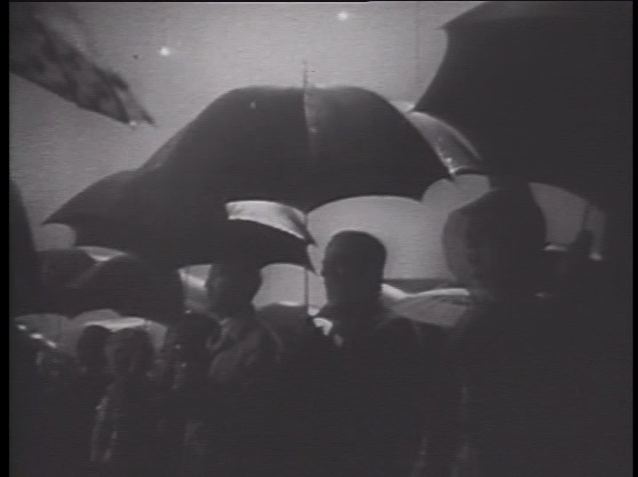
To quote the last post: "I think Capra tries to take a look at how fascism works. I think this is quite explicit at times - the big John Doe rally in the rain strikes me as a fairly deliberate parody of Triumph of the Will - or at least, of Nazi iconography" - here is what I mean:

The rally has all the trimmings of a big Nazi rally - huge crowds, radio mics and reporters, cameras and lights and hoopla - but all this imagery is undercut. The rally occurs in a torrential downpour - neither the bright daylight of the daytime scenes at Nuremburg, or the dramatic torchlight of the night scenes. John Doe arrives, passing like Hitler through the masses waiting for him, but unlike Hitler, with almost no fanfare. No one recognizes him as he passes through the crowd; Capra shoots his progress from a long distance in one shot, emphasizing his anonymity. Only when he reaches the stage does anyone recognize him. He then stands in front of the crowd, in front of a microphone, expected to speak; Capra frames him alone on the podium, in shots that do recall Riefenstahl’s shots of Hitler, but to opposite effect. Doe is alone, isolated (like Hitler in that, too), but with the opposite of Hitler’s commanding gaze and presence. He looks down, his face is desperate, and of course, he is sopping wet - a dripping, downcast man who doesn’t know what to say. The crowds are not arranged in ornaments, at least not in the lighting Capra provides - they are a sodden mass of people, obscured by umbrellas and hats and newspapers held over their heads, the whole thing swallowed up in mist and rain and darkness. The whole rally is a farce - the whole story a very complex mass of fraud and delusion, cynicism mixed with misapplied idealism, and this its point of collapse. Capra makes superb use of the imagery of Nazi propaganda, and of mass ornaments, undermining them, to expose the sordidness of the rally, not to mention the Nazis.


Tuesday, May 31, 2011

Mr. Deeds Goes to Town

This post started out as a Sunday Screen Shot post, but, well, I got a bit carried away... Actually - this comes from Sunday's double bill at the Brattle - Mr. Deeds Goes to Town and My Man Godfrey - between shows I scribbled down my thoughts on Mr. Deeds... when I got home, I set about making a post out of them, and - well, kept going...


So - Deeds strikes me as an odd film - it's right there in the middle of Capra's career, and it seems to wobble a bit. The tone is very uneven, the ideas sort of vague and half finished - the formula is a bit more obvious than in some of the other films. The opening sections are quite fine - but after Jean Arthur shows up, things start to go wrong. Deeds starts acting up, and the film goes a bit sour. Beating up the literati is a kind of turning point - Deeds stops looking like a yokel who happens to be smarter than the sophisticated New Yorkers and starts looking like a bully. The impression never entirely goes away, not until the end...


What’s worse is that in that middle part (and even through some of the end), the film starts to depend a bit too much on Deeds getting dumber when the plot requires it. That’s a problem with a lot of recent comedies - people get smarter or dumber depending on where they are in the plot. That afflicts this film - Deeds starts very smart - but starts to get weird - some of which is harmlessly weird, but a lot of it requires him to really behave - stupidly. (The Coen brothers, remaking this, got around it by letting Norville Barnes be an imbecile from the beginning.) This is, though, a danger Capra often runs up against - he’s responsible for some if it, I’m afraid. He (and Riskin and Swerling and their other writers) were always trying to play on this line - to make characters who are genuinely divided, complex, pulled by multiple forces - smart but naive; innocent but clever, or cynical but good-hearted, etc. - in stories that balance comedy, tragedy, melodrama, politics, farce, and so on - it’s a constant element in their work. And that division puts all their films in danger of doing what this one does - relying on a kind of inconsistency to work...

Mr. Deeds, I think, is less successful than most of their films - they usually pull off the balancing act. Mr. Smith also works the yokel in the big city angle for all it is worth - but it never requires Smith to be an idiot, or to become a different person from scene to scene. Ditto George Bailey - there, Stewart (and the script) always keep the division, the multiple forces pulling at him, always present, in every scene. Some of this, I think, is Jimmy Stewart - who always carries an air of barely suppressed psychosis in his films - he always plays multiple registers. But a lot of it is the script.

The fact is - Dr. Van Haller isn’t far off - Deeds does bounce all over the place. Granted - most of the time, Deeds has a sharp sense of where he is on the cycle - he rides the waves deliberately. That too depends on the actor - Cooper always seems cool and aware, in control of something - he can brood, but he always seems to know where he is. (Unlike Stewart, who can give the impression of barely holding it all back.) Unfortunately, this very quality - Cooper’s calm, his thoughtfulness, the impression of awareness he gives - confuses the meaning of the wilder scenes. When he starts taking swings at people - he comes off as too cool and deliberate to quite believe that he was losing his shit. It makes him a bully...

This is a minority position, I am sure, but I think Meet John Doe is actually a better film. It has more of the edge that Stewart’s films have - Cooper seems too grounded in Mr. Deeds. In John Doe, his character seems to work better - he comes off both as more of an innocent among the wolves, and as a bit of a wolf himself. I don’t ever believe that Mr. Deeds is in danger of cracking - but John Doe - yes, I can see that.

Still - I think Cooper is quite marvelous in Mr. Deeds - he has a way of conveying common sense - looking at things in a way that makes you see that he isn’t fooled. (Though when they need him to be fooled, they have him play dumb.) I think this works a bit better in John Doe, I admit - I think in Mr. Deeds, he’s supposed to be too much a yokel - in Doe, though he’s an innocent of sorts, he’s one who’s been around. His knowingness and his innocence both make more sense. Though as far as Cooper goes, he plays knowing innocence to perfection.


(I should say - though I think Meet John Doe is a more interesting, powerful film, Capra is more in control of Mr. Deeds. The politics in John Doe are a mess - Capra tries to do way too much. He's trying, at the same time, to champion something about America and its political life, while criticizing it - now, that's an important part of what makes Capra's films so powerful. He returns over and over to the ways what is good in true in American politics is co-opted by cynical politicians, newspapermen, businessmen [all professions he rather admires, though], who turn ideals into slogans to cover their own greed and quest for power. Anyone who tries to inject something innocent, pure, good - is soaked up into the system... Okay - and alongside this already dividedlook at American politics, I think Capra tries to take a look at how fascism works. I think this is quite explicit at times - the big John Doe rally in the rain strikes me as a fairly deliberate parody of Triumph of the Will - or at least, of Nazi iconography.... I suppose, if I wanted to write about John Doe, I should have written about John Doe, [UPDATED, with that link] though...)

So, to try to get to the end of this - what? I do think Mr. Deeds is a great film - just a bit squishy. There's so much right - funny lines and bits of business and people, a nice (complicated) love story, all those wonderful bit players Capra always featured - and - don't get me wrong, some real sting in the tail. The scene when the man breaks in on Deeds with a gun and a tale of woe is great stuff - Capra does desperation as well as anyone....


But it's not up with his best (before or after) - because - too much of the plot requires Deeds (and other people) to get smarter or dumber between scenes... Because Capra and his collaborators (Riskin etc.) were urban sophisticates playing up the small town yokel salt of the earth hokum. Capra can never quite lose his real abiding love for fast talking newspaper men and women - he’s never particularly convincing here. Jean Arthur too has to change for somewhat arbitrary plot reasons. (Unlike in Mr. Smith, where her evolution seems much more organic.) So - something of a lesser film from one of the giants of American cinema.... There are worse ways to spend a Sunday afternoon.

Thursday, December 17, 2009

Something Siegfried Kracauer Said

About girls...


and men and machines...


that applies to politics...


...though more than politics...


though sometimes, more politics...


made me think about how images and politics work together...


...to do evil...


And how evil...


...might be countered:


by being reconfigured


Maybe?


...gave me something to write anyway.

Sunday, December 16, 2007

A Film about Living in the World

I almost forgot this: a blogathon, for It's a Wonderful Life. More like, almost forgot it was set for today... we are talking, after all, about the greatest movie of all time. An opinion I've held firmly for a decade or more - though I admit to having doubts lately. Mostly under the pressure of a steady diet of Ozu films, which cover much the same ground, but without the need to end happily every single time. (That is a vital point, to understanding Ozu or Capra - that things can go either way. Ozu got to retell stories with different endings and configurations - Capra did the same thing, but felt he had to always end them well. This makes some of his endings feel very strange - they are very arbitrary. Sometimes, in Mr. Smith Goes to Washington, naming one, the "happy" ending is almost pure rhetoric - what really happens is far more complex... which is one reason that film remains a serious contender for the top slot....) But this is time to praise It's a Wonderful Life: and praise we shall.

There is much to praise: Capra was among the 2-3 best filmmakers ever (stories aside) - this is no exception. Cinematography, acting, handling of actors, staging, sound, story telling, is all utterly masterful. He gets short shift these days, on purely technical matters - that is criminal. His peers are Hitchcock, Godard, maybe Kurosawa, Imamura - directors who used everything cinema had to offer at the very highest level (as opposed to equally masterful filmmakers who chose more limited palettes - Ozu and Mizoguchi, Renoir or Bresson, maybe) - and he got there first.... Or taking more specific felicities - his manipulation of time, say - the "real time" of the film is about what - 20 minutes? we start with people praying for George - flashback to tell his whole life up to that point, then an extended dream sequence, then one last reel in the present. And the flashbacks are expertly paced: Capra lingers over every episode, taking his time, then shooting off like an express train. Look at the way he plays out George and Mary's courtship - all the hesitations, false starts, false turns, the comings and goings and shifts of tone and emotion in their love story, then - once love is declared, cutting straight to the wedding. It's like that throughout - episodes played out in detail, but strung together at a breakneck pace. (This is something TV totally ruins: commercials cutting up long sequences and taking the shock out of the ellipses.)... Or take it's literary references and lineage: obvious stuff like Dickens, a comparison it earns, for its willingness to show the harshness alongside the melodrama, for its handling of characters - the deeper, rounder characters at the center, surrounded by types... Though this is also, if not an allusion to the Confidence Man, an excellent example of Melville's notion of the "original character" - the way a central character can reveal everyone around him. Though too - they reveal him - representing the ways he could choose to live, by becoming (like them) adequate to his role. They represent options, some quite attractive, but all of them limitations: Mary's stability and her will to transform their small scale life into a kind of fairy tale; Potter's rapaciousness; Sam Wainwright's goofball selfishness and enthusiasm; Violet's easy hedonism, etc. Good or bad, all of those characters have settled - they are what they are, and George is not. (Though it's worth remembering that we see George from outside too, at least a couple times: the scene with the schoolteacher's husband, particularly - he takes a crack at George, and rails at him, and everything he says makes sense - he's right, and George knows it...)

It's that, I guess, that in the end, makes this film what it is. It's that doubleness, to everything - how every good thing is, in some ways, a limitation. How you have to live within the limits of thw world you are in, the choices you make, the person you are - but you don't have to be happy about it, and the minute you get too happy about it, you are stuck with it. And George's world is a bitterly ironic world (bittersweet, of course): everything cuts both ways. What is this film about? The way a community (a town, a family, any community) sustains and traps its members. About the necessity of both self-determination and fulfilling ones obligations to the community. It is about the ways no one is ever alone, and how one is always alone. It is about how our strengths trap us, how our best instincts lead us to do things that hurt us. It is about how we can never break out of the systems we live in, and how we can never simply accept those systems. About the necessity of constant self-invention. It's a film about contradictions, that can't be resolved. Yes - the ending fudges the issue a bit, but not enough to obscure it: anything George did, assuming he was as decent about it as he is in the film, would have made something in the world a better place and something else would have suffered. To be true to himself he would have to sacrifice something of himself - that would have been as true if he had gone away and become Robert Moses as it is if he stayed in Bedford Falls.

Everything in the film is double-edged. Everything that happens has at least two meanings. Everything is built on sudden reversals. Everything is built on the ways George's intelligence and ambition forces him into a position that (seems to?) thwart his ambition and intelligence. There are times (the courtship scenes, say, or the wedding night) when the contradiction becomes almost unbearable. He loves her - of course he loves her, why shouldn't he? But he knows that marrying her will trap him there; but he knows he's trapped whether he marries her or not. And their honeymoon: Mary's whimsy and imagination, turning their troubles into a dream, is coupled with the frustration of comparing the reality of their poverty, their responsibilities, to their dreams of travel. The scene is a tribute to their strength, their resourcefulness, their ambition and decency - but it's also a parody of his dreams, and it's a lie to pretend it's not cruel.

It's that constant pressure that links Capra to Ozu - they both pose individuals against communities (families, social obligations), and both refuse to resolve the conflict. They never let their protagonists off the hook - American films usually find a way for the hero to couple up and still be free - Japanese films all too often insist that happiness (and self-fulfillment) requires serving the group. Capra and Ozu, though, don't make it so easy: true individuality almost always involves social obligations - which almost always choke our individuality. Love, friendship, families - fulfill us and frustrate us.... Ozu was more free to explore this - so that one film can end badly, another less so - while Capra felt obliged to end happily throughout his career. (Or convince us that the end was happy, whatever it looks like.) Though those bell ringing, auld lang syne singing tear jerker triumphs Capra kept putting on screen are a bit more than just unconvincing. Because, first - they aren't really unconvincing. For all the pissing and moaning people do about the way It's a Wonderful Life ends, it's a pretty believable ending. If a popular and well respected man is in trouble, his friends probably will take up a collection for him - if he has rich friends, they will probably raise enough to buy what he needs. What's arbitrary about it is not the happiness of the ending, it's the idea that it's an ending at all. It's worth remembering that the ending of It's a Wonderful Life is a direct steal from a scene in the middle of You Can't Take it With You. The only thing different at the end of It's A Wonderful Life is that George sees himself a bit more clearly.... His life? he won't go to jail, but he's still not rich, he's still going to have to go to work on boxing day, with the same problems he had before. Will he understand things a bit better, having seen himself through Frank Capra's eyes? What more can we ask for?