Showing posts with label Film of the Month. Show all posts

Friday, August 07, 2009

Writing the City

(Cross-posted at Film of the Month Club.)


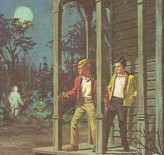
One of the things that struck me about Hands Over the City was the number of representations of the city that appear. So much of the film is structured around ways of describing the city. We see Nottola's model (above) - we see several maps - we see his office, with a map painting on one wall, huge photos of the city on other walls, as well as windows looking at the city, and the model itself. But the city is represented by more than just images - there are words and numbers about the city, reports, statistics. The archive room is as much a representation of the city as the maps are.


But none of these representations are adequate - they are often quite flawed. The episode discussing the common wall of the house that collapsed is a case in point: the officials explain that they had no way of knowing - the scale of the map would make a meter thick wall 1/2mm wide line - their pens have 1 mm nibs - they can't represent the real width with their tools. It's a common theme - the reports are all accurate, in their way - but all miss things. You see the various officials making excuses and avoiding responsibilities - but their information, their maps, records, etc., are all equally ambiguous. The representations of the city tend to hide it as much as reveal it. Da Vita gets at this, with his all too apt metaphor - everything was by the book, but the book needs to be rewritten...


While most of this misreading and ambiguity is unintentional, Nottola emerges as a character who can exert willing control over things. He is determined and focused, he knows what he wants. And he sees - and he promises a view of the bay to everyone.. He can imagine it, and represent it - hreates the big model - his office is lined with maps and pictures. He is a visionary - he imagines the city as it will become, he sees it when it is not there. He will build it - but before he builds it, he imagines it, he is, rather literally, a writer of the city:


Now it is true, he is as apt to see the profits he can get as the biuldings he can build - he still falls into that class of ambiguous villains, the 20th century developer. There was a nice piece in the New York Times about a new book about Jane Jacobs and Robert Moses, her campaign to stop him from bulldozing Greenwich Village for a superhighway, or driving an interstate through Washington Square Park. Nottola is in the same vein as Moses - more of a crook, maybe, but still, someone trying to realize a vision of a city - though a vision that usually forgets about the people living there. Or reduce them to lists of names...


Anyway - it's a good film about a pretty substantial part of 20th century social history - the reinvention of cities. A process still going on - there are echoes of this film in recent films about urban renewal - Pedro Costa's In Vanda's Room and Colossal Youth, or Jose Luis Guerin's Under Construction - complete with the tour of the new buildings - handsome, safe, boring, and priced out of reach of the people who are being displaced...

Wednesday, June 10, 2009

Links and Anticipation

Just stopping by - a few links on a Wednesday evening...

At the Film of the Month Club, a new film for June - ...no lies, by Mitchell Block - the film (16 minutes long) is embedded at the site, for the time being anyway - if possible, watch it before jumping into the conversation on the blog. Reasons will become clear when you've seen it, I think. Peter Rinaldi hosts this month - an interview with Mitchell Block, the director, will appear in the upcoming days....

Roger Ebert celebrates John Wayne on the 30th anniversary of his death.

The Nagisa Oshima retrospective is coming to Berkeley, and MIchael Guillen has details, and a long interview with James Quandt.

Pacze Moj has Oshima links, for those of us not in Berkeley.

And that's a reminder that Wildgrounds is hosting a Japanese Cinema Blogathon, starting Monday - I shall be diving into that...

Monday, April 20, 2009

Film Clubs


Another week without a post here - at least I managed to get up another installment of my Dr. Mabusethon at the Film of the Month Club. Hopefully a couple more of those to come before the month is over. I am endlessly intrigued by those films. And by Fritz Lang, who I've never paid enough attention to, but am becoming utterly fascinated by...

Meanwhile, today is the day for the TOERIFC's discussion of the Serpent's Egg - which, as it happens, appears to be Ingmar Bergman's stab at a Fritz Lang film... And I clicked on The Kind of Face You Hate today, rather than just read through RSS - and was reminded just who's sinister mug graces the banner there. Is there nowhere to turn? Can there be any escape? from -

Thursday, April 02, 2009

April Things to Do


Checking in again: less than a week since my last post! Not much to say here - a few links, mostly.

First - it is April, and I am hosting the Film of the Month Club's April entry - Fritz Lang's Mabuse the Gambler. Given my wretched track record posting this year, this is a bit scary - fortunately, it ties in with the German film class I'm taking, so should work out pretty well. I'm taking it as a chance to both expand on what the class covers, and and to work through some of Lang's work a bit more systematically than I might. That and it's a hell of a film...

On a similar note - I've been lax in tracking blogathons lately: I totally missed the Underrated blogathon at Chicago Ex-Patriate... My old crony Joseph B. is hosting a blogathon in honor of the 50th year of the French New Wave, inspired by the BFI's celebration of the same. 50 years - given that even at this late date, one runs into people who seem utterly flummoxed by Nouvelle Vague, it is amazing to think that it is has been 50 years since 400 Blows, Breathless, etc. came out...

And speaking of New Waves - another reason I'm completely strapped for time is another fantastic series at the HFA - this one in honor of Kiju Yoshida and his wife and collaborator, Mariko Okada. They will be present this weekend with their films, and again next weekend, when they will be presenting and discussing Ozu's Autumn Afternoon. This is heaven....

And one more film link - Matt Zoller Seitz is working through a series of posts on Wes Anderson - starting with an essay on his influence. Inexplicably, he leaves out Ozu. But I won't deny that I think Anderson is the best American filmmaker since David Lynch, so any big project like this is manna...

And so? There's also baseball, days from beginning.... Spring is in the air - things are looking up. But I have plenty to do this month.... I'll need a tiger in the tank...

Thursday, February 12, 2009

A Week Later...

(Pablo the Penguin, in the Galapagos.)

More than a week. I have no excuse - or not much of an excuse. Classes, the German film class I mentioned before, and a Drama class - they aren't really a reason not to blog, they haven't been all that time consuming so far.

I can't blame my film-going. At least last week end brought a couple fine movies to town: The Class was a treat, a worthy winner at Cannes last year. It's hard to say much about it - it's a self-contained and self-sufficient kind of film. It says what it shows and shows what it says - anything you can say about it is in the film. And Truffaut's The Wild Child has been rereleased, to continue the pedagogical theme. I hadn't seen it before... I am not a huge Truffaut fan, but this was hugely satisfying, on par with his best (400 Blows, Shoot the Piano Player, I'd say) - lean and spare and beautiful, great work.

ON video - there's the Three Cabelleros, under consideration at the Film of the Month Club - a strange, somewhat uneven hodge podge of propaganda, travelogue, animation, that builds to some rather extravagant surrealism, and filthy jokes featuring Donald Duck.... I did watch Rio Bravo - I haven't seen it in ages, and it's nice to be reminded what a fine work it is. Character over story, you bet... The German film class bracketed Nosferatu and Mabuse the Gambler (Part 1) - we'll see if I can muster anything on those in the future- not this week, apparently...

And out in the world? Pitchers and catchers are reporting - the world is a happy place. The sporting news has not been happy - another superstar disgraced - that's Bud Selig at that last link, saying A-Rod "shamed the game." No word if he said that in a Claude Rains voice, but it's certainly a piece of performance art. Steroids saved the game in the 90s, saved it in spite of people like Selig, saved Selig - it's good they're cleaning it up, but when anyone in authority in the game says they are shocked or shamed by the dopers, you know they are lieing. I'll take the cheaters over the liars any day.

But I don't care. Bud Selig can't reduce my happiness in the game - he's been trying for years to ruin it, and hasn't done it yet. This is too wonderful a time of year to care....

ANyway - let's wrap up with some remembrances. Today is the 200th birthday of both Charles Darwin and Abraham Lincoln. Both widely celebrated on the web. Jacqueline Lynch has a nice post up about one of the stranger moments in classic American cinema - the Abraham number in Holiday Inn. A fairly late blackface routine in American film, and one presented almost guiltily, and cut in the middle with a neat chorus by Louise Beavers. It's strange - off-putting now, with signs that the filmmakers shared the discomfort, the sense that this was not right... anyway - a nice essay...

Monday, February 02, 2009

Weekend Film Watching

Time to check back in here. I'll start with bloggage: a new month starts on the Film of the Month Club - this month, looking at Disney's WWII Latin America propaganda cartoon, Three Cabelleros. Oddly enough, I look forward to this more than usual - I remember it, seeing a picture of Donald and the Parrot from the film in some book I had, maybe a Disney encyclopedia of some sort, maybe the articles about South America. Something about it must have made an impression on me, since I remember the picture but not the book. Anyway - here's hoping for a lively discussion... The next couple days I'll be at classes - tomorrow, my German film class: which reminds me that at the other monthly film discussion group, Jonathan Lapper will be leading a discussion of The Tin Drum from February 16 on.

Meanwhile - it was an interesting weekend. Started badly: my neighbors were making noise half the night Friday, putting me in a poor state of mind; it was a particularly lousy weekend for new movies - in the end, absolutely nothing lured me out of the house. But I did leave the house for the rep theaters, and was richly rewarded. A Paul Schrader double feature, with Schrader in attendance: he was quite inspiring. Funny, sometimes insightful and informative (he had a tendency to circle the questions, but it didn't matter, because he usually ended up telling interesting stories anyway), but always entertaining. He talked about religious symbolism (in Light Sleeper), saying he wanted images that weren't obvious - not like "fucking Darren Aronofsky" putting a "tattoo of Jesus on his fucking back." - "You have to cover your tracks!" He turned a confusing, awkward comment about Pickpocket from the crowd into a reiteration of his love for the film. He talked about making a "Marxist" film for Universal, in Blue Collar - and about fitting films' politics to the logic of the characters. It was a good night.

The films are pretty good as well. Light Sleeper is an odd concoction: a midlife crisis film - Schrader said he was looking for a way to write about middle age without falling into the usual cliches, when he had a dream about a drug dealer, growing old - that became the film. Willem Dafoe plays the dealer - Susan Sarandon his boss, who's going legit (cosmetics) - Dana Delany his old girlfriend, in their stoned days... bad things happen, redemption is sought... It's a nicely made film, though Schrader's style is relatively unexceptional - but he knows how to tell a story. He talked quite a bit about the music, by Michael Been of the Call - about his idea to have a suite of songs expressing the thoughts of the character, about wanting to use Dylan songs, but having Dylan not give him the ones he needed. Been's music almost works - it might have, except it's done in a very irritating late 80s/early 90s pop style that dates it worse than any of the costumes... Still - a good piece of work.

Blue Collar, on the other hand, is easily the best Schrader film I have seen - Richard Pryor, Harvey Keitel and Yaphet Kotto are autoworkers, the first two family men with money troubles, the third an ex-con - they all have troubles, money, lack of respect at work, from the company or the union - they decide to rob the union shop. And that sets off a string of events that - change everything. It's first rate: the cast is extraordinary - Keitel and Kotto are always fine, and here, Pryor is astonishing - moving from his fast-talking persona to dead serious, thoughtful, fearful, defiant - just great. Schrader develops the characters, avoids demonizing or sanitizing - people do good and bad things for good and bad reasons, we never stop sympathizing with them, even when we know they are doing wrong. The film itself is, indeed, Marxist - a condemnation of the system, the corruption in the system itself, not in the particular people or institutions - a condemnation of the means of keeping people in place. Really, a genuinely great film.

Finally - staying home and firing up the DVD player - I watched Husbands and Wives. Which I was rather startled to discover (given my other recent Woody Allen experiences) is a pretty good film. It's the most satisfying Woody Allen film I've seen since Zelig, I'll say that. The story is - Woody and MIa Farrow play Gabe and Judy, married 10 years; their friends Jack and Sally (played by Sydney Pollack and Judy Davis) split up at thebeginning, precipitating a bit of a crisis for Gabe and Judy. He's soon flirting with a clever 20 year old writer; she passively pursues a co-worker; Jack screws his aerobics instructor and Sally goes after Michael, the same man Judy pines for. The film cycles among all these people and stories, and sometimes goes further, acting out bits of Gabe's novel, jumping into flashbacks for any of the characters - and framing the whole thing with a series of interviews with the characters. This gets at why I like this film - it is quite stylistically audacious. Allen uses handheld cameras, jump cuts, and all the twisty time structures, things like the mock interviews... It's interesting to look at, which is not often the case with Woody Allen films - and more than that, it serves the story. for all its fictiveness, it is, like a lot of his work, very essayistic - examining moral and personal issues almost abstractly: acting them out. Here - the links to Gabe's novel are underlined by the style - the film (with its look, with its narrative jumps, the flashbacks and forwards and fantasy sequences and so on) feels distinctly written. Ed Howard's comments on the film note that it's one of Allen's few nods to Godard - I think that's right, not just in the look, but in the way it is made like a novel, with a particularly willful first person narrator. Though it's an odd first person, with its multiple points of view, its shifting sympathies - it's quite dialogic. It is, in the end, very satisfying - it lives up to the claims Allen's fans make about his films.

Sunday, January 11, 2009

Ambiguity

(Cross posted to Film of the Month Club.)

I want to try to develop some of the issues raised in comments about who actually exists in Bad Influence. Not so much because I think it matters who exists or not - but because the way film hints at the possibility, and then does not resolve it, raises points about information in films that I find fascinating.

So who is real? The film sets you up to wonder about Alex, especially - even raising the point explicitly. Pismo says the cops won't believe he exists - and that's the plot in the last third or so - how can Michael (and Pismo) prove that Alex exists, and that he did these things, not Michael? That's what happens in the last act - they chase down evidence that Alex exists - finally trapping him on the Manhattan Beach pier.... But what's interesting about the question is that the film doesn't resolve it. It maintains its ambiguity to the end. In fact, it probably raises more questions about what is real, without answering them. What about Pismo? He's even more ambiguous than Alex, if you think about it. We don't see anyone interact with him other than Michael and Alex. What's more - his function in the plot is as a kind of return of the repressed. He's more Michael's physical double than Alex (a fact the film plays with, from his introduction on.) He shows up at MIchael's door, asking for money, paranoid about an old drug conviction, or later, telling Alex he has "the fear." Which prompts Alex to ask Michael what he is afraid of, what he wants.

The question of what is real isn't all that important in itself. The symbolic links among the characters are obvious enough, and don't depend on their literal identity. What is interesting is how the film handles the possibility, and how it fits with other aspects of the film. How does the film handle it? By hinting at it - then raising it explicitly, and setting it up as the point of the story - then seeming to resolve it - but, rather pointedly, not resolving it. Most of the hints, in fact, are more about the symbolism than the reality of these characters. Alex doesn't really seem to be anything but a slumming gangster of some kind when he first appears. He plays tempter - plays Faust - though he also seems to be acting as Michael's id, or enabling Michael's id. The characters are linked - most clearly in Alex's first appearance in the bar. We see Michael at the bar drinking a beer - we see him in a fight, getting pushed around - then we see a closeup of a hand, breaking a beer bottle on the bar - then we see Alex. But that hand breaking the bottle - it's certainly edited to make us think for a second that's Michael... But even this is just a symbolic link - and symbolism isn't ontology.

Once Alex's existence is named as a problem, though, this manipulation of information becomes significant. You realize that the film has not shown us who beat Patterson, who killed Claire, you realize that no one has seen Alex except Michael (and Pismo and Claire, but one is as reclusive as Alex, and the other is dead). No one but Michael has talked to Alex on the phone. It is possible to put Michael and Alex in the same place for any of the important moments - and possible to rationalize Alex's presence (as Michael's imagination) at places where there seem to be witnesses (like the fiancee's party.) Episodes like the robberies are played ambiguously - we see Alex's face, but Michael wears a mask, and acts completely dissociated from the crimes, enough to make us question the point of view they represent. And everything that might count as evidence - the videotape, even the pictures we see at the beginning of the film, before Alex meets Michael - have disappeared, been destroyed, etc. Now: by naming the question (of Alex's existence) in the film, it sets you up to expect a resolution. The film never plays the story as if Alex didn't exist - everything is structured as if it were a mystery to be solved. And indeed - the ending of the film seems to solve it: Alex's confession is on tape - then he is shot....

And yet the film maintains its ambiguity. Alex's body doesn't come to the surface - no one actually watches the video footage. Michael walks off to talk to the police - but Pismo lags behind, and we don't actually see Michael meet the police. Nothing is resolved.

I think this is important. It does a couple things: one is, I think it links it to another branch of films, to art films - Antonioni and the like. It shares some of their aesthetic - the stark, urban landscapes, the blank white walls, the fascination with photography and video; and it shares their ambiguity, and interest in ambiguity. The unanswered questions of who killed who, or if anyone killed anyone, of Blowup or Terrorizer or a Michael Haneke film. I don't know how much connection there is to those films, probably some, though even without direct links, many of the ideas and images were in the air in 1990.

It's also important for foregrounding the question of evidence, in the film, and for film watchers. What constitutes proof that something is "real" in a fiction? Most of the time, we take it for granted - if the filmmakers put someone on screen and show something happening, we assume it is actually happening, within that fictional world. So why would we doubt that? Why would we ask if 2 characters are really the same person? Why would we ask if something was a figment of someone's imagination? and if the problem comes up - how do you decide, in the film, what is real and what is not?

How does this film suggest that Alex is not real? I'd say: 1) his introduction, that ambiguous cutting around the bottle; 2) by foregrounding the story templates, doppelganger stories, Faust stories; 3) by manipulating what we see and don't see - and then foregrounding the manipulation, so we notice that the film seems to have arbitrarily skipped something like Patterson's beating. 4) And finally - by making it an explicit problem for the plot - by having Pismo and Michael realize that they have no way of proving that Alex exists.... Or - how does the film prove that Claire (for instance) is "real"? Well - as I said in a comment: she's on tape - other people see her on tape. That's how we know Michael is real. We see people that we can't reduce to Michael's perception, and those people react to him: thus we know he "exists." And that evidence is missing for Alex - and for Pismo. Alex does not appear anywhere Michael is not, or if he does, Michael's independent existence can't be proved; there are no pictures of him (and he has no intention of letting anyone get any - they won't knock over a convenience store, it has cameras), no one hears his voice. Same with Pismo - again - only Michael and Alex see him, except at the club - which we could read as "really" Michael. (I think there's enough time to at least pretend Michael's trip to get the gun is not simultaneous.) No pictures of him, no one else hears him talk. And when there is a real chance of two of them being seen (as when they are trying to dispose of the body, or even at the end), Pismo conveniently disappears when people come along (or the film stops.)

But likewise - how would we prove that Michael and Alex are the same person? Well - the film could tell us, explicitly (as in Fight Club.) Or we could imagine a final scene - Michael telling the cops how Alex did what he did, showing them the tape - and we might see the tape, and see Michael confessing the crimes... Or we could see the cops coming to the end of the pier and see that what we thought was Michael was Pismo - and then see Michael's body in the water. There are undoubtedly more subtle ways of making the point - but of course, the film does none of them.

Anyway: that is all for now. By rooting through all this, I don't mean to say that the characters really are the same person, or that the question of whether they are or aren't is all that important. What I think is important is the fact that the film does not resolve the question - and that it does raise issues about knowledge and reality in film. The ways it relates those questions to technology - might be another essay...

Monday, January 05, 2009

Bad Influence and Neo (Not so) nNoir

Cross-posted at the Film of the Month Club.

One of the interesting features of neo-noir, probably following in Chinatown's footsteps, is the use of light, in place of darkness. Bad Influence follows that trend -light plays a key role in its look, throughout. It begins in darkness, and certainly, shadows and dark are significant in the film - but it is remarkable how much emphasis there is on light.


Its key spaces (Michael's workplace and his apartment) are bright, airy places, with white walls, bright lighting, windows, white decor.


When he moves outside, much of the story takes place under the brilliant LA sky:


Meanwhile, as the deeds grow darker, darkness enters the film, as well - though light remains significant. The robbery spree the men go on leads them through dark streets, but the actual crimes occur in the light.


And light itself is a significant part of what is seen. The light of the TV screen is a recurring motif, the TV and camera are integral to the plot; plot points also depend on a tail light, the light of a refrigerator door opening, etc. Even incidental details like the dance routine at one of the underground clubs are built around lights:


And here is darkness, framed in light:


It's a strong pattern throughout the film, and helps establish a theme, maybe: that light hides our bad impulses - darkness reveals them. That may overstate it - the film does fascinating things with what it shows and hides, puts onscreen or off... but its use of light (and whiteness, and glass, surfaces, etc.) is quite remarkable.

...One more thing (added here, not the FOTMC, since this is not a completed thought) - the look of Bad Influence reminds me of certain high modernist films, Antonioni, Edward Yang. It does not present itself as an art film, but it really is - the decor, the modernist spaces, the clean lines, the whites and light, the glass and steel - and the ambiguity of the story. For it is a very ambiguous story. Exactly how many characters are there in this film? A question to be asked! a hint of posts to come!

Thursday, December 18, 2008

Quick Bloggage

The holiday season is here in all its time consuming glory. With weather promised for tomorrow - fun fun! I have been eye deep in Oshima for the last couple weeks - almost over, though there are a few shows left. Including Diary of a Shinjuku Thief, which is one of the 2 or 3 I most wanted to see - but won't be around for. Blast it. But the rest has been glorious. I will try to post comments - whether capsules or mini-essays or just, I don't know - something - we'll see. If it wasn't 11:30 PM, I might try something quick now - I'd note, say - the way he seems to pick a style, a formal principal, with every film, and see what he can do with it. His career is wildly eclectic - I mean, his style shifts with almost every film (though some things remain the same: gorgeous compositions, radical storytelling, political engagement, distancing devices) - one may be rough and loosely structured and the next tight and carefully laid out; one may be color the next black and white; one may be tightly scripted the next semi-improvised - but the shifts are from film to film. Within films, he's very consistent - along with the widescreen compositions, which are always impeccable, he sets himself a fairly well defined set of devices that he uses: the cool formalism of Boy and Ceremony; the disruptive editing in Violence at Noon; the use of lighting and theater in Night and Fog in Japan - and so on.... It's good to see him getting some airing - I think this series is traveling - I hope others get to see it, beyond NY and Boston. And I hope Diary of a Shinjuku Thief comes back to Boston soon...

Meanwhile, before I go - a few links to tide you over....

James Urbaniak on Peter Schiff's prescience. This is as close as I have seen to what it would look like if a time traveler came back in time and went on Fox news. It looks like a fake - Schiff basically describes the summer and fall of 2008 in 2006, and a bunch of nitwits laugh at him. Oops! Oddly, the same morons are still on TV - hasn't Ben Stein been banished yet?

David Cairns on Brazil.

What the hell? The Bush family Christmas video card - starring a dog, though not a shoe, at least not in the minute or so I lasted...

Ed Howard cites Alison Bechdel's rule for movies - 2 women in the film, who talk to one another, about something other than a man. Oshima doesn't come off too well, though he sometimes seems to critique the social patterns that cause this kind of problem, isolation of women from one another etc. Night and Fog in Japan makes an interesting point, a bit accidentally - there are two major women characters, who don't speak to each other and only speak to the crowd about their relationships to the men (to Nozawa, the communist turned journalist who is marrying one of them.) There's also another woman, an older woman, who stands with the girl getting married in the film - she never says a word - she just drifts through the shots - though at the end, during the Stalinist's harangue, she gets a lot of the camera time - it's as if Oshima is making a note of her, of her silence and marginality here... Though he never really makes films about women, the way Ozu or Imamura, let alone Naruse and Mizoguchi did. All fo them have their issues, but they hit this standard a few times....

And finally - the Film of the Month Club is back inaction, with Absolute Beginners as this month's film. A neat choice for a host of reasons,bot least, the consideration of the 80s' place in film history. It's ging to be a while before I get to see the film - but it's a good discussion going on....

Wednesday, July 16, 2008

Weekly Post

This is getting awful. I am back on my summer schedule, lucky to post once a week... I don't know. I can blame vacations or the heat or watching the Red Sox or playing softball, but who knows...

All right: keep a toe in until I get some energy back.... The Film of the Month Club has moved on to its new film: The Fireman's Ball. I look forward to this - Czech new wave is one of those things I have never really explored - in fact, I don't know if I have explored it at all... This is a perfect excuse. Assuming I can muster the energy to sit down in front of the TV and watch a movie...

There are other blogathons going on, coming, or just concluded - check out the blogathon page to the right. The one I'm itching for is Maya's Kiyoshi Kurosawa blogathon (mentioned down at the bottom of this post) coming on the 19th. That's coming up fast: if Im going to show some life it had better be quick.

The year is halfway through: I should make a list or something... the year so far. Others have. Maybe I should make a list of the films that have played in Boston, possibly for the only time in years - that I was too lazy to go to? Boarding Gate? Chaotic Ana? God - how can I face myself?

The best I have seen? Quite a few of this year's releases made it onto last year's retrospective lists - so this is only since the last list post. 2008 releases, best since May:

1. Edge of Heaven
2. My Winnipeg
3. Chop Shop
4. Up the Yangtze
5. Gonzo: Life and Works of Dr. Hunter S. Thompson
6. Speed Racer
7. Operation Filmmaker
8. Monkey Warfare
9. All For Free
10. The Tracey Fragments

Heavy on the documentaries and Canadians, as usual this time of year. I have to write some of these up, if I ever get the energy to sit in front of the computer for a couple hours... Right.

And music? Haven't been buying a lot of stuff, down from usual. But some recent good stuff... new Beck record (Modern Guilt) sounds pretty good, though I just got it... And the Melvins have a new one out - I've been listening to the Melvins a lot lately. Working backwards from Boris, I guess you'd say. New one is called Nude with Boots... And I've been digging up Mark Stewart records when I can - Edit, the new one, is pretty interesting. And Sigur Rus - who in the last couple years have become one of my favorites. Haven't quite gotten into this one yet, but they usually come... Still - overall, I haven't been buying that many records this year: the best all year are probably the Earth record (Bees Made Honey in the Lion's Skull) - with Bill Frisell! and the latest Nick Cave (Dig, Lazarus, Dig!)

All this of course is an excuse to post a video - easy material! Let's use live Earth - Engine of Ruin. Another beautiful song...

Wednesday, May 28, 2008

Authorship in Kazuo Hara's Films

[Cross Posted from the Film of the Month Club blog - added here for archival purposes.]

Thinking about The Emperor's Naked Army Marches On made me curious about Kazuo Hara's other films. Earlier this month I watched his two earlier films, Sayonara CP and Extreme Private Eros: Love Song 1974, hoping to get a better idea of Hara as a filmmaker. I posted some notes on his style and themes at my blog - but now I'd like to address another characteristic of these films I put off from that post. This emerges, specifically, from some of Harrytuttle's comments here, that Okuzaki seems to be more important to the film than Hara. It's an interesting point - in fact, I think it is characteristic of Hara's approach.

His films are definitely about strong personalities: the poet and photographer in Sayonara CP, Miyuki Takeda in Extreme Private Eros, and Okuzaki, are all assertive individuals with their own agendas. But usually even documentaries about strong characters retain a fairly clear hierarchy of "authorship": the subjects (Bob Dylan or Mark Borchardt or the Crumbs) do their thing - the filmmakers (Pennebaker, Smith, Zwigoff) film it and shape it. The subject of the films may control their discourse - but the filmmakers retain control of the discourse of the film. But Hara cedes more control of the films to his subjects - he allows them to shape what is in the film, to comment on the film more directly. Okuzaki's crusade is a good example - along with his tendency to perform, to stage manage confrontations, to act violently (though always photogenically). And his control of what will be in the film - inviting Hara to film him killing Koshimizu is probably the extreme example, but there are others. Several posts and comments here have explored Okuzaki's "shtick", so I will concentrate a bit more on the earlier films.

In Sayonara CP, the Greenlawn group (an organization of cerebral palsy sufferers) has significant input into the film, shaping its content, and its purposes. When the film is endangered (the wife of one of the main characters, the poet, Hiroshi Yokota, demands he stop filming), the Greenlawn people are as adamant about continuing as Hara. (And a good deal more vocal - he just keeps shooting; they yell at Yokota, nearly get into fight with him.) Beyond this, both Yokota and the other main character, a photographer, are given extended scenes, and explain their ideas and hopes at length. Hara has spoken of his desire to show things that are hidden - the CP sufferers share this desire. The photographer says he began taking pictures because other people took pictures of him - "we can only be passive" he says - he wants to reverse that, to look, as well as be looked at. He implicates Hara in this - Hara was always photographing him, he says - now he wants to be the one with the camera. Yokota, the poet, has similar goals - to read his poetry in public, to make people look at him, listen to him, acknowledge him. He has a major speech at the end of the film - describing his hopes for the film, for a different kind of film, only to have those hopes shattered. He will always be helpless, he says - while Hara cuts between shots of Yokota sitting nude in the street and repeatedly trying and failing to stand. Whose idea was that? Hara's? Yokota's? Either way, it pits the image against the words in a way that, I think, that underlines the authority of the character in the film. Both of these men resist their appropriation by the film, at least by speaking about it directly.

Hara's second film, Extreme Private Eros: Love Song 1974, contains perhaps the most extreme example of this shared authorship. The film is a portrait of Hara's ex-lover, Miyuki Takeda - an extraordinary woman in her own right. The first half of the film is fairly conventional, as far as the relationship between Hara and Takeda, as filmmaker and subject, go - he shoots her, she talks, goes about her business - but the film is basically his. But in the second half the relationship changes. He films her giving birth - but this was her idea. We heard her plans earlier - she wants to give birth completely alone, with no help from anyone: and wants Hara to film it. That is what happens. She has the baby, while Hara films and his current lover records the sound. This scene is hers by any standards - she plans it, does the work (to say the least), and Hara just records.... This also tends to recast her activity in the earlier scenes - Hara tagging along as she went through the Okinawa underworld, trying to help the women there. Only at the end do we learn what she was doing there: by the end, seeing her efforts to create a model community, we see her as a far more active character than before.

Now - I don't think this in any way diminishes Hara's contributions to the films, and I certainly don't think it makes them less interesting formally than other documentaries. On the contrary - I think it makes the tension between the subject of the documentary and the maker of the documentary more explicit. It plays into the broader issues of control and independence found in these films, and often into their themes of revelation and repression - as all these characters in many ways seek to say and show things that have been suppressed. In this they are partners with Hara - though as well, as a filmmaker, he is appropriating their words and their images for his own purposes. They often, fairly explicitly, try to take control of those words and images back. It makes for a fascinating interplay.

Sunday, May 25, 2008

Observations on Style and Theme for Kazuo Hara

At the Film of the Month Club, the conversation about Kazuo Hara's The Emperor's Naked Army Marches On is going apace. It is a rich and strange film, lending itself to a world of consideration - politics, history, Japanese society - the psychology of the protagonist, Kenzo Okuzaki - moral and ethical considerations, both for Okuzaki and the filmmakers - as well as being a fascinating piece of filmmaking. The conversation there so far has bent more toward the politcal, ethical, psychological elements of the film - I want to wrote about the formal elements of the film, and about Hara's style and themes as a filmmaker. I took a look at his earlier films as well, themselves quite extraordinary works: Sayonara CP is about a group of cerebral palsy sufferers; Extreme Private Eros: Love Song 1974about an Miyuki Takeda, Hara's ex-lover who has gone to Okinawa to try to help the bar girls there... These are some notes, some continuities among these films, and some of the devices used by Hara in The Emperor's Naked Army Marches On...

- Form and Style - the film follows a relatively common documentary form: Hara and crew follow their subject around, generally not interfering or overtly shaping the material. Hara doesn't add a lot of explanation - no voiceover, fairly minimal titles, and only a couple interviews of people other than Okuzaki to give context to the story. This is similar to his other films - even when there are more conventional interviews (as in Sayonara CP), they aren't presented as ways to fill in a broader kind of story - they are filmed and presented as monologues by the characters in the film. They don't provide context for the film's subject - they are the film's subject.

- Style - looking more closely at some of Hara's techniques: his preference for fly on the wall observation; his manipulation of sound and image (which is less radical in this film than the earlier ones - probably because he had enough budget to shoot real synch sound); his occasionally jarring use of text - these elements have thematic implications as well, that we will return to.

- Structure - in the interview cited by Girish, Hara mentions trying to show Okuzaki as an action hero. The film, in fact, is structured as a mystery - as a detective story. It is structured around a literal murder mystery - why were 2 private killed 23 days after the war ended in 1945? Who ordered them killed, who did the deed, and why? Okuzaki tracks down this mystery, interviewing all the surviving witnesses - but he does it like a detective - he doesn't just seek the truth about what happened 40 odd years before, he seeks to inflict justice in the present as well. (And yes, "inflict" seems to be the right word there.)

- Narration - while Hara does avoid conventional documentary construction - voiceover and explanations and background information and so on, he maintains a good deal of control over the narration of the film, the flow of information. The Emperor's Naked Army... begins with somewhat random seeming clips of Okuzaki - at a wedding, visiting the police, mounting a couple protests, visiting a man in the hospital - these scenes introduce him without explicitly stating who he is or what he is doing. But in fact, a good deal of information is revealed: we learn about his past, his records, from his own accounts (and eventually from Hara); we get some glimpses of his character, that might come clearer later (his remark that nations and families are walls between people - at a wedding! - should give us a hint as to his iconoclasm); we learn about his goals, his obsessions, and get some hints of his methods. Hara sets up later scenes: the first old comrade he meets is Yamada, in the hospital - who will also be the final, most significant encounter (shown) in the film.

- Themes - the dominant theme throughout Hara's work is one of revealing what is hidden - more than hidden, what is repressed. In the Iris interview, he mentions this, specifically about Sayonara CP - to show handicapped bodies because they are difficult to look at. "What I wanted to do with the film is show exactly what people did not want to see, to expose the hidden." Its a theme running throughout his films: in Extreme Private Eros, showing his private life and that of Takeda, as well as showing two explicit births; in The Emperor's Naked Army, he exposes the secrets - shameful, evil - from the war.

In fact, he goes beyond showing what is hidden. It's more that he explores the acts of revealing and hiding, and the mechanisms of repression. All three films contain moments that hide as well as show: obviously the things people don't want to tell, but also the people who resist being on film; acts of direct censorship and repression, and so on. So in Sayonara CP we see: the wife of the main character (Yokota, the poet) trying to stop the film, demanding that Hara stop filming in her home, which he ignores; police breaking up Yokota's poetry reading, calling it a freak show. In Extreme Private Eros: there is a similar scene - Takeda is distributing pamphlets to bar girls in Okinawa, with Hara filming - some men approach and the screen goes black and a title informs us that "Hara was assaulted by gangsters." It's similar to the end of Naked Army - where the trip to New Guinea yields nothing but a title saying the footage was confiscated by the Indonesian government. Even without elisions of this sort, the hiding/revealing dynamic appears: the quintessential example may be Takeda's birthing scene in Extreme Private Eros. Hara shoots the birth in one take - and presents the take in the film - even though the camera went out of focus early in the shot. He's showing something as intimate as it is possible to show - but showing it out of focus, blurred and ambiguous.

These scenes seem to me to come close to the core of Hara's ideas. They occur throughout his films - he emphasizes them, with titles explaining what's missing, or with a voiceover running over the out of focus shot of the birth of Tekeda's child - or just through their placement. They tend to come near the climax of the films, as when the police break up Yokota's poetry reading, at the end of the climax of the poem itself, for instance. They tend to come between moments of great power: in Sayonara CP, Hara draws out the moment hen Yokota reads his poem - the police arrive - and immediately after the scene, there is a shot of Yokota naked, in the middle of street, talking about his hopes for the film, and their let down. The end of Naked Army is similar - the emotional peak of the film is probably the long ocnfrontation between Okuzaki (and Oshima the anarchist) and Yamada - after this, comes the (invisible) trip to New Guinea and Okuzaki's attempted murder of Koshimizu's son. The latter especially, is the climax of the film - it's what the story has been building toward: the solution of the mystery (who killed the men and why? by that timem Koshimizu has emerged as the clear villain of the piece), and Okuzaki's imposition of justice (or vengeance.) And it happens offscreen, told in titles and an interview with Okuzaki's wife. Which is probably all the more appropriate given that Okuzaki's vengeance goes awry - he doesn't shoot the perpetrator of the old crimes - he shoots his son.