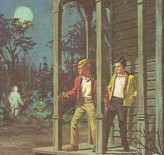
I have been very absent from this blog for quite a while now. At least in the last few weeks I have had a viable excuse - I've just moved, to a different state, a very irksome process. The last week or so particularly have been very busy, lots of work, disruption, and, since I am an old man and did the move myself (with various friends and relations), lingering aches and pains. And a cold. And a lovely stretch of weather more suitable to March than May....
All this, particularly the timing of the move, meant I am not contributing directly to the latest project at Wonders in the Dark - but it is a good one, and I am certainly taking advantage of it.
The first annual Allan Fish Online Film Festival is being held, starting yesterday, May 11, Allan's birthday, and running - quite some time. The concept is that each day, someone wil host and post a link to a film that can be found online, and host a discussion. Details here, in Sam's introduction. This festival is being held in memory of Allan Fish, the fine writer who co-ran Wonders in the Dark with Sam Juliano all those years, who died absurdly young last fall. He was an insatiably curious cinephile, who used the internet to track down obscure and undistributed films - this is a fine tribute to his passion.
So click on over, take a peek, watch some films, and talk about them.
Showing posts with label blogathons. Show all posts
Showing posts with label blogathons. Show all posts
Friday, May 12, 2017

Thursday, May 14, 2015
Film Preservation Blogathon
Just want to drop a quick link in here for the Film Preservation Blogathon running this year at Ferdy on Films, This Island Rod and Wonders in the Dark. I am coming out of my Ivan the Terrible induced isolation, so don't have a lot to say just now - but you can find plenty to read, and can donate to a good cause - the National Film Preservation Foundation. Enjoy!
The theme of this year's blogathon is Science Fiction film - Ivan the Terrible is NOT a science fiction film, though shots like this might give you that impression...

The theme of this year's blogathon is Science Fiction film - Ivan the Terrible is NOT a science fiction film, though shots like this might give you that impression...

Monday, September 26, 2011
Belated Maddin Post

A very busy week and weekend has made me miss not only my usual Sunday screen shot post, but a Guy Maddin blogathon, hosted by Fandor. Alas! I can do no more than offer a partial atonement...


Tuesday, September 06, 2011
Quick Links - Nick Ray Plus
I don't want to forget this - though I have been forgetting it... Don't miss the Nicholas Ray Blogathon hosted by Tony Dayoub at Cinema Viewfinder. There is a host of material there, and around the internet....
Also - I'm reminded that yesterday was Freddie Mercury's birthday - that's gotta be worth noting....
Also - I'm reminded that yesterday was Freddie Mercury's birthday - that's gotta be worth noting....
Friday, May 20, 2011
Friday Movie Follies
I think I will keep it simple today - straight up random... though first - a film link - a Woody Allen Blogathon, starting, I think, today.... there's another Woody Allen film coming out, that, like most of his films, seems to be getting good notices before it's actually released - who knows, maybe this one really isn't all that bad. Glenn Kenny liked it! I don't know; the previews filled me with dread. The descriptions seem to indicate that it is against nostalgia - the reviews, on the other hand, like most of Allen's recent reviews, seem driven mainly by nostalgia - a desperate hope that this time he will give us what he gave us back when we loved Woody Allen. Still - I might break my once every 7 years Woody Allen film attendance record...
But now - music:
1. Danielson - Olympic Portions
2. Tool - Forty six & 2
3. Sunny Day Real Estate - Shadows
4. Loren Connors - Airs No. 7
5. Neutral Milk Hotel - Untitled
6. Billy Bragg & Wilco - Eisler On the Go
7. Decembrists - of Angels and Angles
8. MIA - Born Free
9. Kali Bahlu - A Game Called Who Am I [are you a leprechaun?]
10. Melt Banana - Slide Down
Nothing there demands a video - so in honor of the possibility of getting rid of a whole bunch of the more obnoxious Christians this weekend - here's Blondie:
But now - music:
1. Danielson - Olympic Portions
2. Tool - Forty six & 2
3. Sunny Day Real Estate - Shadows
4. Loren Connors - Airs No. 7
5. Neutral Milk Hotel - Untitled
6. Billy Bragg & Wilco - Eisler On the Go
7. Decembrists - of Angels and Angles
8. MIA - Born Free
9. Kali Bahlu - A Game Called Who Am I [are you a leprechaun?]
10. Melt Banana - Slide Down
Nothing there demands a video - so in honor of the possibility of getting rid of a whole bunch of the more obnoxious Christians this weekend - here's Blondie:
Monday, March 07, 2011
Korean Film Blogathon - Announcement and List
Today is the first day of the Korean film blogathon. I have been looking forward to this very much. Korean films have become one of the most exciting national movements in the world in the past decade or so. I know there was a strong Korean film tradition before that - unfortunately, I have seen very few Korean films from before the 00s, almost none from before the 1990. That is something I hope to change....
One of the things I like about Korean cinema is that it is so varied. Most of my own experience has been with auteur cinema from Korea - that is a strong point, with Bong Joon-ho, Park Chan-Wook, Lee Chang-Dong, Hong Sang-soo all among the world's very best, and several others (Im Sang-soo for instance) - not far behind... But beyond auteur cinema is a thriving pop cinema industry - and even the auteurs often work in popular genres, and have produced some of the biggest drawing films of the decade. (And pop cinema has produced some fine directors - Kim Jee-woon, for example.) Leaving aside my own personal preferences, that is, to me, the surest sign of a powerful national cinema - the ability to produce exciting popular cinema as well as art cinema. It's what marked American cinema during its highest periods - it's a characteristic of Japanese films through most of the 20th century, of Hong Kong in the 70s through the 90s, and so on. At the moment, I'm not sure any national cinema now does as good a job of playing both sides, art films and pop films, as South Korea...
So then: I hope to write more as the week goes along - but I think I'll start like with the Iranian blogathon a couple weeks ago, with a list. These films are, again, heavy on the auteurs, though I did try to spread it out among several of them... and Song Kang-ho, who's in 4 of them - and could have been in even more, since he's in a number of near misses as well. He is, I think, one of the great stars of the decade - possibly THE film star of the decade.... Even if I weren't inclined to see any Korean film that got an American release on principal, I would see any film he is in on principal.

1.) Secret Sunshine - Lee Chang-dong
A woman and her son move to her husband's home town after he is killed in a car accident. En route, she is rescued from car trouble by a Mr. Kim (the almost inevitable Song Kang-ho), a mechanic, who soon takes her under his wing. Helps her find a place to live, start up a piano school, etc. - keeps trying to romance her without much luck. She slowly integrates into the town; she is trying to reinvent herself, cutting off all ties with her family and inlaws - and almost starts to manage it when - something worse happens. So. There is a pharmacist in town who annoys her with religion - desperate now, she takes it - converts, zealously, and decides to make the grand gesture of forgiving the one who had harmed her most. But when she does, he says he too has found god, and god has forgiven him already.... She is understandably outraged. She replaces zealous evangelical christianity with self-destruction and vengeance, but.... It's an extraordinary film, rich and complicated and full. It swings from comedy to horror to despair to comedy again, turning on a dime, and committing itself completely to every mode. When it runs down, as it does, as she runs down, it turns to the basics, the camera turning down to the sun playing on the ground - one must find salvation in the earth... All through, it poses Song against Jeon Do-yeun (the woman) - as she breaks down, he waits - standing over her shoulder, in the background, half in focus, shot after shot - watching, waiting. This does tend to become symbolic - he's God: real God - he's waiting for her, but she has to save herself. He can't save her - he's singing karaoke to himself when she comes for help with her son; he gets mad when she makes a pass at him, while trying to insult him. But he's always there, watching and waiting, but not insisting. It works.
2) Sympathy for Mr. Vengeance - Park Chan-wook
A deaf mute who works at a factory has a sister who is dying for lack of a kidney. He can't donate, but he can sell one of his own and buy one for her on the black market - or try - the black marketeers double cross him and he is left without money or kidney for his sister, and down one himself. Well - when a kidney becomes legally available, he has no money, but he (and his anarchist girlfriend) come up with a cunning plan - kidnap the boss's daughter. This almost works, even, until the sister discovers how they are getting her kidney. After that, no one gets out alive.... A film about guilty consciences, where everyone has good reasons, but do stupid, careless, selfish things - and are ruthlessly punished by someone else with a guilty conscience. Add to this politics - anti-capitalist, while mocking (but seeming to understand and half agree with) anarchists; add to that allusions to one of the greatest thrillers ever, High and Low. A rather plainer, more direct film than Park's later films - as well as harsher than his earlier films.
3) Memories of Murder - Bong Joon-ho
Korean policier set in 1986 in a village where women start turning up dead. The local police are don't get very far, they're hacks, and brutes who are more interested in torturing suspects into confessions than catching the killer. A professional from Seoul arrives, with bright ideas and attention to the evidence, and they try to investigate for real. Things move, but not always forward - they make progress, they fail, women keep getting killed, they work on suspects but can't prove anything (they might even be innocent), and the cops themselves change places, the Seoul detective turning brutal, the locals thinking about the evidence and the process - but in the end, none of them get anywhere.... It is a striking and remarkable films, though - witty and strange from the beginning (a little kid imitating the cop - Song again - investigating one of the murders), funny and weird and a bit political (the old military rule is crumbling - students and radicals are protesting, talking back to the cops - culminating in a brawl that pretty much destroys everything), and featuring first rate performances by all...
4) Mother - Bong Joon-ho
A girl is killed, head bashed in and left on a roof; a local kid, brain damaged, is arrested and pinned with the killing - he was drinking, he went home that way... His mother insists on his innocence, fighting the cops, hiring a lawyer, pamphleting the neighborhood, but nobody cares. But she manages to falsely accuse her son's no good pal - he starts to shake her down, but then decides to help her - together, they uncover evidence and piece together the story... Like Bong's other films, it is a masterful mixture of tension and wit - everything happens at an angle, high melodrama played against straight comedy. There are strange flashbacks and details, there are hallucinatory sets and giddy shots and odd misdirections. A great looking film - big, wide shots and tight closeups, blurry (but active) backgrounds, beautiful compositions, high comedy....
5) Virgin Stripped Bare by her Bachelors - Hong Sang-soo
Like most of Hong's films, a love triangle - here, a gallery owner and a film director pursue a much younger girl. It is a very highly structured film - told twice, more or less in the same order, once roughly from the gallery owner's point of view, once more explicitly from the girl's. There are interesting variations between the two - some attributable to different perspectives or memories - some seem completely playful. Scenes are flipped around, dialogue is different - in one half a fork falls on the ground; in the other a spoon... It's a lovely, fascinating film - hard to pin down, but moving... Shot in black and white, quite lovely, though both the DVD and print I saw of it seemed to be in pretty bad shape - though not so much damaged as glitchy - I almost wonder if that's what it really looks like.... (I also just remembered that this film was the subject of a blog-a-thon of its own, back in 2007...)
6) Lies - Jang Sun-woo
A 38 year old sculptor and an 18 year old student meet and fuck, about that abruptly. They have their reasons, and get together again, but then he starts to draw her into his more exotic habits - he starts by spanking her, then moves on to whips and sticks and wires - things get harsh. She takes it,though - and then he takes it - but they are happy enough. But nothing lasts forever.... It's a very strange and radical film - the sex is real, the beatings are mostly real - while the filmmaking is very stylized. There are documentary moments, with the actors (in and out of character) talking to the camera, discussing the film; the artifice of the film is foregrounded, the constant assertion of the presence of the camera in the room with the actors - which comes to a head in a scene where the crew appears to comfort the girl after a terrible fight with another girl - or when someone off camera seems to start talking to the characters (the devil has no smell). All this does a couple things - at once reminding us that we are watching an art film; but also that what we are watching is really happening... it keeps the tension of the depiction of what we see and the act of depicting something present all the time... Well, I'm not going to pretend not to be a nerd about things like that - I love it...
7) The President's Last Bang - Im Sang-soo
The assassination of Park Chun-hee, told in a strange, dark comic style. A parade of nincompoops pass through the film - the president, his oafish bodyguard, the KCIA man with a bad liver and worse breath, various underlings, some competent, most not, various whores and singers and actresses looking for a break, unflappable waiters, drivers pressed into emergency service as assassins, cowardly generals, etc. It reaches a crisis point at the president's meal with 2 girls, an actress and a Japanese singer, the bodyguard (who isn't armed), an obsequious secretary, and the KCIA man - who halfway through stages a coup, apparently deciding to do it on the spot. Mayhem and screwups of all sorts follow.... It's a marvelous film - the style, ice cold, sharp as a knife satire - the absurdity of it all, the incompetence, everywhere. Played, though, against a number of characters whose competence or decency seems to be stranded by events, and who bring out a surprising depth of emotion.
8) Why has the Bodhi Darma Left for the East - Bae Yung Kyun
The first Korean film I ever saw... The title comes from a zen koan, the film is structured somewhat like a koan. It is slow and very beautiful, shot imaginatively and expressively - things constantly change, move, change significance. The story is very basic, and slippery - it works you into its rhythms, you fall into its patterns and it makes sense on its own levels. Though there is a plot, I suppose - a young monk, who leaves his obligations, seeks enlightenment, and in the end, decides to return to the world in order to learn to love it - told in an oblique way...
9) Thirst - Park Chan-wook
Vampire film combined with Zola, with all that ought to entail. Song Kang-ho, again, plays a priest who volunteers to be infected with a disease (the Emmanuel Virus, named for a Dr Emmanuel) for science - he dies, of course, coughing up blood through a flute, but comes back, whispering a prayer under the sheet. He goes home and gains a following who think he can heal - then meets an old friend, who thinks he has cancer. The friend invites him to his house for mahjong - he discovers that the girl he thought was the friend's sister was a foundling, now his wife - abused! miserable! But our hero gets a whiff of her blood, and - the sun burns him - but - the blood is the life... Soon he's drinking blood from a fat guy in a coma and flirting with the girl - she seduces him - he tells her what his disease is - she isn't quite as terrified as he'd like... in fact, everyone who finds out about him wants a bit of the action. Anyway - he and the girl act out Therese Raquin (and every other story where a wife gets a sap to help her kill her husband) and are duly consumed with guilt and paranoia - and sooner or later, he shares his disease with her - and she takes to it like a natural.... blood and gore and comedy follow, before a genuinely moving end. Like most of Park's films, morality shifts and blurs all over the place - the priest is guilt ridden and tries not to hurt people, unless he has to, and then he has a great ability not to stop things he wants to be true. The girl loves it, she is sensuous and wild. Park shoots the whole thing without ever quite committing - to a point of view, a moral position, a consistent tone - it's always funny, but has that consistent undercurrent of sadness in his work.
10) Woman on the Beach - Hong Sang-soo
Another triangle, and another diptych from Hong. Here, a film director and his friend go to the beach so the director can write - they take the friend's girlfriend with them. But she is not his girlfriend, she says (he is married) - soon enough, she and the director are lovers, though this has complications. They leave, but the director comes back and starts pursuing another girl, who he seems to think looks like the first one - then Moon-sook (her name) comes back, finds out about his affair, gets drunk and makes trouble. They hang around for a while, he hurts his leg, he writes his script, then leaves after a confrontation with Moon-sook (after she has one with the other woman) - he leaves, and she lets him go, and she and the other woman say goodbye. This is made in the full flower of Hong's style - the long takes, the little zooms to reframe, the arrangements of 2-3 people in shots, the conversations, the twists and turns of emotion and plot. Very well done - very much like Rohmer, like those early films, their emotional mazes, etc. It is hard, in fact, to pick one of Hong's films over any other, easier to talk about them in the mass - he is one of the most consistent filmmakers going, revisiting the same kinds of stories, in the same style, but endlessly reworking them, finding new nuances to them. They are lovely films, everyone one engaging from start to end...
One of the things I like about Korean cinema is that it is so varied. Most of my own experience has been with auteur cinema from Korea - that is a strong point, with Bong Joon-ho, Park Chan-Wook, Lee Chang-Dong, Hong Sang-soo all among the world's very best, and several others (Im Sang-soo for instance) - not far behind... But beyond auteur cinema is a thriving pop cinema industry - and even the auteurs often work in popular genres, and have produced some of the biggest drawing films of the decade. (And pop cinema has produced some fine directors - Kim Jee-woon, for example.) Leaving aside my own personal preferences, that is, to me, the surest sign of a powerful national cinema - the ability to produce exciting popular cinema as well as art cinema. It's what marked American cinema during its highest periods - it's a characteristic of Japanese films through most of the 20th century, of Hong Kong in the 70s through the 90s, and so on. At the moment, I'm not sure any national cinema now does as good a job of playing both sides, art films and pop films, as South Korea...
So then: I hope to write more as the week goes along - but I think I'll start like with the Iranian blogathon a couple weeks ago, with a list. These films are, again, heavy on the auteurs, though I did try to spread it out among several of them... and Song Kang-ho, who's in 4 of them - and could have been in even more, since he's in a number of near misses as well. He is, I think, one of the great stars of the decade - possibly THE film star of the decade.... Even if I weren't inclined to see any Korean film that got an American release on principal, I would see any film he is in on principal.

1.) Secret Sunshine - Lee Chang-dong
A woman and her son move to her husband's home town after he is killed in a car accident. En route, she is rescued from car trouble by a Mr. Kim (the almost inevitable Song Kang-ho), a mechanic, who soon takes her under his wing. Helps her find a place to live, start up a piano school, etc. - keeps trying to romance her without much luck. She slowly integrates into the town; she is trying to reinvent herself, cutting off all ties with her family and inlaws - and almost starts to manage it when - something worse happens. So. There is a pharmacist in town who annoys her with religion - desperate now, she takes it - converts, zealously, and decides to make the grand gesture of forgiving the one who had harmed her most. But when she does, he says he too has found god, and god has forgiven him already.... She is understandably outraged. She replaces zealous evangelical christianity with self-destruction and vengeance, but.... It's an extraordinary film, rich and complicated and full. It swings from comedy to horror to despair to comedy again, turning on a dime, and committing itself completely to every mode. When it runs down, as it does, as she runs down, it turns to the basics, the camera turning down to the sun playing on the ground - one must find salvation in the earth... All through, it poses Song against Jeon Do-yeun (the woman) - as she breaks down, he waits - standing over her shoulder, in the background, half in focus, shot after shot - watching, waiting. This does tend to become symbolic - he's God: real God - he's waiting for her, but she has to save herself. He can't save her - he's singing karaoke to himself when she comes for help with her son; he gets mad when she makes a pass at him, while trying to insult him. But he's always there, watching and waiting, but not insisting. It works.
2) Sympathy for Mr. Vengeance - Park Chan-wook
A deaf mute who works at a factory has a sister who is dying for lack of a kidney. He can't donate, but he can sell one of his own and buy one for her on the black market - or try - the black marketeers double cross him and he is left without money or kidney for his sister, and down one himself. Well - when a kidney becomes legally available, he has no money, but he (and his anarchist girlfriend) come up with a cunning plan - kidnap the boss's daughter. This almost works, even, until the sister discovers how they are getting her kidney. After that, no one gets out alive.... A film about guilty consciences, where everyone has good reasons, but do stupid, careless, selfish things - and are ruthlessly punished by someone else with a guilty conscience. Add to this politics - anti-capitalist, while mocking (but seeming to understand and half agree with) anarchists; add to that allusions to one of the greatest thrillers ever, High and Low. A rather plainer, more direct film than Park's later films - as well as harsher than his earlier films.
3) Memories of Murder - Bong Joon-ho
Korean policier set in 1986 in a village where women start turning up dead. The local police are don't get very far, they're hacks, and brutes who are more interested in torturing suspects into confessions than catching the killer. A professional from Seoul arrives, with bright ideas and attention to the evidence, and they try to investigate for real. Things move, but not always forward - they make progress, they fail, women keep getting killed, they work on suspects but can't prove anything (they might even be innocent), and the cops themselves change places, the Seoul detective turning brutal, the locals thinking about the evidence and the process - but in the end, none of them get anywhere.... It is a striking and remarkable films, though - witty and strange from the beginning (a little kid imitating the cop - Song again - investigating one of the murders), funny and weird and a bit political (the old military rule is crumbling - students and radicals are protesting, talking back to the cops - culminating in a brawl that pretty much destroys everything), and featuring first rate performances by all...
4) Mother - Bong Joon-ho
A girl is killed, head bashed in and left on a roof; a local kid, brain damaged, is arrested and pinned with the killing - he was drinking, he went home that way... His mother insists on his innocence, fighting the cops, hiring a lawyer, pamphleting the neighborhood, but nobody cares. But she manages to falsely accuse her son's no good pal - he starts to shake her down, but then decides to help her - together, they uncover evidence and piece together the story... Like Bong's other films, it is a masterful mixture of tension and wit - everything happens at an angle, high melodrama played against straight comedy. There are strange flashbacks and details, there are hallucinatory sets and giddy shots and odd misdirections. A great looking film - big, wide shots and tight closeups, blurry (but active) backgrounds, beautiful compositions, high comedy....
5) Virgin Stripped Bare by her Bachelors - Hong Sang-soo
Like most of Hong's films, a love triangle - here, a gallery owner and a film director pursue a much younger girl. It is a very highly structured film - told twice, more or less in the same order, once roughly from the gallery owner's point of view, once more explicitly from the girl's. There are interesting variations between the two - some attributable to different perspectives or memories - some seem completely playful. Scenes are flipped around, dialogue is different - in one half a fork falls on the ground; in the other a spoon... It's a lovely, fascinating film - hard to pin down, but moving... Shot in black and white, quite lovely, though both the DVD and print I saw of it seemed to be in pretty bad shape - though not so much damaged as glitchy - I almost wonder if that's what it really looks like.... (I also just remembered that this film was the subject of a blog-a-thon of its own, back in 2007...)
6) Lies - Jang Sun-woo
A 38 year old sculptor and an 18 year old student meet and fuck, about that abruptly. They have their reasons, and get together again, but then he starts to draw her into his more exotic habits - he starts by spanking her, then moves on to whips and sticks and wires - things get harsh. She takes it,though - and then he takes it - but they are happy enough. But nothing lasts forever.... It's a very strange and radical film - the sex is real, the beatings are mostly real - while the filmmaking is very stylized. There are documentary moments, with the actors (in and out of character) talking to the camera, discussing the film; the artifice of the film is foregrounded, the constant assertion of the presence of the camera in the room with the actors - which comes to a head in a scene where the crew appears to comfort the girl after a terrible fight with another girl - or when someone off camera seems to start talking to the characters (the devil has no smell). All this does a couple things - at once reminding us that we are watching an art film; but also that what we are watching is really happening... it keeps the tension of the depiction of what we see and the act of depicting something present all the time... Well, I'm not going to pretend not to be a nerd about things like that - I love it...
7) The President's Last Bang - Im Sang-soo
The assassination of Park Chun-hee, told in a strange, dark comic style. A parade of nincompoops pass through the film - the president, his oafish bodyguard, the KCIA man with a bad liver and worse breath, various underlings, some competent, most not, various whores and singers and actresses looking for a break, unflappable waiters, drivers pressed into emergency service as assassins, cowardly generals, etc. It reaches a crisis point at the president's meal with 2 girls, an actress and a Japanese singer, the bodyguard (who isn't armed), an obsequious secretary, and the KCIA man - who halfway through stages a coup, apparently deciding to do it on the spot. Mayhem and screwups of all sorts follow.... It's a marvelous film - the style, ice cold, sharp as a knife satire - the absurdity of it all, the incompetence, everywhere. Played, though, against a number of characters whose competence or decency seems to be stranded by events, and who bring out a surprising depth of emotion.
8) Why has the Bodhi Darma Left for the East - Bae Yung Kyun
The first Korean film I ever saw... The title comes from a zen koan, the film is structured somewhat like a koan. It is slow and very beautiful, shot imaginatively and expressively - things constantly change, move, change significance. The story is very basic, and slippery - it works you into its rhythms, you fall into its patterns and it makes sense on its own levels. Though there is a plot, I suppose - a young monk, who leaves his obligations, seeks enlightenment, and in the end, decides to return to the world in order to learn to love it - told in an oblique way...
9) Thirst - Park Chan-wook
Vampire film combined with Zola, with all that ought to entail. Song Kang-ho, again, plays a priest who volunteers to be infected with a disease (the Emmanuel Virus, named for a Dr Emmanuel) for science - he dies, of course, coughing up blood through a flute, but comes back, whispering a prayer under the sheet. He goes home and gains a following who think he can heal - then meets an old friend, who thinks he has cancer. The friend invites him to his house for mahjong - he discovers that the girl he thought was the friend's sister was a foundling, now his wife - abused! miserable! But our hero gets a whiff of her blood, and - the sun burns him - but - the blood is the life... Soon he's drinking blood from a fat guy in a coma and flirting with the girl - she seduces him - he tells her what his disease is - she isn't quite as terrified as he'd like... in fact, everyone who finds out about him wants a bit of the action. Anyway - he and the girl act out Therese Raquin (and every other story where a wife gets a sap to help her kill her husband) and are duly consumed with guilt and paranoia - and sooner or later, he shares his disease with her - and she takes to it like a natural.... blood and gore and comedy follow, before a genuinely moving end. Like most of Park's films, morality shifts and blurs all over the place - the priest is guilt ridden and tries not to hurt people, unless he has to, and then he has a great ability not to stop things he wants to be true. The girl loves it, she is sensuous and wild. Park shoots the whole thing without ever quite committing - to a point of view, a moral position, a consistent tone - it's always funny, but has that consistent undercurrent of sadness in his work.
10) Woman on the Beach - Hong Sang-soo
Another triangle, and another diptych from Hong. Here, a film director and his friend go to the beach so the director can write - they take the friend's girlfriend with them. But she is not his girlfriend, she says (he is married) - soon enough, she and the director are lovers, though this has complications. They leave, but the director comes back and starts pursuing another girl, who he seems to think looks like the first one - then Moon-sook (her name) comes back, finds out about his affair, gets drunk and makes trouble. They hang around for a while, he hurts his leg, he writes his script, then leaves after a confrontation with Moon-sook (after she has one with the other woman) - he leaves, and she lets him go, and she and the other woman say goodbye. This is made in the full flower of Hong's style - the long takes, the little zooms to reframe, the arrangements of 2-3 people in shots, the conversations, the twists and turns of emotion and plot. Very well done - very much like Rohmer, like those early films, their emotional mazes, etc. It is hard, in fact, to pick one of Hong's films over any other, easier to talk about them in the mass - he is one of the most consistent filmmakers going, revisiting the same kinds of stories, in the same style, but endlessly reworking them, finding new nuances to them. They are lovely films, everyone one engaging from start to end...
Friday, March 04, 2011
Friday Ritual Music Post
Right? Plus a little bit more. Like - after a year or so when they seemed to be out of fashion, blogathons are everywhere. Another big one (for my money) coming up next week - Korean Film Blogathon, at New Korean Cinema and cineAWESOME. Conveniently, in Boston, this is the week Lee Chang-dong's Poetry opens, one of the films I am most anticipating.
And, looking back (in more ways than one) - I found out late about the Jean Harlow blogathon in honor of her 100th birthday - it started Monday and continues all week, and is well worth a few clicks.
Now, music - the year's off to a lively start, a bunch of nice records out - PJ Harvey, Mogwai, The Decembrists and so on - not that I've actually listened to most of them yet. One of these days I will have to make some kind of stab at reviewing them... not today, I fear. Nope - we're back to straight random 10 posting today!
1. Amos Milburn - One Scotch, One Bourbon, One Beer
2. Stephen Malkmus & The Jicks - Elmo Delmo
3. Ramones - California Sun (live)
4. De Rosa - Steam Comes off Our House [another mojo collection special.]
5. Heavens to Betsy - Waitress Hell
6. The Stooges - ATM
7. OOIOO - Ring Ring Lee
8. The Beatles - Here, there and Everywhere
9. Grateful Dead - Sugar Magnolia
10. James Brown - I'll Go Crazy (live)
Amos Milburn, doing Bad, Bad Whiskey:
And - another thing I could use right now - California Sun:
And, looking back (in more ways than one) - I found out late about the Jean Harlow blogathon in honor of her 100th birthday - it started Monday and continues all week, and is well worth a few clicks.
Now, music - the year's off to a lively start, a bunch of nice records out - PJ Harvey, Mogwai, The Decembrists and so on - not that I've actually listened to most of them yet. One of these days I will have to make some kind of stab at reviewing them... not today, I fear. Nope - we're back to straight random 10 posting today!
1. Amos Milburn - One Scotch, One Bourbon, One Beer
2. Stephen Malkmus & The Jicks - Elmo Delmo
3. Ramones - California Sun (live)
4. De Rosa - Steam Comes off Our House [another mojo collection special.]
5. Heavens to Betsy - Waitress Hell
6. The Stooges - ATM
7. OOIOO - Ring Ring Lee
8. The Beatles - Here, there and Everywhere
9. Grateful Dead - Sugar Magnolia
10. James Brown - I'll Go Crazy (live)
Amos Milburn, doing Bad, Bad Whiskey:
And - another thing I could use right now - California Sun:
Sunday, February 27, 2011
Sound and Image in Shirin and The Mirror
Today is the last day of the Iranian Film Blogathon, hosted at the Sheila Variations. Today I want to write a bit about Shirin, one of Abbas Kiarostami's most experimental films. Shirin is best known, perhaps, for being made up completely of shots of women in a darkened theater, watching a movie, an adaptation of an old poem, Khosrow and Shirin. The film on the screen that we don't see (but hear) is an old fashioned melodrama - the audience reacts, more or less as one would imagine... we hear the story, and see the emotional high points reflected in the audience's faces.
There are many things to say about this film, I'm interested in the play of sound and image. This is the most extreme instance of Kiarostami's love of manipulating the sound and image tracks of his films - a love he shares with many Iranian art film directors. His soundtracks have always been among the densest, richest, most beautiful in film - usually ambient sound, the world around the characters, as well as the dialogue - I remember from his films, car engines and tires on gravel, traffic noises, sirens in the city, bird calls, even wings flapping, construction sounds, machine sounds, snatches of music and talk from radios, prayers... There is a sense, consistently, in his films, of the world pressing in on some kind of enclosed space - all those cars passing by teeming cities, with the sound, and glimpses of the city and countryside just out of reach. In all his films, there is a play between when we can see and can't see - things glimpsed too quickly to grasp - and on the manipulation of sound. He manipulates tape recording in documentary films (sound cutting out in Close-Up, say) - manipulates the soundtrack of the metafictional films, the various levels of reality competing. He makes films that underline the way sound and pictures interrelate - the stories about how he shoots and records films like A Taste of Cherry, or Shirin - putting them together after the fact, sound and image - keep the relationship of sound and image in your mind. Shirin, then, is the most extreme version of this, where the sound track and images never mesh. The pictures, the audience for the film we hear, react to the sound - but remain separate from it. Though they do react - maybe not literally, maybe they are reacting to whatever he is telling them to react to, but he has edited the sound and image into a coherent piece. Which is also consistent with his other works - he manipulates sound and image to form a beautiful whole. In Shirin, this is done partly by matching the audience emotions to the soundtrack, partly by manipulating lighting (we see the flickers of the film, as well as hear it, which show and hide the other people in the audience) - and partly through cutting between images in time with the sound. A lot of the things I've read about this film concentrate on how the sounds modify what we see - but it's worth noting that the images also modify what we hear. They do work to generate emotional investment in the narrative. This is, among other things, a way to tell an old fashioned story in a fresh way...
This interest in sound and pictures is common in Iranian films. Documentaries (real and fake) get a lot of mileage from their manipulation of sound. Jafar Panahi's The Mirror does this masterfully - sound becomes vital to the film. The story is allegedly about a little girl, left at school by her mother (who may be having a baby), trying to get home - then half way through, she rebels against the film crew shooting her, and heads off on her own - and they follow. It's a neat trick, ratcheting up the tension on the story - and a device that highlights both the relationship between sight and sound, and the importance that the manipulation of information (what we see or hear or know, and when) has in Iranian films. When the girl leaves the film crew, the film suddenly becomes like a surveillance. The role of sound changes - where before, the noises and traffic and people were obstacles for the girl to overcome, as well as the texture of the world she lived in, when she leaves, this becomes a kind of obstacle to us, the viewers. (Through the film crew.) The crew follows, but now the cameraman has to work to jeep her in sight. She is miked, but the mike cuts in and out, sometimes dramatically (at one point there is a screech of tires, then the mike cuts out, and for a long time, we don’t see or hear the girl - this is a very distressing moment, no matter how much you tell yourself, it's being staged! it's being staged!) There are always cars and trucks and people between us and the girl, sometimes the camera loses the girl, though we still hear her, and the crew drives around looking for her, while she talks to people. It gives the film other dimensions - the sheer intrusiveness of film (media, surveillance,w hat have you), a rather graphic demonstration of the sheer number of people in Tehran. And pushes the theme of seeing and hearing, being seen and heard, that Panahi pursues in several of his films. I mentioned in my earlier comments on The Circle, the effects of Panahi withholding information - his way of showing a character's reaction to something before showing the cause of the reaction. (More or less the whole idea behind Shirin....) It's also there in Offsides - the way the characters are prevented from seeing the game, but try to follow it, through glimpses, sounds, and so on... Though of course it also goes back to realism, the invention of realism - you can follow an entire soccer game through The Mirror, for instance, off snippets we hear on the radio...
There are many things to say about this film, I'm interested in the play of sound and image. This is the most extreme instance of Kiarostami's love of manipulating the sound and image tracks of his films - a love he shares with many Iranian art film directors. His soundtracks have always been among the densest, richest, most beautiful in film - usually ambient sound, the world around the characters, as well as the dialogue - I remember from his films, car engines and tires on gravel, traffic noises, sirens in the city, bird calls, even wings flapping, construction sounds, machine sounds, snatches of music and talk from radios, prayers... There is a sense, consistently, in his films, of the world pressing in on some kind of enclosed space - all those cars passing by teeming cities, with the sound, and glimpses of the city and countryside just out of reach. In all his films, there is a play between when we can see and can't see - things glimpsed too quickly to grasp - and on the manipulation of sound. He manipulates tape recording in documentary films (sound cutting out in Close-Up, say) - manipulates the soundtrack of the metafictional films, the various levels of reality competing. He makes films that underline the way sound and pictures interrelate - the stories about how he shoots and records films like A Taste of Cherry, or Shirin - putting them together after the fact, sound and image - keep the relationship of sound and image in your mind. Shirin, then, is the most extreme version of this, where the sound track and images never mesh. The pictures, the audience for the film we hear, react to the sound - but remain separate from it. Though they do react - maybe not literally, maybe they are reacting to whatever he is telling them to react to, but he has edited the sound and image into a coherent piece. Which is also consistent with his other works - he manipulates sound and image to form a beautiful whole. In Shirin, this is done partly by matching the audience emotions to the soundtrack, partly by manipulating lighting (we see the flickers of the film, as well as hear it, which show and hide the other people in the audience) - and partly through cutting between images in time with the sound. A lot of the things I've read about this film concentrate on how the sounds modify what we see - but it's worth noting that the images also modify what we hear. They do work to generate emotional investment in the narrative. This is, among other things, a way to tell an old fashioned story in a fresh way...
This interest in sound and pictures is common in Iranian films. Documentaries (real and fake) get a lot of mileage from their manipulation of sound. Jafar Panahi's The Mirror does this masterfully - sound becomes vital to the film. The story is allegedly about a little girl, left at school by her mother (who may be having a baby), trying to get home - then half way through, she rebels against the film crew shooting her, and heads off on her own - and they follow. It's a neat trick, ratcheting up the tension on the story - and a device that highlights both the relationship between sight and sound, and the importance that the manipulation of information (what we see or hear or know, and when) has in Iranian films. When the girl leaves the film crew, the film suddenly becomes like a surveillance. The role of sound changes - where before, the noises and traffic and people were obstacles for the girl to overcome, as well as the texture of the world she lived in, when she leaves, this becomes a kind of obstacle to us, the viewers. (Through the film crew.) The crew follows, but now the cameraman has to work to jeep her in sight. She is miked, but the mike cuts in and out, sometimes dramatically (at one point there is a screech of tires, then the mike cuts out, and for a long time, we don’t see or hear the girl - this is a very distressing moment, no matter how much you tell yourself, it's being staged! it's being staged!) There are always cars and trucks and people between us and the girl, sometimes the camera loses the girl, though we still hear her, and the crew drives around looking for her, while she talks to people. It gives the film other dimensions - the sheer intrusiveness of film (media, surveillance,w hat have you), a rather graphic demonstration of the sheer number of people in Tehran. And pushes the theme of seeing and hearing, being seen and heard, that Panahi pursues in several of his films. I mentioned in my earlier comments on The Circle, the effects of Panahi withholding information - his way of showing a character's reaction to something before showing the cause of the reaction. (More or less the whole idea behind Shirin....) It's also there in Offsides - the way the characters are prevented from seeing the game, but try to follow it, through glimpses, sounds, and so on... Though of course it also goes back to realism, the invention of realism - you can follow an entire soccer game through The Mirror, for instance, off snippets we hear on the radio...
Friday, February 25, 2011
Friday Music, Iranian Edition
It's Friday, and that's music day, so in honor of the Iranian Films Blogathon, here is some Iranian music...
Here is Take it Easy Hospital, the band featured in No One Knows About Persian Cats, performing live in Budapest:
And another band featured in the movie, the Yellow Dogs:
And, clicking around on YouTube - here's something different, a rather video featuring some rather neat Tool inspired animation, by a metal band called Aliaj:
And - to finish - something completely different: traditional Persian music, by Mohammad-Reza Shajarian.
Here is Take it Easy Hospital, the band featured in No One Knows About Persian Cats, performing live in Budapest:
And another band featured in the movie, the Yellow Dogs:
And, clicking around on YouTube - here's something different, a rather video featuring some rather neat Tool inspired animation, by a metal band called Aliaj:
And - to finish - something completely different: traditional Persian music, by Mohammad-Reza Shajarian.
Tuesday, February 22, 2011
Iranian Film Blogathon - Announcement and a List
All this week, The Sheila Variations is running a blogathon dedicated to films from Iran, beginning Monday and running through Sunday. I hope to contribute more substantively as the week goes on - there are many things to be said about Iranian films; right now, though, I am behind on everything, so I will have to start with something more modest. Perhaps a list of my all time favorite Iranian films?
It's something of an awkward list - very heavy on the Great Auteurs - Kiarostami, Makhmalbaf, Mehrjui, and heavily pre-2000 (all but one) - but that mirrors my viewing experience. As I mentioned previously, Iranian films were something of a thing back in the late 90s - they were certainly featured in festivals, retrospectives and so on. In the 00s - they haven't exactly faded from view, and in some ways, they are more available then before (heck - I found a copy of Offside for $3 at Big Lots a while back...) - but some of the excitement seems to be gone. And - with the increasing repression in Iran, the films have dried up as well as people go abroad or suffer under the government. And artistically - while several important directors have emerged in the 2000s (Panahi, Ghobadi, Samira Makhmalbaf, notably), they seem less adventurous than the previous generation. (Panahi might be the exception there.) Kiarostami and Makhmalbaf in particular combined humanism, realism and political engagement (in difficult circumstances) with some of the most audacious formal experimentation in the world. Their successors have carried on the first three, but (except for Panahi) dialed back on the experimentation. Which leaves us with some nice films in the 00s but not quite the eye-opening masterpieces of the earlier years. (Though it should be said that neither Kiarostami or Makhmalbaf have abandoned anything - their recent films have been as challenging as ever...)
So without further ado - a fairly simple list, with some commentary...
1. Through the Olive Trees - the third film in Abbas Kiarostami's Koker/Poshtar trilogy, after Where is the Friend's House? and Life Goes On, and a particularly elaborate piece of metafiction. The three films seem like a camera tracking backwards, revealing levels of framing. The first one tells a story, directly. The second tells a story about the people acting in the first film, revealing its fictionality, as well as the reality behind the fiction of the film. This, the third, tells a story about the making of the second film, while foregrounding its own fictionality, even more than the previous film, as actors step in and out of roles, the time frames are manipulated and so on. It's also a lovely and funny love story, focusing on a young man, an actor in the second film, trying to convince the girl he has a crush on to love him. Ending, as Kiarostami films are wont to do, magnificently.
2. A Moment of Innocence - Mohsen Makhmalbaf's reflection on his own youth, as a political radical... In 1974, Makhmalbaf (ae 17) attempted to steal the gun from a cop; he ended up stabbing him and the policeman shot him. 20 years later the policeman showed up to audition as an actor in one of Makhmalbaf’s films, and they made this film. It;s mostly about the process of making the film - looking for actors, coaching the actors, using the rehearsals to talk about their own motivations 20 years before. And, in the end, shooting the film, about the events, 20 years ago - but, I guess you'd say, trying to get it right this time. A beautiful and moving film, full of wit and grace and a sense of sadness and regret, and redemption. A marvel.
3. The Circle -one of Jafar Panahi's ambitious feminist films - following a series of women one night in Tehran, a series of women, one after another, in a circle through the night in the city, each one running, but all ending up in jail... An intense and powerful film, its politics is brutal and sharp and expressed through the story - it has a propulsive desperation, with its tight, in you face camera style, putting you in the middle of the story, starting stories in the middle, staying close to the protagonist (at any given time)... Panahi has a way, in many of his films, of withholding information - sometimes by limiting our point of view to the characters - but also, by denying us information they have. In this film, we often see women panicking before we learn what spooks them - we have to figure out what is going on. An intense and masterful work.
4. Close Up - Here, Kiarostami and Makhmalbaf team up, in a film, about a man who Mohsen Makhmalbaf, insinuating himself into a family, convincing them he wanted to use them in his next film. He was, in the end, caught, exposed and tried - Kiarostami filmed the trial as the man tried to explain, his obsession with art, his poverty and helplessness, the pleasure and power of acting this role. And then, the principals play themselves in this film, and the imposter gets to meet Makhmalbaf himself (an amazing scene, the man bursts into helpless weeping when he sees Makhmalbaf). One of the first films to plunge wholeheartedly into metafiction, a device that became extremely common in 1990s Iranian cinema.
5. A Taste of Cherry - Kiarostami again, here - shot almost entirely from a car, driving around the outskirts of Tehran, as a man looks for someone to bury him, if he kills himself. He finds three potential helpers - a soldier (who runs away), a Afghani religious student who tries to convince him not to do it for religious reasons, and a taxidermist, who will do it (because he needs the money), but tries to talk him out of it for humanist reasons. And in the end? a strange coda, on video, the film crew on the side of the hill where the man was to die, soldiers lurking near the tree that marked his grave - stepping outside the story without any fuss, leaving it hanging in the air, accompanied by Louis Armstrong. It's a strange and lovely film about alienation (a film set almost entirely on a series of barren hills on the outskirts of a city of 6 million) and paying attention...
6. The Cycle- A much older film - Darius Mehrjui's 1978 film about a father and son who get involved in a blood donation scheme - they give blood, they get involved in the workings of a hospital, they get involved with gangsters, etc... Slow building but brilliant... Sometimes reminiscent of Oshima's The Sun's Burial - the blood donation scheme (an obvious enough metaphor in both cases), the way the film follows the factions involved, the similar blend of nihilism and metaphor.
7. Where is the Friend's House? - Lovely film, the first of Kiarostami's Koker/Poshtar films. A boy takes his friend’s notebook by mistake, tries to return it, running an obstacle course to do so: his mother won’t listen to him trying to explain what he’s doing; the friend lives in the next town and when he gets there, no one knows the boy he’s looking for; the town itself is a maze of streets and stairs and alleys - he's sent back and forth, following lead after lead, never quite finding the friend. It's full of nifty details and characters, very funny at times...
8. A True Story - Abolfazl Jalili is a filmmaker whose work showed up stateside in the 90s, but not so much since. This is another of the many films about filmmaking from the late 90s - here - a documentary about a boy with as crippled leg. The story starts as the director looking for an amateur actor for a film - he finds this boy, a talented musician, and sets out to get help for his bad leg, and to make a film about it.
9. The Silence - If there is a more deliciously sensuous director in the world than Mohsen Makhmalbaf, I don't know who it is. In this film, a blind boy and his mother have five days before they will be evicted. The boy tunes lutes for a mean instrument maker, but he keeps getting lost - he rides the bus to work, but follows people with beautiful voices or who play beautiful music. He is led around by a gorgeous little girl in long braids who dances to his lute tuning, wearing cherries for earrings and flower petals to paint her nails. The movie is full of grace notes, building to a thoroughly transcendent ending - the landlord knocks 4 times and the boy imagines it as Beethoven's fifth. Pieces of the symphony crop up on the soundtrack, he gets people to play it - at the end, he gets a pair of pot pounders to play the beat - then a whole factory pounds it, then, it turns into a full symphonic (augmented with middle eastern instruments) rendering of the fifth.
10. The Cow - One of the films that brought modernist filmmaking to Iran - Merhjui's 1969 film is about a man named Hassan who owns the only cow in his village. He loves his cow. He goes one day to work, and while he is gone, the cow dies. The village panics - they don't want to tell him, so they hide when he returns. He refuses to admit the cow is dead - he ends up moving into the barn an becoming the cow himself. The villagers drag him away in ropes - this doesn't end well. A strange, surrealist film, full of clever details and subplots - a neighboring village, an idiot, a delinquint who'd been to the city, old women worrying about witchcraft - a great film. And - I recently discovered to my great delight - available on Netflix, on DVD or streaming.
It's something of an awkward list - very heavy on the Great Auteurs - Kiarostami, Makhmalbaf, Mehrjui, and heavily pre-2000 (all but one) - but that mirrors my viewing experience. As I mentioned previously, Iranian films were something of a thing back in the late 90s - they were certainly featured in festivals, retrospectives and so on. In the 00s - they haven't exactly faded from view, and in some ways, they are more available then before (heck - I found a copy of Offside for $3 at Big Lots a while back...) - but some of the excitement seems to be gone. And - with the increasing repression in Iran, the films have dried up as well as people go abroad or suffer under the government. And artistically - while several important directors have emerged in the 2000s (Panahi, Ghobadi, Samira Makhmalbaf, notably), they seem less adventurous than the previous generation. (Panahi might be the exception there.) Kiarostami and Makhmalbaf in particular combined humanism, realism and political engagement (in difficult circumstances) with some of the most audacious formal experimentation in the world. Their successors have carried on the first three, but (except for Panahi) dialed back on the experimentation. Which leaves us with some nice films in the 00s but not quite the eye-opening masterpieces of the earlier years. (Though it should be said that neither Kiarostami or Makhmalbaf have abandoned anything - their recent films have been as challenging as ever...)
So without further ado - a fairly simple list, with some commentary...
1. Through the Olive Trees - the third film in Abbas Kiarostami's Koker/Poshtar trilogy, after Where is the Friend's House? and Life Goes On, and a particularly elaborate piece of metafiction. The three films seem like a camera tracking backwards, revealing levels of framing. The first one tells a story, directly. The second tells a story about the people acting in the first film, revealing its fictionality, as well as the reality behind the fiction of the film. This, the third, tells a story about the making of the second film, while foregrounding its own fictionality, even more than the previous film, as actors step in and out of roles, the time frames are manipulated and so on. It's also a lovely and funny love story, focusing on a young man, an actor in the second film, trying to convince the girl he has a crush on to love him. Ending, as Kiarostami films are wont to do, magnificently.
2. A Moment of Innocence - Mohsen Makhmalbaf's reflection on his own youth, as a political radical... In 1974, Makhmalbaf (ae 17) attempted to steal the gun from a cop; he ended up stabbing him and the policeman shot him. 20 years later the policeman showed up to audition as an actor in one of Makhmalbaf’s films, and they made this film. It;s mostly about the process of making the film - looking for actors, coaching the actors, using the rehearsals to talk about their own motivations 20 years before. And, in the end, shooting the film, about the events, 20 years ago - but, I guess you'd say, trying to get it right this time. A beautiful and moving film, full of wit and grace and a sense of sadness and regret, and redemption. A marvel.
3. The Circle -one of Jafar Panahi's ambitious feminist films - following a series of women one night in Tehran, a series of women, one after another, in a circle through the night in the city, each one running, but all ending up in jail... An intense and powerful film, its politics is brutal and sharp and expressed through the story - it has a propulsive desperation, with its tight, in you face camera style, putting you in the middle of the story, starting stories in the middle, staying close to the protagonist (at any given time)... Panahi has a way, in many of his films, of withholding information - sometimes by limiting our point of view to the characters - but also, by denying us information they have. In this film, we often see women panicking before we learn what spooks them - we have to figure out what is going on. An intense and masterful work.
4. Close Up - Here, Kiarostami and Makhmalbaf team up, in a film, about a man who Mohsen Makhmalbaf, insinuating himself into a family, convincing them he wanted to use them in his next film. He was, in the end, caught, exposed and tried - Kiarostami filmed the trial as the man tried to explain, his obsession with art, his poverty and helplessness, the pleasure and power of acting this role. And then, the principals play themselves in this film, and the imposter gets to meet Makhmalbaf himself (an amazing scene, the man bursts into helpless weeping when he sees Makhmalbaf). One of the first films to plunge wholeheartedly into metafiction, a device that became extremely common in 1990s Iranian cinema.
5. A Taste of Cherry - Kiarostami again, here - shot almost entirely from a car, driving around the outskirts of Tehran, as a man looks for someone to bury him, if he kills himself. He finds three potential helpers - a soldier (who runs away), a Afghani religious student who tries to convince him not to do it for religious reasons, and a taxidermist, who will do it (because he needs the money), but tries to talk him out of it for humanist reasons. And in the end? a strange coda, on video, the film crew on the side of the hill where the man was to die, soldiers lurking near the tree that marked his grave - stepping outside the story without any fuss, leaving it hanging in the air, accompanied by Louis Armstrong. It's a strange and lovely film about alienation (a film set almost entirely on a series of barren hills on the outskirts of a city of 6 million) and paying attention...
6. The Cycle- A much older film - Darius Mehrjui's 1978 film about a father and son who get involved in a blood donation scheme - they give blood, they get involved in the workings of a hospital, they get involved with gangsters, etc... Slow building but brilliant... Sometimes reminiscent of Oshima's The Sun's Burial - the blood donation scheme (an obvious enough metaphor in both cases), the way the film follows the factions involved, the similar blend of nihilism and metaphor.
7. Where is the Friend's House? - Lovely film, the first of Kiarostami's Koker/Poshtar films. A boy takes his friend’s notebook by mistake, tries to return it, running an obstacle course to do so: his mother won’t listen to him trying to explain what he’s doing; the friend lives in the next town and when he gets there, no one knows the boy he’s looking for; the town itself is a maze of streets and stairs and alleys - he's sent back and forth, following lead after lead, never quite finding the friend. It's full of nifty details and characters, very funny at times...
8. A True Story - Abolfazl Jalili is a filmmaker whose work showed up stateside in the 90s, but not so much since. This is another of the many films about filmmaking from the late 90s - here - a documentary about a boy with as crippled leg. The story starts as the director looking for an amateur actor for a film - he finds this boy, a talented musician, and sets out to get help for his bad leg, and to make a film about it.
9. The Silence - If there is a more deliciously sensuous director in the world than Mohsen Makhmalbaf, I don't know who it is. In this film, a blind boy and his mother have five days before they will be evicted. The boy tunes lutes for a mean instrument maker, but he keeps getting lost - he rides the bus to work, but follows people with beautiful voices or who play beautiful music. He is led around by a gorgeous little girl in long braids who dances to his lute tuning, wearing cherries for earrings and flower petals to paint her nails. The movie is full of grace notes, building to a thoroughly transcendent ending - the landlord knocks 4 times and the boy imagines it as Beethoven's fifth. Pieces of the symphony crop up on the soundtrack, he gets people to play it - at the end, he gets a pair of pot pounders to play the beat - then a whole factory pounds it, then, it turns into a full symphonic (augmented with middle eastern instruments) rendering of the fifth.
10. The Cow - One of the films that brought modernist filmmaking to Iran - Merhjui's 1969 film is about a man named Hassan who owns the only cow in his village. He loves his cow. He goes one day to work, and while he is gone, the cow dies. The village panics - they don't want to tell him, so they hide when he returns. He refuses to admit the cow is dead - he ends up moving into the barn an becoming the cow himself. The villagers drag him away in ropes - this doesn't end well. A strange, surrealist film, full of clever details and subplots - a neighboring village, an idiot, a delinquint who'd been to the city, old women worrying about witchcraft - a great film. And - I recently discovered to my great delight - available on Netflix, on DVD or streaming.
Friday, February 18, 2011
Friday Music Cleveland Noir Edition
Thursday, February 17, 2011
Same Place, 10 Years Later...

Here again - another post inspired by the Love of Film (Noir) blogathon, which continues apace... This is a pretty direct follow up to my first post - this time, let's look at how John Huston handled the meeting between Gutman and Spade in his version of the Maltese Falcon. Doing this, I admit, isn't quite saying anything about noir - though the comparison of the scenes brings out a couple things that do mark the style...
Both films draw pretty directly on the Hammett book - but there are some notable differences between the way the films handle this scene. First, the Huston version is a good deal longer - and split into two interviews, as in the book. Second - Wilmer's present (in both parts), significantly. And Cairo is not. Those changes illustrate a couple things different in Huston's version - the supporting characters have quite a bit more to do in the 1941 version. Gutman and Cairo are featured in the first, but Wilmer is almost a cameo. (A shame since it's Dwight Frye, who brings even more baby faced psychopathy to the role than Elisha Cook.) The other change - removing Cairo from the scene - is directly relevant to the evolution of film noir, I think. Huston's version never departs from Spade's point of view. That's a fairly important element in noir - the limitation of knowledge. Characters who are in the dark - and audiences who are kept in the dark with them. We don't get the outside perspective, we don't know more than the characters. We share their subjectivity.
As for this scene - in some ways, it is actually more conventional than in Del Ruth's version. Instead of beginning in the middle of the conversation, as Del Ruth did, we start with an establishing three shot -

- then move closer through a series of alternations. The effect is less jarring than in the 1931 film - also, better integrated into the film as a whole. This scene comes as a departure from the otherwise stolid style of the 1931 film - here, the angles, decor, and so on are used as in the rest of the film.


Huston's framings aren't quite as jarring as Del Ruth's, but in this film too, the objects, decor, and so on, are very prominent. Bottles, lamps, paintings, light and dark, windows and so on surround the characters - sometimes innocuously, sometimes as pure visual elements - but always seeming to be waiting to take on significance....


The sequence builds to this very famous low angle shot of Gutman - then Spade jumps up, and we get this - not quite as low, but noticeable - and Sam's threatening gesture echoing the painting behind him....

... Wilmer comes back in, and we get this lovely, tense triangle (lots of triangles in this film), before Spade storms off...

When Spade returns, Huston follows much the same pattern. Establishing shots with Spade, Gutman and WIlmer, then a two shot, Spade on the couch now...

He alternates closer shots, shooting Gutman from below...

...and Spade more from eye level (though below Gutman's POV) - with Spade starting to look hemmed in by the bottles and flowers and background decor...

...Gutman rises to pour the spiked drink, looming over Spade -

- and shot from below, as he looks down on Spade, waiting for the mickey to kick in -

- and as it does, the camera comes closer, catching his anticipation -

...then moving closer to Spade, surrounded by bottles and flowers and curtains, looking up, starting to drift a bit...

And ending, with a pair of shots of the men on the couch, the fatal glasses raised...

And so... you can see the evolution of filmmaking in the ten years between these films - in Huston's moving camera, the more expansive staging, and so on... But also the continuity - the similar use of decor, of props, the similar framings - low(ish) angles, the prominent placement of props in the shots. And the specific differences, as in the very different conceptions of Gutman... As it happens - this is clearly the high point of the 1931 film - and probably the high point in 1941 as well. The dialogue shines - the performances shine - and both filmmakers rise to the moment. A conversation between two men - but one frought with deception, threat, menace - which you get from the way the scenes look. And those bottles, glasses, resting there like loaded guns... neat stuff.
Monday, February 14, 2011
Not Quite Noir
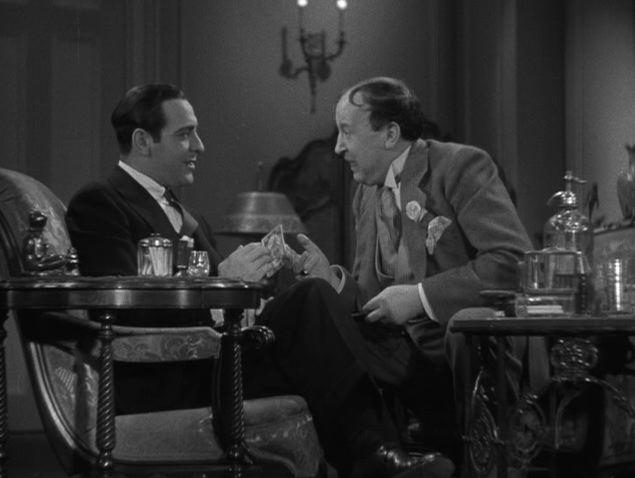
From the Maltese Falcon, 1931: this is not film noir - most of the film is a solid, not too interesting looking reading of the text, stagy, competent, nothing special. (Though very entertaining, because of the power of the text, the excellent cast, and Roy Del Ruth's clean, precise presentation.) But in a couple scenes, things change a bit. Like this one, Spade's interview with Gutman - which moves fast from an insert of the telegram from Gutman to their conversation - which starts in the middle, with alternating medium shots, low angled, full of little details in the front of the screen - the bottle, Gutman's fan, Spade's knee and hand... these alternate, as they talk (the familiar dialogue from the novel that Huston used in 1941 as well):


Only well into the conversation do we get longer shots of the men, though as soon as we do - and the convcersation turns to money - the camera moves in again, framing them even tighter than before:


Then backing off, as the money changes hands...

...and backs off more as Wilmer comes in:

Some of this is repeated, less drastically, in the DA's office - though there Del Ruth starts with an establishing shot, before moving in, to similar obstructed medium shots, with hats, telephones, lamps springing into the frame:


All that - moments of visual flair in an otherwise fairly generic looking film. But the story is noir (Hammett is it's founding angel), and here - the camera inserts itself into the decor, and things lose their natural shapes. Shadows break free from their objects, faces, hands, objects, break off from their proper places, and become looming presences... stylistically, noir grew out of expressionism - passed through horror, as much as any style in America - and melded with the crime movies of the 30s... And along the way, put out feelers, so to speak, those moments when the images start to pulse into menacing being, like here...
Inspired by the Love of Film (Noir) blogathon, also at the Siren's.
Raising money for film preservation... donate!


Only well into the conversation do we get longer shots of the men, though as soon as we do - and the convcersation turns to money - the camera moves in again, framing them even tighter than before:


Then backing off, as the money changes hands...
...and backs off more as Wilmer comes in:

Some of this is repeated, less drastically, in the DA's office - though there Del Ruth starts with an establishing shot, before moving in, to similar obstructed medium shots, with hats, telephones, lamps springing into the frame:


All that - moments of visual flair in an otherwise fairly generic looking film. But the story is noir (Hammett is it's founding angel), and here - the camera inserts itself into the decor, and things lose their natural shapes. Shadows break free from their objects, faces, hands, objects, break off from their proper places, and become looming presences... stylistically, noir grew out of expressionism - passed through horror, as much as any style in America - and melded with the crime movies of the 30s... And along the way, put out feelers, so to speak, those moments when the images start to pulse into menacing being, like here...
Inspired by the Love of Film (Noir) blogathon, also at the Siren's.
Raising money for film preservation... donate!
Saturday, February 12, 2011
Iranian Film Blogathon
I just saw a post about another blogathon - this one, inspired by Jafar Panahi's imprisonment, and a letter written to the Berlin Film Festival - is devoted to Iranian Cinema, and is scheduled for the week of February 21-27. I am very pleased to see this - it seems to me that Iranian cinema has been somewhat neglected in the last decade - in the late 90s, when I was particularly movie mad, Iranian films seemed to be at the center of the world's art cinema. New Kiarostami or Makhmalbaf films were events - though often events one could only read about for a year.... In the 2000s - I'm not sure - but a lot of that excitement seemed to be lost - probably not coincidentally, as Iran's politics took a retrograde turn, culminating in the disaster of the last election, which has led directly to Panahi's incarceration (for example.) Iranian films are (or seem) less talked about now - this blogathon will be a very welcome reminder, I think, of what they achieved. While they seem less talked about in the 00s, I don't know if they have become any less accomplished - not least because of the work of Panahi himself, whose films this decade have been, as far as I am concerned, almost as crucial as those of Kiarostami and Makhmalbaf in the 90s.
I'm under no illusions about the possible effects a bunch of film bloggers talking about Panahi and Iranian films might have on the Iranian government - but it can serve to remind us of what that government is trying to destroy.
I'm under no illusions about the possible effects a bunch of film bloggers talking about Panahi and Iranian films might have on the Iranian government - but it can serve to remind us of what that government is trying to destroy.
Friday, February 11, 2011
Friday Musical Interlude
Again, it is not my intention to ONLY post Friday music notes, but that's what we've got... That should change - there are things going on in the world which should bring some life out of me - a new Film Preservation Blogathon, next week, again hosted by the Self-Styled Siren and Ferdy on Films. It will be, like the first one, a purposeful blogathon, raising money for film preservation - you can donate here.
And, coming next month, we have a blogathon devoted to Korean film, hosted by New Korean Cinema and Cineawsome. This is scheduled for March 7-13 - it should be good... This is closer to the reasons for the lack of posts here, too - last week's Hong Sang-Soo series at the HFA kept me out at night - I am trying to write somethign about it - at the rate I'm going I might make it by next month...
UPDATE: I didn't mean to miss this - there has also been a Michael Mann blogathon going on right now (2/7-14) at Seeti Maar- Diary of a Movie Lover. Worth checking out...
But for now - it's Friday - and that's my musical day, and the only effective bit of discipline I'm able to impose on myself, so here goes, completely randomly:
1. Robert Wyatt - Lullaloop
2. James Brown - Try Me (live)
3. Ramones - Glad to See You Go
4. Modest Mouse - Ohio
5. Better than Ezra - Allison Foley
6. Janelle Monae - Mushroom's and Roses
7. Husker Du - Celebrated Summer (live)
8. Smokey Robinson - Tears of a Clown [iTunes is bering very very kind today...]
9. Pere Ubu - The Fevered Dream of Hernando de Soto
10. Soft Machine - A Certain Kind
Video? since we have 2 entries with Robert Wyatt - here's a third - singing Comfortably Numb, live, with David Gilmour:
And, coming next month, we have a blogathon devoted to Korean film, hosted by New Korean Cinema and Cineawsome. This is scheduled for March 7-13 - it should be good... This is closer to the reasons for the lack of posts here, too - last week's Hong Sang-Soo series at the HFA kept me out at night - I am trying to write somethign about it - at the rate I'm going I might make it by next month...
UPDATE: I didn't mean to miss this - there has also been a Michael Mann blogathon going on right now (2/7-14) at Seeti Maar- Diary of a Movie Lover. Worth checking out...
But for now - it's Friday - and that's my musical day, and the only effective bit of discipline I'm able to impose on myself, so here goes, completely randomly:
1. Robert Wyatt - Lullaloop
2. James Brown - Try Me (live)
3. Ramones - Glad to See You Go
4. Modest Mouse - Ohio
5. Better than Ezra - Allison Foley
6. Janelle Monae - Mushroom's and Roses
7. Husker Du - Celebrated Summer (live)
8. Smokey Robinson - Tears of a Clown [iTunes is bering very very kind today...]
9. Pere Ubu - The Fevered Dream of Hernando de Soto
10. Soft Machine - A Certain Kind
Video? since we have 2 entries with Robert Wyatt - here's a third - singing Comfortably Numb, live, with David Gilmour:
Tuesday, December 14, 2010
December Miscellany
Nothing much important here, but the world is turning around me, and I should put in a word....
The Cliff Lee sweepstakes are over - turns out there really was a "mystery team" - the Phillies! Not that mysterious, I guess. You had to wonder if they were going to step into any of the bidding - they aren't that far off the Boston/New York superteam standard. I will have to work up some baseball thoughts when I have some time - it has been a happy season here in the land of the bean and the cod...
On the film front - I have to get a note up about David Cairns' Late Film Blogathon, ongoing now.
UPDATE: forgot this one - Spielberg blogathon, hosted by Adam Zanzie (Icebox Movies) and Ryan Kelly (Medfly Quarantine.) Running from 12/18-28 - that is, right now!
Coming in January - a Hitchcock Blogathon - a very promising affair.
And? I must leave you - I am still in thrall to the Vampires, for another day or so. After that, the holidays... I hope to get back in here and make up for some of my slackness, but who knows.
For now - Happy Holidays!
The Cliff Lee sweepstakes are over - turns out there really was a "mystery team" - the Phillies! Not that mysterious, I guess. You had to wonder if they were going to step into any of the bidding - they aren't that far off the Boston/New York superteam standard. I will have to work up some baseball thoughts when I have some time - it has been a happy season here in the land of the bean and the cod...
On the film front - I have to get a note up about David Cairns' Late Film Blogathon, ongoing now.
UPDATE: forgot this one - Spielberg blogathon, hosted by Adam Zanzie (Icebox Movies) and Ryan Kelly (Medfly Quarantine.) Running from 12/18-28 - that is, right now!
Coming in January - a Hitchcock Blogathon - a very promising affair.
And? I must leave you - I am still in thrall to the Vampires, for another day or so. After that, the holidays... I hope to get back in here and make up for some of my slackness, but who knows.
For now - Happy Holidays!
Thursday, November 04, 2010
Japanese Film Blogathon, 2010

I don't have any content yet, but I have to post a link to this - the second Japanese Film Blogathon, hosted by Wildgrounds. It's probably no secret that Japanese film is one of my passions - I will have to contribute. And I will certain enjoy the reading.
I could start by answering the questions on this page (there is a poll - go answer, if you wish!):
1) What is your favorite era of Japanese cinema? Up to the end of the 30s? 40s and 50s? 60s? 70s and 80s? 90s and 00s?
If I have to answer - the 50s - the old guard (Mizoguchi, Ozu, Naruse, etc.) were still at the peak of the powers - the post-war generation (Kurosawa, Ichikawa, Kobayashi, etc.) came into their own, and were also at the height of their powers - younger filmmakers got their start (Imamura, Masumura, etc.); you had thriving genre cinema, along with art cinema, all of it - pop and art - capable of creating powerful, exciting work... It's an absolute golden age of film. And from an auteurist point of view - Ozu, Kurosawa and Naruse all produced a body of work in the 50s that will rank with any director's decade ever - Mizoguchi comes off below them only because he only survived half the decade. And Ichikawa's 50s work is not far off the mark.

Now - I imagine, if I were able to see as many films from the 30s as I have the 50s, it could challenge the later decade. Ozu, in the 30s, might have been even more impressive than he was in the 50s; the only other major director I have seen even a fair sampling of from the 30s is Naruse - his early work also holds up very well to the later... So I don't know. I do know - the 60s were a strange time - when pop cinema thrived; when the new wave directors created films as impressive as anyone anywhere - Imamura's 60s films can stand with anyone's, Oshima isn't far behind, and many others - Suzuki, Teshigahara, Shinoda, etc. - did fine work as well. The previous generation - Kurosawa, Ichikawa, etc. - continued to make good films, but started to drop off. Kurosawa dropped out of sight for half the decade - Ichikawa's films started to decline (roughly when Natto Wada stopped collaborating with him)... And - if I remember my history right - the film market collapsed utterly. A collapse that continued in the 70s, and knocked even the art film makers out of action - Imamura disappeared for most of the 70s, Oshima was forced abroad, Kurosawa could barely work.... Since 1980 - I think Japanese film has been revived - certainly, a lot of the old guard started making films again, and good ones; new talent emerged, and so on - but at a much more modest level than the past. Though even now, a number of my absolute favorite contemporary directors are Japanese....

2) What is your favorite genre? Jidai-geki/Chambara? Horror/Monster? Yakuza/gangster? Gendai-geki/shomin-geki? Pinku/roman-porno? Anime?
This is harder to answer - because in general, I am not so much a fan of genres as of films - I certainly like art films, and auteurist films - my favorite genres, you might say, are directors. So - Ozu, Mizoguchi, Naruse, Kurosawa, Ichikawa, Imamura, Oshima, Suzuki, Kurosawa, Miyazaki, Kore-Eda, Miike - working across the full range of genres, almost. Though for poll taking purposes, the answer is always Ozu.

But still - go read - and I hope to come up with something of my own for this... it is a subject very dear to my heart.
Friday, August 06, 2010
Some Blogathon Notes
I haven't kept up my ongoing blogathon page for the last year - partly because it seems to be a trend that has passed. They are few and far between these days. But they still come up, and can provide a good deal of focused reading, as well as new links - so - Ivan G. Shrive's offered up a couple links, that I will more or less shamefully repeat...
There's a John Huston blogathon going on now at Icebox Movies - a blog I don't think I came across before. So this one has borne fruit already! Though like everything on the internet, you usually find out it's been done before - though I don't see any evidence anyone but me knew that blogathon existed.... Huston is a very interesting figure, so there should be plenty to chew on...
UPDATE: Let me add the roundup links, since this is well under way: Day 1... Day 2.... Day 3... Day 4... Day 5....
Ivan also mentions a Summer Movie Blogathon at another blog I'd never heard of, Silents and Talkies. This one takes place on August 16-18.
Finally - also in Ivan's post, though I knew about this one already, Tony Dayoub is hosting a David Cronenberg blogathon the second week of September - 6-12. Cronenberg, I fear, is not quite my cup of tea - though that shouldn't be an impediment to enjoying this blogathon, since part of my problem is that I find him more interesting to read about than watch. So that should work out!
There's a John Huston blogathon going on now at Icebox Movies - a blog I don't think I came across before. So this one has borne fruit already! Though like everything on the internet, you usually find out it's been done before - though I don't see any evidence anyone but me knew that blogathon existed.... Huston is a very interesting figure, so there should be plenty to chew on...
UPDATE: Let me add the roundup links, since this is well under way: Day 1... Day 2.... Day 3... Day 4... Day 5....
Ivan also mentions a Summer Movie Blogathon at another blog I'd never heard of, Silents and Talkies. This one takes place on August 16-18.
Finally - also in Ivan's post, though I knew about this one already, Tony Dayoub is hosting a David Cronenberg blogathon the second week of September - 6-12. Cronenberg, I fear, is not quite my cup of tea - though that shouldn't be an impediment to enjoying this blogathon, since part of my problem is that I find him more interesting to read about than watch. So that should work out!
Saturday, February 13, 2010
Things to Read and things to Argue About
Hello world - rather a lot going on in blogland this week, and coming up next week. The big event, I imagine, is the For the Love of Film: Film Preservation Blogathon - starting Sunday and running all week, hosted by Ferdy on Films and the Self-Styled Siren. It's a blogathon and a blog-a-thon - promising what looks like an overwhelming slate of writing on the subject, as well as providing direct support for the National Film Preservation Foundation. An important and fascinating topic - should be a good week of reading...
Meanwhile - Girish has another discussion of Auteurism at his blog - I'm not sure I can stand it. I can't even bring myself to read through it, to tell the truth. I run into an argument about auteurism every couple years somewhere - 2 years ago at Girish's blog, for instance - I can't muster any enthusiasm for another go... On the other hand, Girish posted an interesting question on Facebook yesterday - a question about the diegetic status of Fontaine's voiceover narration in Bresson's A Man Escaped. Is it diegetic or not? the consensus in the thread seems to be that since Fontaine is a character in the world of the film, his narration would be diegetic, even if displaced from the time of the images. Sounds good - though it strikes me that there could be times when you would want to distinguish between diegetic words, and diegetic sound - that is, between words (or perhaps the thoughts or meanings they express) that issue from within the depicted world - and sounds that, perhaps, do not exist in that world. I suppose the Bresson film is not the best example - but what about Joe Gillis' narration in Sunset Boulevard? the words seem to me to be diegetic enough, coming from a character in the film (even if he is dead as he says them) - but couldn't you say that the speech, the actual sounds of those words, don't exist in the real world of the film? Or other examples - Mark Whitacre's voiceover in The Informant! - or Takeshi Kinoshiro's character's words in Fallen Angels. Whitacre's voiceover is presented as his stream of consciousness, but the sounds - the spoken words - do not have the same reality that the dialogue has; Kinoshiro plays a mute - the words are, again, in his head (more narration after the fact - time and memory being a central theme in Wong Kar-wei's work), but never spoken - the words express diegetic thoughts, but the sounds of the words are not real in the fictional world. I'm not sure if diegetic/non-diegetic is the right distinction to make on this - but I think it is important to pay attention to the materiality of the sounds in a film, or the precise form words are given. Filmmakers play with these things, use them - think of how much Soderbergh gets out of the ways the voices in Whitacre's head interact with the words spoken in the film... This question threatens to keep expanding - like, what can you do with the different conventions for presenting a letter in a film? the paper and text on screen; the reader's voice reading (literally, or as voiceover); the writer's voice, the various tricks, like showing the writer writing and saying the words out loud... There's a lot there.
And one more bit of blog business - an interesting discussion springing up at Wonders in the Dark - Sam Juliano ponders the importance of professional criticism, and its relationship with amateur criticism - on the internet, particularly. The proximate cause was this post - a Why I Don't Like Citizen Kane essay by Stephen Russell-Gebbett. Both posts have garnered millions of comments, which makes adding anything to the fray pretty foolish... But, having read the two essays fairly carefully (and skimmed the comments), I can't help adding a word or two hundred.
First - it's a strange piece for Juliano to hang his complaint on - whether Mr. Russell-Gebbett is a professional or not, his post is a fairly serious attempt to make a case against Citizen Kane. The idea, the reasons, could well have been written by a professional - the prose even seems to be competent, careful, etc. - it rather undermines Juliano's point. As does the fact that Russell-Gebbett never says anything that would pass as an attack on professional criticism. He doesn't claim to be taking on the critical establishment, doesn't claim that he's as good as anyone else and just as entitled to his opinion, or any of the other myriad ways bloggers avoid accountability when these arguments crop up. (Maybe there's something like that in comments - I didn't see any in my scan of the comments, but maybe there's something there.) I'm not sure why Juliano attaches that particular set of arguments to Russell-Gebbett's post. (If anything, Juliano indulges in the professional's version of the duck and weave - appeals to authority, deference to authority - the critic's way of avoiding accountability.)
Second - one of the problems in debates like this is that the arguments tends to congeal around the question of whether professionalism makes you a better writer or critic - it doesn't. There is no reason why amateurs can't match professionals at this game, especially in blog sized posts. (And no lack of evidence that amateurs do just that.) It is true that professionals, on balance, are better writers and critics than amateurs - not because professionalism conveys authority so much as that ability tends to get people to be willing to pay you...
Which brings me to a third point, and one I don't see being made that much in this argument. What actually makes you a professional is not a paycheck, but an editor. And particularly, a professional editor. Professionalism is more a matter of credentials than anything else. For academics, the credentialing is explicit - you have to earn a degree, by proving to credentialed experts that you have mastered the field. It's not so defined for writing, but it really does amount to proving to someone that your work deserves to be published under their name. It's the editors that make the professional writer. And in practical terms, for telling the difference between professional and amateur writing online say - that's true for both senses of "editor" - editor as selector of the best work; editor in terms of crossing the t's and dotting the i's and making sure you don't use "barnstorm" when you mean "firestorm." (Not to pick on Mr. Juliano, but...) Professionalism, and whatever authority it conveys, depends on the matrix of professionals vouching for one another - a critics' value is determined by their being accepted and cited by other critics, and by knowledgeable readers.
That, I suppose, brings us around to the facts on the internet. The technology is changing: much of the discourse of professionalism is tied very closely to the technological fact of text being distributed through ink on paper. But text now is distributed almost as much through bits on screens as ink on paper, and the costs and labor and material involved is so different as to be impossible to compare. 20 years ago, if I wanted to play media critic, I might have printed this out and handed it around to my friends; 30 years ago I would have had to type it up and then xerox or mimeograph it. Now, I type it in blogger, hit publish and 20 or 30 people end up reading it before the day it out! a brave new world! But it is - the means of publication changes the dynamic between writer and editor - makes it possible for anyone to be their own editor, basically.
That, however, does not make all writing equal - what it does is create a problem - when anyone can publish more or less at will - how do we credential one another? One way, obviously, is through sites like The House Next Door - edited websites, that can vouch for the ability of the writers there. But they also provide a lot of links to blogs and sites that aren't professional in any meaningful sense - and provide a kind of endorsement of them, as well. But that's a different kind of endorsement, and implies a different kind of relationship among writers, readers, editors and the like. The internet does undo the hierarchical model of credentialing that editors provide - but that doesn't make all writing and criticism equal. Good writing is still good writing; good criticism is still good criticism. (And professionalism is no guarantee of good criticism - has everyone forgotten the Tom O'Neill's Sunrise article? He's a pro...) What I think it means is that "credentialing" becomes less formalized - it becomes a function of links, from people you trust to other people you trust - from good critics to other good critics, or maybe more precisely, from good readers to good writers...
I think there is too much attention paid to the internet as a means of publication, as an outlet for writers, and not enough to the ways the internet creates a network of readers - who then report on their reading to one another. I think this is a responsibility we need to pay more attention to - we need to be better readers, and to act as readers who can recommend strong (interesting, knowledgeable, creative, what have you) writing. I think perhaps people reading and writing on the internet need to pay more attention to the way that we are becoming collective editors. I don't know what will become of journalistic criticism, in its current form - I don't know if it will last very long. I think in fact, blogs and whatever sites carry on this kind of writing, might well absorb most of the functions of that kind of criticism. Indeed have - blogs now are as good a read as most professional reviewers, and often approach the quality of good film journals - though you have to wade through a lot more second rate stuff to find the good stuff. Not to mention the way blogs and Facebook and the like blend more or less serious film writing with all manner or fluff and all kinds of other writing... though for me, that very mixture of discourses is a feature of the medium, not a bug. It's one of the main attractions...
I better stop, before I start thinking about the future of academic criticism, and film books... cause that's a whole other set of questions, isn't it...
Meanwhile - Girish has another discussion of Auteurism at his blog - I'm not sure I can stand it. I can't even bring myself to read through it, to tell the truth. I run into an argument about auteurism every couple years somewhere - 2 years ago at Girish's blog, for instance - I can't muster any enthusiasm for another go... On the other hand, Girish posted an interesting question on Facebook yesterday - a question about the diegetic status of Fontaine's voiceover narration in Bresson's A Man Escaped. Is it diegetic or not? the consensus in the thread seems to be that since Fontaine is a character in the world of the film, his narration would be diegetic, even if displaced from the time of the images. Sounds good - though it strikes me that there could be times when you would want to distinguish between diegetic words, and diegetic sound - that is, between words (or perhaps the thoughts or meanings they express) that issue from within the depicted world - and sounds that, perhaps, do not exist in that world. I suppose the Bresson film is not the best example - but what about Joe Gillis' narration in Sunset Boulevard? the words seem to me to be diegetic enough, coming from a character in the film (even if he is dead as he says them) - but couldn't you say that the speech, the actual sounds of those words, don't exist in the real world of the film? Or other examples - Mark Whitacre's voiceover in The Informant! - or Takeshi Kinoshiro's character's words in Fallen Angels. Whitacre's voiceover is presented as his stream of consciousness, but the sounds - the spoken words - do not have the same reality that the dialogue has; Kinoshiro plays a mute - the words are, again, in his head (more narration after the fact - time and memory being a central theme in Wong Kar-wei's work), but never spoken - the words express diegetic thoughts, but the sounds of the words are not real in the fictional world. I'm not sure if diegetic/non-diegetic is the right distinction to make on this - but I think it is important to pay attention to the materiality of the sounds in a film, or the precise form words are given. Filmmakers play with these things, use them - think of how much Soderbergh gets out of the ways the voices in Whitacre's head interact with the words spoken in the film... This question threatens to keep expanding - like, what can you do with the different conventions for presenting a letter in a film? the paper and text on screen; the reader's voice reading (literally, or as voiceover); the writer's voice, the various tricks, like showing the writer writing and saying the words out loud... There's a lot there.
And one more bit of blog business - an interesting discussion springing up at Wonders in the Dark - Sam Juliano ponders the importance of professional criticism, and its relationship with amateur criticism - on the internet, particularly. The proximate cause was this post - a Why I Don't Like Citizen Kane essay by Stephen Russell-Gebbett. Both posts have garnered millions of comments, which makes adding anything to the fray pretty foolish... But, having read the two essays fairly carefully (and skimmed the comments), I can't help adding a word or two hundred.
First - it's a strange piece for Juliano to hang his complaint on - whether Mr. Russell-Gebbett is a professional or not, his post is a fairly serious attempt to make a case against Citizen Kane. The idea, the reasons, could well have been written by a professional - the prose even seems to be competent, careful, etc. - it rather undermines Juliano's point. As does the fact that Russell-Gebbett never says anything that would pass as an attack on professional criticism. He doesn't claim to be taking on the critical establishment, doesn't claim that he's as good as anyone else and just as entitled to his opinion, or any of the other myriad ways bloggers avoid accountability when these arguments crop up. (Maybe there's something like that in comments - I didn't see any in my scan of the comments, but maybe there's something there.) I'm not sure why Juliano attaches that particular set of arguments to Russell-Gebbett's post. (If anything, Juliano indulges in the professional's version of the duck and weave - appeals to authority, deference to authority - the critic's way of avoiding accountability.)
Second - one of the problems in debates like this is that the arguments tends to congeal around the question of whether professionalism makes you a better writer or critic - it doesn't. There is no reason why amateurs can't match professionals at this game, especially in blog sized posts. (And no lack of evidence that amateurs do just that.) It is true that professionals, on balance, are better writers and critics than amateurs - not because professionalism conveys authority so much as that ability tends to get people to be willing to pay you...
Which brings me to a third point, and one I don't see being made that much in this argument. What actually makes you a professional is not a paycheck, but an editor. And particularly, a professional editor. Professionalism is more a matter of credentials than anything else. For academics, the credentialing is explicit - you have to earn a degree, by proving to credentialed experts that you have mastered the field. It's not so defined for writing, but it really does amount to proving to someone that your work deserves to be published under their name. It's the editors that make the professional writer. And in practical terms, for telling the difference between professional and amateur writing online say - that's true for both senses of "editor" - editor as selector of the best work; editor in terms of crossing the t's and dotting the i's and making sure you don't use "barnstorm" when you mean "firestorm." (Not to pick on Mr. Juliano, but...) Professionalism, and whatever authority it conveys, depends on the matrix of professionals vouching for one another - a critics' value is determined by their being accepted and cited by other critics, and by knowledgeable readers.
That, I suppose, brings us around to the facts on the internet. The technology is changing: much of the discourse of professionalism is tied very closely to the technological fact of text being distributed through ink on paper. But text now is distributed almost as much through bits on screens as ink on paper, and the costs and labor and material involved is so different as to be impossible to compare. 20 years ago, if I wanted to play media critic, I might have printed this out and handed it around to my friends; 30 years ago I would have had to type it up and then xerox or mimeograph it. Now, I type it in blogger, hit publish and 20 or 30 people end up reading it before the day it out! a brave new world! But it is - the means of publication changes the dynamic between writer and editor - makes it possible for anyone to be their own editor, basically.
That, however, does not make all writing equal - what it does is create a problem - when anyone can publish more or less at will - how do we credential one another? One way, obviously, is through sites like The House Next Door - edited websites, that can vouch for the ability of the writers there. But they also provide a lot of links to blogs and sites that aren't professional in any meaningful sense - and provide a kind of endorsement of them, as well. But that's a different kind of endorsement, and implies a different kind of relationship among writers, readers, editors and the like. The internet does undo the hierarchical model of credentialing that editors provide - but that doesn't make all writing and criticism equal. Good writing is still good writing; good criticism is still good criticism. (And professionalism is no guarantee of good criticism - has everyone forgotten the Tom O'Neill's Sunrise article? He's a pro...) What I think it means is that "credentialing" becomes less formalized - it becomes a function of links, from people you trust to other people you trust - from good critics to other good critics, or maybe more precisely, from good readers to good writers...
I think there is too much attention paid to the internet as a means of publication, as an outlet for writers, and not enough to the ways the internet creates a network of readers - who then report on their reading to one another. I think this is a responsibility we need to pay more attention to - we need to be better readers, and to act as readers who can recommend strong (interesting, knowledgeable, creative, what have you) writing. I think perhaps people reading and writing on the internet need to pay more attention to the way that we are becoming collective editors. I don't know what will become of journalistic criticism, in its current form - I don't know if it will last very long. I think in fact, blogs and whatever sites carry on this kind of writing, might well absorb most of the functions of that kind of criticism. Indeed have - blogs now are as good a read as most professional reviewers, and often approach the quality of good film journals - though you have to wade through a lot more second rate stuff to find the good stuff. Not to mention the way blogs and Facebook and the like blend more or less serious film writing with all manner or fluff and all kinds of other writing... though for me, that very mixture of discourses is a feature of the medium, not a bug. It's one of the main attractions...
I better stop, before I start thinking about the future of academic criticism, and film books... cause that's a whole other set of questions, isn't it...
Sunday, November 29, 2009
Post Holiday Catchup
Well, Thanksgiving is beyond us, the "Holiday Season" has descended, the work week beckons, and I am home and - um - have a whole mess of homework for class... But I have to put something here... at least a few links, if nothing else.
First - I have been remiss in not linking to Frankensteinia's Boris Karloff Blogathon - I've been worse than that - I haven't even been reading it. He should have had the decency not to be born the week of Thanksgiving - how could he? But blogathons may end, but the internet never ends, and there is plenty there and at all the links to read...
And - a new quiz from Dennis Cozzalio - I promise to respond sometime this week.
The end of the decade lists are starting to appear - I will let Girish's post on the Cinematheque Ontario list stand for them all for now.
And? Long time internet acquaintance Evan Waters has a short radio play airing here - it should be archived for 2 weeks...
Finally? In honor of last week's concert - how about a blurry picture of the Feelies, tuning up?

First - I have been remiss in not linking to Frankensteinia's Boris Karloff Blogathon - I've been worse than that - I haven't even been reading it. He should have had the decency not to be born the week of Thanksgiving - how could he? But blogathons may end, but the internet never ends, and there is plenty there and at all the links to read...
And - a new quiz from Dennis Cozzalio - I promise to respond sometime this week.
The end of the decade lists are starting to appear - I will let Girish's post on the Cinematheque Ontario list stand for them all for now.
And? Long time internet acquaintance Evan Waters has a short radio play airing here - it should be archived for 2 weeks...
Finally? In honor of last week's concert - how about a blurry picture of the Feelies, tuning up?

Subscribe to:
Posts (Atom)