Showing posts with label Godard. Show all posts

Tuesday, September 13, 2022

Jean-Luc Godard

Jean-Luc Godard has died. That generation has been going - is he the last one left? It is getting close. He was one of the big ones - for me, he is close to the most important film maker of all time. For me, he is close to the best film maker of all time - though no one could pass Ozu. But importance? You can make a case for some of the filmmakers in the silent era - Griffith, Murnau, Lang, Eisenstein, Chaplin - they made the form. But after that? He was a public figure as well as a filmmaker, and he set the agenda for art films for the last 60 years. Sometimes, he did this as much as a figure to define cinema against as what cinema was - but he was still there, at the center of it, making films, talking about films, demanding viewers and readers respond to films.


I responded to his films. He was one of my introductions to art films - back in the 80s, I saw Aphaville, and was caught. It was mind-blowing - beautiful, strange, funny - and for all its difficulty, and his reputation for difficulty, readily accessible. I saw Breathless not too much later and enjoyed it just as much. His 60s films, at least, are usually like this - there is plenty to hang on to as you work through their intricacies. They are still among the most enjoyable films of all time. Alphaville, Breathless, Pierrot le Fou, Vivre Sa Vie, Week End, Contempt - all rich, gorgeous works, entertaining, challenging, inventive, everything. His later films, admittedly, are harder sledding - but they are still gorgeous, and the more recent ones, leaning into the collagist aesthetic he has always embraced, are quite enjoyable as well, in their somewhat more specialized way. 


So - he was instrumental in forming my taste in films, in defining what I thought film could do. I may have been predisposed to artsy films, but he gave me art films that I could sink my teeth into. He made films that remain completely satisfying, at every level, that deepen every time I watch one of them. He was one of the greatest of them all - for me, it's Godard and Ozu at the top, no mistakes. I will miss him. That generation - the New Waves, French, English, Japanese and so on - are almost all gone. And Godard was the center of that generation, and now he is gone. 

Farewell.


Wednesday, October 05, 2016

Alphaville

(Cross posted from Wonders in the Dark.)


Alphaville is the first Godard film I ever saw, way back in the mid-80s. I saw it on a double bill with Alexander Nevsky, if my memory is accurate after 30 odd years. I remember liking Nevsky, though finding it all a bit strange; but Alphaville was a revelation. I had ideas about what Godard was supposed to be like - he was supposed to be difficult, possibly blasphemous (this is back around the time of Hail Mary - which I think was the second Godard film I ever saw, and came a bit closer to what I had been led to expect.) Instead, I saw this astonishing science fiction noir...


It is a beautiful film, with its rich play of light and dark, its bodies in rest and motion in overlit antiseptic spaces and dingy dark hallways, its faces, its eyes, especially Anna Karina's face and eyes. It's an overpoweringly romantic film - I walked out enthralled by Eluard and the staging of his poetry, Anna Karina’s voice, the light and dark, hands and faces, the strange contrast between Karina and Eddie Constantine - that sequence is, by itself, one of the most romantic, achingly sensual, passages ever put on film. I had never seen anything like it then, and haven't seen much like it since. But what might have been even more surprising was how funny the film is. Full of jokes, full of wit, visual, verbal, jokes coming out of the material, the references, the performances, staging, the setting. (That machine that asks you to insert a coin, then gives you a thank you token.) It's always serious, but never takes itself seriously - a pretty universal trait in Godard’s films. They are funny - they are full of serious things, conversations, ideas, images - but they are packed with jokes, visual and verbal puns, in jokes, references and allusions that become comical in context. (And it gets even funnier when you start spotting the things Monty Python stole - it's tattooed on the back of their neck!) It was a fine introduction to Godard - it conditioned me to look for beauty, romanticism, sensuality and wit, as well as Deep Thoughts and Art. (Which it has; don't discount that.)


And even more - it worked quite well, when I saw it the first time, as straight up science fiction. It holds up as science fiction now, both as pop fiction and for its ideas. It's ideas are legit, it’s image of the future: artificial intelligence, technology and technocracy, its particular brand of dystopia - a cool vicious embrace of science and logic, a technocratic tyranny, power diffused and de-personalized, a cruel, violent regime uncluttered by charismatic monsters. Dr. Von Braun is a cold dead eyed technocratic sadist, surrounded by dull technicians who follow him around like nervous interns. The only villain with any personality is Alpha 60 itself, a thing of rhythmic flashing lights, slide shows, and a mechanical voice. People have become zombies in this world, responding automatically - "Yes, I'm fine, don't mention it" - to any conversation; clapping politely at executions - their responses as automated as machines. Against this comes Lemmy Caution violent cool in a trench coat, cigarettes, and 45 automatic, crashing through this world with passion, emotion and art. This might be Godard's most Romantic film, too - in the sense of Romanticism as the embrace of passion, art and beauty, emotion and disorder against logic, order, science. Lemmy comes bearing pop culture props and poetry and represents the artist very well. He represents Godard very well - this is his quintessential mixture - pop culture and high art, science fiction tropes (high and low science fiction), plus noir, plus comics, plus high art, Eluard and Celine, and Cinema, always cinema - and maybe some general semantics to boot. All of it is fed in, all of it is taken seriously, and all of it is material for jokes. Nothing is allowed to settle in Godard's films - and it's that settling, that insistence on control, predictability, order, that Godard (and Lemmy) object to under the rule of Alpha 60.


Though in fact even the computer is more complicated that that. It is commanding and charismatic, in its way - almost Romantic, in a strange sense. A Satanic figure, undone by the hero - but compelling in itself. Satanic in Mick Jagger's sense, which itself is a Romantic notion of the devil - Satanic like Lucifer, bringer of light, trying to take the place of god, to rule all creation - not a bad description of Alpha 60.


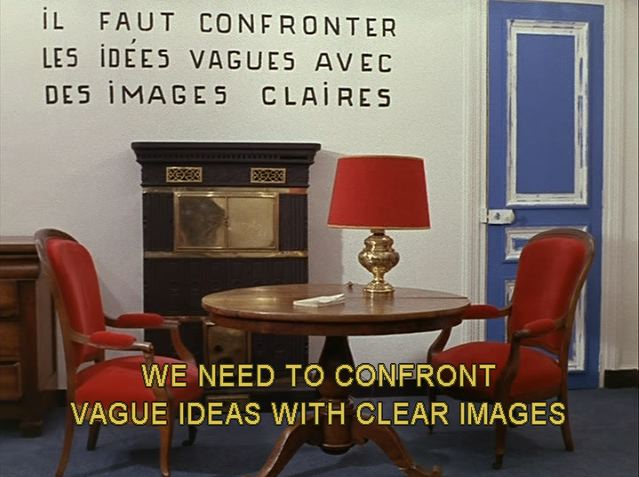
And yet it’s a very ordinary monster, that computer - represented by just what you see there - lights, wires, boxes; sometimes by fans, or a simple flashing light, and always by a disembodied, mechanical, voice. This is another extraordinary quality of Alphaville - it is a very convincing science fiction film made up entirely of things in the real, contemporary (1965), world. It is probably the epitome of the type of film I referred to writing about Face of Another, films that shoot the real world to look and feel like science fiction. Alphaville is shot on the streets of Paris, in the buildings of Paris - but the glass and steel Paris, the modern Paris, of lights and machines and clean, modernist design. It looks other-worldly.


Godard constructs a futuristic world from this. Streets and cars and most of the actual technology are all contemporary, though shot and combined to look alien. Godard treats the world as it is like a science fiction place: flying in from New York (6000 miles away), becomes intergalactic travel. Only the computers are not part of the everyday world - but they are perfectly normal contemporary (1965) machines. Rooms full of banks of processors, wires, with keyboards and switches and card slots and flashing lights. You don’t see a lot of computers from 1965 - though it's interesting to consider that the back rooms where the real computing lives aren't that commonly seen now. We see the desktops and laptops and screens, keyboards and mice, the phones and tablets and all the other things people use - everything that interfaces with humanity. But even now, we don’t see the back rooms, where the infrastructure lives. Even now, it seems a bit alien when you see it (in Werner Herzog’s new internet film, say) - and not much different from what it looked like in 1965. Routers and processors and disk arrays and wires haven’t changed that much.


Though Godard does imagine the interface with humanity, though this didn't exist so much in 1965. It's an odd mix of analog and digital - invisible technology, disembodied voices, pervasive surveillance, microwave ovens - all made of sound and light. He warps it out of the real world, combining things in strange ways, showing pieces of the world, showing a world of sound and light, reflections and window panes, that subtly distort the world. Inside and outside, up and down, intermingle - it's an odd, translucent world, up on the surface....


And when the chance comes to use cinema to transform the world, he’s ready:


And so it is. A beautiful film, funny, fairly exciting, as adventure yarn (at least containing action scenes, half joke and half real excitement), imagining a dystopic future and what might be done about it, arguing what we have to protect - art, love, words - without quite (quite) disavowing what we could get from technology. And at times, almost exploding from sheer passion, desire and loss. Alphaville, the Capital of Pain, indeed...

Friday, May 01, 2015

Walpurgisnacht & May Day

Happy May Day, ladies and gentlemen! It is a happy May day, this year - we have an actualy sort-of socialist to vote for! Bernie Sanders, senator from Vermont, is running for president, as a Democrat. Now - I don't have any illusions that he is going to win - though I don't know how much that matters. If he's there to keep bringing up economic matters, it can't hurt. And it's nice to have someone to vote for in the primaries that I can vote for without reservation. I am no fan of Hillary Clinton - she and Bill have always come off as trimmers, willing to give up anything for an inch of advantage for themselves - it's hard to imagine her holding the line on as much as Obama has been able to keep from the GOP. But in the end, that doesn't matter in the least - in the general election I will vote for a Democrat, the nominated Democrat, even if it's Martin O'Malley. Parties matter infinitely more than the candidate, especially in these days - with an extremely partisan political climate, and one party openly pursuing class and often race warfare. Not that I'm ever tempted to vote for Republicans, but now, it is imperative that people vote for Democrats, until the Republicans are broken, and change their positions.

That's a topic for another day, I suppose. Today - I'm just happy there's a candidate for president whose politics make sense to me. And is a Vermonter! Go Bernie!

Now - for music - my Russian culture class is into the 20th century, and this week talked about Mikhail Bulgakov and Master and Margarita, and thus I am thinking more of Walpurgisnacht than May Day proper. And so, in honor of professor Woland and co. (and the fact that the book managed to make it into the mainstream of international pop culture within a year of its eventual publication) - here is a top 10 songs about the devil:

1. Rolling Stones - Sympathy for the Devil
2. Beck - Devil's Haircut
3. Robert Johnson - Me and the Devil Blues
4. Van Halen - Running with the Devil
5. James Blood Ullmer - Devil's Got to Burn
6. Throwing Muses - Devil's Roof
7. Brian Jonestown Massacre - The Devil May Care (Mom & Dad Don't)
8. Nick Cave - Up Jumped the Devil
9. Grateful Dead - Friend of the Devil
10. Modest Mouse - This Devil's Workday

And video? well - here's footage of the Stones working it out. With a camera rolling around the studio maned by mad Frenchmen, I imagine.


And I suppose any Walpurgisnacht tribute needs the Sabs:


And finally - we need some witches for Witch Night, so here's some live Eagles for you. I'm sure there's a great clamor for live Eagles from my readers...

Sunday, January 15, 2012

Sunday Shopping Report


This was a surprise - I found a copy of Godard's Histoire(s) du Cinema on the shelves at Newbury Comics! I knew it was being released, but can't say I expected to find a copy in a local store....


It'll keep me busy a while - 7 hours long and all - but that's not a problem.

I also found this one -


- the new Criterion edition of Tokyo Drifter. But that's what I went in looking for...

Sunday, December 04, 2011

Happy Birthday, JLG!

A day late, as it happens, but it suits our purposes. And next week - Week End starts a full week's run at the Brattle! Hurrah!

I shall celebrate with a nice cup of coffee, maybe a beer...


Tuesday, July 20, 2010

What Amazon has Brought Me

Just dropping by, this post, for a bit of celebration -


a very welcome delivery in the mail -


the more or less brand new Ozu double box, The Only Son -


and There was a Father -


plus Vivre Sa Vie, which has been out awhile, but I finally bought it....


It's a great moment. The Godard is one of my all time favorites


tending to alternate with PIerrot le Fou as my favorite Godard...


The Ozus are masterworks that have been nigh on impossible to see -


but thrilling, in their quintessential


and unquintessential


Ozuness...


it is a bounteous day.

Wednesday, July 14, 2010

Bastille Day Avec JLG

Happy Bastille Day, France!


It's been a very Godard week for me. I saw the rereleased Breathless over the weekend, watched the 2 or 3 Things I know About Her DVD (mainly to listen to the commentary, this time), dug around the extras on both those DVDs... Had a very Godard-like train ride the other day. It helped that I was reading CinemaScope's Film Socialisme article - but... there was a woman sitting near me, studying flashcards - "Working Capital and its components" the top one read. Across from me, advertisements - one a car ad, with a woman standing in the poster, beside a stack of cars, all different colors and makes. The other - I don't know what it was for - it looked like some kind of art - light blue with white, like clouds, swirls, faces (that looked like the designs in the pull quotes in the CinemaScope article.) There was a tall woman standing in front of me - staring out the window - then turning, and staring past my ear for a moment or two... and the people on the train, all lined up, all blank... and one woman, halfway down the car, who looked from a distance like Marina Vlady. And after this, toward the end of the ride, another woman, in a crowd, holding the bar - all I could see of her was one arm, reaching up to hold the support - she had, tattooed in beautiful script on her arm, a quote from W.E.B. DuBois (it turns out): "I sit with Shakespeare and he winces not."


It's all - something. There's that sense of gratification and wonder you get when you see something through someone else's eyes - to see yourself in a Godard film, in Godard's world... but here - to remember that it's not a particularly pleasant world he's describing. A world of commerce, capital (and its components), the dreary deadening routine of 9 to 5 work, chopped up constricted time, the colonization of the imagination by a language of commerce, authority, conformity - can't deny those things. Though too - can't deny the thrill of higher things - a great bit of language (whatever it means to see it turned into a bit of body art) - or the excitement of anticipating a new Godard film - or the brilliance and beauty of the old Godard films. Or - the realization just how well Godard encapsulated the world, described it, recreated it. Those 60s films saw the future, and the future they describe is closer to the truth than most.


So - there's more to France than Godard, but there's no question, Godard has done the country proud, and there are many worse ways to celebrate the French than by watching a Godard film or two.

Saturday, April 11, 2009

Breathless

This is my second contribution to Joseph B's New Wave blogathon - or, since the two started out together, but both got a bit out of hand - part 2 of the first... Anyway - turn our attention to one film... The 400 Blows may be the founding film of the new wave, but for me, the definitive film remains, Breathless. It's the one, the early example, that sets the parameters for the new wave as it developed. It's all there - the jump cuts, the loose style, the movie madness, the appropriation of genres, the natural locations (shooting in the street, often enough), the seedy glamor - all there. And it establishes one of the key elements of these films - their mixed modes of discourse (to get nerdy about it.) In a number of ways - in the sense of appropriating genres and styles (the crime film); in the ways it incorporates other texts and images (newspapers, comics, films, ads, street signs, you name it); in the way it shifts registers - direct addresses to the camera, people stepping out of character, the in jokes, quotes of all sorts... This is a pretty significant change from most previous films: these films, especially Godard, but you get it from quite a bit of the new wave, do not present a unified "discourse" - what you see and hear does not all come from inside the fiction, or have the same relationship to the fiction. These films tell their stories - don't just show them. They keep the forms, the act of telling, of shaping the film, in view. And they don't pretend they are just telling a story that existed somewhere, sometime - their stories come from other texts, they are - the fictions, I mean - performances themselves - they are not to be taken as the real world...

All of which is there from the beginning:


This remains as audacious a film as I have ever seen - it's still more challenging and strange than most of its descendants. That blend of experimentation, art film, genre film, its loose humor, the whole breeziness of the story and style - and its pretty convincing melancholy - still holds up. Because it is beautiful - look at the light and space and smoke in this shot:


And - well - underrated as a straight fiction. Godard can tell a story - can get characters on screen - quick, without conventional detailing, but a shot like this, the first meeting between Michel and Patricia, packs so much of the film's style into it, a style that does sketch these people... Here they are - on the street - back tot he camera (they are indifferent to it, though they never seem to forget it) - moving, as always, the camera moving - glamorous, cool, and a bit shabby...


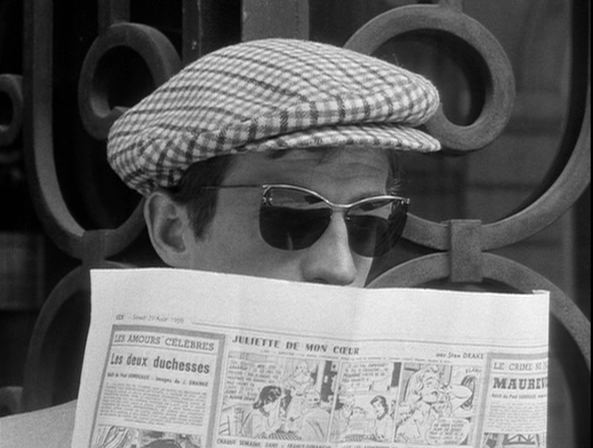
Finally - since I am eye-deep in Fritz Lang at the moment, it's hard to miss the parallels - not just the imagery, but the themes. Advertisements - newspapers - messages - cityscapes - Breathless is most assuredly a picture of its time, as well. And Godard seems to be aiming for the same deliberate blend of art film and popular film that Lang went for. He never quite masters making popular films in a popular style - but he never leaves the genres and forms behind either. And, like Lang never forgets the importance of information...

Throw in all the references - to Lang himself with his eyepatch and monocle:


Characters framed in shop windows:


Irises:


Ads:


Working class detectives:


And always, the city as media: