Showing posts with label WWII. Show all posts

Sunday, December 22, 2024

Battle of the Bulge 80 Years On

One of the casualties of my neglect for blogging in the last 7 or 8 years is my history posts. I was quite committed to my Civil War commemorations; I managed to keep up the appearance through the WWI anniversaries - but never tried anyhting like that with WWII. Granted, WWII didn't have as good an anniversary to base posts on as the 150 and 100 for those other wars - but 80 would have worked. I did some 70 and 75 year anniversaries. If I hadn't given up on writing, I might have tried it.

But here it is, December 2024, 80 years since the Battle of the Bulge - and I figure I should give it a shot again. The battle itself began on December 16, 1944, and lasted through the end of January. The Germans launched a surprise attack on American lines in the Ardennes forest of Luxembourg and Belgium, hoping to punch through this poorly defended area, get into the Americans' rear, drive to Antwerp and cause the US and UK to either abandon one another or abandon the USSR. It was complete folly, but Hitler was well gone by that time, and didn't put up much resistance to his pipe dreams. The end of 1944 was an interesting time in the war - the Allies had basically had their way all summer, once they broke out of Normandy; but things were starting to go sour in the fall. Operation Market Garden, an ambitious and misguided attempt to cross the Rhine in the Netherlands with a massive parachute drop, went very wrong; fighting on the borders, the Battle of Aachen, or in the Hurtgen Forest or the Vosges mountains, bogged down significantly. Punching into Germany was not going to be easy. While the allies prepared for the next stage of fighting, they left the Ardennes somewhat under defended. Divisions mangled in the Hurgen forest, or brand new on the front, were there, resting, training, waiting. They did not expect trouble in the Ardennes, a mountainous, wooded area full of river valleys and bad roads, very difficult for armies to move through. Which is why that is where the Germans attacked in 1914 and 1940, and now again in 1944.

When the attack came, it was a complete surprise. The German forces shattered the American fron lines - thin and patchy as they were - and threatened to get out fo the woods and out where they could cause trouble. But the Americans fought desperately to save the situation. They defended every post card village and miserable crossroads with all they could find. Their leaders, Ike and company, reacted far faster than Hitler imagined, immediately ordering reinforcements into the area, ordering Patton to utrn north and cut thins thing off. The Germans still punched deep into Belgium - but it took longer than they hoped, and they never did break through in the north, where they were expecting to make a big breakthrough. They got stuck for days trying to take crossroad towns like St Vith; they never did manage to take another town, Bastogne. Panzer divisions drove past, leaving these places isolated in their rear - but doing that, with Americans still parked on the best roads, meant they couldn't get a strong enough force forward, and more importantly than that, they couldn't get supplies forward - they couldn't get gasoline forward. They ran out of gas; the allies counterattacked an drove them back, often in long drawn out slogs through woods and hills - the kind of thing that made the Hurtgen forest such a nightmare.

But in the end - it's hard to say whether this battle delayed the end of the war or accelerated it. A lot of Germans died, a lot of equipment was ruined, the luftwaffe was pretty much crippled after trying a massive surprise attack on January 1, 1945. They did not have the resources for any of this stuff. It they had dug in and fought it out 0on the borders the whole time, they may have dragged things out a lot longer. Or, if they had held the west with the least they could manage, and done everythign they could to hold off the Soviets in the east - they might have extended the war a while. Even more people may have died. But the results weren't going to change. So it's hard to say there was any point to any of it, other than dying in Belgium instead of Germany.

On the other hand - the Battle of the Bulge made a hell of a story. It was a fascinating, dramatic battle. The fighting in the fall of 1944 was ugly stuff: grinding through dense woods, one German emplacement at a time - it was getting back to the meat grinder horrors of WWI. But the bulge was mobile, complicated, with forces scattered all over the map, desperate fighting for towns and crossroads and lonely hills, without a lot of contact with anyone else. Fights for Clerveau, St Vith, the Elsenborn Ridge, Wiltz, Bastogne, places like Hotton and Marche and Stavelot all happened on their own, the men attacking or holding cut off from the rest of the battle. This, I imagine, is mostly a function of the terrain - narrow roads through heavy woods, so that fights were concentrated on the towns, the open places, the river crossings and so on. It made for fantastic stories.

The fight for Bastogne gets most of the attention - got the press at the time, got one of the great World War II movies, in Battleground. It was a good story - a crucial position, surrounded, held by a famous elite unit (the 101st Airborne), in a well known town - there were spectacular air drops and a daring rescue mission by Patton's tanks. And it produced one of the definitive quotes of the war - "Nuts!" -  Anthony McAuliffe's answer to demands from the Germans to surrender. And there is the fact that it held - that the Americans won the fight, tactically as well as strategically. It was a perfect focal point for talking about the Battle of the Bulge.

But it was not the only crucial fight in the battle. Other towns, especially St Vith, another major road hub, saw equally desperate fighting north of Bastogne. St Vith fell, in the end - but the battle there held up the Germans for days, blocked the roads west for days, and was almost as important in disrupting the overall attack as Bastogne. Many other towns and villages - Clerveaux, Hotton, the twin villages of Rocherath and Krinkelt, saw desperate stands of their own, that held up the Germans, bought time, even when they did not hold. And the last of those - Rocherath-Krinkelt was part of what was, in the end, probably the most important fight in the Battle fo the Bulge - the decisive moment, the battle of Elsenborn Ridge. This was the very northern edge fo the battle - this is where the Germans expected to break through most decisively, with their best divisions, their best equipment, the works. And here, the 99th and 2nd infantry divisions held. They held out for days in places like Rocherath and Krinkelt, before falling back to a solid defensive position on the ridge itself. (Joined there by several other divisions.) And this line held. Some of the Germans got past them, and made trouble to their west - but they were isolated. The main line held, and the Germans finally had to shunt their tanks south, to try to take the long way to Antwerp. Past St Vith and Bastogne, which held long enough to make those roads difficult. So it went.

It is all very fascinating. And here I have to turn to a bit of autobiography. Back when I was a wean, I was a terrible military history nerd - I'd say teenaged history nerd, but this started long before that. It started in fifth grade - I got the present of Bruce Catton's history of the Army of the Potomac - I read that and I was hooked. I promptly emptied the school library of everything they had about the Civil War, then any other history I could find. When the school library was exhausted I cleaned out the town libraries. That is where I found a host of popular military histories, mostly of WWII. This might have really started when Reader's Digest published an abridged A Bridge Too Far - but it went from there. All those writers: Cornelius Ryan, Walter Lord, John Toland, their books - The Longest DayDay of Infamy and Incredible Victory - and the hero of this story, John Toland's Battle: The Story of the Bulge.

I loved that book. I was probably in 6th or 7th grade when I read it, and it hit hard. Of all those books, it's the one I go back to (along with Catton's). I still read it almost every December. I can see the reasons - the battle itself was fascinating, and the setting, those woods and hills of the Ardennes, is part of it. I've seen pictures of the place - take away the castles and I see Vermont and Western Maine in those hills and woods and narrow river valleys. I could imagine what the battle looked like. And the situation is very evocative: the surprise attack, the desperate scramble to hold off the Germans long enough to bring things back to normal. The best war stories are underdog stories, and this is one of the rather few times when Americans really the underdogs in WWII - at least for a week or two. And while I don't know if Toland's account is necessarily the best it could be - it seems very spotty, probably because he was a journalist and wrote it from the interviews he could get, emphasizing the stories, and concentrating on the best accounts he found. But that is also its strength - because it is so rooted in the first hand accounts he obviously relied on, it is very visceral, it conveys that sense of desperate struggle. There are accounts in there: Hurley Fuller at Clerveaux; Don Boyer and Bruce Clarke at St Vith; people like Jesse Morrow at the twin villages; Sam Hogan in Hotton, on the western edge of the battle, that have buried themselves in my soul. They are extraordinarily evocative, of the confusion, horror, heroism, madness of war. 

I suppose I should note - Toland's access to interviewees shapes what he wrote about, it is pretty obvious. Those fights are all vitally important, and he had sources; another battle - something like Noville, north of Bastogne, where the 10th Armored division and elements of the 101st held off a German division for a day or so are just as crucial, just as evocative - but his account is looser there. I imagine this is all a matter of sources. And overall, it does warp his account of the battle - which is too reliant on those eye-witness accounts, and sometimes lets the broader picture slip by too quickly. But that's a nit pick, and after all - it is the source of the books power too, so - I can live with it.

And so: 80 years ago, this month, all this happened. It is a very resonant story, one I go back to almost every year. And one I wanted to write something about. 

Wednesday, December 07, 2016

Pearl Harbor 75

Today is the 75th anniversary of the Japanese attack on Pearl Harbor. A carrier fleet sent planes to attack the American navy base there, and achieved complete surprise, and devastated the American fleet there. It as not just a surprise, but illegal, since translation and decoding difficulties delayed the Japanese embassy's delivery of its declaration of war until after the attack had taken place - probably not very important practically, but important propaganda... At about the same time, Japan launched attacks across the Pacific, in the Philippines and other American possessions, on British Hong Kong and southeast Asia (Malaya), and so on. They swept all before them - by spring they held the Malay peninsular and Singapore, Borneo and New Guinea, they'd taken the Philippines, the Allies were driven back to Australia, and it was in danger. But that was as far as they got.

In the end, Pearl Harbor did the Japanese no good. They did terrible damage to the American battleship fleet, but there were no carriers present - so it did little more than inconvenience the Americans. The attack itself showed this change: a carrier based air force wrecked a host of surface ships - that was the way the war was going to go. Carriers and their planes were going to do the major work: everything else was support. The Japanese made it worse, by concentrating on the ships, and neglecting the harbor - they did not bomb supplies or ship building and repair facilities or oil or armament stores - the port and its facilities were far more important o the Americans than the ships. Attacking the ships had the biggest psychological impact on the Americans, but all of it bad for Japan - it's easy to identify with ships; attacking ships meant casualties were probably a lot higher than if they had attacked facilities - all pissing the USA off and keeping the infamy of the attack in the front of their minds. Attacking facilities would have been far more useful strategically, and probably less harmful politically - though probably not by much. As it was, the US never lost the use of the port, and got most of the ships back in service before the war was over - they ended up pissing us off without doing the country any real harm.

It brought us into the war. We immediately declared war on Japan - a few days later, Germany and Italy declared war on us - almost as big a folly as Japan's attacks, probably. They might have gotten away with not fighting us for a while had they not declared war. Though we were pretty overtly committed to Britain by that time, so we'd have been in the shooting soon enough. And in the event - we took a licking from Japan in those early months, finally stopping their advances at the Coral Sea and Midway, before pushing back, starting at Guadalcanal, and moving on from there, with ever diminishing effective resistance. Though dug in Japanese could exact a terrific toll on their attackers - but they were increasingly isolated as the war went on, as Japan's navy and especially their naval air forces were destroyed. It was a carrier war - though lots of infantrymen had to die to convince the Japanese they were beat...

Tuesday, September 15, 2015

Ivan's Childhood

[Also cross posted at Wonders in the Dark as part of their ongoing Childhood films countdown.]


Andrei Tarkovsky's Ivan’s Childhood begins with the sound of a cuckoo, and a shot of a boy standing behind a tree, looking up at us through cobweb. It ends with the same boy chasing a little girl along a beach, the two of them circling a dead black tree, that seems to keep forcing itself into the image. Both are dreams: the boy, Ivan, is in the middle of a war, dreaming of the world before the war, his childhood. He is still a child in the present of the film, but his childhood is long gone.


Ivan’s Childhood, like Germany Year Zero, is a war film about childhood that is also a childhood film about war, using each side of the equation to heighten the emotion of the other. Ivan is already a hardened veteran when Ivan’s Childhood begins - orphaned, a partisan, now working for the regular army as a scout. That is where he is when the film’s story begins - but that is not how the film begins. It begins with the dream, Ivan walking, running, flying, through fields and forests, coming to rest at his mother’s feet, drinking from a bucket of water. It begins with the childhood he has lost, before waking him to the war he is living in. But it is a very thin line between waking and dreaming. The difference may mean everything to Ivan, but it is very permeable for Tarkovsky’s filmmaking. In Ivan’s dream, Tarkovsky’s camera soars and swirls, almost gleefully defying gravity and rules of space. But when Ivan wakes in a ruined windmill and goes out, the camera remains as vertiginous as in the dream, swinging around, taking extreme angles, cutting up his experiences into flashes of imagery. Real life is immediately established as being as disorienting and strange as any dream.


As we come to know Ivan, we see that he thinks of himself as an adult, the equal of anyone around him - but he is still a child. In the banal outside world, he tries to be an adult, but he isn't, and he remains at the mercy of the men around him. They try to force him to be a child, to go to school, to find surrogate parents, none of which he he thinks he needs. And Tarkovsky's filmmaking emphasizes Ivan’s subjectivity, both awake and in dreams, in ways that show just how close he is to his lost childhood. Dreams and childhood push into his life, haunting him. Ivan isn't always sure which is which - he worries that he is talking in his sleep, his dreams and memories escaping into the world where he wants to be treated as an adult. And apart from the dreams, we see that Ivan has a kind of psychic bond to the world around him. Much of the film is set in a house serving as headquarters for Lt. Galtsev's unit, a house where 8 Russians, none over 19, were held before being shot by the Germans. Their last message is written on the wall - “Avenge us” they say. Tarkovsky emphasizes this graffiti throughout the film - and Ivan, when left alone in the room, is swept up into the story of those executed children. He hears them; feels them; sees them (and his mother, and himself). He seems to slip between his present and the past, theirs and his own, increasingly acting out their story. They are palpable ghosts for him.


It’s not just how Ivan sees the world, but how Tarkovsky sees the world that keeps the boundaries between reality and visions permeable. The camera work remains fluid and inventive throughout; the editing disruptive, jumping across time and space without connections. Things appear out of context, and Tarkovsky takes his time to reveal the context. For example, the first sight we have of Lt. Galtsev - a hand sticking up out of a blackness. A hand coming out of the ground? Out of the swamp Ivan had been wading through? No - eventually we see it is just a man, sleeping. But Tarkovsky delays the revelation. Similar imagery continues - isolated body parts (of the living or the dead); slippage between reality, flashbacks, visions and dreams; and the nature shots - vertiginous rows of trees, people moving through them; the earth disappearing under their feet. Some of this harkens back to other films - especially to Cranes Are Flying, another crucial Soviet war film. Tarkovsky’s camera work owes a lot to that film - the camera flying, spinning, moving, dancing, all of it in luscious black and white. As well as specific scenes and moments - particularly the scenes in a wooded swamp, referring to the death of the hero of Cranes Are Flying.


There are thematic parallels as well - the way human beings are swallowed by nature; the god’s eye views and worm’s eye views of the world. But we can see some of Tarkovsky’s obsessions appearing as well. Bells - pervasive natural imagery, the elements (earth water air and fire) - flying - memories, visions, dreams - and images and words on walls, seeming to come off the walls, into the minds of the characters in the film.


And in the end, Tarkovsky blurs all the lines of the film - between reality and visions, between Ivan's subjectivity and others, between all the times of the film. The final sequence takes place at the end of the war, the Soviets going throught he ruins of Germany - Galtsev, the only survivor, going through old Nazi records, looking at the fate of their prisoners. He finds Ivan's record - and it is as if he can follow the records into Ivan's memories and dreams. He imagines/sees/feels Ivan’s death - rather, the film shows it, but shows it as if Galtsev were experiencing it. And Tarkovsky moves from the vision of Ivan’s death to another dream, children on a beach, Ivan and his mother again - in a way here that links Galtsev to Ivan's mother, making identical gestures, reality and dream combining:


And so we end, with Ivan playing on the beach, running, laughing, with a little girl - though still haunted by the image of the war, that gaunt stark tree in the middle of the beach. (That reminds me, maybe incongruously, but maybe not, of the hanging tree in Budd Boetticher’s Ride Lonesome.) The kids play, but around that tree, that seems to keep intruding into the frame, and finally swallows them up.

Germany Year Zero

[Cross posted from Wonders in the Dark as part of their Childhood films countdown. I neglected to post here when I posted it there - the holiday weekend and all, traveling, things were hectic... I wish I were taking this WWII class just now - I took it a couple years ago.... Childhood in WWII films would make a good paper; this and my other post for WITD would almost make a paper between them.]


War films often use children as protagonists - we've seen several in this countdown already (Come and See, Empire of the Sun, The Tin Drum, among others), with more to come surely. There are many reasons for this - I think those reasons add up to to the fact that the plight of children, of childhood, in wartime brings the horror of war into very sharp focus. Children in war films may be victims, they may be corrupted, may become (or be) evil, or at least hard-boiled, they may not seem to understand the nature of war, may not seem to treat it as completely real - but however they act, or are affected by the war, they reveal its nature through what it makes them. Children are new people - they are pliable, in the process of being formed - and what war turns them into shows us what war is. (And this, in turn, is why so many great films about childhood seem to be war films - because childhood is about becoming what you will be, and war heightens that, the way childhood heighten the effects of war. And maybe because childhood isn't necessarily as innocent, pleasant, secure as we wish it were - children in war become hyperbolic versions of childhood in any difficult situation.) Beyond this, children in war films draw the viewer in - child protagonists are often in the position of the viewer, having to learn about their world as they move through it. And maybe most of all - whatever a child might do in a war film, we know the child did not cause the ear. Children are always acted on by the war, no matter how active they are - adults in warfare raise questions of responsibility that children can sidestep.

In Roberto Rossellini's Germany Year Zero, his protagonist, Edmund, does all these things. He is innocent - but he is corrupted, even before the film started (with his Nazi education), and is led to more and more compromised actions that culminate in murder. He is formed by the war, and by the horrific aftermath of the war - learning from it, made what he is by it. And he is our guide to the world of the film, Berlin after the war. This is quite literal - the camera often follows him through the streets, watching him in his environment, showing us the city and what happens there. He guides us through many encounters, vignettes of suffering and cruelty, in the streets and at home. At the same time, though, he is not just guide but quester - searching for food, searching (quite explicitly - Rossellini's symbolism and ideas aren't subtle here) for meaning, what the war meant, what he is, what life means for himself and others. He is both Virgil and Dante in the inferno of ruined Berlin - and one of the damned souls as well, a ghost in a ghost of a city.


There is no question that it is hell, and these are the damned. Rossellini doesn't dwell on Germany's role in the war, but the tone of the film, and the overall gist of the story doesn't leave much doubt about it - the people of Berlin are in hell, a hell on earth, and one they created, and one they damned themselves to. This is a relentlessly pessimistic film. Everyone Edmund encounters is a kind of monster. His father is weak and useless, full of self pity, if basically a decent man; his brother hides from the Allies, a burden to his family, who then whines at them for doing what they have to to help him. His sister, actually, might be the one truly admirable person in the film - willing to do what she can to help her father and brother, unwilling to condemn Edmund for what he does to help them, constantly trying to get Karl-Heinz to take responsibility, all while waiting in vain for her own lover, who is held in a prison camp somewhere. And those are the good guys - their neighbors are selfish bullies who steal and condemn and pass the blame. Edmund meets a former teacher who is a particularly overdetermined monster - a pedophile who seems to live with a ring of pedophiles, an unrepentant Nazi, still preaching its ethos of the strong living at the expense of the weak (while ducking work on some kind of health exemption) and living off the black market. The other kids Edmund encounters are hard-bitten thieves and gangsters. The people in the streets are selfish and dangerous - they fight over a dead horse in the street; old women chase Edmund away from a job he gets, claiming he's too young, though really doing it to get more for themselves. Even the Allies are shown as careless jerks, taking pictures at Hitler's bunker and buying Nazi memorobilia. (Nothing new about nitwits taking selfies at Auschwitz.) There isn't much relief from it, and even good deeds come wrapped in cynicism - a doctor who does a good deed; Christl's relative kindness; Edmund's sister, and Edmund himself, up toa point...


Only up to a point. As things go from bad to worse for Edmund and his family, he begins to consider desperate measures. His father is sick, and after a brief stay in a hospital, he comes home, to find the family in very dire straights. There is no more power in the house; they have no money, no food - they are in trouble. The old man's self-pity is getting the best of him - he tells Edmund he'd be better off dead; when he comes home he says he has been "condemned to live." Well - not for long. Edmund, still scrambling for food or a way out of this, had been talking to the teacher again - Henning spouted Nazi platitudes about letting the weak die so the strong can live, and Edmund took it to heart. He acts: he poisons the old man, hoping that would let the other three get on with their lives. It immediately backfires - the minute he gives his father the poison the police arrive and Karl Heinz decides to do the right thing. (I told you Rossellini wasn't being subtle.) In fact, Karl-Heinz is very quickly released (as his father and sister had told him would happen), but it is too late - the father is dead, and Edmund realizes he killed his father for nothing. It's too much - he runs - retracing many of his steps from earlier in the film, but especially going back to Henning - who drives him away in horror, refusing to take responsibility for what he said.


That (as Rossellini says in the introduction to the film on the Criterion disk) is the key idea of the film - it is about bad education. Edmund is trained by Nazism, grows up in it, internalizing its values - but when he acts on those values, his elders deny responsibility. The symbolism behind this, of the German people creating Nazism willingly, and then trying to pretend it wasn’t them, is clear enough as well. Germans do not come off well. The father, who seems to have disliked Nazism, clearly never had the courage or strength to do anything about it. His sons embrace it unambiguously. Henning is the other side - an unrepentant Nazi, but one who ducks and dodges - avoiding work, avoiding responsibility, dispensing bad advice and running away from it. Getting a former student to peddle Hitler records to soldiers for him (which I suppose is better than the other fate he had in mind for Edmund.) He’s a thoroughly loathsome creature.


And yet, the film is not just about damnation. Alongside Edmund's story runs his brother's story - in some ways, Karl Heinz is the hidden center of the film. He is the source of the family's trouble, being on the run - they have to feed him, and he not only costs them a ration card, but he is the most employable member of the family and does nothing. He is hard to take - preaching at his sister and Edmund for the things they do to feed him (self-righteously refusing to eat the food Edmund brings back from his nighttime adventure, all while reclining on a cot.) But one of the most interesting aspects of the film is the way it balances his story against Edmund's. The ironies of their stories are not subtle, the way Karl-Heinz does the right thing at exactly the time Edmund does the worst possible thing - but the construction is more sophisticated than the obvious irony might indicate. Karl-Heinz’s story unfolds in the background - Rossellini watches Edmund, but in a way the real battle is fought over Karl-Heinz - his struggle and his decision is the decisive one. Except it isn’t. The film plays as though we think Edmund’s story is the real one, but the real story that is his brother's - except it isn’t, Edmund's is the real center.

Both brothers act at the same time - Edmund to poison his father; Karl-Heinz to surrender to the Allies - and their actions cancel each other out. Karl-Heinz gives himself up to save his father; Edmund kills his father to save his brother - but when he does, Karl-Heinz no longer needs saving, and when Karl-Heinz acts his father is beyond saving. The final sting of the story comes from the fact that Karl-Heinz could in fact save the family - had he done so at any other time, he would have, but he waited just a bit too long. And, consistent with Rossellini's theme, he waited because of his education - he took to heart what he learned from the Nazis, the need to fight to the death, the lack of mercy to expect from the Allies (probably justified, if he'd been caught by the Russians) - and held until it was too late. And Edmund is doomed.

The final section of the film is devastating. Edmunds walks through the city, retracing many of his travels from earlier in the film. He goes to Henning, who drives him out; he looks for the kids, Joe and Christl, but they chase him away; he wanders the streets, increasingly isolated - he tries to play soccer with some kids, but they won't have him; he hears music, and stands outside a church - but as others go toward the music, he turns away, alone.


And goes on, drawn on to death. But never quite shedding his place as a child. He tries to play, hopscotch, soccer - right up to the end, he is sliding down a bar he finds in a ruined house. But he also can't escape his place as a killer, as the product of a monstrous system who has become monstrous himself...


Friday, June 06, 2014

D-Day + 70


70th Anniversary of D-Day today. As always, Sam Fuller provides the imagery.


I have given the Second World War somewhat short shrift here, in my occasional historical writing - mostly film stuff, when I have written about it. There's probably a lot more where that came from - it's obviously a rich vein of material for filmmakers. I haven't written so much about the direct history for a couple reasons - one, that WWII is very heavily covered in the popular media (if not well). I write about the Civil War and The Great War at least partly because it's harder to find material on those wars - I write it partly to counter their relative invisibility. Though also because if I want to learn more, I have to read books, and if I read books, I spend more time thinking about the subject matter (rather than the form, which tends to draw me when I write about films), and writing about it. And, of course, because the Civil War is having its 150th anniversary, and WWI its centenary. The dates drive a desire to immerse myself in the history a bit more.

But today is D-Day, 70 years later, and worthy of a comment. On the movies, I suppose - Fuller, in particular, is the master, his Omaha Beach sequence about as perfect as war movies get. Love, hate, action, violence, death; in one word - emotion. You see similar sequences (men blowing the wire on the beach) in other D-Day films, but they don't have Fuller's precision - something like the Longest Day (which is a pretty darned good movie, for all that) can't reproduce the sand level point of view Fuller gets. There are reasons - partly the fact that he was there; partly because of the work he does to build up the emotional connections of the men in the squad, and make that pay off in the combat sequences; and partly because he has such a true eye for detail, and how to construct a sequence.

But that's all right. D-Day is part of such a vast operation, it is very difficult to get a grasp on all of it. All of it is fascinating - I can't do justice to the whole of it, so am inclined to honor the best depiction of a part of it I know. It was a monumental accomplishment - and obviously a lot of it done in the months building up to the landings - though like so much of warfare, it comes down to a guy crawling far enough forward to set off a bomb under the enemy's defenses. Repeated (some variation on the theme) thousands of times by thousands of men up and down the coast.

Quite a thing.

Sunday, June 01, 2014

Bad History on Bad Television (A Rant)

By now, I have a pretty good idea of what to expect from the History Channel, glorious franchise of alien and templar fiction, junk collectors, and CGI Romans. But when I saw they were airing something called The World Wars, talking about the world wars, as one long war - well, what could I do? When I turned it on, they were talking about Churchill, who seemed about to invade Turkey - it looked worth a shot. Though not at the moment - I think the Red Sox were in the process of winning a game at the time, a great novelty, so I flipped away - but not before recording the thing to watch later. By the time I came back, though, I had come across a reference to it in the world, from no less that Charles Pierce - his remarks were acerbic and on point - but not enough to dissuade me from watching. Just enough to make me watch it to find out what it got wrong as much as any inherent interest. And when I started watching it - well - it didnt take long to turn into straight up hate-watching: ladies and gentlemen, this is just about as bad a history documentary as you are likely to see. Outside of vanity projects (check out Nietzsche and the Nazis sometime - if you want to know less about the rise of Nazism than you do now) or overt propaganda, this is about as bad as it gets. ("Better than The Eternal Jew!" - now there's a tag line to be proud of.)

The World Wars is comprehensively bad. Aesthetically, it is a mess. It's done as voiceover over mainly re-enactments, with some archival footage for variety, and the occasional talking head. The re-enacments are very lame: actors playing famous people strike characteristic poses (Churchill sips scotch and smokes cigars! Hitler stares maniacally at the camera! Patton rides on the back of a tank! Neville Chamberlain twitches! Tojo smokes a cigarette over a map!), and sometimes make speeches or have symbolic conversations; battlefield recreations; part 2 offers lots of aerial shots of planes and stuff on the ground. This stuff is bad, but I suppose I can't single it out - it's what passes for historical documentaries on much of TV these days, not just the History Channel. Still - this is 20th century history, and using cheesy recreations in place of the infinite supply of archival material seems odd; and when they cut to actual footage of the wars, it is very jarring - how much better looking the real stuff is, how much more dynamic, detailed, rich it is. It's not as if they use archival material all that well - but when they do, the film looks a lot less stupid. Because the recreations sure look stupid. I know this sort of thing is probably only interesting to military history nerds, but still - couldn't they have found someone to coach the actors in how to pretend to shoot a rifle? Poor old Churchill is shown in a trench banging away at the Hun, but when he shoots the thing, he's holding the rifle 3 or 4 inches away from his shoulder! what the hell? The nerd in me kept getting smacked in the nose by things like that - the cleanest WWI sets ever; Mussolini shooting the three stupidest soldiers in human history; some kind of post-war tank used to represent the Germans' invasion of France; German soldiers with panzerfausts in France, 1940; Japanese naval casualties at Midway called "soldiers;" British soldiers (helmets, anyway) in the Battle of the Bulge; even the archival footage had what looked like a B-17 bombing London in the blitz. I'm usually relatively forgiving of this kind of thing when it turns up in a historical movie - but in a documentary, when you have the option of showing actual footage - your recreations had better get it right. And top all of this off with the endless repetition of the thing - it's 6 hours long, but there feels like about an hour's worth of material - shots, sequences, narration, are repeated over and over again - they must assume no one is actually going to watch this thing from beginning to end, and design it so you can start anywhere. Felt that way, anyway...

Okay... for all that, it might be all right if the rest of it worked. But alas. Start with the organizing principal of the show - it is all organized around a handful of Great Men. Now - Great Man history itself is a tired old thing - but it works well enough for introductory history. I don't stray too far away in my Civil War posts, after all - it's an easy way to organize material. And might have worked here, if they had done it better. But they managed to make a mess of this too. First, it's really Great Men of WWII, right from the start - they ignore the Great Men of WWI in favor of the likes of Hitler and Patton and Mussolini. That might have worked if they focused on how the Great War shaped these men - they do that with Hitler (who's the star of the piece after all), since they can't really pretend a German corporal altered the course of history. But McArthur and Patton, especially, are pumped up well beyond their actual contributions. All while leaving everyone else out - all the people who did matter int he first world war - Pershing and Ludendorf and Douglas Haig are nowhere to be seen. This is the core of why this is so bad: they have chosen a number of men to follow, but then, instead of following them, while keeping an eye on the context, they have treated the men they are following as if they are the only ones who matter. And even more - they don't even bother to name anyone else. It's rather shocking to get through a show about WWI without hearing the names Franz Ferdinand or Kaiser Wilhelm or Gavrilo Principe or Tsar Nicholas II or David Lloyd George or Pershing or Haig or Ferdinand Foch, or, indeed, anyone French. In WWII, at least the people they name are important - but it is something, and not something good, to never hear the names Eisenhower, Montgomery, Nimitz, Hirohito, or any Frenchmen, or even any of the other famous Nazis! Hitler has Germany to himself, not having to share with the usual suspects, Goering and Goebbels and Himmler and Hess. Between these two bad habits - treating their named characters as if they were the only people who mattered, and ignoring everyone else - it becomes a very bad bit of history. But they are quite consistent about it - they treat McArthur and Patton as if their efforts broke the stalemate in France in 1918; they treat them as if they were the only Americans to matter in WWII; they treat all the relationships and decisions in the war (on all sides) as if they involved only their dozen or so named people. So Roosevelt decides whether to discipline Patton for slapping a soldier, not Ike; Roosevelt brings Patton back to active duty for the Battle of the Bulge (definitely more on that later), not Ike; Hitler invades France because Churchill becomes prime minister - etc.

The worst of it is probably in Russia. The revolution is all Lenin and Stalin (and the Germans, who apparently planned and funded the whole thing). They even stage it like that - Lenin comes back to Russia, gets off a train, and meets Stalin in a vast empty train station. Gone the masses, gone the Revolution itself, just Lenin and Stalin, giving Stalin far more of a role than he had in fact. It's a perfectly Stalinist move - dropping everyone except the Great Leaders. The show tops it in part two though - there, they surpass Stalin himself, and erase Lenin from history... But we're getting to that.

All of this is small potatoes next to what they do to history itself. They don't do much of anything right, historically. They can't even tell a story - it's very hard to piece together a good chronology out of it all. They hop around in time (all through the show), never quite stitching anything together. It's even harder to put together a narrative (to work out the causes and effects.) And if you know the history - oh: it gets painful. They sometimes stab at explaining events - but they make such a hash of the chronology, the narrative makes no sense. They tell things out of order, they conflate historical events (as if they are adapting someone's biography, and conflating characters for efficiency sake - I suppose that might explain Ike's disappearance, for instance.) This is carelessness - but it verges on outright deception - and a few times, goes well beyond that. Saying Patton conquered Italy in 6 weeks - or that he was held out of combat from August 1943 until the Battle of the Bulge - those aren't just errors. Those are flat lies.

I was thinking about that: if this were a paper, a student project, turned in to a class - you would have to give it a straight F, for the history alone. They get some things so shockingly wrong it's almost impossible to explain. The claims about Patton and Italy - it might just be an editing error - he was instrumental in conquering Sicily in 6 weeks, sure - not Italy. Maybe they meant that - but think what it means that a mistake like that would get into the final script of a show like this. If it's an accident - how does that happen? It's too big an accident - it's a lie.

It's not the only one. The moment that knocked me over when I started watching it came in the first episode - after building up to Gallipoli and its aftermath, they turned to Russia - and Lenin, Germany's secret weapon. Now - that's a bit of a stretch, though the Germans certainly hoped he'd do what he did. But the kick comes in what the show claims he went to Russia to do - it says, he went to overthrow the Tsar. And later - they say he did overthrow the Tsar. But Lenin didn't overthrow the Tsar - the Tsar was out before Lenin started back; the Revolution was well under way. And he didn't overthrow the Tsar in October 1917 - he overthrew Karensky's provisional government. How do you get a thing like that wrong? you can look it up on Wikipedia, and get it right. Why would they put that in the show? I might understand if this were part of their Great Man of History approach -but they don't bother to name Nicholas II; he's not part of the story. So... why not get it right? Of course, they make it worse in part two - there, Stalin seizes control of Russia and establishes Communism - Lenin has been written out of the story; written out after he was the star of part 1!

That's one, and not the last. Let's see - according to this show, the Night of the Long Knives is when Hitler wiped out his political enemies and seized total control of the state. They've basically conflated the knight of the long knives with the Reichstag fire. Or - they reverse the order of the Battle of Britain and the Blitz - putting the Blitz first. I don't know why, though I suppose the gist of the reason is to make Hitler look worse than he really was (kind of pointless really). This kind of thing is endemic - they can't get the chronology straight in the best of times - it's almost hopeless trying to list all the places they screw things up. Hitler's rise to power; the events after the Munich accords that led to the war; US/Japanese relations in the Pacific - all are incoherent. They almost get WWII right - though they skip long stretches of it (nothing seems to have happened in the Pacific from Midway to the invasion of the Philippines; Russians jump straight from Stalingrad to Berlin; etc.) They mess up a couple pieces pretty badly, though - they have us invading Italy, then Mussolini is overthrown - and that is the end of the fight in Italy. Which would come as news to my uncle who got shot in the Liri Valley 70 years ago last month. They credit this victory to Patton - who was gone before the Invasion of the Italian Peninsular took place. And add that he then was out of combat until the Battle of the Bulge, where he was called on (by Roosevelt, of course) to save the Allies from defeat - almost every word of which is nonsense. Patton led the Third Army through France. Ike called on Montgomery to save the day after the Battle of the Bulge - and Patton to take charge of the southern half of the battlefield. And - etc. What can I say?

It's not just the facts they get wrong - they get larger issues wrong too. Like completely ignoring the importance Hitler always put on attacking the USSR - making it seem like his invasion of the USSR was a terrible and inexplicable betrayal of his great friend Stalin. Or screwing up all the reasons the western powers fought in 1939; or the progress of trouble in the Pacific; or the reasons for the battle of Stalingrad; and on and on. And if we go into the sins of omission - this post will go on forever. (It's getting there already.) But - all the details from the wars are gone. The Pacific campaign in WWII is gone. (Guadalcanal and Tarawa and Iwo Jima and Okinawa, all gone.) The North African campaign is gone. Most of the Italian campaign is gone. Everything after Stalingrad and between D-Day and the Battle of the Bulge are all gone. Other than Pearl Harbor and Midway, and the Lusitania, back in WWI, the naval wars are gone. The air wars are gone, other than the Blitz, the Battle of Britain (in the wrong order) and the 2 a-bombs. France is gone, from both wars - no Frenchmen are named in either war (though apparently DeGaulle gets a moment in the international edition of the stupid thing.) Someone does mention that 100,000 of them died in the 6 weeks of 1940, which might be the only mention of anyone's casualties, other than the 100 million total...

And non-military? Let's go back to the end of WWI - they use archives and show a bunch of newspaper headlines about the Armistice. One of the newspapers has a story about a camp set up to house flu victims - the only mention of the epidemic of 1918, that killed more people than the war. BUt then again - they mention the Final Solution, death camps and so on - but not Kristallnacht, or any of Hitler's racial laws - do they use the word "holocaust"? It's horrible.

And I did say comprehensively bad - I haven't mentioned the commentators yet, have I? They have their usual run of professional historians, biographers of famous men and the like - but they've supplemented the experts with a perfect rogue's gallery of 21st century failures. Maybe the likes of John Major and Leon Panetta are harmless enough - but who in god's green earth thought it would be a good idea to let Dick Cheney and Donald Rumsfeld and Colin Powell out of their cages? Not to mention John McCain and weeping Joe Lieberman, who turns up at the end to talk about the holocaust. Stanley McChrystal, I suppose, might have some qualification for his speaking parts - though it's tempting to think his main qualification is that like Douglas McArthur, he knows what it means to forget that in the USA the military is most definitely subservient to the civilian government. But how can you get around Cheney, Rumsfeld and Powell? Unless it's someone's idea of a joke - to bring in lying fools to lend their voices to a show that butchers history. They are what Pierce is exercised about up there - Crooks & Liars too, though they don't seem to notice how bad the history is. (And to show this is not just a partisan rant - here's NewsBusters taking a shot at the thing.) I can't quite say the show is committed to the kind of right-wing politics the commentators would indicate - most of the politics are as incoherent as the rest of it... though the show it pretty explicit in its pro-army bias. (I'd say pro-military, but the navy and air force, most of the time, are completely invisible.) In part 2, they play scene after scene contrasting Hitler's greatest military the world had ever seen, to crazy Brits and Americans building dams and power plants and houses, and keeping Oklahoma from flying into the Atlantic, instead of giving Churchill and McArthur all the tanks they want. And of course bringing on the Bush boys to nod soberly and talk about the importance of a strong military... After 3 or 4 of those scenes the thought must enter someone's head that for all Germany's militarism - who won the war?

Okay: I am done. Almost. There is one more thing I have to say about the commentators - I suspect very strongly that more than one of them - historians as much as politicians, maybe more so - were scripted by the show's writers. Because the commentators repeat the same kinds of things the show does - the same personalization of the war; especially around Patton. Real historians would talk about Eisenhower's appointments of Patton - real historians, if they were talking about D-Day would mention Ike somewhere. Sure, maybe they cut it out - but there are lots of places where they talk about things that clearly involve someone other than FDR and Patton, FDR and Churchill, Hitler and Stalin - and they use the same phrasing the show does, make the same interpretive mistakes the show makes. I don't know why they are doing - but the talking heads are certainly not providing expertise. I may be too harsh in this - more than once, I could tell the except was talking about something completely different than the show made it seem like they were talking about. One guy talks about the Russian Winter - how the German march on Moscow was stopped (in 1941) by the cold, the Siberian reinforcements who came up, and their own lack of preparation - but the show edits this bit into its own discussion of Stalingrad. Another case of conflation. But I don't think there's much doubt - a lot of those historians were just reading lines...

All right - that is all. I could run up another 2500 words I fear, but I won't. Not now anyway. I am almost calm again! it is almost out of my system! though since this thing will be replayed every week for the next 20 years - I am sure it will annoy me again before too long...

Monday, June 04, 2012

Midway 70

Of topical relevance - here's John Ford's Battle of Midway...

Sunday, May 13, 2012

Oshima Post

It's been a couple weeks since my last Sunday screen shot post - the reason is, maybe predictably, the World War II class I have been taking - it's paper time... I was writing about prison camp movies (mostly) - and giving pride of place to this one: Nagisa Oshima's Merry Christmas Mr. Lawrence. More precisely, I suppose, I was writing about the depiction of the enemy - and face to face interaction between enemies - a theme given rich opportunities for development in prison camps.


Merry Christmas Mr. Lawrence is pretty much about just that - it's about seeing the other side from the other side: it is close to unique, a Japanese film, with a famous Japanese director, made from a book by a South African, co-written and produced by Englishmen, that's committed to looking at both sides, from both sides, and from outside as well. Digging into the political and social divisions on both sides of the war, exploring all the perspectives. Including on outside, analytical perspective - look at all those long shots, high angles - dispassionate and objective, though always alongside explorations of what the characters perceive. I know people sometimes compare Oshima to Godard - that may not be as helpful as it sounds, but this they have in common - an approach that tries to move back and forth between seeing things from inside, as their characters see them - and outside, analytically, "objectively" - and putting these perspectives on film.


Oshima is also one of the great political filmmakers - he never lets us forget who holds the whip - or how power is exercised up and down the system. Individuals are swallowed, and individuals fight back, and individual desires and psychology constantly interfere - his films do all that, and keep it in a real, analytical setting in the world. So we see the Japanese hierarchy - the officers, a bunch of cultured arrogant brutes, lording it over their non-coms - who lord it over the privates - who here, get to lord it over the Koreans, as well as the prisoners. It's certainly consistently with Oshima's work, his interest in the treatment of Koreans - here, the film starts with a Korean guard being beaten, an act that touches off the whole series of actions...


That's relatively common in Japanese films about the war - at least the ones I've seen, mostly from New Wave directors like Oshima. I mentioned it regarding Fires on the Plain - the amount of divisiveness you see in Japanese war films, far more than I think usually appears in other country's films. A lot of these films - Fires, as well as Fighting Elegy, or Kobayashi's The Human Condition - date from the late 50s and 60s, a particularly fractious time in Japan; Oshima's films, all of them, are particularly steeped in the chaotic politics of the 1960s. But Merry Christmas Mr. Lawrence is just as interested in the divisions among the allies - the main officers there - Colonel Lawrence, Group Commander Hicksley, Major Jack Celliers - are as different as Captain Yanoi is from Sergeant Hara (the main Japanese characters.) Hicksley as rather ridiculous, by the book, regular military type; Celliers a heroic, flamboyant and a bit self-destructive free spirit (played by David Bowie as something of an alien - at least as seen by Captain Yanoi)


...and Lawrence as a kind of Easternized westerner - a world traveller who speaks Japanese, and spends the film trying (it seems) to explain the Japanese to the British and the British to the Japanese. It never really works - the Japanese have guns, they don't have to listen; the other officers - well - Hicksley doesn't understand him; and Jack is too determined to get himself killed.


Yanoi is interesting enough himself, a Shakespeare quoting radical aesthete, who survived the February 26th incident, and Hara, played by Beat Takeshi, his first film role, but already the kind of performer who can hold his own with David Bowie and Ryuichi Sakamoto - a salt of the earth professional who dreams of Merlene Deitrich and kills like a machine.


And Oshima does a superb job of making them all count - Lawrence is the center of the film, the pivot - everyone interacts through him... And Celliers is the engine of the plot - he comes to the camp and turns everything upside down. He's a fascinating character - an overt Christ figure, with his initials, and his otherworldliness and martyrdom - though also Judas, specializing in betrayal and destroying Yanoi with a kiss.


But - in a film full of religious imagery - churches, hymns, Christian allusions (Jesus and Judas), as well as Buddhism, direct and indirectly portrayed -


- it's Hara who is the one genuinely religious character. He's the one chanting sutras for the dead; he's shaven headed in his cell at the end, with his prayer beads and monk's composure.


And he is Father Christmas, giving life to the others:


And so.... I've found that every time I see an Oshima film, I have liked it more - the more I see his work, think about his work, the more impressive he becomes. I suppose some of that is the political nature of the work - it can be hard to process the first time through - and maybe distracts from the rest of what he does. There's no denying what a beautiful filmmaker he is. And how clever he is - this one manages to work in in-jokes about his other films ("did she cut it off?"), its stars (Bowie wishing he could sing), other films - it's a joy. And he knows how to use the stars he has, exploiting Bowie's charisma, Sakamoto's presence, and Takeshi's face...


Sunday, April 22, 2012

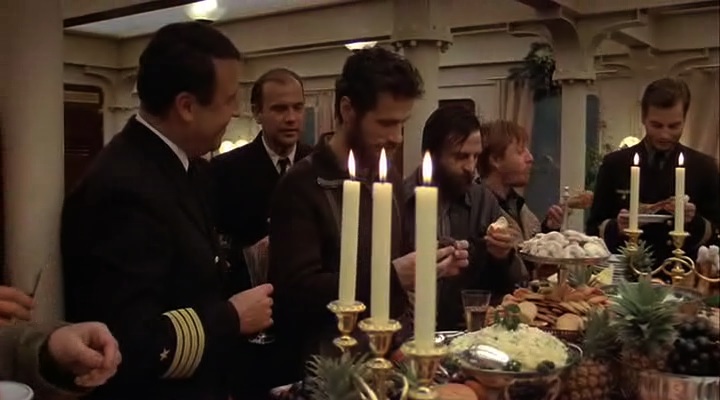
Das Boot

This week's World War II film is Das Boot - Wolfgang Petersen's epic submarine movie... It is, I think, basically a Howard Hawks movie, men in a tight and dangerous corner - like Only Angels Have Wings or Rio Bravo - surrounded and outnumbered with nothing but your courage and stubbornness and your Captain (or sheriff) to carry you along. And, I might as well say, a damned fine Howard Hawks film at that.


Sunday, April 08, 2012

Christian Imagery in WWII

It is fascinating how much films about war, one of the more convincing disproofs of the existence of God, rely on religious imagery. I suppose it's irresistible - to find meaning in all the suffering and sacrifice through the obvious imagery. And - it's not as if the imagery isn't earned. War is full of sacrifice and suffering that does, or can, contribute to a higher cause - people dying for others... And when you look at the life of someone like Corrie Ten Boom, or the people I mentioned a couple weeks ago, Leopold Socha or Si Kaddour Benghribit, it's hard to deny they make as good an argument for God as you are likely to find. It's a notion of god that is equal to the best men do - and god's as good a name for it as anything...

And so for this Easter - sacrifice:


And resurrection:

Sunday, April 01, 2012

WWII In the Philippines


This is where the class I am taking has gotten to - the Philippines, maybe the center of the American war in the Pacific. It's where the first extended fighting took place (for Americans) - scene of the biggest American disaster, at Bataan - and the key to driving the Japanese back, when the war turned our way. So it's gotten an extended treatment - a couple weeks, a couple films - it's a big deal.

The problem is, the films in class have been American films, and alas, pretty mediocre one at that. So Proudly We Hail is a 1943 film about nurses on Bataan - it has the merits of the times - it's a solid studio production, with a fine cast, and Mark Sandrich directing, and it even takes some effort to stay true to the nurses' story (which is pretty astonishing, when you get down to it.) Unfortunately, it couples this with a few bits of shameless melodrama, grafted on love stories, and a very dubious bit where Veronica Lake blows herself up to prevent capture by invisible Japanese. And - Sandrich doesn't seem to have the chops for it. He's a fine director when he has Fred Astaire to photograph - here, he seems pedestrian, and the film, though honorable enough, I suppose, feels awfully flat... The other film isn't much better - The Great Raid. This is the story of a raid by a Ranger company to rescue the last 500 or so prisoners at Cabanatuan POW camp - the last of the survivors of the Bataan Death March still in the Philippines, I think. It's a pretty astonishing tale - but the film manages to bloat it up and slow it down and sap most of the energy from it. Problem there is, it splits its attention between the rescuing Rangers, the POWs, and the civilians in Manila smuggling food into the camps. Particularly one Margaret Utinsky - a woman who definitely deserves her own movie, and a better one than this. The film works well enough when it sticks with the Rangers - but the camp scenes are sappy and predictable, and marred by an unjustifiable imaginary love affair - with the poor Miss U, whose 3 years of smuggling is compressed into the 3 days of the raid for no good reason. And that love story - sweet lord - what a cheap plot device!

It is a shame, I suppose, that no Americans have managed a great film about the war in the Philippines - it just so happens, though, that from the other side comes what is probably the single best film about any part of World War II - Kon Ichikawa's masterpiece, Fires on the Plain. This is set near the end of the war - on the island of Leyte, where the Americans landed before landing on Luzon (the main island of the Philippines, where Manila, Bataan, Cabanatuan are.) The film starts after the Japanese have been beaten on Leyte - the remnants are still there, some looking for a way out, some waiting to die. It follows one soldier, banished from his unit because he has TB, but banished from the hospital because he can still walk, as he wanders...


It's a death march to nowhere for Tamura and the others. It is strange how much the Japanese ended up reproducing the conditions they imposed on others. At the beginning of the war, they forced the American and Filipino prisoners from Bataan to march across Luzon, nearly starving to death - the Bataan Death March. At the end of the war, the Japanese soldiers were doing the same thing, on their own. That's what this film is - a death march - soldiers walk back and forth, a kind of quest with no purpose, waiting to die. Or more often - kill one another, to eat or be eaten.


It's important, though, that they do it to themselves - as much as they did it to their enemies. Behind it all is bad planning and bad tactics, and through it all, they are all at one another's throats. Ichikawa lays it on thick - these soldiers are constantly fighting themselves. From the very beginning - Tamura being slapped -


To the end (almost the end) - three soldiers killing each other -


The Japanese soldiers devour one another - figuratively as well as literally... I think this film is sometimes criticized for not taking sides - for not acknowledging the Japanese culpability in all this horror. But that doesn't seem fair. It's a film about soldiers, from the bottom up - politics would be out of place. I also think it reflects the divisions in Japan - it does seem that a lot of Japanese films about the war, at least the ones that come to the US, were made by liberals and humanists - the anti-war voices in Japan got to express themselves after the war. But while Fires on the Plain lacks the sometimes explicit criticism of Japanese militarism and its aftermath that can be seen in other filmmakers (Oshima and Kobayashi come to mind), it's hard to miss the way, even on its own terms, almost everything that happens to the Japanese soldiers is caused by Japanese actions. They all turn on everyone else, and Ichikawa, one of the great underrated craftsmen of film, shows it, all along:


They do run into the Americans, eventually - with disastrous results. And the guerillas - the fires on the plain... The Americans are dangerous - the Filipinos ruthless - but even here, Ichikawa leads us back to Japanese behavior. Maybe not directly, but indirectly, symbolically. Note that a total of 2 women appear in the film: one the Filipino civilian that Tamura shoots; one a Filipino guerilla who shoots a man trying to surrender. The latter may seem cruel - but the former reminds us who started that kind of thing.


And so - it is a great film. Brutal - harsh and sharp, devoid of sentimentality - strangely comic, but one of the most complete visions of human evil as there is. But not just evil. And all of it stunningly beautiful.