Showing posts with label screen grabs. Show all posts

Tuesday, September 15, 2015

Ivan's Childhood

[Also cross posted at Wonders in the Dark as part of their ongoing Childhood films countdown.]


Andrei Tarkovsky's Ivan’s Childhood begins with the sound of a cuckoo, and a shot of a boy standing behind a tree, looking up at us through cobweb. It ends with the same boy chasing a little girl along a beach, the two of them circling a dead black tree, that seems to keep forcing itself into the image. Both are dreams: the boy, Ivan, is in the middle of a war, dreaming of the world before the war, his childhood. He is still a child in the present of the film, but his childhood is long gone.


Ivan’s Childhood, like Germany Year Zero, is a war film about childhood that is also a childhood film about war, using each side of the equation to heighten the emotion of the other. Ivan is already a hardened veteran when Ivan’s Childhood begins - orphaned, a partisan, now working for the regular army as a scout. That is where he is when the film’s story begins - but that is not how the film begins. It begins with the dream, Ivan walking, running, flying, through fields and forests, coming to rest at his mother’s feet, drinking from a bucket of water. It begins with the childhood he has lost, before waking him to the war he is living in. But it is a very thin line between waking and dreaming. The difference may mean everything to Ivan, but it is very permeable for Tarkovsky’s filmmaking. In Ivan’s dream, Tarkovsky’s camera soars and swirls, almost gleefully defying gravity and rules of space. But when Ivan wakes in a ruined windmill and goes out, the camera remains as vertiginous as in the dream, swinging around, taking extreme angles, cutting up his experiences into flashes of imagery. Real life is immediately established as being as disorienting and strange as any dream.


As we come to know Ivan, we see that he thinks of himself as an adult, the equal of anyone around him - but he is still a child. In the banal outside world, he tries to be an adult, but he isn't, and he remains at the mercy of the men around him. They try to force him to be a child, to go to school, to find surrogate parents, none of which he he thinks he needs. And Tarkovsky's filmmaking emphasizes Ivan’s subjectivity, both awake and in dreams, in ways that show just how close he is to his lost childhood. Dreams and childhood push into his life, haunting him. Ivan isn't always sure which is which - he worries that he is talking in his sleep, his dreams and memories escaping into the world where he wants to be treated as an adult. And apart from the dreams, we see that Ivan has a kind of psychic bond to the world around him. Much of the film is set in a house serving as headquarters for Lt. Galtsev's unit, a house where 8 Russians, none over 19, were held before being shot by the Germans. Their last message is written on the wall - “Avenge us” they say. Tarkovsky emphasizes this graffiti throughout the film - and Ivan, when left alone in the room, is swept up into the story of those executed children. He hears them; feels them; sees them (and his mother, and himself). He seems to slip between his present and the past, theirs and his own, increasingly acting out their story. They are palpable ghosts for him.


It’s not just how Ivan sees the world, but how Tarkovsky sees the world that keeps the boundaries between reality and visions permeable. The camera work remains fluid and inventive throughout; the editing disruptive, jumping across time and space without connections. Things appear out of context, and Tarkovsky takes his time to reveal the context. For example, the first sight we have of Lt. Galtsev - a hand sticking up out of a blackness. A hand coming out of the ground? Out of the swamp Ivan had been wading through? No - eventually we see it is just a man, sleeping. But Tarkovsky delays the revelation. Similar imagery continues - isolated body parts (of the living or the dead); slippage between reality, flashbacks, visions and dreams; and the nature shots - vertiginous rows of trees, people moving through them; the earth disappearing under their feet. Some of this harkens back to other films - especially to Cranes Are Flying, another crucial Soviet war film. Tarkovsky’s camera work owes a lot to that film - the camera flying, spinning, moving, dancing, all of it in luscious black and white. As well as specific scenes and moments - particularly the scenes in a wooded swamp, referring to the death of the hero of Cranes Are Flying.


There are thematic parallels as well - the way human beings are swallowed by nature; the god’s eye views and worm’s eye views of the world. But we can see some of Tarkovsky’s obsessions appearing as well. Bells - pervasive natural imagery, the elements (earth water air and fire) - flying - memories, visions, dreams - and images and words on walls, seeming to come off the walls, into the minds of the characters in the film.


And in the end, Tarkovsky blurs all the lines of the film - between reality and visions, between Ivan's subjectivity and others, between all the times of the film. The final sequence takes place at the end of the war, the Soviets going throught he ruins of Germany - Galtsev, the only survivor, going through old Nazi records, looking at the fate of their prisoners. He finds Ivan's record - and it is as if he can follow the records into Ivan's memories and dreams. He imagines/sees/feels Ivan’s death - rather, the film shows it, but shows it as if Galtsev were experiencing it. And Tarkovsky moves from the vision of Ivan’s death to another dream, children on a beach, Ivan and his mother again - in a way here that links Galtsev to Ivan's mother, making identical gestures, reality and dream combining:


And so we end, with Ivan playing on the beach, running, laughing, with a little girl - though still haunted by the image of the war, that gaunt stark tree in the middle of the beach. (That reminds me, maybe incongruously, but maybe not, of the hanging tree in Budd Boetticher’s Ride Lonesome.) The kids play, but around that tree, that seems to keep intruding into the frame, and finally swallows them up.

Germany Year Zero

[Cross posted from Wonders in the Dark as part of their Childhood films countdown. I neglected to post here when I posted it there - the holiday weekend and all, traveling, things were hectic... I wish I were taking this WWII class just now - I took it a couple years ago.... Childhood in WWII films would make a good paper; this and my other post for WITD would almost make a paper between them.]


War films often use children as protagonists - we've seen several in this countdown already (Come and See, Empire of the Sun, The Tin Drum, among others), with more to come surely. There are many reasons for this - I think those reasons add up to to the fact that the plight of children, of childhood, in wartime brings the horror of war into very sharp focus. Children in war films may be victims, they may be corrupted, may become (or be) evil, or at least hard-boiled, they may not seem to understand the nature of war, may not seem to treat it as completely real - but however they act, or are affected by the war, they reveal its nature through what it makes them. Children are new people - they are pliable, in the process of being formed - and what war turns them into shows us what war is. (And this, in turn, is why so many great films about childhood seem to be war films - because childhood is about becoming what you will be, and war heightens that, the way childhood heighten the effects of war. And maybe because childhood isn't necessarily as innocent, pleasant, secure as we wish it were - children in war become hyperbolic versions of childhood in any difficult situation.) Beyond this, children in war films draw the viewer in - child protagonists are often in the position of the viewer, having to learn about their world as they move through it. And maybe most of all - whatever a child might do in a war film, we know the child did not cause the ear. Children are always acted on by the war, no matter how active they are - adults in warfare raise questions of responsibility that children can sidestep.

In Roberto Rossellini's Germany Year Zero, his protagonist, Edmund, does all these things. He is innocent - but he is corrupted, even before the film started (with his Nazi education), and is led to more and more compromised actions that culminate in murder. He is formed by the war, and by the horrific aftermath of the war - learning from it, made what he is by it. And he is our guide to the world of the film, Berlin after the war. This is quite literal - the camera often follows him through the streets, watching him in his environment, showing us the city and what happens there. He guides us through many encounters, vignettes of suffering and cruelty, in the streets and at home. At the same time, though, he is not just guide but quester - searching for food, searching (quite explicitly - Rossellini's symbolism and ideas aren't subtle here) for meaning, what the war meant, what he is, what life means for himself and others. He is both Virgil and Dante in the inferno of ruined Berlin - and one of the damned souls as well, a ghost in a ghost of a city.


There is no question that it is hell, and these are the damned. Rossellini doesn't dwell on Germany's role in the war, but the tone of the film, and the overall gist of the story doesn't leave much doubt about it - the people of Berlin are in hell, a hell on earth, and one they created, and one they damned themselves to. This is a relentlessly pessimistic film. Everyone Edmund encounters is a kind of monster. His father is weak and useless, full of self pity, if basically a decent man; his brother hides from the Allies, a burden to his family, who then whines at them for doing what they have to to help him. His sister, actually, might be the one truly admirable person in the film - willing to do what she can to help her father and brother, unwilling to condemn Edmund for what he does to help them, constantly trying to get Karl-Heinz to take responsibility, all while waiting in vain for her own lover, who is held in a prison camp somewhere. And those are the good guys - their neighbors are selfish bullies who steal and condemn and pass the blame. Edmund meets a former teacher who is a particularly overdetermined monster - a pedophile who seems to live with a ring of pedophiles, an unrepentant Nazi, still preaching its ethos of the strong living at the expense of the weak (while ducking work on some kind of health exemption) and living off the black market. The other kids Edmund encounters are hard-bitten thieves and gangsters. The people in the streets are selfish and dangerous - they fight over a dead horse in the street; old women chase Edmund away from a job he gets, claiming he's too young, though really doing it to get more for themselves. Even the Allies are shown as careless jerks, taking pictures at Hitler's bunker and buying Nazi memorobilia. (Nothing new about nitwits taking selfies at Auschwitz.) There isn't much relief from it, and even good deeds come wrapped in cynicism - a doctor who does a good deed; Christl's relative kindness; Edmund's sister, and Edmund himself, up toa point...


Only up to a point. As things go from bad to worse for Edmund and his family, he begins to consider desperate measures. His father is sick, and after a brief stay in a hospital, he comes home, to find the family in very dire straights. There is no more power in the house; they have no money, no food - they are in trouble. The old man's self-pity is getting the best of him - he tells Edmund he'd be better off dead; when he comes home he says he has been "condemned to live." Well - not for long. Edmund, still scrambling for food or a way out of this, had been talking to the teacher again - Henning spouted Nazi platitudes about letting the weak die so the strong can live, and Edmund took it to heart. He acts: he poisons the old man, hoping that would let the other three get on with their lives. It immediately backfires - the minute he gives his father the poison the police arrive and Karl Heinz decides to do the right thing. (I told you Rossellini wasn't being subtle.) In fact, Karl-Heinz is very quickly released (as his father and sister had told him would happen), but it is too late - the father is dead, and Edmund realizes he killed his father for nothing. It's too much - he runs - retracing many of his steps from earlier in the film, but especially going back to Henning - who drives him away in horror, refusing to take responsibility for what he said.


That (as Rossellini says in the introduction to the film on the Criterion disk) is the key idea of the film - it is about bad education. Edmund is trained by Nazism, grows up in it, internalizing its values - but when he acts on those values, his elders deny responsibility. The symbolism behind this, of the German people creating Nazism willingly, and then trying to pretend it wasn’t them, is clear enough as well. Germans do not come off well. The father, who seems to have disliked Nazism, clearly never had the courage or strength to do anything about it. His sons embrace it unambiguously. Henning is the other side - an unrepentant Nazi, but one who ducks and dodges - avoiding work, avoiding responsibility, dispensing bad advice and running away from it. Getting a former student to peddle Hitler records to soldiers for him (which I suppose is better than the other fate he had in mind for Edmund.) He’s a thoroughly loathsome creature.


And yet, the film is not just about damnation. Alongside Edmund's story runs his brother's story - in some ways, Karl Heinz is the hidden center of the film. He is the source of the family's trouble, being on the run - they have to feed him, and he not only costs them a ration card, but he is the most employable member of the family and does nothing. He is hard to take - preaching at his sister and Edmund for the things they do to feed him (self-righteously refusing to eat the food Edmund brings back from his nighttime adventure, all while reclining on a cot.) But one of the most interesting aspects of the film is the way it balances his story against Edmund's. The ironies of their stories are not subtle, the way Karl-Heinz does the right thing at exactly the time Edmund does the worst possible thing - but the construction is more sophisticated than the obvious irony might indicate. Karl-Heinz’s story unfolds in the background - Rossellini watches Edmund, but in a way the real battle is fought over Karl-Heinz - his struggle and his decision is the decisive one. Except it isn’t. The film plays as though we think Edmund’s story is the real one, but the real story that is his brother's - except it isn’t, Edmund's is the real center.

Both brothers act at the same time - Edmund to poison his father; Karl-Heinz to surrender to the Allies - and their actions cancel each other out. Karl-Heinz gives himself up to save his father; Edmund kills his father to save his brother - but when he does, Karl-Heinz no longer needs saving, and when Karl-Heinz acts his father is beyond saving. The final sting of the story comes from the fact that Karl-Heinz could in fact save the family - had he done so at any other time, he would have, but he waited just a bit too long. And, consistent with Rossellini's theme, he waited because of his education - he took to heart what he learned from the Nazis, the need to fight to the death, the lack of mercy to expect from the Allies (probably justified, if he'd been caught by the Russians) - and held until it was too late. And Edmund is doomed.

The final section of the film is devastating. Edmunds walks through the city, retracing many of his travels from earlier in the film. He goes to Henning, who drives him out; he looks for the kids, Joe and Christl, but they chase him away; he wanders the streets, increasingly isolated - he tries to play soccer with some kids, but they won't have him; he hears music, and stands outside a church - but as others go toward the music, he turns away, alone.


And goes on, drawn on to death. But never quite shedding his place as a child. He tries to play, hopscotch, soccer - right up to the end, he is sliding down a bar he finds in a ruined house. But he also can't escape his place as a killer, as the product of a monstrous system who has become monstrous himself...


Thursday, July 09, 2015

Let the Right One In

Published as part of the Childhood Films countdown at Wonders in the Dark.


Adolescence can be a terrible time. It can be very painful. It is a time when you lose yourself, lose what you have been, and become a new person in spite of yourself. For most of us, this happens surrounded by others going through the same thing at the same time - is it any wonder how horribly 12 and 13 year olds can treat one another? Let the Right One In is a vampire movie, and a bit of a social satire (if that’s the word) - but mostly, it is about that time when you stop being a child and start to become something else (not quite an adult - but not a child). It is about loss - the loss of childhood, of identity, though also other losses (losing connections with other people, through death or changes in you and them) - but also about what you become. Change is loss, but also gain - you lose who you were, you become someone new. It is about the effects of these changes on groups of kids - about their cruelty, their pain, about how they cope, and perhaps escape.

The main story is about Oskar, a 12 year old living in a particularly horrifying suburb of Stockholm in 1981 (a period promising transition itself - Brezhnev was on his last legs; Reagan was rattling sabers across the sea - the Cold War itself was starting to change, but it wasn't sure what it was going to change into, and Sweden was right there between the two of them). Oskar lives with his mother, who is seldom home; his father lives in the country and is something of a refuge for the boy (except when he's drinking). He goes to school, where he is too clever for his own good, with an excessive interest in police matters; his classmates torment him mercilessly, and he goes home and imagines bloody vengeance on them. There don't seem to be any other kids in his apartment complex; then one moves in - Eli, a strange girl about his age who doesn't seem to dress appropriately for the cold, who seems about as lonely and suspicious as Oskar. It doesn't take them long to become friends - they bond over a Rubik's cube, and they are soon very close.


But Eli has secrets of her own. The film doesn't waste a lot of time letting us in on them - she lives with a Hakan, an odd, quiet, older man, who murders and guts people in the woods to bring her blood. Or tries - when he is interrupted, she has to go out herself and find prey, for she is a vampire. She kills a middle aged drunk, touching off a sub plot involving a number of aging alcoholics, who may have seen her. Meanwhile, things escalate at the school - the kids bullying Oskar get worse, and when he fights back (at Eli's urging), he hurts one of them badly enough to cause further repercussions. The assorted plots build - rising trouble among the kids; the developing friendship and intimacy between Oskar and Eli; and the complications coming out of the killings. Hakan is caught in the act of trying to kill another kid, and leaves Eli alone; one of the friends of the man she killed finds her and tries to kill her while she sleeps, but Oskar warns her and she kills the man; then the boys at school try to get their ultimate vengeance on Oskar, but Eli saves him in a spectacularly gruesome fashion, and they leave together.


It delivers as a horror film, but it is much more concerned with the relationships. The film concentrates on Oskar and Eli - the novel it is based on develops a number of relationships in addition to theirs. It delves into the lives of the kids who torment Oskar; it details Eli and Hakan's relationship; it spends more time with the old drinkers; more time with Oskar and his family. But the broader scope of the book mainly expands and deepens the themes that are at the heart of Oskar and Eli's relationship - the sense of loss, loneliness, change, and their powerlessness against that change. In the book, we learn that the bullies are more like Oskar than not - they lose parents, families, they are going through the same changes he is - they take their troubles out on him, creating a chain of misery. The film retains hints of this - Oskar's main tormenter has an older brother, who is introduced in the film bullying the little brother (who will pass it on to Oskar); the film also retains the subplot with Ginia and Lacke, an older couple who are in the process of losing one another (and in the end, lose everything.) This is a world of pain; everyone is alone, everyone is isolated - and Eli is the epitome of all of their pain.

Most of the characters are kids, most of them on the edge of puberty, about to change forever - and Eli is trapped forever at that very moment. Eli was made a vampire at age 12 - taken from his family, castrated, tortured to death, though not to actual death, then trapped forever at that point of transition and pain. Eli is locked forever in pre-pubescence, trapped between childhood and adulthood, between boy and girl, life and death, ageless and 12 years old, always in the middle. The film is extraordinary at capturing her strange condition - it shows her childishness, her sense of discovery of the world, of things like the Rubik's cube, her loneliness, her desire for contact, a connection, her willingness to try things - while never losing the sense that she is hundreds of years old, has been through this before, has suffered everything and more. And that she is a vampire, and must live on blood, is subject to a host of rules and conditions - she will catch fire in the sun; she cannot enter a place without being invited, without consequences, and so on. She is immensely powerful, but she can't get along without the help of others. We see it in her relationship with Oskar - she genuinely likes him, she longs for friendship, for communication - but she also sees that she can use him, that he can replace Hakan. She uses him - his anger and fear, his loneliness - while at the same time responding to him directly, as one lonely child to another. The film handles this with great care, we can see both; it is a superb balancing act.


And it is a superb film throughout. I've written before about its look, the cold spare spaces of Blackeberg, all square buildings and empty courtyards, a fair version of hell, but that excellence is everywhere in the film. It's beautiful, and it uses its look and feel to advance the themes. It is a film about the end of childhood, about transition - and plays that out, all the shots of doorways and windows and gates we see. The themes come from the book - the importance of those liminal spaces, the central metaphor of the vampire's inability to go in uninvited, with Eli as the ultimate liminal character, forever caught <i>between</i> - and the film finds the imagery to give them weight and power.


So we come back to adolescence, to the traumatic transition from a childhood to maturity, to the loss of oneself, and the discovery of a new self - and the importance of that part of the change. Oskar, at the end of the film, has lost everything - abandoned his family, his life, left a trail of devastation in his wake - he is moving into a very uncertain future, very possibly headed for a life of slavery to a vampire who needs him to kill for her, and certainly obliged to drag her around with him wherever he goes.... But he is on his way somewhere - moving, alive, sane, not locked in a trunk until sunset. He has put off the childish things, and become someone else, something no one else, not even Eli, can do.

Wednesday, October 31, 2012

Re-Animator

All right, it's Halloween, and I will never forgive myself if I go the whole month of October without a single post about horror movies. Though this will not be anything like the last couple years, where I actually put some work into it - and dealt with true masterpieces of the genre... I am eye deep in Ezra Pound (not to mention a hurricane, though that didn't do us much harm in Boston), and haven't spent much time on anything else - but still....

Instead - here is an old favorite - one of the high points of the comic-horror sex and gore mashups of the 80s, Stuart Gordon's Re-Animator. Which provided many a drunken evening of pleasure back in the day... There's not a huge amount that needs to be said about it - it's a mix of a Frankenstein remake and a zombie film (mashing up horror sub-genres as well as everything else) - and a success on almost every score. It is genuinely funny, full of oh so quotable lines ("trysting with a bubble headed co-ed - you're not even a second rate scientist!"), and very dark comedy... I wouldn't call it exactly frightening, but it is certainly creepy often enough... and if it isn't quite the meditation on the limits of man and science and knowledge and the boundary between life and death that Mary Shelley's Frankenstein was, or even the fairly moving bildungsroman the Universal Frankensteins are - it is a not unintelligent examination of hubris and sexual passion and love and loss, in among the grue and the jokes.... A very fine film to celebrate the season with.


Sunday, August 26, 2012

Lola

It's been a while since I have posted my sunday screen shots. I don't know if this marks a return to it - but - one is moved, now and then. This time, by Fassbinder's Lola - the colors! the compositions! the Sirkian (and Sternbergian) set design! a very fine film indeed.


Sunday, May 13, 2012

Oshima Post

It's been a couple weeks since my last Sunday screen shot post - the reason is, maybe predictably, the World War II class I have been taking - it's paper time... I was writing about prison camp movies (mostly) - and giving pride of place to this one: Nagisa Oshima's Merry Christmas Mr. Lawrence. More precisely, I suppose, I was writing about the depiction of the enemy - and face to face interaction between enemies - a theme given rich opportunities for development in prison camps.


Merry Christmas Mr. Lawrence is pretty much about just that - it's about seeing the other side from the other side: it is close to unique, a Japanese film, with a famous Japanese director, made from a book by a South African, co-written and produced by Englishmen, that's committed to looking at both sides, from both sides, and from outside as well. Digging into the political and social divisions on both sides of the war, exploring all the perspectives. Including on outside, analytical perspective - look at all those long shots, high angles - dispassionate and objective, though always alongside explorations of what the characters perceive. I know people sometimes compare Oshima to Godard - that may not be as helpful as it sounds, but this they have in common - an approach that tries to move back and forth between seeing things from inside, as their characters see them - and outside, analytically, "objectively" - and putting these perspectives on film.


Oshima is also one of the great political filmmakers - he never lets us forget who holds the whip - or how power is exercised up and down the system. Individuals are swallowed, and individuals fight back, and individual desires and psychology constantly interfere - his films do all that, and keep it in a real, analytical setting in the world. So we see the Japanese hierarchy - the officers, a bunch of cultured arrogant brutes, lording it over their non-coms - who lord it over the privates - who here, get to lord it over the Koreans, as well as the prisoners. It's certainly consistently with Oshima's work, his interest in the treatment of Koreans - here, the film starts with a Korean guard being beaten, an act that touches off the whole series of actions...


That's relatively common in Japanese films about the war - at least the ones I've seen, mostly from New Wave directors like Oshima. I mentioned it regarding Fires on the Plain - the amount of divisiveness you see in Japanese war films, far more than I think usually appears in other country's films. A lot of these films - Fires, as well as Fighting Elegy, or Kobayashi's The Human Condition - date from the late 50s and 60s, a particularly fractious time in Japan; Oshima's films, all of them, are particularly steeped in the chaotic politics of the 1960s. But Merry Christmas Mr. Lawrence is just as interested in the divisions among the allies - the main officers there - Colonel Lawrence, Group Commander Hicksley, Major Jack Celliers - are as different as Captain Yanoi is from Sergeant Hara (the main Japanese characters.) Hicksley as rather ridiculous, by the book, regular military type; Celliers a heroic, flamboyant and a bit self-destructive free spirit (played by David Bowie as something of an alien - at least as seen by Captain Yanoi)


...and Lawrence as a kind of Easternized westerner - a world traveller who speaks Japanese, and spends the film trying (it seems) to explain the Japanese to the British and the British to the Japanese. It never really works - the Japanese have guns, they don't have to listen; the other officers - well - Hicksley doesn't understand him; and Jack is too determined to get himself killed.


Yanoi is interesting enough himself, a Shakespeare quoting radical aesthete, who survived the February 26th incident, and Hara, played by Beat Takeshi, his first film role, but already the kind of performer who can hold his own with David Bowie and Ryuichi Sakamoto - a salt of the earth professional who dreams of Merlene Deitrich and kills like a machine.


And Oshima does a superb job of making them all count - Lawrence is the center of the film, the pivot - everyone interacts through him... And Celliers is the engine of the plot - he comes to the camp and turns everything upside down. He's a fascinating character - an overt Christ figure, with his initials, and his otherworldliness and martyrdom - though also Judas, specializing in betrayal and destroying Yanoi with a kiss.


But - in a film full of religious imagery - churches, hymns, Christian allusions (Jesus and Judas), as well as Buddhism, direct and indirectly portrayed -


- it's Hara who is the one genuinely religious character. He's the one chanting sutras for the dead; he's shaven headed in his cell at the end, with his prayer beads and monk's composure.


And he is Father Christmas, giving life to the others:


And so.... I've found that every time I see an Oshima film, I have liked it more - the more I see his work, think about his work, the more impressive he becomes. I suppose some of that is the political nature of the work - it can be hard to process the first time through - and maybe distracts from the rest of what he does. There's no denying what a beautiful filmmaker he is. And how clever he is - this one manages to work in in-jokes about his other films ("did she cut it off?"), its stars (Bowie wishing he could sing), other films - it's a joy. And he knows how to use the stars he has, exploiting Bowie's charisma, Sakamoto's presence, and Takeshi's face...


Sunday, April 22, 2012

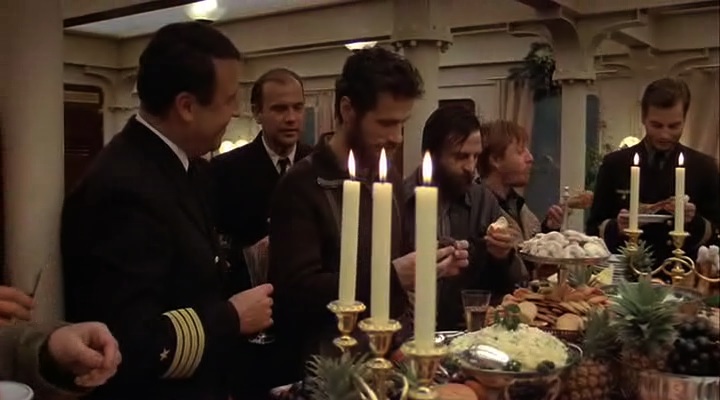
Das Boot

This week's World War II film is Das Boot - Wolfgang Petersen's epic submarine movie... It is, I think, basically a Howard Hawks movie, men in a tight and dangerous corner - like Only Angels Have Wings or Rio Bravo - surrounded and outnumbered with nothing but your courage and stubbornness and your Captain (or sheriff) to carry you along. And, I might as well say, a damned fine Howard Hawks film at that.