In honor of the blogathon - here's one of the noiriest songs you will ever hear, by frequent pulp and film citing Pere Ubu - My Dark Ages, live in 1995.
in the dark I get so confused, I fall in love like a fall from grace...
You can donate to the film preservation fund at this link.
Showing posts with label noir. Show all posts
Showing posts with label noir. Show all posts
Friday, February 18, 2011

Thursday, February 17, 2011
Same Place, 10 Years Later...

Here again - another post inspired by the Love of Film (Noir) blogathon, which continues apace... This is a pretty direct follow up to my first post - this time, let's look at how John Huston handled the meeting between Gutman and Spade in his version of the Maltese Falcon. Doing this, I admit, isn't quite saying anything about noir - though the comparison of the scenes brings out a couple things that do mark the style...
Both films draw pretty directly on the Hammett book - but there are some notable differences between the way the films handle this scene. First, the Huston version is a good deal longer - and split into two interviews, as in the book. Second - Wilmer's present (in both parts), significantly. And Cairo is not. Those changes illustrate a couple things different in Huston's version - the supporting characters have quite a bit more to do in the 1941 version. Gutman and Cairo are featured in the first, but Wilmer is almost a cameo. (A shame since it's Dwight Frye, who brings even more baby faced psychopathy to the role than Elisha Cook.) The other change - removing Cairo from the scene - is directly relevant to the evolution of film noir, I think. Huston's version never departs from Spade's point of view. That's a fairly important element in noir - the limitation of knowledge. Characters who are in the dark - and audiences who are kept in the dark with them. We don't get the outside perspective, we don't know more than the characters. We share their subjectivity.
As for this scene - in some ways, it is actually more conventional than in Del Ruth's version. Instead of beginning in the middle of the conversation, as Del Ruth did, we start with an establishing three shot -

- then move closer through a series of alternations. The effect is less jarring than in the 1931 film - also, better integrated into the film as a whole. This scene comes as a departure from the otherwise stolid style of the 1931 film - here, the angles, decor, and so on are used as in the rest of the film.


Huston's framings aren't quite as jarring as Del Ruth's, but in this film too, the objects, decor, and so on, are very prominent. Bottles, lamps, paintings, light and dark, windows and so on surround the characters - sometimes innocuously, sometimes as pure visual elements - but always seeming to be waiting to take on significance....


The sequence builds to this very famous low angle shot of Gutman - then Spade jumps up, and we get this - not quite as low, but noticeable - and Sam's threatening gesture echoing the painting behind him....

... Wilmer comes back in, and we get this lovely, tense triangle (lots of triangles in this film), before Spade storms off...

When Spade returns, Huston follows much the same pattern. Establishing shots with Spade, Gutman and WIlmer, then a two shot, Spade on the couch now...

He alternates closer shots, shooting Gutman from below...

...and Spade more from eye level (though below Gutman's POV) - with Spade starting to look hemmed in by the bottles and flowers and background decor...

...Gutman rises to pour the spiked drink, looming over Spade -

- and shot from below, as he looks down on Spade, waiting for the mickey to kick in -

- and as it does, the camera comes closer, catching his anticipation -

...then moving closer to Spade, surrounded by bottles and flowers and curtains, looking up, starting to drift a bit...

And ending, with a pair of shots of the men on the couch, the fatal glasses raised...

And so... you can see the evolution of filmmaking in the ten years between these films - in Huston's moving camera, the more expansive staging, and so on... But also the continuity - the similar use of decor, of props, the similar framings - low(ish) angles, the prominent placement of props in the shots. And the specific differences, as in the very different conceptions of Gutman... As it happens - this is clearly the high point of the 1931 film - and probably the high point in 1941 as well. The dialogue shines - the performances shine - and both filmmakers rise to the moment. A conversation between two men - but one frought with deception, threat, menace - which you get from the way the scenes look. And those bottles, glasses, resting there like loaded guns... neat stuff.
Monday, February 14, 2011
Not Quite Noir
From the Maltese Falcon, 1931: this is not film noir - most of the film is a solid, not too interesting looking reading of the text, stagy, competent, nothing special. (Though very entertaining, because of the power of the text, the excellent cast, and Roy Del Ruth's clean, precise presentation.) But in a couple scenes, things change a bit. Like this one, Spade's interview with Gutman - which moves fast from an insert of the telegram from Gutman to their conversation - which starts in the middle, with alternating medium shots, low angled, full of little details in the front of the screen - the bottle, Gutman's fan, Spade's knee and hand... these alternate, as they talk (the familiar dialogue from the novel that Huston used in 1941 as well):


Only well into the conversation do we get longer shots of the men, though as soon as we do - and the convcersation turns to money - the camera moves in again, framing them even tighter than before:


Then backing off, as the money changes hands...

...and backs off more as Wilmer comes in:

Some of this is repeated, less drastically, in the DA's office - though there Del Ruth starts with an establishing shot, before moving in, to similar obstructed medium shots, with hats, telephones, lamps springing into the frame:


All that - moments of visual flair in an otherwise fairly generic looking film. But the story is noir (Hammett is it's founding angel), and here - the camera inserts itself into the decor, and things lose their natural shapes. Shadows break free from their objects, faces, hands, objects, break off from their proper places, and become looming presences... stylistically, noir grew out of expressionism - passed through horror, as much as any style in America - and melded with the crime movies of the 30s... And along the way, put out feelers, so to speak, those moments when the images start to pulse into menacing being, like here...
Inspired by the Love of Film (Noir) blogathon, also at the Siren's.
Raising money for film preservation... donate!


Only well into the conversation do we get longer shots of the men, though as soon as we do - and the convcersation turns to money - the camera moves in again, framing them even tighter than before:


Then backing off, as the money changes hands...
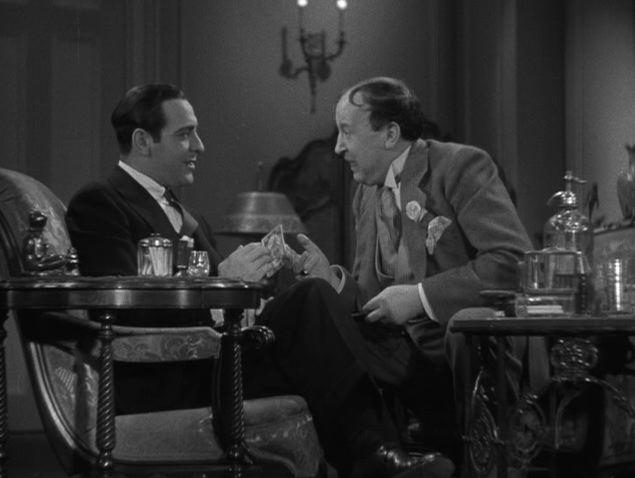
...and backs off more as Wilmer comes in:

Some of this is repeated, less drastically, in the DA's office - though there Del Ruth starts with an establishing shot, before moving in, to similar obstructed medium shots, with hats, telephones, lamps springing into the frame:


All that - moments of visual flair in an otherwise fairly generic looking film. But the story is noir (Hammett is it's founding angel), and here - the camera inserts itself into the decor, and things lose their natural shapes. Shadows break free from their objects, faces, hands, objects, break off from their proper places, and become looming presences... stylistically, noir grew out of expressionism - passed through horror, as much as any style in America - and melded with the crime movies of the 30s... And along the way, put out feelers, so to speak, those moments when the images start to pulse into menacing being, like here...
Inspired by the Love of Film (Noir) blogathon, also at the Siren's.
Raising money for film preservation... donate!
Monday, January 05, 2009
Bad Influence and Neo (Not so) nNoir
Cross-posted at the Film of the Month Club.
One of the interesting features of neo-noir, probably following in Chinatown's footsteps, is the use of light, in place of darkness. Bad Influence follows that trend -light plays a key role in its look, throughout. It begins in darkness, and certainly, shadows and dark are significant in the film - but it is remarkable how much emphasis there is on light.

Its key spaces (Michael's workplace and his apartment) are bright, airy places, with white walls, bright lighting, windows, white decor.


When he moves outside, much of the story takes place under the brilliant LA sky:

Meanwhile, as the deeds grow darker, darkness enters the film, as well - though light remains significant. The robbery spree the men go on leads them through dark streets, but the actual crimes occur in the light.

And light itself is a significant part of what is seen. The light of the TV screen is a recurring motif, the TV and camera are integral to the plot; plot points also depend on a tail light, the light of a refrigerator door opening, etc. Even incidental details like the dance routine at one of the underground clubs are built around lights:

And here is darkness, framed in light:

It's a strong pattern throughout the film, and helps establish a theme, maybe: that light hides our bad impulses - darkness reveals them. That may overstate it - the film does fascinating things with what it shows and hides, puts onscreen or off... but its use of light (and whiteness, and glass, surfaces, etc.) is quite remarkable.
...One more thing (added here, not the FOTMC, since this is not a completed thought) - the look of Bad Influence reminds me of certain high modernist films, Antonioni, Edward Yang. It does not present itself as an art film, but it really is - the decor, the modernist spaces, the clean lines, the whites and light, the glass and steel - and the ambiguity of the story. For it is a very ambiguous story. Exactly how many characters are there in this film? A question to be asked! a hint of posts to come!
One of the interesting features of neo-noir, probably following in Chinatown's footsteps, is the use of light, in place of darkness. Bad Influence follows that trend -light plays a key role in its look, throughout. It begins in darkness, and certainly, shadows and dark are significant in the film - but it is remarkable how much emphasis there is on light.

Its key spaces (Michael's workplace and his apartment) are bright, airy places, with white walls, bright lighting, windows, white decor.


When he moves outside, much of the story takes place under the brilliant LA sky:

Meanwhile, as the deeds grow darker, darkness enters the film, as well - though light remains significant. The robbery spree the men go on leads them through dark streets, but the actual crimes occur in the light.

And light itself is a significant part of what is seen. The light of the TV screen is a recurring motif, the TV and camera are integral to the plot; plot points also depend on a tail light, the light of a refrigerator door opening, etc. Even incidental details like the dance routine at one of the underground clubs are built around lights:

And here is darkness, framed in light:

It's a strong pattern throughout the film, and helps establish a theme, maybe: that light hides our bad impulses - darkness reveals them. That may overstate it - the film does fascinating things with what it shows and hides, puts onscreen or off... but its use of light (and whiteness, and glass, surfaces, etc.) is quite remarkable.
...One more thing (added here, not the FOTMC, since this is not a completed thought) - the look of Bad Influence reminds me of certain high modernist films, Antonioni, Edward Yang. It does not present itself as an art film, but it really is - the decor, the modernist spaces, the clean lines, the whites and light, the glass and steel - and the ambiguity of the story. For it is a very ambiguous story. Exactly how many characters are there in this film? A question to be asked! a hint of posts to come!
Subscribe to:
Posts (Atom)