Showing posts with label books. Show all posts

Sunday, December 22, 2024

Battle of the Bulge 80 Years On

One of the casualties of my neglect for blogging in the last 7 or 8 years is my history posts. I was quite committed to my Civil War commemorations; I managed to keep up the appearance through the WWI anniversaries - but never tried anyhting like that with WWII. Granted, WWII didn't have as good an anniversary to base posts on as the 150 and 100 for those other wars - but 80 would have worked. I did some 70 and 75 year anniversaries. If I hadn't given up on writing, I might have tried it.

But here it is, December 2024, 80 years since the Battle of the Bulge - and I figure I should give it a shot again. The battle itself began on December 16, 1944, and lasted through the end of January. The Germans launched a surprise attack on American lines in the Ardennes forest of Luxembourg and Belgium, hoping to punch through this poorly defended area, get into the Americans' rear, drive to Antwerp and cause the US and UK to either abandon one another or abandon the USSR. It was complete folly, but Hitler was well gone by that time, and didn't put up much resistance to his pipe dreams. The end of 1944 was an interesting time in the war - the Allies had basically had their way all summer, once they broke out of Normandy; but things were starting to go sour in the fall. Operation Market Garden, an ambitious and misguided attempt to cross the Rhine in the Netherlands with a massive parachute drop, went very wrong; fighting on the borders, the Battle of Aachen, or in the Hurtgen Forest or the Vosges mountains, bogged down significantly. Punching into Germany was not going to be easy. While the allies prepared for the next stage of fighting, they left the Ardennes somewhat under defended. Divisions mangled in the Hurgen forest, or brand new on the front, were there, resting, training, waiting. They did not expect trouble in the Ardennes, a mountainous, wooded area full of river valleys and bad roads, very difficult for armies to move through. Which is why that is where the Germans attacked in 1914 and 1940, and now again in 1944.

When the attack came, it was a complete surprise. The German forces shattered the American fron lines - thin and patchy as they were - and threatened to get out fo the woods and out where they could cause trouble. But the Americans fought desperately to save the situation. They defended every post card village and miserable crossroads with all they could find. Their leaders, Ike and company, reacted far faster than Hitler imagined, immediately ordering reinforcements into the area, ordering Patton to utrn north and cut thins thing off. The Germans still punched deep into Belgium - but it took longer than they hoped, and they never did break through in the north, where they were expecting to make a big breakthrough. They got stuck for days trying to take crossroad towns like St Vith; they never did manage to take another town, Bastogne. Panzer divisions drove past, leaving these places isolated in their rear - but doing that, with Americans still parked on the best roads, meant they couldn't get a strong enough force forward, and more importantly than that, they couldn't get supplies forward - they couldn't get gasoline forward. They ran out of gas; the allies counterattacked an drove them back, often in long drawn out slogs through woods and hills - the kind of thing that made the Hurtgen forest such a nightmare.

But in the end - it's hard to say whether this battle delayed the end of the war or accelerated it. A lot of Germans died, a lot of equipment was ruined, the luftwaffe was pretty much crippled after trying a massive surprise attack on January 1, 1945. They did not have the resources for any of this stuff. It they had dug in and fought it out 0on the borders the whole time, they may have dragged things out a lot longer. Or, if they had held the west with the least they could manage, and done everythign they could to hold off the Soviets in the east - they might have extended the war a while. Even more people may have died. But the results weren't going to change. So it's hard to say there was any point to any of it, other than dying in Belgium instead of Germany.

On the other hand - the Battle of the Bulge made a hell of a story. It was a fascinating, dramatic battle. The fighting in the fall of 1944 was ugly stuff: grinding through dense woods, one German emplacement at a time - it was getting back to the meat grinder horrors of WWI. But the bulge was mobile, complicated, with forces scattered all over the map, desperate fighting for towns and crossroads and lonely hills, without a lot of contact with anyone else. Fights for Clerveau, St Vith, the Elsenborn Ridge, Wiltz, Bastogne, places like Hotton and Marche and Stavelot all happened on their own, the men attacking or holding cut off from the rest of the battle. This, I imagine, is mostly a function of the terrain - narrow roads through heavy woods, so that fights were concentrated on the towns, the open places, the river crossings and so on. It made for fantastic stories.

The fight for Bastogne gets most of the attention - got the press at the time, got one of the great World War II movies, in Battleground. It was a good story - a crucial position, surrounded, held by a famous elite unit (the 101st Airborne), in a well known town - there were spectacular air drops and a daring rescue mission by Patton's tanks. And it produced one of the definitive quotes of the war - "Nuts!" -  Anthony McAuliffe's answer to demands from the Germans to surrender. And there is the fact that it held - that the Americans won the fight, tactically as well as strategically. It was a perfect focal point for talking about the Battle of the Bulge.

But it was not the only crucial fight in the battle. Other towns, especially St Vith, another major road hub, saw equally desperate fighting north of Bastogne. St Vith fell, in the end - but the battle there held up the Germans for days, blocked the roads west for days, and was almost as important in disrupting the overall attack as Bastogne. Many other towns and villages - Clerveaux, Hotton, the twin villages of Rocherath and Krinkelt, saw desperate stands of their own, that held up the Germans, bought time, even when they did not hold. And the last of those - Rocherath-Krinkelt was part of what was, in the end, probably the most important fight in the Battle fo the Bulge - the decisive moment, the battle of Elsenborn Ridge. This was the very northern edge fo the battle - this is where the Germans expected to break through most decisively, with their best divisions, their best equipment, the works. And here, the 99th and 2nd infantry divisions held. They held out for days in places like Rocherath and Krinkelt, before falling back to a solid defensive position on the ridge itself. (Joined there by several other divisions.) And this line held. Some of the Germans got past them, and made trouble to their west - but they were isolated. The main line held, and the Germans finally had to shunt their tanks south, to try to take the long way to Antwerp. Past St Vith and Bastogne, which held long enough to make those roads difficult. So it went.

It is all very fascinating. And here I have to turn to a bit of autobiography. Back when I was a wean, I was a terrible military history nerd - I'd say teenaged history nerd, but this started long before that. It started in fifth grade - I got the present of Bruce Catton's history of the Army of the Potomac - I read that and I was hooked. I promptly emptied the school library of everything they had about the Civil War, then any other history I could find. When the school library was exhausted I cleaned out the town libraries. That is where I found a host of popular military histories, mostly of WWII. This might have really started when Reader's Digest published an abridged A Bridge Too Far - but it went from there. All those writers: Cornelius Ryan, Walter Lord, John Toland, their books - The Longest DayDay of Infamy and Incredible Victory - and the hero of this story, John Toland's Battle: The Story of the Bulge.

I loved that book. I was probably in 6th or 7th grade when I read it, and it hit hard. Of all those books, it's the one I go back to (along with Catton's). I still read it almost every December. I can see the reasons - the battle itself was fascinating, and the setting, those woods and hills of the Ardennes, is part of it. I've seen pictures of the place - take away the castles and I see Vermont and Western Maine in those hills and woods and narrow river valleys. I could imagine what the battle looked like. And the situation is very evocative: the surprise attack, the desperate scramble to hold off the Germans long enough to bring things back to normal. The best war stories are underdog stories, and this is one of the rather few times when Americans really the underdogs in WWII - at least for a week or two. And while I don't know if Toland's account is necessarily the best it could be - it seems very spotty, probably because he was a journalist and wrote it from the interviews he could get, emphasizing the stories, and concentrating on the best accounts he found. But that is also its strength - because it is so rooted in the first hand accounts he obviously relied on, it is very visceral, it conveys that sense of desperate struggle. There are accounts in there: Hurley Fuller at Clerveaux; Don Boyer and Bruce Clarke at St Vith; people like Jesse Morrow at the twin villages; Sam Hogan in Hotton, on the western edge of the battle, that have buried themselves in my soul. They are extraordinarily evocative, of the confusion, horror, heroism, madness of war. 

I suppose I should note - Toland's access to interviewees shapes what he wrote about, it is pretty obvious. Those fights are all vitally important, and he had sources; another battle - something like Noville, north of Bastogne, where the 10th Armored division and elements of the 101st held off a German division for a day or so are just as crucial, just as evocative - but his account is looser there. I imagine this is all a matter of sources. And overall, it does warp his account of the battle - which is too reliant on those eye-witness accounts, and sometimes lets the broader picture slip by too quickly. But that's a nit pick, and after all - it is the source of the books power too, so - I can live with it.

And so: 80 years ago, this month, all this happened. It is a very resonant story, one I go back to almost every year. And one I wanted to write something about. 

Monday, July 15, 2013

A Different Kind of Civil War Post

I have been writing mostly about battles, but I have been reading a wider variety of things. I recently finished reading Drew Gilpin Faust's This Republic of Suffering, about the process of coping with death in the Civil War. There was lots of death to cope with.


I was thinking about that last week. THe weekend of the 4th, my brothers and I went up to Bucksport and Ellsworth on a day trip; wandered around Fort Knox for a while, then went to Ellsworth, looking for our great-grandfather's grave. Our grandmother came from Ellsworth, though she moved away, and we hadn't been back all that often - but we knew some of her people were buried up there, so took a look.

We found it, the old man's grave; we then looked around for more ancestors, further back. This was more a shot in the dark - though the family hailed from that part of Maine, we did not know if they were from Ellsworth proper or somewhere else. In the end, we did find more: our great-great-grandparents' gravestone, to be precise:


Old Henry had an American flag next to him, and is listed as a veteran of the Civil War. He was not alone. There were quite a few graves of soldiers in the Civil War up there, most of them serving, like Henry, in the 1st Volunteers - a unit that, in fact, only served for 3 months. But Henry, and probably quite a few others, reenlisted in other units - quite a few of them (up in that part of the state, near Bangor, along the Penobscot) in what would become known as the 1st Maine Heavy Artillery Regiment. There's definitely a story there - the Heavy Artillery regiments had a strange history. They were posted in the Washington defenses for most of the war; they were very large, and they had a very comfortable duty, in the capitol, where they undoubtedly felt they were quite safe. But then Ulysses S Grant came east, and he saw thousands of men, trained and equipped and ready to be used, and he set about to use them. He came east with the power to take what he wanted, even if it made politicians nervous (and they were very jittery about the capitol), so he stripped the capitol's defenses, and assigned these units to regular infantry brigades and divisions and corps (and some of them were quite as big as a veteran infantry brigade all my themselves) and marched them off to Virginia with the rest of the army.

Walking around in the cemetery, not far from the Lunt family plot, I saw another one, the Higgins family plot. They too had a son in the 1st Maine Heavy Artillery. He was not so lucky (my great great grandfather survived, else I would have a different great great grandfather.) John P. died May 19, 1864, aged 17 years, 2 months, killed at Spotsylvania (probably Harris' Farm, right at the end of the battle.)


But what was really striking was on the other side of the stele:


That's lists three Higgins children, dying within a week of one another in March 1864, ae. 12, 10 and 2 - 2 months before John P. would die at Spotsylvania.

I know that sort of thing was more common in the 19th century - diseases could be deadly, whole families could die in a week like that - but it was worse during the Civil War. Especially in the south, where there was often serious shortages of food, medicine and so on - but in the north too. But here, too - one is struck by the weight of these deaths, by the weight of death itself in the war. That's the subject of Faust's book - the ways the country dealt with the shocking death totals. And it is hard to imagine how a family could deal with this - to lose three children within a week; then lose an older son 2 months later to battle. And imagining the mother's position - because John P. wasn't alone in the 1st Me. Heavy Artillery - his father was a captain. There may have been other brothers as well (I think a couple older sons did survive the war) - any of them could die at any time. What it must have been like...

All right. The regiment itself, I should say, left its mark on the war. They lost heavily at Spotsylvania, but even after that battle, they were still very large by Civil War standards - at Petersburg, in mid-June, they still had around 900 men. (400 or so would have been more typical...) And on June 18th, they were ordered to attack - next year, when it is time for the anniversary of these battles, I might go into detail... The Petersburg campaign was a blend of one of Grant's greatest moments, and the latest in a line of disastrous performances by the command structure of the Army of the Potomac. For now, leave it this way - by the time the 1st Maine Heavy Artillery was sent in to charge that June afternoon, it was too late - Lee's men were waiting, dug in to their eyeballs. THe rest of their brigade knew it - Bruce Catton reports one of them shouting "Lie down, you damned fools, you can't take them forts!" But the 1st Maine didn;t listen. They went in - they lost 632 men out of 900 or so.

One of them my great great grandfather, wounded. But he lived, served out the war, was mustered out, and went home, and had a family, and 10 years later my great grandmother was born...

Wednesday, October 05, 2011

Flann O'Brien Centennial

When money's tight and hard to get
And your horse has also ran,
When all you have is a heap of debt -
A PINT OF PLAIN IS YOUR ONLY MAN

Flann O'Brien - Brian O'Nolan (or perhaps more properly, Brian Ó Nualláin), to his mum - born 100 years ago today. I read At Swim-Two-Birds 20 odd years ago, probably at the prompting of Anthony Burgess, and have read it at regular intervals since; read, 20 years ago, everything else I could find by O'Brien (and Myles na Gopaleen), loving it all, though not returning so often. Not sure why, as The Third Policeman and The Dalkey Archive are nearly as entertaining as the first novel. I dip into the Best of Myles more often, though usually not at length - an essay here, a catechism there....

What, as to the quality of solidity, imperviousness, and firmness, are facts?
Hard.
And as to temperature?
Cold.
What with what do they share this quality of frigidity?
Print.
To what do hard facts belong?
The situation.
And to what does a cold fact belong?
The matter.
What must we do to the hard facts of the situation?
Face up to the hard facts of the situation.
WHat does a cold fact frequently still do?
Remain.
And what is notoriously useless as a means of altering the hard facts of the situation?
All the talk in the world.
Is this killing you?
It certainly is.

He was, his books are, truly delightful. All of them as funny as anything ever written, and just as clever - many a joke on novel making to be found. And could he turn a phrase - I could quote all his books whole, almost - though this bit, on drink, got me laughing hopelessly the first time I read it, and, well -
Innumerable persons with whom I had conversed had represented to me that spiritous liquors and intoxicants generally had an adverse effect on the senses and the body and that those who became addicted to stimulants in youth were unhappy throughout life and met with death at the end by a drunkard's fall, expiring ingloriously at the stair-bottom in a welter of blood and puke.
Ah, the musical flow of the language, the hint of parody (the language of temperance pamphlets and sermons), and that glorious swerve at the end. Beautiful, man. It'll live, Mr. Lamont, it'll live.

Thursday, June 16, 2011

June 16

Hoopsa boyaboy hoopsa! Hoopsa boyaboy hoopsa! Hoopsa boyaboy hoopsa!

Happy Bloomsday!

UPDATE: for one single post to read on Ulysses and the joys of Joyce, I would recommend Sheila O'Malley...

Wednesday, June 16, 2010

More World Cup Comments

Happy Bloomsday! Not much left of it - time to take in the words, though: "Mr Leopold Bloom ate with relish the inner organs of beasts and fowls. He liked thick giblet soup, nutty gizzards, a stuffed roast heart, liverslices fried with crustcrumbs, fried hencods' roes. Most of all he liked grilled mutton kidneys which gave to his palate a fine tang of faintly scented urine." Such a beautiful book.

Anyway - my mind has not been on literature this past week - but rather, Sport. The World Cup (eclipsing even the Celtics' run) - thanks to the magic of DVR, I have managed to see every game played so far - not every minute, perhaps, but a good percentage of them. And might as well offer opinions, group by group?

Group A? France looked terrible; after the first game, Mexico looked solid and South Africa looked passable, though the second game against Uruguay changes that - though they really only fell apart after the penalty. But Uruguay has been a revelation. They packed it in against France and completely baffled them - then came out playing a much freer, more open game against South Africa, dominating them. They look well deserving of the second round, and Diego Forlan looks like one of the players of the tournament so far - he looked to have more real chances on goal than France did in the first game, and he scored a perfect beauty of a goal in the second game... I think Mexico has a fine shot at beating France - France would have to play far better to get past them. Could happen, but - they look ready to collapse, and god, I hope they do. It's Bloomsday, after all...

Group B: Argentina looks legit - they didn't overwhelm Nigeria, but they dominated play. Though Nigeria kept the pressure on, and their goalie was huge. I could see them coming back from that. South Korea looked very good, though against Greece, who were helpless. Tomorrow's game there will tell - whether Argentina is really a title contender, and whether South Korea is really as good as they looked. If South Korea gets exposed, NIgeria might be able to beat them - I could see that. Finally - Messi didn't get a goal, but looked his brilliant self.

Group C: Slovenia's win complicates things, but I think they're still hard pressed to get through - even if they can draw out, both England the the US should beat Algeria, and should get more than a goal... England lost on that ghastly bit of keeping, but looked beatable anyway - they mounted decent threats, but had lots of trouble at the back, defenders getting beaten and so on... The US, meanwhile, looked like a pretty complete team - solid D (after their ugly breakdown on the Gerrard goal), great keeper, enough offense. They have choked before in the world cup though. England too, though they usually wait for the second round...

Group D: deutschland, deutscheland uber alles... They are always sort of favorites - they looked like the real deal there. Their strikers are going to score - their midfield play looks strong and creative - they don't mess up on D - they should be around at the end. They're young and all, but they laid those doubts to rest. Of the others - Serbia probably played better than the results - though they obviously ran out of steam at the end - got a red card when a beaten defender grabbed a player; and lost on a penalty after an idiotic handball. (Lots of strange incompetence in the first round - goalie blunders by England, Algeria, Paraguay; this handball; the Danish own goal... nerves? exhaustion, in Serbia's case, I think.) Ghana, on the other hand, looked very impressive. The African teams have been a bit disappointing, but not Ghana. They had injury problems too, with Essian out - but the rest of the team came through - Kevin Prince Boateng had a very nice game... The US and England (assuming they get through) will get the top two teams in this group, and frankly, I think Germany and Ghana will both win those games...

Group E: The Netherlands is another team with a load of talent but a bad track record - their opening game was rather bland. Denmark hung around, and looked like they were going to beat themselves, with that own goal - though the Dutch got better later. They looked a lot more dangerous without Van der vaart and Van Persie - I think because they were all coming into the middle - the subs went wide - and Wesley Snejder began to operate in the extra space. A couple teams have this problem - England worries about having too many midfielders in the middle; I thought SPain's troubles were partly due to their tendency to bunch up... Holland looked much better late. In the other game - the commentators were right - Cameroon had nothing coming through the mid-field, reduced to long balls into the box at the end. Japan played hard and did a good job creating chances, and played a pretty good D as well. Denmark can beat them - they have to, I think - but I can see Japan getting through. I'd like to see that, being a Japanophile - though I like the Denmark team too...

Group F: This is Italy's group, isn't it? All ties of course. Italy looked dull and inoffensive, though probably more organized than France. Paraguay gave them a good game, and should have won - gave them a gift. The other two - Slovakia outplayed New Zealand, but looked like they though the game was over by the 80 minute mark - you could see trouble brewing - they stopped working on D... NZ didn't stop and you see the results. Italy and Paraguay should get through anyway. Ho hum.

Group G: The Portugal/Cote D'Ivoire game was not much fun - Portugal has nothing but Christiano Ronaldo and their defense to go on, though both are first rate. (Though if there is a more irritating player in the game than CR I don't know who it is - a diving diva, though my god, he can do things on the field...) CIV had trouble mounting scoring threats, but they played a good game - hopefully, Drogba will be stronger in the later games - he looked very tentative out there - this game might re-establish his confidence - and they could do better. They have to - Brazil wasn't overwhelming, but they were Brazil. They got careless at the end, but still... and North Korea - played DEFENSE and played it well, and even managed a couple counters... things might go differently for them against less composed teams - they might get some points out of this group yet...

Group H: Spain looked beautiful, but came up empty. Switzerland gave them very little, and took what they got. Chile looked great - Honduras looked like what they were - a team in a weak confederation sneaking in on a late goal by someone else... Spain is hardly out of it - Chile can score, but can they stop Spain? Can Switzerland repeat their performance against Chile? Can they score enough against Honduras? Interestingly - you can almost imagine this group leaving someone behind with six points - if Spain wins out, while Chile beats Switzerland and Switzerland Honduras - none of them all that far-fetched... that would be very interesting in itself. It's probably a bit more likely to see the Swiss and Spanish go through, though...

And so... second set of games, here we go - with Brazil and Germany the two powerhouses who've basically established themselves - the rest are still a bit up in the air. I think Ghana and Uruguay are the most impressive underdogs so far (Switzerland is a bit too one-dimensional to get away with it forever), though South Korea is certainly promising. The rest, I imagine, will be clarified this upcoming week...

Thursday, January 28, 2010

Salinger

Another icon dies - J. D. Salinger, only a day after Howard Zinn... Is it true that many of the comments on Salinger's death are personal? it seems that way - notes about reading Catcher in the Rye, the personal connection the reader had to it. There may be good reasons - Salinger seems to me to have had a particularly intimate way of writing - "to inhabit the skin" of Holden Caufield, say (as Ted Burke put it) - a quality, that intimacy, that interiority - I remember from all his work I read. My strongest memory of Salinger is personal - less the stories, more the fact that I found a copy of Nine Stories at a summer camp where my parents volunteered and we usually took summer vacation. An old beat up paperback, maybe missing the cover, that I carried around with me most of the week, reading it when I could, sitting in the shade, reading it in the back seat of the car. I remember there was something off about that summer - somebody did a lot of fighting, me and my mother, or me and my brothers, or my brothers and my parents - I don't remember who or why, just a kind of simmering tension, that was unusual, especially for vacations. (Might have been the year my brother broke his leg, though that seems late - but it would certainly explain the bad tempers.) There was one day, we took a day trip somewhere - godawful hot, but someone had to go to the DMV, I think it was - and I ended up stuck in the car with some collection of quarreling relatives, waiting while someone was attending to unpleasant official business. Sitting in the back seat listening to whatever argument and whining was going on, reading Salinger, and tuning out everything else. It seemed like the perfect thing to be reading... As for Catcher in the Rye, I read that in high school, toward the end - later than a lot of people did, I suspect. I liked it well enough, but it didn't really stick with me. I was enough of an old fart at 17 that I was obsessed with "The Love Song of J. Alfred Prufrock" - the most inspiring novel at the time was Ignacio Silone's Bread and Wine. After the fact, I found, the best book I read at the time to be The Great Gatsby - I had to reread it once or twice to really get it, but it gained in power; I can't say the same for Catcher in the Rye... but Nine Stories haunts me.

Wednesday, July 08, 2009

This may be scientific, but it's pretty horrible

For of the Spirit of Ed Wood blogathon, literary division.


I know next to nothing about Dr. John Button, but if anyone exemplifies the spirit of Ed Wood, it was Dr. John Button. Who was Dr. John Button? Whatever else he was, he was a ghostwriter for the Stratemeyer syndicate, mass producers of children's literature from the beginning of the 20th century to - well, today, in spirit at least. Now Edward Stratemeyer - that's what people like Ed Wood, enthusiastic purveyors of unabashed pulp fiction, aspired to be - knocking out stories by the score, first whole books, then outlines, that he farmed out to his ghostwriters, all of it written to spec - 25 chapters, 200 or so pages, one after another... all of it immensely popular, and some of it pretty damned good - with a few series that changed the cultural landscape. The Hardy Boys - Nancy Drew - maybe Tom Swift and the Bobbsey Twins... That's Edward Stratemeyer.

I loved the Hardy Boys when I was a kid - yes I did. I think I read the first one in second grade, and was addicted from the start - I read every one of them I could find. I emptied all the libraries I had access to - and since I had access to some old and shabby libraries, I read the original set of books along with the current set of books. (The Syndicate rewrote the early books starting in 1959: they dumbed down the prose, turned the boys squeaky clean, took out the racism [which was pretty bad for a while], and most of the characterization to boot.] Now I wasn't the most discriminating reader when I was 8, but I had my favorites, and there were some head-scratchers in the series - I was pleased to discover on re-reading them that my faves were actually pretty good, and the dubious ones were actually pretty bad... Okay. The fact is, I suppose, the Stratemeyer's techniques were bound to create a very uneven series - only as good as the outliners and the ghostwriters currently employed. It is no surprise that the first 10-11 are the strongest - they were written by Leslie McFarlane, a more than fair writer; the were probably outlined, at least some of them, by old Edward Stratemeyer himself. He died in 1930, and it's the early 30s when things go south - the stories get dumber; the racism gets more pronounced; the characters get more caricatured... And then, in 1938, with McFarlane gone, the syndicate hired our hero, Dr. John Button, to write the books....

He wrote five: The Secret Warning; The Twisted Claw; The Disappearing Floor; The Mystery of the Flying Express; and The Clue of the Broken Blade. Even when I was a kid, I could tell these were a bit - off. Not that the rest of the series is great lit - the first 11 (say) are pretty damned good for what they are; there's a nice renaissance in the 40s and 50s (the stories tend to be sillier, but there's a nice sense of atmosphere to a lot of them, some cool set pieces, and a couple better than average detective stories); but they grow increasingly perfunctory and formulaic in the late 50s and 60s onward, and are near unreadable by the 70s. (An opinion I held in real time...) But the bad books and bad stretches tend to be boring and drab affairs - flat prose and flat stories and predictable action and....

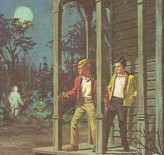
Not the Dr. John Button books. No. They are bad, but they are bad in the finest tradition of Ed Wood. (Though bad a decade or so before Ed Wood started to be bad.) They are bad for all the normal reasons - lazy plots, built on coincidence and caricatured characters, realized in dull, awkward prose, full of implausible events and - more or less uniquely in a property this closely controlled by its owners - jammed full of continuity errors. Like getting characters' names wrong - like the Hardy Boys mother's name wrong. That sort of thing.... They are bad for those reasons - but they are also bad for - well - let's cut to the chase: the Plan 9 From Outer Space of juvenile fiction, and the source of this humble blog's name, and its blogger's screenname - The Disappearing Floor.

If you were to click on that last link, you'd find a couple summaries of this book - both of which give up after 4-5 chapters. Let me give you a partial itinerary for the boys: they start at a train station - go to a place called Great Notch, somewhere in the hills - they hike into the woods - they fall into a cave (and meet their father) - they leave the cave, find a bag of silver dollars, and head off to return it to some place called Wayne City - after driving a cab into the river, precipitating a riot at the bank, and discovering that the bag contains $82,000 (in silver dollars) - they go back to the woods, where Dad has been KO'd - once more into the cave, more trouble there - they haul Dad to a hospital - they go back to Bayport - then up into the woods with a bunch of girls and their Aunt Gertrude. There - Dad turns up and is mauled by a tiger that the boys kill with pointed sticks (no, really!) and a rock - they take him to the hospital again, send the girls back home - go back looking for the bad guys and are attacked by another tiger, and rescued by the villain - they go to thank him, but are worried he'll recognize him so they drag up. Then it's off to the town of Erie, for another bank robbery - they follow the robbers who bury gold in a cemetery - later a crazy old man digs up the gold during a thunder storm - the boys capture the head robber - then get kidnapped - go to an Old Dark House - are frozen solid and set adrift in a rowboat - go back to the house - where most of the rest of the story takes place... Though they do leave a few times, once to fly from Erie to Columbia to buy a book, then back, tailed by the wolfish gangster Weeping Sam himself - they hide at an amusement park, then back to the house, where Fenton Hardy gets electrocuted and frozen solid....

Right. It's like that - constant motion, until they reach the house, and even there they go in and out, up and down, as does the house (the title coming from a room with an elevator in the floor) - contending with a mad scientist who grows plants with electricity, has a device for quick freezing people, immobilizes people with magnetic fields, has a system of electric ghosts to scare off intruders, as well as more prosaic electric traps and locks, has the whole place bugged ("the listening ear"), has a machine that can force you to tell the truth - etc.... What happens in all these places - never mind the science fiction - is wildly absurd: randomly finding bags of money, people turning up and disappearing at will, the boys dressing up as old women to fool Duke Beeson, and later pretending to be Duke Beeson to fool Weeping Sam - and full of extremely strange things. Two Tigers loose in the woods? a group of -sun-worshippers? "Ozonites" - led by Chief Shining Light - an Indian Prince (native of India, that is) - who's really Duke Beeson? I don't know how much of this is the fault of the syndicate's outliners (Edna Stratemeyer Squire, in fact, daughter of old Edward) and how much is Button's, but whoever it is - it's a pretty amazing performance....

It's bad - but it sneaks up on you. It's like those Ed Wood films - however silly the story is, however badly acted, shot, written it is - it has a kind of total, warped commitment. It's ridiculous - but you can't parody it, you can't make fun of it. The Hardy Boys books, over all, are pretty easy to make fun of - the coincidences, the convenient disappearances and reappearances of Fenton Hardy, the frequent blows to the head, Chet and his hobbies, his appetite, his cowardice - everything rolled out like cloclwork... But this one plays like a parody of all that - Button never met a cliche he didn't like, and could execute them with all the obviousness and lack of grace that Ed Wood would have later - so if Fenton Hardy turns up unexpectedly in a cave, Button isn't going to waste any time looking for a way to make it seem plausible - no: he's just there! if the outliner lost track of where the bag of coins was, Button doesn't care - Oh! it fell in a hole! it looks like a rock! And far be it from him to change the dollar amounts - if the outline says it's a bag of coins in the first chapter, he's not going to quibble too much about what 82,000 silver dollars would weigh in the next chapter, nor let carrying that amount of money slow the Hardy boys from swimming out of a sinking taxi cab... And if you are going to set most of the story in an old dark house, you can bet that you get to the old dark house by way of a thunderstorm in a cemetery at midnight with a cackling madman digging up buried loot...

And that - along with the pace and the sheer weirdness of it - makes it a surprisingly fun read. It's a hoot. It doesn't hurt that, compared to most of the series, it contains some really memorable villains. That's something of a Dr. John Button specialty, in all his books. The bad guys in most Hardy Boys books are a pretty bland lot - snarling swarthy brutes, plus the occasional con man or cold eyed pretty boy assassin, who never really do much beyond whack the boys on the head and explain their evil schemes after they've been captured.... Not Button's villains - they sneer and menace and get lines - lots of lines - and names - Dick Tracy type names: Kuntz the deep sea diver (in The Secret Warning); Pierre the French Canadian Pirate (in the Twisted Claw); and in this book - Duke Beeson, alias Chief Shining Light; wolfish Weeping Sam his main henchman; Louis Butts; three stooges named (as they should be) Pudge, Runt and Spike. They carry on, they get in fights, they scheme against one another and the boys - and when Eben Adar (the mad sceintist) points his truth tellign machine at them, they tell their life stories. At least Duke Beeson does: "The first thing I ever stole was my teacher's pocketbook," he said in a drawl.... HIs books as a group do this - make the villains much more prominent, treating them like, well - Dick Tracy, and other comic strips - or the better Hollywood adventure tales, giving the bad guys scenery to chew... it goes a long way toward making these books enjoyable.

And finally - there's the dialogue. This has more than its share of Ed Wood worthy lines. The boys find the bad guys frozen solid - "This may be scientific," concluded Joe, "but it's pretty horrible." Or in re the tiger they have downed, and possibly killed - "Give me your stick. I'll poke him." Or perhaps this exchange: the old madman, Eben Adar, is giving Aunt Gertrude a tour, showing her his electric flowers...
"-and this species here, Getrude, this is a rare variety of Ch'lienglien, a Chinese flower of exquisite beauty. Ah, but the Orientals have never seen this."
"Gracious, it is huge, Eben..."

Which I suppose brings us to a final point. You have to start to wonder - all this absurdity - the obvious, unapologetic coincidences and cliches, the heavy handed foreshadowing, and - well - lines like that one? or the inclusion of those sun-worshippers? Given that "sun-worshippers" usually turns up in old books and movies and comics as a reference to nudists... and the boys, dressing up as old women? and - well - maybe - I can't help suspecting that maybe Dr. John Button was in on a bit more of the unintentional comedy than he lets on. But in the end, I suppose it doesn't matter - the book is - utterly ridiculous, but funny as hell anyway, packed full of stuff, completely shameless - and a joy to read. As much fun as an Ed Wood movie, and it would be just as funny if it were all meant as a parody, as it is, thinking it's just ineptitude. There's a fine line between clever and stupid - and sometimes, the line doesn't matter in the least.

Tuesday, June 16, 2009

Bloomsday

While I work on a couple posts for the Japanese Cinema Blogathon - let us honor the day - though how, how? It has been some years since I have read the book - making it hard to come up with a neat little commemorative quote. NOt that you're going to get too far trying to sum up Joyce in a sentence or two... but still... I know reading it, the first time, it was the newspaper section - "IN THE HEART OF THE HIBERNIAN METROPOLIS" - that gave me the first jolt - the first indication that things were going to change. (Though I knew enough of the book to know they were going to change.) This is what they were talking about, I thought. But I think what used to stymie me (when I tried reading it, in my youth, in early college I suppose it must have been - I remember one summer out of school I determined I was going to read it) - came later. I made it, twice at least, well into the book - only to come a cropper somewhere in the middle - "Send us, bright one, light one, Herhorn, quickening and wombfruit." Somewhere after that. I ground along, but expired on the shores of that section (what do they call it? Oxen of the Sun?) - maybe in its depths, in later days. I tried it more than once, and that is where it ended - until it didn't: somewhere I learned to read it (could I blame Flann O'Brien? not impossible) - and now, it probably is my favorite part...
Our worth acquaintance, Mr Malachi Mulligan, now appeared in the doorway as the students were finishing their apologue accompanied with a friend whom he had just reencountered, a young gentleman, his name Alec Bannon, who had late come to town, it being his intention to buy a colour or a cornetcy in the fencibles and list for the wars. Mr Mulligan was civil enough to express some relish of it all the more as it jumped with a project of his own for the cure of the very evil that had been touched upon. Whareat he handed round to the company a set of pasteboard cards which he had had printed that day at Mr Quinnell's bearing a legend printed in fair italics: Mr Malachi Mulligan, Fertiliser and Incubator, Lambay Island. HIs project, he went on to expound, was to withdraw from the round of idle pleasures such as form the chief business of sir Fopling Popinjay and sir Milksop Quidnunc in town and devote himself to the noblest task for which our bodily organism has been framed. Well, let us hear of it, good friend, said Mr Dixon. I make no doubt it smacks of wenching.

And so on, in increasingly wonderfully purpling prose.

Thank you, Mr. Joyce...

Thursday, June 04, 2009

Books - Very Lush and Full of Ostriches

First - goodbye to David Carradine - I can't say I watched a lot of Kung Fu as a kid, but it was one of those shows everyone seemed to breath - at least, everyone my age.... Every time I've seen him since he's held the screen... Keith probably means more to me, given my Altman worship, but David Carradine's presence in anything was reason to watch it.


Now - trying to keep from backsliding into the postaweek mode of this spring, I think I'll try my hand at one of the memes going around - the Reading the movies meme, courtesy of The Dancing Image... I don't know if I've been tagged, but it looks like everyone's diving in with enthusiasm, so me too. The twist is - I did this 2 1/2 years ago, during Andy Horbal's Film Criticism blogathon: two posts of it, in fact! But that's no reason not to do it again...

I'm not sure I can improve on the 10 books listed then (see below, or the posts linked above) - but I can add to them.

1. Noel Burch - To the Distant Observer - on Japanese films. Probably where I became a formalist. Not that I bought everything he said, especially his value judgments - but I loved that he dug into the formal elements of films, how they work, and how they relate form to meaning. My interest in the difference between representational and presentational art, between expressionism and formalism (and my ideas about what those things mean) come from reading Burch. I stilll find myself thinking in those terms, usually hearing Burch's claims in the back of my head....

2. Godard on Godard - probably not surprising how often this comes up in these lists - Ed Howard, Glenn Kenny, etc. - for good reasons, Godard is simply a superb essayist, a characteristic that carried over to his films. He's also, when pinned down, as clear and careful an analyst of his own work as any filmmmaker gets - his essay on Two or Three Things I Know About Her got me a paper once - about McCabe and Mrs. Miller...

3. Sergei Eisenstein - though Eisenstein was no slouch. I read a few of his books - Film form or Notes of a Film Director, maybe Lessons with Eisenstein, a long long time ago - I saw Ivan the Terrible on TV one night, out of the blue with no preparation, and decided I had to learn more... I read all of them, before I read anything else about film, or before I had seen much more than Ivan the Terrible of the films one might see as a cinephile... I was probably a film formalist before I'd seen an appreciable number of films, come to think of it...

4. Paul Schrader - Transcendental Style in Film - This is another book I don't quite believe, but I still admire it deeply. It's a fascinating attempt to put films in the context of the rest of the culture - philosophy, the arts, religion, and though I can't accept all his claims, the attempt is inspiring.

5. Rick Altman - any of several, but The American Film Musical is one that really set me going a few years ago. Though the truth is - the Busby Berkeley films touring a few years ago sent me to Altman, and Altman sent me on from there... I could list a couple other of his books - A Theory of Narrative, for instance, from last year, was a treat - I find myself thinking in his terms: single focus narratives, double, multiple...

6. More recently, by German Film Class put me onto a couple works that live up to any standards: Siegfried Kracauer's From Caligari to Hitler is a seminal work, and argument aside, is one of the most detailed broad scale works of criticism I know....

7. and Tom Gunning's The Films of Fritz Lang is, like the books on Ozu, Capra and Kurosawa noted below, a magisterial assessment of the career of one of the essential directors.

8. And the class reminded me what a great book the Herzog on Herzog volume is. Herzog is as good a talker as anyone alive, and Paul Cronin guides him through his career in a fine way. It's revealing and fascinating (though I doubt I'd take much of it as gospel truth) - though, as he might say, that's just the accountant's truth. What he says illuminates the films, the ideas behind the films, himself, and he is endlessly fascinating....

9. Speaking of filmmakers who are totally compelling speakers, and writers - Guy Maddin's From the Atelier Tovar is another wonder. Trtuth is, Maddin's commentaries might rival Herzog's - and this book is a marvellous read. I can always find a quote there (or a post title.)

10. Oh god - another dozen possibilities occur to me, from Christian Metz (Film Language) or Peter Wollen (Signs and Meaning) to Jane Feur on the American musical (again) to Bunuel's My Last Sigh to Robert Ray's ABCs of Classical Hollywood Cinema - but no - let's actually dial it back: to Halliwell's Film Guide - which one? I don't know - 1994, I think, is the one I bought, way back in, about, 1994. And used as just that in those dark days before the IMDB. I'm not sure I ever agreed with its judgments - it didn't matter, because it was where I could find information, about pretty much anything, as long as it had been released in the UK.....

So that's that! And for old times sake - here are the first 10, from 2006 - all of which I value as much as ever now...

1. David Bordwell on Ozu
2. Mitsuhiro Yoshimoto's Kurosawa book.
3. Stanley Cavell - Pursuits of Happiness
4. Ray Carney on Frank Capra
5. Pier Paolo Pasolini - Heretical Empiricism.
6. Sarris' American CInema
7. Audie Bock - Japanese Film Directors
8. Stephen Teo - Hong Kong Cinema
9. Truffaut/Hitchcock
10. James Sanders' Celluloid Skylines (on New York in the movies)

Wednesday, August 27, 2008

Back to School Linkage

And again at the turning of the seasons comes another of Dennis Cozzalio's oh so excellent quizzes - Professor Zachary Smith's Lost in the Space at the end of the Summer Quiz. These are not things to be entered into lightly, though there are 16 answers up already since yesterday (as of this posting.) But no, this can't be rushed...

Elsewhere - Girish lauds Manny Farber.

Moviezzz urges critics to see more foreign movies. He's also been reading Haruki Murakami - my own gateway drug to Japanese literature, and probably Japanese movies. Not to mention a comment on the 1968 Chicago Democratic National Convention - in connection with the Chicago 10 DVD. I should Probably watch that film - given the attention paid to 1968 in France by filmmakers, it's interesting to wonder what came out of 1968 in the states - Medium Cool, which is a hell of a start.

Things are going a bit better for the country these days, at least as far as the Democratic National Convention goes. I haven't said much about politics here lately - I don't know what I am supposed to say. I can think of no excuse on earth not to vote for anyone the Democrats nominated - and don't see much point in quibbling about who they nominated - as long as they win. Bush has nigh on demolished this country - and completely demolished the Republican party. In 2000, I could see John McCain as president without feeling all that distraught about it - now? he's spent 8 years groveling t some of the worst people in American political history, and now represents nothing but more of the same, with possibly a bit less raw stupid at the top. Plenty of dishonesty and raw privilege though...

But that aside: not only is it a great relief to have one of the major parties nominate a Black man for president (narrowly beating a White woman in the primaries), and that (both of them, really) a sign(s) that we are, in small ways, still capable of doing things right - better than we used to anyway... But this is the first time since, probably, Gary Hart that I have felt that someone with a reasonable chance of being president is someone I would, on balance, like to see as the president. Kerry, Gore (in 2000 at least) both Clintons, Dukakis, any of the other major contenders - Bradley, Brown, Edwards - were all people I'd settle for. (And back in the day, I voted for Jesse Jackson, without thinking he had much chance - but hoping he'd get some pull at the convention. But I don't think I'd have wanted him as president.) But Obama - runs on programs I can support (mostly); and seems like someone who can get people to follow him. That counts - presidents ought to have charisma - they ought to be able to command respect and admiration, even from their foes. I can see him doing that, and putting it to good use.

So that's my political speech for the year. (Far cry from 4 years ago - all politics, all the time!) And I guess it brings us to the obligatory music video - probably a boring choice, half the internet's going to be linking to it, but hey, it's good enough for the Dems, so - the O'Jays, with Love Train:


[And let me add: it's the O'Jays! why shouldn't half the internet link to it?]

Monday, April 14, 2008

American Cinema Blogathon

Today is the 40th anniversary of the publication of one of the towering classics of film criticism - Andrew Sarris' The American Cinema. This is being commemorated with a blogathon, hosted by Film at 11 - write about American filmmakers since 1968 using Sarris' categories and general schemes. (I imagine as well there will be posts about Sarris himself and the place of his book in film history - and many film lovers' personal histories.)

There should be plenty more to come from this one - it's a more open ended blogathon, starting today, and going forward. And - though Adam's focus is on discussing post-68 fimmakers within Sarris' framework, the topic itself (auteurism, Sarris himself, etc.) remans a vital one - as anyone clicking over to that big argument at Girish's can see. So I look forward to what can come from this.

Wednesday, July 11, 2007

The Clue in the Dollar Bins, or A Well Spent Lunch Hour

Sometimes, dreams do come true. In this case - 7 Tom Swifts, 1920s printings, scattered among the under $5 shelves at a local used bookstore. What bliss!

Saturday, December 04, 2004

Sygns of the Family?

I have started reading Samuel Delany. Started for a class - Triton was on the syllabus (actually, Trouble on Triton, but I had an old Bantam paperback on hand, and figured I'd save a couple bucks. I don't know what that lost me - a Kathy Acker introduction, which may or may not be worth the expense - and possibly something at the back? I compared them - they both had the appendices, and they looked alike - but are they? I have heard rumors of something by Leslie K. Steiner - a Delany alter ego - in the new version - but is it so? I am haunted...)

I've lost the plot. This is the point. I started reading Triton for a class - read it - liked it, very much (did I love it? in a way. But Delany is an odd case - I have tried reading his science fiction in the past, and not been able to keep at it; something about the self-consciousness of it, makes it, somehow, seem smug - he's too good - and somehow too smug about what he's doing... But that's not fair,a nd part of the point of this post is to note how I lost that feeling.) (So did I love it? in a sense - yes - but Delany's books tend to split, a bit - on one side, a text - sentences running together, creating a story and a world and people - all of this utterly engaging; on the other side something of a treatise on Science Fiction, or The Paraliterary, or, The Novel, or... not that that bothers me as such - I like metafiction as much as the next man, but...)

I can't get this started. And the irony is, originally, I wrote this not to discuss Samuel R. Delany, and still less, my (emotional? or critical?) reaction to him - but because I was reading Delany, and some criticism of Delany, and - coincidentally - via Pandagon - found this: Gender News - a conservative site about gender issues. A week or so ago (getting on to 2 weeks now, I think - I started this note almost a week ago), they had an article up called Deliberate Childlessness: Moral Rebellion With a New Face - which basically says it all. Reading within, one finds:

The church must help this society regain its sanity on the gift of children. Willful barrenness and chosen childlessness must be named as moral rebellion. To demand that marriage means sex--but not children--is to defraud the creator of His joy and pleasure in seeing the saints raising His children. That is just the way it is. No kidding.

With that, I'd say, we are halfway, at least, to the line of thought presented in Stars in My Pocket Like Grains of Sand (which I have started reading in the wake of Triton: (as described in this essay by Earl Jackson Jr..) "In such a circular patriarchal theology, nonreproductive sexuality becomes associated with blasphemous treason." That's not far from what our Gender News writer, R. Albert Mohler, Jr., said - not far at all. The blasphemy part is there. The treason is implied - but those guys (the religious right) are increasingly pushing for a union of blasphemy and treason.

And doing it all in terms that Delany parodied 20 years ago. They're a creepy lot.

(Jackson cite via Long Story, Short Pier - specifically, this post from almost 2 weeks past...)

Saturday, October 09, 2004

Goodbye, Goodbye, Goodbye

Jacques Derrida has died. Legal scholar Jack Balkin writes a nice appreciation....

I read Derrida in grad school, back in the 80s. Most decidedly tough sledding, but fascinating. The first piece of his I read (or tried to read) was his "Living On/Borderlines" essay in the Deconstruction and Criticism book, collecting the "Yale Mafia" inside one set of covers. Derrida's contribution ran an essay on Blanchot on top of a long footnote consisting of an essay on - long footnotes? It's been awhile. The way it looked on the page, though, was instantly addictive, and I kept reading Derrida in hopes that I could understand some of it. Eventually I did, though I had to read a lot of Nietzsche and a fair amount of Hegel first.

But understanding aside - the way he wrote suggested things, ways of writing, mixed registers. You don't see that sort of thing in academic writing all that often. You see it, instead, in works of genius like The Third Policeman . It is pleasant to imagine Derrida as a kind of gallic, "serious" Flann O'Brien. It's only slightly far-fetched - O'Brien's japes are very serious; Derrida in turn seems, if not precisely comical, certainly delighted in the sheer oddness of his writing. The puns and wordplay and elaborate typographical trickery he occasionally indulged in cannot be completely rationalized as high seriousness.

At any rate, it was that - the sense of excitement in the act of writing and thinking that his work gave off - that drew me to him first, and kept me at it, long enough to get some clue what was going on. And then - frankly, it made sense. A lot of what he said simply makes sense. Not that I can possibly justify that conclusion at this hour of the night. But as far as I am concerned, Derrida made the world a better place.