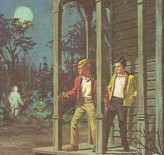
I am going to begin a new series - taking off from this one: A Favorite Directors Blogathon, started at Loren Rosson III's The Busybody, then picked up by others. I can't claim any direct connection, except that I've seen his posts (and some others, like Carson Lund's), and figure it is a good idea. I have been thinking about a way to write about directors - or maybe make some kind of ranking. I did that once, a long time ago - it's not a list that changes all that often, but it would be nice to revisit it...
And so - let us begin. I will start with Nagisa Oshima, partly to celebrate his career on the occasion of his death, though also because he makes a good starting point. To the extend that this is a countdown, he would make sense - he probably lands around 20 or so all time - though it isn't that much of a countdown. I prefer Andrew Sarris' method of lumping them - pantheon, far side of paradise, etc. (Though I've never quite managed to figure out how to make them fit his categories; but the general principal obtains.) Now - this series is obviously devoted to the pantheon - though even in the pantheon, there might be some striation. Up there at the top, there are the greater gods, the inner circle, the holy trinity - Ozu, with Capra and Godard and Mizoguchi right there at his side; then - oh - Hawks and Altman, Imamura, Rivette, Fritz Lang... and so on. I am not going to commit to anything like a list at this point - but I want to sketch in the parameters of what I want to write about....
That is enough preamble. Oshima: it took me a while to warm to him (if "warm" is a word you could ever use for him) - took a while to see enough of his films, and to see them in a proper format - and it was hard to know what to make of him when I did see them. I found him hard to place - it wasn't until I'd seen most of his films that he started to make sense to me. Some of this is because of his characteristic style and subject matter - which is to say - the lack of a characteristic style and subject matter. He changes constantly, in every dimension - content, style, form, tone - think just about the three films he made in 1960: Cruel Story of Youth - a youth behaving badly film; The Sun's Burial, an ensemble piece about a slum; Night and Fog in Japan, another ensemble piece, this time among political types; they are all fairly gorgeous widescreen color films, but the way they are made varies - look at how theatrical, formal, artificial, Night and Fog in Japan is, compared to the others... And move forward - he made black and white films, color films; widescreen and low tech; he adapted books (The Catch) and comics (Band of Ninja), worked with theatrical groups (Diary of a Shinjuku Thief - which remains the one major Oshima I haven't been able to see, to my intense annoyance), made films within films (The Man Who Left His Will On Film); made historical films and contemporary films, made pornographic films, horror films, surrealist comedies, samurai films, made films in English and French as well as Japanese...
It's odd: his eclecticism reminds me of Ichikawa, a comparison that might not go over very well - Oshima did not like Ichikawa, I believe. But they both have an ability to move among many styles, radically different styles, and maintain their identities. They carry their tone, almost everywhere - and it's a similar tone - dark, cool, comic - usually given fairly direct political implications by Oshima, more indirectly so by Ichikawa.... They are also alike in moving among all these styles while maintaining a similar technical mastery - neither one is capable of a bad shot... Oshima distinguishes himself, I think, steps above Ichikawa, in his critical capacity - as a filmmaker, you can never quite forget that he is a critic. He moves among a number of different filmmaking modes, always interested, I think, in how these modes work - he's always exploring film as a form, as a way of making meaning. This is something that links him to Godard, I think - Godard is like that too, an essayist in film. Many of the French New Wave directors had that quality - Rivette, Moullet - of using their films as ways to explore the art form... Oshima shares that. He does, I think, parallel the European filmmakers of the time - affinities appear, especially for Godard, Antonioni, and Pasolini. Though in fact, I think he is more varied and experimental than any of them, other than Godard. He did try damned near everything.
Finally - when I wrote about Merry Christmas, Mr. Lawrence last year, I noted that he was one of the great political filmmakers - he is. The complexity of the power relations in that film - the hierarchies, class divisions, national divisions (Japanese and Korean, English and South African, and Dutch and so on), personal divisions - is common to his films. They all explore power and its distribution, how it works in real society. His interest in the place of Koreans in Japanese society is a recurring example.... I don't think it would be too far off to say that he is the most interesting political filmmaker in the world.
Okay - enough of that... on to the films! I am not going to drag these out, just name and move on, unless something seems like it needs to be said.
1. The Ceremony - A big family saga stretching from the end of WWII to the 1970s, full of Manchurians, war criminals, right wing loons, a token communist, and series of ceremonies - with other activities (baseball, sex, meals) presented as rituals themselves. It reminded me of some of the big epic Oliveira pictures, Doomed Love or Francesca - that kind of absurdity, theatricality, with the gorgeous look of the rest of Oshima's films.
2. The Sun's Burial - plays like a nihilistic version of Pigs and Battleships - nasty criminals in the slums. A woman is buying blood from beggars and threading her way through a variety of obstacles - rival gangs, political; agitators, her junk lord father, various weak men who try to love her. She is a monumental villain, but she is also more or less indestructible. (She might as well be a vampire - immortal, living off the blood of others...) It is a great looking film, though we'll get to say that a lot in this post - understated lighting, all browns and golds, wonderful widescreen compositions, long fluid takes - not as showy as some contemporaries (SUzuki, say), or as detailed as Imamura, but still brilliant.
3. Boy - Story of a family of con men, who work by staging car accidents - seen through the eyes of a boy.... Again - extraordinary looking - no shots less than amazing, and many among the classics: the 2 kids sitting in the snow talking about their snowman/alien; a brawl at an inn in black and white that goes to color at the end. The family at the northernmost tip of Japan in a blizzard. Full of gorgeous off center compositions, oddly balanced, things coming in and out of the frame - some disruptive editing, plenty of sound and color tricks. Japanese flags everywhere...
4. Death by Hanging - R (a Korean) is condemned to be hanged - he is hanged, but doesn't die. This poses a problem - the cops and officials set out to prove to him first that he is R, then, that he is a killer, and third, that he is guilty and should die. They do this by acting out his story - first comically, but then almost seriously (as R starts to get involved) then moving out into the streets. Oshima gets in a number of modes in this one film - hilarious at times, horrifying, politically pointed, finally strange and haunting, and moving.
5. Merry Christmas Mr. Lawrence - Well, I've said my piece on this before - it does not have the reputation some of his others have, but I think it probably should. It is hard to find anything approaching its political complexity in any other war films - especially as it applies its complex view of power to both sides. About seeing the other side from the other side, under pressure....
6. Ai No Corrida - Sada Abe story. She's a maid at an inn - she spies on the master and mistress making love, and soon enough he seduces her, and then it's off to the races. Famous for the sex, I guess, though it's a pretty convincing film - seeing the rest of his films reveals its place better. You can see how it builds on Ceremony or Boy. The satire is toned down, but it's still mordantly funny. And political - that famous scene, where he's passed by a column of soldiers, going the opposite way - they to their doom, he to his... though his seems a lot more admirable.
7. The Man Who Left His Will On Film - Begins with footage of a man with a camera who is immediately chased by someone else. The first man appears to kill himself while the chaser - Motoki - watches. From there it moves to a meeting by a group trying to make political films - then to scenes with Motoki and Yasuko (the dead man's lover? or Motoki's?) talking about film, these films, the other man - who may or may not exist - etc. You are down the rabbit hole in a hurry here. What emerges, though, is a film about Tokyo - documentary footage of riots, a film of landscapes they all argue about, the filmmakers going into the streets themselvesm to try to recreate the testament film - the most memorable, interesting element of the film is the view of the locations - the streets, the highways, the buildings, the neighborhoods. Which is an interesting twist...
8. Night and Fog in Japan - A wedding of a couple who met during the ANPO protests, a reporter and an activist; their friends gather, and old rivalries and such reemerge, mostly around a boy who disappeared during the protests. That, in turn,sets off flashbacks by the score - to 1950 when the groom's generation agitated against an earlier treaty andthe Korean war, as well as to the ANPO protests (which happened, one should note, in June 1960 - the film was released in October 1960 (though not for long...) Oshima uses every trick in the book - it looks like it's inpsired by La Chinoise at times, which is an impressive feat for 7 years earlier - black outs (and white outs), freeze frames, explicit theatrical lighting and other effects, automated camera movements (tracking around the room), hidden cuts, putting different times and places in the same shot, inserted texts (writing on the walls, like Ozu or Godard), books, inserted speeches, long arguments about politics, and very fractured narative. Though for all that, the story itself might not be so extreme - the wedding is a carvival site to bring all these people together - the airing of grievances follows. And while it is politically motivated, the basic story is mostly just a mystery story - how did the "spy" get away? who rang the buzzer? Still - it works - it makes the political factionalism vivid and interesting; individuates the characters to a remarkable extent - and generally retains the post-modern air of the whole thing.
9. Cruel Story of Youth - Story of student and a girl - he rescues her from a lecher, they hang around, he seduces her, they start shaking men down, using her for bait - these two disaffected youths are contrasted with her sister and the man she used to love - he was an idealist, but now he runs an abortion clinic.... In that, it anticipates the generational conflicts of Night and Fog in Japan, without the explicit politics. It skirts the political, though - released in June, 1960, it contains footage from some of the anti-ANPO demonstrations that spring.
10. Violence at Noon - Mostly about a rapist and murderer, with flashbacks to a love confusion at a kind of collective farm that was washed away by a flood. Marked by some very cool weird cuts. This one, like a couple of Oshima's films in the early 60s, feels at times like Imamura - oddly, Oshima tends to go for the shocks more....
There are plenty more worthwhile Oshimas - some of them, at least, on DVD in the states. They are worth seeing, though unless you want to see Charlotte Rampling having an affair with an chimp, you might want to steer around Max Mon Amour.
Showing posts with label Oshima. Show all posts
Showing posts with label Oshima. Show all posts
Tuesday, January 29, 2013

Tuesday, January 15, 2013
Nagisa Oshima
Nagisa Oshima has died... The period in which he emerged, the Japanese new wave, if you can call it that, is one of the high points, the absolute high points, of film history. I am, fairly obviously, more of an Imamura man - but I guess that's like saying I'm more of an Ozu man than a Mizoguchi man - there's not that big a gap. And Oshima is the director who defines the period for me - his experimentation, overt political engagement, intellectual ambition, and rather all-encompanssing interests - epitomize the era - inventive, challenging, and always beautiful filmmaking. His contemporaries do seem to have found their niches, worked a more particular ground - maybe only Yoshida can approach the variety of film work Oshima did... He was, then, one of the great ones - and I salute him.


Sunday, May 13, 2012
Oshima Post
It's been a couple weeks since my last Sunday screen shot post - the reason is, maybe predictably, the World War II class I have been taking - it's paper time... I was writing about prison camp movies (mostly) - and giving pride of place to this one: Nagisa Oshima's Merry Christmas Mr. Lawrence. More precisely, I suppose, I was writing about the depiction of the enemy - and face to face interaction between enemies - a theme given rich opportunities for development in prison camps.

Merry Christmas Mr. Lawrence is pretty much about just that - it's about seeing the other side from the other side: it is close to unique, a Japanese film, with a famous Japanese director, made from a book by a South African, co-written and produced by Englishmen, that's committed to looking at both sides, from both sides, and from outside as well. Digging into the political and social divisions on both sides of the war, exploring all the perspectives. Including on outside, analytical perspective - look at all those long shots, high angles - dispassionate and objective, though always alongside explorations of what the characters perceive. I know people sometimes compare Oshima to Godard - that may not be as helpful as it sounds, but this they have in common - an approach that tries to move back and forth between seeing things from inside, as their characters see them - and outside, analytically, "objectively" - and putting these perspectives on film.

Oshima is also one of the great political filmmakers - he never lets us forget who holds the whip - or how power is exercised up and down the system. Individuals are swallowed, and individuals fight back, and individual desires and psychology constantly interfere - his films do all that, and keep it in a real, analytical setting in the world. So we see the Japanese hierarchy - the officers, a bunch of cultured arrogant brutes, lording it over their non-coms - who lord it over the privates - who here, get to lord it over the Koreans, as well as the prisoners. It's certainly consistently with Oshima's work, his interest in the treatment of Koreans - here, the film starts with a Korean guard being beaten, an act that touches off the whole series of actions...

That's relatively common in Japanese films about the war - at least the ones I've seen, mostly from New Wave directors like Oshima. I mentioned it regarding Fires on the Plain - the amount of divisiveness you see in Japanese war films, far more than I think usually appears in other country's films. A lot of these films - Fires, as well as Fighting Elegy, or Kobayashi's The Human Condition - date from the late 50s and 60s, a particularly fractious time in Japan; Oshima's films, all of them, are particularly steeped in the chaotic politics of the 1960s. But Merry Christmas Mr. Lawrence is just as interested in the divisions among the allies - the main officers there - Colonel Lawrence, Group Commander Hicksley, Major Jack Celliers - are as different as Captain Yanoi is from Sergeant Hara (the main Japanese characters.) Hicksley as rather ridiculous, by the book, regular military type; Celliers a heroic, flamboyant and a bit self-destructive free spirit (played by David Bowie as something of an alien - at least as seen by Captain Yanoi)

...and Lawrence as a kind of Easternized westerner - a world traveller who speaks Japanese, and spends the film trying (it seems) to explain the Japanese to the British and the British to the Japanese. It never really works - the Japanese have guns, they don't have to listen; the other officers - well - Hicksley doesn't understand him; and Jack is too determined to get himself killed.


Yanoi is interesting enough himself, a Shakespeare quoting radical aesthete, who survived the February 26th incident, and Hara, played by Beat Takeshi, his first film role, but already the kind of performer who can hold his own with David Bowie and Ryuichi Sakamoto - a salt of the earth professional who dreams of Merlene Deitrich and kills like a machine.

And Oshima does a superb job of making them all count - Lawrence is the center of the film, the pivot - everyone interacts through him... And Celliers is the engine of the plot - he comes to the camp and turns everything upside down. He's a fascinating character - an overt Christ figure, with his initials, and his otherworldliness and martyrdom - though also Judas, specializing in betrayal and destroying Yanoi with a kiss.

But - in a film full of religious imagery - churches, hymns, Christian allusions (Jesus and Judas), as well as Buddhism, direct and indirectly portrayed -

- it's Hara who is the one genuinely religious character. He's the one chanting sutras for the dead; he's shaven headed in his cell at the end, with his prayer beads and monk's composure.

And he is Father Christmas, giving life to the others:

And so.... I've found that every time I see an Oshima film, I have liked it more - the more I see his work, think about his work, the more impressive he becomes. I suppose some of that is the political nature of the work - it can be hard to process the first time through - and maybe distracts from the rest of what he does. There's no denying what a beautiful filmmaker he is. And how clever he is - this one manages to work in in-jokes about his other films ("did she cut it off?"), its stars (Bowie wishing he could sing), other films - it's a joy. And he knows how to use the stars he has, exploiting Bowie's charisma, Sakamoto's presence, and Takeshi's face...


Merry Christmas Mr. Lawrence is pretty much about just that - it's about seeing the other side from the other side: it is close to unique, a Japanese film, with a famous Japanese director, made from a book by a South African, co-written and produced by Englishmen, that's committed to looking at both sides, from both sides, and from outside as well. Digging into the political and social divisions on both sides of the war, exploring all the perspectives. Including on outside, analytical perspective - look at all those long shots, high angles - dispassionate and objective, though always alongside explorations of what the characters perceive. I know people sometimes compare Oshima to Godard - that may not be as helpful as it sounds, but this they have in common - an approach that tries to move back and forth between seeing things from inside, as their characters see them - and outside, analytically, "objectively" - and putting these perspectives on film.

Oshima is also one of the great political filmmakers - he never lets us forget who holds the whip - or how power is exercised up and down the system. Individuals are swallowed, and individuals fight back, and individual desires and psychology constantly interfere - his films do all that, and keep it in a real, analytical setting in the world. So we see the Japanese hierarchy - the officers, a bunch of cultured arrogant brutes, lording it over their non-coms - who lord it over the privates - who here, get to lord it over the Koreans, as well as the prisoners. It's certainly consistently with Oshima's work, his interest in the treatment of Koreans - here, the film starts with a Korean guard being beaten, an act that touches off the whole series of actions...

That's relatively common in Japanese films about the war - at least the ones I've seen, mostly from New Wave directors like Oshima. I mentioned it regarding Fires on the Plain - the amount of divisiveness you see in Japanese war films, far more than I think usually appears in other country's films. A lot of these films - Fires, as well as Fighting Elegy, or Kobayashi's The Human Condition - date from the late 50s and 60s, a particularly fractious time in Japan; Oshima's films, all of them, are particularly steeped in the chaotic politics of the 1960s. But Merry Christmas Mr. Lawrence is just as interested in the divisions among the allies - the main officers there - Colonel Lawrence, Group Commander Hicksley, Major Jack Celliers - are as different as Captain Yanoi is from Sergeant Hara (the main Japanese characters.) Hicksley as rather ridiculous, by the book, regular military type; Celliers a heroic, flamboyant and a bit self-destructive free spirit (played by David Bowie as something of an alien - at least as seen by Captain Yanoi)

...and Lawrence as a kind of Easternized westerner - a world traveller who speaks Japanese, and spends the film trying (it seems) to explain the Japanese to the British and the British to the Japanese. It never really works - the Japanese have guns, they don't have to listen; the other officers - well - Hicksley doesn't understand him; and Jack is too determined to get himself killed.


Yanoi is interesting enough himself, a Shakespeare quoting radical aesthete, who survived the February 26th incident, and Hara, played by Beat Takeshi, his first film role, but already the kind of performer who can hold his own with David Bowie and Ryuichi Sakamoto - a salt of the earth professional who dreams of Merlene Deitrich and kills like a machine.

And Oshima does a superb job of making them all count - Lawrence is the center of the film, the pivot - everyone interacts through him... And Celliers is the engine of the plot - he comes to the camp and turns everything upside down. He's a fascinating character - an overt Christ figure, with his initials, and his otherworldliness and martyrdom - though also Judas, specializing in betrayal and destroying Yanoi with a kiss.

But - in a film full of religious imagery - churches, hymns, Christian allusions (Jesus and Judas), as well as Buddhism, direct and indirectly portrayed -

- it's Hara who is the one genuinely religious character. He's the one chanting sutras for the dead; he's shaven headed in his cell at the end, with his prayer beads and monk's composure.

And he is Father Christmas, giving life to the others:

And so.... I've found that every time I see an Oshima film, I have liked it more - the more I see his work, think about his work, the more impressive he becomes. I suppose some of that is the political nature of the work - it can be hard to process the first time through - and maybe distracts from the rest of what he does. There's no denying what a beautiful filmmaker he is. And how clever he is - this one manages to work in in-jokes about his other films ("did she cut it off?"), its stars (Bowie wishing he could sing), other films - it's a joy. And he knows how to use the stars he has, exploiting Bowie's charisma, Sakamoto's presence, and Takeshi's face...

Thursday, December 18, 2008
Quick Bloggage
The holiday season is here in all its time consuming glory. With weather promised for tomorrow - fun fun! I have been eye deep in Oshima for the last couple weeks - almost over, though there are a few shows left. Including Diary of a Shinjuku Thief, which is one of the 2 or 3 I most wanted to see - but won't be around for. Blast it. But the rest has been glorious. I will try to post comments - whether capsules or mini-essays or just, I don't know - something - we'll see. If it wasn't 11:30 PM, I might try something quick now - I'd note, say - the way he seems to pick a style, a formal principal, with every film, and see what he can do with it. His career is wildly eclectic - I mean, his style shifts with almost every film (though some things remain the same: gorgeous compositions, radical storytelling, political engagement, distancing devices) - one may be rough and loosely structured and the next tight and carefully laid out; one may be color the next black and white; one may be tightly scripted the next semi-improvised - but the shifts are from film to film. Within films, he's very consistent - along with the widescreen compositions, which are always impeccable, he sets himself a fairly well defined set of devices that he uses: the cool formalism of Boy and Ceremony; the disruptive editing in Violence at Noon; the use of lighting and theater in Night and Fog in Japan - and so on.... It's good to see him getting some airing - I think this series is traveling - I hope others get to see it, beyond NY and Boston. And I hope Diary of a Shinjuku Thief comes back to Boston soon...
Meanwhile, before I go - a few links to tide you over....
James Urbaniak on Peter Schiff's prescience. This is as close as I have seen to what it would look like if a time traveler came back in time and went on Fox news. It looks like a fake - Schiff basically describes the summer and fall of 2008 in 2006, and a bunch of nitwits laugh at him. Oops! Oddly, the same morons are still on TV - hasn't Ben Stein been banished yet?
David Cairns on Brazil.
What the hell? The Bush family Christmas video card - starring a dog, though not a shoe, at least not in the minute or so I lasted...
Ed Howard cites Alison Bechdel's rule for movies - 2 women in the film, who talk to one another, about something other than a man. Oshima doesn't come off too well, though he sometimes seems to critique the social patterns that cause this kind of problem, isolation of women from one another etc. Night and Fog in Japan makes an interesting point, a bit accidentally - there are two major women characters, who don't speak to each other and only speak to the crowd about their relationships to the men (to Nozawa, the communist turned journalist who is marrying one of them.) There's also another woman, an older woman, who stands with the girl getting married in the film - she never says a word - she just drifts through the shots - though at the end, during the Stalinist's harangue, she gets a lot of the camera time - it's as if Oshima is making a note of her, of her silence and marginality here... Though he never really makes films about women, the way Ozu or Imamura, let alone Naruse and Mizoguchi did. All fo them have their issues, but they hit this standard a few times....
And finally - the Film of the Month Club is back inaction, with Absolute Beginners as this month's film. A neat choice for a host of reasons,bot least, the consideration of the 80s' place in film history. It's ging to be a while before I get to see the film - but it's a good discussion going on....
Meanwhile, before I go - a few links to tide you over....
James Urbaniak on Peter Schiff's prescience. This is as close as I have seen to what it would look like if a time traveler came back in time and went on Fox news. It looks like a fake - Schiff basically describes the summer and fall of 2008 in 2006, and a bunch of nitwits laugh at him. Oops! Oddly, the same morons are still on TV - hasn't Ben Stein been banished yet?
David Cairns on Brazil.
What the hell? The Bush family Christmas video card - starring a dog, though not a shoe, at least not in the minute or so I lasted...
Ed Howard cites Alison Bechdel's rule for movies - 2 women in the film, who talk to one another, about something other than a man. Oshima doesn't come off too well, though he sometimes seems to critique the social patterns that cause this kind of problem, isolation of women from one another etc. Night and Fog in Japan makes an interesting point, a bit accidentally - there are two major women characters, who don't speak to each other and only speak to the crowd about their relationships to the men (to Nozawa, the communist turned journalist who is marrying one of them.) There's also another woman, an older woman, who stands with the girl getting married in the film - she never says a word - she just drifts through the shots - though at the end, during the Stalinist's harangue, she gets a lot of the camera time - it's as if Oshima is making a note of her, of her silence and marginality here... Though he never really makes films about women, the way Ozu or Imamura, let alone Naruse and Mizoguchi did. All fo them have their issues, but they hit this standard a few times....
And finally - the Film of the Month Club is back inaction, with Absolute Beginners as this month's film. A neat choice for a host of reasons,bot least, the consideration of the 80s' place in film history. It's ging to be a while before I get to see the film - but it's a good discussion going on....
Tuesday, December 09, 2008
Oshima Series
I forgot to post this over the weekend - the Harvard Film Archive is currently showing a complete retrospective of feature films by Nagisa Oshima. This is a fine way to close out the year. I've seen a few of his films, 8-10, but not enough, and most of them from the margins of his career - very beginning and the end. I'm particularly looking forward to seeing more of the films from the late 60s - the two I have seen (Death by Hanging and The Man Who Left his Will on Film) were outstanding... this is a good thing.
Subscribe to:
Posts (Atom)