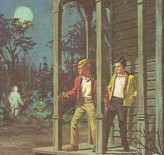
I am getting lazy lazy about blogging, but have to come in here for this - the World Series starts tonight - with some good old fashioned curses on the line. Cubs and Indians! Though for me, it looks like a Red Sox intramural game - Tito, Napoli, Miller, Coco Crisp vs. Theo, Lester, Lackey, Anthony Rizzo (probably why Theo is in Chicago - if AdGon had worked out in Boston, he and Tito might still be there...) Fun times!
All logic dictates the Cubs to win. If the Indians had their full compliment of pitchers, it would be close to a toss up, since with Kluber, Salazar, Carrasco and Tomlin, they would be a match for anyone. As it is - Cubs just have more at their disposal. And some big game players in there - Lester going for his third ring, Lackey too... But still - I think I might root for the Indians. Underdogs - and not the Cubs. Much as I like this edition, they are the Cubs...
Meanwhile - as far from that as you can get - I read that Jack Chick has died. Well - not completely unrelated. Chick's tracts - the little ones, the ones people handed out at camp meetings and on the streets - have always been around me, and I got to read a good sample fo them when I was a kid. I always remember This Was Your Life - some smug asshole gets struck dead at a party and goes before the throne of god to be confronted with his sins. Typical camp meeting style scare mongering "evangelism" - with a line I couldn't ignore. At one point our damned hero is sitting in church - he's all excited - "see! I went to church!" - but god can read minds: "I wonder who's winning the ball game?" That's a burning offense! And poor me, sitting in some church service, wondering who was, in fact, winning the ball game, or who would make the all star game, or whatever occupied my mind, thought, well - I guess I am one of the damned too....
So: now he is dead, Mr. Chick. Im not sure if it's more surprising that he was still alive, or that he existed at all - there is something about those little tracts that suggests an elaborate joke of some kind. Dark dungeons, in particular, has taken on a pretty strong half life as a camp classic - but a lot of them have that effect. Even when I was a kid and subject to that kind of pressure more than I care to admit, Chick tracts were almost amusing, and somehow extremely compelling. I think it's the art - the simple, crude, mostly realistic style - it was within my reach, maybe. I wished I could draw, tell stories in pictures (and words), and those tracts showed a way to do it. Maybe. I know that - here's an irony for you - the look of those comics had the same effect that the art in the Advanced Dungeons and Dragons books had, especially the incidental art in the DMG - "no honor among thieves" - the same pen and ink drawings, clear and quick points, little mini-narratives in every picture... like marginal doodles. I have a soft spot for that kind of art generally - illustrations in Hardy Boys books do the same thing. Great stuff. So - I could smirk at the heavy handed fire and brimstone stuff and admire the form, even in high school or before....
Though that didn't work so well when I came across some of the comic books he published. The Crusaders - sweet holy fucking Jesus! The tracts are fairly standard issue high pressure Repent or Go To Hell! "evangelism" or cheesy culture war stuff (taking on evolution, D&D or whatever). But the comics? I saw some of those when I was in high school still - fairly innocuous things about smuggling bibles into Russia or whatever - but in college, I came across the harder stuff. One of the guys had a pile of them he'd let people read - and these... I guess it's the "Alberto" stuff that really took the prize: a former Jesuit who found the truth and revealed the inner workings of the Catholic church. Yikes: they invented communism, evolution, satanism, nazism, homosexuality and rock and roll (if I remember it right), all while priests and nuns fucked like rabbits and filled tunnels with aborted fetuses.... I don't think that is hyperbole. They were astonishing, those comics - both for their virulent anti-Catholicism (in 1979! I still heard some ant-papists running around in the 70s and 80s, but even the worst of them weren't accusing the pope of founding both the communists and nazis), and for the batshit insanity of it all. It was stuff straight from the good old days, 19th century know nothing anti-catholic propaganda (rather specifically: I saw the same stories in 19th century anti-Catholic tracts)... horror show stuff, played - kind of straight. Though like a lot of things, it's hard to tell the difference between someone trying to seriously argue that the pope founded the communist and nazi parties, and someone parodying the idea, to make a good horror story...
Anyway. I can't deny, I found those things fascinating - the tracts anyway. The comics, trying for a more sophisticated style, plus their plain evil, were less interesting. Read them once and walk away... But the tracts - people still hand them out on the streets once in a while and I look them over with that odd mix of amusement and revulsion, and, well, envy - at some weird level, making art, no matter what the purpose, offers something like redemption, even for evil people and evil art. Maybe that attitude goes back to Chick, just a bit - the split between the stupidity and viciousness of the content, and the inherent value of being able to express yourself is very strong in some of those tracts. I suppose I am one of the damned - damned to formalism. There are worse things, though.
Showing posts with label comics. Show all posts
Showing posts with label comics. Show all posts
Tuesday, October 25, 2016

Tuesday, May 11, 2010
Kick-Ass And Superheroes
So I ventured into the mainstream this weekend, taking in a show of Kick-Ass - and came out surprisingly happy. It's an awfully clever movie that pulls enough from the right sources to almost do justice to them - a post-incredibles superhero movie, a post-Kill Bill John Woo homage, probably a lot of other post-'s I'm missing for ignoring comics and TV for the last decade - none of it up to the sources, but none of it insulting... Ya got a normal guy who reads too many comics and thinks, why not dress up and fight crime? So he does it, with disastrous consequences - but he keeps doing it, and probably would end up dead except a real superhero turns up, in the form of an 11 year old girl (and her father, Nicholas Cage in a home made Batsuit and handlebar mustache channeling Adam West...) So - this makes him famous, and draws the ire of a local gangster, who has a son who also reads comics and so dresses up as his own superhero, to lure the others in... it all ends in blood (fire, explosions, brutal beatdowns and Joker quotes...) In the end, Hit Girl goes to school (woe to the bullies) - sequels are promised....
I've seen a certain amount of angst about the premise - the little kid making like Chow Yun-fat, the little kid getting the shit kicked out of her (which she does), the little kid calling people cunts - but I can't get too worked up about any of that. Movies are make believe, and this is particularly obviously make believe - and enough about the process of making believe to make something thematic of it. And kids - even 11 year olds - make believe things like this - blood and guts and fake violence and extravagant horrible fears and dangers overcome in the most hyperbolic ways possible - who didn't make up stuff like this? I did, and I was as tame a lad as you can find... It's tempting to get woo woo about it, about how it's a fairy tale (complete with absent mothers and monsters to defeat and dark night journeys and all the rest) and all - so I might as well. I think, as far as superhero movies go, it does a better job than almost any at getting at something Walter Chaw says in his review - "this superhero game makes perfect sense for kids feeling their way around a budding moral sextant, navigating their twisted, confused straits--but not so much adults, who need to find a better way through." I think he's hit it on the head there - this one plays its adolescent material straight - the underlying themes are acted out in the film. It's not as good a film as The Incredibles (to name one), but it has the same kind of sneaky seriousness...
The question of comic book movie seriousness has become something of an internet meme this week, thanks to Matt Zoller Seitz' subtly titled article at Salon - Superheroes Suck! Responses abound - Jim Emerson, The Telegraph, Pandagon (going outside the movie world) - with plenty of comments hashing it all out... I'm not sure how much I can add, but some things have been running through my head... I can't say I disagree with Seitz - most superhero films do suck - or, maybe better, are drab, formulaic crowd-pleasers, disposable and harmless... I disagree with him on a couple specifics - I liked Kick-Ass quite a bit, as you might be able to guess - and I still love the two Burton Batman films, especially the first one - though that's partly down to the experience of seeing it (twice the first two nights - a great urban showing, packed house, everyone cheering everything - Jack, Prince, Burton, the Batman, the Joker, Vicky Vail - absolutely wonderful... and the next night in a suburban theater with a crowd sharply divided between black kids cheering for the Joker and Prince and white kids cheering for Batman and, for some reason, booing Prince; complete with a fist fight before the show and a stabbing in the parking lot during the show... Exhibit A in why I'll take cities over suburbs any day of the week....)
Where was I? Oh yes - one of the problems with Seitz' article, I think, is that it looks like he's saying - Superhero movies can't be great films... when what he really presents is, No Superhero movies have been great films. He does not make an argument (not a convincing one anyway) for why superhero films can't be great films - maybe he doesn't mean to, but given the sweeping terms of his complaints - it looks like that's what he has in mind....
A second problem is - he doesn't quite define his terms. What is he talking about? You can, I think, parse out what he means, looking at his examples, at what he leaves out (The Incredibles?) He seems to mean - Mainstream American films adapted from mainstream American Superhero (or masked hero) comic books. It's an interesting definition though - because it seems to me to rather conveniently define around the superhero films that have the best claim for being "great" films - or at least, substantially interesting, individualized, imaginative films - films with the ambition and substance of the zombie films he praises. Let me name names - take these four: The Incredibles; Kill Bill; A History of Violence; Ichi the Killer - make it five - Big Man Japan. None of them fit - 2 Japanese films; an original story; a manga adaptation, and a fairly mainstream, non-superhero comic adaptation. That seems important to me - first, that to exclude films that don't suck, you have to do quite a bit of definitional shuffling - but also, that you can construct a pretty well defined type of superhero film that - to some extent - sucks... But I think what makes those films suck is that they are, in fact, mainstream adaptations of mainstream superhero comics. They are adaptations of long established characters and stories - that are guarded rather heavily by their owners and fans. It is difficult to make films out of them that go against the desires of their owners and fans - they have become very beholden to whatever the current vogue is for superhero comics.
The truth (as I've written about in the past) is that I have a soft spot for the more ridiculous kinds of superhero stories - Burton's Batman films, and even more, the 60's Batman. Even the Schumacher Batmans (which really puts me in a minority.) Camp, surrealism, ultraviolence (all coming together in Takashi Miike's films) - these things have been drained a bit from the superhero genre, but they have been there in the past, and can be again. (See Chris Stangl's comment on Seitz' article.) It's harder to do at the center - the big budget, high prestige properties - easier to do at the margins - smaller comics, smaller budgets. That might be why Kick-Ass is better than most of the other recent superhero films - its striving to be part of the mainstream might be why it still doesn't measure up to those 5 exceptions I named.
I've seen a certain amount of angst about the premise - the little kid making like Chow Yun-fat, the little kid getting the shit kicked out of her (which she does), the little kid calling people cunts - but I can't get too worked up about any of that. Movies are make believe, and this is particularly obviously make believe - and enough about the process of making believe to make something thematic of it. And kids - even 11 year olds - make believe things like this - blood and guts and fake violence and extravagant horrible fears and dangers overcome in the most hyperbolic ways possible - who didn't make up stuff like this? I did, and I was as tame a lad as you can find... It's tempting to get woo woo about it, about how it's a fairy tale (complete with absent mothers and monsters to defeat and dark night journeys and all the rest) and all - so I might as well. I think, as far as superhero movies go, it does a better job than almost any at getting at something Walter Chaw says in his review - "this superhero game makes perfect sense for kids feeling their way around a budding moral sextant, navigating their twisted, confused straits--but not so much adults, who need to find a better way through." I think he's hit it on the head there - this one plays its adolescent material straight - the underlying themes are acted out in the film. It's not as good a film as The Incredibles (to name one), but it has the same kind of sneaky seriousness...
The question of comic book movie seriousness has become something of an internet meme this week, thanks to Matt Zoller Seitz' subtly titled article at Salon - Superheroes Suck! Responses abound - Jim Emerson, The Telegraph, Pandagon (going outside the movie world) - with plenty of comments hashing it all out... I'm not sure how much I can add, but some things have been running through my head... I can't say I disagree with Seitz - most superhero films do suck - or, maybe better, are drab, formulaic crowd-pleasers, disposable and harmless... I disagree with him on a couple specifics - I liked Kick-Ass quite a bit, as you might be able to guess - and I still love the two Burton Batman films, especially the first one - though that's partly down to the experience of seeing it (twice the first two nights - a great urban showing, packed house, everyone cheering everything - Jack, Prince, Burton, the Batman, the Joker, Vicky Vail - absolutely wonderful... and the next night in a suburban theater with a crowd sharply divided between black kids cheering for the Joker and Prince and white kids cheering for Batman and, for some reason, booing Prince; complete with a fist fight before the show and a stabbing in the parking lot during the show... Exhibit A in why I'll take cities over suburbs any day of the week....)
Where was I? Oh yes - one of the problems with Seitz' article, I think, is that it looks like he's saying - Superhero movies can't be great films... when what he really presents is, No Superhero movies have been great films. He does not make an argument (not a convincing one anyway) for why superhero films can't be great films - maybe he doesn't mean to, but given the sweeping terms of his complaints - it looks like that's what he has in mind....
A second problem is - he doesn't quite define his terms. What is he talking about? You can, I think, parse out what he means, looking at his examples, at what he leaves out (The Incredibles?) He seems to mean - Mainstream American films adapted from mainstream American Superhero (or masked hero) comic books. It's an interesting definition though - because it seems to me to rather conveniently define around the superhero films that have the best claim for being "great" films - or at least, substantially interesting, individualized, imaginative films - films with the ambition and substance of the zombie films he praises. Let me name names - take these four: The Incredibles; Kill Bill; A History of Violence; Ichi the Killer - make it five - Big Man Japan. None of them fit - 2 Japanese films; an original story; a manga adaptation, and a fairly mainstream, non-superhero comic adaptation. That seems important to me - first, that to exclude films that don't suck, you have to do quite a bit of definitional shuffling - but also, that you can construct a pretty well defined type of superhero film that - to some extent - sucks... But I think what makes those films suck is that they are, in fact, mainstream adaptations of mainstream superhero comics. They are adaptations of long established characters and stories - that are guarded rather heavily by their owners and fans. It is difficult to make films out of them that go against the desires of their owners and fans - they have become very beholden to whatever the current vogue is for superhero comics.
The truth (as I've written about in the past) is that I have a soft spot for the more ridiculous kinds of superhero stories - Burton's Batman films, and even more, the 60's Batman. Even the Schumacher Batmans (which really puts me in a minority.) Camp, surrealism, ultraviolence (all coming together in Takashi Miike's films) - these things have been drained a bit from the superhero genre, but they have been there in the past, and can be again. (See Chris Stangl's comment on Seitz' article.) It's harder to do at the center - the big budget, high prestige properties - easier to do at the margins - smaller comics, smaller budgets. That might be why Kick-Ass is better than most of the other recent superhero films - its striving to be part of the mainstream might be why it still doesn't measure up to those 5 exceptions I named.
Saturday, March 28, 2009
3 Recent Releases
Another 11 days between posts - terrible. Anyway - today, outside, we have an unmistakably spring day - what a joy! Kiju Yoshida retrospective playing in town - that will be good. These things keep me occupied and in a good mood, though they are perhaps not the best incentive to write.... So once more, some quick notes on some recent films, to try to maintain the illusion of being a blogger...
Sita Sings the Blues - *** - a neat animated musical adaptation of the Ramayana - inventive, funny, smart, a fine film all around. I'm not sure I have much to say beyond that - don't suppose I need to say much. Very enjoyable....
Watchmen * - I suppose I have something to say about this.... I didn't plan to see it, actually - considering it completely pointless. But there it was, and there I was, and so... It could have been terrible - I feared it would be terrible, but it was not. For all the slowmo and attempts at spectacular imagery, it's a remarkably conventional looking film. The fancy shots are all static - probably because they are copied from the comic book. It's an object lesson in a problem with adapting comics - films exist in time and space, comics just in space: the film uses a lot of the look of the comic, but the comic can plaster the words on top of the images, alongside the images - the film has to play the words over the images, in time. And that forces the filmmakers to find something to do while people are yapping away - and what Snyder does is what every B movie director since the invention of sound has one - he cuts back and forth between the people talking in a perfectly normal series of shot/countershots. Which is not quite a criticism - classical filmmaking has lasted all this time because it works very well. It is legible - and this film, dull as it is most of the time, is utterly legible. Now - things get a bit dicey during the action scenes - still legible, but also even more dull than the dialogue. Though here and there Snyder tries to get creative - show something from a distance, in a longer take, something like that - which just exposes the lame handling of the action itself. The actors can’t fight - the violence is slow and boring and unbelievable. There’s a reason modern American actions films slice up the action and blur it and confuse matters - they don’t know how to stage or perform fights. Snyder doesn’t either. The result is something that looks like an old Republic serial. Anyway - one reason I went was to find out if the film had anything interesting to say about adaptation - the answer is mostly no. The film removes most of the critical material from the comic - its exploration of the comics form, its attention to the media world, its relentless focus on signs and meanings, on reading - all gone, and not replaced by anything that could be considered a film equivalent. (And there are no lack of films dealing with those kinds of issues, from Fritz Lang to Frank Capra to Godard to the better Batman films.) All that’s left is the story, which is exposed as being very thin indeed; and the world - which has lost most of its depth, but is still pretty interesting. That’s about all that save the film, that and Snyder’s surprising B movie style eptitude...
Hunger **** - now this is an extraordinary film. About the death of Bobby Sands, but starting elsewhere - starts with a prison guard, showing his routine on the way to the jail - then a prisoner, Davey, who is brought in and introduced to the life - only slowly picks Sands out of the rest of the prisoners, getting a particularly bad beating. Continues to develop, slowly, showing the prisoners fighting, losing - finally building to Sands (and others) starting their strike. With the decisive moment shown in a central sequence - 20 plus minutes, including one very long (17 minute) take - of Sands and a priest discussing his plan. It’s a riveting scene: it might seem stagy, but it is not at all - the balance on the screen, two men in profile smoking and talking, on increasingly serious matters, while the light changes and wreathes their heads in halos - is utterly powerful, and what film was invented for. (And probably a reference, at least in part - at least reminiscent of - the train ride in La Chinoise - though more serious, and more balanced.) The rest shows Sands starving to death, sometimes in the same objective observational style, but sometimes with moments of subjectivity - as he loses control and slips into hallucination. Extraordinary film.
Sita Sings the Blues - *** - a neat animated musical adaptation of the Ramayana - inventive, funny, smart, a fine film all around. I'm not sure I have much to say beyond that - don't suppose I need to say much. Very enjoyable....
Watchmen * - I suppose I have something to say about this.... I didn't plan to see it, actually - considering it completely pointless. But there it was, and there I was, and so... It could have been terrible - I feared it would be terrible, but it was not. For all the slowmo and attempts at spectacular imagery, it's a remarkably conventional looking film. The fancy shots are all static - probably because they are copied from the comic book. It's an object lesson in a problem with adapting comics - films exist in time and space, comics just in space: the film uses a lot of the look of the comic, but the comic can plaster the words on top of the images, alongside the images - the film has to play the words over the images, in time. And that forces the filmmakers to find something to do while people are yapping away - and what Snyder does is what every B movie director since the invention of sound has one - he cuts back and forth between the people talking in a perfectly normal series of shot/countershots. Which is not quite a criticism - classical filmmaking has lasted all this time because it works very well. It is legible - and this film, dull as it is most of the time, is utterly legible. Now - things get a bit dicey during the action scenes - still legible, but also even more dull than the dialogue. Though here and there Snyder tries to get creative - show something from a distance, in a longer take, something like that - which just exposes the lame handling of the action itself. The actors can’t fight - the violence is slow and boring and unbelievable. There’s a reason modern American actions films slice up the action and blur it and confuse matters - they don’t know how to stage or perform fights. Snyder doesn’t either. The result is something that looks like an old Republic serial. Anyway - one reason I went was to find out if the film had anything interesting to say about adaptation - the answer is mostly no. The film removes most of the critical material from the comic - its exploration of the comics form, its attention to the media world, its relentless focus on signs and meanings, on reading - all gone, and not replaced by anything that could be considered a film equivalent. (And there are no lack of films dealing with those kinds of issues, from Fritz Lang to Frank Capra to Godard to the better Batman films.) All that’s left is the story, which is exposed as being very thin indeed; and the world - which has lost most of its depth, but is still pretty interesting. That’s about all that save the film, that and Snyder’s surprising B movie style eptitude...
Hunger **** - now this is an extraordinary film. About the death of Bobby Sands, but starting elsewhere - starts with a prison guard, showing his routine on the way to the jail - then a prisoner, Davey, who is brought in and introduced to the life - only slowly picks Sands out of the rest of the prisoners, getting a particularly bad beating. Continues to develop, slowly, showing the prisoners fighting, losing - finally building to Sands (and others) starting their strike. With the decisive moment shown in a central sequence - 20 plus minutes, including one very long (17 minute) take - of Sands and a priest discussing his plan. It’s a riveting scene: it might seem stagy, but it is not at all - the balance on the screen, two men in profile smoking and talking, on increasingly serious matters, while the light changes and wreathes their heads in halos - is utterly powerful, and what film was invented for. (And probably a reference, at least in part - at least reminiscent of - the train ride in La Chinoise - though more serious, and more balanced.) The rest shows Sands starving to death, sometimes in the same objective observational style, but sometimes with moments of subjectivity - as he loses control and slips into hallucination. Extraordinary film.
Friday, October 19, 2007
Seeking New Advances
Not that I have anything profound to say. Baseball playoffs still going on - from the looks of it, they may be going on in January. At least Boston and Cleveland are making it worth while - the only competitive series of the post-season so far. Not surprising that it's competitive - they're the best two teams and playing like it. Boston has been underwhelming, but they've been oddly resilient all year, looking about ready to choke and then not choking... so I'd say it's still about even money who wins it. Edge to the Indians, but close. The Rockies, meanwhile, get to sit around and think about it for a week - a red hot team with a chance to cool down; a young team with a week to think about how amazing it is that they're in the world series... with the best team in baseball coming up. Meaning - I'll stick to predicting the AL to win. Though the real fun, as it pours rain here in Boston, is the fact that they will be starting the world series on, what, October 23 - in either Boston or Cleveland, then going to Denver, the last weekend in October. Barring rain, snow, sleet.... that's first rate planning.
In other sports news - Yankees let Torre go. As a red sox fan, I am happy. I can't see anyone else winning in that situation any time soon. Even with the players they have, and they probably won't have them for long. Go Blue Jays!...
Meanwhile - leaving sports for a bit - plenty of bloggy goodness around. Close-Up blogathon rolling along; Montgomery Clift blogathon a couple days ago, on his birthday; next week, a double-bill-a-thon. (I have a couple movie posts I've put off so long they might end up in this blogathon - fortunately, it might fit...) Elsewhere, Tucker points to the Write a novel in a month website - an idea that always seems appealing in October, but I never seem to do anything about....
And Walter at Quiet Bubble has a couple comics posts up, including this magnificent tribute to Gasoline Alley. I may have a comics binge coming on: just bought Douglas Wolk's Reading Comics - we'll see if that leads anywhere. I'm building up a huge backlog of things to procrastinate writing about here...
Finally - sorry, no random music links. I dunno. I want to write about music, but I'm getting tired of that gimmick. We must find a better way.... But in the meanwhile, a video is in order. I picked up a Creation compilation recently - lousy sound quality: great music. I think I posted a video of the band doing Makin' Time some time back - no harm doing it again, but happily, there's more from the same show, 3 songs, including Makin' Time. Good stuff.
In other sports news - Yankees let Torre go. As a red sox fan, I am happy. I can't see anyone else winning in that situation any time soon. Even with the players they have, and they probably won't have them for long. Go Blue Jays!...
Meanwhile - leaving sports for a bit - plenty of bloggy goodness around. Close-Up blogathon rolling along; Montgomery Clift blogathon a couple days ago, on his birthday; next week, a double-bill-a-thon. (I have a couple movie posts I've put off so long they might end up in this blogathon - fortunately, it might fit...) Elsewhere, Tucker points to the Write a novel in a month website - an idea that always seems appealing in October, but I never seem to do anything about....
And Walter at Quiet Bubble has a couple comics posts up, including this magnificent tribute to Gasoline Alley. I may have a comics binge coming on: just bought Douglas Wolk's Reading Comics - we'll see if that leads anywhere. I'm building up a huge backlog of things to procrastinate writing about here...
Finally - sorry, no random music links. I dunno. I want to write about music, but I'm getting tired of that gimmick. We must find a better way.... But in the meanwhile, a video is in order. I picked up a Creation compilation recently - lousy sound quality: great music. I think I posted a video of the band doing Makin' Time some time back - no harm doing it again, but happily, there's more from the same show, 3 songs, including Makin' Time. Good stuff.
Wednesday, May 23, 2007
Do I look like I'm joking?
I wish I had written this last week. This is what the misunderstood blogathon was made for. I was thinking about it, reading this defense of Batman Forever - I was thinking, you're defending Batman Forever? - ho hum; I am going to defend Batman and Robin! Now that's some contrarianism, there! But I couldn't really think of a reasonable defense of the film - at least nothing misunderstood: all I've really got is, Uma Thurman is funny as hell! Is that enough?
But there's something in that Sophomore Critic post:
But let me point out: Sophomore Critic refers to Batman Returns as one of the Dark Batman stories. He's not the first - the Burton films were originally pushed as heirs to The Dark Knight Returns, not to Adam West. That happened even as they were dominated by their campy villains and black-comedy scripts - the aspects that survived (and were extended) in the Schumacher films. The truth is, Burton's Batmans straddle the two sides of Batman, Dark/Camp. And so do I. Unlike a lot of the Batman fans I've known through the years, I like both: Miller's book is outstanding - some of the other stories in that vein, like Alan Moore's The Killing Joke, might be even better. But the TV show is better still - eye-popping colors and absurd dialogue and goofy plots and villains and West's dead pan - it's up there with the best TV has to offer, not far off the standard set by Get Smart or Police Squad (how did that only last 6 episodes? Lord).
This is what I think (and why this should have been for the misunderstood blogathon): posing the Dark Batman against the Camp Batman is itself a misunderstanding of the power and importance of both. The real opposition should be between the Dark and Camp Batman, on one side, and the straight, "heroic" Batman on the other. The real opposition should be between the ironic forms of Batman and the unironic forms.
Here I speak a bit from faulty memory, but I believe for much of its run, at least early, Batman was a fairly straightforward heroic comic. Batman the character was not a joke - nor was he a twisted weirdo or tormented vigilante. Both tendencies get some play, with the noirish tones making the most impression in the early works, and the silliness becoming excessive later - but mostly, it's pretty straightforward good guys and bad guys.
Both the Camp Batman and the Dark Batman ironize this. The Dark Batman tends to add a twist to the story - instead of a straightforward protector of the innocent, Batman becomes a bit sinister. Driven by vengeance, violent and cruel, solitary and haunted - he becomes fearful, himself, constantly in danger of lsipping over. Or, a variation of this - the world around him is made utterly corrupt, irredeemable - and his place is as one able to master the evil and corruption in himself, and turn it to fighting evil in the world. He becomes something of a necessary outlaw - only outlaws can fight crime effectively, this version goes. He has to be almost a crook himself to fight crime... These kinds of stories make plain their relationship with the "straight" Batman: sometimes by variations on the stories, though, interestingly, often by opposing Batman to Superman - that's Miller's take, for instance. Though he also twists Superman - but the basic idea is of Batman as a dark knight, vs. Superman as the fairly unambiguous conventional hero. Batman as flawed - Superman as superhuman.
Now - the Camp Batman has it easier: those stories get to make fun of the conventions of crime-fighting and superheroes directly. They also make fun of the aura of dread and fear in the Dark Knight stories, and all the supercriminals, the conspiracies, the terrible secrets of those stories. And - at some level, as comedy is wont to do - they undermine the desire for order that underlies the Dark Batman stories. Since - no matter how terrible things are, no matter how chaotic - they suggest there's a reason for the bad things, a unifying force to the pain and suffering in the world. Not just people being dicks, which, when you get down to it, is what comedy argues. This is, of course, one of the reasons comedy (including satire, irony, parody, and other meaner types of comedy) is superior to other art forms. Most of the evil in the world does come down to people being dicks. But even with this opposition to the Dark Knight type stories, there is kinship. The world of Heroic Batman is a world that can make sense - it is possible, through hard work and effort, to make things right. Dark Batman stories say no - the world is corrupt to the core - all you can do is hold the evil at bay for a while (usually at great sacrifice). There is a desire for order, and conspiracy theories and supervillains and the like project an imaginary order on the world - but it is not, really, there. And the Camp Batman stories deny the possibility of order, at least, some transcendent order, something that explains it all. Beyond, maybe, the fact that people are going to be dicks about it.
But getting back to cases: what makes the Tim Burton Batman films so wonderful - is that they do both: they have the horror, the dread, the ugliness, the angst and madness in hero and villain alike - and they are funny: and they make their villains campy, ironic, superior - The Joker and the Penguin both spend a lot of time outside the story - they manipulate the story - they are artists (as the Joker insists) - they are in on the joke. This tendency goes overboard in the Schumacher films - with some of the edge lost. It stays funny - at least Carrey and Thurman are funny, mostly because they are so good (the scripts aren't much) - but they're different. They're in on the joke, but the joke is all there is. Which, if the films were better made, would be more than enough - but it still missed the degree to which the different sides of Batman beling together. It is a dark character - but the darkness works even better when it is tied to the basic absurdity of the whole affair. Burton combined them, and his films remain the standards for the franchise, and I don't see that changing.
But there's something in that Sophomore Critic post:
Furthermore, It's important for everyone to realize that since Batman's creation in what I believe was the 1920s, there have been two parallel versions of Batman going on. One is the "dark knight" Batman, the mysterious force of good who no one knows about, and then there's the "camp" batman, who's more family-friendly, and more colorful, put it that way, his costume has blues and purples in it, rather than just plain black.(There's quite a bit more - some nice comments on the differences between types of Batman, and Robin's place in the scheme.) That's a nice statement of the opposition between the Dark Batman and the Camp Batman - a common theme to commentary on the films, in particular. And I remembered it when the shots of the Heath Ledger as the Joker started turning up - to great enthusiasm in the blogosphere. With a certain level of disdain for Jack's Joker being expressed - these days, the Dark Batman gets a lot more love than the Camp Batman.
But let me point out: Sophomore Critic refers to Batman Returns as one of the Dark Batman stories. He's not the first - the Burton films were originally pushed as heirs to The Dark Knight Returns, not to Adam West. That happened even as they were dominated by their campy villains and black-comedy scripts - the aspects that survived (and were extended) in the Schumacher films. The truth is, Burton's Batmans straddle the two sides of Batman, Dark/Camp. And so do I. Unlike a lot of the Batman fans I've known through the years, I like both: Miller's book is outstanding - some of the other stories in that vein, like Alan Moore's The Killing Joke, might be even better. But the TV show is better still - eye-popping colors and absurd dialogue and goofy plots and villains and West's dead pan - it's up there with the best TV has to offer, not far off the standard set by Get Smart or Police Squad (how did that only last 6 episodes? Lord).
This is what I think (and why this should have been for the misunderstood blogathon): posing the Dark Batman against the Camp Batman is itself a misunderstanding of the power and importance of both. The real opposition should be between the Dark and Camp Batman, on one side, and the straight, "heroic" Batman on the other. The real opposition should be between the ironic forms of Batman and the unironic forms.
Here I speak a bit from faulty memory, but I believe for much of its run, at least early, Batman was a fairly straightforward heroic comic. Batman the character was not a joke - nor was he a twisted weirdo or tormented vigilante. Both tendencies get some play, with the noirish tones making the most impression in the early works, and the silliness becoming excessive later - but mostly, it's pretty straightforward good guys and bad guys.
Both the Camp Batman and the Dark Batman ironize this. The Dark Batman tends to add a twist to the story - instead of a straightforward protector of the innocent, Batman becomes a bit sinister. Driven by vengeance, violent and cruel, solitary and haunted - he becomes fearful, himself, constantly in danger of lsipping over. Or, a variation of this - the world around him is made utterly corrupt, irredeemable - and his place is as one able to master the evil and corruption in himself, and turn it to fighting evil in the world. He becomes something of a necessary outlaw - only outlaws can fight crime effectively, this version goes. He has to be almost a crook himself to fight crime... These kinds of stories make plain their relationship with the "straight" Batman: sometimes by variations on the stories, though, interestingly, often by opposing Batman to Superman - that's Miller's take, for instance. Though he also twists Superman - but the basic idea is of Batman as a dark knight, vs. Superman as the fairly unambiguous conventional hero. Batman as flawed - Superman as superhuman.
Now - the Camp Batman has it easier: those stories get to make fun of the conventions of crime-fighting and superheroes directly. They also make fun of the aura of dread and fear in the Dark Knight stories, and all the supercriminals, the conspiracies, the terrible secrets of those stories. And - at some level, as comedy is wont to do - they undermine the desire for order that underlies the Dark Batman stories. Since - no matter how terrible things are, no matter how chaotic - they suggest there's a reason for the bad things, a unifying force to the pain and suffering in the world. Not just people being dicks, which, when you get down to it, is what comedy argues. This is, of course, one of the reasons comedy (including satire, irony, parody, and other meaner types of comedy) is superior to other art forms. Most of the evil in the world does come down to people being dicks. But even with this opposition to the Dark Knight type stories, there is kinship. The world of Heroic Batman is a world that can make sense - it is possible, through hard work and effort, to make things right. Dark Batman stories say no - the world is corrupt to the core - all you can do is hold the evil at bay for a while (usually at great sacrifice). There is a desire for order, and conspiracy theories and supervillains and the like project an imaginary order on the world - but it is not, really, there. And the Camp Batman stories deny the possibility of order, at least, some transcendent order, something that explains it all. Beyond, maybe, the fact that people are going to be dicks about it.
But getting back to cases: what makes the Tim Burton Batman films so wonderful - is that they do both: they have the horror, the dread, the ugliness, the angst and madness in hero and villain alike - and they are funny: and they make their villains campy, ironic, superior - The Joker and the Penguin both spend a lot of time outside the story - they manipulate the story - they are artists (as the Joker insists) - they are in on the joke. This tendency goes overboard in the Schumacher films - with some of the edge lost. It stays funny - at least Carrey and Thurman are funny, mostly because they are so good (the scripts aren't much) - but they're different. They're in on the joke, but the joke is all there is. Which, if the films were better made, would be more than enough - but it still missed the degree to which the different sides of Batman beling together. It is a dark character - but the darkness works even better when it is tied to the basic absurdity of the whole affair. Burton combined them, and his films remain the standards for the franchise, and I don't see that changing.
Wednesday, September 22, 2004
Art1 Art2 Art3 Art4
Long Story, Short Pier has another comics post up. Debating the definition again - or rather, the word to use to describe the thing he means when he says comics. "Sequential Art" or some such. Here the players are Eddie Campbell, speaking through an interview at Graphic Novel Review, the ubiquitous and inevitable Scott McCloud (so I'm taking this class, Harvard Extension, "Reading Across Media" - and first class, not far into the first lecture, what does the professor do but start drawing boxes on the blackboard, then lines between them, then little guys in them - all the while talking about the structure of narrative, ad the importance of the gap between panels. We will, in time, be reading Understanding Comics - though she noted, at the end of the class, that a good place to start in understanding narrative was - well - right there...), and Kip Manley himself. Whose take is this:
But we’re you and me both at once tenacious and fickle: once we’ve named a thing, we balk at the idea of changing that name—but that very truculence lets black-garbed stagehands work some magic by changing the thing just enough when we’re looking somewhere else. I’ve seen previous attempts to do what Eddie Campbell wants, from “comix” to “drawn books,” and while I’d never say never or not in a million years, nonetheless: my money’s on “comics.” Sad as it may seem, it’s much, much bigger than the longjohns—and it always would have been, if only we’d known how to look.
Now in the company of these giants who am I? But my money's with Kip. Cause to me it seems what is unique in that art form - the thing that makes it an art form itself (whatever you call it - format? medium? something) is - well - what Kip said, just above what I just quoted: that "all they have to work with is one picture after another". Everything else - the drawing (or photos or whatever), the words, the stories, the plots, the themes and ideas and characters and - getting back to Professor Kakoudaki - even the idea of transition itself - belongs to something else (all of them, maybe, something different, though often overlapping and etc.) What makes it comics (or whathaveyou) is the series of pictures - which exists as much in Rose is Rose as Maus. So - I'm for comics.
Subscribe to:
Posts (Atom)