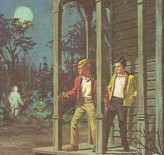
Happy New Year!
This blog has become a ghost site - I thought it was bad last year, or the year before, but - 4 posts? Why bother at all? Well - if I could get back to posting, I suppose that would be the answer in itself. I won't promise it. As it is - it's as good a place as any to toss some thoughts out into the world, to let them float in the ether on a sea of forced metaphors. It's as good a place as any to welcome the new decade, to bid the last one farewell and all.
It was a strange decade. For me, personally, it began on something of an all time low: my mother died, the day after Christmas, in 2009; 2010 began with her funeral. There has been a lot of that this decade - I am of an age when the generations before me are starting to die. My father, a couple close friends, many uncles and aunts have passed, some of them very hard to process. But - I am of an age when that is going to happen. I am getting perilously close to the age when having my contemporaries die will seem less like a shock and more of the natural way of things. Another decade and I will be there, I am afraid.
But that said: the first half of the 2010s weren't a bad time for me. I moved to a place I liked, a good apartment, where I stayed for 7 years. I took classes, I wrote, I posted regularly, here, and sometimes on other blogs. I got out of the country a couple times, still played softball, sometimes well, I ate well, lived well. My job even seemed to reach a detente with me - though that got me accused of "complacency." That, of course, should have been a sign - was a sign - but - that's the second half of the decade. In all - I lived pretty well in the first half of the 10s. Even just using this blog as indication - I posted regularly; I started up a couple series that carried on a while, and gave me a chance to write some things I liked. History posts - following along with the Civil War, then WWI for a while; music posts, those band of the month posts; movies - screen shots and directors and things like that. It was good. I was, I think I would have to say, satisfied with my lot in life.
The second half fo the decade has been a bit different. Maybe not objectively - nothing really bad has happened to me, except of my own making (sort of) - but a lot of the things I was satisfied with had to go. And the world outside has gone straight to hell. For me - the job is what got me. Things changed. A generation of managers where I worked left, and a new generation came in - people who use words like "disruption" as a positive term; people who openly admitted to forming their management ideas by watching TED talks and reading online management consultants. The results were predictable. And I was not willing to take it, because I did not have to. I had resources to move, and did, though it meant I gave up living in the city - but I could live closer to my family, could support myself on a lot less money, and could engage in other past times - bowling and D&D in place of softball and education! So - not a bad tradeoff, over all. Though it changed me in strange ways. I went from being a fairly obsessive habitual movie goer to almost never going to movies, and barely even watching movies. I went from the blogging you see before 2017 to almost nothing since 2017. Some of this is me - some of this might be the world, the way the technology has evolved (as fewer and fewer blogs seem all that important - Twitter is where all the conversations seem to be happening. That is not a good thing.) BUt there is it.
And the world, of course, has gone to hell. It held on in the first half of the decade - but you could see the disaster coming. The mid-term elections in 2010 doomed us, giving the Republicans completely undeserved and unrepresentative control of the machinery of government that they have exploited to hold power as they sink into smaller and smaller minority status. The GOP, long having embraced white supremacy as a vital part of their politics, doubled down on it. They reacted shamefully to Obama's election, the worst of them used it to build the racist elements in the party. All this brought us to Trump, who has made all the racism, sexism, xenophobia and everything else the whole point of his existence. Was Trump a break from what the GOP had been? Maybe - there is a sense that earlier Republicans used racism as a way to get votes for their tax cuts. Trump and his closest supporters seem to be using tax cuts to keep support for their racism. The white supremacy seems to be their defining point. It sometimes seems like this is so.
And no? Trump himself is a plain fascist - he has all the makings: the racism, xenophobia, authoritarianism, use of violence for politics, corporatism, aestheticization of politics, turning it explicitly into spectacle, and working very hard to make only the spectacle seem to matter. (Though I think the most important element in the aesthetics of fascism is the idea of the dominance of Myth. It's the idea of a mythological justification - Make America Great Again. The red hats are part of it - but the idea of a lost golden age, an imaginary version fo the country that conforms to their political goals, etc, is what really defines fascism. This is an essay I am not going to write just now, though.) The country, of course, is something else - even now, he is only the president, one branch of government, he is a Republican, one party - if the other branches act, if the other parties resist, if his own party decides to try to not be fascists - he is not going to succeed in turning the country into something worse than it is. He has been impeached; there are elections coming; we will see how this goes.
But I don't want to write about the future. This is one last look back at the decade gone. So: the second half fo this decade - 2016 on at least - have gone from worse to worse. All the celebrity deaths in 2026 hit hard. My job went to hell in 2026. And Trump - getting elected came on top of a primary and election campaign that defied my ability to imagine the depths of stupidity possible int he American political system. Trump? The idiotic attacks on Hilary Clinton? Though the defenses of her were sometimes just as hard to take - I mean - how could any Democrat worth a damn vote for anyone who voted for the war in Iraq? why was that forgiven? I don't know. Now - 2020 - big chunks of the country, the Democrats in particular, seem determined to relive 2016. I don't get this. Why does so much of the discussion in the Democratic party revolve around Bernie Sanders (and by extension, Hilary Clinton?) That might be because I read Twitter and Facebook too much - that is a topic unto itself. The point is, 2016 was awful even before Trump got elected; his election just made sure the next 4 years would be even worse.
All right. That is enough. One more thing - just a hint. Technology - here is something I have been thinking about lately. There are major technological shifts going on - streaming, Disney's domination of the entertainment industry, the effects on discourse of Twitter and FAcebook, etc. But have there been any real technological changes in the last 10 years? Twitter and Fecebook existed in 2010; youtube did; streaming services existed. Digital film distribution. Almost everyhting that defines the technological world now existed, was even fairly significant, in 2010. Compare 2010 to 200 - that is not true. The 00s brought us youtube, Facebook and Twitter and MySpace and all the other dumber forms of online communication. It brought ius smart phones, tablets, iPods, it started streaming services. Or the 90s - from 1990 to 2000 we gaines DVDs, the world wide net and the popularization of the internet; computers changed fairly significantly; digital photography and video started to appear (though they became ubiquitous in the 00s). What has appeared int he 2010s that has changed things the way - any of a dozen things changed the world in the previous decades? This has been more about cultural shifts to accommodate technology - which have mostly felt bad: corporate control over all of it; the colonization of places like Facebook and Twitter by propagandists, who have made all of us amateur propagandists and ad writers. Another reason to worry, I guess.
But I won't end with pessimism. I like a lot of what the world offers. I can lose days browsing through YouTube - I don't know why videos have replaced blogs as the preferred method of amateur communication, but it seems they have. 10 years ago, I counted mostly blogs as the most interesting sources of information and discussion online. Now? it tends to be youtubers - Seth Skorkowsky! The History Guy! Scholagladatoria! (All reflecting my recent interest in games and history, no doubt.) Is this better than reading blogs? I won't say yes - but it's still a nice feature of the internet, the ease with which people with interesting things to say can communicate with the world, without a lot of extraneous resources.
And so - happy new year! Happy new decade! And here's hoping I manage to post something here before 2030...
Showing posts with label blogs. Show all posts
Showing posts with label blogs. Show all posts
Wednesday, January 01, 2020

Wednesday, May 23, 2018
Get Smart
And here is the first of my three essays posted at Wonders in the Dark - Get Smart! And a bit about The Sitcom, in the 60s at least...

I love 60s sitcoms. Even now, along with a few British shows, and cartoons (Simpsons or Futurama or Bevis and Butthead) they are the sit coms I am most likely to watch when they come on TV, even ahead of great shows like Seinfeld, or All in the Family or Taxi or MASH. Get Smart, Batman, Hogan’s Heroes - even the Beverly Hillbillies - I can always watch those shows.
It’s personal preference, shows I grew up on (though already in syndication; watching them at 4 in the afternoon, between Gunsmoke and Mr. Rogers), but it’s also the style. Sitcoms changed in the 60s - especially in the mid-60s. The culture changed; the technology changed (color TV!) - sitcoms shifted along with these things. The early classics - I Love Lucy, The Honeymooners, Leave it to Beaver - were all domestic shows, centered in the home; this was still the case in the early 60s, with shows like My Three Sons, The Andy Griffith Show, though the latter is as much about the town as his home. But around the middle of the 60s, shows started to appear that were more and more set outside the home - Get Smart, Hogan’s Heroes, Batman, Gilligan’s Island. And shows still built around home and family started to get a bit stranger - Bewitched and its magic, The Munsters and Addams Family, with their monsters, even the Beverly Hillbillies, with it’s over the top farce (it’s Li’l Abner vibe.) The technology changed - most of these shows were in color; most of them used single camera setups rather than multi-camera live shooting. And the tone changed - they were parodic, satiric, they embraced absurdity, camp, surrealism. They stopped trying to be realistic, they stopped pretending to be about people like you and me in naturalistic (if comic and extreme) situations - they embraced genre stories, and made fun of them, usually by combining commonplace situations (going to work, hanging with your friends, or even the old domesticity of sitcoms) with absurd situations - spies, POWs, witches, superheroes. In many ways, they adopted the style and tone of cartoons, comic strips, comic books - directly, when it comes to the Addams Family or Batman, but a lot of these shows share the style.
It didn’t last. Sitcoms in the 70s developed in a different direction - even political and socially aware shows became naturalistic again, treated their characters and situations as real people. All in the Family and Normal Lear’s other shows; Happy Days; and all the (wonderful) workplace comedies of the 70s - The Mary Tyler Moore Show, MASH, Taxi, Barney Miller - did this. Showed real work places, not comic spy headquarters or German POW camps; dropped the genre parodies, the absurdity, the magic and science fiction. The 70s was a great era for sitcoms - but I miss the weirdness of the 60s.
And none of them did it better than Get Smart. It was developed and written by Mel Brooks and Buck Henry (with Henry staying on as story editor for two years), conceived as a combination of James Bond and Inspector Clouseau. It starred Don Adams, Barbara Feldon and Ed Platt, plus a mob of character actors, with single or recurring roles. It ran 5 seasons, 4 on NBC and one on CBS, fading a bit through the years, and engaging in more than a few cheap ratings boosts in latter years, though we don’t need to dwell on that. And it was exemplary of the kind of show I am talking about here. It was made right when shows switched to color - the pilot is black and white, but the rest of the show is color; it was a single camera show for it’s whole run; it was a genre parody, and one that let in a lot of genre nonsense - spies and adventure, and funny gadgets, and straight up science fiction; it was never shy about parodying other culture - movies, other TV shows, and so on; it was packed with in-jokes, puns, references outside the show (names and titles and such); and it was a work place comedy, combining the goofy spy stuff with the banalities of an office job, using both to send up the other.
And it was brilliant. The talent was top flight - Brooks and Henry are as good a pair of originators as you could ask, and the rest of the team measured up as well. Leonard Stern and Jay Sandrich, Irving Szathmary’s glorious theme song and scores, a host of fine writers to create the show. It featured a host of outstanding supporting players, but the cast - the three leads were perfect.
Don Adams carried it, of course - he’s ideal, a perfect buffoon, with his weird voice and beady little eyes, his physical flair, the way he walks, the way he could move, the way he wore a suit. It helps that he’s a little guy, looking up to everyone around him (including 99, when he didn’t pull her down to his eye level), vain and silly, his size making him a bit more ridiculous, but also a bit more sympathetic than he could have been. He is great at everything - the broad physical comedy, the little stuff (the way he can smoke or put out a cigarette), the voices, the serious detectiving, the oblivion, the prudishness and occasional bout of lust - he was always great. He had a mile long list of catch phrases, but always seemed to deliver them as though he were thinking of them for the first time ever - except when it was funnier to think he’d used the same line 4 times this month already. He was great.
His two main foils more than hold their own. Barbara Feldon was gorgeous, with a husky, sexy voice - and she was a fine actress, and marvelous comedian. The writers didn’t give her the gags they gave Max and the Chief, but she got all the reactions, and she played them with the precision and timing that Adams played the jokes. She had an infinite supply of eye rolls and head tilts, side eyes and body language, that convey a kind of infinite patience, as though she were managing this idiot until he needed to do something heroic. And Ed Platt embodies sober authority, but with a slow burn, driven to distraction by Max, but never quite breaking, and recovering when he did - he didn’t have 99’s infinite patience, or her understanding that idiot or not, Max was blessed by the gods (or the writers) and would always come out right, so he blew up now and then, but he always recovered - and could sell the idea that he was in control all along, no matter how bad things got, how ridiculous Max's solution was, Platt could make it seem as though that was what the Chief had in mind from the start. With that voice - he could sell anything.

They were a great trio. They could carry all the modes of the show - the spy stuff, but also the workplace stuff and the social stuff. The workplace comedy was obvious from the beginning: in the pilot, Max clocks in when he enters the chief’s office, mentions overtime later - the show always had that element. Office politics, boss/employee dynamics, money - wages, benefits - unions, perks, the competition, part time work, interdepartmental rivalries, regulations, paperwork, anything you could imagine in a workplace comedy. Some of it more than you’d see in actual workplace comedies later - unions and wages and benefits and hours and such, especially. The show plays the workplace jokes against the spy jokes, a pattern that extends across everything in the show. The adventure stuff is constantly deflated with banality: the Job, or things like dialing wrong numbers, the indifference the population seems to have to all their gunplay and brawling, or just the way everyone in Washington seems to know who Control is, where they are located, what their phone number is, sometimes before the spies do. And it goes the other way - the everyday concerns of an office job or apartment life travestied by throwing spies and science fiction machines and gunplay into it. Those marvelous machines - show phones, and all the other places they hid phones; the protective devices in Max's apartment; the Cone of Silence; all the inflato-coats and lipstick guns and radio controlled pool balls and giant arrows and everything else - which parody James Bond, but also mean that the spy stuff is buried deep into their everyday lives. Kind of like the way phones and computers and technology is buried into our lives, now....

There’s more of course. Get Smart was political - a cold war comedy that mocked the cold war from start to finish. A war time comedy that mocked the military, as well as spies, as well as cops - it was a product of its time, maybe, however much it also mocked the counterculture. It was a product of its time in less admirable ways too - ethnic jokes and sexism - but these things weren’t straightforward. It had plenty of ethnic jokes - but they were as often about the people who held stereotypes as they were stereotypes themselves. And sexist jokes - Max got the lines, the action, the story, at 99’s expense; this got really bad in the last year or so, when poor 99 married him, and was confined to the house for most of the last two seasons - but it also made fun of sexism. One of their running gags is 99 coming up with a good idea, an important question, a way out of their predicament, and Max either ignoring her or saying he’d rather do it his way. 99 always defers - and Max always does what she suggested. Shoot - I saw someone making fun of that on Twitter the other day! Max the mansplainer, in 1965. There is a lot of that - with 99 and Max, with the racial and ethnic jokes they make. They play the jokes both ways - it can be complicated.

Of course, a lot of it depends on the fact that nothing, in this show, is taken seriously. I mean - nothing is treated as though it were real. There is no sense that Max or 99 or the Chief, or any of the villains and supporting characters, are real, in the way Mary Richards or Hawkeye or Archie Bunker are treated as though they are real. There is always distance - always a sense of unreality. Characters don’t have to be consistent, in this world: Max can be an idiot for 20 minutes then turn into James Bond himself for the last act. Max can be a prude in one show and a skirt chaser in the next, without missing a beat. He respects 99, he ignores 99, he flirts with 99, he’s oblivious to 99. Situations are ridiculous - machines that vaporize buildings and people without a trace; magnets that can sink a whole fleet; masters of disguise who can turn into anyone (and do - they loved that plot device!); the chief and Larrabee - or even Siegfried, complete with a mustache - dressed up as old ladies, and no one noticing. And all of it completely pliable - half the world might be destroyed, but there they all are at the end back in the office arguing about time off and whether KAOS gets better benefits. It’s not inconsistent - it’s as though the whole world was being made up again in every scene. It’s a cartoon aesthetic - not as explicit as Bugs Bunny or Krazy Kat, but it’s got the same sense that it’s not subject to any of the rules of god or man, except that it should be funny. It’s an aesthetic shared with a lot of sitcoms in the 60s, that then passed out of sitcoms - except for the animated ones. The Simpsons and Futurama, Family Guy and South Park can feel a lot like that era of TV. Though probably not as much as some of those 60s shows felt like Bugs Bunny or Pogo.
In short - it was a good one. Always funny - usually with decent story lines (though they clearly struggled sometimes to find 30 little spy stories every year for the show - a lot of them feel very thin.) Max is an icon, and 99 and the Chief (and Siegfried, especially) are not far behind. They created a host of running gags, that worked almost all the way through the show - I can't list them all can I? Missed it by that much! I asked you not to tell me that! The old X trick - second time I fell for it this month! I hope you don't mind that crack about the dummy. Sorry about that, Chief. Would you believe.... They created a host of cool and backing parts - Siegfried and Larrabee and a string of scientists to make up the gadgets, The Claw and Harry Hoo and Rupert of Rattskeller and a million lookalikes. (They leaned hard on doubles in this show - Alexi Sebastion, the Chameleon, the league of imposters, as well as Charles, King of Coronia, Connie and Floyd. They might have overdone it - but it's part of the style I think - nothing is real, nothing is permanent, no one is who they necessarily seem to be, and everything works out in the end.) I can watch this show all day and all night - it is as good as they come.


I love 60s sitcoms. Even now, along with a few British shows, and cartoons (Simpsons or Futurama or Bevis and Butthead) they are the sit coms I am most likely to watch when they come on TV, even ahead of great shows like Seinfeld, or All in the Family or Taxi or MASH. Get Smart, Batman, Hogan’s Heroes - even the Beverly Hillbillies - I can always watch those shows.
It’s personal preference, shows I grew up on (though already in syndication; watching them at 4 in the afternoon, between Gunsmoke and Mr. Rogers), but it’s also the style. Sitcoms changed in the 60s - especially in the mid-60s. The culture changed; the technology changed (color TV!) - sitcoms shifted along with these things. The early classics - I Love Lucy, The Honeymooners, Leave it to Beaver - were all domestic shows, centered in the home; this was still the case in the early 60s, with shows like My Three Sons, The Andy Griffith Show, though the latter is as much about the town as his home. But around the middle of the 60s, shows started to appear that were more and more set outside the home - Get Smart, Hogan’s Heroes, Batman, Gilligan’s Island. And shows still built around home and family started to get a bit stranger - Bewitched and its magic, The Munsters and Addams Family, with their monsters, even the Beverly Hillbillies, with it’s over the top farce (it’s Li’l Abner vibe.) The technology changed - most of these shows were in color; most of them used single camera setups rather than multi-camera live shooting. And the tone changed - they were parodic, satiric, they embraced absurdity, camp, surrealism. They stopped trying to be realistic, they stopped pretending to be about people like you and me in naturalistic (if comic and extreme) situations - they embraced genre stories, and made fun of them, usually by combining commonplace situations (going to work, hanging with your friends, or even the old domesticity of sitcoms) with absurd situations - spies, POWs, witches, superheroes. In many ways, they adopted the style and tone of cartoons, comic strips, comic books - directly, when it comes to the Addams Family or Batman, but a lot of these shows share the style.
It didn’t last. Sitcoms in the 70s developed in a different direction - even political and socially aware shows became naturalistic again, treated their characters and situations as real people. All in the Family and Normal Lear’s other shows; Happy Days; and all the (wonderful) workplace comedies of the 70s - The Mary Tyler Moore Show, MASH, Taxi, Barney Miller - did this. Showed real work places, not comic spy headquarters or German POW camps; dropped the genre parodies, the absurdity, the magic and science fiction. The 70s was a great era for sitcoms - but I miss the weirdness of the 60s.
And none of them did it better than Get Smart. It was developed and written by Mel Brooks and Buck Henry (with Henry staying on as story editor for two years), conceived as a combination of James Bond and Inspector Clouseau. It starred Don Adams, Barbara Feldon and Ed Platt, plus a mob of character actors, with single or recurring roles. It ran 5 seasons, 4 on NBC and one on CBS, fading a bit through the years, and engaging in more than a few cheap ratings boosts in latter years, though we don’t need to dwell on that. And it was exemplary of the kind of show I am talking about here. It was made right when shows switched to color - the pilot is black and white, but the rest of the show is color; it was a single camera show for it’s whole run; it was a genre parody, and one that let in a lot of genre nonsense - spies and adventure, and funny gadgets, and straight up science fiction; it was never shy about parodying other culture - movies, other TV shows, and so on; it was packed with in-jokes, puns, references outside the show (names and titles and such); and it was a work place comedy, combining the goofy spy stuff with the banalities of an office job, using both to send up the other.
And it was brilliant. The talent was top flight - Brooks and Henry are as good a pair of originators as you could ask, and the rest of the team measured up as well. Leonard Stern and Jay Sandrich, Irving Szathmary’s glorious theme song and scores, a host of fine writers to create the show. It featured a host of outstanding supporting players, but the cast - the three leads were perfect.
Don Adams carried it, of course - he’s ideal, a perfect buffoon, with his weird voice and beady little eyes, his physical flair, the way he walks, the way he could move, the way he wore a suit. It helps that he’s a little guy, looking up to everyone around him (including 99, when he didn’t pull her down to his eye level), vain and silly, his size making him a bit more ridiculous, but also a bit more sympathetic than he could have been. He is great at everything - the broad physical comedy, the little stuff (the way he can smoke or put out a cigarette), the voices, the serious detectiving, the oblivion, the prudishness and occasional bout of lust - he was always great. He had a mile long list of catch phrases, but always seemed to deliver them as though he were thinking of them for the first time ever - except when it was funnier to think he’d used the same line 4 times this month already. He was great.
His two main foils more than hold their own. Barbara Feldon was gorgeous, with a husky, sexy voice - and she was a fine actress, and marvelous comedian. The writers didn’t give her the gags they gave Max and the Chief, but she got all the reactions, and she played them with the precision and timing that Adams played the jokes. She had an infinite supply of eye rolls and head tilts, side eyes and body language, that convey a kind of infinite patience, as though she were managing this idiot until he needed to do something heroic. And Ed Platt embodies sober authority, but with a slow burn, driven to distraction by Max, but never quite breaking, and recovering when he did - he didn’t have 99’s infinite patience, or her understanding that idiot or not, Max was blessed by the gods (or the writers) and would always come out right, so he blew up now and then, but he always recovered - and could sell the idea that he was in control all along, no matter how bad things got, how ridiculous Max's solution was, Platt could make it seem as though that was what the Chief had in mind from the start. With that voice - he could sell anything.

They were a great trio. They could carry all the modes of the show - the spy stuff, but also the workplace stuff and the social stuff. The workplace comedy was obvious from the beginning: in the pilot, Max clocks in when he enters the chief’s office, mentions overtime later - the show always had that element. Office politics, boss/employee dynamics, money - wages, benefits - unions, perks, the competition, part time work, interdepartmental rivalries, regulations, paperwork, anything you could imagine in a workplace comedy. Some of it more than you’d see in actual workplace comedies later - unions and wages and benefits and hours and such, especially. The show plays the workplace jokes against the spy jokes, a pattern that extends across everything in the show. The adventure stuff is constantly deflated with banality: the Job, or things like dialing wrong numbers, the indifference the population seems to have to all their gunplay and brawling, or just the way everyone in Washington seems to know who Control is, where they are located, what their phone number is, sometimes before the spies do. And it goes the other way - the everyday concerns of an office job or apartment life travestied by throwing spies and science fiction machines and gunplay into it. Those marvelous machines - show phones, and all the other places they hid phones; the protective devices in Max's apartment; the Cone of Silence; all the inflato-coats and lipstick guns and radio controlled pool balls and giant arrows and everything else - which parody James Bond, but also mean that the spy stuff is buried deep into their everyday lives. Kind of like the way phones and computers and technology is buried into our lives, now....

There’s more of course. Get Smart was political - a cold war comedy that mocked the cold war from start to finish. A war time comedy that mocked the military, as well as spies, as well as cops - it was a product of its time, maybe, however much it also mocked the counterculture. It was a product of its time in less admirable ways too - ethnic jokes and sexism - but these things weren’t straightforward. It had plenty of ethnic jokes - but they were as often about the people who held stereotypes as they were stereotypes themselves. And sexist jokes - Max got the lines, the action, the story, at 99’s expense; this got really bad in the last year or so, when poor 99 married him, and was confined to the house for most of the last two seasons - but it also made fun of sexism. One of their running gags is 99 coming up with a good idea, an important question, a way out of their predicament, and Max either ignoring her or saying he’d rather do it his way. 99 always defers - and Max always does what she suggested. Shoot - I saw someone making fun of that on Twitter the other day! Max the mansplainer, in 1965. There is a lot of that - with 99 and Max, with the racial and ethnic jokes they make. They play the jokes both ways - it can be complicated.

Of course, a lot of it depends on the fact that nothing, in this show, is taken seriously. I mean - nothing is treated as though it were real. There is no sense that Max or 99 or the Chief, or any of the villains and supporting characters, are real, in the way Mary Richards or Hawkeye or Archie Bunker are treated as though they are real. There is always distance - always a sense of unreality. Characters don’t have to be consistent, in this world: Max can be an idiot for 20 minutes then turn into James Bond himself for the last act. Max can be a prude in one show and a skirt chaser in the next, without missing a beat. He respects 99, he ignores 99, he flirts with 99, he’s oblivious to 99. Situations are ridiculous - machines that vaporize buildings and people without a trace; magnets that can sink a whole fleet; masters of disguise who can turn into anyone (and do - they loved that plot device!); the chief and Larrabee - or even Siegfried, complete with a mustache - dressed up as old ladies, and no one noticing. And all of it completely pliable - half the world might be destroyed, but there they all are at the end back in the office arguing about time off and whether KAOS gets better benefits. It’s not inconsistent - it’s as though the whole world was being made up again in every scene. It’s a cartoon aesthetic - not as explicit as Bugs Bunny or Krazy Kat, but it’s got the same sense that it’s not subject to any of the rules of god or man, except that it should be funny. It’s an aesthetic shared with a lot of sitcoms in the 60s, that then passed out of sitcoms - except for the animated ones. The Simpsons and Futurama, Family Guy and South Park can feel a lot like that era of TV. Though probably not as much as some of those 60s shows felt like Bugs Bunny or Pogo.
In short - it was a good one. Always funny - usually with decent story lines (though they clearly struggled sometimes to find 30 little spy stories every year for the show - a lot of them feel very thin.) Max is an icon, and 99 and the Chief (and Siegfried, especially) are not far behind. They created a host of running gags, that worked almost all the way through the show - I can't list them all can I? Missed it by that much! I asked you not to tell me that! The old X trick - second time I fell for it this month! I hope you don't mind that crack about the dummy. Sorry about that, Chief. Would you believe.... They created a host of cool and backing parts - Siegfried and Larrabee and a string of scientists to make up the gadgets, The Claw and Harry Hoo and Rupert of Rattskeller and a million lookalikes. (They leaned hard on doubles in this show - Alexi Sebastion, the Chameleon, the league of imposters, as well as Charles, King of Coronia, Connie and Floyd. They might have overdone it - but it's part of the style I think - nothing is real, nothing is permanent, no one is who they necessarily seem to be, and everything works out in the end.) I can watch this show all day and all night - it is as good as they come.

Gunsmoke
Here's another piece I posted last week on Wonders in the Dark, as part of their TV countdown.

Gunsmoke was the first and last - the first (or almost the first) western for grownups on TV; and very nearly the last western of any kind of TV. Lasting 20 years will do that - you're first, you outlast your peers, and sometimes your entire genre. When it came on TV, it led to a flood of similar shows - The Rifleman, Have Gun Will Travel, many others - that shared its grown up approach the western, and its artistic values, and serving, as it did, as a launching ground for many significant actors and directors. It stayed on TV all those years because it was a very fine show - begun as a serious show, and taken seriously, with quality writing, a fantastic cast, solid production values, and consistently fine craft. They brought in first rate guest stars, they brought in first rate directors, they gave them first rate scripts - 635 episodes worth (though I suppose not all 635 were first rate; I can point you to some stinkers) - it changed through the years, but it was always watchable.
I watched it, of course, when I was a kid, both the reruns and the new ones. I didn't care if it had been on forever; I didn't really know it had been on that long until people started talking about it. I never saw any of the black and white shows until a long time after - they weren't the ones in reruns. It didn't matter. It was probably my favorite show when I was a kid, maybe right up to the time it went off the air, maybe beyond. (And not just the show: I read the books too - over and over, in fact; I liked Gunsmoke.) I liked all westerns - Gunsmoke and Bonanza and Big Valley, especially - but even then, I could tell Gunsmoke had an edge on them. I could tell it was more serious - it had action and excitement, good guys and bad guys, but it had characters too, who had depth, and breadth. More than that, maybe (since Bonanza and Big Valley were also strong on character), it had stories that were deeper and smarter than those other shows. I couldn't have described the difference then, and barely can now, but it's there - maybe it had something to do with the stakes - on Gunsmoke things seemed to matter a bit more.
It was designed that way. It was created for radio, and conceived as a hard-boiled western, explicitly reminiscent of Raymond Chandler (inspired by the Philip Marlowe radio show, in fact) - you can hear it in the early shows. Robbery, murder, lynch mobs, venal newspapermen gloating about circulation and Doc Adams angling for more autopsies, Matt accused of having an affair, and an innocent little boy who turns out to be the killer, and William Conrad as Dillon narrating and ruminating (in the best Raymond Chandler style) about how awful human beings really are. And that's just the first episode! (Here it is, on YouTube: "Billy the Kid"). The darkness didn't entirely carry over to the TV version, a couple years later - but there's plenty of it there. The first show has Matt soliloquizing on Boot Hill about the "Gomorrah of the Plains", keeps a good dose of his bitterness and sarcasm, and his strong sense of isolation (walking away alone as he does), in a story with a cold blooded killer, who just wants to be left alone. (You can see it here: "Matt Gets It", complete with John Wayne telling the audience that this show was going to last a while.) Chandler's influence is still there - Matt loses a gun fight in that first show, and when he recovers, has to go back to try again - that's pretty much standard procedure for a Hammett or Chandler character. And Matt has to outsmart the gunslinger - another bit you see in those classic detective stories. Marlowe would be proud.
As the show evolved, some of that fell away. Even on the radio, the characters had softened - Doc Adams, say, is a pretty nasty piece of work in those early shows. The ensemble, the relationships among the characters became more important, and anchored the show through those 20 years - but it still maintained the grown up approach. The material is dark, full of violence and cruelty, but its maturity is also in the complexity of the characters, both good guys and bad guys. Heroes fail - they can be selfish and unpleasant like the doctor sometimes, physically damaged like Chester, morally compromised like Miss Kitty might be. And the villains are seldom simplistic - they have reasons for what they do; they can be charming, some can be plaintive. If someone starts threatening bar girls, you can bet he lost a daughter or granddaughter somewhere along the line. Many episodes work in multiple foils for Matt Dillon, putting him between a couple hard bitten killers, or a couple aggrieved families - everyone with their reasons. And in those early shows, he fails as often as not - at least, fails to stop other people from massacring each other, or ends up killing people he tried very hard not to have to kill. He's there to keep the peace, but there isn't a lot of peace to keep.
This aspect is more pronounced in the early years - by the end, Matt and his friends were pretty well ascended to godhood, the villains tended to be a bit more simplistic, and the guest stars were usually a bit more obviously on the good or evil side. But it never went away completely. It evolved out of the noirish style of the early shows, into something else, though something still rooted in adult problems and complex behavior. The evolotution is reflected in Matt himself - the angry, brooding, tarnished hero of the radio show and early TV gave way to a stoic, strong hero, one who passes through the mire without being soiled. That's not criticism - it's just different, more Gary Cooper, less Bogie, if that makes sense. That element took over pretty quickly, I suppose - looking at James Arness, you couldn't quite picture him as anything other than a strong silent type - if he had stayed bitter and cracked, he would have been terrifying - John Wayne in The Searchers, maybe, something more disturbing than any villain could be. This change didn't hurt the show - it made Matt into a central hub for the rest of the show to revolve around. It made the dynamics of the cast, the strengths of the guest stars, and the stories themselves shine, with Dillon as anchor, and often as a kind of light that illuminates the nature of others.

Gunsmoke lasted a long time, surviving many changes to the technology and form of television. It moved from radio to TV, first as a half hour show, later as an hour. In the mid-60s, it switched to color. It changed through the years, but generally maintained its quality - though it's hard to miss how much better it was earlier. That's something I learned late - the color shows were the ones in syndication, in the early 70s, and onward - that's what I saw when I was 10, what I watched now and then through the 80s and 90s - it's what I knew. They were fine shows - they made me think I had good taste when I was 10... But then I saw the black and white episodes. They were a revelation. The half hour shows are superb - tight, efficient little morality plays that never really preach, great looking, with sharp, memorable characters, and even then, a cool mix of action, drama, comedy. They were great shows - but I think the show really blossomed with the hour long format.
They had room. Even now, watching the half hour shows, they can go by a bit too quickly - they don't get the chance to linger and develop - and it's the lingering and development that made Gunsmoke so good. The hour long episodes have everything: well developed stories, with characters who have time to evolve in the course of the show, to work out multiple relationships. It feels as though every black and white hour long show I remember was some kind of trip - maybe those shows were aired more often; maybe they're the ones I remember best. But there are good reasons why journeys are a staple of story telling (and most definitely of westerns) - a chance to put a number of characters in a situation and let it stew. Those shows end up being some of the best hour long shows ever made for TV.

The black and white episodes have another advantage - they look fantastic. The sets, costumes, props are all very well chosen - and in the black and white episodes,they look right. They look beat up, shabbier, dirtier; cabins and houses and street and fields look like hard places to live - they look real. The color shows lost some of this. Color, I suspect, shows up how clean the sets and clothes are; even artfully mistreated props, like Festus' costumes, look a bit too artfully messed up. Did they get more conventional later? does black and white indicate grime and wear better? Maybe. But part of it, I think, is that the later shows fell out of step with western movies. The early Gunsmokes were contemporary with films like Anthony Mann's westerns, Budd Boetticher's, mature films by Hawks and Ford, classics like Shane and High Noon. TV couldn't match the production values of top of the line films - but they could match their look. (And low budget westerns thrived in those days as well - filmmakers knew how to make westerns look good no matter what the budget.) But western films evolved between 1955 and 1970, evolved as much as any genre did. Content restrictions disappeared - you could show far more, and what seemed dark on TV in 1955 looked old fashioned next to The Wild Bunch or The Good, the Bad and the Ugly. Films brought in outside influences - Japanese films; European films. The style became more extreme; the look became grittier, grimier. Gunsmoke in the 70s didn't look at all like contemporary westerns (at least not the best of them.) It's a jarring effect: it makes everything, in the later shows, look clean, antiseptic, in ways the older ones never dd. By 1975, it was the last western on TV, maybe not that bad a show, but somehow it felt old, rote, even compared to what you expected to see in a western. And so it went, and that was that.
But it had a magnificent run. It set off a run of serious western shows; it has had an influence beyond. Matt Dillon is an icon - but so are others, particularly Doc. (I offer Star Trek's Bones as evidence; heck - I could offer Brad Dourif, on Deadwood, riffing on Doc, maybe more the early radio Doc, but still.) The cast and characters of the show were, in fact, fantastic. Arness, Stone, Blake and both Dennis Weaver and Ken Curtis - great actors playing fascinating characters, that the writers seemed to understand. Coming off writing about Get Smart, a show that gave in to ratings desperation at the end, do you know how refreshing it is to see a male and female lead not ever get together? At least not marry (though Matt seemed to know where her room was located in the early shows...) - how many long running shows were able to keep that discipline? The main cast is matched by the guests, often as not - what a pleasure it is to watch someone like Warren Oates or Bruce Dern come in and chew up the scenery. Now - this was common enough practice in those days - a good many of those serious westerns did the same thing - brought on special guests; gave up and coming directors the chance to work. But they did it well on Gunsmoke.


Gunsmoke was the first and last - the first (or almost the first) western for grownups on TV; and very nearly the last western of any kind of TV. Lasting 20 years will do that - you're first, you outlast your peers, and sometimes your entire genre. When it came on TV, it led to a flood of similar shows - The Rifleman, Have Gun Will Travel, many others - that shared its grown up approach the western, and its artistic values, and serving, as it did, as a launching ground for many significant actors and directors. It stayed on TV all those years because it was a very fine show - begun as a serious show, and taken seriously, with quality writing, a fantastic cast, solid production values, and consistently fine craft. They brought in first rate guest stars, they brought in first rate directors, they gave them first rate scripts - 635 episodes worth (though I suppose not all 635 were first rate; I can point you to some stinkers) - it changed through the years, but it was always watchable.
I watched it, of course, when I was a kid, both the reruns and the new ones. I didn't care if it had been on forever; I didn't really know it had been on that long until people started talking about it. I never saw any of the black and white shows until a long time after - they weren't the ones in reruns. It didn't matter. It was probably my favorite show when I was a kid, maybe right up to the time it went off the air, maybe beyond. (And not just the show: I read the books too - over and over, in fact; I liked Gunsmoke.) I liked all westerns - Gunsmoke and Bonanza and Big Valley, especially - but even then, I could tell Gunsmoke had an edge on them. I could tell it was more serious - it had action and excitement, good guys and bad guys, but it had characters too, who had depth, and breadth. More than that, maybe (since Bonanza and Big Valley were also strong on character), it had stories that were deeper and smarter than those other shows. I couldn't have described the difference then, and barely can now, but it's there - maybe it had something to do with the stakes - on Gunsmoke things seemed to matter a bit more.
It was designed that way. It was created for radio, and conceived as a hard-boiled western, explicitly reminiscent of Raymond Chandler (inspired by the Philip Marlowe radio show, in fact) - you can hear it in the early shows. Robbery, murder, lynch mobs, venal newspapermen gloating about circulation and Doc Adams angling for more autopsies, Matt accused of having an affair, and an innocent little boy who turns out to be the killer, and William Conrad as Dillon narrating and ruminating (in the best Raymond Chandler style) about how awful human beings really are. And that's just the first episode! (Here it is, on YouTube: "Billy the Kid"). The darkness didn't entirely carry over to the TV version, a couple years later - but there's plenty of it there. The first show has Matt soliloquizing on Boot Hill about the "Gomorrah of the Plains", keeps a good dose of his bitterness and sarcasm, and his strong sense of isolation (walking away alone as he does), in a story with a cold blooded killer, who just wants to be left alone. (You can see it here: "Matt Gets It", complete with John Wayne telling the audience that this show was going to last a while.) Chandler's influence is still there - Matt loses a gun fight in that first show, and when he recovers, has to go back to try again - that's pretty much standard procedure for a Hammett or Chandler character. And Matt has to outsmart the gunslinger - another bit you see in those classic detective stories. Marlowe would be proud.
As the show evolved, some of that fell away. Even on the radio, the characters had softened - Doc Adams, say, is a pretty nasty piece of work in those early shows. The ensemble, the relationships among the characters became more important, and anchored the show through those 20 years - but it still maintained the grown up approach. The material is dark, full of violence and cruelty, but its maturity is also in the complexity of the characters, both good guys and bad guys. Heroes fail - they can be selfish and unpleasant like the doctor sometimes, physically damaged like Chester, morally compromised like Miss Kitty might be. And the villains are seldom simplistic - they have reasons for what they do; they can be charming, some can be plaintive. If someone starts threatening bar girls, you can bet he lost a daughter or granddaughter somewhere along the line. Many episodes work in multiple foils for Matt Dillon, putting him between a couple hard bitten killers, or a couple aggrieved families - everyone with their reasons. And in those early shows, he fails as often as not - at least, fails to stop other people from massacring each other, or ends up killing people he tried very hard not to have to kill. He's there to keep the peace, but there isn't a lot of peace to keep.
This aspect is more pronounced in the early years - by the end, Matt and his friends were pretty well ascended to godhood, the villains tended to be a bit more simplistic, and the guest stars were usually a bit more obviously on the good or evil side. But it never went away completely. It evolved out of the noirish style of the early shows, into something else, though something still rooted in adult problems and complex behavior. The evolotution is reflected in Matt himself - the angry, brooding, tarnished hero of the radio show and early TV gave way to a stoic, strong hero, one who passes through the mire without being soiled. That's not criticism - it's just different, more Gary Cooper, less Bogie, if that makes sense. That element took over pretty quickly, I suppose - looking at James Arness, you couldn't quite picture him as anything other than a strong silent type - if he had stayed bitter and cracked, he would have been terrifying - John Wayne in The Searchers, maybe, something more disturbing than any villain could be. This change didn't hurt the show - it made Matt into a central hub for the rest of the show to revolve around. It made the dynamics of the cast, the strengths of the guest stars, and the stories themselves shine, with Dillon as anchor, and often as a kind of light that illuminates the nature of others.
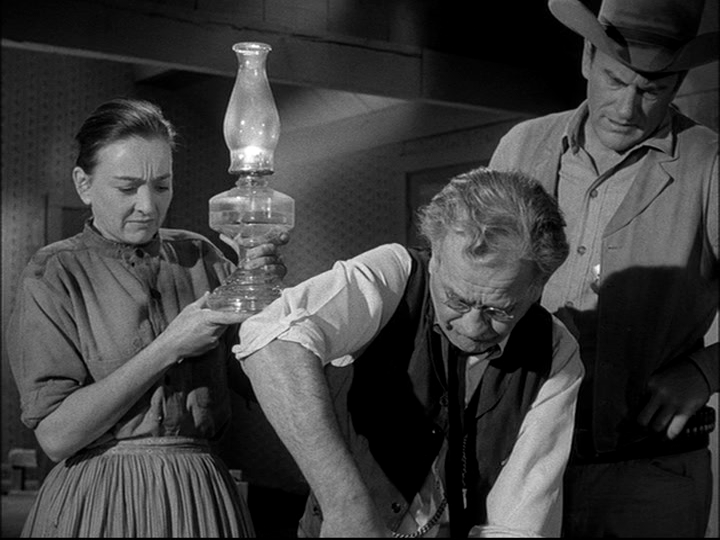
Gunsmoke lasted a long time, surviving many changes to the technology and form of television. It moved from radio to TV, first as a half hour show, later as an hour. In the mid-60s, it switched to color. It changed through the years, but generally maintained its quality - though it's hard to miss how much better it was earlier. That's something I learned late - the color shows were the ones in syndication, in the early 70s, and onward - that's what I saw when I was 10, what I watched now and then through the 80s and 90s - it's what I knew. They were fine shows - they made me think I had good taste when I was 10... But then I saw the black and white episodes. They were a revelation. The half hour shows are superb - tight, efficient little morality plays that never really preach, great looking, with sharp, memorable characters, and even then, a cool mix of action, drama, comedy. They were great shows - but I think the show really blossomed with the hour long format.
They had room. Even now, watching the half hour shows, they can go by a bit too quickly - they don't get the chance to linger and develop - and it's the lingering and development that made Gunsmoke so good. The hour long episodes have everything: well developed stories, with characters who have time to evolve in the course of the show, to work out multiple relationships. It feels as though every black and white hour long show I remember was some kind of trip - maybe those shows were aired more often; maybe they're the ones I remember best. But there are good reasons why journeys are a staple of story telling (and most definitely of westerns) - a chance to put a number of characters in a situation and let it stew. Those shows end up being some of the best hour long shows ever made for TV.

The black and white episodes have another advantage - they look fantastic. The sets, costumes, props are all very well chosen - and in the black and white episodes,they look right. They look beat up, shabbier, dirtier; cabins and houses and street and fields look like hard places to live - they look real. The color shows lost some of this. Color, I suspect, shows up how clean the sets and clothes are; even artfully mistreated props, like Festus' costumes, look a bit too artfully messed up. Did they get more conventional later? does black and white indicate grime and wear better? Maybe. But part of it, I think, is that the later shows fell out of step with western movies. The early Gunsmokes were contemporary with films like Anthony Mann's westerns, Budd Boetticher's, mature films by Hawks and Ford, classics like Shane and High Noon. TV couldn't match the production values of top of the line films - but they could match their look. (And low budget westerns thrived in those days as well - filmmakers knew how to make westerns look good no matter what the budget.) But western films evolved between 1955 and 1970, evolved as much as any genre did. Content restrictions disappeared - you could show far more, and what seemed dark on TV in 1955 looked old fashioned next to The Wild Bunch or The Good, the Bad and the Ugly. Films brought in outside influences - Japanese films; European films. The style became more extreme; the look became grittier, grimier. Gunsmoke in the 70s didn't look at all like contemporary westerns (at least not the best of them.) It's a jarring effect: it makes everything, in the later shows, look clean, antiseptic, in ways the older ones never dd. By 1975, it was the last western on TV, maybe not that bad a show, but somehow it felt old, rote, even compared to what you expected to see in a western. And so it went, and that was that.
But it had a magnificent run. It set off a run of serious western shows; it has had an influence beyond. Matt Dillon is an icon - but so are others, particularly Doc. (I offer Star Trek's Bones as evidence; heck - I could offer Brad Dourif, on Deadwood, riffing on Doc, maybe more the early radio Doc, but still.) The cast and characters of the show were, in fact, fantastic. Arness, Stone, Blake and both Dennis Weaver and Ken Curtis - great actors playing fascinating characters, that the writers seemed to understand. Coming off writing about Get Smart, a show that gave in to ratings desperation at the end, do you know how refreshing it is to see a male and female lead not ever get together? At least not marry (though Matt seemed to know where her room was located in the early shows...) - how many long running shows were able to keep that discipline? The main cast is matched by the guests, often as not - what a pleasure it is to watch someone like Warren Oates or Bruce Dern come in and chew up the scenery. Now - this was common enough practice in those days - a good many of those serious westerns did the same thing - brought on special guests; gave up and coming directors the chance to work. But they did it well on Gunsmoke.


Tuesday, May 22, 2018
Columbo
(Despite the lack of posts here, I have been busy lately - this is the third of three posts in about a week for the epic TV countdown at Wonders in the Dark - this one for Columbo.

Somewhere in Los Angeles are two people who hate each other - or at least one of them hates the other one. Maybe we will see them together; maybe we will see them separately; maybe we will just see one of them, going about some strange ritual. Maybe they'll talk - maybe they will be, or act, friendly, but more likely they will quarrel. Either way, one of this is going to kill the other. Maybe we see the killer covering up the crime; maybe we now recognize that their rituals were aimed at hiding the crime. By the time the first commercial comes, it looks like they will get away with it. When we come back, the police are on hand. Among them is a dumpy looking guy in a raincoat, who putters around, and notices things; he sticks his nose into conversations; he looks at the bodies; he talks to the relatives. He probably talks to the killer, and he'll probably notice something when he does. By the end of the first scene we know there's more to this guy than meets the eye. Over the next hour, he'll keep running into the killer, and it's going to take the killer longer to catch on that there's more to him than meets the eye, but he will - but by then it will be too late.
That is Columbo, and for my money, it's the best show ever made on network television in the USA. Columbo ran 7 years in the 1970s, came back for a couple more seasons and string of TV movies in the 80s and 90s, and every episode (except one or two here and there) fit that description above. The shows were a series of little movies, 90-100 minutes long, airing in rotation with a number of other shows (McCloud and McMillan & Wife, later Hec Ramsey too) in its first run - the longer production schedules (a show a month, instead of a show a week) meant episodes were made with a lot more care than the average TV show of the time. They looked it. It starred Peter Falk, and brought in high profile guest stars, writers and directors, as prestige television has always done. Columbo's early years boast Steven Bochco and Steven Spielberg at the start of their careers; later years featured people like Jonathan Demme, and along the way, any number of Hollywood veterans and actors got a shot behind the camera - Richard Quine and Leo Penn; Ben Gazzara and Patrick McGoohan. And of course a parade of guest stars, to kill and be killed, or sometimes to offer dubious advice in the role of lawyers or uncles or ex-hubands and wives.

It originated as a television episode, became a play, then a TV movie, written by Richard Levinson and William Link. They built a detective out of Crime and Punishment and Father Brown, and used the Crime and Punishment plot as their template: we see the crime, know who did it, why, how - the police come in later, most of them all wrong about the killing, but one of them figures it out, and spends the rest of the story trying to make an arrest that will stick by talking to the suspect. Columbo was openly and unapologetically formulaic, but that is where it got its strength. It has the rigid form of a sonnet or blues song, and the almost infinite variability of those forms. The fact that the stories all follow the same structure - killing, investigation/confrontation, solution/arrest - means that all the show's attention goes to the details. The restrictions force the writers to be brilliant - every killing has to be imaginative, every killer has to be interesting, their motives have to be believable, their victims and the survivors - have to be interesting. The process of solving the crime has to be clever, and - most of all - the interactions of the characters have to be completely compelling. It worked - it held up through 9 or 10 sets of shows over 25 plus years, staying watchable right to the end. The mysteries are compelling (far more often than on other long running crime shows); Columbo's work to solve them fascinating, clever, full of quiet demonstrations of his abilities. The killers and those around them make good television - they all seem to think they can talk their way out of anything, because they are Super Geniuses, and it keeps them engaged with Columbo, as he circles them, tracking down the crime, figuring them out.

The shows are not really mysteries (except a few designed for a twist) - the suspense is all in how Columbo figures out the crime, and pins it on the killer. And the substance of the show is in the interactions between Columbo and those killers, and the people around them. (A flock of husbands and wives and children and parents and uncles and aunts and lawyers and secretaries and hangers on who are usually as loathsome and pathetic and sometimes wonderful as the killers and victims.) Columbo lurks, and talks - he tells stories about his wife and nephews and brothers in law and cousins and childhood and he gets to know the killers, he goads or soothes them, and he gets them in the end. For all the show's debt to Dostoevsky, Columbo usually doesn't break the killers down psychologically. He figures them out, alongside the plot of the crime, and usually gets them through some detail, some clue everyone's overlooked that he can get them to plant somewhere. He shows them what looks like a sure fire way out of trouble, but he's always waiting by the door. No, where the show really lives is in the characterizations themselves - Columbo revealing the people he interacts with; and revealing himself, in a way. The plots and such make for a fascinating puzzle show - but those conversations, and the situations around them, are what raise the show to something more.
It's a show with a quiet, but firm social conscience. It was always very class conscious - Columbo is often described as a blue-collar detective, and the contrast between him and the rich, arrogant, privileged set of murderers he runs to ground gives it it's tone. But it uses class and money as more than just a contrast between rich killers and middle class cop. Money is always present in the show, almost always the reason for the crime - but the exact reason for this varies. The killers may all be rich, but don't miss how often the plot depends less on straight greed than on the threat of losing ones position. Over and over: someone who has gotten rich somehow, who was not, in fact, born rich, finds themselves facing a divorce, losing their job or business, being disinherited, being exposed as having stolen it or riding someone else's talents. Columbo was as much about anxiety about money as about the corruption of money - anxiety about money, and status - of being exposed. Though don't miss either how that money corrupts - the killers and their initial victims tend to all be rich; but there are many shows where the killers get someone else, as well. Maybe a witness - sometimes, just a lower class accomplice, who has to die to protect the killer's alibi. These tend to be the killings that bring out Columbo's claws - when he gets really tough with killer (like Leonard Nimoy's doctor, who kills a nurse and a drifter, or Robert Conrad's fitness guru who poisons a woman who might have heard something), it's because they've started killing people below their station.
There's another important piece of working class consciousness: the value of work itself. Columbo himself does this - Levinson and Link say it plain in the pilot: Columbo tells the killer, you do this once, you have one chance to get it right; I do this 100 times a year - I practice what I do, I learn it. Columbo does what he does by putting in the work - you can't deny his genius, but you can't miss his thoroughness, or the way he's willing to teach himself something new to solve a case. Even his patter is usually just cover for doing the grunt work of collecting clues and evidence. But this goes beyond Columbo himself - the show always values talent. The killers who are most sympathetic tend to be the ones who are good at something valuable - Johnny Cash's singer; Donald Pleasance as a vinter; Janet Leigh's actress; Ruth Gordon's mystery writer - are all craftsmen. They are rich, some of them are pretty much evil (Cash plays someone being blackmailed for statutory rape, who murders the both blackmailer and the girl), but they got rich by working for it. Even some of the more unpleasant figures - Patrick McGoohan's parade of psychotic spies and soldiers; John Cassavetes' conductor - are partly redeemed by the fact that they are good at what they do.

That respect for craftmanship - for artistry, through effort - suffuses the show. It features artists often enough - writers, musicians, painters, chess masters, photographers, chefs, scientists - it tends to respect them, even when they are villains. And it is built on the same respect - the quality of the scripts, the filmmaking effort, the parade of character actors, in leads, and tucked into the corners. Among its many delights are the chance to spot Bruce Kirby and Timothy Carey and Val Avery in the cast a couple times a season. It's guests tend to be TV stars (Dick Van Dyke, Robert Culp and McGoohan, Wlliam Shatner), old time movie stars (Ray Milland, Ida Lupino, Myrna Loy, Ruth Gordon), and those more independent film types - people from Cassavetes' films (including Falk and Cassavetes and Gena Rowlands and Ben Gazzara, behind the camera.) It's not flashy casting, it's casting built on craftsmanship. It's also not above playing it for laughs - William Shatner comes on, and is pilloried, playing a comic version of both himself and Columbo - he's bald, wears lifts, and turns out to be a complete con man, as well as a helpless ham. For every real artist, there is a smug asshole who thinks he matters because he has a TV show; and there are innumerable "business consultant" types who think they are rich because they are brilliant when they are, in fact, glorified con men, preying on real businessmen, who usually act like glorified gangsters. Columbo's creators do not hold a high opinion of American business, I think.
There are other elements of social conscience in the show - it's very sympathetic to women. Lots of women get murdered; more than a few of them are murderers; they are not necessarily any more sympathetic than the men around them. But the show manages to convey their sense of having to fight harder to get anything - men in the show don't take them seriously; they fight off bullies; they are manipulated and ignored. The writers - and Columbo, often enough - notice, and let the women have their say. They aren't condemned when they cheat on their husbands; they are not treated like usurpers for holding jobs men have (though Columbo, in some episodes, seems surprised at their positions). And shows where women kill men who cheat them - well, feel a bit different than shows where men kill. Though the show can still create a female monster - Johnny Cash's wife, in his episode - blackmailing him for statutory rape, though it is strongly hinted that she was providing him with underage girls in the first place - well... villainy knows no gender.
And so: I'll end with a quick little list - 5 of my favorite episodes, since this should let me look a bit at how the theme and variation structure worked...

Somewhere in Los Angeles are two people who hate each other - or at least one of them hates the other one. Maybe we will see them together; maybe we will see them separately; maybe we will just see one of them, going about some strange ritual. Maybe they'll talk - maybe they will be, or act, friendly, but more likely they will quarrel. Either way, one of this is going to kill the other. Maybe we see the killer covering up the crime; maybe we now recognize that their rituals were aimed at hiding the crime. By the time the first commercial comes, it looks like they will get away with it. When we come back, the police are on hand. Among them is a dumpy looking guy in a raincoat, who putters around, and notices things; he sticks his nose into conversations; he looks at the bodies; he talks to the relatives. He probably talks to the killer, and he'll probably notice something when he does. By the end of the first scene we know there's more to this guy than meets the eye. Over the next hour, he'll keep running into the killer, and it's going to take the killer longer to catch on that there's more to him than meets the eye, but he will - but by then it will be too late.
That is Columbo, and for my money, it's the best show ever made on network television in the USA. Columbo ran 7 years in the 1970s, came back for a couple more seasons and string of TV movies in the 80s and 90s, and every episode (except one or two here and there) fit that description above. The shows were a series of little movies, 90-100 minutes long, airing in rotation with a number of other shows (McCloud and McMillan & Wife, later Hec Ramsey too) in its first run - the longer production schedules (a show a month, instead of a show a week) meant episodes were made with a lot more care than the average TV show of the time. They looked it. It starred Peter Falk, and brought in high profile guest stars, writers and directors, as prestige television has always done. Columbo's early years boast Steven Bochco and Steven Spielberg at the start of their careers; later years featured people like Jonathan Demme, and along the way, any number of Hollywood veterans and actors got a shot behind the camera - Richard Quine and Leo Penn; Ben Gazzara and Patrick McGoohan. And of course a parade of guest stars, to kill and be killed, or sometimes to offer dubious advice in the role of lawyers or uncles or ex-hubands and wives.

It originated as a television episode, became a play, then a TV movie, written by Richard Levinson and William Link. They built a detective out of Crime and Punishment and Father Brown, and used the Crime and Punishment plot as their template: we see the crime, know who did it, why, how - the police come in later, most of them all wrong about the killing, but one of them figures it out, and spends the rest of the story trying to make an arrest that will stick by talking to the suspect. Columbo was openly and unapologetically formulaic, but that is where it got its strength. It has the rigid form of a sonnet or blues song, and the almost infinite variability of those forms. The fact that the stories all follow the same structure - killing, investigation/confrontation, solution/arrest - means that all the show's attention goes to the details. The restrictions force the writers to be brilliant - every killing has to be imaginative, every killer has to be interesting, their motives have to be believable, their victims and the survivors - have to be interesting. The process of solving the crime has to be clever, and - most of all - the interactions of the characters have to be completely compelling. It worked - it held up through 9 or 10 sets of shows over 25 plus years, staying watchable right to the end. The mysteries are compelling (far more often than on other long running crime shows); Columbo's work to solve them fascinating, clever, full of quiet demonstrations of his abilities. The killers and those around them make good television - they all seem to think they can talk their way out of anything, because they are Super Geniuses, and it keeps them engaged with Columbo, as he circles them, tracking down the crime, figuring them out.

The shows are not really mysteries (except a few designed for a twist) - the suspense is all in how Columbo figures out the crime, and pins it on the killer. And the substance of the show is in the interactions between Columbo and those killers, and the people around them. (A flock of husbands and wives and children and parents and uncles and aunts and lawyers and secretaries and hangers on who are usually as loathsome and pathetic and sometimes wonderful as the killers and victims.) Columbo lurks, and talks - he tells stories about his wife and nephews and brothers in law and cousins and childhood and he gets to know the killers, he goads or soothes them, and he gets them in the end. For all the show's debt to Dostoevsky, Columbo usually doesn't break the killers down psychologically. He figures them out, alongside the plot of the crime, and usually gets them through some detail, some clue everyone's overlooked that he can get them to plant somewhere. He shows them what looks like a sure fire way out of trouble, but he's always waiting by the door. No, where the show really lives is in the characterizations themselves - Columbo revealing the people he interacts with; and revealing himself, in a way. The plots and such make for a fascinating puzzle show - but those conversations, and the situations around them, are what raise the show to something more.
It's a show with a quiet, but firm social conscience. It was always very class conscious - Columbo is often described as a blue-collar detective, and the contrast between him and the rich, arrogant, privileged set of murderers he runs to ground gives it it's tone. But it uses class and money as more than just a contrast between rich killers and middle class cop. Money is always present in the show, almost always the reason for the crime - but the exact reason for this varies. The killers may all be rich, but don't miss how often the plot depends less on straight greed than on the threat of losing ones position. Over and over: someone who has gotten rich somehow, who was not, in fact, born rich, finds themselves facing a divorce, losing their job or business, being disinherited, being exposed as having stolen it or riding someone else's talents. Columbo was as much about anxiety about money as about the corruption of money - anxiety about money, and status - of being exposed. Though don't miss either how that money corrupts - the killers and their initial victims tend to all be rich; but there are many shows where the killers get someone else, as well. Maybe a witness - sometimes, just a lower class accomplice, who has to die to protect the killer's alibi. These tend to be the killings that bring out Columbo's claws - when he gets really tough with killer (like Leonard Nimoy's doctor, who kills a nurse and a drifter, or Robert Conrad's fitness guru who poisons a woman who might have heard something), it's because they've started killing people below their station.
There's another important piece of working class consciousness: the value of work itself. Columbo himself does this - Levinson and Link say it plain in the pilot: Columbo tells the killer, you do this once, you have one chance to get it right; I do this 100 times a year - I practice what I do, I learn it. Columbo does what he does by putting in the work - you can't deny his genius, but you can't miss his thoroughness, or the way he's willing to teach himself something new to solve a case. Even his patter is usually just cover for doing the grunt work of collecting clues and evidence. But this goes beyond Columbo himself - the show always values talent. The killers who are most sympathetic tend to be the ones who are good at something valuable - Johnny Cash's singer; Donald Pleasance as a vinter; Janet Leigh's actress; Ruth Gordon's mystery writer - are all craftsmen. They are rich, some of them are pretty much evil (Cash plays someone being blackmailed for statutory rape, who murders the both blackmailer and the girl), but they got rich by working for it. Even some of the more unpleasant figures - Patrick McGoohan's parade of psychotic spies and soldiers; John Cassavetes' conductor - are partly redeemed by the fact that they are good at what they do.

That respect for craftmanship - for artistry, through effort - suffuses the show. It features artists often enough - writers, musicians, painters, chess masters, photographers, chefs, scientists - it tends to respect them, even when they are villains. And it is built on the same respect - the quality of the scripts, the filmmaking effort, the parade of character actors, in leads, and tucked into the corners. Among its many delights are the chance to spot Bruce Kirby and Timothy Carey and Val Avery in the cast a couple times a season. It's guests tend to be TV stars (Dick Van Dyke, Robert Culp and McGoohan, Wlliam Shatner), old time movie stars (Ray Milland, Ida Lupino, Myrna Loy, Ruth Gordon), and those more independent film types - people from Cassavetes' films (including Falk and Cassavetes and Gena Rowlands and Ben Gazzara, behind the camera.) It's not flashy casting, it's casting built on craftsmanship. It's also not above playing it for laughs - William Shatner comes on, and is pilloried, playing a comic version of both himself and Columbo - he's bald, wears lifts, and turns out to be a complete con man, as well as a helpless ham. For every real artist, there is a smug asshole who thinks he matters because he has a TV show; and there are innumerable "business consultant" types who think they are rich because they are brilliant when they are, in fact, glorified con men, preying on real businessmen, who usually act like glorified gangsters. Columbo's creators do not hold a high opinion of American business, I think.
There are other elements of social conscience in the show - it's very sympathetic to women. Lots of women get murdered; more than a few of them are murderers; they are not necessarily any more sympathetic than the men around them. But the show manages to convey their sense of having to fight harder to get anything - men in the show don't take them seriously; they fight off bullies; they are manipulated and ignored. The writers - and Columbo, often enough - notice, and let the women have their say. They aren't condemned when they cheat on their husbands; they are not treated like usurpers for holding jobs men have (though Columbo, in some episodes, seems surprised at their positions). And shows where women kill men who cheat them - well, feel a bit different than shows where men kill. Though the show can still create a female monster - Johnny Cash's wife, in his episode - blackmailing him for statutory rape, though it is strongly hinted that she was providing him with underage girls in the first place - well... villainy knows no gender.
And so: I'll end with a quick little list - 5 of my favorite episodes, since this should let me look a bit at how the theme and variation structure worked...
- Negative Reaction: this is the one with Dick Van Dyke as a photographer. It's interesting because while he is an artist, and artists usually get a break on the show, he is one of the most irredeemably evil characters they ever created. He kills his wife, strictly for money; he kills a harmless ex-con who almost worships him for giving him a job, purely to make his own alibi work (framing him for good measure); he takes the usual contempt for Columbo farther most, becoming abusive - only to have it all swept away at the last minute, when he sees how Columbo has set him up. A great show - using Van Dyke's affability to mask his viciousness; and the fact that it is, maybe, a show about failure and self-loathing. He used to be an artist, but he has become a hack: his fall leads him to this. Great show.
- Murder by the Book: This is the first regular episode, and features the Stevens, Bochco and Spielberg, and from the first shot is obviously up to something fantastic. Long shot of the street and a slow zoom back into the room where a man is typing - Spielberg was already capable of virtuosity. The show as a whole is well made, and often rather flashy - usually not this effectively though. The rest of the episode - Jack Cassidy as the untalented half of a writing team that's about to break up, who kills his partner, and then a lonely widow who sees something she couldn't - is first rate as well. It sets up those class tensions, the anxiety about losing status: Cassidy knows he can't continue as he is without his partner to write the books; he kills the witness almost without thinking about it - arrogance of the rich. It's a fine episode, already varying the motivations from the pilots.
- Swan Song: This is the Johnny Cash episode. He plays an ex-con country singer, forced to give all his money to his wife (Ida Lupino), who's blackmailing him for sleeping with an underage choir girl - though it's hinted that the wife set them up in the first place. So he kills both of them. The plot doesn't hold up so well in this one - but the interplay between Cash and Falk is superb. Cash's character is a nasty piece of work, other than the singing; he starts out angry and abusive of Columbo - but he changes. This comes as close as any episode to having Columbo literally talk someone into confessing - it's also fascinating to watch Cash's guilt catch up with him. He softens, he fades on screen, and is grateful when he's caught. Worth noting too that in the mid-70s, Johnny Cash was not the hero he was in the 50s and 60s, or would be in the 90s and on - this is a down period for him, but this show could still see him for what he was.
- A stitch in Crime: this is the Leonard Nimoy episode - Nimoy can vie with anyone (Van Dyke and Robert Conrad's Milo Janus might be the other finalists) for the most loathsome character in the series. He plans a clever way of killing his mentor, with dissolving sutures in the heart, then kills a nurse who starts to suspect, then kills a drifter to make the cops think the nurse was selling him drugs. This, and Nimoy's mocking contempt, gets Columbo's goat, provoking near violence. All this, by the way, is provoked by resentment over someone else getting his name on a scientific project. He's a piece of work.
- The Conspirators: this is a bit of a wild card - this is the last episode from the 7th season, the last one in the 70s, the last one for 10 years or so. It stars Clive Revill as an Irish poet who uses his book tours as cover to raise money to buy guns for the IRA. It's different - the structure of the show is like all the others, but the plot, and Revill, are not. He is almost unique in the series for being a professional criminal, a practiced gun-runner. (As is his victim.) The story is different - professional criminals; political motives; this character. It brings up the show's respect for professionalism - he is something of a mirror of Columbo. A poor kid, ex-con, who became a writer, a poet - though also a terrorist. He's an artist, and a professional. He's Columbo's peer - he's done this before. He poses a different kind of challenge. Their interactions are increasingly cordial in the show - some of it is due to Revill's charm, but there's more than a hint of mutual respect here as well - two men doing their jobs. It's a fascinating episode, a good way for the show to go off the air...
Friday, September 15, 2017
Monty Python's Flying Circus
(Another TV post, cross-posted from Wonders in the Dark, part of the TV countdown.)
This is very near and dear to my heart. For my money, Monty Python's Flying Circus is the best show ever on television.
What was it? A sketch comedy show, made by a group of writers and performers (and a doctor) from Cambridge and Oxford, plus an American animator, aired at the end of the 1960s and the early 70s on BBC; some of it was recorded in front of a studio audience, but this was augmented with material shot outside the studio, as well as animation. It ran 3 1/2 years, 45 episodes in total. After it ended, the troop continued to work, together and separately; they made a compilation film from reshot versions of some of their best sketches, a way to distribute the material in those pre-video tape days (and before the show went into syndication, in the US at least); a couple years later, they made an original film, a spoof of King Arthur tales (and Eisenstein), that became much more of a success. Somewhere in here, the show was picked up by PBS in the United States, and soon became a hit, which encouraged PBS to start picking up other British comedy shows. They also made records, right from the start, and went on to make more films, to perform live and so on, generating a fair amount of product. However these things were received when they were made, by the mid-70s they were part of the culture, and easy to find - on radio, syndication, by word of mouth. By the end of the decade, and into the 80s, Monty Python had sunk very deep roots in youth culture, here in the USA at least. For me and most of my pals, anyway: you walked around high school and college quoting them and stealing their jokes, you watched the reruns on PBS and you scrounged up the VHS of the Holy Grail and watched that, over and over and over, you wore it out, you bought the records and listened to them, you sang the songs (sit on my face and let my lips embrace you!), you learned the names of philosophers and cheeses and many, many synonyms for death, you heard of things like Watney's Red Barrel and Biggles and Algy that might not otherwise have jumped the pond, you made jokes about your idiom, you learned what litotes was, you picked up many excellent insults (sniveling little rat faced git), and years later, you saw Godard's Weekend and recognized half a dozen Monty Python bits. Well, I did.
That kind of adoration doesn't always hold up. Things get into the culture (some part of the culture, large, small, who cares), they become cults of a kind. And later? Some of them you outgrow; some stay the way they started out - shared jokes and references and the shared memories they can point to. These things can be fun, smart, perfectly good works of art or entertainment - but they never really go beyond that; their quality never quite surpasses the joy of sharing a fun secret with people. I've felt that way with, oh - watching Star Blazers with the physics majors back in college; or with a few films - Better off Dead or Reanimator and From Beyond or watching early Beavis and Butthead or South Park. But then there are things, things that start the same way, as a shared reference among your friends, that you look at later, or over time, and realize they are better than your love of them. They are just as good from a distance as up close. They are as intellectually stimulating as they are amusing. You realize, this thing is great. I've seen films make that move, for me, and in the culture - The Big Lebowski might be the best example, which went from being dismissed, to become a cult favorite, to being seen as something like a masterpiece. (That's my trajectory for the film, and not just mine I think.) Monty Python started at that cult favorite stage for me, but every time I come back to it, the deeper, smarter, more comprehensively brilliant it becomes.
It is the best. But what makes it the best? I think to answer that, we must go to the tape:
(Makes you wonder, by the way - I wonder where the Semi-final of Part 3 of Kierkegard's Journals, starring Richard Chamberlain, Peggy Mount and Billy Bremner would come in this poll?)
Let's start with the obvious - it is very funny, as funny as anything on TV. That is especially true of its peaks - The Piranha Brothers, the Dead Parrot Sketch, the Upper Class Twit of the Year, the Ministry of Silly Walks - any of those are as good as any 5 or 10 minutes of television anywhere. But it is also true that over 45 episodes, with half a dozen skits a show, and maybe another half dozen bits every week, it is hard to maintain the high points. There are bad skits, there are bad episodes - but not a lot, and "bad" is definitely relative. There is almost always something to hold on to - a turn of phrase, a visual gag, a half-serious idea - to make everything at least a bit interesting. And those peaks are very high peaks. Taken just as comedy; and it is remarkable what a range of comic styles it offered. Over-educated verbal play to be sure, but also plenty of physical comedy, plenty of satire - political, social, cultural, parody and other cultural references, plenty of low humor - bawdiness, toilet humor, it is irreverent, scatological, sometimes very nasty (cannibalism jokes abound), and often deliberately, and knowingly, offensive. Racial, ethnic, gender stereotypes abound, sometimes rather nasty ones. But part of what makes it so good is that all these comic modes get mixed up relentlessly - The Royal Philharmonic Goes to the Bathroom - and never seem to stand still. What exactly is being made fun of doesn't stay the same very long - usually because everything is being made fun of at once.
All that, I suppose, is what might make it the best comedy ever aired on television; there's more, and that's what makes it the best show. It's not just how funny Luigi Vercotte describing Doug Piranha's way with words is - it's that it is almost beautiful. The words themselves, in their best verbal sketches, are beautiful, as words, as performances. The way Palin lists off Doug's literary tropes; the way Cleese declares that parrot dead; the way Palin says of the space alien out to win Wimbledon, "he wasna so much a man as a blancmange!" - the images are absurd, and the words flow. And the ideas behind the jokes swerve and twist, shift registers, like the way the satire shifts from Dinsdale's ultraviolence to Doug's sarcasm, or the way the mostly verbal comedy of the Dead Parrot sketch turns into something bit different when Cleese walks into what is supposed to be different pet shop, to see the same guy behind the counter, the same cage on the floor. Along with everything else going on in the sketch, the show has just made a joke about generic props on TV - but here, Cleese's character notices, is startled by it - for him, the world is changing shape. Everything has shifted a bit further into surrealism, beyond the verbal absurdity, to a surreal world. Only to completely break the illusion, with Cleese stepping out of character and Chapman coming in to break it up before it gets any sillier. That fluidity is fundamental to the show , it;s always there. The comedy shifts registers, sketches break in the middle, turn into something else, characters in one walk off into another, the world changes around them. Most episodes maintain this kind of protean world - there can be a kind of continuity, but it's continuity of jokes, or words, or performers, who find the world swirling around them like they were Buster Keaton in the Playhouse, or agent Cooper at the end of Twin Peaks.
(Speaking of fluidity - look how that clip starts with comedy about language, shifts to satire about greedy doctors, then to film parody, and jokes about TV interviews, then a joke about adaptation - spinning always everywhere at once.)
There is always philosophy running just under the comedy in Monty Python's Flying Circus. It's there in the show's consistent deconstruction of comedy - explaining their jokes, dropping (or mocking) their punchlines, showing the process of writing the joke, or introducing the writer ("Eric wrote a sketch"), or making up a a whole sequence out of writing a joke (The Funniest Joke in the World.) Even more, though, it's in the linguistics of the show - the magnificent verbal comedy, and all the verbal play, the puns and anagrams, the love of names, titles, phrases, words, all the jokes about words, all the jokes about figures of speech (it's a pun! no, not a pun, what you do call it when it's the same backwards as forwards?), all the sketches that hinge on some kind of linguistic problem. TV presenters indicating pauses and punctuations with gestures; semaphore versions of Wuthering Heights; a talk show host making his speech first in a normal voice, then in a high pitched comic whine; policemen who can only hear you when you speak in a certain register; people who only speak the beginnings, middles or ends of words; people who multiply every number by 10; people who speak differently in alternating sentences - this list could go on a while. But it adds up - the use of language (use and abuse) is always there, thematically. It's funny - but it's informative, too - it is philosophy; some sketches come close to being as much concrete enactments of philosophical (or linguistic) problems as Dekalog is. (Though here the philosopher is more likely to be Wittgenstein.)
Let's take the poet McTeagle:
There's a good deal of fun being had here with the pretensions of modern art; there's a joke on the idea that calling something art makes it art. But then again - Ewan McTeagle's "poems" are not that far from being poetry after all. Note their economy, their rhythms, their directness: "If you could see your way to lending me sixpence. I could at least buy a newspaper. That's not much to ask anyone." The Pythons are poking fun at modern poetry, maybe at William Carlos Williams ("I have eaten the plums that were in the icebox..."), but they're doing it by writing lines that get most of what they need to have to be poetry. They almost sound right, even if the material is a joke. And the sketch is packed with jokes - making jokes about Scotsmen, mocking pretentious critics, and of course parodying a real historical figure, the poet William McGonagall. And that joke has some layers to it: McTeagle's joke poems are probably genuinely better poetry than McGonagall's was. (Especially if you like modern poetry.) But the joke shifts again - it might start by taking the piss (from McGonagall, maybe the likes of Williams, definitely the critics it is mocking), but it gets harder as you go to dismiss the idea behind it - if you say you are making art, that's art. Or maybe, the admiration in the sheer bloody mindedness it takes to persist for someone as bad as McGonagall. And there is no getting around the fact that, whatever these poems are as poetry, they are hilarious as comedy - and as verbal comedy. And that good verbal comedy is not far from being poetry itself. I offer as evidence:
A nod's as good as a wink to a blind bat!
It's the old stockbroker syndrome, the suburban fin de siecle ennui, angst, weltschmertz, call it what you will.
Oh, we use only the finest baby frogs, dew-picked and flown from Iraq, cleansed in the finest quality spring water, lightly killed, and sealed in a succulent, Swiss, quintuple-smooth, treble-milk chocolate envelope, and lovingly frosted with glucose.
Someone whose boots I would gladly lick clean until holes wore through my tongue, a man who is so totally and utterly wonderful, that I would rather be sealed in a pit of my own filth, than dare tread on the same stage with him. Ladies and gentlemen, the incomparably superior human being, Harry Fink!
He used... sarcasm. He knew all the tricks, dramatic irony, metaphor, pathos, puns, parody, litotes and... satire. He was vicious.
I'll do what I like, because I'm six foot five and I eat punks like you for breakfast.
Oh, I've had such a morning in the High Court. I could stamp my little feet the way those QC's carry on.
Listen, I gotta fight the lion. That's what that guy Scott's all about. I know. I've studied him already.
Well there are three things we can do with your mother. We can burn her, bury her, or dump her.
Argument is an intellectual process. Contradiction is just the automatic gainsaying of anything the other person says.
I wandered lonely as a crab.
Look how serious I've gotten.
I love how the show flows, all those changing registers of comedy, its all-consuming appetite for culture - pop culture, high and low culture, anything, everything. I love its parodies, and how easily it switches from making fun of a pretentious TV talk show to Mummy references, to a ridiculous musical interlude, to chicken fighting archeologists. I can't make anything like a list of the cultural references in the show - but I can suggest the range. Art films (Pasolini, Godard, Visconte), Hollywood prestige films (Hitchcock, Peckinpaugh), Hollywood epics (David O Selzer! 20th Century Vole!), B movies (monster films and westerns and noir and spy pictures etc), even underground films (parodies of stag films and the like) - they hit everything. Usually in a way that is both very funny in itself, and makes you want to go watch a low budget Mummy picture, or something with Rock Tree and Doris Dog. They get the same range in literary references (the poet McGonagall to Shakespeare's Gay Boys in Bondage - wait: how many types of literature is that parodying at once?), art references, jokes about history, the law, politics, sports - anything. (Anything goes in, anything comes out - fish, bananas, old pyjamas, mutton, beef and trout.) (Thus mocking Cole Porter, World War II documentaries, censorship, and making a modestly serious anti-war statement.) (Etc.)
Finally, let me talk about the men who made this show. It's rather unique in being almost completely self-contained: the 6 principals wrote and performed it, supported by a very solid crew, including some excellent supporting actors. (Carol Cleveland and Connie Booth, the Fred Tomlinson singers, in particular.) The fact that they wrote and played all of it gives it a lot of the unity it has: its fascination with language, history, films, art, literature, its surreal, absurdist tone, all remain through the series, and come up immediately in the work the members of the troop did later. They have thrived afterwards - John Cleese maybe the most, as writer and performer - though Eric Idle and Michael Palin had long, interesting careers as actors, and Terry Jones and Terry Gilliam both turned to filmmaking. Gilliam's work on the show contains a lot of the things I've been harping on about - most of the imagery is found imagery, old magazines, cartoons, high and low art, as well as his own drawings, all of them combined to create worlds that are capable of anything. Nothing in fixed - everything can turn into anything. He's followed those ideas through his film career. Graham Chapman might have had the most disappointing post-Python career, struggling with alcoholism and never living up to his promise as an actor. He was good - maybe better out of the sketch comedy of the show - Arthur and Brian are almost well realized characters in the films. He didn't have Cleese's comic virtuosity, or Palin's versatility, or Idle's ability to find a Type he could embody. (No one does smarm better than Eric Idle: another word I learned from the Pythons, by the way.) He was always a fine part of the ensemble, but only really seemed to emerge as an individual performer in those later films - especially Life of Brian, where he excels.
In any case, the fact that the 6 of them made the show - wrote it and played most of it and maintained significant control of it, is surely how it stayed as good as it did. It gave it the unity it had - and it meant that it was easier for them to stop, when they started to run out of ideas.
So to finish this off - I am going to make two lists. First - my favorite sketches - then, my favorite episodes. Because it's not enough just to run yourself over in a car - you have to get through the course and shoot yourself, to become twit of the year! Best sketches:
1. Piranha brothers (Season 2, Episode 1)
2. Upperclass Twit of the year (1.12)
3. Dead parrot (1.8)
4. Science fiction sketch (Scotsmen and a Blancmange at Wimbledon) (1.7)
5. The Ministry of Silly Walks (2.1)
6. Election Night Special (the very silly party seems to have risen quite far since those days) (2.6)
7. The Argument clinic (3.3)
8. Scott of the Antarctic (2.10)
9. Archeology Today (2.8)
10. Lifeboat (How long is it? that's a rather personal question!) (2.13)
And episodes: the show tends to be thought of first through its skits rather than the episodes - but some of them are quite strong. There are a few with complete narratives (the Cycling Tour, in particular), and others where one or two sketches take up the whole show. Those, I admit, tend to be the ones near the top.
1. Dinsdale (2.1) - silly walks and the Piranha brothers, in the same show?
2. Spanish Inquisition (2.2) - Spanish inquisition and courtroom charades, as well as those semaphore classics
3. Man's crisis of identity in the latter half of the twentieth century (1.5) - confuse a cat, police raids, a nightmare job interview - this is the 5th episode of the show, and probably the first great episode. They started slowly, started to get up to speed around the 3rd and 4th episode (Idle's Nudge, Nudge sketch is in episode 3) - but this one is the one that really nails what the show can be.
4. You’re no fun anymore (1.7) - This one has the science fiction sketch, scotsmen, tennis and a blancmange.
5. Cycling Tour (3.8) - a complete narrative, in which Mr Pither attempts a tour of Devon and Cornwall - only to rescue Clodagh Rogers who turns into Trotsky, le revolutionaire, then Eartha Kitt....
6. Royal Episode 13 (2.13) - this has some fine linguistic games (men who only speak the beginning, middle or ends of words), historical jokes (13 reasons why Henry III was a bad king), and then the lifeboat and undertaker cannibalism sketches, just in time for the Queen to tune in...
7. Scott of the Antarctic (2.10) - “I played Mrs. Jesus Christ in a geological siscline!”
8. The Naked ant (1.12) - this one has Mr Hilter in Mineshead, the upperclass twits, etc.
9. Archeology Today (2.8) - has archeology today, of course, but also the judges, Mr. and Mrs. Git, hunting mosquitoes with a bazooka, and so on.
10. The Ant, an Introduction (1.9) - llamas, lumberjacks, hunting films, and a quiet evening at home ruined by unwanted guests - "what's brown and sounds like a bell?"... Though as it should be, the scatology gives way to a cheerful Christmas carol as the credits roll - "Ding Dong Merrily on High," obviously, after that bell joke...
This is very near and dear to my heart. For my money, Monty Python's Flying Circus is the best show ever on television.
What was it? A sketch comedy show, made by a group of writers and performers (and a doctor) from Cambridge and Oxford, plus an American animator, aired at the end of the 1960s and the early 70s on BBC; some of it was recorded in front of a studio audience, but this was augmented with material shot outside the studio, as well as animation. It ran 3 1/2 years, 45 episodes in total. After it ended, the troop continued to work, together and separately; they made a compilation film from reshot versions of some of their best sketches, a way to distribute the material in those pre-video tape days (and before the show went into syndication, in the US at least); a couple years later, they made an original film, a spoof of King Arthur tales (and Eisenstein), that became much more of a success. Somewhere in here, the show was picked up by PBS in the United States, and soon became a hit, which encouraged PBS to start picking up other British comedy shows. They also made records, right from the start, and went on to make more films, to perform live and so on, generating a fair amount of product. However these things were received when they were made, by the mid-70s they were part of the culture, and easy to find - on radio, syndication, by word of mouth. By the end of the decade, and into the 80s, Monty Python had sunk very deep roots in youth culture, here in the USA at least. For me and most of my pals, anyway: you walked around high school and college quoting them and stealing their jokes, you watched the reruns on PBS and you scrounged up the VHS of the Holy Grail and watched that, over and over and over, you wore it out, you bought the records and listened to them, you sang the songs (sit on my face and let my lips embrace you!), you learned the names of philosophers and cheeses and many, many synonyms for death, you heard of things like Watney's Red Barrel and Biggles and Algy that might not otherwise have jumped the pond, you made jokes about your idiom, you learned what litotes was, you picked up many excellent insults (sniveling little rat faced git), and years later, you saw Godard's Weekend and recognized half a dozen Monty Python bits. Well, I did.
That kind of adoration doesn't always hold up. Things get into the culture (some part of the culture, large, small, who cares), they become cults of a kind. And later? Some of them you outgrow; some stay the way they started out - shared jokes and references and the shared memories they can point to. These things can be fun, smart, perfectly good works of art or entertainment - but they never really go beyond that; their quality never quite surpasses the joy of sharing a fun secret with people. I've felt that way with, oh - watching Star Blazers with the physics majors back in college; or with a few films - Better off Dead or Reanimator and From Beyond or watching early Beavis and Butthead or South Park. But then there are things, things that start the same way, as a shared reference among your friends, that you look at later, or over time, and realize they are better than your love of them. They are just as good from a distance as up close. They are as intellectually stimulating as they are amusing. You realize, this thing is great. I've seen films make that move, for me, and in the culture - The Big Lebowski might be the best example, which went from being dismissed, to become a cult favorite, to being seen as something like a masterpiece. (That's my trajectory for the film, and not just mine I think.) Monty Python started at that cult favorite stage for me, but every time I come back to it, the deeper, smarter, more comprehensively brilliant it becomes.
It is the best. But what makes it the best? I think to answer that, we must go to the tape:
(Makes you wonder, by the way - I wonder where the Semi-final of Part 3 of Kierkegard's Journals, starring Richard Chamberlain, Peggy Mount and Billy Bremner would come in this poll?)
Let's start with the obvious - it is very funny, as funny as anything on TV. That is especially true of its peaks - The Piranha Brothers, the Dead Parrot Sketch, the Upper Class Twit of the Year, the Ministry of Silly Walks - any of those are as good as any 5 or 10 minutes of television anywhere. But it is also true that over 45 episodes, with half a dozen skits a show, and maybe another half dozen bits every week, it is hard to maintain the high points. There are bad skits, there are bad episodes - but not a lot, and "bad" is definitely relative. There is almost always something to hold on to - a turn of phrase, a visual gag, a half-serious idea - to make everything at least a bit interesting. And those peaks are very high peaks. Taken just as comedy; and it is remarkable what a range of comic styles it offered. Over-educated verbal play to be sure, but also plenty of physical comedy, plenty of satire - political, social, cultural, parody and other cultural references, plenty of low humor - bawdiness, toilet humor, it is irreverent, scatological, sometimes very nasty (cannibalism jokes abound), and often deliberately, and knowingly, offensive. Racial, ethnic, gender stereotypes abound, sometimes rather nasty ones. But part of what makes it so good is that all these comic modes get mixed up relentlessly - The Royal Philharmonic Goes to the Bathroom - and never seem to stand still. What exactly is being made fun of doesn't stay the same very long - usually because everything is being made fun of at once.
All that, I suppose, is what might make it the best comedy ever aired on television; there's more, and that's what makes it the best show. It's not just how funny Luigi Vercotte describing Doug Piranha's way with words is - it's that it is almost beautiful. The words themselves, in their best verbal sketches, are beautiful, as words, as performances. The way Palin lists off Doug's literary tropes; the way Cleese declares that parrot dead; the way Palin says of the space alien out to win Wimbledon, "he wasna so much a man as a blancmange!" - the images are absurd, and the words flow. And the ideas behind the jokes swerve and twist, shift registers, like the way the satire shifts from Dinsdale's ultraviolence to Doug's sarcasm, or the way the mostly verbal comedy of the Dead Parrot sketch turns into something bit different when Cleese walks into what is supposed to be different pet shop, to see the same guy behind the counter, the same cage on the floor. Along with everything else going on in the sketch, the show has just made a joke about generic props on TV - but here, Cleese's character notices, is startled by it - for him, the world is changing shape. Everything has shifted a bit further into surrealism, beyond the verbal absurdity, to a surreal world. Only to completely break the illusion, with Cleese stepping out of character and Chapman coming in to break it up before it gets any sillier. That fluidity is fundamental to the show , it;s always there. The comedy shifts registers, sketches break in the middle, turn into something else, characters in one walk off into another, the world changes around them. Most episodes maintain this kind of protean world - there can be a kind of continuity, but it's continuity of jokes, or words, or performers, who find the world swirling around them like they were Buster Keaton in the Playhouse, or agent Cooper at the end of Twin Peaks.
(Speaking of fluidity - look how that clip starts with comedy about language, shifts to satire about greedy doctors, then to film parody, and jokes about TV interviews, then a joke about adaptation - spinning always everywhere at once.)
There is always philosophy running just under the comedy in Monty Python's Flying Circus. It's there in the show's consistent deconstruction of comedy - explaining their jokes, dropping (or mocking) their punchlines, showing the process of writing the joke, or introducing the writer ("Eric wrote a sketch"), or making up a a whole sequence out of writing a joke (The Funniest Joke in the World.) Even more, though, it's in the linguistics of the show - the magnificent verbal comedy, and all the verbal play, the puns and anagrams, the love of names, titles, phrases, words, all the jokes about words, all the jokes about figures of speech (it's a pun! no, not a pun, what you do call it when it's the same backwards as forwards?), all the sketches that hinge on some kind of linguistic problem. TV presenters indicating pauses and punctuations with gestures; semaphore versions of Wuthering Heights; a talk show host making his speech first in a normal voice, then in a high pitched comic whine; policemen who can only hear you when you speak in a certain register; people who only speak the beginnings, middles or ends of words; people who multiply every number by 10; people who speak differently in alternating sentences - this list could go on a while. But it adds up - the use of language (use and abuse) is always there, thematically. It's funny - but it's informative, too - it is philosophy; some sketches come close to being as much concrete enactments of philosophical (or linguistic) problems as Dekalog is. (Though here the philosopher is more likely to be Wittgenstein.)
Let's take the poet McTeagle:
There's a good deal of fun being had here with the pretensions of modern art; there's a joke on the idea that calling something art makes it art. But then again - Ewan McTeagle's "poems" are not that far from being poetry after all. Note their economy, their rhythms, their directness: "If you could see your way to lending me sixpence. I could at least buy a newspaper. That's not much to ask anyone." The Pythons are poking fun at modern poetry, maybe at William Carlos Williams ("I have eaten the plums that were in the icebox..."), but they're doing it by writing lines that get most of what they need to have to be poetry. They almost sound right, even if the material is a joke. And the sketch is packed with jokes - making jokes about Scotsmen, mocking pretentious critics, and of course parodying a real historical figure, the poet William McGonagall. And that joke has some layers to it: McTeagle's joke poems are probably genuinely better poetry than McGonagall's was. (Especially if you like modern poetry.) But the joke shifts again - it might start by taking the piss (from McGonagall, maybe the likes of Williams, definitely the critics it is mocking), but it gets harder as you go to dismiss the idea behind it - if you say you are making art, that's art. Or maybe, the admiration in the sheer bloody mindedness it takes to persist for someone as bad as McGonagall. And there is no getting around the fact that, whatever these poems are as poetry, they are hilarious as comedy - and as verbal comedy. And that good verbal comedy is not far from being poetry itself. I offer as evidence:
A nod's as good as a wink to a blind bat!
It's the old stockbroker syndrome, the suburban fin de siecle ennui, angst, weltschmertz, call it what you will.
Oh, we use only the finest baby frogs, dew-picked and flown from Iraq, cleansed in the finest quality spring water, lightly killed, and sealed in a succulent, Swiss, quintuple-smooth, treble-milk chocolate envelope, and lovingly frosted with glucose.
Someone whose boots I would gladly lick clean until holes wore through my tongue, a man who is so totally and utterly wonderful, that I would rather be sealed in a pit of my own filth, than dare tread on the same stage with him. Ladies and gentlemen, the incomparably superior human being, Harry Fink!
He used... sarcasm. He knew all the tricks, dramatic irony, metaphor, pathos, puns, parody, litotes and... satire. He was vicious.
I'll do what I like, because I'm six foot five and I eat punks like you for breakfast.
Oh, I've had such a morning in the High Court. I could stamp my little feet the way those QC's carry on.
Listen, I gotta fight the lion. That's what that guy Scott's all about. I know. I've studied him already.
Well there are three things we can do with your mother. We can burn her, bury her, or dump her.
Argument is an intellectual process. Contradiction is just the automatic gainsaying of anything the other person says.
I wandered lonely as a crab.
Look how serious I've gotten.
I love how the show flows, all those changing registers of comedy, its all-consuming appetite for culture - pop culture, high and low culture, anything, everything. I love its parodies, and how easily it switches from making fun of a pretentious TV talk show to Mummy references, to a ridiculous musical interlude, to chicken fighting archeologists. I can't make anything like a list of the cultural references in the show - but I can suggest the range. Art films (Pasolini, Godard, Visconte), Hollywood prestige films (Hitchcock, Peckinpaugh), Hollywood epics (David O Selzer! 20th Century Vole!), B movies (monster films and westerns and noir and spy pictures etc), even underground films (parodies of stag films and the like) - they hit everything. Usually in a way that is both very funny in itself, and makes you want to go watch a low budget Mummy picture, or something with Rock Tree and Doris Dog. They get the same range in literary references (the poet McGonagall to Shakespeare's Gay Boys in Bondage - wait: how many types of literature is that parodying at once?), art references, jokes about history, the law, politics, sports - anything. (Anything goes in, anything comes out - fish, bananas, old pyjamas, mutton, beef and trout.) (Thus mocking Cole Porter, World War II documentaries, censorship, and making a modestly serious anti-war statement.) (Etc.)
Finally, let me talk about the men who made this show. It's rather unique in being almost completely self-contained: the 6 principals wrote and performed it, supported by a very solid crew, including some excellent supporting actors. (Carol Cleveland and Connie Booth, the Fred Tomlinson singers, in particular.) The fact that they wrote and played all of it gives it a lot of the unity it has: its fascination with language, history, films, art, literature, its surreal, absurdist tone, all remain through the series, and come up immediately in the work the members of the troop did later. They have thrived afterwards - John Cleese maybe the most, as writer and performer - though Eric Idle and Michael Palin had long, interesting careers as actors, and Terry Jones and Terry Gilliam both turned to filmmaking. Gilliam's work on the show contains a lot of the things I've been harping on about - most of the imagery is found imagery, old magazines, cartoons, high and low art, as well as his own drawings, all of them combined to create worlds that are capable of anything. Nothing in fixed - everything can turn into anything. He's followed those ideas through his film career. Graham Chapman might have had the most disappointing post-Python career, struggling with alcoholism and never living up to his promise as an actor. He was good - maybe better out of the sketch comedy of the show - Arthur and Brian are almost well realized characters in the films. He didn't have Cleese's comic virtuosity, or Palin's versatility, or Idle's ability to find a Type he could embody. (No one does smarm better than Eric Idle: another word I learned from the Pythons, by the way.) He was always a fine part of the ensemble, but only really seemed to emerge as an individual performer in those later films - especially Life of Brian, where he excels.
In any case, the fact that the 6 of them made the show - wrote it and played most of it and maintained significant control of it, is surely how it stayed as good as it did. It gave it the unity it had - and it meant that it was easier for them to stop, when they started to run out of ideas.
So to finish this off - I am going to make two lists. First - my favorite sketches - then, my favorite episodes. Because it's not enough just to run yourself over in a car - you have to get through the course and shoot yourself, to become twit of the year! Best sketches:
1. Piranha brothers (Season 2, Episode 1)
2. Upperclass Twit of the year (1.12)
3. Dead parrot (1.8)
4. Science fiction sketch (Scotsmen and a Blancmange at Wimbledon) (1.7)
5. The Ministry of Silly Walks (2.1)
6. Election Night Special (the very silly party seems to have risen quite far since those days) (2.6)
7. The Argument clinic (3.3)
8. Scott of the Antarctic (2.10)
9. Archeology Today (2.8)
10. Lifeboat (How long is it? that's a rather personal question!) (2.13)
And episodes: the show tends to be thought of first through its skits rather than the episodes - but some of them are quite strong. There are a few with complete narratives (the Cycling Tour, in particular), and others where one or two sketches take up the whole show. Those, I admit, tend to be the ones near the top.
1. Dinsdale (2.1) - silly walks and the Piranha brothers, in the same show?
2. Spanish Inquisition (2.2) - Spanish inquisition and courtroom charades, as well as those semaphore classics
3. Man's crisis of identity in the latter half of the twentieth century (1.5) - confuse a cat, police raids, a nightmare job interview - this is the 5th episode of the show, and probably the first great episode. They started slowly, started to get up to speed around the 3rd and 4th episode (Idle's Nudge, Nudge sketch is in episode 3) - but this one is the one that really nails what the show can be.
4. You’re no fun anymore (1.7) - This one has the science fiction sketch, scotsmen, tennis and a blancmange.
5. Cycling Tour (3.8) - a complete narrative, in which Mr Pither attempts a tour of Devon and Cornwall - only to rescue Clodagh Rogers who turns into Trotsky, le revolutionaire, then Eartha Kitt....
6. Royal Episode 13 (2.13) - this has some fine linguistic games (men who only speak the beginning, middle or ends of words), historical jokes (13 reasons why Henry III was a bad king), and then the lifeboat and undertaker cannibalism sketches, just in time for the Queen to tune in...
7. Scott of the Antarctic (2.10) - “I played Mrs. Jesus Christ in a geological siscline!”
8. The Naked ant (1.12) - this one has Mr Hilter in Mineshead, the upperclass twits, etc.
9. Archeology Today (2.8) - has archeology today, of course, but also the judges, Mr. and Mrs. Git, hunting mosquitoes with a bazooka, and so on.
10. The Ant, an Introduction (1.9) - llamas, lumberjacks, hunting films, and a quiet evening at home ruined by unwanted guests - "what's brown and sounds like a bell?"... Though as it should be, the scatology gives way to a cheerful Christmas carol as the credits roll - "Ding Dong Merrily on High," obviously, after that bell joke...
Thursday, September 14, 2017
Dekalog (For Wonders in the Dark)
(Cross posted on Wonders in the Dark, part of the television countdown.)

Dekalog is a 10 part television series, made in Poland in 1988, directed by Krzystof Kieslowski, written by Kieslowski and Krzystof Piesiewicz, his frequent writing collaborator. Each episode in the series is dedicated to one of the Ten Commandments, though the links are often quite free. The series is, in practice, more like a film cycle than television series - each episode is self-contained, linked only in their relationships to the commandments, and the setting, a large apartment complex in Warsaw. (And the filmmakers and crew.) Kieslowski conceived of the films as 10 separate films. He did not conform to TV conventions: recurring characters in an ongoing story; the need to pace the stories to match the way TV is watched, in the home, with the phone ringing and tea boiling and so on. Indeed, since 1989, Dekalog has been treated more like a film, or group of films, than as television. This is understandable: the films were distributed theatrically outside Poland, and Kieslowski himself was an established filmmaker when they were made, and his subsequent works made him a major art house figure internationally in the 1990s. He is a filmmaker first, and so Dekalog is treated as part of his film career. This is probably even more the case for Dekalog than for other TV shows made by people established in the film industry. David Lynch and Twin Peaks comes to mind - a series made by an established film figure a year or so after Dekalog, that, however congruent with Lynch's career, is still seen primarily as a television show. Of course, Twin Peaks did play by the rules of television - a continuing series with characters and a through-plot and so on - which certainly helps explain the difference. But the fact remains, Dekalog's origins in television is seen as somewhat incidental to what it is.
I don't really mean to dispute that - Kieslowski’s own remarks and ideas about the show push criticism in that direction; I have certainly always thought of these films that way myself. But it is interesting to consider how they do relate to television, as an art form, as a social force, as technology. The strongest link to television, I think, is the way Dekalog is structured around the home, the family, the domestic space. Television is a domestic form of entertainment and art - it exists in the home, to be watched in the home; Dekalog is centered around the idea of home. Far more than other Kieslowski films, which are often about individuals making their way in the world, or at least about how people live in public, outside the home, Dekalog is almost entirely rooted in domestic spaces. When it leaves the domestic sphere, it either brings it in through other means (as the ways the domestic ethical problems of Episodes 2 and 8 are discussed in a class in Episode 8), or makes the loss of the home a felt absence in the story (Episode 5 can be seen this way.) The apartment complex where the series is set may seem to be just the device linking these stories - but in fact, those homes become central to the stories being told. The importance of children in the series, and the importance of relationships between parents and children, is an obvious theme - but these themes are themselves part of the series' emphasis on the home. Home as family, as social space; home as physical space, actual buildings and rooms; home as symbolic space - a place of safety, rest, protection. Almost everything in the series hits one of those themes.

Kieslowski and Piesiewicz present a complex vision of the domestic world, as well. Homes (as physical spaces as well as domestic spaces) are complicated - sheltering and protective, but also dangerous, often broken. They promise protection but don’t deliver, neither the physical space or the social one of families. Homes do not protect you from bombs - they do not protect you from being spied on - they do not protect you from being pulled out in the middle of the night on a wild goose chase - they do not protect you from being stolen by your relatives - they do not protect you from thieves. When they do offer protection, that protection is not guaranteed - you can be refused shelter. You can be banished from your home. And even when you seem to have a stable, safe home, there is no guarantee that what you have is what you think you have. Your wife's child may not be yours; the man you thought was your father may not be; you sister can be your mother. Someone could be listening in on the phone; and if you think going back to your mother's house will offer you protection, be careful - you never know who's hiding in the closet. Home promises stability but it is never there.
In many of the episodes, this instability is shown through a significant absence. So in Episode 1, the mother is out of the country; in Episode 2, the husband is in a coma; in 3, Ewa's husband is missing, so she pulls Janusz away from his family on Christmas eve; Episode 4 is structured around the dead mother; Episode 10, a dead father. Episode 9 has a more symbolic version of this - first, in the husband's very Freudian lack, that his wife tries to fill with a young lover; later, by shifting to the more abstract idea that they are missing a child, which they hope to fill by adopting. These absences create many of the stories - certainly 2, 3, 4, 9 and 10 work that way - the thing that is missing drives the plot. The story itself, of course, can go a couple different ways - it can end up destroying a home and family (as in 1), it can end up restoring a home and family (2, maybe 9, even 10, in a sense) - but for all of them, the status of the family, the home, is what is at stake in the story.

Other episodes approach it from different angles. The protagonists may have lost their homes, or at least their connections to others, as in Episodes 5 and 6; they may be expelled from the home (or expel themselves) as in Episode 7; they may be denied the shelter of a home as in Episode 8. Or home itself may disappear, as literally happens in the Doctor's backstory in Episode 2. It is interesting that Episodes 5 and 6, the most famous episodes, both expanded into feature films, feature protagonists who are the most isolated. The characters of 6 are all alone, separated from any family, and most companionship. Magda has lovers, but they are not very reliable or satisfying; the landlady's son is on the other side of the world, and though she sometimes treats Tomek as a surrogate son, she and he are both intensely solitary figures; Tomek has no family, and has even lost the closest thing he had to a friend. We usually see these three in their apartments, in their homes - but these are places that offer very little solace. Their living spaces give them no privacy, no protection - they all spy on each other, interfere with one another, often with very dire consequences. They all look for a connection - and you can almost imagine the three of them forming a kind of family of their own - but it doesn't come, and the connections they form are imaginary ones, existing only in the own heads.
Episode 5, and A Short Film About Killing, is even more extreme. (One of the harshest films ever made, frankly.) Of all the films in the cycle, it spends the least time in anyone's home - none, that I can think of. It all takes place in public. Despite the story occurring out in the streets, Jacek and his victim are almost perfectly alone in the film, living completely in their heads, hostile to everyone around them. Even in this episode, though, home operates as a structuring absence. The end of the film, with Jacek telling the attorney about his sister's death, reveals, probably, the reason why he is here, alone in the city. Having helped kill her in a drunken accident, he has lost his family and home. We have less information about the cab driver's isolation, but we see it played out. He treats his neighbors with contempt (leaving Andrej and pregnant Dorota in the cold, rather than giving them a ride); we get a hint at how his neighbors treat him, when someone drops a dirty rag on him. He lives in the apartment complex, but he rejects it - and it rejects him. Unlike the other characters who live there, we never see him at home - all we hear of his family are his pleas with Jacek that his death will leave his wife alone, and the possibility that the woman in a wheelchair in the courtroom scenes is his wife. The attorney, meanwhile, is only seen in either public places - school, the court, prison - or alone. We do, though, get a glimpse of his family life when a colleague congratulates him on his child. That is all.

The double edged significance of home, though, probably comes out the most starkly in Episodes 7 and 8. In 7, a girl in her early twenties kidnaps her 6 year old daughter, who has been raised as her sister. It's notable that this is almost the only episode in the series to show a complete, intact family (we get a glimpse at one in 3, though the poor father is pulled out in the middle of the night) - and because this is by far the most poisonous family in the series. Majka's parent's home may contain the entire family, but it is a family based on deception, on the exploitation of children - the younger Majka as much as her daughter Ania. Even here, though, Majka is driven as much by the desire to find a home as the desire to leave the one she is in - she takes Ania and seeks out the child's father, a teacher who seduced (to put it as kindly as possible) her when she was 16. She doesn't say so, quite, but she seems driven by the hope that she can find a new home, a real home, uniting her child with its true parents. It is a vain hope, even though Woytek seems to regret losing the same thing - and has turned to making teddy bears, as if in compensation for losing his child. They come together, sharing a space sharing a shot briefly - but they can't even look at one another, and their child is asleep, buried by teddy bears....

And it ends. He calls Majka's mother, she leaves - that is all. In the end, her mother finds her, takes Ania back, and Majka rides away alone on a train. She loses everything - her mother keeps the semblance of home, but it is one based on a lie, and it's hard not to see Majka's absence becoming the fissure that destroys that home in the end.
Episode 8, finally, is structured around the notion of home as shelter, and shelter denied - as well as raising the stakes, by setting that drama in the midst of the holocaust. It is also the most metafictional part of the series - discussing its own backstory in a class, along with the plot of Episode 2; containing direct comments on the apartment block, the idea of all the stories going on in that space. It brings the themes to the foreground: children in peril, what adults owe children, the notion of a home as a refuge, a chance to live - though also the possibility of betrayal. (The real backstory of the backstory - the false information that the family intended to shelter Elżbieta were collaborators - raises that image: home as false security.) Though this is not about a family in the present, or even really about homes in the present, these images permeate the film. The home Elżbieta is denied; the house where she met Zofia and her husband during the war, which they return to, and Zofia finds herself turned away; the tailor's home - which was denied its possibility of saving a child.
Episode 8 might also be seen as a model for the series as a whole. Zofia's class is a seminar about ethics - from what we see of it, it seems to operate by posing ethical dilemmas, that are then filled in by the class. That's not far from the structure of the whole Dekalog: take 10 situations suggested by the commandments and tell them as stories, rooted in lived human experience. That is what Kieslowski and Piesiewicz do - and indeed, the sense of lived experience elevate them. It is also important, I imagine, that episode 8 is also both explicitly based on an actual story from World War II, and brings politics and history explicitly into the series. Grounding these things in the lived experience of 2 specific women, yes - but also implicating them in the overall history of Poland in direct, inescapable ways.
All together, then, Dekalog is a magnificent piece of work, as film, as television, however you want to slice it. It is a very rich text, for its stories, for its ideas, and certainly as filmmaking. There are many ways to look at it - taking it as a meditation on the idea of home, family, on how they work as both shelter and menace is just one to look at it, though it's an important element. And one that links it more strongly to television - an art form made for the home, about home. It has to rank very high.

(Let me offer a quick recap of the episodes: it may help.)
1. Father and son live happily, though his wife is gone; they work work with computers, waiting for the pond to freeze; father and sister differ, one religious, one rational. The father calculates that the pond is frozen, then tests it – but the boy goes skating and disappears, leaving his father and aunt desolate.
2. A man is in a coma, his wife has had an affair and gotten pregnant - if the man lives, she needs to abort the child, but if he is going to die, she will keep the baby. She nags the man’s doctor to know if he is going to live or die. He refuses to answer, she insists - he finally tells her the man will die. The man of course lives,and is pleased to have a child, even if it is not his.
3. Christmas eve, a man’s former lover comes to his house, saying her husband is missing and asking for help finding him. He goes with her, and they search the city and replay the end of their affair. In the morning she admits her husband left her long ago - she just bet herself she could keep this man out all night, or she would kill herself.
4. A man and his daughter are happy together - but there is a letter from her mother that she finally can't resist reading. She looks at it, and may or may not open it - she makes up a fake version and reads it, saying she is not the man's child. She then makes a pass at him, but he resists. In the morning, she repents - they end up burning the original of the letter, except for a bit of it, which says the same thing she wrote in the forgery. (Assuming it was a forgery.)
5. Follows a young lawyer, a bitter taxi driver, and a young man, the lawyer through his exams, the young man looking for a cabbie to kill. He kills this one, a brutal, horrific murder. Then cut to the end of the trial, then the execution, with the lawyer trying to comfort the killer, and railing against the system.
6. A postal worker spies on a woman; when his stalking starts causing her problems, he confesses. Later they go out together, but she ends up humiliating him - she immediately repents, but not before he tries to kill himself.
7. A woman kidnaps a child who has been raised as her sister but is really her daughter. They are found, though and she leaves alone in the end.
8. A professor has a visitor in her class – a woman who tells a story about a jewish child who was refused by a Polish family who said they could not bear false witness, to claim she was Christian. It was the professor of course, and the woman who tells the story was the child – the professor had good reasons for her actions, but has hated herself since anyway. She takes comfort in the child’s survival.
9. A doctor is impotent - he half tells his wife to have an affair, but when he finds out that she did have an affair, he becomes wildly jealous. He also treats a girl who needs major surgery to be able to sing, professionally - she would rather not, but her family, and the doctor get her to do it. In the end, the man and wife are nearly reconciled, but the lover hangs around, leading to a near crisis.
10. Two brothers discover that their father was one of the country’s most important stamp collectors. They get tied up in a scam to trade a kidney for a crucial stamp, but this is a ruse to allow someone to rob their father's apartment and take all the stamps. In the end, after many trials, they forgive each other and bond over having picked up their father's bug for stamps.


Dekalog is a 10 part television series, made in Poland in 1988, directed by Krzystof Kieslowski, written by Kieslowski and Krzystof Piesiewicz, his frequent writing collaborator. Each episode in the series is dedicated to one of the Ten Commandments, though the links are often quite free. The series is, in practice, more like a film cycle than television series - each episode is self-contained, linked only in their relationships to the commandments, and the setting, a large apartment complex in Warsaw. (And the filmmakers and crew.) Kieslowski conceived of the films as 10 separate films. He did not conform to TV conventions: recurring characters in an ongoing story; the need to pace the stories to match the way TV is watched, in the home, with the phone ringing and tea boiling and so on. Indeed, since 1989, Dekalog has been treated more like a film, or group of films, than as television. This is understandable: the films were distributed theatrically outside Poland, and Kieslowski himself was an established filmmaker when they were made, and his subsequent works made him a major art house figure internationally in the 1990s. He is a filmmaker first, and so Dekalog is treated as part of his film career. This is probably even more the case for Dekalog than for other TV shows made by people established in the film industry. David Lynch and Twin Peaks comes to mind - a series made by an established film figure a year or so after Dekalog, that, however congruent with Lynch's career, is still seen primarily as a television show. Of course, Twin Peaks did play by the rules of television - a continuing series with characters and a through-plot and so on - which certainly helps explain the difference. But the fact remains, Dekalog's origins in television is seen as somewhat incidental to what it is.
I don't really mean to dispute that - Kieslowski’s own remarks and ideas about the show push criticism in that direction; I have certainly always thought of these films that way myself. But it is interesting to consider how they do relate to television, as an art form, as a social force, as technology. The strongest link to television, I think, is the way Dekalog is structured around the home, the family, the domestic space. Television is a domestic form of entertainment and art - it exists in the home, to be watched in the home; Dekalog is centered around the idea of home. Far more than other Kieslowski films, which are often about individuals making their way in the world, or at least about how people live in public, outside the home, Dekalog is almost entirely rooted in domestic spaces. When it leaves the domestic sphere, it either brings it in through other means (as the ways the domestic ethical problems of Episodes 2 and 8 are discussed in a class in Episode 8), or makes the loss of the home a felt absence in the story (Episode 5 can be seen this way.) The apartment complex where the series is set may seem to be just the device linking these stories - but in fact, those homes become central to the stories being told. The importance of children in the series, and the importance of relationships between parents and children, is an obvious theme - but these themes are themselves part of the series' emphasis on the home. Home as family, as social space; home as physical space, actual buildings and rooms; home as symbolic space - a place of safety, rest, protection. Almost everything in the series hits one of those themes.

Kieslowski and Piesiewicz present a complex vision of the domestic world, as well. Homes (as physical spaces as well as domestic spaces) are complicated - sheltering and protective, but also dangerous, often broken. They promise protection but don’t deliver, neither the physical space or the social one of families. Homes do not protect you from bombs - they do not protect you from being spied on - they do not protect you from being pulled out in the middle of the night on a wild goose chase - they do not protect you from being stolen by your relatives - they do not protect you from thieves. When they do offer protection, that protection is not guaranteed - you can be refused shelter. You can be banished from your home. And even when you seem to have a stable, safe home, there is no guarantee that what you have is what you think you have. Your wife's child may not be yours; the man you thought was your father may not be; you sister can be your mother. Someone could be listening in on the phone; and if you think going back to your mother's house will offer you protection, be careful - you never know who's hiding in the closet. Home promises stability but it is never there.
In many of the episodes, this instability is shown through a significant absence. So in Episode 1, the mother is out of the country; in Episode 2, the husband is in a coma; in 3, Ewa's husband is missing, so she pulls Janusz away from his family on Christmas eve; Episode 4 is structured around the dead mother; Episode 10, a dead father. Episode 9 has a more symbolic version of this - first, in the husband's very Freudian lack, that his wife tries to fill with a young lover; later, by shifting to the more abstract idea that they are missing a child, which they hope to fill by adopting. These absences create many of the stories - certainly 2, 3, 4, 9 and 10 work that way - the thing that is missing drives the plot. The story itself, of course, can go a couple different ways - it can end up destroying a home and family (as in 1), it can end up restoring a home and family (2, maybe 9, even 10, in a sense) - but for all of them, the status of the family, the home, is what is at stake in the story.

Other episodes approach it from different angles. The protagonists may have lost their homes, or at least their connections to others, as in Episodes 5 and 6; they may be expelled from the home (or expel themselves) as in Episode 7; they may be denied the shelter of a home as in Episode 8. Or home itself may disappear, as literally happens in the Doctor's backstory in Episode 2. It is interesting that Episodes 5 and 6, the most famous episodes, both expanded into feature films, feature protagonists who are the most isolated. The characters of 6 are all alone, separated from any family, and most companionship. Magda has lovers, but they are not very reliable or satisfying; the landlady's son is on the other side of the world, and though she sometimes treats Tomek as a surrogate son, she and he are both intensely solitary figures; Tomek has no family, and has even lost the closest thing he had to a friend. We usually see these three in their apartments, in their homes - but these are places that offer very little solace. Their living spaces give them no privacy, no protection - they all spy on each other, interfere with one another, often with very dire consequences. They all look for a connection - and you can almost imagine the three of them forming a kind of family of their own - but it doesn't come, and the connections they form are imaginary ones, existing only in the own heads.
Episode 5, and A Short Film About Killing, is even more extreme. (One of the harshest films ever made, frankly.) Of all the films in the cycle, it spends the least time in anyone's home - none, that I can think of. It all takes place in public. Despite the story occurring out in the streets, Jacek and his victim are almost perfectly alone in the film, living completely in their heads, hostile to everyone around them. Even in this episode, though, home operates as a structuring absence. The end of the film, with Jacek telling the attorney about his sister's death, reveals, probably, the reason why he is here, alone in the city. Having helped kill her in a drunken accident, he has lost his family and home. We have less information about the cab driver's isolation, but we see it played out. He treats his neighbors with contempt (leaving Andrej and pregnant Dorota in the cold, rather than giving them a ride); we get a hint at how his neighbors treat him, when someone drops a dirty rag on him. He lives in the apartment complex, but he rejects it - and it rejects him. Unlike the other characters who live there, we never see him at home - all we hear of his family are his pleas with Jacek that his death will leave his wife alone, and the possibility that the woman in a wheelchair in the courtroom scenes is his wife. The attorney, meanwhile, is only seen in either public places - school, the court, prison - or alone. We do, though, get a glimpse of his family life when a colleague congratulates him on his child. That is all.

The double edged significance of home, though, probably comes out the most starkly in Episodes 7 and 8. In 7, a girl in her early twenties kidnaps her 6 year old daughter, who has been raised as her sister. It's notable that this is almost the only episode in the series to show a complete, intact family (we get a glimpse at one in 3, though the poor father is pulled out in the middle of the night) - and because this is by far the most poisonous family in the series. Majka's parent's home may contain the entire family, but it is a family based on deception, on the exploitation of children - the younger Majka as much as her daughter Ania. Even here, though, Majka is driven as much by the desire to find a home as the desire to leave the one she is in - she takes Ania and seeks out the child's father, a teacher who seduced (to put it as kindly as possible) her when she was 16. She doesn't say so, quite, but she seems driven by the hope that she can find a new home, a real home, uniting her child with its true parents. It is a vain hope, even though Woytek seems to regret losing the same thing - and has turned to making teddy bears, as if in compensation for losing his child. They come together, sharing a space sharing a shot briefly - but they can't even look at one another, and their child is asleep, buried by teddy bears....

And it ends. He calls Majka's mother, she leaves - that is all. In the end, her mother finds her, takes Ania back, and Majka rides away alone on a train. She loses everything - her mother keeps the semblance of home, but it is one based on a lie, and it's hard not to see Majka's absence becoming the fissure that destroys that home in the end.
Episode 8, finally, is structured around the notion of home as shelter, and shelter denied - as well as raising the stakes, by setting that drama in the midst of the holocaust. It is also the most metafictional part of the series - discussing its own backstory in a class, along with the plot of Episode 2; containing direct comments on the apartment block, the idea of all the stories going on in that space. It brings the themes to the foreground: children in peril, what adults owe children, the notion of a home as a refuge, a chance to live - though also the possibility of betrayal. (The real backstory of the backstory - the false information that the family intended to shelter Elżbieta were collaborators - raises that image: home as false security.) Though this is not about a family in the present, or even really about homes in the present, these images permeate the film. The home Elżbieta is denied; the house where she met Zofia and her husband during the war, which they return to, and Zofia finds herself turned away; the tailor's home - which was denied its possibility of saving a child.
Episode 8 might also be seen as a model for the series as a whole. Zofia's class is a seminar about ethics - from what we see of it, it seems to operate by posing ethical dilemmas, that are then filled in by the class. That's not far from the structure of the whole Dekalog: take 10 situations suggested by the commandments and tell them as stories, rooted in lived human experience. That is what Kieslowski and Piesiewicz do - and indeed, the sense of lived experience elevate them. It is also important, I imagine, that episode 8 is also both explicitly based on an actual story from World War II, and brings politics and history explicitly into the series. Grounding these things in the lived experience of 2 specific women, yes - but also implicating them in the overall history of Poland in direct, inescapable ways.
All together, then, Dekalog is a magnificent piece of work, as film, as television, however you want to slice it. It is a very rich text, for its stories, for its ideas, and certainly as filmmaking. There are many ways to look at it - taking it as a meditation on the idea of home, family, on how they work as both shelter and menace is just one to look at it, though it's an important element. And one that links it more strongly to television - an art form made for the home, about home. It has to rank very high.

(Let me offer a quick recap of the episodes: it may help.)
1. Father and son live happily, though his wife is gone; they work work with computers, waiting for the pond to freeze; father and sister differ, one religious, one rational. The father calculates that the pond is frozen, then tests it – but the boy goes skating and disappears, leaving his father and aunt desolate.
2. A man is in a coma, his wife has had an affair and gotten pregnant - if the man lives, she needs to abort the child, but if he is going to die, she will keep the baby. She nags the man’s doctor to know if he is going to live or die. He refuses to answer, she insists - he finally tells her the man will die. The man of course lives,and is pleased to have a child, even if it is not his.
3. Christmas eve, a man’s former lover comes to his house, saying her husband is missing and asking for help finding him. He goes with her, and they search the city and replay the end of their affair. In the morning she admits her husband left her long ago - she just bet herself she could keep this man out all night, or she would kill herself.
4. A man and his daughter are happy together - but there is a letter from her mother that she finally can't resist reading. She looks at it, and may or may not open it - she makes up a fake version and reads it, saying she is not the man's child. She then makes a pass at him, but he resists. In the morning, she repents - they end up burning the original of the letter, except for a bit of it, which says the same thing she wrote in the forgery. (Assuming it was a forgery.)
5. Follows a young lawyer, a bitter taxi driver, and a young man, the lawyer through his exams, the young man looking for a cabbie to kill. He kills this one, a brutal, horrific murder. Then cut to the end of the trial, then the execution, with the lawyer trying to comfort the killer, and railing against the system.
6. A postal worker spies on a woman; when his stalking starts causing her problems, he confesses. Later they go out together, but she ends up humiliating him - she immediately repents, but not before he tries to kill himself.
7. A woman kidnaps a child who has been raised as her sister but is really her daughter. They are found, though and she leaves alone in the end.
8. A professor has a visitor in her class – a woman who tells a story about a jewish child who was refused by a Polish family who said they could not bear false witness, to claim she was Christian. It was the professor of course, and the woman who tells the story was the child – the professor had good reasons for her actions, but has hated herself since anyway. She takes comfort in the child’s survival.
9. A doctor is impotent - he half tells his wife to have an affair, but when he finds out that she did have an affair, he becomes wildly jealous. He also treats a girl who needs major surgery to be able to sing, professionally - she would rather not, but her family, and the doctor get her to do it. In the end, the man and wife are nearly reconciled, but the lover hangs around, leading to a near crisis.
10. Two brothers discover that their father was one of the country’s most important stamp collectors. They get tied up in a scam to trade a kidney for a crucial stamp, but this is a ruse to allow someone to rob their father's apartment and take all the stamps. In the end, after many trials, they forgive each other and bond over having picked up their father's bug for stamps.

Subscribe to:
Posts (Atom)