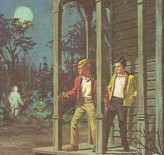
Well, what am I supposed to do? Given the 150th anniversary of the Civil War, and specifically, this week, the 150th anniversary of the Emancipation Proclamation, how can I not write about these two films together? And how can I not think about the history, and what they do with history, doing it? I know it's a temptation to pull the chin and suck the thumb, but I am not going to fight it... They do make an interesting pair. It's somewhat of a rarity, films about the Civil War, that are directly about slavery, and that treat slavery as the issue of the Civil War - it was, but it's been hard to say so through the years. There have been films that did this, but they are rare - and to have two of them appear at once, major productions to boot - it is a rarity, and an occasion to mark.
Lincoln is the sober one, the serious one - and is, indeed, a fine sprawling epic chamber piece about passing a piece of legislation. Granted, one of the most important pieces of legislation ever passed in this country, the 13th Amendment, abolishing slavery. The moment, maybe, that the Constitution became a document for good in the world, on balance. And this very important thing is given the full force of many great talents - the film is, in fact, a very satisfying thing. It's also classic Spielberg, the good and bad - dynamic and intelligent, especially in the details - though also, alas, bombastic, sentimental, and so much on the nose, in the big moments. And, strangely enough, for a film about the end of slavery, it doesn't have a lot to say about slavery. Or about slaves - or free blacks, for that matter. We see some black soldiers - and the film dwells on a couple White House servants, William Slade and Elizabeth Keckley - but they are there almost exclusively to shadow the Lincolns, to connect the Lincolns to black people. (Something similar happens at the end, when Thaddeus Stevens’ domestic arrangements are revealed.) None of this is unusual, which is part of why it is disconcerting to see it here, in a film about the end of slavery. And then one might be led to read about Elizabeth Keckley herself - her background, her activities while working with the Lincolns, as an organizer and so on - and her passivity in the film becomes very jarring. It seems off that there is nothing here to reveal the rest of her life - the idea that she has a story of her own, outside this one. You get a little more of that with Stevens and his housekeeper/wife, which has the virtue of offering a little shift in your perspective. It can be a powerful effect - I’m reminded of the moment in Imitation of Life when the housekeeper’s life, outside her work, is shown. (And of course her death, where she insists she be buried like general - and can afford to do it.) This film doesn't really do that, and it is a shame - it needs it.
It might be surprising to discover that Django Unchained addresses slavery more directly - and more seriously, to be honest. Tarantino plays up the sensationalism, the horror of slavery - but it’s hard to say that isn’t justified. Read about Elizabeth Keckley - an educated house slave - beaten, raped, abused by her owners - one of whom was her father. Tarantino insists on the casual horror of slavery - you can say it's part and parcel to his usual treatment of violence, and it is - but then again, he has always taken a much more complicated approach to violence than he gets credit for. He jokes about it - but he has always made you feel it, one way or the other. If there is a weakness in his treatment of slavery, it might be that he makes its horrors seem a function of the plot, of this story, maybe not so casual after all. Django and Broomhilda's love story, their attempts to escape, their punishments, set up a lot of the abuse they suffer. That, and the particulars of the “mandingo fighting” might just explain too much - make their treatment seem exceptional. But it is hard to say that they are exceptional - I say again, read about Elizabeth Keckley - who went through most of the same things Broomhilda does, simply because she was property. Though still - everything that happened to every slave happened to an individual person, who had every bit as much a story to their lives as these characters do. Every slave experienced slavery as a human being, and as an affront to their existence. So Tarantino does what a story teller is supposed to do - takes something systemic, and embodies it in specific human beings. Though since he is Quintin Tarantino, he also embodies it in a gunslinger out of an Italian western. (With a friend and ally out of Karl May.)
He isn't trying to fool you. The film starts with a title, announcing it takes place in 1958, 2 years before the beginning of the Civil War - I doubt that's a mistake - it's a signal that this is not the real world, it's Tarantino-world - or maybe that this film is going to be about why the ware started a year earlier than it really did... The story and film itself is certainly entertaining - Django is a slave in Texas, bought by a dentist who turns out to be a bounty hunter - they find the men Django was purchased to find, then the bounty hunter takes him on as a partner - and then they go to find Django's wife. Which brings us to one of Tarantino's patented showdowns, between Django and King Schulz and the slaveowner, a pretentious fool who runs "mandingo fights" - though the real antagonist turns out to be Samuel L. Jackson. It all builds to a showdown -
...Reading about the film, I find a lot of disappointment with the ending - things turn ultra-violent at the end, and all the fairly serious stuff that went before is left behind. The ending is, I won't deny, highly entertaining, but it is also, I won't deny either, disappointing. The blood and guts does not really flow out of the story - and it loses touch with the themes. It really is thematically disappointing that, in the end, Django is treated as if he were genuinely exceptional - as if his story is not really implicated in the system anywhere. The ending gives the uncomfortable feeling that Tarantino wrote himself into a corner - couldn't think of a way out of the situation he'd created, so turned it into a bloodbath.... Of course, that's perfectly congruent with the history - the whole damned country wrote itself into a corner, and couldn't figure a way out of it except through a bloodbath - so maybe it's unfair to ask more of a simple filmmaker. Still...
I think this also indicates the main artistic problem with the film - it isn't all that well realized a story. It is, for one thing, the most straightforward, conventional film Tarantino has ever made. It is episodic and a bit rambling, though mostly chronological, without his usual machinations with time and structure. It has an interesting effect - it is long and rambling and episodic and not always all that well stitched together - but I didn't really care. I could have watched him run variations on these characters, with these actors, for hours without complaint. It's almost a disappointment when they stop talking and start shooting, even aside from the specifics of the ending. It's an odd thing to say, but this might be the first thing Tarantino has done that should have been a TV show instead of a film. He has the characters, the setting, the cast - he has the rudiments of a plot (though nowhere near enough to make a single satisfying story from, though any of the pieces could be expanded to make satisfying mini-stories...) - you could spin it out forever, if you wanted to. But TV is a step down - Tarantino's gift has always been for film scripting. Convoluted time frames, structural games - there is so much pleasure, and significance, in the shape of his stories, that it is a let down to see him start at the beginning and continue to the end, without doing much with the structure of the film.
Though I won't deny it - it's a fine way to spend a few hours.... The usual talk, violence and excitement, even enough serious ideas about the history to keep a history nerd like me happy... Wise too in its approach to the ways blacks were used to control one another - Jackson's Stephen is a nightmare, and answers Candie's question, why don't they kill us? because the one who steps out gets cut down first, usually by one of their own...
And most of all - it is an actor's dream, and everyone in it takes full advantage of it. Waltz and DiCaprio and Jackson devour the scenery, revel in their roles - Foxx smolders - all the bit players dive in with relish... it's nothing groundbreaking, but is very enjoyable and satisfying anyway.
Showing posts with label Tarantino. Show all posts
Showing posts with label Tarantino. Show all posts
Saturday, January 05, 2013

Saturday, August 29, 2009
Grading on the Curve
Time to add my two cents to the rest of the internet... I have seen Inglourious Basterds... Uh oh.... I think I should have forced myself to only look at the negative reviews - I would have come out singing a different song.
It is, taken as dispassionately as I can manage, a gripping, sometimes funny, sometimes harrowing, superbly written and made film - that has more or less nothing at stake, probably due to having just about exactly one character in it. Everyone else is a function, a plot point - acted with aplomb (except for a few caricatures that are enacted with the perfect pitch of absurdity - think Eli Roth, Mike Myers, or the people playing the German High Command) - everything is made with great care and energy, but it is all just a machine. The exception? Christoph Waltz, playing a fairly transparent Tarantino stand in (motormouth, omniscient, demiurge, foot fetishist...), overall - I guess maybe not quite a character either - more the Author. Though, one might note, not the only author, or Auteur - heck, it's lousy with auteurs, inventing scenarios, enacting them, stage managing them, editing them - as well as, of course, making actual film... staging bits of actual theater... writing, or carving, things....
All of this, I'd have to say, erases most of the real history involved. I suppose you can argue about what it means to erase the actual history of WWII, especially WWII as a story about Germans and Jews - you could, but I don't think it's worth as much trouble as some of the critics (pro and con) are going to. He isn't denying that history - he isn't telling a story that justifies glossing over what really happened. The holocaust, the final solution, is treated as an inciting incident, a piece of backstory - that may be a loaded thing to do (therein lies Rosenbaum's objections, as I read them) - but it does not deny the holocaust. Maybe it treats the holocaust like any other historical phenomenon - subject, like all history, to absorption into stories, absorption into history - there is some point in resisting this, in treating the holocaust as somehow resistant to history... But it isn't. It is history, in the end, and will move, like everything else has moved, from lived reality to books and stories and signs, which is all there really is of the past.... Tarantino doesn't lie about that past - he just treats it as part of the grand text of history - but I can't say that he says anything terribly important about that past. It's a convention, a plot device - it's not history....
And besides, say the champions, it's more about film (history) than history (history), anyway. Which is fair enough - though even the film references seemed a bit like name dropping - "oh look! Emil Jannings!" - though to be fair, there are some pretty interesting names being dropped (not just Joe May [I think I caught a Joe May reference] - Karl May! Rather prominently, that...) I don't think, that is, one gets anything particularly profound out of the film references - though what you get, you get underlined, starred, bolded, in red. No bit of irony or meaning, no moment of audience manipulation and complicity goes unmarked... He seems very eager to make these points, and make sure no one misses them. You know - Hitler giggles and squeals over Zoller (hero of the film within a film) slaughtering hundreds of Americans - 5 minutes later, the audience in the real theater giggles and squeals in exactly the same way as Hitler and company - etc....
So no - it's not a great film. It's a marvelously well made film - but it doesn't do much with its powerful material, and it doesn't add up to as good a story as Tarantino at his best... But - you know - that's on a curve, set by all those gushing reviews....
...Because under it all run some interesting threads. For example - the role of language, words, accents - even signs, marks - semiotics. "Meta-signs" maybe, "metalanguage" - not what people say, but the language they say it in; not the language but the accents. Not even that - the betrayal of the body (hands; feet)... Or the way people assume other cultural identities - we have Jews hiding as French; Brad Pitt rather implausibly claiming to be Apache (which probably inspires the Karl May reference... Jonathan Rosenbaum brings this up, for instance in the comments at Bright Lights After Dark - Tarantino not only uses the holocaust as a plot device, he brings in references to Native Americans and scalping, but purely as a "movie myth"... But here, I'm not so sure just how dumb Tarantino really is. Yes indeed, he has Brad Pitt claiming to be Apache and using this as an excuse for his scalping routine - but: for heaven's sake - that's a character talking - whether Tarantino should use the myth or not, this is a character in the film invoking the myth... And then there is that Karl May reference - that is, a reference to a German tradition of completely invented American Indian mythology. I don't know - I think maybe all that mythologizing, all the cultural cross-dressing, all the complexities of language and culture and history and mythologies and dehumanizing analogies (Jews and rats, duly evoked) - might just start to rise to the level of content....) We have spies, assuming various identities, out of movies or not - we have clever casting jokes (they have to be jokes), like a German born actor being accused of not speaking proper German... All this gives a bit of a twist to Pitt's determination to make sure no one who serves the Nazis can ever escape that fact...
Finally... as history - I have nothing against alternative history, but there is one thing that is very much a-historical about this film. Though again - it's a strange and maybe haunting kind of ahistoricism. Is it, shall we say, entirely a coincidence that Eli Roth plays someone called the "Bear Jew"? That this Bear Jew and his comrades are murderous, cruel, irregulars operating behind German lines? partisans, basically - not subject to the rules of warfare... and... Because what is missing from this film is most precisely the Bear - and what the Basterds do would probably not seem too out of place behind the lines on the Eastern Front. Where is the Eastern Front? where are the Russians? All this talk about ending the war by killing the German high command is fine and good - but even if that happened - what do you do about Stalin? Even the war movie-in-a-movie, set in Italy, sounds a lot more like something you'd get in Russia somewhere... Eli Roth, at least, has the decency to swipe a few shots from Eisenstein - otherwise, the reds would be completely missing. But - this film, the Basterds especially, plays a lot more like an eastern front movie might - atrocities and horrors on all sides (though played for laughs.) And I suspect some of that is supposed to be there - Tarantino is too attentive to his words not to mean something by calling his most brutal character (played by a Jewish actor with Russian heritage) "The Bear Jew"...
It is, taken as dispassionately as I can manage, a gripping, sometimes funny, sometimes harrowing, superbly written and made film - that has more or less nothing at stake, probably due to having just about exactly one character in it. Everyone else is a function, a plot point - acted with aplomb (except for a few caricatures that are enacted with the perfect pitch of absurdity - think Eli Roth, Mike Myers, or the people playing the German High Command) - everything is made with great care and energy, but it is all just a machine. The exception? Christoph Waltz, playing a fairly transparent Tarantino stand in (motormouth, omniscient, demiurge, foot fetishist...), overall - I guess maybe not quite a character either - more the Author. Though, one might note, not the only author, or Auteur - heck, it's lousy with auteurs, inventing scenarios, enacting them, stage managing them, editing them - as well as, of course, making actual film... staging bits of actual theater... writing, or carving, things....
All of this, I'd have to say, erases most of the real history involved. I suppose you can argue about what it means to erase the actual history of WWII, especially WWII as a story about Germans and Jews - you could, but I don't think it's worth as much trouble as some of the critics (pro and con) are going to. He isn't denying that history - he isn't telling a story that justifies glossing over what really happened. The holocaust, the final solution, is treated as an inciting incident, a piece of backstory - that may be a loaded thing to do (therein lies Rosenbaum's objections, as I read them) - but it does not deny the holocaust. Maybe it treats the holocaust like any other historical phenomenon - subject, like all history, to absorption into stories, absorption into history - there is some point in resisting this, in treating the holocaust as somehow resistant to history... But it isn't. It is history, in the end, and will move, like everything else has moved, from lived reality to books and stories and signs, which is all there really is of the past.... Tarantino doesn't lie about that past - he just treats it as part of the grand text of history - but I can't say that he says anything terribly important about that past. It's a convention, a plot device - it's not history....
And besides, say the champions, it's more about film (history) than history (history), anyway. Which is fair enough - though even the film references seemed a bit like name dropping - "oh look! Emil Jannings!" - though to be fair, there are some pretty interesting names being dropped (not just Joe May [I think I caught a Joe May reference] - Karl May! Rather prominently, that...) I don't think, that is, one gets anything particularly profound out of the film references - though what you get, you get underlined, starred, bolded, in red. No bit of irony or meaning, no moment of audience manipulation and complicity goes unmarked... He seems very eager to make these points, and make sure no one misses them. You know - Hitler giggles and squeals over Zoller (hero of the film within a film) slaughtering hundreds of Americans - 5 minutes later, the audience in the real theater giggles and squeals in exactly the same way as Hitler and company - etc....
So no - it's not a great film. It's a marvelously well made film - but it doesn't do much with its powerful material, and it doesn't add up to as good a story as Tarantino at his best... But - you know - that's on a curve, set by all those gushing reviews....
...Because under it all run some interesting threads. For example - the role of language, words, accents - even signs, marks - semiotics. "Meta-signs" maybe, "metalanguage" - not what people say, but the language they say it in; not the language but the accents. Not even that - the betrayal of the body (hands; feet)... Or the way people assume other cultural identities - we have Jews hiding as French; Brad Pitt rather implausibly claiming to be Apache (which probably inspires the Karl May reference... Jonathan Rosenbaum brings this up, for instance in the comments at Bright Lights After Dark - Tarantino not only uses the holocaust as a plot device, he brings in references to Native Americans and scalping, but purely as a "movie myth"... But here, I'm not so sure just how dumb Tarantino really is. Yes indeed, he has Brad Pitt claiming to be Apache and using this as an excuse for his scalping routine - but: for heaven's sake - that's a character talking - whether Tarantino should use the myth or not, this is a character in the film invoking the myth... And then there is that Karl May reference - that is, a reference to a German tradition of completely invented American Indian mythology. I don't know - I think maybe all that mythologizing, all the cultural cross-dressing, all the complexities of language and culture and history and mythologies and dehumanizing analogies (Jews and rats, duly evoked) - might just start to rise to the level of content....) We have spies, assuming various identities, out of movies or not - we have clever casting jokes (they have to be jokes), like a German born actor being accused of not speaking proper German... All this gives a bit of a twist to Pitt's determination to make sure no one who serves the Nazis can ever escape that fact...
Finally... as history - I have nothing against alternative history, but there is one thing that is very much a-historical about this film. Though again - it's a strange and maybe haunting kind of ahistoricism. Is it, shall we say, entirely a coincidence that Eli Roth plays someone called the "Bear Jew"? That this Bear Jew and his comrades are murderous, cruel, irregulars operating behind German lines? partisans, basically - not subject to the rules of warfare... and... Because what is missing from this film is most precisely the Bear - and what the Basterds do would probably not seem too out of place behind the lines on the Eastern Front. Where is the Eastern Front? where are the Russians? All this talk about ending the war by killing the German high command is fine and good - but even if that happened - what do you do about Stalin? Even the war movie-in-a-movie, set in Italy, sounds a lot more like something you'd get in Russia somewhere... Eli Roth, at least, has the decency to swipe a few shots from Eisenstein - otherwise, the reds would be completely missing. But - this film, the Basterds especially, plays a lot more like an eastern front movie might - atrocities and horrors on all sides (though played for laughs.) And I suspect some of that is supposed to be there - Tarantino is too attentive to his words not to mean something by calling his most brutal character (played by a Jewish actor with Russian heritage) "The Bear Jew"...
Subscribe to:
Posts (Atom)