(This is yet another post inspired by and intended for the
Japanese Cinema blogathon at Wildgrounds. I've been looking for an excuse to dive into Ozu deep and seem to have found it.)
I want to write about 2 of Ozu's most unusual films,
Early Spring and
Tokyo Twilight. They tend to be neglected, though they have been released in the states, part of Eclipse's
Late Ozu set; they tend to be treated as lesser Ozu, when they are considered. Even David Bordwell can't quite get behind
Tokyo Twilight... I suppose it's true - they are lesser Ozu - but compared to almost anyone else, they are extraordinary.
The main case against them is that they are more definitively melodramatic than most of Ozu's films.
Early Spring tells the story of a salariman and his wife (Sugiyama, and Masako) - he is restless at work, they are unhappy together, they have lost a child some years back, a common enough cause for marital angst, for Ozu and for everyone else. The salariman has an affair with a woman from work (Goldfish); the rest of their circleof friends and coworkers gossip and make trouble; his wife finds out and leaves him; he is transferred to the provinces. It is unusual for the focus on a young, childless couple; the workplace (though this is a throwback to Ozu in the 30s); the sex - as well as its tone, which combines a certain urban coldness with its melodrama.
 Tokyo Twilight
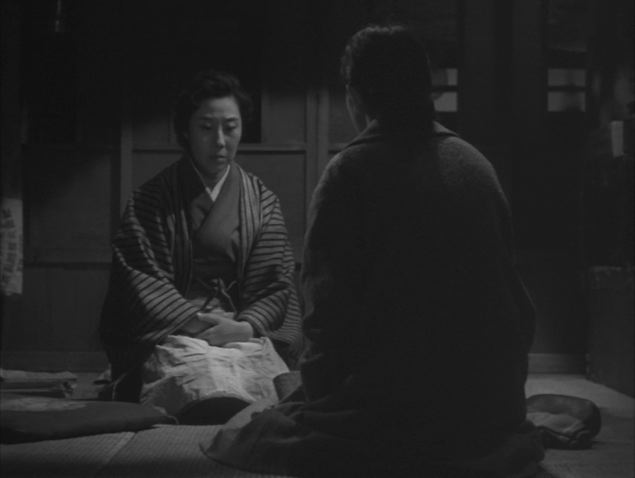
 is a more convoluted affair - it returns to the family, but this is a very melodramatic family. Chishu Ryu plays the patriarch, with two daughters, Takako and Akiko; he's a miserable, passive bully; Takako (played by Setsuko Hara), has left her drunkard college professor husband; Akiko has fallen for a cad, dropped out of school to learn English shorthand, and now finds herself in a family way. Meanwhile - dad's misery stems from being abandoned by his wife (played by
Isuzu Yamada - who is luminous) - she has now turned up running a cheap mahjong parlor where some of Akiko's friends hang out. Soon, Akiko meets her mother - but things don't get better afterwards. Abortion and death follow, as they usually do (though not so much in Ozu's films) - someone goes to Hokkaido, somewhat more common for Ozu, though perhaps no less horrible than death and abortion. All this is played for the melodrama, and looks as grim as it sounds - most of the action occurring at night, and all of it in the dead of winter. And all of it in Tokyo's streets and bars and seedy noodle shops and mahjong parlors, plus a couple middle class houses that come off as forbidding and cruel as the rest.

They are quite a bit different from the films around them - one of the reasons I think they are somewhat discounted is that they don't fit the standard narrative about Ozu. These two films were released in 1956 and 1957 - they are the two films he made directly after
Tokyo Story. The story goes - he turned more and more to the Japanese family; he turned to more affluent characters; he told ever more oblique and plotless stories. All of which is a reasonable generalization to make about his films in the 50s - except that right in the middle, here are these two. At the same time - they are not unprecedented for Ozu. His early college comedies, workplace films like
Where Now Are the Dreams of Youth?, or the office parts of
Tokyo Chorus and
I Was Born, But... anticipate the milieu, and some of the story, of
Early Spring. Tokyo Twilight picks up themes from several of his older films - the lost parent returning, that is the plot of both
Floating Weeds films; the rebellious spoiled child from
A Mother Must be Loved; the bad marriage from the
Munekata Sisters, maybe. Perhaps more importantly, both films adopt the tone and themes of older films - the social commentary and satire of
Early Spring referring back to those early bittersweet college and salariman films; the unabashed melodrama, played for at least some shock value, in
Tokyo Twilight, as in
The Munekata Sisters, or
A Mother Must be Loved, or
Women of Tokyo. They both move from the settings of many of the 50s films to a seedier Tokyo, or to the blank modernity of the office sections of the city - again, harking back to the settings of the older films.

I mentioned in the
comments below that the more Ozu films you see, the more you see in them. These films are an illustration of that, I think. I saw
Tokyo Twilight 8-10 years ago - at the time, I had seen most of the post-war films, and a handful of the prewar films - basically the ones that are available on DVD now (Floating Weeds, and the
Eclipse Silent Comedy set.) At the time - it seemed utterly anomalous - a handsome and austere, but rather sloppy attempt at - something... But between then and seeing it again, I saw the full
Ozu retrospective - seeing all those older films, seeing the range of films he made, changed how I saw his later films. And watching
Tokyo Twilight now, it seems much more comprehensible. And impressive.
The truth is - it seems to me that in these two films, as well as some of the other films Ozu made in the late 50s (
Good Morning, notably), Ozu is looking for new ways to make films. He had, by this time, settled on a pretty narrow range of devices and styles - the low camera, the lack of camera movements, the elliptical narration, the understated tone, the oblique transitions, etc. - but within that set of devices, he constantly looked for new ways to use them. What surprised me, watching these films again this month, was just that - the ways he fit these quite different stories, settings, characters, into his customary forms. Or used his forms to create different effects. They do things differently - take his famous "pillow shots" - in
Early Spring, these are often shots of buildings - there isn't a lot of nature in this film. The shots even include a bit of an editorializing - zombie salarimen, who could have come from
Pulse or
Tokyo Sonata:
 Tokyo Twilight
 offers an even odder version of these transitions: here, Ozu often uses shots of minor characters as a kind of pillow shot - along with the usual shots of streets and bars that introduce locations in his late films, he often includes several shots of the people in these places. The hangers on in the Etoile bar; the poor devils at the police station:

Some of these shots go nowhere - they are purely transitional. Some of them develop quite a ways - there are some fairly elaborate conversations among some of the completely incidental denizens of some of the bars. And even when the main characters are on hand, and plot is being advanced - this film is quite consistent in putting off the revelation of the plot point of the scene. It starts from the very beginning - Ryu's character goes into a bar, has a conversation with the woman proprietor and a man drinking at the bar, mostly about oysters and pearls - then, after a few monutes of that, Ryu asks about "Professor Numata", who has been here drinking with his students, it turns out. This is a double delay, of course - since Ozu doesn't tell us who Numata is, or why Ryu's character cares. We find that out in the next scene - though again, after Ryu and Hara have been on screen a while, making small talk. Numata, it turns out, is her husband - a drunkard, possibly violent - she has left him. But we don't get that until the end of the scene. Ozu does this - tucking plot information into the end of a scene - constantly in this film. It is almost an organizing principal. At the same time, the story is a lot more explicit than usual for 50s Ozu - we see the big confrontations and turning points. It is almost as if he needed to compensate for the melodrama of the plot by spending a lot more time on digressions and odd side details.
Though it's also true that he uses those diversions to make points. He spends a lot of time with secondary characters in both films. Some of these are used to create parallels to the main story line, especially in
Early Spring. He shows us the couple next door to the main characters - a couple who have also been through adulteries and troubles and come out - together, at least. He also shows us the travails of another salariman - whose wife is having a baby, to their distress. But again, they work through it, and create a counterpoint to the main couple and their lost child. There are also several men who represent different attitudes toward office work: one has risen to power; one exiled to the provinces; one has dropped out and opened a coffee shop; one (getting drunk at the shop) is about to retire without anything to live on; the one who loved his work, is dying of a lung disease; and two of the main character's old army buddies bring in a working class perspective - one makes pots; one fixes things.
The other, nastier function the minor characters fill is to - for lack of a better word - judge the main characters. In Early Spring, we are privy to the office gossip against Goldfish and Sugiyama (who are having the affair) - they even confront her, causing her to confront him, and his wife to find out about the business. This sort of thing is even harsher in
Tokyo Twilight. Akiko is judged by everyone - bartenders, noodle shop owners, her boyfriend's cronies - all abuse her behind her back. It's harsh - especially since Ozu never presents her as anything but sympathetic (except with her parents, significantly - though he makes sure we understand that.) He shoots her with sympathy throughout:

In fact, it is notable that in this film (and in
Early Spring, really), everyone - almost everyone - comes off well: sympathetically, at least. Everyone has their reasons - the mother who left her family, the father who stayed, the two daughters - everyone is sympathetic, but trapped by their circumstances... It is, after all, a classic melodrama, and Ozu plays up the melodrama as much as he ever did. But - undercut it, at the same time. Most notably in a scene at the mahjongg parlor - as usual, Ozu is delaying the point of the scene (which is really the confrontation between Akiko and her mother) - here, though, he does it by having one of the players tell the sordid tale of Akiko and Kenji. He - and the others - turn it into a joke - they do it in funny voices, turning it into a cliché, a soap opera, with stock characters and situations. This scene parodies the plot, and it is probably not the only place Ozu does so in
Tokyo Twilight. But emphasizing the hackneyed plot creates a strange tension between it and the people in the story - Ozu spends a lot more time establishing them as sympathetic, rich characters than with the plot. Though this too is interesting in comparison to his other films - he develops this kind of depth of character more than he usually did at this point in his career. That’s ironic in itself - he makes these denizens of an over the top pot-boiler more conventionally rounded than he does the people in his more characteristic films. (Where what characterization we get, we get through indirection and implication - more than here, where things are often stated and acted and reacted to directly.)

Though I have to add - this is more of a staple of melodrama than is sometimes acknowledged. Melodrama at its best is very self-conscious - however ironic or stylized or sincere - it is shameless - it plays its extreme stories straight, while highlighting all the exaggeration and excess. Melodrama is highly presentationalist, I think - the idea of someone in the story parodying the story, as the mahjong players do, is almost as necessary as the shock cut from Akiko’s abortion to the child, or Hara’s ferocious bawling at the end.

Though even in this film - the shot that precedes that one, of Hara sitting along, in the hallway, with the bundle of flowers her mother has just given her, is much more typical of Ozu's approach. It isn't that it is any less melodramatic - it's restrained, but the restraint is calculated and precise, and expresses her pain and regret and everything else, as powerfully as the more extreme moments. Melodrama comes from the highlighting of emotions: it builds strong emotions, and it expresses them - usually hyperbolically - but it doesn't have to. Ozu did this as well as anyone: getting across an intense emotional moment in the most precise, minimal way. In this scene: her mother has come to pay her farewells to Akiko; Hara sits in the hall and listens, but never speaks. Her mother leaves - and Hara moves her right hand from her hip to where it is in this shot, cradling the flowers her mother gave her for Akiko. It's all there, and it's breathtaking.