Another month comes to a close, and so it's time for another director. I will continue in the direction I've been taking - counting down my favorite Japanese directors. If Oshima is 6 - and Kurosawa 5 - #4 is Mikio Naruse.
Naruse is probably the least discussed of these, of my favorites, if not of the acknowledged greats of Japanese cinema. He's not very well represented on DVD. Things were much worse in the past - when I started tracking down Japanese films, in the late 90s, it was possible to see a decent selection of Ozu or Mizoguchi - 6 or 8 films anyway - Kurosawa was very well represented, as always... Oshima and Imamura were not so easy to find - but Oshima stuff was around, and Imamura was alive and active, and his new films were being distributed, and he got (in 1998 or so) a full retrospective that toured the states... Naruse did not get that treatment for another decade or so, and even now, is the least available of these filmmakers on DVD, at least region 1. But - there was that retrospective a few years back - and seeing a sweeping selection of his work, in a short time, was, for me, as overwhelming as one could expect. I wrote up most of it at the time - so in place of the capsules here, I will point you to what I wrote then. Part 1 and part 2, and some overflow, here.
You will find most of my general thoughts about him scattered among those reviews - I could offer some generalities. Compared to his most canonical contemporaries - I think where Ozu works with simple setups, and uses editing to put together his stories, and subtly disrupt the surface (which he does - I think he is one of the most radical mainstream filmmakers imaginable), and Mizoguchi moves his camera to shape and exploit space (something Ozu does with editing), Naruse works with composition. That is - Ozu combines shots to create space and meaning; Mizoguchi moves the camer to do it; Naruse builds in in shots on screen. He uses depth, layers, symmetries, positioning characters in the middle of complicated backgrounds, complicated spatial arrangements caught in single shots, single set ups, etc. He uses static compositions to create complex images - a style that I think turns up in a few later directors, sometimes more than the moving camera or montage heavy styles of Ozu or Mizoguchi. Imamura, Ichikawa do this a lot as well - I don't know if they got it from Naruse, it's not exactly unique - but he is a master. Probably not THE master - check out that fish atop this blog! - but he'll do.
That'll do. And so? a more or less straight list - though you can find more, sometimes quite a bit more, at the links above. Finally - is there a filmmaker ever who paid closer attention to money?
1. Late Chrysanthemums
2. When a Woman Ascends the Stairs - worth noting that Hideko Takemine might well be the most beautiful woman ever put on screen, especially in front of Naruse's camera.
3. Wife! Be Like a Rose! - comedy! and masterfully handled, at that...
4. Mother
5. Floating Clouds - an interesting film, because, despite his reputation as a melodramatist, maybe something of a miserablist - this is one of the few films that don't end on at least a stubborn note - I have to quote myself: For good bad or indifferent, Naruse's heroines usually have to keep going at the end - their stories don't really end - some episode ends, the film can end, but they have to get up in the morning and go back to whatever it is they do.... His films usually end with the woman ascending the stairs... This is an exception.
6. Every Night's Dream
7. The Sound of the Mountain
8. Repast
9. Summer Clouds
10. Lightning - almost a comedy!
Showing posts with label Naruse. Show all posts
Showing posts with label Naruse. Show all posts
Monday, April 29, 2013

Sunday, May 08, 2011
Mother's Day Nihon no Eiga Style
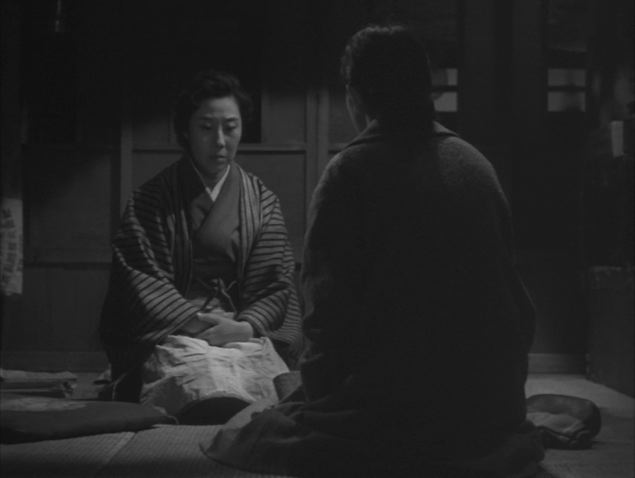
If I were going to start posting something like a Sunday Screen Shot, this would be the place to start - Happy Mother's Day! and if there's a richer source of mother's on film than Japanese film, I'm not sure what it is... there is no limit, I think, to the number of pictures I could fine here.




Sunday, October 16, 2005
Weekly Movie Roundup
Kind of back to normal this week. Still some Naruse's showing, but not the solid block like last week. So then...
A Countess From Hong Kong - * - Charlie Chaplin brings Marlon Brando and Sophia Loren together on an ocean liner. He's a politician, she's a white russian countess who's been hustling in Hong Kong and sees a chance to smuggle herself to America. Hilarity and romance - is supposed to ensue, but what ensues is pretty bad. Lots of talk, lots of glowering from Brando, bits of stained farce. Poor Charlie.
Wife! Be Like a Rose! - **** - some Naruse left... seeing this the second time, I am more sure than before that it is among his best films. He had the filmmaking thing down pat - he still moves the camera a lot in this film, but has lost the mannered showiness of the silents I've seen - he had figured out how to use sound already - and he shows a complete mastery of tone. The way the film shifts - tone, style, pace - when Kimiko goes to the mountains is first rate. (The story, roughly, is this: Kimiko is a modern girl, working in a office, in love with a boy - in an unneurotic way almost completely missing from Japanese films of the day - hell, missing from most American films, then or now; her mother, meanwhile, is a poet, a teacher; her father has abandoned them for an ex-geisha. Eventually, Kimiko heads into the mountains to bring dad back - where she meets his other woman, and her family, and gets a new perspective on things.) It' a great little film - funny, sweet, masterfully made, and probably should be considered among the better films of the 30s...
Wallace and Gromit in The Curse of the Were-rabbit - *** - amusing tale featuring Nick Parks' claymation stars... W&G here are running a humane pest-riddance service - but when Wallace tries to branwash the rabbits out of liking their veg - bad things happen... All very amusing indeed.
Thumbsucker - **1/2 - I don't know what I think of this exactly. Story is - a 17 year old who still sucks his thumb - his father, his orthodontist (Keanu Reeves! in full hippy-mode!), the school nurse all have ideas... the thumbsucking isn't all that important tot he story - it's about the kid navigating though his senior year... I don't know what to think. It's an honorable effort - it features a Magnificent Cast, who are all on top of their game: Keanu Reeves gives it some star power, and sends himself up - while Tilda Swinton, Vincent D'Onofrio and Vince Vaughn provide the acting chops. Lou Pucci (as the thumbsucker) acquits himself well in this company... But for all it has going for it - it still seems disjointed - jumping from one setup to the next, sometimes offering a rather pat set of oppositions (speed/pot, notably) which give the film a certain by-the-numbers feel. I don't know. I can't tell if I liked it more or less than I should have....
A Countess From Hong Kong - * - Charlie Chaplin brings Marlon Brando and Sophia Loren together on an ocean liner. He's a politician, she's a white russian countess who's been hustling in Hong Kong and sees a chance to smuggle herself to America. Hilarity and romance - is supposed to ensue, but what ensues is pretty bad. Lots of talk, lots of glowering from Brando, bits of stained farce. Poor Charlie.
Wife! Be Like a Rose! - **** - some Naruse left... seeing this the second time, I am more sure than before that it is among his best films. He had the filmmaking thing down pat - he still moves the camera a lot in this film, but has lost the mannered showiness of the silents I've seen - he had figured out how to use sound already - and he shows a complete mastery of tone. The way the film shifts - tone, style, pace - when Kimiko goes to the mountains is first rate. (The story, roughly, is this: Kimiko is a modern girl, working in a office, in love with a boy - in an unneurotic way almost completely missing from Japanese films of the day - hell, missing from most American films, then or now; her mother, meanwhile, is a poet, a teacher; her father has abandoned them for an ex-geisha. Eventually, Kimiko heads into the mountains to bring dad back - where she meets his other woman, and her family, and gets a new perspective on things.) It' a great little film - funny, sweet, masterfully made, and probably should be considered among the better films of the 30s...
Wallace and Gromit in The Curse of the Were-rabbit - *** - amusing tale featuring Nick Parks' claymation stars... W&G here are running a humane pest-riddance service - but when Wallace tries to branwash the rabbits out of liking their veg - bad things happen... All very amusing indeed.
Thumbsucker - **1/2 - I don't know what I think of this exactly. Story is - a 17 year old who still sucks his thumb - his father, his orthodontist (Keanu Reeves! in full hippy-mode!), the school nurse all have ideas... the thumbsucking isn't all that important tot he story - it's about the kid navigating though his senior year... I don't know what to think. It's an honorable effort - it features a Magnificent Cast, who are all on top of their game: Keanu Reeves gives it some star power, and sends himself up - while Tilda Swinton, Vincent D'Onofrio and Vince Vaughn provide the acting chops. Lou Pucci (as the thumbsucker) acquits himself well in this company... But for all it has going for it - it still seems disjointed - jumping from one setup to the next, sometimes offering a rather pat set of oppositions (speed/pot, notably) which give the film a certain by-the-numbers feel. I don't know. I can't tell if I liked it more or less than I should have....
Wednesday, October 12, 2005
Naruse Week 2
This is a full slate, indeed. 9 more films, in 4 days - of a possible 10. The 10th, Yearning, played Columbus day at 9:15pm, and I found myself staring to lose it about 8:30 pm.... Alas! even I need sleep! I had another chance to see it last week, at the MFA - but skipped it in a pique when they asked me to check my backpack before going into the film. Figuring, of course, that I'd get to see it later... oh well. 17 films is a lot to absorb in 2 weeks as it is...
(As I warned last week - this is kind of a notebook dump, and I will probably give away some plot details. Naruse's films don't exactly depend on their plot twists - but if I spoil some effect by talking about it here, I'm sorry...)
Late Chrysanthemums - This is another of the three Naruse films I had been able to see before this series: it's been on video. It's about 4 ex-geisha trying to make it in 50s Tokyo. One is a money-lender, one operates a business, the other two are poor, and work as maids - one is sickly and dreamy, the other is carefree and careless. The latter two have children, though they are rather disappointing, marrying on their own, moving to Hokkaido... This is a pattern Naruse returned to many times - telling the story of a group of people - a family, the workers at a geisha house, or former colleagues - who represent a certain range of attitudes toward the world. There's usually a stingy money-grubber, usually a partier, usually one or two practical types, someone romantic and dreamy, someone resigned and ineffectual, trying, maybe, to preserve tradition... These roles are usually distributed among a group of women - if men are around, they're usually layabouts or drunkards or fool or cheats. At best, a married lover of one of the women, waiting to go back to his wife... In this film, the men manage to do all of those things - drink, loaf, beg for money, and go back to their wives...
It's a great film - one of the best, I think, though I might think that because, having seen it before, I was able to pay more attention to the details of how Naruse put it together. He does interesting things with transitions - he as a way of including shots that are completely logical syntactically, but don't fit semantically. For example - if someone leaves a house, he will cut to a shot of a person walking along the street. It's a normal, logical, transition - except the person shown on the street will not be the person who left the house, or the person who is shown entering a house when the next scene starts. That's a rather banal example - but it's a pattern he often exploits. There's a scene toward the end - Okin (the money-lender) is talking to her long ago lover Tabe - he's after money, but he's also angling for a night with her: they talk about staying the night, she's less enthused (since he's after her money), he's trying... Then Naruse cuts from the conversation to a shot of 2 people in bed: but we soon realize, it's not Okin and Tabe, it's Otomi and Tamae (the maids - who have been drinking and complaining about their children (and Okin, of course)). They're drunk, and talking about Tamae's daughter's honeymoon. Then it's back to Okin and Tabe... In this film, the effect is to bind the 4 women together - they are different, and their differences work out the possibilities available to them - and the various ways that they can suffer. It also indicates the bonds between people - this is probably more obvious in the family films (Lightning or Summer Clouds, for example), where the cross cutting (and the thematic blending, like that linkage of sexual suggestiveness, between Okin and Tabe, then the other two women talking about Tamae's daughter's wedding night) tends to emphasize their interconnections, their inability to escape from one another.
Repast - Setsuko Hara stars as the unhappy wife of a Tokyo man working in Osaka. His niece turns up - she's run away from home, and in Osaka, she hangs around the house, flirts with the husband and a neighbor kid, spends money, smokes cigarettes and loafs while Hara works works works... Hara finally can't take it anymore and heads home to mother. Of course her husband's niece goes as well, and son starts flirting with the man Hara is considering flirting with... It is, typically, a handsome, quiet film. It is interesting how Naruse makes the story seem to turn on food - the couple talks about what they are eating, about the cost of food, about how it tastes; the first fight (involving the niece) is precipitated by the girl not cooking anything for the husband. People buy food for each other, talk over meals, break up or get back together again over food, and so on. Naruse does something like this in a lot of his films - weaving threads, some significant object, through the story: money plays this role in Late Chrysanthemums... (money as objects - coins and bills and such... money in general is an inescapable presence in all of his films.)
Summer Clouds - a sprawling drama about a farming family, centering on a war widow running a farm. She survives, while her brothers sink into money difficulties and capitalism. We can see Japanese society changing in front of our eyes. Another gorgeous film, this one shot in scope and color. Another ensemble drama - a dozen or so significant characters, with the film taking time with most of them. Building sympathy for most of them, even when they have directly contradictory ideas - even after they do horrible, destructive (and usually self-destructive) things to one another. Naruse seems to subscribe to something like Renoir's statement - "the terrible thing is, everyone has good reasons" - even if he does take sides. Here, the brother tries to do things the way the did when he was young - hurting everyone around him, and failing to hold anyone in place... Naruse manages to make him sympathetic, understandable, even if he doesn't pull punches on what a disaster the old guy is for his family when he gets his way...
Floating Clouds - Hideko Takamine stars as the mistress of a married man played by Masayuki Mori, who made wartime promises back in Indo-china that he is not inclined to honor in postwar Japan. He does, however, apparently expect the occasional adulterous interlude. Takamine makes gestures toward dropping him, but he keeps coming back, and she sticks to him when he does. Naruse's films tend to be full of misery and sorrow, but usually driven by lack of money, selfish and foolish friends and neighbors, and the fate of being a woman in Japan - this one moves beyond those quieter forms of unhappiness into melodrama and degradation. Prostitution, other women, rape, murder appear alongside the Naruse standards of poverty and humiliation - it is also rather unusual (at least in the films of his I've seen) for ending in death. For good bad or indifferent, Naruse's heroines usually have to keep going at the end - their stories don't really end - some episode ends, the film can end, but they have to get up in the morning and go back to whatever it is they do.... His films usually end with the woman ascending the stairs... This is an exception.
Lightning - Takamine again, this time as the youngest of her mother's 4 children (with 4 men) - the other three are a mopey romantic whose philandering husband dies; a scheming bitch; and a layabout son who spends his time drinking and playing pachinko - add the 2nd sister's inept husband and a lecherous baker (who pursues Takamine, while bedding her sisters) - it makes a living hell of the home situation. On the other hand, it's less oppressive than most of these films - for one thing, Takamine, from the beginning, can take care of herself (she's a bus guide), and never seems in any danger of getting dragged down into the misery of the rest of her family. When things get too much, she lights out for the territories, taking a room in the suburbs... For another thing, the film itself has a much more comic tone than film like Flowing or Summer Clouds. It's corrosive comedy - at times, it is very close to the sharpness of Ichikawa's 50s satires (Mr. Pu or A Billionaire), or Imamura's. Naruse, I should note, is perfectly capable of comedy - the early films I've seen have all contained a great deal of comic business, and even late, many of these films - especially the ensemble pieces - contain a lot of wit, and even some slapstick. In Lightning, though, it is much closer to the dominant mode.
The Whole Family Works - 1939 film about a working family - 7 kids, 3 of them already working, the 4th at the point of deciding whether to continue studying or become an apprentice. Then the oldest son decides he has to go back to school, to study electrical engineering, if he wants to get out of the cycle of poverty his family is in. Remarkable for a number of reasons (besides the typically superb filmmaking) - on is how it gives weight to both sides of the debate. The boy is right, of course - if he continues to work, he will end up with his own household in exactly the same place his father is - working endlessly just to keep food on the table. He's earning 18 yen a year as he is - that's not going to change significantly, If he studies, he can earn 70 yen a year. It will take 5 years to get the education he wants - but it's worth it. But right as he is, the family is right too - if he leaves, they will have a serious problem being able to feed their children. And when he leaves, the other boys will decide they have to leave - with 3 kids too young to work, plus grandparents, things will be bad. Naruse clearly sees this dilemma - clearly understands that the boy is more right - but he does justice to the other side... The second remarkable thing is the war. It's 1939: watching it now, it is hard to ignore the fact that all the talk about who works and who studies will be swept away in a year or so - all four of these working class kids are probably going to be shipped off to China or the Pacific islands to die. The war pokes up through the story a couple times - the little kids are constantly playing with guns; the older kids play with guns, or dream of the war. It's hard to say how this was meant - the effect now is to remind us where things were going, what was at stake. The film feels terribly prescient...
Flowing - another ensemble story, this time in a geisha house. A group of characters - a talented and beautiful geisha, who's just a little too romantic to hold her own, tries to run the place, and keep things together; her daughter is hard-headed, practical, outspoken; one sister is a money-lender, the other is a layabout; two other geisha work with them - one young, foolish, careless - the other aging, a gossip (a wonderful comic character - played by Haruko Sugimura, who was a great comic actress, frequently for Ozu, as well as Naruse...) They are plagued by the uncle of a former geisha at the house - they cheated her, he is there to collect...Things crumble, but they keep it together during the movie at least...
The Sound of the Mountain - adaptation of a Kawabata novel about a man flirting with his daughter-in-law, while his son behaves like a brute toward a series of women. Setsuko Hara and So Yamamura star, with Ken Uehara as the wretch of a son - all are superb, especially Hara. A subtle and beautiful film, capturing the feel of Kawabata - the strange moments in his books, the symbolism (the Noh mask the father buys...) A very great film.
The Wanderer's Notebook - biography of Fumiko Hayashi, author of many books about the suffering of women, the source of many of Naruse's films. Based on her first novel, which told her life story to that point. Starring, again, Hideko Takamine - who plays Hayashi in a distinctive and rather wonderful way. She's got a strange slink to her in this film - a way of looking at things that expresses her intelligence and anger at her misery. She also gets some fine chances to go wild - a couple drunk scenes, a couple wild bar scenes, singing, dancing, raising hell. Another fine movie - in scope, lush black and white... Nice stuff.
And that's that. There are two more at the Museum of Fine Arts not shown yet - Scattered Clouds (Naruse's final film) and Tsuruhachi and Tsurujiro, from the 1930s. There are also several films there that have already been shown at the Harvard Film Archive. I look forward to seeing these films again (Lightning, Wife Be Like a Rose, Mother) - their richness tends to emerge on repeated viewings. This has been a wonderful series - I hope these films are shown around the country, and I hope some of them at least make it out on DVD. There have been a few new DVD editions of Ozu films out since the major restoration of his films a couple years ago. Naruse is almost as deserving....
(As I warned last week - this is kind of a notebook dump, and I will probably give away some plot details. Naruse's films don't exactly depend on their plot twists - but if I spoil some effect by talking about it here, I'm sorry...)
Late Chrysanthemums - This is another of the three Naruse films I had been able to see before this series: it's been on video. It's about 4 ex-geisha trying to make it in 50s Tokyo. One is a money-lender, one operates a business, the other two are poor, and work as maids - one is sickly and dreamy, the other is carefree and careless. The latter two have children, though they are rather disappointing, marrying on their own, moving to Hokkaido... This is a pattern Naruse returned to many times - telling the story of a group of people - a family, the workers at a geisha house, or former colleagues - who represent a certain range of attitudes toward the world. There's usually a stingy money-grubber, usually a partier, usually one or two practical types, someone romantic and dreamy, someone resigned and ineffectual, trying, maybe, to preserve tradition... These roles are usually distributed among a group of women - if men are around, they're usually layabouts or drunkards or fool or cheats. At best, a married lover of one of the women, waiting to go back to his wife... In this film, the men manage to do all of those things - drink, loaf, beg for money, and go back to their wives...
It's a great film - one of the best, I think, though I might think that because, having seen it before, I was able to pay more attention to the details of how Naruse put it together. He does interesting things with transitions - he as a way of including shots that are completely logical syntactically, but don't fit semantically. For example - if someone leaves a house, he will cut to a shot of a person walking along the street. It's a normal, logical, transition - except the person shown on the street will not be the person who left the house, or the person who is shown entering a house when the next scene starts. That's a rather banal example - but it's a pattern he often exploits. There's a scene toward the end - Okin (the money-lender) is talking to her long ago lover Tabe - he's after money, but he's also angling for a night with her: they talk about staying the night, she's less enthused (since he's after her money), he's trying... Then Naruse cuts from the conversation to a shot of 2 people in bed: but we soon realize, it's not Okin and Tabe, it's Otomi and Tamae (the maids - who have been drinking and complaining about their children (and Okin, of course)). They're drunk, and talking about Tamae's daughter's honeymoon. Then it's back to Okin and Tabe... In this film, the effect is to bind the 4 women together - they are different, and their differences work out the possibilities available to them - and the various ways that they can suffer. It also indicates the bonds between people - this is probably more obvious in the family films (Lightning or Summer Clouds, for example), where the cross cutting (and the thematic blending, like that linkage of sexual suggestiveness, between Okin and Tabe, then the other two women talking about Tamae's daughter's wedding night) tends to emphasize their interconnections, their inability to escape from one another.
Repast - Setsuko Hara stars as the unhappy wife of a Tokyo man working in Osaka. His niece turns up - she's run away from home, and in Osaka, she hangs around the house, flirts with the husband and a neighbor kid, spends money, smokes cigarettes and loafs while Hara works works works... Hara finally can't take it anymore and heads home to mother. Of course her husband's niece goes as well, and son starts flirting with the man Hara is considering flirting with... It is, typically, a handsome, quiet film. It is interesting how Naruse makes the story seem to turn on food - the couple talks about what they are eating, about the cost of food, about how it tastes; the first fight (involving the niece) is precipitated by the girl not cooking anything for the husband. People buy food for each other, talk over meals, break up or get back together again over food, and so on. Naruse does something like this in a lot of his films - weaving threads, some significant object, through the story: money plays this role in Late Chrysanthemums... (money as objects - coins and bills and such... money in general is an inescapable presence in all of his films.)
Summer Clouds - a sprawling drama about a farming family, centering on a war widow running a farm. She survives, while her brothers sink into money difficulties and capitalism. We can see Japanese society changing in front of our eyes. Another gorgeous film, this one shot in scope and color. Another ensemble drama - a dozen or so significant characters, with the film taking time with most of them. Building sympathy for most of them, even when they have directly contradictory ideas - even after they do horrible, destructive (and usually self-destructive) things to one another. Naruse seems to subscribe to something like Renoir's statement - "the terrible thing is, everyone has good reasons" - even if he does take sides. Here, the brother tries to do things the way the did when he was young - hurting everyone around him, and failing to hold anyone in place... Naruse manages to make him sympathetic, understandable, even if he doesn't pull punches on what a disaster the old guy is for his family when he gets his way...
Floating Clouds - Hideko Takamine stars as the mistress of a married man played by Masayuki Mori, who made wartime promises back in Indo-china that he is not inclined to honor in postwar Japan. He does, however, apparently expect the occasional adulterous interlude. Takamine makes gestures toward dropping him, but he keeps coming back, and she sticks to him when he does. Naruse's films tend to be full of misery and sorrow, but usually driven by lack of money, selfish and foolish friends and neighbors, and the fate of being a woman in Japan - this one moves beyond those quieter forms of unhappiness into melodrama and degradation. Prostitution, other women, rape, murder appear alongside the Naruse standards of poverty and humiliation - it is also rather unusual (at least in the films of his I've seen) for ending in death. For good bad or indifferent, Naruse's heroines usually have to keep going at the end - their stories don't really end - some episode ends, the film can end, but they have to get up in the morning and go back to whatever it is they do.... His films usually end with the woman ascending the stairs... This is an exception.
Lightning - Takamine again, this time as the youngest of her mother's 4 children (with 4 men) - the other three are a mopey romantic whose philandering husband dies; a scheming bitch; and a layabout son who spends his time drinking and playing pachinko - add the 2nd sister's inept husband and a lecherous baker (who pursues Takamine, while bedding her sisters) - it makes a living hell of the home situation. On the other hand, it's less oppressive than most of these films - for one thing, Takamine, from the beginning, can take care of herself (she's a bus guide), and never seems in any danger of getting dragged down into the misery of the rest of her family. When things get too much, she lights out for the territories, taking a room in the suburbs... For another thing, the film itself has a much more comic tone than film like Flowing or Summer Clouds. It's corrosive comedy - at times, it is very close to the sharpness of Ichikawa's 50s satires (Mr. Pu or A Billionaire), or Imamura's. Naruse, I should note, is perfectly capable of comedy - the early films I've seen have all contained a great deal of comic business, and even late, many of these films - especially the ensemble pieces - contain a lot of wit, and even some slapstick. In Lightning, though, it is much closer to the dominant mode.
The Whole Family Works - 1939 film about a working family - 7 kids, 3 of them already working, the 4th at the point of deciding whether to continue studying or become an apprentice. Then the oldest son decides he has to go back to school, to study electrical engineering, if he wants to get out of the cycle of poverty his family is in. Remarkable for a number of reasons (besides the typically superb filmmaking) - on is how it gives weight to both sides of the debate. The boy is right, of course - if he continues to work, he will end up with his own household in exactly the same place his father is - working endlessly just to keep food on the table. He's earning 18 yen a year as he is - that's not going to change significantly, If he studies, he can earn 70 yen a year. It will take 5 years to get the education he wants - but it's worth it. But right as he is, the family is right too - if he leaves, they will have a serious problem being able to feed their children. And when he leaves, the other boys will decide they have to leave - with 3 kids too young to work, plus grandparents, things will be bad. Naruse clearly sees this dilemma - clearly understands that the boy is more right - but he does justice to the other side... The second remarkable thing is the war. It's 1939: watching it now, it is hard to ignore the fact that all the talk about who works and who studies will be swept away in a year or so - all four of these working class kids are probably going to be shipped off to China or the Pacific islands to die. The war pokes up through the story a couple times - the little kids are constantly playing with guns; the older kids play with guns, or dream of the war. It's hard to say how this was meant - the effect now is to remind us where things were going, what was at stake. The film feels terribly prescient...
Flowing - another ensemble story, this time in a geisha house. A group of characters - a talented and beautiful geisha, who's just a little too romantic to hold her own, tries to run the place, and keep things together; her daughter is hard-headed, practical, outspoken; one sister is a money-lender, the other is a layabout; two other geisha work with them - one young, foolish, careless - the other aging, a gossip (a wonderful comic character - played by Haruko Sugimura, who was a great comic actress, frequently for Ozu, as well as Naruse...) They are plagued by the uncle of a former geisha at the house - they cheated her, he is there to collect...Things crumble, but they keep it together during the movie at least...
The Sound of the Mountain - adaptation of a Kawabata novel about a man flirting with his daughter-in-law, while his son behaves like a brute toward a series of women. Setsuko Hara and So Yamamura star, with Ken Uehara as the wretch of a son - all are superb, especially Hara. A subtle and beautiful film, capturing the feel of Kawabata - the strange moments in his books, the symbolism (the Noh mask the father buys...) A very great film.
The Wanderer's Notebook - biography of Fumiko Hayashi, author of many books about the suffering of women, the source of many of Naruse's films. Based on her first novel, which told her life story to that point. Starring, again, Hideko Takamine - who plays Hayashi in a distinctive and rather wonderful way. She's got a strange slink to her in this film - a way of looking at things that expresses her intelligence and anger at her misery. She also gets some fine chances to go wild - a couple drunk scenes, a couple wild bar scenes, singing, dancing, raising hell. Another fine movie - in scope, lush black and white... Nice stuff.
And that's that. There are two more at the Museum of Fine Arts not shown yet - Scattered Clouds (Naruse's final film) and Tsuruhachi and Tsurujiro, from the 1930s. There are also several films there that have already been shown at the Harvard Film Archive. I look forward to seeing these films again (Lightning, Wife Be Like a Rose, Mother) - their richness tends to emerge on repeated viewings. This has been a wonderful series - I hope these films are shown around the country, and I hope some of them at least make it out on DVD. There have been a few new DVD editions of Ozu films out since the major restoration of his films a couple years ago. Naruse is almost as deserving....
Monday, October 03, 2005
Naruse Week One
The Mikio Naruse series, playing at the Museum of Fine Arts and the Harvard Film Archive, has begun. I am going to try to post something here about every film - probably catchall posts like this one, though I might post these as I go, like I started doing with this post. [This is updated from a coiuple days ago.] Probably depends on time and all that. I'd bet on catchalls.
One more thing - I am not going to be a stickler about not revealing plot details. I don't know how much play these films are going to get in the general public, but it probably won't be a lot. So - it's a bitter truth that there won't be enough people to spoil them for... And I'd rather move on to make the case for their importance, which kind of requires some plot details sometimes.... I will try not to give away too much, but no promises.
1) When A Woman Ascends the Stairs: might be his masterpiece, certainly the best known Naruse film. A bar hostess approaches 30, struggling for money, steering among a group of men who lust for her or long for her. She will not turn tricks - she swore fidelity to her dead husband and uses it as an excuse to stay away from the men around her. But she is beset by a string of disasters - a friend/rival kills herself over her debts (a caution for Mama-san, if she owned a bar); she becomes ill; she gets involved with a man who turns out to be a fraud; she gets drunk and lets herself be seduced by another married man she loves who won't leave his wife. Through it all, her family mooches off her, her bar manager hovers over her, only to turn preachy at the end, though he can't maintain the pose of superiority... All this is conveyed in quiet, balanced compositions, deep and complex. Hideko Takamine, probably the most beautiful of the great Japanese actresses, Naruse's frequent star, is outstanding - the rest of the cast strong.... Naruse's style is as austere as Ozu's - where Ozu cuts, Mizoguchi moves the camera, and Naruse works mostly through the shot - the composition, the arrangement of people and objects on the screen. Very few camera movements, and the editing is never abrasive as it is in Ozu: it's all depth and composition. Some shots as deep and textured as Imamura - others simple and pure - always precise. There is a quiet accumulation of detail and emotion. This is a brilliant, stunning film, comparable to anything from the other greats.
2) Mother: Kinuyo Tanaka as the mother, living in some poverty in post-war Japan. She loses most of her family in the film - first her son dies, then her husband, then her brother adopts her daughter and her sister takes her son back... I had seen this film before, but forgot all but the basic set up (everyone leaves her, the money troubles), and it's general characteristics, the handsome, fairly quiet style, etc. It's set in an old-fashioned looking neighborhood, and Naruse spends a lot of time in the street, shooting people moving around, festivals, shops, and so on, all the while keeping the family's story embedded in the life of the neighborhood. The story telling is elliptical - scenes fade without showing their resolution, transitions often leave out the big events happening between. Most of the cinematic work is done by composition and staging, the editing isn't as abrupt as in his early films - there are some neat jokes, like bringing up a "The End" title halfway through the film - then showing the characters at a movie.... Finally, Tanaka is, as always, wonderful - here, Naruse develops a kind of characteristic shot of her - holding the shot of her face, as a look of happiness or strength fades to aching sadness.
3) Flunky! Work Hard! - The Museum of Fine Arts tried to bill this as "Little Man, Try Hard!"- I gotta go with the older title.... This is a short comedy made in 1931 about a poor insurance salesman, trying to sell policies to a wealthy family so he can take care of his own family. Slapstick at first, with business involving the man's son hiding from the neighborhood mothers (after he beat up the other kids) - then joined by the father, hiding from the rent collector. Then more slapstick involving the Flunky and a rival insurance agent. But this is Shochiko - sooner or late, a kid is going to suffer, and sure enough, someone gets hit by a train - the insurance agent, trying to make up for his son beating up one of the rich kids (3 of the rich kids, actually) takes the boy home, and wins their business... But we can guess who was really hit by the train. When the father learns his son's fate - the film explodes - Naruse launches into a barrage of flashbacks, images of planes and trains - then cuts to the hospital, all shadows and fast cuts and the mother pacing in and out of the frame (an image that comes up repeatedly in his early films), and dripping faucets and the works....
4) Every Night's Dream - 1933, Shochiko comic melodrama, featuring appearances by a couple of Ozu's regulars, Takeshi Sakamoto and Tatsuo Saito. Saito plays the rather useless husband of a bar hostess (played by Sumiko Kurishima) with a son. Saito looks for work, but there aren't any jobs, and he's not all that energetic about getting one. Meanwhile, Sakamoto is hanging around, smoking a pipe and leering over the barmaid. Will she turn tricks? Will he find a job? Or - this being Shochiko - will the boy be hit by a car?
The plot is a kind of hash of Shochiko themes - poverty, sick kids, moral dilemmas - several contemporary Ozu films (That Night's Wife, Women of Tokyo, An Inn in Tokyo) use similar themes - this seems less sharp than the similar Ozu films, maybe because Ozu had a couple years start on Naruse, and was more established and sure of his techniques. It is a good deal more pessimistic than Ozu's films - crime is punished in Ozu's, but not before it pays the bills. Here, crime does not pay, is not really punished (someone jumps in a river - Naruse fans should be able to guess whether it's the weakling husband or the tough wife) - though the utter darkness descends very late, and doesn't seem all that much more convincing than Ozu's modest self-sacrificers.
The most notable element of this film is the style - Naruse, in the 30s, seems heavily influenced by the Russians - you see it in Flunky - you see it here. Metaphoric editing, flashbacks and visions, lots of strong manipulation of space; repeated shots, fast cuts, intrusive tracks, usually into a character, though sometimes away from a character. I wouldn't say that any of these devices have clear, given meanings - they tend to function by startling us, by making us notice a character's inner turmoil. The tracks, for instance, function largely through contrast - the tracks in feel like the story demanding a decision - then a track away from someone signals a change in their attitude, their decision to act. The contrast between different kinds of camera moves is what creates meaning - it’s almost a Kuleshov effect: the tracks in may have some intrinsic meaning, but mostly they serve to startle us - and take on meaning mostly through contrast with the final track out from the character. Overall, these early films are flashier than the later ones - and very “expressionistic” - though usually using Russian techniques (montage, some camera movement) instead of German ones (mise-en-scene, lighting, manipulation of space.) The difference I'm getting at (between "Russia" and "German" styles) can be seen in the use of cameras movement - they don’t manipulate space the way they do in Mizoguchi (or Murnau) - they work more by shocking us - they make you notice them - they are formalist, in their “making strange” - or “presentationalist” - a major element in formalism, since the point of presentational filmmaking is to startle to audience. That is not to say Naruse does not use lighting and manipulation of space to great effect - these films are full of technique of this sort.
5) Wife! Be Like A Rose! - another better known Naruse, the first Japanese sound film released in the United States. Story of modern girl who decides to retrieve her father, who has deserted her and her mother, from the ex-geisha he's livig with. But when she arrives, things are not as they seem... The sound is, in fact, pretty well done - clear, and not hindering Naruse's camera style. (This isn't as flashy as the 2 silent films, but he still moves the camera plenty. His style has, however, solidified - he's moving toward the emphasis on the composition of the shots, the use of decor, lighting and so on - and it feels more organic than the earlier films.) He's also well in command of the use of sound as sound - he's particularly fond of using sound to bridge scenes - more than once he starts music in one scene that seems to be extra-diegetic, only to shift to another scene, where someone is playing the music. He does this with dialogue and diegetic sound - starting the sound from the following scene over the end of the previous - playing dialogue or sound from different scenes, etc. He plays foreground and background dialogue against one anote a couple times as well - the mother's poetry, the father's second family, talking around the girl. Those transitions, by the way, are a relic of his silent days - in Every Night’s Dream, he frequently cut into scenes on dialogue cards. The most extreme version going something like this: 1) shots of father and son, playing outside; 2) shot of intertitle, talking about work and money; 3) shots of the madam of the bar where the wife works; 4) shots of the room; 5) intertitle, continuing earlier dialogue; 6) shot of the wife, who has been speaking all along. That is only one example. He picks that up where he left off when sound comes - and seems even more adept at it.
6) Traveling Actors (or, more charmingly, though not so accurately, The Actors Who Play the Horse.) Not surprisingly, this is indeed about the actors who play the horse in a traveling Kabuki troupe. It's funny - the forelegs are played by a proud veteran, the hind legs by a newcomer - they brag, study horses, talk... Then, after a drunken oaf of a barber ruins their horse's head, they go on strike - and are replaced by, horror of horrors, a real horse! That won't stand - and in the end, they go on a rampage, in costume of course.... It's very entertaining - less biting than most Naruse, odd in not featuring women in any significant roles - though there might be some politics in the fate of the actors. Craftsmen replaced by the novelty of the real!
7) A Tale of Archery at the Sanjusangendo - the son of a former archery champion who killed himself after failing to surpass the record of his rival, sets out to reclaim the title of Japan's greatest archer.... the current champion's family hires thugs to stop him - but a mysterious stranger (played by Kazuo Hasegawa) protects him - but who could the mystery man be? If you can't guess, you don't know much about Samurai films. It's entertaining, but that's about all. It's stunningly beautiful, but you knew that too, I hope.
8) Song Lantern - (aka Lantern Singer) - in this, a Noh singer humiliates an old amateur who had been unwisely shooting off his mouth - the old man kills himself, and the Noh singer is disowned by his father. (I don't know exactly what it means that the singer is played by Shôtarô Hanayagi, star of Mizoguchi's Story of the Last Chrysanthemum, where - well, same idea - traditional arts, exile, redemption...) He (the singer) turns to singing under street lanterns (thus the title) - he makes friends with a rival, then he meets the daughter of the old man he killed, and teaches her Noh dance... Inevitably, she is called on to perform for the singer's father. It's a full moon. The story is no great shakes, but as always it's a lovely film, played with a certain amount of wry comedy, and given a few bursts of astonishment.
One more thing - I am not going to be a stickler about not revealing plot details. I don't know how much play these films are going to get in the general public, but it probably won't be a lot. So - it's a bitter truth that there won't be enough people to spoil them for... And I'd rather move on to make the case for their importance, which kind of requires some plot details sometimes.... I will try not to give away too much, but no promises.
1) When A Woman Ascends the Stairs: might be his masterpiece, certainly the best known Naruse film. A bar hostess approaches 30, struggling for money, steering among a group of men who lust for her or long for her. She will not turn tricks - she swore fidelity to her dead husband and uses it as an excuse to stay away from the men around her. But she is beset by a string of disasters - a friend/rival kills herself over her debts (a caution for Mama-san, if she owned a bar); she becomes ill; she gets involved with a man who turns out to be a fraud; she gets drunk and lets herself be seduced by another married man she loves who won't leave his wife. Through it all, her family mooches off her, her bar manager hovers over her, only to turn preachy at the end, though he can't maintain the pose of superiority... All this is conveyed in quiet, balanced compositions, deep and complex. Hideko Takamine, probably the most beautiful of the great Japanese actresses, Naruse's frequent star, is outstanding - the rest of the cast strong.... Naruse's style is as austere as Ozu's - where Ozu cuts, Mizoguchi moves the camera, and Naruse works mostly through the shot - the composition, the arrangement of people and objects on the screen. Very few camera movements, and the editing is never abrasive as it is in Ozu: it's all depth and composition. Some shots as deep and textured as Imamura - others simple and pure - always precise. There is a quiet accumulation of detail and emotion. This is a brilliant, stunning film, comparable to anything from the other greats.
2) Mother: Kinuyo Tanaka as the mother, living in some poverty in post-war Japan. She loses most of her family in the film - first her son dies, then her husband, then her brother adopts her daughter and her sister takes her son back... I had seen this film before, but forgot all but the basic set up (everyone leaves her, the money troubles), and it's general characteristics, the handsome, fairly quiet style, etc. It's set in an old-fashioned looking neighborhood, and Naruse spends a lot of time in the street, shooting people moving around, festivals, shops, and so on, all the while keeping the family's story embedded in the life of the neighborhood. The story telling is elliptical - scenes fade without showing their resolution, transitions often leave out the big events happening between. Most of the cinematic work is done by composition and staging, the editing isn't as abrupt as in his early films - there are some neat jokes, like bringing up a "The End" title halfway through the film - then showing the characters at a movie.... Finally, Tanaka is, as always, wonderful - here, Naruse develops a kind of characteristic shot of her - holding the shot of her face, as a look of happiness or strength fades to aching sadness.
3) Flunky! Work Hard! - The Museum of Fine Arts tried to bill this as "Little Man, Try Hard!"- I gotta go with the older title.... This is a short comedy made in 1931 about a poor insurance salesman, trying to sell policies to a wealthy family so he can take care of his own family. Slapstick at first, with business involving the man's son hiding from the neighborhood mothers (after he beat up the other kids) - then joined by the father, hiding from the rent collector. Then more slapstick involving the Flunky and a rival insurance agent. But this is Shochiko - sooner or late, a kid is going to suffer, and sure enough, someone gets hit by a train - the insurance agent, trying to make up for his son beating up one of the rich kids (3 of the rich kids, actually) takes the boy home, and wins their business... But we can guess who was really hit by the train. When the father learns his son's fate - the film explodes - Naruse launches into a barrage of flashbacks, images of planes and trains - then cuts to the hospital, all shadows and fast cuts and the mother pacing in and out of the frame (an image that comes up repeatedly in his early films), and dripping faucets and the works....
4) Every Night's Dream - 1933, Shochiko comic melodrama, featuring appearances by a couple of Ozu's regulars, Takeshi Sakamoto and Tatsuo Saito. Saito plays the rather useless husband of a bar hostess (played by Sumiko Kurishima) with a son. Saito looks for work, but there aren't any jobs, and he's not all that energetic about getting one. Meanwhile, Sakamoto is hanging around, smoking a pipe and leering over the barmaid. Will she turn tricks? Will he find a job? Or - this being Shochiko - will the boy be hit by a car?
The plot is a kind of hash of Shochiko themes - poverty, sick kids, moral dilemmas - several contemporary Ozu films (That Night's Wife, Women of Tokyo, An Inn in Tokyo) use similar themes - this seems less sharp than the similar Ozu films, maybe because Ozu had a couple years start on Naruse, and was more established and sure of his techniques. It is a good deal more pessimistic than Ozu's films - crime is punished in Ozu's, but not before it pays the bills. Here, crime does not pay, is not really punished (someone jumps in a river - Naruse fans should be able to guess whether it's the weakling husband or the tough wife) - though the utter darkness descends very late, and doesn't seem all that much more convincing than Ozu's modest self-sacrificers.
The most notable element of this film is the style - Naruse, in the 30s, seems heavily influenced by the Russians - you see it in Flunky - you see it here. Metaphoric editing, flashbacks and visions, lots of strong manipulation of space; repeated shots, fast cuts, intrusive tracks, usually into a character, though sometimes away from a character. I wouldn't say that any of these devices have clear, given meanings - they tend to function by startling us, by making us notice a character's inner turmoil. The tracks, for instance, function largely through contrast - the tracks in feel like the story demanding a decision - then a track away from someone signals a change in their attitude, their decision to act. The contrast between different kinds of camera moves is what creates meaning - it’s almost a Kuleshov effect: the tracks in may have some intrinsic meaning, but mostly they serve to startle us - and take on meaning mostly through contrast with the final track out from the character. Overall, these early films are flashier than the later ones - and very “expressionistic” - though usually using Russian techniques (montage, some camera movement) instead of German ones (mise-en-scene, lighting, manipulation of space.) The difference I'm getting at (between "Russia" and "German" styles) can be seen in the use of cameras movement - they don’t manipulate space the way they do in Mizoguchi (or Murnau) - they work more by shocking us - they make you notice them - they are formalist, in their “making strange” - or “presentationalist” - a major element in formalism, since the point of presentational filmmaking is to startle to audience. That is not to say Naruse does not use lighting and manipulation of space to great effect - these films are full of technique of this sort.
5) Wife! Be Like A Rose! - another better known Naruse, the first Japanese sound film released in the United States. Story of modern girl who decides to retrieve her father, who has deserted her and her mother, from the ex-geisha he's livig with. But when she arrives, things are not as they seem... The sound is, in fact, pretty well done - clear, and not hindering Naruse's camera style. (This isn't as flashy as the 2 silent films, but he still moves the camera plenty. His style has, however, solidified - he's moving toward the emphasis on the composition of the shots, the use of decor, lighting and so on - and it feels more organic than the earlier films.) He's also well in command of the use of sound as sound - he's particularly fond of using sound to bridge scenes - more than once he starts music in one scene that seems to be extra-diegetic, only to shift to another scene, where someone is playing the music. He does this with dialogue and diegetic sound - starting the sound from the following scene over the end of the previous - playing dialogue or sound from different scenes, etc. He plays foreground and background dialogue against one anote a couple times as well - the mother's poetry, the father's second family, talking around the girl. Those transitions, by the way, are a relic of his silent days - in Every Night’s Dream, he frequently cut into scenes on dialogue cards. The most extreme version going something like this: 1) shots of father and son, playing outside; 2) shot of intertitle, talking about work and money; 3) shots of the madam of the bar where the wife works; 4) shots of the room; 5) intertitle, continuing earlier dialogue; 6) shot of the wife, who has been speaking all along. That is only one example. He picks that up where he left off when sound comes - and seems even more adept at it.
6) Traveling Actors (or, more charmingly, though not so accurately, The Actors Who Play the Horse.) Not surprisingly, this is indeed about the actors who play the horse in a traveling Kabuki troupe. It's funny - the forelegs are played by a proud veteran, the hind legs by a newcomer - they brag, study horses, talk... Then, after a drunken oaf of a barber ruins their horse's head, they go on strike - and are replaced by, horror of horrors, a real horse! That won't stand - and in the end, they go on a rampage, in costume of course.... It's very entertaining - less biting than most Naruse, odd in not featuring women in any significant roles - though there might be some politics in the fate of the actors. Craftsmen replaced by the novelty of the real!
7) A Tale of Archery at the Sanjusangendo - the son of a former archery champion who killed himself after failing to surpass the record of his rival, sets out to reclaim the title of Japan's greatest archer.... the current champion's family hires thugs to stop him - but a mysterious stranger (played by Kazuo Hasegawa) protects him - but who could the mystery man be? If you can't guess, you don't know much about Samurai films. It's entertaining, but that's about all. It's stunningly beautiful, but you knew that too, I hope.
8) Song Lantern - (aka Lantern Singer) - in this, a Noh singer humiliates an old amateur who had been unwisely shooting off his mouth - the old man kills himself, and the Noh singer is disowned by his father. (I don't know exactly what it means that the singer is played by Shôtarô Hanayagi, star of Mizoguchi's Story of the Last Chrysanthemum, where - well, same idea - traditional arts, exile, redemption...) He (the singer) turns to singing under street lanterns (thus the title) - he makes friends with a rival, then he meets the daughter of the old man he killed, and teaches her Noh dance... Inevitably, she is called on to perform for the singer's father. It's a full moon. The story is no great shakes, but as always it's a lovely film, played with a certain amount of wry comedy, and given a few bursts of astonishment.
Subscribe to:
Posts (Atom)