I don't know how much I should say about Roman Polanski's arrest - but I probably want to say something. It's obviously a central topic on the blogs these days (here's a roundup from Spout) - with some patterns emerging. The film blogs I read seem to lean toward supporting old Roman - the political blogs I read (mostly liberal), tend to line up against him. (The right wingers, as near as I can tell, are also against him, but more self-righteous about it.) It's a dicey case - in a matter of speaking... I remember back in my AOL days, he'd come up every now and then - like when he won best director for The Pianist. Those arguments were different - they usually divided between people who refused to see his films because of his (unpunished) crime and people who said the films had nothing to do with his actions, and should be seen and judged on their own merits. I don't remember there being ideological splits - there were liberals and conservatives on both sides of the argument. And it was a movie board, so I guess everyone was a movie geek, and again, a split...
The terms now are different - people are arguing about whether he should be extradited, made to serve his time. I suppose this is natural - the facts have changed. In 2003, both sides worked on the assumption, I think, that he would probably live out most of his life in Europe without facing the consequences. Now that he's in custody, the stakes are different - talking about punishment is not a matter of talking about boycotts...
So then.... My position then was - you have to see the films; The Pianist was a masterpiece, so were those older films - what he did, including running out on a jail sentence, shouldn't impact what you think of his films. The question of his conviction was not really relevant - he didn't seem likely to come back to face time... But now - it is relevant. And - I guess, my story is the same: whatever happens, the films - the good ones - are just as good... As for the other - I might have been willing to let him live and die abroad, unable to travel to the US or other places - any hardship he might have suffered would have been well earned, but the trouble of dragging him back might not have been worth it... But now that he's been arrested - sounds like a good thing to me.
I don't think anyone is disputing the central facts - that he drugged and raped a 13 year old. And then fled the country. Which makes it rather hard to imagine exactly what grounds anyone has for saying he shouldn't be brought back and made to stand trial (at least). It may well be true that the actual legal case was mishandled enough that it would have to be dismissed - I don't know. OJ Simpson walked around free, after all, but he took his chances in the court of law, and was acquitted - if Polanski can beat the rap the old fashioned way, more power to him... But - I don't see any grounds for not making Polanski take his chances too, especially now that we have him. And - though I don't know how strongly I think we should have been pursuing him - I think if we have a chance to arrest him, we should certainly take it.
So there it is: he's been arrested? That's a very good thing. I don't know what happens next - maybe he'll do time, maybe he'll get the case dismissed, maybe somewhere in between - as long as it's done inside the legal system, it's a good thing. The idea that because he made some great films he should be given special treatment - allowed to flee the country without consequences, and eventually simply let the matter drop - that's a strange attitude to take. If he'd done his time, or won the case, it would be legitimate to talk about how long ago this happened, and shouldn't we maybe let it go.... (well, not let it go - I mean - he raped a 13 year old! if he doesn't serve some time, it's going to be hard to ignore that.) But he didn't, so, why the hell are people sympathizing with him? and calling for his release? I don't get that, not at all...
Tuesday, September 29, 2009

Wednesday, September 23, 2009
Band Wagon
I'd never get away with Joseph B.'s periodic post - What's in the Netflix Queue? - these days, I'd be lucky to get a post a year out of that. I've been sitting on a couple films for months - like The Band Wagon, sitting on a shelf since - the new year? maybe. Ouch...
Anyway - Band Wagon is an interesting case. Story is - Fred Astaire as Tony Hunter, who like Fred in the early fifties, used to be a star and is now washed up. He comes to NY where some friends have a script - they pitch it to the resident Broadway genius (Jack Buchanon channeling Oscar Jaffe, and apparently Vincente Minnelli) who sees it as an updated musical Faust. They bring in Cyd Charisse to dance with Fred and off they go - but the serious pyrotechnic Faust bombs, so they rework it into the original light review in the script. We see this as a series of numbers, culminating in a murder mystery ballet. Hooray! The world is a stage, the stage is a world of entertainment!
It's an interesting case because, while presented as a musical comedy, it feels more like a melodrama - it's one of those stories that struggles to force a kind of happy go lucky frame around notably dark material. It plays like Two Weeks in Another Town, with a happy ending, and more hoofing - Tony Hunter's desperation, confusion, sense of being left behind by the world, the arts, the fear of failure - permeates it. The cheerful musical seems grafted on. Certainly, the musical that emerges on "stage" in the film feels desperate and hokey, and rather tedious. I think I'd rather see the musical Faust they were making fun of.... It's not a ridiculous idea, really - it's anticipating where musicals were about to go in the 50s - a musical Faust, combining popular and classical dancing, comedy and tragedy, set in contemporary New York - it's not more unlikely than a musical version of Romeo and Juliet in the modern age, mixing popular, ballet, and avant garde dance, right?
The film, I think, is definitely closer to that idea than it is to the happy story in the plot. Personally, I think Minnelli is better at melodrama than musicals - or maybe I should say, his musicals (the three I've seen anyway - it's not one of my strong suits) seem to work best through a kind of darkness. Meet Me In St. Louis is a notably melancholy musical, with moments of fairly genuine pain. There's an ache there - the fear of growing up, leaving home, fear of change, the deeper themes of entering the modern world - all part of that film. (For that matter, wasn't Cabin in the Sky a bit of a Faust tale?) It's the same here - a man facing his own mortality, or maybe worse, his obsolescence - and in general, the fear of failure for the whole company. It does very well at capturing that anxiety - but it let's everyone off, shifting gears and orchestrating a happy ending.... Though the very ending - might be the most haunted, mournful declaration of love I have ever seen - the words are romantic; the look - is melodrama...
Oh well. That aside, it's impeccably directed, shot, staged, dressed (people and sets), written, acted, full of jokes and lines and bits of business, and that pervasive undercurrent of desperation... And it has it's showstoppers - the utterly gorgeous Girl Hunt ballet; the "Dancing in the Dark" dance where Fred and Cyd learn to dance with one another; and the delicious "shine on your Shoes" - great stuff. In what has the makings of a great film, but I am inclined to think tries too hard to hide it's essentially melodramatic nature. I do think Minnelli's melodramas are his best films - Some Came Running or Home from the Hill or The Bad and the Beautiful - those are his masterpieces... Band Wagon plays like it would rather be that, but has to be a comedy...
Anyway - Band Wagon is an interesting case. Story is - Fred Astaire as Tony Hunter, who like Fred in the early fifties, used to be a star and is now washed up. He comes to NY where some friends have a script - they pitch it to the resident Broadway genius (Jack Buchanon channeling Oscar Jaffe, and apparently Vincente Minnelli) who sees it as an updated musical Faust. They bring in Cyd Charisse to dance with Fred and off they go - but the serious pyrotechnic Faust bombs, so they rework it into the original light review in the script. We see this as a series of numbers, culminating in a murder mystery ballet. Hooray! The world is a stage, the stage is a world of entertainment!
It's an interesting case because, while presented as a musical comedy, it feels more like a melodrama - it's one of those stories that struggles to force a kind of happy go lucky frame around notably dark material. It plays like Two Weeks in Another Town, with a happy ending, and more hoofing - Tony Hunter's desperation, confusion, sense of being left behind by the world, the arts, the fear of failure - permeates it. The cheerful musical seems grafted on. Certainly, the musical that emerges on "stage" in the film feels desperate and hokey, and rather tedious. I think I'd rather see the musical Faust they were making fun of.... It's not a ridiculous idea, really - it's anticipating where musicals were about to go in the 50s - a musical Faust, combining popular and classical dancing, comedy and tragedy, set in contemporary New York - it's not more unlikely than a musical version of Romeo and Juliet in the modern age, mixing popular, ballet, and avant garde dance, right?
The film, I think, is definitely closer to that idea than it is to the happy story in the plot. Personally, I think Minnelli is better at melodrama than musicals - or maybe I should say, his musicals (the three I've seen anyway - it's not one of my strong suits) seem to work best through a kind of darkness. Meet Me In St. Louis is a notably melancholy musical, with moments of fairly genuine pain. There's an ache there - the fear of growing up, leaving home, fear of change, the deeper themes of entering the modern world - all part of that film. (For that matter, wasn't Cabin in the Sky a bit of a Faust tale?) It's the same here - a man facing his own mortality, or maybe worse, his obsolescence - and in general, the fear of failure for the whole company. It does very well at capturing that anxiety - but it let's everyone off, shifting gears and orchestrating a happy ending.... Though the very ending - might be the most haunted, mournful declaration of love I have ever seen - the words are romantic; the look - is melodrama...
Oh well. That aside, it's impeccably directed, shot, staged, dressed (people and sets), written, acted, full of jokes and lines and bits of business, and that pervasive undercurrent of desperation... And it has it's showstoppers - the utterly gorgeous Girl Hunt ballet; the "Dancing in the Dark" dance where Fred and Cyd learn to dance with one another; and the delicious "shine on your Shoes" - great stuff. In what has the makings of a great film, but I am inclined to think tries too hard to hide it's essentially melodramatic nature. I do think Minnelli's melodramas are his best films - Some Came Running or Home from the Hill or The Bad and the Beautiful - those are his masterpieces... Band Wagon plays like it would rather be that, but has to be a comedy...
Sunday, September 20, 2009
New Theater, Misc Commentary
In the last couple days, a couple items about the availability of films caught my eye. The first, a very happy piece of news, comes from the Boston Globe's movie blog - a new movie theater is coming to Boston! The Stuart Street Playhouse, currently, as the name states, a theater, will reopen on October 9 as a movie theater - a nice big room, featuring indie and foreign films. (Details.) It will be programmed by the people who run the West Newton cinema - I've never been there, but it seems comparable to the Kendall, or maybe the Somerville Theater - two excellent cinemas across the river. Ty Burr's comments on the Globe's blog are to the point - Boston, now, has no commercial art houses. There are two big multiplexes - pretty good ones, I admit, with some decent semi-indie stuff along with the mainstream fare... It was not always thus - there used to be lots and lots of cinemas in Boston. Even in my filmgoing memory (serious for 15 years, sporadic for 8-10 years before that) half a dozen cinemas have disappeared - the Cheri, Copley Square, Nickolodeon, I think I remember this Stuart street cinema, there were screens out in Allston, there were screens downtown, on Washington Street... They all closed - creating a strange condition, before the Fenway opened - there was an art house (the Nicklolodeon), a quasi art house (the Copley - one of the most appalling excuses for a multiplex I have ever come across - 9 screens, most of them small, ugly, badly designed - hideous!), and the Cheri - which generally stuck to action films, some big, some small (saw Tigerland there, not long before it gave up the ghost) - But nothing for straightforward mainstream films. That's long been the situation in Cambridge/Somerville (unless you go out to the hinterlands) - art houses, rep houses, semi-mainstream fare - it was more pronounced in the late 90s. There were times when it was harder for me, living in the city (or on the red line) to get to a mainstream Hollywood film than to the latest Rohmer. Easier to see Expect the Unexpected than Babe: Pig in the City...
That's not the case now. The two big multiplexes (Fenway and the Boston Common) take care of the mainstream stuff - everything else, is on the Cambridge side of the river. Though the fact is - given the geography of Boston/Cambridge, there's not a great deal of difference between them - from most of Boston and suburbs, Harvard Square is as accessible as either of the Boston multiplexes - straight up the red line, straight up Mass Ave. The Kendall is pretty close to the subway - getting there by car can be a bit of adventure. The Coolidge, Somerville Theater, even the MFA, are all right on both the subway and major streets. All these places - Harvard Square (with its three film outlets - an AMC Loews theater; the Brattle and the Harvard Film Archive), Kendall, the Common and the Fenway - are within 2-3 miles of one another. Even the Coolidge and MFA or Somerville Theater are only another mile or so off - none of them are more than an hours walk from each other. Boston ain't big - add Cambridge, Somerville and Brookline, and it's still not big. This new theater is just as conveniently located, a bit closer to the South End, not far from the T...
And it is good news. Boston may not be able to match NY for films, but it's still a good city for a film lover. Though a lot better 15 years ago. Another theater can't hurt - I imagine in practice it will just add another screen for one of the films showing at the Kendall or Harvard Square or the Coolidge - but even just that can't be bad. Indie films that draw decent crowds often end up taking up a couple screens in those places - if one of them moves to Boston, it can open a screen somewhere else. Maybe dilute the effect of bland crowd pleasers that run for 6 months in those places... Anything, to get more options in the theaters. I hope this works - I certainly intend to give it my trade. I may be somewhat resigned to the fact that film as Film might become a museum piece only, a curio, something for the connoisseur - but I don't want to see that happen any time soon. And hate the idea that more adventurous, or at least, less commercial material, might become almost exclusively the domain of festivals, museums, and DVDs. I'm glad, yes, that DVDs are available - it probably has made it possible to see a lot more than I could have seen 20 years ago, or at least, to be less at the mercy of programmers and luck... But - film is Film, and that experience is well worth holding on to. Including all the peripheral elements - getting to the theater on time, getting across town in time for another show... Speaking just for myself - that is part of my life, a part I find quite enjoyable - the walks, the spaces, the seats in the theaters, the experience of walking out of a film, from dark to light... If I am sitting around home watching movies, I might as well read a book.
Meanwhile: on the other side of things, the DVD side - saw another odd post at Dan Schneider's Cinemension blog a day or so back. He starts out fairly reasonably - lamenting the difficulty of finding foreign films, and complaining about their cost. I suppose he protests a bit too much - the fact is, an astonishing amount of old and foreign material is available, and more all the time... though I suppose most cinephiles are always wanting something that's not around. (Me? Where's Night and Day? For example...) As for the prices - it's certainly irritating, though I suppose the prices aren't that extravagant. And they are certainly explicable - economies of scale, and all - you can charge minimal prices for popular films because you are going to move them in large quantities - not so much with Satantango or that new Gaumont Treasures set. Though that's on Netflix, so, you know... there are ways to ease the pain...
All that fairly reasonable commentary is followed, though, by one of his stranger hobby horses - the need for dubbing instead of subtitles. He keeps repeating this - it's an opinion he mostly has to himself, at least among people who would, in theory, watch a foreign language film. (Most people who complain about subs aren't really candidates for anything beyond foreign pop films - Jacky Chan, anime and the occasional European melodrama are about as far as that goes.) The flaw in his argument is obvious enough - he says film is a visual medium - this is wrong: film is an audio-visual medium. Adding text to a film is certainly far less intrusive than changing the entire soundtrack. Anyway - I suppose he's being consistent - he seems generally to have little respect for the materiality of art - his view seems to be, Art=Representation - words in a film are what they mean, nothing else - he does not seem interesting in words as sound. Or take this bit - he says:
That strikes me as a very odd way to think about acting. Though it is consistent - he sees acting as the portrayal of a character, as what is represented. Not as material, so to speak. It's a different approach to art to see the signifier, the material, as having artistic importance, as carrying as much function as the meaning of what is on screen. But - I think you are bound to run into trouble sooner or later if you dismiss the signifier... it might lead you to declare Ulysses overrated.... a result, again, of reducing a work of art to its story, ignoring the means by which it is told.
That's not the case now. The two big multiplexes (Fenway and the Boston Common) take care of the mainstream stuff - everything else, is on the Cambridge side of the river. Though the fact is - given the geography of Boston/Cambridge, there's not a great deal of difference between them - from most of Boston and suburbs, Harvard Square is as accessible as either of the Boston multiplexes - straight up the red line, straight up Mass Ave. The Kendall is pretty close to the subway - getting there by car can be a bit of adventure. The Coolidge, Somerville Theater, even the MFA, are all right on both the subway and major streets. All these places - Harvard Square (with its three film outlets - an AMC Loews theater; the Brattle and the Harvard Film Archive), Kendall, the Common and the Fenway - are within 2-3 miles of one another. Even the Coolidge and MFA or Somerville Theater are only another mile or so off - none of them are more than an hours walk from each other. Boston ain't big - add Cambridge, Somerville and Brookline, and it's still not big. This new theater is just as conveniently located, a bit closer to the South End, not far from the T...
And it is good news. Boston may not be able to match NY for films, but it's still a good city for a film lover. Though a lot better 15 years ago. Another theater can't hurt - I imagine in practice it will just add another screen for one of the films showing at the Kendall or Harvard Square or the Coolidge - but even just that can't be bad. Indie films that draw decent crowds often end up taking up a couple screens in those places - if one of them moves to Boston, it can open a screen somewhere else. Maybe dilute the effect of bland crowd pleasers that run for 6 months in those places... Anything, to get more options in the theaters. I hope this works - I certainly intend to give it my trade. I may be somewhat resigned to the fact that film as Film might become a museum piece only, a curio, something for the connoisseur - but I don't want to see that happen any time soon. And hate the idea that more adventurous, or at least, less commercial material, might become almost exclusively the domain of festivals, museums, and DVDs. I'm glad, yes, that DVDs are available - it probably has made it possible to see a lot more than I could have seen 20 years ago, or at least, to be less at the mercy of programmers and luck... But - film is Film, and that experience is well worth holding on to. Including all the peripheral elements - getting to the theater on time, getting across town in time for another show... Speaking just for myself - that is part of my life, a part I find quite enjoyable - the walks, the spaces, the seats in the theaters, the experience of walking out of a film, from dark to light... If I am sitting around home watching movies, I might as well read a book.
Meanwhile: on the other side of things, the DVD side - saw another odd post at Dan Schneider's Cinemension blog a day or so back. He starts out fairly reasonably - lamenting the difficulty of finding foreign films, and complaining about their cost. I suppose he protests a bit too much - the fact is, an astonishing amount of old and foreign material is available, and more all the time... though I suppose most cinephiles are always wanting something that's not around. (Me? Where's Night and Day? For example...) As for the prices - it's certainly irritating, though I suppose the prices aren't that extravagant. And they are certainly explicable - economies of scale, and all - you can charge minimal prices for popular films because you are going to move them in large quantities - not so much with Satantango or that new Gaumont Treasures set. Though that's on Netflix, so, you know... there are ways to ease the pain...
All that fairly reasonable commentary is followed, though, by one of his stranger hobby horses - the need for dubbing instead of subtitles. He keeps repeating this - it's an opinion he mostly has to himself, at least among people who would, in theory, watch a foreign language film. (Most people who complain about subs aren't really candidates for anything beyond foreign pop films - Jacky Chan, anime and the occasional European melodrama are about as far as that goes.) The flaw in his argument is obvious enough - he says film is a visual medium - this is wrong: film is an audio-visual medium. Adding text to a film is certainly far less intrusive than changing the entire soundtrack. Anyway - I suppose he's being consistent - he seems generally to have little respect for the materiality of art - his view seems to be, Art=Representation - words in a film are what they mean, nothing else - he does not seem interesting in words as sound. Or take this bit - he says:
Furthermore, if one watches classic foreign films from the 1950s and 1960s, which were routinely dubbed for American audiences (often retained in DVD releases), one can see how superior dubbing is. As example, Ingmar Bergman's Spider Trilogy is dubbed, and the fact that different actors and voices are used for the characters played by Max Von Sydow actually enhances all the characterizations, for we really get that it is not Max Von Sydow in all three films, but characters who merely look like Von Sydow, but sound different, even down to the peculiarities of their emotional vocal choices.
That strikes me as a very odd way to think about acting. Though it is consistent - he sees acting as the portrayal of a character, as what is represented. Not as material, so to speak. It's a different approach to art to see the signifier, the material, as having artistic importance, as carrying as much function as the meaning of what is on screen. But - I think you are bound to run into trouble sooner or later if you dismiss the signifier... it might lead you to declare Ulysses overrated.... a result, again, of reducing a work of art to its story, ignoring the means by which it is told.
Tuesday, September 15, 2009
Some Recent Viewings
It has become a struggle to come up with anything for this blog. Very odd. It's true I have done some traveling lately - have started a class - and back to work, after some time off, always a challenge... an "opportunity"... my movie going has been light, and I haven't done much with the films I've been seeing... but things are starting to get back in the groove...
There is this, notable - James Whale films at the HFA. This is a treat - the horror films are familiar, but the melodramas and comedies are not - they hold up well to the rest. Remember Last Night? is a rather Thin Man-nish production - a pair of drunken upper class twits celebrate their 6 month anniversary with their even more appalling (and drunk) friends - all of whom are cheating on their spouses, borrowing and stealing money from one another, and getting in dutch with the mob... booze flows, glassware breaks, the help is insulted and at the end of it, someone turns up shot in his bed and no one remembers what they did the night before,. Edward Arnold is called in, a cop, someone's friend, who charges around noisily accusing everyone at random, while the bodies (and plot twists) continue to pile up... When the running time is up, Arnold randomly solves the case, and everyone has a drink. All this plays like a very nasty parody of a thin man film (full of utterly horrible characters and endless misbehavior and a ridiculous plot), disguised as an homage. It is, however, gorgeous looking, all those big white sets and evening gowns and Whales characteristic camerawork - there's one magnificent shot in the middle of the film, a long snaky tracking crane shot through the house as the "heroes" rush to help one of their friends, who may have taken poison... Nonsense, but lovely nonsense.
Waterloo Bridge is better -Whale's breakthrough film, a WWI melodrama with Mae Clarke as an American chorus girl in wartime London, sunk to a more basic profession. She picks up a naive young soldier in the Canadian army - takes him home - and he proves such a dear she sends him on his way not only unkissed (etc.), but without taking any money from him. He does not get the hint and is back in the morning asking her to marry him (as men did in old films - though in a wartime setting, this is a bit less far-fetched.) She won't - but he's persistent and she ends up in the country with his family - she keeps trying to get away, but he keeps coming for her... Anyway: a fine film. The soggy plot is more than redeemed by the cast and Whale's direction - Mae Clark is particularly fine - a poor man's Barbara Stanwyck, all twitchy, fast movement, buzzing with energy - she doesn't have Stanwyck's control, but she has a nice edge to her. The film as a whole is stagy, but Whale gives it a nice sense of space and shoots it with grace - lots of long takes, a fluid camera, fairly sophisticated sound - it's a neat little film. Even manages to fight off most of the sentimentality - balances it with a fairly clear eyed view of war and sex and money.
And finally - Impatient Maiden also played - another nifty little film, again with Mae Clarke, this time as the secretary to a divorce attorney, a job which has taught her cynicism. She rescues a neighbor from suicide - and falls for Lew Ayres as the doctor who answers the call (while her roomie, Una Merkel, falls for Andy Devine, as a "gentleman nurse" - both laying on the cornpone charm)... Love blooms, but there is no money, so they are impatient - then - he grows moral, while she is more than willing to screw around like it's 2009. So they break up, and things get complicated as the divorce lawyer takes a turn... Anyway - films like this are why I adore the early 30s - it's got a lot in common with the Capra films of the period - a blend of comedy and romance, a few melodramatic twists, though not too sappy. (It lacks the hard edges of Warner Brother's films of this sort - or the desperation that turns up in most Capra films.) They all mix modes, mix moods, they rip along at a ferocious pace, a good number of them treat women as conscious agents in their fate - it's a lovely period. Impatient Maiden is a joy - breezy, modern, and though a few sentimentalities emerge about sex, they are as much about money as sex - our leads can't marry for they have no money... Money being deeply ingrained in this story. It's got a nice sense of place as well - old LA - the girls live on Bunker Hill, ride the Angel's Flight, live in a nest of rooms in a tenement.... Whale loves the space - tracks through it, through walls, showing all the rooms, the tight quarters and inconvenient telephones... And again - Clarke is wonderful - playing who girl who, basically, simply seems to have been born 70 years too soon. Though frankly, I'm not sure how likely a woman like this - who has nothing against love and sex, but finds marriage overrated to the point of irrelevancy - is to show up on screen in 2009...
And finally - since I'm here - the one new film I've seen: Extract is the latest from Mike Judge. Too bad James Whale isn't around to direct it... Judge is no director - he can be a scattershot writer as well, but he's still as sharp an observer as you can ask. There is a plot - a bottling plant for food flavor extracts - a worker is hurt in a freak accident - a con lady induces him to hire a lawyer; meanwhile, the owner has marriage trouble, and listens to Ben Affleck's advice on how to fix it - hire a gigolo? This business proceeds in fits and starts, though the pleasure is in the scenes, the interactions, the character sketches, the little caricatures... The cast is a treat - Affleck is marvellous, a dude dude, dumb as a board, selfish and lazy and irresponsible, and still acting like a manipulator; Clifton Collins as the unfortunate Step, JK Simmons as the #2 guy at the plant, who can't bother to learn anyone's name... even Gene Simmons, perfectly cast as an ambulance chaser... Jason Bateman anchors it, an ideal straight man, just a little bit smarter and better than anyone else, though still stupid - or really, selfish and innattentive... It's not a great film - but it's a sweet and generous one, as Judge's work usually is...
There is this, notable - James Whale films at the HFA. This is a treat - the horror films are familiar, but the melodramas and comedies are not - they hold up well to the rest. Remember Last Night? is a rather Thin Man-nish production - a pair of drunken upper class twits celebrate their 6 month anniversary with their even more appalling (and drunk) friends - all of whom are cheating on their spouses, borrowing and stealing money from one another, and getting in dutch with the mob... booze flows, glassware breaks, the help is insulted and at the end of it, someone turns up shot in his bed and no one remembers what they did the night before,. Edward Arnold is called in, a cop, someone's friend, who charges around noisily accusing everyone at random, while the bodies (and plot twists) continue to pile up... When the running time is up, Arnold randomly solves the case, and everyone has a drink. All this plays like a very nasty parody of a thin man film (full of utterly horrible characters and endless misbehavior and a ridiculous plot), disguised as an homage. It is, however, gorgeous looking, all those big white sets and evening gowns and Whales characteristic camerawork - there's one magnificent shot in the middle of the film, a long snaky tracking crane shot through the house as the "heroes" rush to help one of their friends, who may have taken poison... Nonsense, but lovely nonsense.
Waterloo Bridge is better -Whale's breakthrough film, a WWI melodrama with Mae Clarke as an American chorus girl in wartime London, sunk to a more basic profession. She picks up a naive young soldier in the Canadian army - takes him home - and he proves such a dear she sends him on his way not only unkissed (etc.), but without taking any money from him. He does not get the hint and is back in the morning asking her to marry him (as men did in old films - though in a wartime setting, this is a bit less far-fetched.) She won't - but he's persistent and she ends up in the country with his family - she keeps trying to get away, but he keeps coming for her... Anyway: a fine film. The soggy plot is more than redeemed by the cast and Whale's direction - Mae Clark is particularly fine - a poor man's Barbara Stanwyck, all twitchy, fast movement, buzzing with energy - she doesn't have Stanwyck's control, but she has a nice edge to her. The film as a whole is stagy, but Whale gives it a nice sense of space and shoots it with grace - lots of long takes, a fluid camera, fairly sophisticated sound - it's a neat little film. Even manages to fight off most of the sentimentality - balances it with a fairly clear eyed view of war and sex and money.
And finally - Impatient Maiden also played - another nifty little film, again with Mae Clarke, this time as the secretary to a divorce attorney, a job which has taught her cynicism. She rescues a neighbor from suicide - and falls for Lew Ayres as the doctor who answers the call (while her roomie, Una Merkel, falls for Andy Devine, as a "gentleman nurse" - both laying on the cornpone charm)... Love blooms, but there is no money, so they are impatient - then - he grows moral, while she is more than willing to screw around like it's 2009. So they break up, and things get complicated as the divorce lawyer takes a turn... Anyway - films like this are why I adore the early 30s - it's got a lot in common with the Capra films of the period - a blend of comedy and romance, a few melodramatic twists, though not too sappy. (It lacks the hard edges of Warner Brother's films of this sort - or the desperation that turns up in most Capra films.) They all mix modes, mix moods, they rip along at a ferocious pace, a good number of them treat women as conscious agents in their fate - it's a lovely period. Impatient Maiden is a joy - breezy, modern, and though a few sentimentalities emerge about sex, they are as much about money as sex - our leads can't marry for they have no money... Money being deeply ingrained in this story. It's got a nice sense of place as well - old LA - the girls live on Bunker Hill, ride the Angel's Flight, live in a nest of rooms in a tenement.... Whale loves the space - tracks through it, through walls, showing all the rooms, the tight quarters and inconvenient telephones... And again - Clarke is wonderful - playing who girl who, basically, simply seems to have been born 70 years too soon. Though frankly, I'm not sure how likely a woman like this - who has nothing against love and sex, but finds marriage overrated to the point of irrelevancy - is to show up on screen in 2009...
And finally - since I'm here - the one new film I've seen: Extract is the latest from Mike Judge. Too bad James Whale isn't around to direct it... Judge is no director - he can be a scattershot writer as well, but he's still as sharp an observer as you can ask. There is a plot - a bottling plant for food flavor extracts - a worker is hurt in a freak accident - a con lady induces him to hire a lawyer; meanwhile, the owner has marriage trouble, and listens to Ben Affleck's advice on how to fix it - hire a gigolo? This business proceeds in fits and starts, though the pleasure is in the scenes, the interactions, the character sketches, the little caricatures... The cast is a treat - Affleck is marvellous, a dude dude, dumb as a board, selfish and lazy and irresponsible, and still acting like a manipulator; Clifton Collins as the unfortunate Step, JK Simmons as the #2 guy at the plant, who can't bother to learn anyone's name... even Gene Simmons, perfectly cast as an ambulance chaser... Jason Bateman anchors it, an ideal straight man, just a little bit smarter and better than anyone else, though still stupid - or really, selfish and innattentive... It's not a great film - but it's a sweet and generous one, as Judge's work usually is...
Friday, September 11, 2009
Another Anniversary
I don't write as much about politics these days, largely because I don't have any patience for the current "debate" - which makes it hard to talk about the World Trade Center/Pentagon attacks from 8 years ago. There's no dissociating the event from its political ramifications. It is odd, though, to notice how the memory is evolving - the pain and fear of the day itself is fading; I've found myself talking about the day with that odd kind of nostalgia people get - where were you when... Where was I when - I was in a meeting - as I went in, someone said something about a plane hitting the WTC, but they weren't too concerned - it sounded like a small plane, no one seemed worried. I came out of the meeting and everyone was glued to their computers watching CNN on the internet, or listening to the radio, or on the phone to people at home with televisions.... And the buildings came down and everyone went home, like a herd of zombies. I checked the news and the internet, looking for people I knew, and then I watched Beavis and Butthead Do America, figuring nothing I could do would change a thing. It was a very difficult time, that fall - it did not help then to know that the confusion and fear would not last, that someday I would be looking back on it like this. But we adjust to beams falling, then we adjust to beams not falling - the key is to try not to break anything while the beams are falling. I don't think the USA did a very good job with that. But that's politics, and that way lies madness, or endless screeds against the hypocrites, thieves, liars and dupes in the Republican party.
Saturday, August 29, 2009
Grading on the Curve
Time to add my two cents to the rest of the internet... I have seen Inglourious Basterds... Uh oh.... I think I should have forced myself to only look at the negative reviews - I would have come out singing a different song.
It is, taken as dispassionately as I can manage, a gripping, sometimes funny, sometimes harrowing, superbly written and made film - that has more or less nothing at stake, probably due to having just about exactly one character in it. Everyone else is a function, a plot point - acted with aplomb (except for a few caricatures that are enacted with the perfect pitch of absurdity - think Eli Roth, Mike Myers, or the people playing the German High Command) - everything is made with great care and energy, but it is all just a machine. The exception? Christoph Waltz, playing a fairly transparent Tarantino stand in (motormouth, omniscient, demiurge, foot fetishist...), overall - I guess maybe not quite a character either - more the Author. Though, one might note, not the only author, or Auteur - heck, it's lousy with auteurs, inventing scenarios, enacting them, stage managing them, editing them - as well as, of course, making actual film... staging bits of actual theater... writing, or carving, things....
All of this, I'd have to say, erases most of the real history involved. I suppose you can argue about what it means to erase the actual history of WWII, especially WWII as a story about Germans and Jews - you could, but I don't think it's worth as much trouble as some of the critics (pro and con) are going to. He isn't denying that history - he isn't telling a story that justifies glossing over what really happened. The holocaust, the final solution, is treated as an inciting incident, a piece of backstory - that may be a loaded thing to do (therein lies Rosenbaum's objections, as I read them) - but it does not deny the holocaust. Maybe it treats the holocaust like any other historical phenomenon - subject, like all history, to absorption into stories, absorption into history - there is some point in resisting this, in treating the holocaust as somehow resistant to history... But it isn't. It is history, in the end, and will move, like everything else has moved, from lived reality to books and stories and signs, which is all there really is of the past.... Tarantino doesn't lie about that past - he just treats it as part of the grand text of history - but I can't say that he says anything terribly important about that past. It's a convention, a plot device - it's not history....
And besides, say the champions, it's more about film (history) than history (history), anyway. Which is fair enough - though even the film references seemed a bit like name dropping - "oh look! Emil Jannings!" - though to be fair, there are some pretty interesting names being dropped (not just Joe May [I think I caught a Joe May reference] - Karl May! Rather prominently, that...) I don't think, that is, one gets anything particularly profound out of the film references - though what you get, you get underlined, starred, bolded, in red. No bit of irony or meaning, no moment of audience manipulation and complicity goes unmarked... He seems very eager to make these points, and make sure no one misses them. You know - Hitler giggles and squeals over Zoller (hero of the film within a film) slaughtering hundreds of Americans - 5 minutes later, the audience in the real theater giggles and squeals in exactly the same way as Hitler and company - etc....
So no - it's not a great film. It's a marvelously well made film - but it doesn't do much with its powerful material, and it doesn't add up to as good a story as Tarantino at his best... But - you know - that's on a curve, set by all those gushing reviews....
...Because under it all run some interesting threads. For example - the role of language, words, accents - even signs, marks - semiotics. "Meta-signs" maybe, "metalanguage" - not what people say, but the language they say it in; not the language but the accents. Not even that - the betrayal of the body (hands; feet)... Or the way people assume other cultural identities - we have Jews hiding as French; Brad Pitt rather implausibly claiming to be Apache (which probably inspires the Karl May reference... Jonathan Rosenbaum brings this up, for instance in the comments at Bright Lights After Dark - Tarantino not only uses the holocaust as a plot device, he brings in references to Native Americans and scalping, but purely as a "movie myth"... But here, I'm not so sure just how dumb Tarantino really is. Yes indeed, he has Brad Pitt claiming to be Apache and using this as an excuse for his scalping routine - but: for heaven's sake - that's a character talking - whether Tarantino should use the myth or not, this is a character in the film invoking the myth... And then there is that Karl May reference - that is, a reference to a German tradition of completely invented American Indian mythology. I don't know - I think maybe all that mythologizing, all the cultural cross-dressing, all the complexities of language and culture and history and mythologies and dehumanizing analogies (Jews and rats, duly evoked) - might just start to rise to the level of content....) We have spies, assuming various identities, out of movies or not - we have clever casting jokes (they have to be jokes), like a German born actor being accused of not speaking proper German... All this gives a bit of a twist to Pitt's determination to make sure no one who serves the Nazis can ever escape that fact...
Finally... as history - I have nothing against alternative history, but there is one thing that is very much a-historical about this film. Though again - it's a strange and maybe haunting kind of ahistoricism. Is it, shall we say, entirely a coincidence that Eli Roth plays someone called the "Bear Jew"? That this Bear Jew and his comrades are murderous, cruel, irregulars operating behind German lines? partisans, basically - not subject to the rules of warfare... and... Because what is missing from this film is most precisely the Bear - and what the Basterds do would probably not seem too out of place behind the lines on the Eastern Front. Where is the Eastern Front? where are the Russians? All this talk about ending the war by killing the German high command is fine and good - but even if that happened - what do you do about Stalin? Even the war movie-in-a-movie, set in Italy, sounds a lot more like something you'd get in Russia somewhere... Eli Roth, at least, has the decency to swipe a few shots from Eisenstein - otherwise, the reds would be completely missing. But - this film, the Basterds especially, plays a lot more like an eastern front movie might - atrocities and horrors on all sides (though played for laughs.) And I suspect some of that is supposed to be there - Tarantino is too attentive to his words not to mean something by calling his most brutal character (played by a Jewish actor with Russian heritage) "The Bear Jew"...
It is, taken as dispassionately as I can manage, a gripping, sometimes funny, sometimes harrowing, superbly written and made film - that has more or less nothing at stake, probably due to having just about exactly one character in it. Everyone else is a function, a plot point - acted with aplomb (except for a few caricatures that are enacted with the perfect pitch of absurdity - think Eli Roth, Mike Myers, or the people playing the German High Command) - everything is made with great care and energy, but it is all just a machine. The exception? Christoph Waltz, playing a fairly transparent Tarantino stand in (motormouth, omniscient, demiurge, foot fetishist...), overall - I guess maybe not quite a character either - more the Author. Though, one might note, not the only author, or Auteur - heck, it's lousy with auteurs, inventing scenarios, enacting them, stage managing them, editing them - as well as, of course, making actual film... staging bits of actual theater... writing, or carving, things....
All of this, I'd have to say, erases most of the real history involved. I suppose you can argue about what it means to erase the actual history of WWII, especially WWII as a story about Germans and Jews - you could, but I don't think it's worth as much trouble as some of the critics (pro and con) are going to. He isn't denying that history - he isn't telling a story that justifies glossing over what really happened. The holocaust, the final solution, is treated as an inciting incident, a piece of backstory - that may be a loaded thing to do (therein lies Rosenbaum's objections, as I read them) - but it does not deny the holocaust. Maybe it treats the holocaust like any other historical phenomenon - subject, like all history, to absorption into stories, absorption into history - there is some point in resisting this, in treating the holocaust as somehow resistant to history... But it isn't. It is history, in the end, and will move, like everything else has moved, from lived reality to books and stories and signs, which is all there really is of the past.... Tarantino doesn't lie about that past - he just treats it as part of the grand text of history - but I can't say that he says anything terribly important about that past. It's a convention, a plot device - it's not history....
And besides, say the champions, it's more about film (history) than history (history), anyway. Which is fair enough - though even the film references seemed a bit like name dropping - "oh look! Emil Jannings!" - though to be fair, there are some pretty interesting names being dropped (not just Joe May [I think I caught a Joe May reference] - Karl May! Rather prominently, that...) I don't think, that is, one gets anything particularly profound out of the film references - though what you get, you get underlined, starred, bolded, in red. No bit of irony or meaning, no moment of audience manipulation and complicity goes unmarked... He seems very eager to make these points, and make sure no one misses them. You know - Hitler giggles and squeals over Zoller (hero of the film within a film) slaughtering hundreds of Americans - 5 minutes later, the audience in the real theater giggles and squeals in exactly the same way as Hitler and company - etc....
So no - it's not a great film. It's a marvelously well made film - but it doesn't do much with its powerful material, and it doesn't add up to as good a story as Tarantino at his best... But - you know - that's on a curve, set by all those gushing reviews....
...Because under it all run some interesting threads. For example - the role of language, words, accents - even signs, marks - semiotics. "Meta-signs" maybe, "metalanguage" - not what people say, but the language they say it in; not the language but the accents. Not even that - the betrayal of the body (hands; feet)... Or the way people assume other cultural identities - we have Jews hiding as French; Brad Pitt rather implausibly claiming to be Apache (which probably inspires the Karl May reference... Jonathan Rosenbaum brings this up, for instance in the comments at Bright Lights After Dark - Tarantino not only uses the holocaust as a plot device, he brings in references to Native Americans and scalping, but purely as a "movie myth"... But here, I'm not so sure just how dumb Tarantino really is. Yes indeed, he has Brad Pitt claiming to be Apache and using this as an excuse for his scalping routine - but: for heaven's sake - that's a character talking - whether Tarantino should use the myth or not, this is a character in the film invoking the myth... And then there is that Karl May reference - that is, a reference to a German tradition of completely invented American Indian mythology. I don't know - I think maybe all that mythologizing, all the cultural cross-dressing, all the complexities of language and culture and history and mythologies and dehumanizing analogies (Jews and rats, duly evoked) - might just start to rise to the level of content....) We have spies, assuming various identities, out of movies or not - we have clever casting jokes (they have to be jokes), like a German born actor being accused of not speaking proper German... All this gives a bit of a twist to Pitt's determination to make sure no one who serves the Nazis can ever escape that fact...
Finally... as history - I have nothing against alternative history, but there is one thing that is very much a-historical about this film. Though again - it's a strange and maybe haunting kind of ahistoricism. Is it, shall we say, entirely a coincidence that Eli Roth plays someone called the "Bear Jew"? That this Bear Jew and his comrades are murderous, cruel, irregulars operating behind German lines? partisans, basically - not subject to the rules of warfare... and... Because what is missing from this film is most precisely the Bear - and what the Basterds do would probably not seem too out of place behind the lines on the Eastern Front. Where is the Eastern Front? where are the Russians? All this talk about ending the war by killing the German high command is fine and good - but even if that happened - what do you do about Stalin? Even the war movie-in-a-movie, set in Italy, sounds a lot more like something you'd get in Russia somewhere... Eli Roth, at least, has the decency to swipe a few shots from Eisenstein - otherwise, the reds would be completely missing. But - this film, the Basterds especially, plays a lot more like an eastern front movie might - atrocities and horrors on all sides (though played for laughs.) And I suspect some of that is supposed to be there - Tarantino is too attentive to his words not to mean something by calling his most brutal character (played by a Jewish actor with Russian heritage) "The Bear Jew"...
Thursday, August 27, 2009
The Cost of (Inglourious) Delay
I seem to be the only film fan in America who did not see Inglourious Basterds last week. I had my reasons and I will stick by them - Basterds might turn out to be a better film than the two I saw, but 24 City was only showing that weekend, and I'll bet on Park Chan-wook over Quentin Tarantino any time (not to mention my terror at the short runs Asian films - even great Asians films - get) ... but it's a bit maddening to watch the kinds of conversations it's sparking and not be able to get involved quite yet. Watching the entries from the conversation between Dennis Cozzalio and Bill at The Kind of Face You Hate come across the RSS feed, and not actually read them (let alone jump into them, or any of the other conversations about the film) is very painful. Oh well - 2 more days! Though in the meanwhile, I get to watch my own anticipation about the film go through a fine roller coaster ride. I remember when I first started seeing comments about it - I figured, it's Tarantino, it will be entertaining, but it looks rather pointless... Then people started seeing it - some whining, but a lot of them starting to push it up - Glenn Kenny in particular made it seem very unmissable... but now, alas - the flood of hyperbole is starting to wear on me to the point that the curmudgeons start to sound like they have a point. Or not! I don't know! Terrible!
I admit, even now, I'd put my money on Thirst being the film that holds up... There are the facts: that Tarantino has never really matched his first three films since; that this is taking on History, and History is not always to be trifled with... though there are other facts - that for all his reputation as a fanboy's director, he's always made art films, playing with narrative structure and form, in scenes and whole films, and between films - this sounds like more of the same, maybe even more adventurous and sophisticated than ever; that for all the talk of a slump, he's really (in my opinion) only made one crappy film - Kill Bill I - part 2 was a nice comeback, and Death Proof is as formalized, "parametric" as - I don't know, pick your favorite formalist. And - while History is not to be trifled with, Great Things can emerge from giving it a twist here and there - I'll take Alexandria Why? or Once Upon a Time in China over pretty much any more "responsible" historical filmmaking - if Tarantino can approach those heights (and it's not unthinkable here) - then we could be on to something.
So - 2 more days.... it's been a while since there has been a film getting this much attention in the blogosphere that I actually cared about. I admit I'd be a lot happier if Thirst was getting this much attention - but hey...
I will end with one more comment - Eric Rentschler, who wrote the book on the subject of Nazi cinema, is offering his Nazi cinema class through Harvard's extension school this year... that's something else to look forward to...
I admit, even now, I'd put my money on Thirst being the film that holds up... There are the facts: that Tarantino has never really matched his first three films since; that this is taking on History, and History is not always to be trifled with... though there are other facts - that for all his reputation as a fanboy's director, he's always made art films, playing with narrative structure and form, in scenes and whole films, and between films - this sounds like more of the same, maybe even more adventurous and sophisticated than ever; that for all the talk of a slump, he's really (in my opinion) only made one crappy film - Kill Bill I - part 2 was a nice comeback, and Death Proof is as formalized, "parametric" as - I don't know, pick your favorite formalist. And - while History is not to be trifled with, Great Things can emerge from giving it a twist here and there - I'll take Alexandria Why? or Once Upon a Time in China over pretty much any more "responsible" historical filmmaking - if Tarantino can approach those heights (and it's not unthinkable here) - then we could be on to something.
So - 2 more days.... it's been a while since there has been a film getting this much attention in the blogosphere that I actually cared about. I admit I'd be a lot happier if Thirst was getting this much attention - but hey...
I will end with one more comment - Eric Rentschler, who wrote the book on the subject of Nazi cinema, is offering his Nazi cinema class through Harvard's extension school this year... that's something else to look forward to...
Wednesday, August 26, 2009
Ted Kennedy
Ted Kennedy is dead. He's a complicated figure - he did things that make you cringe; he used his position and family to get away with them - but he also served the country long and honorably. He did as much good as any politician in the last 40 plus years - medicare, immigration reform, health care - it's an impressive record. It would have been a crowning achievement if he could have helped get us out of our current disgraceful health insurance situation - it would be a great monument if it were passed now. He was a politician you could believe actually meant it - he stuck to his political ideas, and they were good political ideas - there was nothing bought and payed for about him. He will be missed.
Sunday, August 23, 2009
Quick Reviews
I need to keep a hand in here... it was a good week for movies. All the talk is about Inglourious Basterds, but that was the odd one out, this weekend. Jia Jiang-ke's 24 City was playing, a handful of shows, only one really convenient, so there was that... and it seems to me, the big release of the week, at least in Boston (some people are getting The Headless Woman, aren't they? Though I've seen the Headless Woman, so...) is Park Chan-wook's latest, Thirst. Tarantino can wait.
Thirst certainly delivers. A vampire film, starring Song Kang-ho as a priest who volunteers for a medical experiment, dies - and then - Vampire! He goes home, rumored to be able to heal the sick, and runs into some old friends, a rotten hypochondriac, and what the priest thought was a sister, but turns out to have been a foundling... and their formidable mother... Before long priest and bullied girl are enacting Zola (or James M. Cain, though it's Zola gets the screen credit...) and sharing diseases... As in all of Park's films, morality and sympathy shift and blur - the priest would do good, but has evil in him - he is, after all, a vampire; the girl has suffered all her life, and now - well... she does not have to suffer quite the same way anymore, and more, she gets to taste all the pleasures long denied.... Park shoots the whole story without committing to any side, quite - or any style, or tone - it veers constantly from horror to comedy to the kind of persistent sadness that appears in all his films I've seen.
And, while I'm here - 24 City is another strong film from Jia Jiang-ke. Set in Chengdu, it's partly a documentary about Factory 420 - which has been sold, and is being leveled, to put up "24 city" - a condo high rise. Workers from the factory are interviewed, telling stories about their lives - about coming to Chengdu from the north (Shanghai, etc.) - about growing up there - about making their way after the factory closed. The twist is - the interviewees are delivered by actors, playing the interviewees... the strangest moment perhaps being Joan Chen playing a woman who was nicknamed "Little Flower" at the plant - because she looked like Joan Chen, in a film called Little Flower... The stories themselves are driven by loss, sometimes recognition (as the final story and shot, a young woman who understands her parents for the first time when she sees them at work - then turns and the camera pans across the city...) - the sense of the old world being replaced, perhaps buy things that are, in fact, better - but without acknowledging what went into the old world... A theme running through Jia's work.
Thirst certainly delivers. A vampire film, starring Song Kang-ho as a priest who volunteers for a medical experiment, dies - and then - Vampire! He goes home, rumored to be able to heal the sick, and runs into some old friends, a rotten hypochondriac, and what the priest thought was a sister, but turns out to have been a foundling... and their formidable mother... Before long priest and bullied girl are enacting Zola (or James M. Cain, though it's Zola gets the screen credit...) and sharing diseases... As in all of Park's films, morality and sympathy shift and blur - the priest would do good, but has evil in him - he is, after all, a vampire; the girl has suffered all her life, and now - well... she does not have to suffer quite the same way anymore, and more, she gets to taste all the pleasures long denied.... Park shoots the whole story without committing to any side, quite - or any style, or tone - it veers constantly from horror to comedy to the kind of persistent sadness that appears in all his films I've seen.
And, while I'm here - 24 City is another strong film from Jia Jiang-ke. Set in Chengdu, it's partly a documentary about Factory 420 - which has been sold, and is being leveled, to put up "24 city" - a condo high rise. Workers from the factory are interviewed, telling stories about their lives - about coming to Chengdu from the north (Shanghai, etc.) - about growing up there - about making their way after the factory closed. The twist is - the interviewees are delivered by actors, playing the interviewees... the strangest moment perhaps being Joan Chen playing a woman who was nicknamed "Little Flower" at the plant - because she looked like Joan Chen, in a film called Little Flower... The stories themselves are driven by loss, sometimes recognition (as the final story and shot, a young woman who understands her parents for the first time when she sees them at work - then turns and the camera pans across the city...) - the sense of the old world being replaced, perhaps buy things that are, in fact, better - but without acknowledging what went into the old world... A theme running through Jia's work.
Tuesday, August 18, 2009
Another Quiz?
It's a scorcher, here in Beantown, hot and humid, and my normal lack of summer ambition is multiplied by the weather... But lo! happy day! another movie quiz! Via Thrilling Days of Yesterday (and at a blog I hadn't been reading... nice!) - some midweek content... The quiz itself is a week or so old, but that can't stop me...
1. Your favourite Humphrey Bogart film in which he doesn't play a gangster or a private eye. (Oh, and not including Casablanca either.)
A. The Treasure of the Sierra Madre, I imagine. Or to Have and Have Not - he's a fisherman there, I guess.
2. Your favourite appearance by a star in drag (boy-girl or girl-boy).
A. In the end, it's Jack Lemmon in Some Like it Hot.
3. Your favourite Laurel & Hardy film; short or feature, or one of each. (This will sort out the men from the boys - or perhaps the men from the girls.)
A. Liberty! Haven’t seen the features in ages, or any of the sound shorts.
4. Your favourite appearance by one star in a role strongly associated with another star. (Eg: Ricardo Cortez as Sam Spade, Grace Kelly as Tracy Lord, Vince Vaughn as Norman Bates...)
A. I should think about this some: Peter Cushing as Sherlock Holmes?
5. The thirties or forties star or stars you most think you'd like, but have yet to really get to know.
A. Jimmy Cagney - don’t have a handle on him yet.
6. Your favourite pre-Petrified Forest Bette Davis film.
A. Not sure. Maybe Three on a Match?
7. Your favourite post-Mildred Pierce Joan Crawford film.
A. Haven’t seen many, if any.
8. Your favourite film that ends with the main character's death.
A: McCabe and Mrs Miller? No - only half the main characters die; Pierrot le Fou? My Life to Live? The Gospel According to Matthew?
9. Your favourite Chaplin talkie.
A: M Verdoux
10. Your favourite British actor and actress.
A: Julie Christie and - Cary Grant? Though I have a soft spot for the bad guys - Basil Rathbone; Alan Rickman.
11. Your favourite post-1960 appearance by a 1930's star.
A: Once Upon a Time in the West?
12. Dietrich or Garbo?
A: Marlene!!!!!
13. Karloff or Lugosi?
A: Karloff.
14. Chaplin or Keaton? (I know some of you will want to say both for all of the above. Me too. But you can't.)
A: Keaton.
15. Your favourite star associated predominantly with the 1950's.
A: Frank Sinatra? Or Toshiro Mifune?
16. Your favourite Melvyn Douglas movie.
A: Probably The Old Dark House...
17. The box-office failure you most think should have been a success.
A: what counts? Vertigo? It's a Wonderful Life?
18. Your favourite performance by an actor or actress playing drunk.
A: Chishu Ryu, in Tokyo Story?
19. Your favourite last scene of any thirties movie.
A: Probably the end of the Awful Truth - though the end of Tabu is nearly perfect horror.
20. Your favourite American non-comedy silent movie.
A: Probably Sunrise? maybe Broken Blossoms, or even Birth of a Nation, for certain values of "favorite".
21. Your favourite Jean Harlow performance.
A: Bombshell
22. Your favourite remake. (Quizmaster's definition: second or later version of a work written as a movie, not a later adaptation of the same novel or play.)
A: Lord, I don't know - the best ones usually turn out to be adaptations, not always of specific works - Batman movies and Vampire stories and the like... so though I'd like to say Jimmy Stewart and Doris Day in The Man Who Knew Too Much - I don't think that quite measures up to the first one. But both versions of Floating Weeds measure up - it's Ozu.
23. Your favourite Orson Welles performance in a film he did not direct, not including The Third Man.
A: Yikes - The Ricotta?
24. Your favourite non-gangster or musical James Cagney film or performance.
A: See question #5.
25. Your favourite Lubitsch movie.
A: Trouble in Paradise
26. Who would win in a fight: Miriam Hopkins or Barbara Stanwyck? (Both in their prime; say in 1934 or so.)
A: Stanwyck - if only because I’d hit anyone who went after her with a chair.
27. Name the two stars you most regret never having co-starred with each other, and - if you want - choose your dream scenario for them. (Quizmaster's qualification: they have to be sufficiently contemporary to make it possible. So, yes to Cary Grant and Lon Chaney Jr as two conmen in a Howard Hawks screwball; no to Clara Bow and Kirsten Dunst as twin sisters on the run from prohibition agents in twenties Chicago, much though that may entice.)
A: Heavens - though in fact it's easy: Stanwyck and Jimmy Stewart in a Frank Capra joint.
28. Your favourite Lionel Barrymore performance.
A: It is Mr. Potter, I guess.
29. Bob Hope and Paulette Goddard or Bob Hope and Dorothy Lamour? (See note on question 14.)
A: haven't seen much but the Lamour films...
30. You won't want to answer this, but: there's been a terrible fire raging in the film libraries of all the major studios. It's far too late to save everything. All you can do is save as much as you can. You've been assigned the thirties. All you'll have time to drag from the obliterating inferno is one 1930's film each from Paramount, MGM, RKO, Columbia, Universal and Warners. Do you stomp around in a film buff's huff saying 'it's too hard, I can't choose just one' and watch them all go up in smoke? Or do you roll your sleeves up and start saving movies?
But if the latter: which ones...?
Paramount - Duck Soup
MGM - Bombshell!!!
RKO - Top Hat
Columbia - Mr Smith Goes to Washington
Universal - Bride of Frankenstein
Warners - I can’t do it. I can’t. I’d break down and cry. I'd dig for gold, pray for blessed event, shuffle off to buffalo and look for a night nurse by the employees entrance... But I'd probably end up with The Adventures of Robin Hood.
1. Your favourite Humphrey Bogart film in which he doesn't play a gangster or a private eye. (Oh, and not including Casablanca either.)
A. The Treasure of the Sierra Madre, I imagine. Or to Have and Have Not - he's a fisherman there, I guess.
2. Your favourite appearance by a star in drag (boy-girl or girl-boy).
A. In the end, it's Jack Lemmon in Some Like it Hot.
3. Your favourite Laurel & Hardy film; short or feature, or one of each. (This will sort out the men from the boys - or perhaps the men from the girls.)
A. Liberty! Haven’t seen the features in ages, or any of the sound shorts.
4. Your favourite appearance by one star in a role strongly associated with another star. (Eg: Ricardo Cortez as Sam Spade, Grace Kelly as Tracy Lord, Vince Vaughn as Norman Bates...)
A. I should think about this some: Peter Cushing as Sherlock Holmes?
5. The thirties or forties star or stars you most think you'd like, but have yet to really get to know.
A. Jimmy Cagney - don’t have a handle on him yet.
6. Your favourite pre-Petrified Forest Bette Davis film.
A. Not sure. Maybe Three on a Match?
7. Your favourite post-Mildred Pierce Joan Crawford film.
A. Haven’t seen many, if any.
8. Your favourite film that ends with the main character's death.
A: McCabe and Mrs Miller? No - only half the main characters die; Pierrot le Fou? My Life to Live? The Gospel According to Matthew?
9. Your favourite Chaplin talkie.
A: M Verdoux
10. Your favourite British actor and actress.
A: Julie Christie and - Cary Grant? Though I have a soft spot for the bad guys - Basil Rathbone; Alan Rickman.
11. Your favourite post-1960 appearance by a 1930's star.
A: Once Upon a Time in the West?
12. Dietrich or Garbo?
A: Marlene!!!!!
13. Karloff or Lugosi?
A: Karloff.
14. Chaplin or Keaton? (I know some of you will want to say both for all of the above. Me too. But you can't.)
A: Keaton.
15. Your favourite star associated predominantly with the 1950's.
A: Frank Sinatra? Or Toshiro Mifune?
16. Your favourite Melvyn Douglas movie.
A: Probably The Old Dark House...
17. The box-office failure you most think should have been a success.
A: what counts? Vertigo? It's a Wonderful Life?
18. Your favourite performance by an actor or actress playing drunk.
A: Chishu Ryu, in Tokyo Story?
19. Your favourite last scene of any thirties movie.
A: Probably the end of the Awful Truth - though the end of Tabu is nearly perfect horror.
20. Your favourite American non-comedy silent movie.
A: Probably Sunrise? maybe Broken Blossoms, or even Birth of a Nation, for certain values of "favorite".
21. Your favourite Jean Harlow performance.
A: Bombshell
22. Your favourite remake. (Quizmaster's definition: second or later version of a work written as a movie, not a later adaptation of the same novel or play.)
A: Lord, I don't know - the best ones usually turn out to be adaptations, not always of specific works - Batman movies and Vampire stories and the like... so though I'd like to say Jimmy Stewart and Doris Day in The Man Who Knew Too Much - I don't think that quite measures up to the first one. But both versions of Floating Weeds measure up - it's Ozu.
23. Your favourite Orson Welles performance in a film he did not direct, not including The Third Man.
A: Yikes - The Ricotta?
24. Your favourite non-gangster or musical James Cagney film or performance.
A: See question #5.
25. Your favourite Lubitsch movie.
A: Trouble in Paradise
26. Who would win in a fight: Miriam Hopkins or Barbara Stanwyck? (Both in their prime; say in 1934 or so.)
A: Stanwyck - if only because I’d hit anyone who went after her with a chair.
27. Name the two stars you most regret never having co-starred with each other, and - if you want - choose your dream scenario for them. (Quizmaster's qualification: they have to be sufficiently contemporary to make it possible. So, yes to Cary Grant and Lon Chaney Jr as two conmen in a Howard Hawks screwball; no to Clara Bow and Kirsten Dunst as twin sisters on the run from prohibition agents in twenties Chicago, much though that may entice.)
A: Heavens - though in fact it's easy: Stanwyck and Jimmy Stewart in a Frank Capra joint.
28. Your favourite Lionel Barrymore performance.
A: It is Mr. Potter, I guess.
29. Bob Hope and Paulette Goddard or Bob Hope and Dorothy Lamour? (See note on question 14.)
A: haven't seen much but the Lamour films...
30. You won't want to answer this, but: there's been a terrible fire raging in the film libraries of all the major studios. It's far too late to save everything. All you can do is save as much as you can. You've been assigned the thirties. All you'll have time to drag from the obliterating inferno is one 1930's film each from Paramount, MGM, RKO, Columbia, Universal and Warners. Do you stomp around in a film buff's huff saying 'it's too hard, I can't choose just one' and watch them all go up in smoke? Or do you roll your sleeves up and start saving movies?
But if the latter: which ones...?
Paramount - Duck Soup
MGM - Bombshell!!!
RKO - Top Hat
Columbia - Mr Smith Goes to Washington
Universal - Bride of Frankenstein
Warners - I can’t do it. I can’t. I’d break down and cry. I'd dig for gold, pray for blessed event, shuffle off to buffalo and look for a night nurse by the employees entrance... But I'd probably end up with The Adventures of Robin Hood.
Saturday, August 15, 2009
Les Paul
Les Paul died Thursday, aged 94 - as a guitar music fan, I can say - he was one of the big ones. Not just a great musician, but central to the development of the instrument, the music industry, the art form.
Here he is playing some Duke Ellington:
And let's not forget the guitar he invented - figuring in the hands of many other great musicians. such as?
Old Neil?
Duane Allman?
Sonny Sharrock:
Peter Green (and Danny Kirwin gets his licks in in this clip):
This Jumping at Shadows has Green front and center, though there's no footage:
And, oh well - Jimmy Page - the business end of Dazed and Confused - skip the crap and play, Jim:
[Had to update - put the first Fleetwood Mac clip in twice, instead of the second one.]
Here he is playing some Duke Ellington:
And let's not forget the guitar he invented - figuring in the hands of many other great musicians. such as?
Old Neil?
Duane Allman?
Sonny Sharrock:
Peter Green (and Danny Kirwin gets his licks in in this clip):
This Jumping at Shadows has Green front and center, though there's no footage:
And, oh well - Jimmy Page - the business end of Dazed and Confused - skip the crap and play, Jim:
[Had to update - put the first Fleetwood Mac clip in twice, instead of the second one.]
Friday, August 07, 2009
Writing the City
(Cross-posted at Film of the Month Club.)

One of the things that struck me about Hands Over the City was the number of representations of the city that appear. So much of the film is structured around ways of describing the city. We see Nottola's model (above) - we see several maps - we see his office, with a map painting on one wall, huge photos of the city on other walls, as well as windows looking at the city, and the model itself. But the city is represented by more than just images - there are words and numbers about the city, reports, statistics. The archive room is as much a representation of the city as the maps are.

But none of these representations are adequate - they are often quite flawed. The episode discussing the common wall of the house that collapsed is a case in point: the officials explain that they had no way of knowing - the scale of the map would make a meter thick wall 1/2mm wide line - their pens have 1 mm nibs - they can't represent the real width with their tools. It's a common theme - the reports are all accurate, in their way - but all miss things. You see the various officials making excuses and avoiding responsibilities - but their information, their maps, records, etc., are all equally ambiguous. The representations of the city tend to hide it as much as reveal it. Da Vita gets at this, with his all too apt metaphor - everything was by the book, but the book needs to be rewritten...

While most of this misreading and ambiguity is unintentional, Nottola emerges as a character who can exert willing control over things. He is determined and focused, he knows what he wants. And he sees - and he promises a view of the bay to everyone.. He can imagine it, and represent it - hreates the big model - his office is lined with maps and pictures. He is a visionary - he imagines the city as it will become, he sees it when it is not there. He will build it - but before he builds it, he imagines it, he is, rather literally, a writer of the city:

Now it is true, he is as apt to see the profits he can get as the biuldings he can build - he still falls into that class of ambiguous villains, the 20th century developer. There was a nice piece in the New York Times about a new book about Jane Jacobs and Robert Moses, her campaign to stop him from bulldozing Greenwich Village for a superhighway, or driving an interstate through Washington Square Park. Nottola is in the same vein as Moses - more of a crook, maybe, but still, someone trying to realize a vision of a city - though a vision that usually forgets about the people living there. Or reduce them to lists of names...

Anyway - it's a good film about a pretty substantial part of 20th century social history - the reinvention of cities. A process still going on - there are echoes of this film in recent films about urban renewal - Pedro Costa's In Vanda's Room and Colossal Youth, or Jose Luis Guerin's Under Construction - complete with the tour of the new buildings - handsome, safe, boring, and priced out of reach of the people who are being displaced...

One of the things that struck me about Hands Over the City was the number of representations of the city that appear. So much of the film is structured around ways of describing the city. We see Nottola's model (above) - we see several maps - we see his office, with a map painting on one wall, huge photos of the city on other walls, as well as windows looking at the city, and the model itself. But the city is represented by more than just images - there are words and numbers about the city, reports, statistics. The archive room is as much a representation of the city as the maps are.

But none of these representations are adequate - they are often quite flawed. The episode discussing the common wall of the house that collapsed is a case in point: the officials explain that they had no way of knowing - the scale of the map would make a meter thick wall 1/2mm wide line - their pens have 1 mm nibs - they can't represent the real width with their tools. It's a common theme - the reports are all accurate, in their way - but all miss things. You see the various officials making excuses and avoiding responsibilities - but their information, their maps, records, etc., are all equally ambiguous. The representations of the city tend to hide it as much as reveal it. Da Vita gets at this, with his all too apt metaphor - everything was by the book, but the book needs to be rewritten...

While most of this misreading and ambiguity is unintentional, Nottola emerges as a character who can exert willing control over things. He is determined and focused, he knows what he wants. And he sees - and he promises a view of the bay to everyone.. He can imagine it, and represent it - hreates the big model - his office is lined with maps and pictures. He is a visionary - he imagines the city as it will become, he sees it when it is not there. He will build it - but before he builds it, he imagines it, he is, rather literally, a writer of the city:

Now it is true, he is as apt to see the profits he can get as the biuldings he can build - he still falls into that class of ambiguous villains, the 20th century developer. There was a nice piece in the New York Times about a new book about Jane Jacobs and Robert Moses, her campaign to stop him from bulldozing Greenwich Village for a superhighway, or driving an interstate through Washington Square Park. Nottola is in the same vein as Moses - more of a crook, maybe, but still, someone trying to realize a vision of a city - though a vision that usually forgets about the people living there. Or reduce them to lists of names...

Anyway - it's a good film about a pretty substantial part of 20th century social history - the reinvention of cities. A process still going on - there are echoes of this film in recent films about urban renewal - Pedro Costa's In Vanda's Room and Colossal Youth, or Jose Luis Guerin's Under Construction - complete with the tour of the new buildings - handsome, safe, boring, and priced out of reach of the people who are being displaced...
Wednesday, August 05, 2009
Summer School for CinemaGeeks
Though summer is supposed to be vacation time, Mr. Dennis Cozzalio of Sergio Leone and the Infield Fly Rule blog insists on assigning home work - blaming it on poor Alan Rickman.... Yes, it's PROFESSOR SEVERUS SNAPE’S SORCERER-TASTIC, MUGGALICIOUS MID-SUMMER MOVIE QUIZ - 38 questions to be answered.... I've certainly been loafing my summer away, but I think I have managed to answer this - so - here goes:
1) Second-favorite Stanley Kubrick film.
A: The Killing
2) Most significant/important/interesting trend in movies over the past decade, for good or evil.
A: I think I have to say, the change in media. The shift from film to digital video; and the shift from film for exhibition to, again, digital forms of exhibition and distribution - from DVDs to digital projection to the internet. In fact - yes - this is what matters most, I think. I don’t know what it is going to do to the art form - but art follows technology, and I expect what emerges from the new systems of production and distribution will have its own value.
3) Bronco Billy (Clint Eastwood) or Buffalo Bill Cody (Paul Newman)?
A: Buffalo Bill - when in doubt, it’s always Altman.
4) Best Film of 1949.
A: Late Spring, easily.
5) Joseph Tura (Jack Benny) or Oscar Jaffe (John Barrymore)?
A: Jaffe - that’s one of the great characters of the 30s.
6) Has the hand-held shaky-cam directorial style become a visual cliché?
A: as much as anything, no more than anything else. It is, but you can say than about almost everything.
7) What was the first foreign-language film you ever saw?
A: I don’t know for sure. Some of the earliest ones I remember were Seven Samurai, the Seventh Seal - I think I saw them on TV somewhere, but I don’t remember when. I definitely saw Ivan the Terrible in 1986 or so, but I was used to subtitles by then, so I must have seen something. Seven Samurai and Seventh Seal were two of the earliest I deliberately sat down to watch, I know that.
8) Charlie Chan (Warner Oland) or Mr. Moto (Peter Lorre)
A: Probably Lorre, though I haven’t seen much of either.
9) Favorite World War II drama (1950-1970).
A: I would say Kon Ichikawa’s Fires on the Plain.
10) Favorite animal movie star.
A: I thought this would be harder, but - a bunch of us were talking about the Thin Man at work - that’s the answer! Asta!
11) Who or whatever is to blame, name an irresponsible moment in cinema.
A: Not sure what this means, exactly. I suppose I might as well take the opportunity to express, for the first time in a couple years, just how godawfully insultingly stupid Life is Beautiful is. It's all right, kiddies, just pretend it didn't happen and it will be like it never happened! hooray!
12) Best Film of 1969.
A: A Touch of Zen?
13) Name the last movie you saw theatrically, and also on DVD or Blu-ray.
A: Since it's taking me most of a month to answer... when I started - 7/17/2009 - the answer was: Tetro in the theater; Happy Feet on DVD... As of 7/25/09: In the Loop in theaters; Lang's Spiders on DVD. Today? 8/5/2009: Hands Over the City on DVD; The Lost World (1925 of course) in a theater; Up new in a theater (though that's almost second run, too...) [Just a coincidence, by the way, seeing Up and the Lost World so close together... a nice one of course. You can work Spiders in there as well - hot air balloons flying to South America?]
14) Second-favorite Robert Altman film.
Nashville
15) What is your favorite independent outlet for reading about movies, either online or in print?
A: CinemaScope? Or Bordwell and Thompson’s blog?
16) Who wins? Angela Mao or Meiko Kaji? (Thanks, Peter!)
A: I can’t really say, I don’t know how many times I have seen one of them (especially Mao) without knowing it - but I remember Meiko Kaji, so I’ll say her.
17) Mona Lisa Vito (Marisa Tomei) or Olive Neal (Jennifer Tilly)?
A: Lean toward Tomei . . . in fact - it’s almost always Tomei, who is gorgeous, and wonderful, in everything she does.
18) Favorite movie that features a carnival setting or sequence.
A: I’ll say some came running, maybe especially since I get to include a picture!

19) Best use of high-definition video on the big screen to date.
A: Zodiac? Che? Both are first rate. Zodiac, I suppose, gets the nod for being more specifically built around DV - the lighting possibilities and so on. Che is just gorgeous, but it would be just as gorgeous or more on 35. Zodiac would kind of have to be a different looking film.
20) Favorite movie that is equal parts genre film and a deconstruction or consideration of that same genre.
A: There are probably lots of these - I might as well say McCabe and Mrs. Miller - which is and subverts everything it is exquisitely.
21) Best Film of 1979.
A: Kieslowski’s Camera Buff
22) Most realistic and/or sincere depiction of small-town life in the movies.
A: Not sure. The art film division probably starts with Hou Hsiao Hsien and Wu Nien-jen - City of Sadness, A Time to Live a Time to Die, A Borrowed Life . . . though if I wanted to be perverse, I could say Satantango . . . American - Some Came Running is in there; so are Preston Sturges’ small town films - Miracle of Morgan Creek, Hail the Conquoring Hero. Or maybe it’s Local Hero . . . Or better - Whiskey Galore?
23) Best horror movie creature (non-giant division).
A: A really good question . . . Bridgitte Lin?

24) Second-favorite Francis Ford Coppola film.
A: The Godfather Part I.
25) Name a one-off movie that could have produced a franchise you would have wanted to see.
A: DArkman comes to mind. Though actually - just about any of the Coen brothers’ films would count - Marge? The Dude? Ulysses Everett McGill? Hi and Ed McDunnough? You bet I’d pay to see more of any of them.
26) Favorite sequence from a Brian De Palma film.
A: I can’t really answer this
27) Favorite moment in three-strip Technicolor.
A: Probably something from The Adventures of Robin Hood.
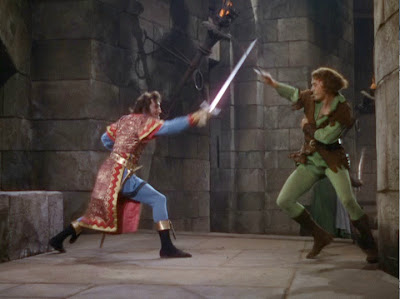
28) Favorite Alan Smithee film. (Thanks, Peter!)
A: I’m not sure how to find this - I don’t think I’ve seen any of the classics listed on IMDB . . .
29) Crash Davis (Kevin Costner) or Morris Buttermaker (Walter Matthau)?
A: Buttermaker, of course.
30) Best post-Crimes and Misdemeanors Woody Allen film.
A: Husbands and Wives is actually pretty good. The only one since then that counts as a genuinely good movie (of those I have seen.)
31) Best Film of 1999.
A: Charisma - Kurosawa’s . . . (where’s 89? City of Sadness, is that answer.)
32) Favorite movie tag line.
A: I can't answer this on demand. I will think of it sometime tomorrow, in the middle of a meeting or walking home...
33) Favorite B-movie western.
A: I'm not sure what counts as a B - but if it is, Seven Men from Now seems like an obvious choice. And 40 Guns, especially given the final question below...
34) Overall, the author best served by movie adaptations of her or his work.
A: Well - why not Dashiell Hammett? The Thin Man films, Maltese Falcon, all the various versions of the Glass Key and Red Harvest - why not?
35) Susan Vance (Katharine Hepburn) or Irene Bullock (Carole Lombard)?
A: I’ll have to say Susan Vance.
36) Favorite musical cameo in a non-musical movie.
A: I could probably come up with more, but it’s hard to beat Ricky Nelson and Dino in Rio Bravo.
37) Bruno (the character, if you haven’t seen the movie, or the film, if you have): subversive satire or purveyor of stereotyping?
A: satire - whether it works or not, I don’t know.
38) Five film folks, living or deceased, you would love to meet. (Thanks, Rick!)
A: Nice question.... Well? 1) Barbara Stanwyck, for I am a groupie. 2) Sam Fuller, of course. 3) Boris Karloff, because not only was he in so many great films - he’s supposed to have been a really nice guy. 4) Speaking of Karloff - Val Lewton. 5) Jean Luc Godard - because - you gotta have Godard. And Jacques Rivette. They’re both alive, so I get the extra one, right?
1) Second-favorite Stanley Kubrick film.
A: The Killing
2) Most significant/important/interesting trend in movies over the past decade, for good or evil.
A: I think I have to say, the change in media. The shift from film to digital video; and the shift from film for exhibition to, again, digital forms of exhibition and distribution - from DVDs to digital projection to the internet. In fact - yes - this is what matters most, I think. I don’t know what it is going to do to the art form - but art follows technology, and I expect what emerges from the new systems of production and distribution will have its own value.
3) Bronco Billy (Clint Eastwood) or Buffalo Bill Cody (Paul Newman)?
A: Buffalo Bill - when in doubt, it’s always Altman.
4) Best Film of 1949.
A: Late Spring, easily.
5) Joseph Tura (Jack Benny) or Oscar Jaffe (John Barrymore)?
A: Jaffe - that’s one of the great characters of the 30s.
6) Has the hand-held shaky-cam directorial style become a visual cliché?
A: as much as anything, no more than anything else. It is, but you can say than about almost everything.
7) What was the first foreign-language film you ever saw?
A: I don’t know for sure. Some of the earliest ones I remember were Seven Samurai, the Seventh Seal - I think I saw them on TV somewhere, but I don’t remember when. I definitely saw Ivan the Terrible in 1986 or so, but I was used to subtitles by then, so I must have seen something. Seven Samurai and Seventh Seal were two of the earliest I deliberately sat down to watch, I know that.
8) Charlie Chan (Warner Oland) or Mr. Moto (Peter Lorre)
A: Probably Lorre, though I haven’t seen much of either.
9) Favorite World War II drama (1950-1970).
A: I would say Kon Ichikawa’s Fires on the Plain.
10) Favorite animal movie star.
A: I thought this would be harder, but - a bunch of us were talking about the Thin Man at work - that’s the answer! Asta!
11) Who or whatever is to blame, name an irresponsible moment in cinema.
A: Not sure what this means, exactly. I suppose I might as well take the opportunity to express, for the first time in a couple years, just how godawfully insultingly stupid Life is Beautiful is. It's all right, kiddies, just pretend it didn't happen and it will be like it never happened! hooray!
12) Best Film of 1969.
A: A Touch of Zen?
13) Name the last movie you saw theatrically, and also on DVD or Blu-ray.
A: Since it's taking me most of a month to answer... when I started - 7/17/2009 - the answer was: Tetro in the theater; Happy Feet on DVD... As of 7/25/09: In the Loop in theaters; Lang's Spiders on DVD. Today? 8/5/2009: Hands Over the City on DVD; The Lost World (1925 of course) in a theater; Up new in a theater (though that's almost second run, too...) [Just a coincidence, by the way, seeing Up and the Lost World so close together... a nice one of course. You can work Spiders in there as well - hot air balloons flying to South America?]
14) Second-favorite Robert Altman film.
Nashville
15) What is your favorite independent outlet for reading about movies, either online or in print?
A: CinemaScope? Or Bordwell and Thompson’s blog?
16) Who wins? Angela Mao or Meiko Kaji? (Thanks, Peter!)
A: I can’t really say, I don’t know how many times I have seen one of them (especially Mao) without knowing it - but I remember Meiko Kaji, so I’ll say her.
17) Mona Lisa Vito (Marisa Tomei) or Olive Neal (Jennifer Tilly)?
A: Lean toward Tomei . . . in fact - it’s almost always Tomei, who is gorgeous, and wonderful, in everything she does.
18) Favorite movie that features a carnival setting or sequence.
A: I’ll say some came running, maybe especially since I get to include a picture!

19) Best use of high-definition video on the big screen to date.
A: Zodiac? Che? Both are first rate. Zodiac, I suppose, gets the nod for being more specifically built around DV - the lighting possibilities and so on. Che is just gorgeous, but it would be just as gorgeous or more on 35. Zodiac would kind of have to be a different looking film.
20) Favorite movie that is equal parts genre film and a deconstruction or consideration of that same genre.
A: There are probably lots of these - I might as well say McCabe and Mrs. Miller - which is and subverts everything it is exquisitely.
21) Best Film of 1979.
A: Kieslowski’s Camera Buff
22) Most realistic and/or sincere depiction of small-town life in the movies.
A: Not sure. The art film division probably starts with Hou Hsiao Hsien and Wu Nien-jen - City of Sadness, A Time to Live a Time to Die, A Borrowed Life . . . though if I wanted to be perverse, I could say Satantango . . . American - Some Came Running is in there; so are Preston Sturges’ small town films - Miracle of Morgan Creek, Hail the Conquoring Hero. Or maybe it’s Local Hero . . . Or better - Whiskey Galore?
23) Best horror movie creature (non-giant division).
A: A really good question . . . Bridgitte Lin?

24) Second-favorite Francis Ford Coppola film.
A: The Godfather Part I.
25) Name a one-off movie that could have produced a franchise you would have wanted to see.
A: DArkman comes to mind. Though actually - just about any of the Coen brothers’ films would count - Marge? The Dude? Ulysses Everett McGill? Hi and Ed McDunnough? You bet I’d pay to see more of any of them.
26) Favorite sequence from a Brian De Palma film.
A: I can’t really answer this
27) Favorite moment in three-strip Technicolor.
A: Probably something from The Adventures of Robin Hood.

28) Favorite Alan Smithee film. (Thanks, Peter!)
A: I’m not sure how to find this - I don’t think I’ve seen any of the classics listed on IMDB . . .
29) Crash Davis (Kevin Costner) or Morris Buttermaker (Walter Matthau)?
A: Buttermaker, of course.
30) Best post-Crimes and Misdemeanors Woody Allen film.
A: Husbands and Wives is actually pretty good. The only one since then that counts as a genuinely good movie (of those I have seen.)
31) Best Film of 1999.
A: Charisma - Kurosawa’s . . . (where’s 89? City of Sadness, is that answer.)
32) Favorite movie tag line.
A: I can't answer this on demand. I will think of it sometime tomorrow, in the middle of a meeting or walking home...
33) Favorite B-movie western.
A: I'm not sure what counts as a B - but if it is, Seven Men from Now seems like an obvious choice. And 40 Guns, especially given the final question below...
34) Overall, the author best served by movie adaptations of her or his work.
A: Well - why not Dashiell Hammett? The Thin Man films, Maltese Falcon, all the various versions of the Glass Key and Red Harvest - why not?
35) Susan Vance (Katharine Hepburn) or Irene Bullock (Carole Lombard)?
A: I’ll have to say Susan Vance.
36) Favorite musical cameo in a non-musical movie.
A: I could probably come up with more, but it’s hard to beat Ricky Nelson and Dino in Rio Bravo.
37) Bruno (the character, if you haven’t seen the movie, or the film, if you have): subversive satire or purveyor of stereotyping?
A: satire - whether it works or not, I don’t know.
38) Five film folks, living or deceased, you would love to meet. (Thanks, Rick!)
A: Nice question.... Well? 1) Barbara Stanwyck, for I am a groupie. 2) Sam Fuller, of course. 3) Boris Karloff, because not only was he in so many great films - he’s supposed to have been a really nice guy. 4) Speaking of Karloff - Val Lewton. 5) Jean Luc Godard - because - you gotta have Godard. And Jacques Rivette. They’re both alive, so I get the extra one, right?
Thursday, July 30, 2009
Oopsies!
Uh oh - more names leaked from that 2003 drug test that got A-Rod earlier this year - this time coming closer to home - cheating swine Manny Ramirez and the sainted David Ortiz are named. Shocking news! Meanwhile, Ortiz wasted little time getting the Boston faithful to put this difficult revelation behind them, hitting a home run to win the afternoon's game....
Personally, I am rather grateful for this revelation. Boston fans were a bit too eager to go after A-Rod or Bonds or Canseco back in the day - local commentary is a bit too willing to sniff at those poor deluded fools in LA who welcomed Manny back with open arms after his suspension. Now - they'll have to find other ways to make fools of themselves. I am happy to report that I have generally not been too stern in my judgments - Manny, getting caught this year, is pretty pathetic - but, he did the time, he's back, there you go... and people like Bonds and such - it was a fact of the game back then. There's no grounds to get self-righteous about it - never was, and every name that comes out just proves it over and over again. There's been a certain amount of talk lately about Bill James' take on steroids - one of the keys of James' argument is that whatever "rules" existed against steroids before 2002 or 3 were openly unenforced, if not simply unenforceable. It was hard, in the 90s, not to see the steroid era as a deliberate policy on the part of major league baseball - home runs put asses in in the seats, most of the promotion of the game was promotion of home runs - not for nothing was the home run contest THE attraction of the all star break in that era. I don't know how to get around this. The plain obviousness of the rampant use of steroids, and the obvious acceptance of this at every level of the game. Maybe not the "purists" - as posturing a bunch of blowhards as you are likely to see - but everyone else. Not that you had to like it - I'm a pitching defense, walks and doubles guy myself, a fan of the national league game stuck in a quintessentially American League city, alas... but it's what it is - or was what it was.
The questions about the hall of fame are coming up, more and more - that's what James is writing about; the other night on one of the Red Sox games, Gordon Edes said almost the same thing - you don't know who used and who didn't - in the end, the odds are almost everyone from 95-05 will have used something - so you probably have to accept it as a fact of the game as it was played and vote for the best players of the era. That is how I feel. Using steroids isn't admirable, but it was done, and done widely, and hall of fame voting (for instance) is always about comparing players to their peers. Now - it might be more of a problem to compare those players to the players who came before - what are the raw totals worth? How much do you have to discount Manny Ramirez to compare him, accurately, to Jim Rice? Personally - I think steroids are already starting to work the other way - I think Jim Rice got into the Hall of Fame mostly as a reaction to the steroid era. I suspect - much as I adored Jim Rice as a ball player - that without the steroid era, Rice would never have made it in. He wasn't getting in before the strike, before McGwire and Sosa and Bonds hitting 60s of home runs, and so on. If they hadn't, even if they had put up the kinds of numbers you would have expected them to - a couple hundred fewer career homers, maybe; topping out around 52-55 in a season, I imagine - I don't think Rice would have gotten in. I don't know if I would have voted for him, for anything except as a home town favorite... I suppose that goes for the juice boys - I don't know if Sosa was really any better than JIm Ed - McGwire was just a power hitter... ON the other hand, steroids or not, I don't see any case for keeping Bonds or Clemens or A Rod out of the hall - if they were cheaters, they were plainly better than all the other cheaters, and probably better than a good many non-cheaters... So...
Baseball. In the end, I expect to treat steroids the way you treat Coors field or the dead ball - one of the conditions of the game at a certain time, that changes the way the stats look.
Meanwhile, to turn to less controversial subjects - I see metro Boston's last big horrendous news item has reached a kind of conclusion, as President Obama's "beer summit" occurs, bringing Henry Louis Gates and police sergeant James Crowley together for a brewski and a few words of wisdom.... I hope those words of wisdom include something to the effect of, "you know, sergeant, while it's true I should not have called you stupid in front of the national media, you really did screw up." It's rather amazing that a significant number of people don't think the cop is essentially to blame. You can't go arresting people for breaking into their own house - or for being pissed off when you show up and investigate them for breaking into their own house... of course, there's some sign the cop knew that, and got Gates to follow him outside in a rage, where he could arrest him for creating a public disturbance - hard to say. But hard to see anything in the story that puts the blame for the arrest anywhere but on the police.
Anyway, it seems to be winding down now. Just as well. Though I hope something more comes out of this than another round of solemn intonations to Never Antagonize An Officer of the Law! Usually from the same people who solemnly intone that Socialized Medicine Will Take Away Your Right to Choose Your Own Health Care! Right. By god, if we've gotta have a police state, let's at least have free health care!
Personally, I am rather grateful for this revelation. Boston fans were a bit too eager to go after A-Rod or Bonds or Canseco back in the day - local commentary is a bit too willing to sniff at those poor deluded fools in LA who welcomed Manny back with open arms after his suspension. Now - they'll have to find other ways to make fools of themselves. I am happy to report that I have generally not been too stern in my judgments - Manny, getting caught this year, is pretty pathetic - but, he did the time, he's back, there you go... and people like Bonds and such - it was a fact of the game back then. There's no grounds to get self-righteous about it - never was, and every name that comes out just proves it over and over again. There's been a certain amount of talk lately about Bill James' take on steroids - one of the keys of James' argument is that whatever "rules" existed against steroids before 2002 or 3 were openly unenforced, if not simply unenforceable. It was hard, in the 90s, not to see the steroid era as a deliberate policy on the part of major league baseball - home runs put asses in in the seats, most of the promotion of the game was promotion of home runs - not for nothing was the home run contest THE attraction of the all star break in that era. I don't know how to get around this. The plain obviousness of the rampant use of steroids, and the obvious acceptance of this at every level of the game. Maybe not the "purists" - as posturing a bunch of blowhards as you are likely to see - but everyone else. Not that you had to like it - I'm a pitching defense, walks and doubles guy myself, a fan of the national league game stuck in a quintessentially American League city, alas... but it's what it is - or was what it was.
The questions about the hall of fame are coming up, more and more - that's what James is writing about; the other night on one of the Red Sox games, Gordon Edes said almost the same thing - you don't know who used and who didn't - in the end, the odds are almost everyone from 95-05 will have used something - so you probably have to accept it as a fact of the game as it was played and vote for the best players of the era. That is how I feel. Using steroids isn't admirable, but it was done, and done widely, and hall of fame voting (for instance) is always about comparing players to their peers. Now - it might be more of a problem to compare those players to the players who came before - what are the raw totals worth? How much do you have to discount Manny Ramirez to compare him, accurately, to Jim Rice? Personally - I think steroids are already starting to work the other way - I think Jim Rice got into the Hall of Fame mostly as a reaction to the steroid era. I suspect - much as I adored Jim Rice as a ball player - that without the steroid era, Rice would never have made it in. He wasn't getting in before the strike, before McGwire and Sosa and Bonds hitting 60s of home runs, and so on. If they hadn't, even if they had put up the kinds of numbers you would have expected them to - a couple hundred fewer career homers, maybe; topping out around 52-55 in a season, I imagine - I don't think Rice would have gotten in. I don't know if I would have voted for him, for anything except as a home town favorite... I suppose that goes for the juice boys - I don't know if Sosa was really any better than JIm Ed - McGwire was just a power hitter... ON the other hand, steroids or not, I don't see any case for keeping Bonds or Clemens or A Rod out of the hall - if they were cheaters, they were plainly better than all the other cheaters, and probably better than a good many non-cheaters... So...
Baseball. In the end, I expect to treat steroids the way you treat Coors field or the dead ball - one of the conditions of the game at a certain time, that changes the way the stats look.
Meanwhile, to turn to less controversial subjects - I see metro Boston's last big horrendous news item has reached a kind of conclusion, as President Obama's "beer summit" occurs, bringing Henry Louis Gates and police sergeant James Crowley together for a brewski and a few words of wisdom.... I hope those words of wisdom include something to the effect of, "you know, sergeant, while it's true I should not have called you stupid in front of the national media, you really did screw up." It's rather amazing that a significant number of people don't think the cop is essentially to blame. You can't go arresting people for breaking into their own house - or for being pissed off when you show up and investigate them for breaking into their own house... of course, there's some sign the cop knew that, and got Gates to follow him outside in a rage, where he could arrest him for creating a public disturbance - hard to say. But hard to see anything in the story that puts the blame for the arrest anywhere but on the police.
Anyway, it seems to be winding down now. Just as well. Though I hope something more comes out of this than another round of solemn intonations to Never Antagonize An Officer of the Law! Usually from the same people who solemnly intone that Socialized Medicine Will Take Away Your Right to Choose Your Own Health Care! Right. By god, if we've gotta have a police state, let's at least have free health care!
Tuesday, July 28, 2009
Memories

July is not a good blogging month for me - there is too much to do: vacations, mine and people visiting me - softball games - baseball to watch, too hot, usually to do a lot of writing... And I suppose I've been a bit burnt out, after taking too classes in the spring, then knocking out a bunch of Japanese film posts in June... not a lot of posts, but longish posts...
Excuses excuses. There are things to do - one thing to do is post a response to Joseph B's Mr. Bernstein Meme. The principal is simple - a memory, with the same kind of disproportionate importance of the girl in white on the ferry, cited by Bernstein in Citizen Kane. Which also puts me in mind of Caveh Zahedi's monologue in Waking Life about Holy Moments... I have been thinking about memory - I have been scanning slides - which create whole webs of associations. The knowledge about who is in the pictures, where, what they are doing - the memories, the sense memories, of the things in the pictures (when I remember them) - and the memories of watching slides themselves. My family had - well, probably thousands of slides. Once a month or so, we would set up a screen, make a big bowl of popcorn, turn off the lights and go through them - grabbing boxes of them blind, going through them almost randomly... An event.
So - that is what I should write about - but it is harder work than it should be. And - I have a lot more slides to go through - making it easy to procrastinate.... Now: I can stick pretty close to Bernstein's memory - a girl, spotted once... In this case - an Asian girl, college aged, throwing a frisbee with some friends in JFK Park, in Harvard Square, 12-15 years ago. Summer - she had short hair, shorts and a tee shirt, she was really good with he frisbee... I don't know what about her stuck - I have spent lots of afternoons in JFK park, eating lunch, reading, whatever - lots of kids throwing frisbees (and playing soccer and volleyball and sunbathing and walking dogs and kids and everything else people do, lazy summer afternoons...) But I remember her.
Though I hope I can write something about this, say:

A train, photographed somewhere on the line from Northern Vermont, NIagara Falls and Toronto, sometime in the summer of 1977 or 78. Nothing spectacular - and honestly, it doesn't really spark any memories. What it does do, though, is remind me of James Bennings' RR - and that film sparks memories. All of it - but especially, starting with shot #4 (the link above has pictures of all the trains in the film), of waiting or trains to cross roads. I had forgotten that - it's rare, now, to have to wait for a long train to cross a road - but when I was a kid, it happened quite a lot. Maybe it happened most when we were traveling in Canada - I remember long trains, trains crossing roads, or running alongside roads. I remember counting the cars of trains, especially when they were crossing the highway. And - some of those big monsters - 100 plus cars - I remember some of those. I remember counting cars on trains - one of the games we played when we were driving (my family) - counting horses, counting snowmobiles, not to mention road bingo - games we played, driving to Vermont, Canada, etc. There's a lot there....
And finally - that train, that trip, to Niagara falls - that's the picture at the top. I haven't come to the rest of the Niagara slides. That's likely to bring back some memories, when I dig them up.
Saturday, July 18, 2009
Distractions

I have nothing much to say here. I have spent this week with a lovely new toy - a little slide scanner, nothing special, but it works. My family took slides - up to the middle of the 80s, maybe - 70%? more? - of the pictures we took were slides. It's been years since anyone bothered to bring out the projector, the screen, all that stuff - they were in danger of disappearing into - nothingness... So this has been a blessing. Quick and simple process getting them on the computer (the machine scans to SD cards) - the quality doesn't seem to be all that good, though it might just be the fact that these are 30 to 50 year old slides, snapshots at that. But it does what it does and does it very well... I've gotten a few hundred done this weekend - god knows how many more there are at the family homestead, but I might get them all in there. I am happy...
Anyway - here is a picture that probably explains a lot. It's hard to see - but that's Johnny West on the arm of the chair; and those are Hardy Boys books on the chair and in hand. That's me at 8 or 9, every inch the nerd I would become...

Now this picture - thankfully, I never became the evil clown I foretold here...

Wednesday, July 08, 2009
This may be scientific, but it's pretty horrible
For of the Spirit of Ed Wood blogathon, literary division.

I know next to nothing about Dr. John Button, but if anyone exemplifies the spirit of Ed Wood, it was Dr. John Button. Who was Dr. John Button? Whatever else he was, he was a ghostwriter for the Stratemeyer syndicate, mass producers of children's literature from the beginning of the 20th century to - well, today, in spirit at least. Now Edward Stratemeyer - that's what people like Ed Wood, enthusiastic purveyors of unabashed pulp fiction, aspired to be - knocking out stories by the score, first whole books, then outlines, that he farmed out to his ghostwriters, all of it written to spec - 25 chapters, 200 or so pages, one after another... all of it immensely popular, and some of it pretty damned good - with a few series that changed the cultural landscape. The Hardy Boys - Nancy Drew - maybe Tom Swift and the Bobbsey Twins... That's Edward Stratemeyer.
I loved the Hardy Boys when I was a kid - yes I did. I think I read the first one in second grade, and was addicted from the start - I read every one of them I could find. I emptied all the libraries I had access to - and since I had access to some old and shabby libraries, I read the original set of books along with the current set of books. (The Syndicate rewrote the early books starting in 1959: they dumbed down the prose, turned the boys squeaky clean, took out the racism [which was pretty bad for a while], and most of the characterization to boot.] Now I wasn't the most discriminating reader when I was 8, but I had my favorites, and there were some head-scratchers in the series - I was pleased to discover on re-reading them that my faves were actually pretty good, and the dubious ones were actually pretty bad... Okay. The fact is, I suppose, the Stratemeyer's techniques were bound to create a very uneven series - only as good as the outliners and the ghostwriters currently employed. It is no surprise that the first 10-11 are the strongest - they were written by Leslie McFarlane, a more than fair writer; the were probably outlined, at least some of them, by old Edward Stratemeyer himself. He died in 1930, and it's the early 30s when things go south - the stories get dumber; the racism gets more pronounced; the characters get more caricatured... And then, in 1938, with McFarlane gone, the syndicate hired our hero, Dr. John Button, to write the books....
He wrote five: The Secret Warning; The Twisted Claw; The Disappearing Floor; The Mystery of the Flying Express; and The Clue of the Broken Blade. Even when I was a kid, I could tell these were a bit - off. Not that the rest of the series is great lit - the first 11 (say) are pretty damned good for what they are; there's a nice renaissance in the 40s and 50s (the stories tend to be sillier, but there's a nice sense of atmosphere to a lot of them, some cool set pieces, and a couple better than average detective stories); but they grow increasingly perfunctory and formulaic in the late 50s and 60s onward, and are near unreadable by the 70s. (An opinion I held in real time...) But the bad books and bad stretches tend to be boring and drab affairs - flat prose and flat stories and predictable action and....
Not the Dr. John Button books. No. They are bad, but they are bad in the finest tradition of Ed Wood. (Though bad a decade or so before Ed Wood started to be bad.) They are bad for all the normal reasons - lazy plots, built on coincidence and caricatured characters, realized in dull, awkward prose, full of implausible events and - more or less uniquely in a property this closely controlled by its owners - jammed full of continuity errors. Like getting characters' names wrong - like the Hardy Boys mother's name wrong. That sort of thing.... They are bad for those reasons - but they are also bad for - well - let's cut to the chase: the Plan 9 From Outer Space of juvenile fiction, and the source of this humble blog's name, and its blogger's screenname - The Disappearing Floor.
If you were to click on that last link, you'd find a couple summaries of this book - both of which give up after 4-5 chapters. Let me give you a partial itinerary for the boys: they start at a train station - go to a place called Great Notch, somewhere in the hills - they hike into the woods - they fall into a cave (and meet their father) - they leave the cave, find a bag of silver dollars, and head off to return it to some place called Wayne City - after driving a cab into the river, precipitating a riot at the bank, and discovering that the bag contains $82,000 (in silver dollars) - they go back to the woods, where Dad has been KO'd - once more into the cave, more trouble there - they haul Dad to a hospital - they go back to Bayport - then up into the woods with a bunch of girls and their Aunt Gertrude. There - Dad turns up and is mauled by a tiger that the boys kill with pointed sticks (no, really!) and a rock - they take him to the hospital again, send the girls back home - go back looking for the bad guys and are attacked by another tiger, and rescued by the villain - they go to thank him, but are worried he'll recognize him so they drag up. Then it's off to the town of Erie, for another bank robbery - they follow the robbers who bury gold in a cemetery - later a crazy old man digs up the gold during a thunder storm - the boys capture the head robber - then get kidnapped - go to an Old Dark House - are frozen solid and set adrift in a rowboat - go back to the house - where most of the rest of the story takes place... Though they do leave a few times, once to fly from Erie to Columbia to buy a book, then back, tailed by the wolfish gangster Weeping Sam himself - they hide at an amusement park, then back to the house, where Fenton Hardy gets electrocuted and frozen solid....
Right. It's like that - constant motion, until they reach the house, and even there they go in and out, up and down, as does the house (the title coming from a room with an elevator in the floor) - contending with a mad scientist who grows plants with electricity, has a device for quick freezing people, immobilizes people with magnetic fields, has a system of electric ghosts to scare off intruders, as well as more prosaic electric traps and locks, has the whole place bugged ("the listening ear"), has a machine that can force you to tell the truth - etc.... What happens in all these places - never mind the science fiction - is wildly absurd: randomly finding bags of money, people turning up and disappearing at will, the boys dressing up as old women to fool Duke Beeson, and later pretending to be Duke Beeson to fool Weeping Sam - and full of extremely strange things. Two Tigers loose in the woods? a group of -sun-worshippers? "Ozonites" - led by Chief Shining Light - an Indian Prince (native of India, that is) - who's really Duke Beeson? I don't know how much of this is the fault of the syndicate's outliners (Edna Stratemeyer Squire, in fact, daughter of old Edward) and how much is Button's, but whoever it is - it's a pretty amazing performance....
It's bad - but it sneaks up on you. It's like those Ed Wood films - however silly the story is, however badly acted, shot, written it is - it has a kind of total, warped commitment. It's ridiculous - but you can't parody it, you can't make fun of it. The Hardy Boys books, over all, are pretty easy to make fun of - the coincidences, the convenient disappearances and reappearances of Fenton Hardy, the frequent blows to the head, Chet and his hobbies, his appetite, his cowardice - everything rolled out like cloclwork... But this one plays like a parody of all that - Button never met a cliche he didn't like, and could execute them with all the obviousness and lack of grace that Ed Wood would have later - so if Fenton Hardy turns up unexpectedly in a cave, Button isn't going to waste any time looking for a way to make it seem plausible - no: he's just there! if the outliner lost track of where the bag of coins was, Button doesn't care - Oh! it fell in a hole! it looks like a rock! And far be it from him to change the dollar amounts - if the outline says it's a bag of coins in the first chapter, he's not going to quibble too much about what 82,000 silver dollars would weigh in the next chapter, nor let carrying that amount of money slow the Hardy boys from swimming out of a sinking taxi cab... And if you are going to set most of the story in an old dark house, you can bet that you get to the old dark house by way of a thunderstorm in a cemetery at midnight with a cackling madman digging up buried loot...
And that - along with the pace and the sheer weirdness of it - makes it a surprisingly fun read. It's a hoot. It doesn't hurt that, compared to most of the series, it contains some really memorable villains. That's something of a Dr. John Button specialty, in all his books. The bad guys in most Hardy Boys books are a pretty bland lot - snarling swarthy brutes, plus the occasional con man or cold eyed pretty boy assassin, who never really do much beyond whack the boys on the head and explain their evil schemes after they've been captured.... Not Button's villains - they sneer and menace and get lines - lots of lines - and names - Dick Tracy type names: Kuntz the deep sea diver (in The Secret Warning); Pierre the French Canadian Pirate (in the Twisted Claw); and in this book - Duke Beeson, alias Chief Shining Light; wolfish Weeping Sam his main henchman; Louis Butts; three stooges named (as they should be) Pudge, Runt and Spike. They carry on, they get in fights, they scheme against one another and the boys - and when Eben Adar (the mad sceintist) points his truth tellign machine at them, they tell their life stories. At least Duke Beeson does: "The first thing I ever stole was my teacher's pocketbook," he said in a drawl.... HIs books as a group do this - make the villains much more prominent, treating them like, well - Dick Tracy, and other comic strips - or the better Hollywood adventure tales, giving the bad guys scenery to chew... it goes a long way toward making these books enjoyable.
And finally - there's the dialogue. This has more than its share of Ed Wood worthy lines. The boys find the bad guys frozen solid - "This may be scientific," concluded Joe, "but it's pretty horrible." Or in re the tiger they have downed, and possibly killed - "Give me your stick. I'll poke him." Or perhaps this exchange: the old madman, Eben Adar, is giving Aunt Gertrude a tour, showing her his electric flowers...
Which I suppose brings us to a final point. You have to start to wonder - all this absurdity - the obvious, unapologetic coincidences and cliches, the heavy handed foreshadowing, and - well - lines like that one? or the inclusion of those sun-worshippers? Given that "sun-worshippers" usually turns up in old books and movies and comics as a reference to nudists... and the boys, dressing up as old women? and - well - maybe - I can't help suspecting that maybe Dr. John Button was in on a bit more of the unintentional comedy than he lets on. But in the end, I suppose it doesn't matter - the book is - utterly ridiculous, but funny as hell anyway, packed full of stuff, completely shameless - and a joy to read. As much fun as an Ed Wood movie, and it would be just as funny if it were all meant as a parody, as it is, thinking it's just ineptitude. There's a fine line between clever and stupid - and sometimes, the line doesn't matter in the least.

I know next to nothing about Dr. John Button, but if anyone exemplifies the spirit of Ed Wood, it was Dr. John Button. Who was Dr. John Button? Whatever else he was, he was a ghostwriter for the Stratemeyer syndicate, mass producers of children's literature from the beginning of the 20th century to - well, today, in spirit at least. Now Edward Stratemeyer - that's what people like Ed Wood, enthusiastic purveyors of unabashed pulp fiction, aspired to be - knocking out stories by the score, first whole books, then outlines, that he farmed out to his ghostwriters, all of it written to spec - 25 chapters, 200 or so pages, one after another... all of it immensely popular, and some of it pretty damned good - with a few series that changed the cultural landscape. The Hardy Boys - Nancy Drew - maybe Tom Swift and the Bobbsey Twins... That's Edward Stratemeyer.
I loved the Hardy Boys when I was a kid - yes I did. I think I read the first one in second grade, and was addicted from the start - I read every one of them I could find. I emptied all the libraries I had access to - and since I had access to some old and shabby libraries, I read the original set of books along with the current set of books. (The Syndicate rewrote the early books starting in 1959: they dumbed down the prose, turned the boys squeaky clean, took out the racism [which was pretty bad for a while], and most of the characterization to boot.] Now I wasn't the most discriminating reader when I was 8, but I had my favorites, and there were some head-scratchers in the series - I was pleased to discover on re-reading them that my faves were actually pretty good, and the dubious ones were actually pretty bad... Okay. The fact is, I suppose, the Stratemeyer's techniques were bound to create a very uneven series - only as good as the outliners and the ghostwriters currently employed. It is no surprise that the first 10-11 are the strongest - they were written by Leslie McFarlane, a more than fair writer; the were probably outlined, at least some of them, by old Edward Stratemeyer himself. He died in 1930, and it's the early 30s when things go south - the stories get dumber; the racism gets more pronounced; the characters get more caricatured... And then, in 1938, with McFarlane gone, the syndicate hired our hero, Dr. John Button, to write the books....
He wrote five: The Secret Warning; The Twisted Claw; The Disappearing Floor; The Mystery of the Flying Express; and The Clue of the Broken Blade. Even when I was a kid, I could tell these were a bit - off. Not that the rest of the series is great lit - the first 11 (say) are pretty damned good for what they are; there's a nice renaissance in the 40s and 50s (the stories tend to be sillier, but there's a nice sense of atmosphere to a lot of them, some cool set pieces, and a couple better than average detective stories); but they grow increasingly perfunctory and formulaic in the late 50s and 60s onward, and are near unreadable by the 70s. (An opinion I held in real time...) But the bad books and bad stretches tend to be boring and drab affairs - flat prose and flat stories and predictable action and....
Not the Dr. John Button books. No. They are bad, but they are bad in the finest tradition of Ed Wood. (Though bad a decade or so before Ed Wood started to be bad.) They are bad for all the normal reasons - lazy plots, built on coincidence and caricatured characters, realized in dull, awkward prose, full of implausible events and - more or less uniquely in a property this closely controlled by its owners - jammed full of continuity errors. Like getting characters' names wrong - like the Hardy Boys mother's name wrong. That sort of thing.... They are bad for those reasons - but they are also bad for - well - let's cut to the chase: the Plan 9 From Outer Space of juvenile fiction, and the source of this humble blog's name, and its blogger's screenname - The Disappearing Floor.
If you were to click on that last link, you'd find a couple summaries of this book - both of which give up after 4-5 chapters. Let me give you a partial itinerary for the boys: they start at a train station - go to a place called Great Notch, somewhere in the hills - they hike into the woods - they fall into a cave (and meet their father) - they leave the cave, find a bag of silver dollars, and head off to return it to some place called Wayne City - after driving a cab into the river, precipitating a riot at the bank, and discovering that the bag contains $82,000 (in silver dollars) - they go back to the woods, where Dad has been KO'd - once more into the cave, more trouble there - they haul Dad to a hospital - they go back to Bayport - then up into the woods with a bunch of girls and their Aunt Gertrude. There - Dad turns up and is mauled by a tiger that the boys kill with pointed sticks (no, really!) and a rock - they take him to the hospital again, send the girls back home - go back looking for the bad guys and are attacked by another tiger, and rescued by the villain - they go to thank him, but are worried he'll recognize him so they drag up. Then it's off to the town of Erie, for another bank robbery - they follow the robbers who bury gold in a cemetery - later a crazy old man digs up the gold during a thunder storm - the boys capture the head robber - then get kidnapped - go to an Old Dark House - are frozen solid and set adrift in a rowboat - go back to the house - where most of the rest of the story takes place... Though they do leave a few times, once to fly from Erie to Columbia to buy a book, then back, tailed by the wolfish gangster Weeping Sam himself - they hide at an amusement park, then back to the house, where Fenton Hardy gets electrocuted and frozen solid....
Right. It's like that - constant motion, until they reach the house, and even there they go in and out, up and down, as does the house (the title coming from a room with an elevator in the floor) - contending with a mad scientist who grows plants with electricity, has a device for quick freezing people, immobilizes people with magnetic fields, has a system of electric ghosts to scare off intruders, as well as more prosaic electric traps and locks, has the whole place bugged ("the listening ear"), has a machine that can force you to tell the truth - etc.... What happens in all these places - never mind the science fiction - is wildly absurd: randomly finding bags of money, people turning up and disappearing at will, the boys dressing up as old women to fool Duke Beeson, and later pretending to be Duke Beeson to fool Weeping Sam - and full of extremely strange things. Two Tigers loose in the woods? a group of -sun-worshippers? "Ozonites" - led by Chief Shining Light - an Indian Prince (native of India, that is) - who's really Duke Beeson? I don't know how much of this is the fault of the syndicate's outliners (Edna Stratemeyer Squire, in fact, daughter of old Edward) and how much is Button's, but whoever it is - it's a pretty amazing performance....
It's bad - but it sneaks up on you. It's like those Ed Wood films - however silly the story is, however badly acted, shot, written it is - it has a kind of total, warped commitment. It's ridiculous - but you can't parody it, you can't make fun of it. The Hardy Boys books, over all, are pretty easy to make fun of - the coincidences, the convenient disappearances and reappearances of Fenton Hardy, the frequent blows to the head, Chet and his hobbies, his appetite, his cowardice - everything rolled out like cloclwork... But this one plays like a parody of all that - Button never met a cliche he didn't like, and could execute them with all the obviousness and lack of grace that Ed Wood would have later - so if Fenton Hardy turns up unexpectedly in a cave, Button isn't going to waste any time looking for a way to make it seem plausible - no: he's just there! if the outliner lost track of where the bag of coins was, Button doesn't care - Oh! it fell in a hole! it looks like a rock! And far be it from him to change the dollar amounts - if the outline says it's a bag of coins in the first chapter, he's not going to quibble too much about what 82,000 silver dollars would weigh in the next chapter, nor let carrying that amount of money slow the Hardy boys from swimming out of a sinking taxi cab... And if you are going to set most of the story in an old dark house, you can bet that you get to the old dark house by way of a thunderstorm in a cemetery at midnight with a cackling madman digging up buried loot...
And that - along with the pace and the sheer weirdness of it - makes it a surprisingly fun read. It's a hoot. It doesn't hurt that, compared to most of the series, it contains some really memorable villains. That's something of a Dr. John Button specialty, in all his books. The bad guys in most Hardy Boys books are a pretty bland lot - snarling swarthy brutes, plus the occasional con man or cold eyed pretty boy assassin, who never really do much beyond whack the boys on the head and explain their evil schemes after they've been captured.... Not Button's villains - they sneer and menace and get lines - lots of lines - and names - Dick Tracy type names: Kuntz the deep sea diver (in The Secret Warning); Pierre the French Canadian Pirate (in the Twisted Claw); and in this book - Duke Beeson, alias Chief Shining Light; wolfish Weeping Sam his main henchman; Louis Butts; three stooges named (as they should be) Pudge, Runt and Spike. They carry on, they get in fights, they scheme against one another and the boys - and when Eben Adar (the mad sceintist) points his truth tellign machine at them, they tell their life stories. At least Duke Beeson does: "The first thing I ever stole was my teacher's pocketbook," he said in a drawl.... HIs books as a group do this - make the villains much more prominent, treating them like, well - Dick Tracy, and other comic strips - or the better Hollywood adventure tales, giving the bad guys scenery to chew... it goes a long way toward making these books enjoyable.
And finally - there's the dialogue. This has more than its share of Ed Wood worthy lines. The boys find the bad guys frozen solid - "This may be scientific," concluded Joe, "but it's pretty horrible." Or in re the tiger they have downed, and possibly killed - "Give me your stick. I'll poke him." Or perhaps this exchange: the old madman, Eben Adar, is giving Aunt Gertrude a tour, showing her his electric flowers...
"-and this species here, Getrude, this is a rare variety of Ch'lienglien, a Chinese flower of exquisite beauty. Ah, but the Orientals have never seen this."
"Gracious, it is huge, Eben..."
Which I suppose brings us to a final point. You have to start to wonder - all this absurdity - the obvious, unapologetic coincidences and cliches, the heavy handed foreshadowing, and - well - lines like that one? or the inclusion of those sun-worshippers? Given that "sun-worshippers" usually turns up in old books and movies and comics as a reference to nudists... and the boys, dressing up as old women? and - well - maybe - I can't help suspecting that maybe Dr. John Button was in on a bit more of the unintentional comedy than he lets on. But in the end, I suppose it doesn't matter - the book is - utterly ridiculous, but funny as hell anyway, packed full of stuff, completely shameless - and a joy to read. As much fun as an Ed Wood movie, and it would be just as funny if it were all meant as a parody, as it is, thinking it's just ineptitude. There's a fine line between clever and stupid - and sometimes, the line doesn't matter in the least.
Monday, July 06, 2009
Summer Vacation

Well, here I am, back from vacation, a week in the rain, with little hints of sun there toward the end. Sun's out today, though - a bit confusing and all. Meanwhile, the blog world rolls along - there are events and blogathons, planned and spontaneous - going on now, or recently concluded...
The blog world rolls along: Cinemastyles celebrates Ed Wood and the 50th anniversary of the release of Plan 9 From Outer Space with The Spirit of Ed Wood blogathon.
Edward Copeland, meanwhile, is watching and writing about the films of another low budget maverick, Werner Herzog.
And - being out of town - I've barely glanced at Radiator Heaven's Michael Mann week, which was, I'm afraid, last week.
There are also a couple posts I need to catch up on for the Film of the Month Club's June film, ...No Lies. And discussion of this month's film, Hands over the City, is underway...
Finally - keeping track of all the film related special events on the blogs is a daunting task - Ed Howard is the latest to take a crack at it, posting a Film Blog Calendar...
Finally: the joys of a month of rain - a hole in the middle of the road: [Updated, since I seem to have left out the hole in the road first time...]

Subscribe to:
Comments (Atom)