Friday is here - and though I continue to fail to get anything else written (perhaps this time in utter despair at the misfortunes of the local 9 - though to those inclined too much to pessimism, let me commend the story of the 2001 Oakland A's, of the 2-10 start and the 102-60 finish - similar hype, similar beginnings...) - I can at least put together a music post in 15 minutes to - do something....
Here goes:
1. Frank Sinatra - My Funny Valentine (live in Paris)
2. Dungen - En Gang I Ar Kom Det En Tar
3. PJ Harvey - I Think I'm a Mother
4. Richard Thompson - Mr. Stupid
5. Earth - Rise to Glory
6. Buzzcocks - Promises
7. Isley Brothers - Footsteps in the Dark
8. Can - Spoon
9. Romeo Void - A GIrl in Trouble
10. Pere Ubu - Codex (Live - Mayo Thompson era)
Now - while I can't find anything better on the video front - here is the song, at least - The Isley Brothers...
and I probably post this every 6 months or so, but you can't have too much Can - this is Spoon:
Friday, April 08, 2011

Friday, April 01, 2011
Musical Foolishness
In honor of April Fools day (the weather is certainly foolish enough...) - let's run genius, starting with Frank Zappa's Dancin' Fool:
Starting point: Frank Zappa - Dancin' Fool
1.Devo - Jocko Homo
2. Captain Beefheart - ZIgzag Wanderer
3. Warren Zevon - Accidentally like a Martyr
4. Talking Heads - Crosseyed and Painless
5. Tom Waits - Singapore
6. Ian Dury & the Blockheads - Reasons to be Cheerful Part 3
7. Jane's Addiction - Ted Just Admit It
8. Nick Cave & Bad Seeds _ Hold on To Yourself
9. George Harrison - Apple Scruffs
10. The Mars Volta - Metatron
Here's Frank live:
And somehow, Ian Dury seems appropriate - since live footage of the song that came up seems rare - here's Hit Me With Your Rhythm Stick...
Though this - a Bollywood number cut to Reasons to be Cheerful, Part 3 - is too good to miss.
Wednesday, March 30, 2011
Baseball Prediction, 2011
Time for a baseball preview - the surest sign of spring, the start of the baseball season.
AL East:
1) Boston - There is obviously a lot of hype this year - they had the most active and successful offseason - and they were not far off last year, a game worse than Texas even with all the injuries, the underachievement (Beckett, Papelbon, Lackey), and so on. I think if they had brought back last year's team, they would be favorites - even without Beltre and Martinez, they would be contenders - but getting Crowford and Gonzalez is a lot more than that. It's hard not to pick them - they didn't have anyone really playing over their head last year - if the breakout players (Buchholz and Bard, notably) regress to the mean, you'd think Beckett, Lackey, Papelbon coming back to their mean would more than balance it out.... and I don't think the kids are all that likely to regress - Buchholz and Bard have been top prospects all along - they didn't overachieve last year. The team bolstered all their options - they have depth almost everywhere, including pitching... So - if they stay healthy - they should be formidable. If everything clicks, they might be awe inspiring.
2) NY Yankees - not exactly slouches, though. The team on the field is still pretty good - they also are more likely to get bounceback years from the likes of Jeter and Granderson than any regression from Cano or Gardner. They might be carrying some defensive holes - Jeter has been bad for a long time; A-Rod is getting old and slow as well - but the rest of the field seems pretty well covered. The pitching is another story though - Sabathia is a horse - Hughes, like Buchholz, has been a big prospect for a long time, and one imagines he'll continue to be an asset for a long time.... But then you get AJ Burnett - who seems to me a lesser version of Beckett and Lackey - not as good to start, and less likely to turn it around. And then - Bartolo Colon? Freddy Garcia? Ivan Nova?? I'll take Dice-K, thanks...
3) Tampa Bay - still a strong rotation, still the likes of Langoria and Upton, maybe Zobrist will bounce back - there's Manny and Damon with a lot to prove, but no real expectations - so they are still relevant... They should still have strong starting - they certainly have lots of good options to choose from, behind a very good ace in Price. The pen? Probably keeps them safely in third.
4) Toronto - they have a mob of good and intriguing young pitchers; they have some interesting players on the field - if Lind or Hill come back, if Snider continues to develop, if Bautista doesn't revert to the mean - they could be dangerous. A couple breaks and they could be fighting for third.
5) Baltimore Orioles - they have what - 3 good young players - and a mob of has-beens; and some promising young starters, and Jeremy Guthrie; and - Kevin Gregg? really? They might score some runs - they might not be embarrassing. Showalter might still be on the upward slope of his inevitable rise and fall... but fourth place would be an upset.
Central:
1) Detroit - I think - assuming Cabrera stays out of jail and all. They have some nice pitchers, especially at the top - Verlander and Schzerzer; they have decent players on the field. I think it's a fine line - they have to stay healthy, stay out of jail, stay out of the old folks home - if they do, they should be in contention. Truth is, I don't have a clue who will win this division - the top three teams all have some real stars, but some gaping holes as well - any of them could break in either direction.
2) Chicago - Why put them 2? call it - strong pitching, Dunn, etc. If Peavy were healthy, yeah, maybe... they have Juan Pierre still, though, and that has to be a major point in Detroit and Minnesota's favor.
3) Minnesota - No - actually, I expect them to win the division, as usual. Mauer and Morneau (if he is healthy) are too good - the Cuddyer Span Young Kubel Thome etc. supporting cast is decent - the pitching is decent - Joe Nathan is back, and the pen becomes deeper for it - so... I should put them first.
4) Cleveland - sooner or later something good might happen; though probably the best thing that could happen is they get enough of of Sizemore or Carmona to peddle them off to a contender at the trade deadline.
5) KC - wait til next year! actually - literally - wait til next year - they have some guys on the farm just waiting to shine - hopefully they will be more Johnny Damon, Carlos Beltran, Billy Butler than Alex Gordon. Who's still around too, isn't he? The organization keeps running out stiffs like Francouer and Melky Cabrera - but maybe, this time next year, all those kids will start to make a difference...
West:
1) Texas - they are somewhat weaker, without Lee, but the division is not strong - they should be safe favorites. They did more to improve their offense than pitching (adding Beltre), but they actually have some nice young pitchers - they should be all right.
2) Anaheim - an offseason which saw them fail to get any of the players who could impact the team, then trade for the worst contract in the game - but they have enough that they could be back in the mix. They should have a pretty good rotation (potentially a very good one, with Haren and Weaver in front of the likes of Santana) - they have enough hitters that they should survive... They are soft, though - getting old in kay positions - they are rteading water at best.
3) Oakland - If they had a little more offense I would be more optimistic - they have some great pitchers. The danger is getting too excited about a good young rotation that isn't backed up by much of a team on the field. Sometimes it works (last year's Giants) - usually, it regresses (last year's Mariners.)
4) Seattle - quite hopeless, until some kids develop. The encouraging thing is that the best player on the team is barely more than a kid himself - King Felix has been around forever, has become the class of the American league - and he's not 25 yet.
National League:
East:
1) Phillies - another superteam, it seems. That is a heck of a rotation, I won't deny it. And a good team, as well - though Utley's absence is bad - and they aren't getting younger. This is the baseball equivalent of the Celtics of the last couple years, I think.
2) Atlanta - they were pretty good last yearm and I suspect they will be better this year - as Heyward and Hanson develop, adding Uggla to hit home runs - they should be solid, a wild card contender.
3) Florida - there's quite a bit of talent here - starting with Hanley Ramirez and Josh Johnson - with nice younger players, some interesting veterans - will Javier Vazquez do his usual NL thing? will Nolasco come back? they never seem to catch all the breaks - but they seem a little stronger coming in than usual - maybe they will move up...
4) NY Mets - this is with Bay & Beltran & Reyes all year. Without them, they go to fifth.
5) Washington - there's actually quite a bit to like here - I think Werth's contract was ridiculous, but he is a good player to have on a team like this - he and Zimmerman are a nice middle of the lineup. They have quite a number of good young pitchers, too - though they also have Livan Hernandez (and may for the next decade, for all I know.) I think if the Mets run into their usual health and sanity issues, the Nats could get 4th...
Central:
1) Cincy - they have a lot of players who seem to be on the rising slope of their careers - Bruce and Stubbs and quite a few pitchers - I'd worry a bit about some of their pitchers maintaining their success - but not too much. They look like a pretty good team, on balance.
2) Cards - without Wainwright, they are nothing special. They aren't bad - though the pitchers may find Lance Berkman's stylings in right field something less than optimal. They will never be out of it - but...
3) Milwaukee - Greinke's out already? there's a degree of hype about them, too - and certainly if things were to work out, they could be a breakout team - Greinke and Marcum at the front of the rotation could be very very good - or - could put in a lot of time on the training table... I think they're more uncertain than the teams I have ahead of them - not necessarily worse, though.
4) Cubs - I have no idea what the Cubs will do. I rather like the chances of Garza and Zambrano mounting nice comebacks - I suspect Pena will get back over the MEndoza line and whack 35 or so bombs - but how it all fits? So stick 'em here...
5) Houston - in fact, I don't know if I believe this. They are a boring pointless team, actually. Even if they stay ahead of the Bucs, who cares?
6) Pittsburgh - that is to say - though the odds of getting out of the cellar aren't great - they are actually sort of an interesting team. McCutcheon is an exciting player - Tabata, Alvarez, even Jones are intriguing. if they find any pitching at all - htey might start moving. If they somehow get some pitching before McCutcheon hits arbitration, they might even approach .500 in a couple years.
West:
1) SF Giants - that is one hell of a pitching staff. As for the offense - they have a hell of a pitching staff. Though any kind of recovery from Sandoval, a full year of Posey - they should be okay.
2) LA Dodgers - they have a pretty good staff as well. Kemp and Ethier are first rate hitters, too. The rest fo the team does not thrill me.
3) Rockies - they tend to walk a tightrope - they too have a pretty nice staff (strange thing to say about the Rocks) - and some great players (Tulowitzki and Gonzalez, particularly.) And are thin behind them...
4) Diamondbacks - they are actually not half bad themselves. Need to get Young and Upton both playing well at the same time - and the young pitchers (Hudson, Kennedy) need to come through. They oculd be quite respectable...
5) Padres - another team with a fine staff and not much offense. Older mediocrities and promising youngsters who have not yet done anything... I imagine as the organization reloads, people like Heath Bell should probably keep a bag packed...
OKAY! Predictions!
AL: Boston - Detroit - Texas & Yankees for the wildcard. Boston comes out, I think.
NL: Phils - Reds - Gints & Atlanta - Phils should win it, but this is harder to predict - Giants will be hard to beat with those arms.
Leaving the Sox winners, though - I hope.
AL MVP = I'm gonna say Carl Crawford - watch him use that center field tringle as a triple machine! watch him steal 40, drive in 100, his .325!
Cy Young: make it a Red Sox sweep - Lester!
Rookie - oy - Hellickson seems like the safest bet.
NL MVP = default of course is Pujols. If not Pujols - Tulowitzki or why not Matt Kemp? AT least until the Marlins make the playoffs, which will give it to Hanley.
Cy Young = Halladay and Lincecum are the default choices there - my money would be on Lincecum.
Rookie = do I know? Belt in SF? could be.
Anyway - off we go! games tomorrow! all is well!
Friday, March 25, 2011
New Records
I can see that my posting has slowed down again - three Friday posts in a row.... At least this time I can vary it a bit. I've managed to buy a decent selection of new records this year - there seems to be a particular concentration of things I want out in the early going this year. WIth more to come (whenever the TV on the Radio record is supposed to come out - April 12?) Not only buying it, but listening to it - though in the 21st century way, all the new stuff in a playlist on the iPod, set to shuffle... It's like listening to the radio, back in the day! 2011 feels like 1977 sometimes. A theme that may return.... Anyway - I can't pretend to review these records - just offer some impressions from what the iTunes fairies have chosen to play...
Danielson: The Best of Gloucester County - haven't has this long, and only a couple songs have come up - but - nice stuff, more normal sounding than usual, though Daniel Smith's voice can never quite be normal. If their early career seemed to be built on variations of The Art of Walking - this is their Cloudland...
Decembrists: The King is Dead - they seem to have moved from remaking the Waterboys to remaking The River. (Though with more than a few early REM moments.) They remain quite good, though nothing on this record has compelled my attention like The Crane Wife did... Still - they are a pretty reliable act - I guess I liked their Waterboys act better...
Deerhoof: Deerhoof vs. Evil - nice stuff as always, a bit different, less jagged than before; they appear to be mellowing. Quieter instrumentation, and when the guitars and drums come in, their softer, gentler, with a bit of a latin lilt... interesting....
Gang of Four: Content - not up to their old stuff, but it still jumps out at you - I once confused a group of people at lunch by saying if I could be anyone other than myself I would want to be Andy Gill... that statement is still operational.... I admit too, every time a song from this CD comes up on shuffle, I like it more than I did the last time.
Iron & Wine: Kiss Each other Clean - Mr. Beam and company channeling Little Feat (or is it Harry Nilson?), between the prettier folk songs. Maybe it is 1977 - the bands that weren't actually around in 77 or 79 seem determined to sound like they were... This should not be taken as complaint though - this in particular is full of lovely songs, and a couple really cool songs, when they really dial up the Little Feat vibe - I've had Big Burned Hand running in my head over the last couple weeks.
Mogwai: Hardcore Will Never Die, But You WIll - even Mogwai is sounding rather mellow and 70s-ish these days - well - maybe it's the context; I'm not sure there's much difference from their usual sound - slightly different nuances of 70s style prog metal? Though then you get the end - "You're Lionel Richie" - which lifts it's main riff straight from Earth, and does it justice...
PJ Harvey: Let England Shake - this requires careful attention - Polly Jean is at the height of her powers. I feel inadequate to say anything about it now... if there's a classic in this bunch of CDs, this is it.
REM: Collapse Into Now - not sure why I bought this, but here it is. Nostalgia can be cruel. Though what little I have heard of it so far sounds - promising. Neat opening riff, that comes back again at the end, after a song that appears to have Patti Smith singing while Stipe does a fake Patti Smith thing - interesting. Looping back to the start is a neat little effect... In general - the songs that have come up on the iPod do seem more appealing than on the last REM record, whatever that was called. SO maybe...
Six Organs of Admittance: Asleep on a Flood Plain - Ben back to the classics, acoustic drones and layered sounds and percussions, and now and then, a blast of electricity coming through in waves...
Wire: Red Barked Tree - the music seems a bit softer than in the past, but the words - "please take the knife out of my back and when you do please twist it" - are up to expected standards.
Friday, March 18, 2011
Random Friday Music Post
Welcome to another Friday. Today I think I will revert to randomness -though one of these weeks I want to put up something on some of the new records I have gotten this year. For some reason, a host of bands I like have released records in early 2011 - I believe I have 10 new CDs since the beginning of the year, which given my diminished music buying is rather impressive. Good stuff too - Decembrists, Gang of Four, PJ Harvey - I'll try to run up a post before too long.
Meanwhile, I managed to get through Evacuation Day without posting anything by the Pogues - the last couple years, I have done that more at Facebook, but I even managed to avoid it there. I have also been haunted all week by the Blue Oyster Cult - "history shows again and again how nature points up the folly of men" - funny how stoner rock stars and monster movie filmmakers have a better grasp of how the world works than politicians and businessmen. I'm not alone in noticing this of course - Andrew O'Hehir had a piece in Salon about Japanese apocalyptic films - they have a strong track record of finding striking images of disaster, that illuminate as well as terrify. History shows again and again how nature points up the folly of men.... framing these images as something that seems less that serious just confuses people - the original films are derived pretty directly from real, horrifying events - and the BOC may kid, but they know what is going on:
But enough of that... today, let's stick to iTunes shuffle:
1. Xiu Xiu - Sad Pony Guerilla Girl
2. Mars Volta - Son et Lumiere
3. Decembrists - Summersong
4. Elton John - Bitter Fingers
5. James Brown - It's a Man's Man's Man's World
6. Public Enemy - Hannibal Lecture
7. Pavement - Type Slowly
8. Neutral Milk Hotel - Avery Island - April 1st
9. Ruins - Muoljimbog
10. Boogie Down Productions - Breath Control
For video - a nice long stretch of The Ruins:
Friday, March 11, 2011
Friday Music and Best Wishes for Japan
Today's terrible news out of Japan has rather put a damper on my enthusiasm for fun Friday music posts - but I shouldn't let that stop me. Since some of my favorite bands are from Japan - and particularly, one of my favorite musicians over the last 20 years or so - it's not hard to come up with some. Hope things come out okay...
You Ishihara & Friends:
Ghost, playing Hazy Paradise:
And - completing the Kurihara trilogy, backing Damon & Naomi on Song to the Siren:
And because that is such a beautiful song - here's Tim Buckley playing it live on the Monkees TV show.
You Ishihara & Friends:
Ghost, playing Hazy Paradise:
And - completing the Kurihara trilogy, backing Damon & Naomi on Song to the Siren:
And because that is such a beautiful song - here's Tim Buckley playing it live on the Monkees TV show.
Monday, March 07, 2011
Korean Film Blogathon - Announcement and List
Today is the first day of the Korean film blogathon. I have been looking forward to this very much. Korean films have become one of the most exciting national movements in the world in the past decade or so. I know there was a strong Korean film tradition before that - unfortunately, I have seen very few Korean films from before the 00s, almost none from before the 1990. That is something I hope to change....
One of the things I like about Korean cinema is that it is so varied. Most of my own experience has been with auteur cinema from Korea - that is a strong point, with Bong Joon-ho, Park Chan-Wook, Lee Chang-Dong, Hong Sang-soo all among the world's very best, and several others (Im Sang-soo for instance) - not far behind... But beyond auteur cinema is a thriving pop cinema industry - and even the auteurs often work in popular genres, and have produced some of the biggest drawing films of the decade. (And pop cinema has produced some fine directors - Kim Jee-woon, for example.) Leaving aside my own personal preferences, that is, to me, the surest sign of a powerful national cinema - the ability to produce exciting popular cinema as well as art cinema. It's what marked American cinema during its highest periods - it's a characteristic of Japanese films through most of the 20th century, of Hong Kong in the 70s through the 90s, and so on. At the moment, I'm not sure any national cinema now does as good a job of playing both sides, art films and pop films, as South Korea...
So then: I hope to write more as the week goes along - but I think I'll start like with the Iranian blogathon a couple weeks ago, with a list. These films are, again, heavy on the auteurs, though I did try to spread it out among several of them... and Song Kang-ho, who's in 4 of them - and could have been in even more, since he's in a number of near misses as well. He is, I think, one of the great stars of the decade - possibly THE film star of the decade.... Even if I weren't inclined to see any Korean film that got an American release on principal, I would see any film he is in on principal.

1.) Secret Sunshine - Lee Chang-dong
A woman and her son move to her husband's home town after he is killed in a car accident. En route, she is rescued from car trouble by a Mr. Kim (the almost inevitable Song Kang-ho), a mechanic, who soon takes her under his wing. Helps her find a place to live, start up a piano school, etc. - keeps trying to romance her without much luck. She slowly integrates into the town; she is trying to reinvent herself, cutting off all ties with her family and inlaws - and almost starts to manage it when - something worse happens. So. There is a pharmacist in town who annoys her with religion - desperate now, she takes it - converts, zealously, and decides to make the grand gesture of forgiving the one who had harmed her most. But when she does, he says he too has found god, and god has forgiven him already.... She is understandably outraged. She replaces zealous evangelical christianity with self-destruction and vengeance, but.... It's an extraordinary film, rich and complicated and full. It swings from comedy to horror to despair to comedy again, turning on a dime, and committing itself completely to every mode. When it runs down, as it does, as she runs down, it turns to the basics, the camera turning down to the sun playing on the ground - one must find salvation in the earth... All through, it poses Song against Jeon Do-yeun (the woman) - as she breaks down, he waits - standing over her shoulder, in the background, half in focus, shot after shot - watching, waiting. This does tend to become symbolic - he's God: real God - he's waiting for her, but she has to save herself. He can't save her - he's singing karaoke to himself when she comes for help with her son; he gets mad when she makes a pass at him, while trying to insult him. But he's always there, watching and waiting, but not insisting. It works.
2) Sympathy for Mr. Vengeance - Park Chan-wook
A deaf mute who works at a factory has a sister who is dying for lack of a kidney. He can't donate, but he can sell one of his own and buy one for her on the black market - or try - the black marketeers double cross him and he is left without money or kidney for his sister, and down one himself. Well - when a kidney becomes legally available, he has no money, but he (and his anarchist girlfriend) come up with a cunning plan - kidnap the boss's daughter. This almost works, even, until the sister discovers how they are getting her kidney. After that, no one gets out alive.... A film about guilty consciences, where everyone has good reasons, but do stupid, careless, selfish things - and are ruthlessly punished by someone else with a guilty conscience. Add to this politics - anti-capitalist, while mocking (but seeming to understand and half agree with) anarchists; add to that allusions to one of the greatest thrillers ever, High and Low. A rather plainer, more direct film than Park's later films - as well as harsher than his earlier films.
3) Memories of Murder - Bong Joon-ho
Korean policier set in 1986 in a village where women start turning up dead. The local police are don't get very far, they're hacks, and brutes who are more interested in torturing suspects into confessions than catching the killer. A professional from Seoul arrives, with bright ideas and attention to the evidence, and they try to investigate for real. Things move, but not always forward - they make progress, they fail, women keep getting killed, they work on suspects but can't prove anything (they might even be innocent), and the cops themselves change places, the Seoul detective turning brutal, the locals thinking about the evidence and the process - but in the end, none of them get anywhere.... It is a striking and remarkable films, though - witty and strange from the beginning (a little kid imitating the cop - Song again - investigating one of the murders), funny and weird and a bit political (the old military rule is crumbling - students and radicals are protesting, talking back to the cops - culminating in a brawl that pretty much destroys everything), and featuring first rate performances by all...
4) Mother - Bong Joon-ho
A girl is killed, head bashed in and left on a roof; a local kid, brain damaged, is arrested and pinned with the killing - he was drinking, he went home that way... His mother insists on his innocence, fighting the cops, hiring a lawyer, pamphleting the neighborhood, but nobody cares. But she manages to falsely accuse her son's no good pal - he starts to shake her down, but then decides to help her - together, they uncover evidence and piece together the story... Like Bong's other films, it is a masterful mixture of tension and wit - everything happens at an angle, high melodrama played against straight comedy. There are strange flashbacks and details, there are hallucinatory sets and giddy shots and odd misdirections. A great looking film - big, wide shots and tight closeups, blurry (but active) backgrounds, beautiful compositions, high comedy....
5) Virgin Stripped Bare by her Bachelors - Hong Sang-soo
Like most of Hong's films, a love triangle - here, a gallery owner and a film director pursue a much younger girl. It is a very highly structured film - told twice, more or less in the same order, once roughly from the gallery owner's point of view, once more explicitly from the girl's. There are interesting variations between the two - some attributable to different perspectives or memories - some seem completely playful. Scenes are flipped around, dialogue is different - in one half a fork falls on the ground; in the other a spoon... It's a lovely, fascinating film - hard to pin down, but moving... Shot in black and white, quite lovely, though both the DVD and print I saw of it seemed to be in pretty bad shape - though not so much damaged as glitchy - I almost wonder if that's what it really looks like.... (I also just remembered that this film was the subject of a blog-a-thon of its own, back in 2007...)
6) Lies - Jang Sun-woo
A 38 year old sculptor and an 18 year old student meet and fuck, about that abruptly. They have their reasons, and get together again, but then he starts to draw her into his more exotic habits - he starts by spanking her, then moves on to whips and sticks and wires - things get harsh. She takes it,though - and then he takes it - but they are happy enough. But nothing lasts forever.... It's a very strange and radical film - the sex is real, the beatings are mostly real - while the filmmaking is very stylized. There are documentary moments, with the actors (in and out of character) talking to the camera, discussing the film; the artifice of the film is foregrounded, the constant assertion of the presence of the camera in the room with the actors - which comes to a head in a scene where the crew appears to comfort the girl after a terrible fight with another girl - or when someone off camera seems to start talking to the characters (the devil has no smell). All this does a couple things - at once reminding us that we are watching an art film; but also that what we are watching is really happening... it keeps the tension of the depiction of what we see and the act of depicting something present all the time... Well, I'm not going to pretend not to be a nerd about things like that - I love it...
7) The President's Last Bang - Im Sang-soo
The assassination of Park Chun-hee, told in a strange, dark comic style. A parade of nincompoops pass through the film - the president, his oafish bodyguard, the KCIA man with a bad liver and worse breath, various underlings, some competent, most not, various whores and singers and actresses looking for a break, unflappable waiters, drivers pressed into emergency service as assassins, cowardly generals, etc. It reaches a crisis point at the president's meal with 2 girls, an actress and a Japanese singer, the bodyguard (who isn't armed), an obsequious secretary, and the KCIA man - who halfway through stages a coup, apparently deciding to do it on the spot. Mayhem and screwups of all sorts follow.... It's a marvelous film - the style, ice cold, sharp as a knife satire - the absurdity of it all, the incompetence, everywhere. Played, though, against a number of characters whose competence or decency seems to be stranded by events, and who bring out a surprising depth of emotion.
8) Why has the Bodhi Darma Left for the East - Bae Yung Kyun
The first Korean film I ever saw... The title comes from a zen koan, the film is structured somewhat like a koan. It is slow and very beautiful, shot imaginatively and expressively - things constantly change, move, change significance. The story is very basic, and slippery - it works you into its rhythms, you fall into its patterns and it makes sense on its own levels. Though there is a plot, I suppose - a young monk, who leaves his obligations, seeks enlightenment, and in the end, decides to return to the world in order to learn to love it - told in an oblique way...
9) Thirst - Park Chan-wook
Vampire film combined with Zola, with all that ought to entail. Song Kang-ho, again, plays a priest who volunteers to be infected with a disease (the Emmanuel Virus, named for a Dr Emmanuel) for science - he dies, of course, coughing up blood through a flute, but comes back, whispering a prayer under the sheet. He goes home and gains a following who think he can heal - then meets an old friend, who thinks he has cancer. The friend invites him to his house for mahjong - he discovers that the girl he thought was the friend's sister was a foundling, now his wife - abused! miserable! But our hero gets a whiff of her blood, and - the sun burns him - but - the blood is the life... Soon he's drinking blood from a fat guy in a coma and flirting with the girl - she seduces him - he tells her what his disease is - she isn't quite as terrified as he'd like... in fact, everyone who finds out about him wants a bit of the action. Anyway - he and the girl act out Therese Raquin (and every other story where a wife gets a sap to help her kill her husband) and are duly consumed with guilt and paranoia - and sooner or later, he shares his disease with her - and she takes to it like a natural.... blood and gore and comedy follow, before a genuinely moving end. Like most of Park's films, morality shifts and blurs all over the place - the priest is guilt ridden and tries not to hurt people, unless he has to, and then he has a great ability not to stop things he wants to be true. The girl loves it, she is sensuous and wild. Park shoots the whole thing without ever quite committing - to a point of view, a moral position, a consistent tone - it's always funny, but has that consistent undercurrent of sadness in his work.
10) Woman on the Beach - Hong Sang-soo
Another triangle, and another diptych from Hong. Here, a film director and his friend go to the beach so the director can write - they take the friend's girlfriend with them. But she is not his girlfriend, she says (he is married) - soon enough, she and the director are lovers, though this has complications. They leave, but the director comes back and starts pursuing another girl, who he seems to think looks like the first one - then Moon-sook (her name) comes back, finds out about his affair, gets drunk and makes trouble. They hang around for a while, he hurts his leg, he writes his script, then leaves after a confrontation with Moon-sook (after she has one with the other woman) - he leaves, and she lets him go, and she and the other woman say goodbye. This is made in the full flower of Hong's style - the long takes, the little zooms to reframe, the arrangements of 2-3 people in shots, the conversations, the twists and turns of emotion and plot. Very well done - very much like Rohmer, like those early films, their emotional mazes, etc. It is hard, in fact, to pick one of Hong's films over any other, easier to talk about them in the mass - he is one of the most consistent filmmakers going, revisiting the same kinds of stories, in the same style, but endlessly reworking them, finding new nuances to them. They are lovely films, everyone one engaging from start to end...
Friday, March 04, 2011
Friday Ritual Music Post
Right? Plus a little bit more. Like - after a year or so when they seemed to be out of fashion, blogathons are everywhere. Another big one (for my money) coming up next week - Korean Film Blogathon, at New Korean Cinema and cineAWESOME. Conveniently, in Boston, this is the week Lee Chang-dong's Poetry opens, one of the films I am most anticipating.
And, looking back (in more ways than one) - I found out late about the Jean Harlow blogathon in honor of her 100th birthday - it started Monday and continues all week, and is well worth a few clicks.
Now, music - the year's off to a lively start, a bunch of nice records out - PJ Harvey, Mogwai, The Decembrists and so on - not that I've actually listened to most of them yet. One of these days I will have to make some kind of stab at reviewing them... not today, I fear. Nope - we're back to straight random 10 posting today!
1. Amos Milburn - One Scotch, One Bourbon, One Beer
2. Stephen Malkmus & The Jicks - Elmo Delmo
3. Ramones - California Sun (live)
4. De Rosa - Steam Comes off Our House [another mojo collection special.]
5. Heavens to Betsy - Waitress Hell
6. The Stooges - ATM
7. OOIOO - Ring Ring Lee
8. The Beatles - Here, there and Everywhere
9. Grateful Dead - Sugar Magnolia
10. James Brown - I'll Go Crazy (live)
Amos Milburn, doing Bad, Bad Whiskey:
And - another thing I could use right now - California Sun:
Sunday, February 27, 2011
Sound and Image in Shirin and The Mirror
Today is the last day of the Iranian Film Blogathon, hosted at the Sheila Variations. Today I want to write a bit about Shirin, one of Abbas Kiarostami's most experimental films. Shirin is best known, perhaps, for being made up completely of shots of women in a darkened theater, watching a movie, an adaptation of an old poem, Khosrow and Shirin. The film on the screen that we don't see (but hear) is an old fashioned melodrama - the audience reacts, more or less as one would imagine... we hear the story, and see the emotional high points reflected in the audience's faces.
There are many things to say about this film, I'm interested in the play of sound and image. This is the most extreme instance of Kiarostami's love of manipulating the sound and image tracks of his films - a love he shares with many Iranian art film directors. His soundtracks have always been among the densest, richest, most beautiful in film - usually ambient sound, the world around the characters, as well as the dialogue - I remember from his films, car engines and tires on gravel, traffic noises, sirens in the city, bird calls, even wings flapping, construction sounds, machine sounds, snatches of music and talk from radios, prayers... There is a sense, consistently, in his films, of the world pressing in on some kind of enclosed space - all those cars passing by teeming cities, with the sound, and glimpses of the city and countryside just out of reach. In all his films, there is a play between when we can see and can't see - things glimpsed too quickly to grasp - and on the manipulation of sound. He manipulates tape recording in documentary films (sound cutting out in Close-Up, say) - manipulates the soundtrack of the metafictional films, the various levels of reality competing. He makes films that underline the way sound and pictures interrelate - the stories about how he shoots and records films like A Taste of Cherry, or Shirin - putting them together after the fact, sound and image - keep the relationship of sound and image in your mind. Shirin, then, is the most extreme version of this, where the sound track and images never mesh. The pictures, the audience for the film we hear, react to the sound - but remain separate from it. Though they do react - maybe not literally, maybe they are reacting to whatever he is telling them to react to, but he has edited the sound and image into a coherent piece. Which is also consistent with his other works - he manipulates sound and image to form a beautiful whole. In Shirin, this is done partly by matching the audience emotions to the soundtrack, partly by manipulating lighting (we see the flickers of the film, as well as hear it, which show and hide the other people in the audience) - and partly through cutting between images in time with the sound. A lot of the things I've read about this film concentrate on how the sounds modify what we see - but it's worth noting that the images also modify what we hear. They do work to generate emotional investment in the narrative. This is, among other things, a way to tell an old fashioned story in a fresh way...
This interest in sound and pictures is common in Iranian films. Documentaries (real and fake) get a lot of mileage from their manipulation of sound. Jafar Panahi's The Mirror does this masterfully - sound becomes vital to the film. The story is allegedly about a little girl, left at school by her mother (who may be having a baby), trying to get home - then half way through, she rebels against the film crew shooting her, and heads off on her own - and they follow. It's a neat trick, ratcheting up the tension on the story - and a device that highlights both the relationship between sight and sound, and the importance that the manipulation of information (what we see or hear or know, and when) has in Iranian films. When the girl leaves the film crew, the film suddenly becomes like a surveillance. The role of sound changes - where before, the noises and traffic and people were obstacles for the girl to overcome, as well as the texture of the world she lived in, when she leaves, this becomes a kind of obstacle to us, the viewers. (Through the film crew.) The crew follows, but now the cameraman has to work to jeep her in sight. She is miked, but the mike cuts in and out, sometimes dramatically (at one point there is a screech of tires, then the mike cuts out, and for a long time, we don’t see or hear the girl - this is a very distressing moment, no matter how much you tell yourself, it's being staged! it's being staged!) There are always cars and trucks and people between us and the girl, sometimes the camera loses the girl, though we still hear her, and the crew drives around looking for her, while she talks to people. It gives the film other dimensions - the sheer intrusiveness of film (media, surveillance,w hat have you), a rather graphic demonstration of the sheer number of people in Tehran. And pushes the theme of seeing and hearing, being seen and heard, that Panahi pursues in several of his films. I mentioned in my earlier comments on The Circle, the effects of Panahi withholding information - his way of showing a character's reaction to something before showing the cause of the reaction. (More or less the whole idea behind Shirin....) It's also there in Offsides - the way the characters are prevented from seeing the game, but try to follow it, through glimpses, sounds, and so on... Though of course it also goes back to realism, the invention of realism - you can follow an entire soccer game through The Mirror, for instance, off snippets we hear on the radio...
Friday, February 25, 2011
Friday Music, Iranian Edition
It's Friday, and that's music day, so in honor of the Iranian Films Blogathon, here is some Iranian music...
Here is Take it Easy Hospital, the band featured in No One Knows About Persian Cats, performing live in Budapest:
And another band featured in the movie, the Yellow Dogs:
And, clicking around on YouTube - here's something different, a rather video featuring some rather neat Tool inspired animation, by a metal band called Aliaj:
And - to finish - something completely different: traditional Persian music, by Mohammad-Reza Shajarian.
Tuesday, February 22, 2011
Iranian Film Blogathon - Announcement and a List
All this week, The Sheila Variations is running a blogathon dedicated to films from Iran, beginning Monday and running through Sunday. I hope to contribute more substantively as the week goes on - there are many things to be said about Iranian films; right now, though, I am behind on everything, so I will have to start with something more modest. Perhaps a list of my all time favorite Iranian films?
It's something of an awkward list - very heavy on the Great Auteurs - Kiarostami, Makhmalbaf, Mehrjui, and heavily pre-2000 (all but one) - but that mirrors my viewing experience. As I mentioned previously, Iranian films were something of a thing back in the late 90s - they were certainly featured in festivals, retrospectives and so on. In the 00s - they haven't exactly faded from view, and in some ways, they are more available then before (heck - I found a copy of Offside for $3 at Big Lots a while back...) - but some of the excitement seems to be gone. And - with the increasing repression in Iran, the films have dried up as well as people go abroad or suffer under the government. And artistically - while several important directors have emerged in the 2000s (Panahi, Ghobadi, Samira Makhmalbaf, notably), they seem less adventurous than the previous generation. (Panahi might be the exception there.) Kiarostami and Makhmalbaf in particular combined humanism, realism and political engagement (in difficult circumstances) with some of the most audacious formal experimentation in the world. Their successors have carried on the first three, but (except for Panahi) dialed back on the experimentation. Which leaves us with some nice films in the 00s but not quite the eye-opening masterpieces of the earlier years. (Though it should be said that neither Kiarostami or Makhmalbaf have abandoned anything - their recent films have been as challenging as ever...)
So without further ado - a fairly simple list, with some commentary...
1. Through the Olive Trees - the third film in Abbas Kiarostami's Koker/Poshtar trilogy, after Where is the Friend's House? and Life Goes On, and a particularly elaborate piece of metafiction. The three films seem like a camera tracking backwards, revealing levels of framing. The first one tells a story, directly. The second tells a story about the people acting in the first film, revealing its fictionality, as well as the reality behind the fiction of the film. This, the third, tells a story about the making of the second film, while foregrounding its own fictionality, even more than the previous film, as actors step in and out of roles, the time frames are manipulated and so on. It's also a lovely and funny love story, focusing on a young man, an actor in the second film, trying to convince the girl he has a crush on to love him. Ending, as Kiarostami films are wont to do, magnificently.
2. A Moment of Innocence - Mohsen Makhmalbaf's reflection on his own youth, as a political radical... In 1974, Makhmalbaf (ae 17) attempted to steal the gun from a cop; he ended up stabbing him and the policeman shot him. 20 years later the policeman showed up to audition as an actor in one of Makhmalbaf’s films, and they made this film. It;s mostly about the process of making the film - looking for actors, coaching the actors, using the rehearsals to talk about their own motivations 20 years before. And, in the end, shooting the film, about the events, 20 years ago - but, I guess you'd say, trying to get it right this time. A beautiful and moving film, full of wit and grace and a sense of sadness and regret, and redemption. A marvel.
3. The Circle -one of Jafar Panahi's ambitious feminist films - following a series of women one night in Tehran, a series of women, one after another, in a circle through the night in the city, each one running, but all ending up in jail... An intense and powerful film, its politics is brutal and sharp and expressed through the story - it has a propulsive desperation, with its tight, in you face camera style, putting you in the middle of the story, starting stories in the middle, staying close to the protagonist (at any given time)... Panahi has a way, in many of his films, of withholding information - sometimes by limiting our point of view to the characters - but also, by denying us information they have. In this film, we often see women panicking before we learn what spooks them - we have to figure out what is going on. An intense and masterful work.
4. Close Up - Here, Kiarostami and Makhmalbaf team up, in a film, about a man who Mohsen Makhmalbaf, insinuating himself into a family, convincing them he wanted to use them in his next film. He was, in the end, caught, exposed and tried - Kiarostami filmed the trial as the man tried to explain, his obsession with art, his poverty and helplessness, the pleasure and power of acting this role. And then, the principals play themselves in this film, and the imposter gets to meet Makhmalbaf himself (an amazing scene, the man bursts into helpless weeping when he sees Makhmalbaf). One of the first films to plunge wholeheartedly into metafiction, a device that became extremely common in 1990s Iranian cinema.
5. A Taste of Cherry - Kiarostami again, here - shot almost entirely from a car, driving around the outskirts of Tehran, as a man looks for someone to bury him, if he kills himself. He finds three potential helpers - a soldier (who runs away), a Afghani religious student who tries to convince him not to do it for religious reasons, and a taxidermist, who will do it (because he needs the money), but tries to talk him out of it for humanist reasons. And in the end? a strange coda, on video, the film crew on the side of the hill where the man was to die, soldiers lurking near the tree that marked his grave - stepping outside the story without any fuss, leaving it hanging in the air, accompanied by Louis Armstrong. It's a strange and lovely film about alienation (a film set almost entirely on a series of barren hills on the outskirts of a city of 6 million) and paying attention...
6. The Cycle- A much older film - Darius Mehrjui's 1978 film about a father and son who get involved in a blood donation scheme - they give blood, they get involved in the workings of a hospital, they get involved with gangsters, etc... Slow building but brilliant... Sometimes reminiscent of Oshima's The Sun's Burial - the blood donation scheme (an obvious enough metaphor in both cases), the way the film follows the factions involved, the similar blend of nihilism and metaphor.
7. Where is the Friend's House? - Lovely film, the first of Kiarostami's Koker/Poshtar films. A boy takes his friend’s notebook by mistake, tries to return it, running an obstacle course to do so: his mother won’t listen to him trying to explain what he’s doing; the friend lives in the next town and when he gets there, no one knows the boy he’s looking for; the town itself is a maze of streets and stairs and alleys - he's sent back and forth, following lead after lead, never quite finding the friend. It's full of nifty details and characters, very funny at times...
8. A True Story - Abolfazl Jalili is a filmmaker whose work showed up stateside in the 90s, but not so much since. This is another of the many films about filmmaking from the late 90s - here - a documentary about a boy with as crippled leg. The story starts as the director looking for an amateur actor for a film - he finds this boy, a talented musician, and sets out to get help for his bad leg, and to make a film about it.
9. The Silence - If there is a more deliciously sensuous director in the world than Mohsen Makhmalbaf, I don't know who it is. In this film, a blind boy and his mother have five days before they will be evicted. The boy tunes lutes for a mean instrument maker, but he keeps getting lost - he rides the bus to work, but follows people with beautiful voices or who play beautiful music. He is led around by a gorgeous little girl in long braids who dances to his lute tuning, wearing cherries for earrings and flower petals to paint her nails. The movie is full of grace notes, building to a thoroughly transcendent ending - the landlord knocks 4 times and the boy imagines it as Beethoven's fifth. Pieces of the symphony crop up on the soundtrack, he gets people to play it - at the end, he gets a pair of pot pounders to play the beat - then a whole factory pounds it, then, it turns into a full symphonic (augmented with middle eastern instruments) rendering of the fifth.
10. The Cow - One of the films that brought modernist filmmaking to Iran - Merhjui's 1969 film is about a man named Hassan who owns the only cow in his village. He loves his cow. He goes one day to work, and while he is gone, the cow dies. The village panics - they don't want to tell him, so they hide when he returns. He refuses to admit the cow is dead - he ends up moving into the barn an becoming the cow himself. The villagers drag him away in ropes - this doesn't end well. A strange, surrealist film, full of clever details and subplots - a neighboring village, an idiot, a delinquint who'd been to the city, old women worrying about witchcraft - a great film. And - I recently discovered to my great delight - available on Netflix, on DVD or streaming.
Friday, February 18, 2011
Friday Music Cleveland Noir Edition
Thursday, February 17, 2011
Same Place, 10 Years Later...

Here again - another post inspired by the Love of Film (Noir) blogathon, which continues apace... This is a pretty direct follow up to my first post - this time, let's look at how John Huston handled the meeting between Gutman and Spade in his version of the Maltese Falcon. Doing this, I admit, isn't quite saying anything about noir - though the comparison of the scenes brings out a couple things that do mark the style...
Both films draw pretty directly on the Hammett book - but there are some notable differences between the way the films handle this scene. First, the Huston version is a good deal longer - and split into two interviews, as in the book. Second - Wilmer's present (in both parts), significantly. And Cairo is not. Those changes illustrate a couple things different in Huston's version - the supporting characters have quite a bit more to do in the 1941 version. Gutman and Cairo are featured in the first, but Wilmer is almost a cameo. (A shame since it's Dwight Frye, who brings even more baby faced psychopathy to the role than Elisha Cook.) The other change - removing Cairo from the scene - is directly relevant to the evolution of film noir, I think. Huston's version never departs from Spade's point of view. That's a fairly important element in noir - the limitation of knowledge. Characters who are in the dark - and audiences who are kept in the dark with them. We don't get the outside perspective, we don't know more than the characters. We share their subjectivity.
As for this scene - in some ways, it is actually more conventional than in Del Ruth's version. Instead of beginning in the middle of the conversation, as Del Ruth did, we start with an establishing three shot -

- then move closer through a series of alternations. The effect is less jarring than in the 1931 film - also, better integrated into the film as a whole. This scene comes as a departure from the otherwise stolid style of the 1931 film - here, the angles, decor, and so on are used as in the rest of the film.


Huston's framings aren't quite as jarring as Del Ruth's, but in this film too, the objects, decor, and so on, are very prominent. Bottles, lamps, paintings, light and dark, windows and so on surround the characters - sometimes innocuously, sometimes as pure visual elements - but always seeming to be waiting to take on significance....


The sequence builds to this very famous low angle shot of Gutman - then Spade jumps up, and we get this - not quite as low, but noticeable - and Sam's threatening gesture echoing the painting behind him....

... Wilmer comes back in, and we get this lovely, tense triangle (lots of triangles in this film), before Spade storms off...

When Spade returns, Huston follows much the same pattern. Establishing shots with Spade, Gutman and WIlmer, then a two shot, Spade on the couch now...

He alternates closer shots, shooting Gutman from below...

...and Spade more from eye level (though below Gutman's POV) - with Spade starting to look hemmed in by the bottles and flowers and background decor...

...Gutman rises to pour the spiked drink, looming over Spade -

- and shot from below, as he looks down on Spade, waiting for the mickey to kick in -

- and as it does, the camera comes closer, catching his anticipation -

...then moving closer to Spade, surrounded by bottles and flowers and curtains, looking up, starting to drift a bit...

And ending, with a pair of shots of the men on the couch, the fatal glasses raised...

And so... you can see the evolution of filmmaking in the ten years between these films - in Huston's moving camera, the more expansive staging, and so on... But also the continuity - the similar use of decor, of props, the similar framings - low(ish) angles, the prominent placement of props in the shots. And the specific differences, as in the very different conceptions of Gutman... As it happens - this is clearly the high point of the 1931 film - and probably the high point in 1941 as well. The dialogue shines - the performances shine - and both filmmakers rise to the moment. A conversation between two men - but one frought with deception, threat, menace - which you get from the way the scenes look. And those bottles, glasses, resting there like loaded guns... neat stuff.
Monday, February 14, 2011
Not Quite Noir
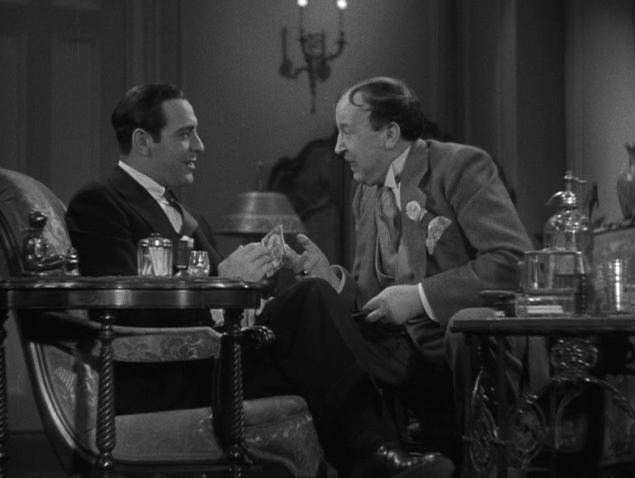
From the Maltese Falcon, 1931: this is not film noir - most of the film is a solid, not too interesting looking reading of the text, stagy, competent, nothing special. (Though very entertaining, because of the power of the text, the excellent cast, and Roy Del Ruth's clean, precise presentation.) But in a couple scenes, things change a bit. Like this one, Spade's interview with Gutman - which moves fast from an insert of the telegram from Gutman to their conversation - which starts in the middle, with alternating medium shots, low angled, full of little details in the front of the screen - the bottle, Gutman's fan, Spade's knee and hand... these alternate, as they talk (the familiar dialogue from the novel that Huston used in 1941 as well):


Only well into the conversation do we get longer shots of the men, though as soon as we do - and the convcersation turns to money - the camera moves in again, framing them even tighter than before:


Then backing off, as the money changes hands...

...and backs off more as Wilmer comes in:

Some of this is repeated, less drastically, in the DA's office - though there Del Ruth starts with an establishing shot, before moving in, to similar obstructed medium shots, with hats, telephones, lamps springing into the frame:


All that - moments of visual flair in an otherwise fairly generic looking film. But the story is noir (Hammett is it's founding angel), and here - the camera inserts itself into the decor, and things lose their natural shapes. Shadows break free from their objects, faces, hands, objects, break off from their proper places, and become looming presences... stylistically, noir grew out of expressionism - passed through horror, as much as any style in America - and melded with the crime movies of the 30s... And along the way, put out feelers, so to speak, those moments when the images start to pulse into menacing being, like here...
Inspired by the Love of Film (Noir) blogathon, also at the Siren's.
Raising money for film preservation... donate!


Only well into the conversation do we get longer shots of the men, though as soon as we do - and the convcersation turns to money - the camera moves in again, framing them even tighter than before:


Then backing off, as the money changes hands...
...and backs off more as Wilmer comes in:

Some of this is repeated, less drastically, in the DA's office - though there Del Ruth starts with an establishing shot, before moving in, to similar obstructed medium shots, with hats, telephones, lamps springing into the frame:


All that - moments of visual flair in an otherwise fairly generic looking film. But the story is noir (Hammett is it's founding angel), and here - the camera inserts itself into the decor, and things lose their natural shapes. Shadows break free from their objects, faces, hands, objects, break off from their proper places, and become looming presences... stylistically, noir grew out of expressionism - passed through horror, as much as any style in America - and melded with the crime movies of the 30s... And along the way, put out feelers, so to speak, those moments when the images start to pulse into menacing being, like here...
Inspired by the Love of Film (Noir) blogathon, also at the Siren's.
Raising money for film preservation... donate!
Sunday, February 13, 2011
Some Notes on Hong Sang-Soo
The first highlight of the film year has been Harvard's Hong Sang-soo series, that played over the last weekend of January and first of February. They showed 8 of his 11 films, and he was there for two nights, doing the Q&A thing - all told, a very pleasing event. (Despite some god-awful weather outside.) He is an intriguing director, one who deserves thought - I'm not sure if I am quite ready to write anything too substantial about his films, though I'd like to. In the meanwhile - given that my thoughts are fragmentary and partial - I will offer some notes on his work, as well as his appearance at Harvard. (A big disadvantage of this approach, though, is that I find that I've made lots of casual references to the films - which are a definite challenge to find and see... I think, however, a lot of the things I mention here are present in enough of his films, that anyone who's seen a couple should be able to know what I'm talking about...)
1) As for the Q&A - these things can be a mixed blessing - some people thrive in those situations, others seem completely lost. Hong came off somewhere in the middle. He's a mumbler (maybe from jet lag? the weather? I don't know), and rather evasive. He circled questions, never quite addressing anything directly - making lots of claims to do it all on intuition, never you mind that AIC degree... Never mind as well the playfulness and patterning of the films themselves, their self-reflexivity, etc. In truth -it seems that he was trying to avoid some kinds of questions - "themes" - in fact, he spoke quite clearly about his working methods and ideas. You can see where the patterns and repetitions in his films come from, you can see the working methods that create the films he makes....
2) He talked about his films starting from everyday things - I could be wrong, but I suspect he means objects as much as incidents. His films have a powerful attention to objects - phones and wallets and clothes and things like cameras and cable cars, cars, and so on. They structure the films, markers of movements and changes; they are also the subject of many incidents - the scenes in Virgin Stripped Bare By her Bachelors discussing how to hold chopsticks, the passage of scarves in Tale of Cinema, Woman is the Future of Man, etc.... Virgin might do this the most - chopsticks in a couple scenes; napkins, forks or spoons, the cameras, gloves, the sheet, etc. Sometimes, the treatment of these objects does seem to carry meaning - like the talismanic nature of something like the red scarf in Woman is the Future of Man, or the contrast between the new video camera and the obsolete 8mm camera in Virgin, or the way Jingu in Oki's Movie riffs on the empty juice box...
3) Building on that - incidents cycle, of course, situations - repeated in films, repeated between films: losing/forgetting wallets (and money) - which happens in several films... things like the impotence and double suicide scenes in Turning Gate and repeated in Tale of Cinema... And more general types of scenes - walks with people in parks, nature, etc - Kangwon, Turning Gate, Oki's Movie... impromptu visits - Turning Gate, Woman is the Future of Man...
4) Structures - doubles and repetitions are absolutely fundamental to Hong's films. They are everywhere, at every level, taking many different forms, doing a number of different things. Repetition becomes a formal element, and not just a way of exploring perspective, or re-evaluating events. I mean - in some films, the repetition is purely formal: Virgin, for example, repeats the story twice, slightly differently - somewhat paradoxically, this makes it more about the content, about differing perspectives, about subjectivity... that quality is stronger still in films like Oki's Movie and Tale of Cinema, that acknowledge shifting levels of narration - that part of what we see is a film-in-a-film. But repetition also occurs in other ways: Oki's section of Oki's Movie, for instance, does this - showing two walks through a park, with 2 different men. This plot device - actions (sometimes words) being repeated, by the same characters, or other characters, happens quite often in Hong's films - Turning Gate's two parts show first a man pursued by a woman, then a man pursuing a woman - it repeats several moments and situations, and repeating old stories as well... Finally - events, episodes, etc. are repeated (as I've been saying) across films - plot elements (usually frustrated love triangles); the impotence/suicide episodes in Turning Gate and Tale of Cinema; all the other repetitions listed above (wallets, scarves, walks in parks, calling people the wrong name, etc.) Actors and character types recur - not quite with the obsessive formalization of an Ozu film, but with some similar effects... The result of all this is, in a way, to turn your attention away from questions about the material - the "modernist" questions of how individuals experience and process events - to questions about form - the more "post-modernist" (or formalist) question of the shapes themselves. Which may have psychological implications as well - as you shift from attention to how one experiences their own life, to how those experiences are inevitably shaped by form - how we experience things as repetitions, how we organize our experiences into patterns. How things today are given meaning by the contexts we put them in - by the things that have happened in the past - a process of sorting and classifying.
I don't know how much that has to do with what Hong Sang-soo is after in these films - though it is not impossible he's thinking on those lines. But it is an interesting phenomenon - and his method, of arranging individual films primarily as exercises in subjectivity, while emphasizing the patterning ("parametric") devices between films - seems to lead you there. To think about how these formal elements relate to questions of subjectivity....
5) He spoke quite a bit about improvisation - not as such, but - his method of working.... to start with very brief treatments of the stories - to look for actors who would fit the characters in this treatment - then to write the script shaping the characters around the actor, as a type, as a person... Then - he said - he would end up writing the actual dialogue on location the day of shooting, and give the actors just enough time to memorize the lines before shooting... And it strikes me that his films have the elements of improvisation - the looseness and ability to surprise within a fairly simple and sometimes rigid structure. Their repetitions, the simplicity of the basic situations, help in this method - they provide the structure and connections for the film, and allow the dialogue and actors to develop the emotional impact...
Saturday, February 12, 2011
Iranian Film Blogathon
I just saw a post about another blogathon - this one, inspired by Jafar Panahi's imprisonment, and a letter written to the Berlin Film Festival - is devoted to Iranian Cinema, and is scheduled for the week of February 21-27. I am very pleased to see this - it seems to me that Iranian cinema has been somewhat neglected in the last decade - in the late 90s, when I was particularly movie mad, Iranian films seemed to be at the center of the world's art cinema. New Kiarostami or Makhmalbaf films were events - though often events one could only read about for a year.... In the 2000s - I'm not sure - but a lot of that excitement seemed to be lost - probably not coincidentally, as Iran's politics took a retrograde turn, culminating in the disaster of the last election, which has led directly to Panahi's incarceration (for example.) Iranian films are (or seem) less talked about now - this blogathon will be a very welcome reminder, I think, of what they achieved. While they seem less talked about in the 00s, I don't know if they have become any less accomplished - not least because of the work of Panahi himself, whose films this decade have been, as far as I am concerned, almost as crucial as those of Kiarostami and Makhmalbaf in the 90s.
I'm under no illusions about the possible effects a bunch of film bloggers talking about Panahi and Iranian films might have on the Iranian government - but it can serve to remind us of what that government is trying to destroy.
I'm under no illusions about the possible effects a bunch of film bloggers talking about Panahi and Iranian films might have on the Iranian government - but it can serve to remind us of what that government is trying to destroy.
Friday, February 11, 2011
Friday Musical Interlude
Again, it is not my intention to ONLY post Friday music notes, but that's what we've got... That should change - there are things going on in the world which should bring some life out of me - a new Film Preservation Blogathon, next week, again hosted by the Self-Styled Siren and Ferdy on Films. It will be, like the first one, a purposeful blogathon, raising money for film preservation - you can donate here.
And, coming next month, we have a blogathon devoted to Korean film, hosted by New Korean Cinema and Cineawsome. This is scheduled for March 7-13 - it should be good... This is closer to the reasons for the lack of posts here, too - last week's Hong Sang-Soo series at the HFA kept me out at night - I am trying to write somethign about it - at the rate I'm going I might make it by next month...
UPDATE: I didn't mean to miss this - there has also been a Michael Mann blogathon going on right now (2/7-14) at Seeti Maar- Diary of a Movie Lover. Worth checking out...
But for now - it's Friday - and that's my musical day, and the only effective bit of discipline I'm able to impose on myself, so here goes, completely randomly:
1. Robert Wyatt - Lullaloop
2. James Brown - Try Me (live)
3. Ramones - Glad to See You Go
4. Modest Mouse - Ohio
5. Better than Ezra - Allison Foley
6. Janelle Monae - Mushroom's and Roses
7. Husker Du - Celebrated Summer (live)
8. Smokey Robinson - Tears of a Clown [iTunes is bering very very kind today...]
9. Pere Ubu - The Fevered Dream of Hernando de Soto
10. Soft Machine - A Certain Kind
Video? since we have 2 entries with Robert Wyatt - here's a third - singing Comfortably Numb, live, with David Gilmour:
Friday, February 04, 2011
Musical Interlude
...another odd week in which I got next to nothing done, leaving me with no answer for it but to post a Friday Random 10 list - which I will do with no further ado:
1. The Wild Swans - The Revolutionary Spirit
2. The Who - I'm a Boy (live at the BBC)
3. The New Pornographers - Use it
4. Bo Diddley - Before You Accuse Me
5. The Pretenders - Stop Your Sobbing
6. David Thomas & Two Pale Boys - Little Sister
7. Mogwai - The Precipice
8. Dinosaur Jr. - Kracked
9. Roxy Music - Re-make/Re-model
10. Nick Cave & Bad Seeds - Darker With the Day
An interesting set... I'm not sure I have ever heard the Wild Swans before - sounds like a candidate for a video... like most of their contemporaries, they still seem to be at it, here live in 09...
Tuesday, February 01, 2011
More Snow! Hooray!
Well, here I am, buckling down for another snow storm, this one threatening to last a couple days, turning into sleet somewhere in the middle. That sort of thing sets off alarms - put down a foot of snow, then cover it in ice - there won't be a tree left standing in New England! The electrical situation may soon become precarious, even in the metropolis. Fortunately, this waited until the middle of the week - it's been a very nice stretch for movies, the last couple weeks - some of last year's best films replayed; and a Hong Sang-Soo series at the HFA. I'd just as soon not try to plow through a blizzard to see them - though I have done worse. I made it out during the April Fool's blizzard of 1997 to see Rebel Without a Cause! I suppose I'd make it to Hong's films anyway...
The weather hasn't started yet, so it's off to work I go. It's supposed to start any minute though. The commute back home in the evening ought to be entertaining.
One possible consolations is that no Groundhogs will be seeing any shadows this week.
That's all for now. I will leave you with a Cat Picture. She agrees with me on the merits of Grinderman, I think.

Subscribe to:
Posts (Atom)