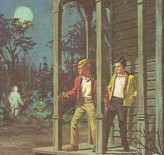
... and only one man could play him...
Don Knotts in Dubya The Movie - coming soon!
(Via Crooked Timber.)
Saturday, November 27, 2004

Wednesday, November 17, 2004
Despair and 10 Salutes
Today I must mourn the passing of a dear friend - my old Mac 4400/200 PC Compatible. It has served me well, loyally and effectively, since somewhere in the vicinity of September 1997. I have invoked this delightful machine before - in this paeon to Word 5.1 namely - for good cause. I have blogged from it, once or twice! It was - until this week - still rolling along.
It was a matter of time, of course. All it needed was something like what happened this week - a blown fuse - and now, it won't do a thing. No life. That is typical - these machines, macs from the mid to late 90s, were notorious for that very problem. Actually, for two problems - losing the ability to power up, and hard drives that stop spinning. This is the second 4400 in my experience to suffer this fate - the power supplies stop working.
I may get it back someday - or find a working chassis and move the hard drive... But I am resigned to accepting the end. I loved this machine, as much as one can love a machine. I have not used it in the last year - this one (17 inch i-mac - another fairly wonderful machine, that has given me no trouble and better, is a positive work of art) is actually fast enough that I can stand to use it for routine word processing. Amazing. Anyway, in honor of the passing of this wonderful machine, I will post my top 10 favorite pieces of computer related hardware and software. Appalling sentimentality! but if you can't be sentimental at a time like this, when can you be?
1. Microsoft Word 5.1b - this is number 1. Other than spelling, it is still the best word processing program I have ever used. I would probably still prefer it to Word for OS X if it had comparable spelling and macro features. Hell, it had them, back, pre OS 7 or 7.5, or something - somewhere in there, the add ins I was using stopped working. That was when I had to move to another machine to be able to spell... But even without it - it ran on that 4400 as well as Word for X runs on this machine - and probably (with its complete customizability and its magnificent full text searching) had a better feature set. It is by far the best piece of software I know of.
2. Mac 4400 - this machine lasted 7 years. I used it for 3 years at work, then brought it home (we switched to Windows), and used it 4 more - 3 of those years as my main writing computer. I switched tot he internet on other machines maybe about 2001 - but used the 4400 to write on. Great machine. Reliable, fast... it did have power problems sometimes, so I left it running all this time... I knew it could not last forever. I managed to wean myself from it okay - but I will miss it. And - it had word 5.1 on it - and I will miss that more.
3. Mac II-ci: I had one of these for a couple years at work. Most of those early 80s macs had their issues - some because of their architecture (something about their bus capacities, I think); some had bad hard disks, some had unreliable power supplies.... This machine did not give me trouble. I beat on it - I crammed everything I could get into it, used it hard - the system got corrupted every 6 months or so and I would have to reinstall everything - that was a fact of life in those days. But the machine - wonderful thing. Reliable, and probably just as quick with word 5.1 as the machine I have now is. I had to give it up when the powermacs came out - I was disappointed. Partly because I knew that getting the first powermacs off the line meant I would have all the problems, and be the last one to get a new, good one - but partly just because I loved my CI.
4. I have to give props to what I have, though - this 17 inch i-mac is perfectly reliable, and by god - it is beautiful! It really is. Every couple years apple comes out with something just stunning. This is the model. And it works.
5. Powerbook 170 - these were sweet machines as well - great keyboards, reliable, sturdy. I still have one, sitting around somewhere. Unlike my beloved 4400, it still boots up. And runs word like a charm. Surprise surprise!
6. Compaq Armada: There is not much in the windows side of the world that I think is even remotely worth using - but this machine is one. Looks like one of those old PB170s - black, blocky, kind of heavy, but indestructible, reliable, powerful enough. You can’t break them. Great computers. And the last machine of any importance with both floppy and CD bays built in. There are times, even now... Thank you Compaq!
7. SE30. Indestructible little things, quick, functional, and you could get a real monitor on it with a little work. But even without it - those luggable macs had some merits. I would not turn one down now.
8. My new 12 inch powerbook. I know. I love it. Sorry. Tiny, sleek, quick, beautiful. Wonderful machine.
9. Hypercard - this is one I would have to think about some. But when I started using computers - macs - at the end fo the 80s - this was a hell of a program. You could do things with hypercard - I remember building my own spreadsheets, back when I was starting out, and didn't have excel for some reason. I built databases that still work better than databases built in access. It was a great piece of software... I did end up using it mostly to build databases - these days, File Maker has a lot of the same functionality and works about as well - efficient, quick, reliable, easy to work with. I don't know if I can put FileMaker here, but it has a lot of the same appeal. Especially compared to crap like Access.
10. Mosaic. Less because it was a perfect piece of software than because it did things that pretty fucking literally changed the world. The way we interact with the world. Obviously, the way you and me right now are interacting in the world. There may be software that did this back in the 80s - excel maybe - but since I started using computers, this is the one program that, single-handedly, just changed things. And hey - it worked. It did what it did.
It was a matter of time, of course. All it needed was something like what happened this week - a blown fuse - and now, it won't do a thing. No life. That is typical - these machines, macs from the mid to late 90s, were notorious for that very problem. Actually, for two problems - losing the ability to power up, and hard drives that stop spinning. This is the second 4400 in my experience to suffer this fate - the power supplies stop working.
I may get it back someday - or find a working chassis and move the hard drive... But I am resigned to accepting the end. I loved this machine, as much as one can love a machine. I have not used it in the last year - this one (17 inch i-mac - another fairly wonderful machine, that has given me no trouble and better, is a positive work of art) is actually fast enough that I can stand to use it for routine word processing. Amazing. Anyway, in honor of the passing of this wonderful machine, I will post my top 10 favorite pieces of computer related hardware and software. Appalling sentimentality! but if you can't be sentimental at a time like this, when can you be?
1. Microsoft Word 5.1b - this is number 1. Other than spelling, it is still the best word processing program I have ever used. I would probably still prefer it to Word for OS X if it had comparable spelling and macro features. Hell, it had them, back, pre OS 7 or 7.5, or something - somewhere in there, the add ins I was using stopped working. That was when I had to move to another machine to be able to spell... But even without it - it ran on that 4400 as well as Word for X runs on this machine - and probably (with its complete customizability and its magnificent full text searching) had a better feature set. It is by far the best piece of software I know of.
2. Mac 4400 - this machine lasted 7 years. I used it for 3 years at work, then brought it home (we switched to Windows), and used it 4 more - 3 of those years as my main writing computer. I switched tot he internet on other machines maybe about 2001 - but used the 4400 to write on. Great machine. Reliable, fast... it did have power problems sometimes, so I left it running all this time... I knew it could not last forever. I managed to wean myself from it okay - but I will miss it. And - it had word 5.1 on it - and I will miss that more.
3. Mac II-ci: I had one of these for a couple years at work. Most of those early 80s macs had their issues - some because of their architecture (something about their bus capacities, I think); some had bad hard disks, some had unreliable power supplies.... This machine did not give me trouble. I beat on it - I crammed everything I could get into it, used it hard - the system got corrupted every 6 months or so and I would have to reinstall everything - that was a fact of life in those days. But the machine - wonderful thing. Reliable, and probably just as quick with word 5.1 as the machine I have now is. I had to give it up when the powermacs came out - I was disappointed. Partly because I knew that getting the first powermacs off the line meant I would have all the problems, and be the last one to get a new, good one - but partly just because I loved my CI.
4. I have to give props to what I have, though - this 17 inch i-mac is perfectly reliable, and by god - it is beautiful! It really is. Every couple years apple comes out with something just stunning. This is the model. And it works.
5. Powerbook 170 - these were sweet machines as well - great keyboards, reliable, sturdy. I still have one, sitting around somewhere. Unlike my beloved 4400, it still boots up. And runs word like a charm. Surprise surprise!
6. Compaq Armada: There is not much in the windows side of the world that I think is even remotely worth using - but this machine is one. Looks like one of those old PB170s - black, blocky, kind of heavy, but indestructible, reliable, powerful enough. You can’t break them. Great computers. And the last machine of any importance with both floppy and CD bays built in. There are times, even now... Thank you Compaq!
7. SE30. Indestructible little things, quick, functional, and you could get a real monitor on it with a little work. But even without it - those luggable macs had some merits. I would not turn one down now.
8. My new 12 inch powerbook. I know. I love it. Sorry. Tiny, sleek, quick, beautiful. Wonderful machine.
9. Hypercard - this is one I would have to think about some. But when I started using computers - macs - at the end fo the 80s - this was a hell of a program. You could do things with hypercard - I remember building my own spreadsheets, back when I was starting out, and didn't have excel for some reason. I built databases that still work better than databases built in access. It was a great piece of software... I did end up using it mostly to build databases - these days, File Maker has a lot of the same functionality and works about as well - efficient, quick, reliable, easy to work with. I don't know if I can put FileMaker here, but it has a lot of the same appeal. Especially compared to crap like Access.
10. Mosaic. Less because it was a perfect piece of software than because it did things that pretty fucking literally changed the world. The way we interact with the world. Obviously, the way you and me right now are interacting in the world. There may be software that did this back in the 80s - excel maybe - but since I started using computers, this is the one program that, single-handedly, just changed things. And hey - it worked. It did what it did.
The Anti-Lincoln
Here is a rather interesting headline: President moves to rein in 2 agencies. I guess that's one way to put it.
After years of finger-pointing and tension within his foreign policy agencies, President Bush is moving aggressively to tame the two most unwieldy agencies -- the CIA and the State Department -- by installing reliable allies at the helm with instructions to clamp down on dissenting career officials, advisers to the president said.
I suppose no one will disagree witht he basic facts and basic interpretation of the facts in that statement, but the evaluation of those facts and interpretations will vary widely. Joshua Michael Marshall, for example, offers a somewhat different slant than the White House insiders quoted in the Globe article:
There has been a running battle along these 'political appointees' versus 'the professionals' lines at the Pentagon, the CIA and, to a much lesser degree, the State Department for more than three years. And by and large the Bush administration's 'political appointees' have been wrong almost every time. There are a few exceptions at the Pentagon -- the early stages of the Afghan campaign being the best example. But at the CIA it's really been pretty much a shut-out. And a number of those screw-ups have been ones of catastrophic proportions.* * *
And the upshot of all that we've seen, the result of all those struggles over the last three years is that the 'appointees' are purging the 'professionals'. Another way to put it is that the folks who were always wrong and often catastrophically wrong are rooting out the folks who were often right and sometimes somewhat wrong. The answer to politicized intelligence, it turns out, is a more thorough politicization of intelligence and the elimination of those who resisted political pressure.
Given that -and it seems pretty much the truth - it's hard to read about the President "reining in" anyone without a feeling of dread.
(Should I explain the title? I may. The north during the Civil War was plagued by politically appointed generals. On the whole, they may not have been any worse than the regular army generals and various volunteers who rose to power, but at the top, they were a disaster. A few of them - some purely political, some regulars who were in the politicians' pockets - held real power, and made hash of it. Benjamin Butler - John C. Fremont - quite a few more. The story of Lincoln winning the war was the story of the political generals being replaced by professionals. So - Bush - compared, in some circles to Lincoln - follows roughly the opposite track. For while the balance of competence is about the same in the civil war - political generals are incompetent and dangerous to our cause, professionals (while they cover a range of abilities, and are often an unimaginative lot) more or less do what they are supposed to do - the direction and results are the opposite. The story of Bush losing the war is the story of Bush purging the professionals for the politicians.
Monday, November 15, 2004
Walking the Plank
I see that Colin Powell is resigning as Secretary of State. Powell has not covered himself in glory in this administration, going against a lot of things he had said in the past in the process of supporting them through their foreign policy misadventures. Still, he represents the grown ups in the administration, the possibility, somewhere, of maturity and integrity, and something like good sense. If he is gone --- reading the tea leaves - this looks like a sign that whatever sense there was will be purged. Coming on the heels of the nomination of Alberto Gonzales for Attorney General, with its attendant message about the United States' respect for International Law (heck - Law itself!), this does not bode well.
UPDATE: Looks like Powell's replacement is going to be Condeleeza Rice. I'm sure Bush could have done worse, though perhaps the greatest indictment of this administration is that there's simply no one anywhere near the white house who would be a good choice. It's not as bad as Gonzales, I guess.
UPDATE: Looks like Powell's replacement is going to be Condeleeza Rice. I'm sure Bush could have done worse, though perhaps the greatest indictment of this administration is that there's simply no one anywhere near the white house who would be a good choice. It's not as bad as Gonzales, I guess.
Sunday, November 14, 2004
Masters of War
Another story that makes you glad to be an American alive in 2004. A Colorado high school band gets a visit from the FBI for singing a Bob Dylan song. Granted, they should probably not try to claim the song is not political - still... still.
Thursday, November 11, 2004
The Luxury of Paranoia
I am not one for conspiracy theories, but neither is Kevin Drum, but he's got a post up on evidence about polling irregularities, which in this day and age is hand in glove with voting fraud, so I can link to that. This is obviously an issue that needs to be examined, with a good deal of care. If it's there - let's find out. If not - better to have good evidence for it. In any case - Drum is not up to conspiracy theory hijinks - he is the epitome of the Supremely Reasonable Pundit, and he is Supremely Reasonable here - blaming the exit pollsters, you know. And he's right - if the problems he cites (from a paper by one Steven Freeman) are caused by some kind of systematic flas in exit polling methodology, then - he's right - the pollsters should explain it. And maybe can. If not - if they don't - does that mean they can't? If they can't...
I don't expect this issue to be laid to rest for some time. Bev Harris is up in arms. (So is Black Box Voting, a different site doing the same kinds of things. I'm not sure what their relationship is, or was...) The meme stays alive in cyberspace (Greg Palast say; Long Story, Short Pier - where Kim seems convinced.) I don't know. I worry, though, that the fact that the election results can be ascribed to other things, that they weren't absurd on the face of them, that the Voices of Reason will insist that we have to Move On and stop indulging in Wishful Thinking. All that may be true - but prove it. At least, let's get as much information out there, where we can look at it and think about it ourselves...
I don't expect this issue to be laid to rest for some time. Bev Harris is up in arms. (So is Black Box Voting, a different site doing the same kinds of things. I'm not sure what their relationship is, or was...) The meme stays alive in cyberspace (Greg Palast say; Long Story, Short Pier - where Kim seems convinced.) I don't know. I worry, though, that the fact that the election results can be ascribed to other things, that they weren't absurd on the face of them, that the Voices of Reason will insist that we have to Move On and stop indulging in Wishful Thinking. All that may be true - but prove it. At least, let's get as much information out there, where we can look at it and think about it ourselves...
Theater of Operations
James Wolcott being brilliant again - or citing Emmanuel Todd in After the Empire being brilliant.
. . . Contrary to those Le Monde intellectuals who see the US as a super-superpower, a hyperpuissance, Todd, a French demographer and author of a book correctly foreseeing the fall of the Soviet Union, says the US has become a "big little bully" incapable of picking on anyone its own size. It makes a show of force attacking the weak--dirtpoor countries with no air defences, such as Iraq and Afghanistan--because a "show" is precisely what it is.
"These conflicts that represent little or no military risk allow the United States to be 'present' throughout the world. The United States works to maintain the illusory fiction of the world as a dangerous place in need of America's protection."
Wolcott cites this in the context of the Fallujah assault - "Operation Phantom Fury" apparently. Wolcott at length:
The US assault on Fallujah is a prime example of what Todd calls "theatrical micromilitarism." I mean, calling it "Operation Phantom Fury"--it's a sick joke. What's "phantom" about it? For months the US has been touting this incursion and publicly built up forces outside the city for weeks, giving the enemy plenty of time to rig explosives and/or skip town. Billing it as a "decisive battle"--another fraud. Guerrilla warfare operates on an entirely different set of rules; as has been oft pointed out, America won every major battle during Vietnam and still lost. What's unfolding is not a decisive moment but a ghastly production that trains hellfire on a symbolic target and "plays well" to American citizens as a flex of muscle, as witness the NY Post cover today of an American soldier with a cigarette dangling from his mouth with the headline "Marlboro Men Kick Butt." Civilian casualties, the destruction of homes and livelihoods, the absence of any significant capture of insurgent ringleaders, these are secondary to getting good action footage over which benedictions can be said.
He is right. This war from the beginning had the stink of being fought because it would be easy to win - not that this comes as any great shock. There's a lot of tough talk from the Bush administration about our foreign policy goals, but even in the middle of the tough talk, there always seem to be a few of the wonkier ne-cons smugging around the sidelines explaining how invading Iraq would send a message to someone that we weren't to be trifled with. That it sent the message to make sure you have working nukes seems to have slipped past these giant brains...
What it means? In the end, it means that these guys really do run everything as theater - as long as they keep the American casualties relatively low, as long as they keep the pictures of American dead off the TV screens, they figure they can hang on to power at home. Use real heroism (and whatever you say about the war, the people on the ground fighting it are running risks and deserve respect) to prop up the image of our strength. Good old "Decisive George Bush" again. Maybe they think they are also projecting power abroad, though Wolcott and Todd don't think so, and I have to suspect they are right. Which is a source of some comfort, since it means they (I mean, Bush and company) are not likely, tough talk aside, to start up any new wars. Just try to flog the one they have. And keep gettign reelected, because Americans don't want to think about the reality of politics or war or the rest of the world. Well - 51% of Americans...
Tuesday, November 09, 2004
Structural Changes!
Yes indeed! 10 new links on the "blogroll" - 5 in each category. It has been oh so many moons since I have done anything cosmetic to this place. Addabitospiceyknow. Anyway, I try to keep it varied - some science, some law, some politics, some art. We'll see. Into the breach.
Update: Already! changed my mind! added another 5 sites! Culture! A Libertarian! A Real Live Preacher! Enjoy!
Update: Already! changed my mind! added another 5 sites! Culture! A Libertarian! A Real Live Preacher! Enjoy!
And We Can Do It Without a Draft, Too, I'll Bet!
Early nominees for the next set of Darwin awards - via TAPPED here's some comment on the American Enterprise Institute's panel on Foreign Policy in the Second Bush Administration. According to one Thomas Donnelly:
The election proves that the goals set forth in the Bush Doctrine essentially reflect what most Americans want their government to do.
With this mandate, the goal of the second administration is to put actual meat behind the lofty goals expressed by the Bush doctrine. By Donnelly’s estimation, this means expanding the Bush doctrine beyond the greater Middle East and -- here’s the kicker -- integrating our China policy into the Bush Doctrine. While the Bush administration confronts rogue regimes in the greater Middle East, the likelihood of a future great-power confrontation with China is increasing substantially -- so we must act.
Ah, the American Enterprise Institute! Where else could we turn for such wisdom? There's more - after calling someone "Panda huggers", Donnelly adds, “Negotiating with ourselves over China,” said Donnelly, “is even dumber than negotiating with Democrats over social security or tax reform.” He is not, apparently, likely to claim the Reality Based Community as his own...
Wars and Rumors of War
We have begun our attack on Fallujah, delayed until after the election, in case things go wrong (the cynicism of our government is boundless). Accompanied by attacks by the insurgents and the declaration of martial law by the Iraqi government. Wonderful. (Juan Cole of course is following the story.) One thing though - I'm reading the lead paragraph:
U.S. Army and Marine units thrust into the heart of the insurgent stronghold of Fallujah on Tuesday, fighting fierce street battles and conducting house-to-house searches on the second day of a major assault to retake the city from Islamic militants.
Why are the people we are fighting called "Islamic militants"? This is odd - granted, they are Islamic, and they are obviously militants - but is that an innocent combination? Because Al Qaeda, for example, are clearly "Islamic Militants" - their militancy and their religion are inextricably linked. But the Iraqi insurgents are motivated by other things, aren't they? Nationalism or tribalism or their own desire for power or whatever it is - including some degree of Islamic ideoloty... I don't know. Semantics and war are a dangerous combination, but it seems likely that terms like this carry some pretty strong propaganda implications, that I'm not sure I like.
Monday, November 08, 2004
Out in the Real World
Good afternoon. This is not going to be a long post, just a post, without even bothering to put any links in. A new bad habit, I guess, though I am not here to whine. Just to maintain the habit, as it were. There's still plenty of politics I could be posting about - I have not yet worked out a full bore How We Lost The Election and How We Can Win The Next Once post, though I've got one simmering. I have 2 years to work on that, so I'm not going to kill myself. I will note what I hope I do, now that the election is over - write more about other stuff - the arts, movies, music, comics, maybe books. Get back to the real world.
I will take this opportunity to note what I have seen recently, very briefly: Sideways - quite funny at times, interesting enough, even if it is about another 40ish white guy moping about self-inflicted wounds. Thought his guy is affecting - maybe in the ways he comes off as more real than most people on movie screens. Being played by Paul Giamatti is always an advantage, but it's more than that - it's details, like his apartment, his car, the fact that he doesn't have a cel phone. And the wine. Wine is what is best and worst about the man - his passion, but a passion he can't quite indulge in without lording it over people, and a passion which hides, not too subtly, some nasty stuff (the fact that he is a drunk.) So this may not be brilliant, but it is a fine movie, with many surprising virtues... And many big virtues - especially the performances, universally fine.
And Undertow - new film by David Gordon Green, starring Jamie Bell and Dermot Mulroney. Very nearly a remake of Night of the Hunter - here the villain is Josh Lucas as Mulroney's brother, just out of the pen - he shows up, tries to act ingratiating, Mulroney tries to do the right thing - but it doesn't take long for the two of them to be fighting over their father's "treasure" a collection of gold coins. This does not end well, and soon Bell takes to the road with a little brother. They pass through a really down and out south, a step or two ahead of Lucas' thug, passing out books as they go. It's a little bit too derivative, but quite gorgeous and moving anyway.
I will take this opportunity to note what I have seen recently, very briefly: Sideways - quite funny at times, interesting enough, even if it is about another 40ish white guy moping about self-inflicted wounds. Thought his guy is affecting - maybe in the ways he comes off as more real than most people on movie screens. Being played by Paul Giamatti is always an advantage, but it's more than that - it's details, like his apartment, his car, the fact that he doesn't have a cel phone. And the wine. Wine is what is best and worst about the man - his passion, but a passion he can't quite indulge in without lording it over people, and a passion which hides, not too subtly, some nasty stuff (the fact that he is a drunk.) So this may not be brilliant, but it is a fine movie, with many surprising virtues... And many big virtues - especially the performances, universally fine.
And Undertow - new film by David Gordon Green, starring Jamie Bell and Dermot Mulroney. Very nearly a remake of Night of the Hunter - here the villain is Josh Lucas as Mulroney's brother, just out of the pen - he shows up, tries to act ingratiating, Mulroney tries to do the right thing - but it doesn't take long for the two of them to be fighting over their father's "treasure" a collection of gold coins. This does not end well, and soon Bell takes to the road with a little brother. They pass through a really down and out south, a step or two ahead of Lucas' thug, passing out books as they go. It's a little bit too derivative, but quite gorgeous and moving anyway.
Wednesday, November 03, 2004
We Are Not the Country We should Be
I am not going to be a gracious loser. I find it very hard to believe how this election went - how can such a manifest failure as George Bush get that many votes? What possesses people? - and I feel great trepidation for the future. I could blog the future - it may not be as bad as all that. There seem to be three likely outcomes: 1) The GOP, red in tooth and maw, takes everything it can get and tears both country and itself apart - the latter will not be a comfort, because I care what happens to my country. 2) the GOP grows up. Without an election to win, they back off the posturing, address their failures, and try to fix things. If Rummy hits the pavement, or Colin Powell starts making decisions again, this might come about. I'm not holding my breath - but this would not be unprecedented. 3) More of the same! incompetence, posturing, lots of noise, but little concrete action, no risks, good or bad, but lots of talk about risks... everything aimed at holding power, which now gets shifted from Bush to Congress, and whoever will be Bush's successor. Pandering continues apace. Iraq either drags on without resolution, or they declare victory and come home, and leave things to work themselves out. This is all too likely. I don't know if this is better or worse than #1. #1 is more likely to energize the opposition, and more likely to crash and burn, choking on its own greed, as it gulps down one too many metaphors at once.... 3...
The feeling I get from all this is that in the end we (the majority of voters in the country) ended up voting for an imaginary candidate. "Decisive George Bush" - as fictional as Giblets - an image of toughness and resolve that no facts, no revelations of lies and shenanigans, no pictures of the President of the United States unable to act with the country under attack until someone tells him what to do, can ever shake. Could shake. They (not me) voted for this chimera - they voted for what they wanted him to be, pretending, wishing, that he was what they thought they needed.
The fact that John Kerry largely was that man - the war hero, the senator with the guts to take on the administration, organizations like the BCCI and such - made no impression. I don't know why. Mabe because the GOP stayed relentlessly on message. Maybe because the democrats, across the board, saw John Kerry for what he was - their opinions of him ranged from enthusiasm to Anybody But Bushism, but they were all interpretations of the actual John Kerry... Can a real man, good bad or indifferent, compete with an imaginary man? You would like to think so, but the evidence before us says no.
Bloody hell.
Anyway, now, let's just hope the democrats decide that this is the time to fight. That they get tough - call Bush on his crap, resist wherever they can - this is not the time to whimper, well the people have chosen... The people chose a lie. The people were wrong. It is our responsibility to wake the fucking people up and get them to stop doing things like this to themselves.
The feeling I get from all this is that in the end we (the majority of voters in the country) ended up voting for an imaginary candidate. "Decisive George Bush" - as fictional as Giblets - an image of toughness and resolve that no facts, no revelations of lies and shenanigans, no pictures of the President of the United States unable to act with the country under attack until someone tells him what to do, can ever shake. Could shake. They (not me) voted for this chimera - they voted for what they wanted him to be, pretending, wishing, that he was what they thought they needed.
The fact that John Kerry largely was that man - the war hero, the senator with the guts to take on the administration, organizations like the BCCI and such - made no impression. I don't know why. Mabe because the GOP stayed relentlessly on message. Maybe because the democrats, across the board, saw John Kerry for what he was - their opinions of him ranged from enthusiasm to Anybody But Bushism, but they were all interpretations of the actual John Kerry... Can a real man, good bad or indifferent, compete with an imaginary man? You would like to think so, but the evidence before us says no.
Bloody hell.
Anyway, now, let's just hope the democrats decide that this is the time to fight. That they get tough - call Bush on his crap, resist wherever they can - this is not the time to whimper, well the people have chosen... The people chose a lie. The people were wrong. It is our responsibility to wake the fucking people up and get them to stop doing things like this to themselves.
Tuesday, November 02, 2004
Election Day
Here we are. Our future as a nation in the balance. Yes, yes, a man's best friend is hyperbole - but there's enough truth to it that I'm not backing off. All the stories about republican vote suppression - their consistent devotion to keeping down the vote - they depend on it - makes me worry. So let's hope the dems get out in force and simply blow Bush away. It can happen. Stranger things have happened. And you want to believe that at least a majority of people know better than to vote for Bush. You have to hope.
On a more personal note - I voted in my current town for the first time. Some kind of club, a VFW or American Legion hall. Paul Krugman has a nice article - "The humbleness of the surroundings only emphasizes the majesty of the process: this is democracy, America's great gift to the world, in action." It's true. The talk about freedom and all in grand abstractions hides the fact that freedom and democracy consists in a bunch of old men and women leafing through sheafs of voter rolls, checking your name off, handing you a ballot... prosaic as hell. It gets you right here!
So off we go! And hope it's clean, and the voting itself is what continues to matter, and not the lawsuits and posturing when it is done. Keep this power in the hands of the voters - don't let it turn into spin, like damn near everything else.
On a more personal note - I voted in my current town for the first time. Some kind of club, a VFW or American Legion hall. Paul Krugman has a nice article - "The humbleness of the surroundings only emphasizes the majesty of the process: this is democracy, America's great gift to the world, in action." It's true. The talk about freedom and all in grand abstractions hides the fact that freedom and democracy consists in a bunch of old men and women leafing through sheafs of voter rolls, checking your name off, handing you a ballot... prosaic as hell. It gets you right here!
So off we go! And hope it's clean, and the voting itself is what continues to matter, and not the lawsuits and posturing when it is done. Keep this power in the hands of the voters - don't let it turn into spin, like damn near everything else.
Thursday, October 28, 2004
I am Happy
The Red Sox won the world series. That does not happen very often. I am euphoric. I just spent an hour or so on the phone with one of my friends, my softball coach. In 1986, I watched most of game 6 alone - I rememebr standing in the living room, in the last inning, 2 outs, with a beer in my hand, waiting to open it, waiting, not wanting to jinx them by celebrating too soon - but ready... And they put people on. My buddy, the osftball buddy, showed up in the middle of the inning - he was already worked up, he'd been listening in the car. We watched - hits were hit, runs scored, and then the grounder went between Buckner's legs. My friend jumped up and down int he middle of the floor screaming "Fuck fuck fuck!" I crawled under a desk. We continued in that vein for some time, and then another pal showed up, a New Yorker, gloating. I hated him.
We had some fun with him last week. He got as taste of what it's like to be us. And tonight - I ended up watching the game alone (we'd been planning to watch the game together, but he had to work) - and I was thinking, in the ninth, this is exactly what happened in 1986. I watched it alone, just like this - so alike, but so completely different. The way it felt. In 86, with a couple outs, when the Mets got people on board, I was terrified - the Sox were so capable of losing. And I remember distinctly saying to myself (and anyone who might have wondered by), just let them hit a pop up; no grounders, no fly balls, a pop up, someone can catch that. Those who would defend Buckner - or rather, MacNamara (I don't blame Buckner - the man was in worse shape than Curt Schilling this year!) - should take note. Everyone saw that disaster coming. I saw it coming. I knew Buckner was not capable of fielding his opsition - in truth, of course, I didn't trrust any of the other infielders, or the outfielders either. But this year? With Cabrera and Reese and Mientkevitch (there's no chance that's spelled right, but hey) out there - with Damon and Kapler int he outfield - they could hit it almost anywhere and someone was going to catch it. Hit it where you want,, I thought, just keep it in the yard - this game is over.
It's a magnificent thing. Baseball is an integral part of my life, as much as religion is for some people. It is all that. What can I say? The Red Sox have won the world series. May they do it again, and again and again.
And they did it fast - I can get some sleep! eventually. They did what I hoped - they marched through the opposition like a bunch of batting practice pitchers - well, the Cards anyway. Or more to the point - stifled them, the way Pedro Martinez or whoever will mow down the Boston College squad in early spring training. They made everyone they faced look overmatched. Looking at it now - the gutsy team playing over their heads looks like the Yankees - keeping in a series they had no business being in... Just doing it all at the beginning of the series. Exciting stuff.
One last thing - for now. As has happened through the whole post-season - whenever someone has a bad stretch, they broke out of it at a key moment. Tonight (and yesterday, a little bit) it was Trot Nixon - a huge double - a couple other hits. Just like Bellhorn and Damon at the end of the Yankee series, or Lowe, or Manny after not getting any RBI in the Yankee series, all along - everyone on the team had a huge game or two in the last week. It's wonderful. Indeed it is.
We had some fun with him last week. He got as taste of what it's like to be us. And tonight - I ended up watching the game alone (we'd been planning to watch the game together, but he had to work) - and I was thinking, in the ninth, this is exactly what happened in 1986. I watched it alone, just like this - so alike, but so completely different. The way it felt. In 86, with a couple outs, when the Mets got people on board, I was terrified - the Sox were so capable of losing. And I remember distinctly saying to myself (and anyone who might have wondered by), just let them hit a pop up; no grounders, no fly balls, a pop up, someone can catch that. Those who would defend Buckner - or rather, MacNamara (I don't blame Buckner - the man was in worse shape than Curt Schilling this year!) - should take note. Everyone saw that disaster coming. I saw it coming. I knew Buckner was not capable of fielding his opsition - in truth, of course, I didn't trrust any of the other infielders, or the outfielders either. But this year? With Cabrera and Reese and Mientkevitch (there's no chance that's spelled right, but hey) out there - with Damon and Kapler int he outfield - they could hit it almost anywhere and someone was going to catch it. Hit it where you want,, I thought, just keep it in the yard - this game is over.
It's a magnificent thing. Baseball is an integral part of my life, as much as religion is for some people. It is all that. What can I say? The Red Sox have won the world series. May they do it again, and again and again.
And they did it fast - I can get some sleep! eventually. They did what I hoped - they marched through the opposition like a bunch of batting practice pitchers - well, the Cards anyway. Or more to the point - stifled them, the way Pedro Martinez or whoever will mow down the Boston College squad in early spring training. They made everyone they faced look overmatched. Looking at it now - the gutsy team playing over their heads looks like the Yankees - keeping in a series they had no business being in... Just doing it all at the beginning of the series. Exciting stuff.
One last thing - for now. As has happened through the whole post-season - whenever someone has a bad stretch, they broke out of it at a key moment. Tonight (and yesterday, a little bit) it was Trot Nixon - a huge double - a couple other hits. Just like Bellhorn and Damon at the end of the Yankee series, or Lowe, or Manny after not getting any RBI in the Yankee series, all along - everyone on the team had a huge game or two in the last week. It's wonderful. Indeed it is.
Tuesday, October 26, 2004
Poking the Head in
I have not done much writing here lately. Blame the Red Sox. The last week or so has been a constant rush, desperation, exultation, anticipation, exhaustion... It continues apace.
Meanwhile, out in blogland, I have been finding James Wolcott's blog to be about the best read out there. He might make the mighty "blogroll" soon, if I ever go in and add some more links.
Meanwhile, out in blogland, I have been finding James Wolcott's blog to be about the best read out there. He might make the mighty "blogroll" soon, if I ever go in and add some more links.
Thursday, October 21, 2004
Baseball Blogging
So Ramiro Mendoza balked in a run, and I turned it off and then it was 0-3 and then....
and now?
Sweet Jesus, look at this. The Sox come back - with the guys who weren't doing it all series suddenly doing it - Bellhorn with another Home Run - and Johnny Damon! just unbelievable.
I got nothing to say but uh - yes! fucking yes! yes yes yes yes yes!
Now let's get the Rog.
Wait - I do have more to say. It's this - one of the things that makes this team so great is the fact that they love winning. They got a lot of crap last year for celebratiing the wild card, then celebrating the short series - the twits whined that they were getting too worked up over the intermediate steps - the real champs, they say, don't celebrate til the end. Well - this gang - celebrate everything. And that, I think, is part of what gives them an edge - they just go out and play and... keep playing.
This is mind blowing. Really is. Wonderful. Amazing. God almighty. Stunning. Stop!
and now?
Sweet Jesus, look at this. The Sox come back - with the guys who weren't doing it all series suddenly doing it - Bellhorn with another Home Run - and Johnny Damon! just unbelievable.
I got nothing to say but uh - yes! fucking yes! yes yes yes yes yes!
Now let's get the Rog.
Wait - I do have more to say. It's this - one of the things that makes this team so great is the fact that they love winning. They got a lot of crap last year for celebratiing the wild card, then celebrating the short series - the twits whined that they were getting too worked up over the intermediate steps - the real champs, they say, don't celebrate til the end. Well - this gang - celebrate everything. And that, I think, is part of what gives them an edge - they just go out and play and... keep playing.
This is mind blowing. Really is. Wonderful. Amazing. God almighty. Stunning. Stop!
Saturday, October 16, 2004
Jon Stewart on Crossfire
I had heard about John Stewart's appearance on Crossfire last week, but seeing the video - my god! (Link Here) He's spectacular - he comes on, they want comedy - he gives them a lecture on their responsibility as a news show. And - despite Tucker Carlson's crying - he's funny anyway! But he gets the serious point made - that they are part of the theater of politics (and the unstated point that Stewart's show is a parody of the theater of politics), and that the theater of politics strips away the reality of politics, and undermines the political system. Stewart makes the point - sticks with it - doesn't slip into platitudes or abstractions - stays funny doing it, though not just funny... And it just hangs there, twisting in the breeze, because the other two make very little effort to discuss it. In fact, Carlson illustrates Stewart's points at almost every turn: whining because Stewart didn't play his assigned role - squirming because Stewart came on and did not just let things go the way they always go. He challenged them to a real discussion - they were not able to respond.
Could they have? I can think of things they could have said - like, "we have to walk a tightrope - we have to make it so politicians keep coming on the show - we try to get past their shields, but we can't do it directly. We have to play the games with them, to get them here, to try to get past the games." I don't know if that is a defense - but it's something. Realistic challenges require access - access requires at least some pandering to the theater. The trick is to get past the defenses, sometimes, just a bit. The problem there is that the show most likely to get at something legitimate behind the spin is the Daily Show. Comedy has always allowed criticism of those in power - Stewart uses it pretty well. Fake debate shows like Crossfire have never done that sort of thing - they allow posturing and scripted outrage. Pro wrestling....
And finally - the Crossfire guys, trying to defend themselves as "hard-hitting" - as not being part of the system - were utterly exposed by Stewart. He did to them exactly what he said they should do to politicians, and they were utterly unable to respond.
Could they have? I can think of things they could have said - like, "we have to walk a tightrope - we have to make it so politicians keep coming on the show - we try to get past their shields, but we can't do it directly. We have to play the games with them, to get them here, to try to get past the games." I don't know if that is a defense - but it's something. Realistic challenges require access - access requires at least some pandering to the theater. The trick is to get past the defenses, sometimes, just a bit. The problem there is that the show most likely to get at something legitimate behind the spin is the Daily Show. Comedy has always allowed criticism of those in power - Stewart uses it pretty well. Fake debate shows like Crossfire have never done that sort of thing - they allow posturing and scripted outrage. Pro wrestling....
And finally - the Crossfire guys, trying to defend themselves as "hard-hitting" - as not being part of the system - were utterly exposed by Stewart. He did to them exactly what he said they should do to politicians, and they were utterly unable to respond.
Thursday, October 14, 2004
States and Terrorism
A very good post at Washington Monthly about the war on terror - about the differences between how conservatives and liberals see the war on terror. The former, Drum says, see it as being against states - rogue states; the latter against groups that mean to do us harm - oftren active in failed states. This arises from Bush's gaffe at the third debate, claiming never to have said he wasn't concerned about Osama Bin Laden. It is more specifically an analysis of his comments when he did utter that unforgettable (except by Bush) remark. What Bush said, at the time, was:
Well, as I say, we haven't heard much from him. And I wouldn't necessarily say he's at the center of any command structure. And again, I don't know where he is. I--I'll repeat what I said. I truly am not that concerned about him. I know he is on the run. I was concerned about him when he had taken over a country. I was concerned about the fact that he was basically running Afghanistan and calling the shots for the Taliban.
This is a very clear statement of what Drum is talking about - Bush looked at even Bin Laden as dangerous because he was running a state. When he lost the state - Bush stopped caring. Drum makes the distinction that liberals indeed do tend to make:
But as dangerous as they [rogue states] are, they're still states, and they still have an interest in continuing to exist — which means they're unlikely to directly threaten the United States. What's more, since central governments dislike competing power centers, they have a fundamental interest in preventing terrorist groups from amassing too much influence within their borders.
Failed states, by contrast, don't, which is why terrorist groups seek them out. And since terrorist groups like al-Qaeda do directly threaten us, it's failed states and non-state terrorist groups themselves who pose a much greater danger to the security of the United States. John Kerry understands this. George Bush and his advisors don't.
This is right, I think. And it has been at the center of a lot of the disputes that have arisen over the last 3 years of foreign policy. The "law enforcement" model some leftists favor is based on the notion that terrorists (the ones we have to worry most about) do not operate through states. Opposition to the Iraq war obviously is built around this. I can speak for myself - when we were attacked, in the early days, when no one quite knew who had attacked us, and people wondered if it could be Saddam Hussein, I was convinced it was not. Because of this - Saddam had a country - he had a political entity that he could lose - that could be attacked and destroyed. To attack us would justify our attacking him and destroying him. He existed, in 2001, at our sufferance - and he had to know that anything that any direct move against us would result in getting him run out on a rail. And - again, speaking for myself - I am convinced that by attacking him we seriously weakened that very real deterrant on state villainy. Rogue states - (pre-conquest) Iraq, North Korea, whoever - had to know that if they messed around too much they could be taken out. But now - they have to think they can be taken out no matter what they do. So - clearly, this is not going to encourage better behavior. This encourages antinomian behavior!
Saturday, October 09, 2004
Goodbye, Goodbye, Goodbye
Jacques Derrida has died. Legal scholar Jack Balkin writes a nice appreciation....
I read Derrida in grad school, back in the 80s. Most decidedly tough sledding, but fascinating. The first piece of his I read (or tried to read) was his "Living On/Borderlines" essay in the Deconstruction and Criticism book, collecting the "Yale Mafia" inside one set of covers. Derrida's contribution ran an essay on Blanchot on top of a long footnote consisting of an essay on - long footnotes? It's been awhile. The way it looked on the page, though, was instantly addictive, and I kept reading Derrida in hopes that I could understand some of it. Eventually I did, though I had to read a lot of Nietzsche and a fair amount of Hegel first.
But understanding aside - the way he wrote suggested things, ways of writing, mixed registers. You don't see that sort of thing in academic writing all that often. You see it, instead, in works of genius like The Third Policeman . It is pleasant to imagine Derrida as a kind of gallic, "serious" Flann O'Brien. It's only slightly far-fetched - O'Brien's japes are very serious; Derrida in turn seems, if not precisely comical, certainly delighted in the sheer oddness of his writing. The puns and wordplay and elaborate typographical trickery he occasionally indulged in cannot be completely rationalized as high seriousness.
At any rate, it was that - the sense of excitement in the act of writing and thinking that his work gave off - that drew me to him first, and kept me at it, long enough to get some clue what was going on. And then - frankly, it made sense. A lot of what he said simply makes sense. Not that I can possibly justify that conclusion at this hour of the night. But as far as I am concerned, Derrida made the world a better place.
I read Derrida in grad school, back in the 80s. Most decidedly tough sledding, but fascinating. The first piece of his I read (or tried to read) was his "Living On/Borderlines" essay in the Deconstruction and Criticism book, collecting the "Yale Mafia" inside one set of covers. Derrida's contribution ran an essay on Blanchot on top of a long footnote consisting of an essay on - long footnotes? It's been awhile. The way it looked on the page, though, was instantly addictive, and I kept reading Derrida in hopes that I could understand some of it. Eventually I did, though I had to read a lot of Nietzsche and a fair amount of Hegel first.
But understanding aside - the way he wrote suggested things, ways of writing, mixed registers. You don't see that sort of thing in academic writing all that often. You see it, instead, in works of genius like The Third Policeman . It is pleasant to imagine Derrida as a kind of gallic, "serious" Flann O'Brien. It's only slightly far-fetched - O'Brien's japes are very serious; Derrida in turn seems, if not precisely comical, certainly delighted in the sheer oddness of his writing. The puns and wordplay and elaborate typographical trickery he occasionally indulged in cannot be completely rationalized as high seriousness.
At any rate, it was that - the sense of excitement in the act of writing and thinking that his work gave off - that drew me to him first, and kept me at it, long enough to get some clue what was going on. And then - frankly, it made sense. A lot of what he said simply makes sense. Not that I can possibly justify that conclusion at this hour of the night. But as far as I am concerned, Derrida made the world a better place.
Tuesday, October 05, 2004
Dick Jokes aplenty
So after swearing not to watch the first presidential debate, but getting sucked in, I decided, what the hey, let's watch the VP debate - made it about 20 minutes, and then it was off to watch the Twins and Yanks. Go Johan! I did flipback now and again... I guess I missed Edwards' big comeback - he had a bad start - letting Cheney lie with impunity, and seeming wobbly and anxious, while Dick repeated his talking points and his miscellany of lies with an air of intelligence and gravity. Something like that - like Cheney's performance - is what I feared from Bush last week - making nonsense sound good... Didn't happen. Happened tonight. Then they switched the domestic policy, economy and such and Edwards came crashing back. So I'm told. Santana was pitching around that vaunted Yankee lineup, holding them down... what can I say?
Meanwhile, I shouldn't post a link to this, but what the heck? Something about Dick Cheney compels me. "A elderly Romanian man mistook his penis for a chicken's neck, cut it off and his dog rushed up and ate it, the state Rompres news agency said Monday." He should have just choked the chicken....
Oh god.
Meanwhile, I shouldn't post a link to this, but what the heck? Something about Dick Cheney compels me. "A elderly Romanian man mistook his penis for a chicken's neck, cut it off and his dog rushed up and ate it, the state Rompres news agency said Monday." He should have just choked the chicken....
Oh god.
Subscribe to:
Posts (Atom)