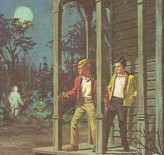
This is a full slate, indeed. 9 more films, in 4 days - of a possible 10. The 10th, Yearning, played Columbus day at 9:15pm, and I found myself staring to lose it about 8:30 pm.... Alas! even I need sleep! I had another chance to see it last week, at the MFA - but skipped it in a pique when they asked me to check my backpack before going into the film. Figuring, of course, that I'd get to see it later... oh well. 17 films is a lot to absorb in 2 weeks as it is...
(As I warned last week - this is kind of a notebook dump, and I will probably give away some plot details. Naruse's films don't exactly depend on their plot twists - but if I spoil some effect by talking about it here, I'm sorry...)
Late Chrysanthemums - This is another of the three Naruse films I had been able to see before this series: it's been on video. It's about 4 ex-geisha trying to make it in 50s Tokyo. One is a money-lender, one operates a business, the other two are poor, and work as maids - one is sickly and dreamy, the other is carefree and careless. The latter two have children, though they are rather disappointing, marrying on their own, moving to Hokkaido... This is a pattern Naruse returned to many times - telling the story of a group of people - a family, the workers at a geisha house, or former colleagues - who represent a certain range of attitudes toward the world. There's usually a stingy money-grubber, usually a partier, usually one or two practical types, someone romantic and dreamy, someone resigned and ineffectual, trying, maybe, to preserve tradition... These roles are usually distributed among a group of women - if men are around, they're usually layabouts or drunkards or fool or cheats. At best, a married lover of one of the women, waiting to go back to his wife... In this film, the men manage to do all of those things - drink, loaf, beg for money, and go back to their wives...
It's a great film - one of the best, I think, though I might think that because, having seen it before, I was able to pay more attention to the details of how Naruse put it together. He does interesting things with transitions - he as a way of including shots that are completely logical syntactically, but don't fit semantically. For example - if someone leaves a house, he will cut to a shot of a person walking along the street. It's a normal, logical, transition - except the person shown on the street will not be the person who left the house, or the person who is shown entering a house when the next scene starts. That's a rather banal example - but it's a pattern he often exploits. There's a scene toward the end - Okin (the money-lender) is talking to her long ago lover Tabe - he's after money, but he's also angling for a night with her: they talk about staying the night, she's less enthused (since he's after her money), he's trying... Then Naruse cuts from the conversation to a shot of 2 people in bed: but we soon realize, it's not Okin and Tabe, it's Otomi and Tamae (the maids - who have been drinking and complaining about their children (and Okin, of course)). They're drunk, and talking about Tamae's daughter's honeymoon. Then it's back to Okin and Tabe... In this film, the effect is to bind the 4 women together - they are different, and their differences work out the possibilities available to them - and the various ways that they can suffer. It also indicates the bonds between people - this is probably more obvious in the family films (Lightning or Summer Clouds, for example), where the cross cutting (and the thematic blending, like that linkage of sexual suggestiveness, between Okin and Tabe, then the other two women talking about Tamae's daughter's wedding night) tends to emphasize their interconnections, their inability to escape from one another.
Repast - Setsuko Hara stars as the unhappy wife of a Tokyo man working in Osaka. His niece turns up - she's run away from home, and in Osaka, she hangs around the house, flirts with the husband and a neighbor kid, spends money, smokes cigarettes and loafs while Hara works works works... Hara finally can't take it anymore and heads home to mother. Of course her husband's niece goes as well, and son starts flirting with the man Hara is considering flirting with... It is, typically, a handsome, quiet film. It is interesting how Naruse makes the story seem to turn on food - the couple talks about what they are eating, about the cost of food, about how it tastes; the first fight (involving the niece) is precipitated by the girl not cooking anything for the husband. People buy food for each other, talk over meals, break up or get back together again over food, and so on. Naruse does something like this in a lot of his films - weaving threads, some significant object, through the story: money plays this role in Late Chrysanthemums... (money as objects - coins and bills and such... money in general is an inescapable presence in all of his films.)
Summer Clouds - a sprawling drama about a farming family, centering on a war widow running a farm. She survives, while her brothers sink into money difficulties and capitalism. We can see Japanese society changing in front of our eyes. Another gorgeous film, this one shot in scope and color. Another ensemble drama - a dozen or so significant characters, with the film taking time with most of them. Building sympathy for most of them, even when they have directly contradictory ideas - even after they do horrible, destructive (and usually self-destructive) things to one another. Naruse seems to subscribe to something like Renoir's statement - "the terrible thing is, everyone has good reasons" - even if he does take sides. Here, the brother tries to do things the way the did when he was young - hurting everyone around him, and failing to hold anyone in place... Naruse manages to make him sympathetic, understandable, even if he doesn't pull punches on what a disaster the old guy is for his family when he gets his way...
Floating Clouds - Hideko Takamine stars as the mistress of a married man played by Masayuki Mori, who made wartime promises back in Indo-china that he is not inclined to honor in postwar Japan. He does, however, apparently expect the occasional adulterous interlude. Takamine makes gestures toward dropping him, but he keeps coming back, and she sticks to him when he does. Naruse's films tend to be full of misery and sorrow, but usually driven by lack of money, selfish and foolish friends and neighbors, and the fate of being a woman in Japan - this one moves beyond those quieter forms of unhappiness into melodrama and degradation. Prostitution, other women, rape, murder appear alongside the Naruse standards of poverty and humiliation - it is also rather unusual (at least in the films of his I've seen) for ending in death. For good bad or indifferent, Naruse's heroines usually have to keep going at the end - their stories don't really end - some episode ends, the film can end, but they have to get up in the morning and go back to whatever it is they do.... His films usually end with the woman ascending the stairs... This is an exception.
Lightning - Takamine again, this time as the youngest of her mother's 4 children (with 4 men) - the other three are a mopey romantic whose philandering husband dies; a scheming bitch; and a layabout son who spends his time drinking and playing pachinko - add the 2nd sister's inept husband and a lecherous baker (who pursues Takamine, while bedding her sisters) - it makes a living hell of the home situation. On the other hand, it's less oppressive than most of these films - for one thing, Takamine, from the beginning, can take care of herself (she's a bus guide), and never seems in any danger of getting dragged down into the misery of the rest of her family. When things get too much, she lights out for the territories, taking a room in the suburbs... For another thing, the film itself has a much more comic tone than film like Flowing or Summer Clouds. It's corrosive comedy - at times, it is very close to the sharpness of Ichikawa's 50s satires (Mr. Pu or A Billionaire), or Imamura's. Naruse, I should note, is perfectly capable of comedy - the early films I've seen have all contained a great deal of comic business, and even late, many of these films - especially the ensemble pieces - contain a lot of wit, and even some slapstick. In Lightning, though, it is much closer to the dominant mode.
The Whole Family Works - 1939 film about a working family - 7 kids, 3 of them already working, the 4th at the point of deciding whether to continue studying or become an apprentice. Then the oldest son decides he has to go back to school, to study electrical engineering, if he wants to get out of the cycle of poverty his family is in. Remarkable for a number of reasons (besides the typically superb filmmaking) - on is how it gives weight to both sides of the debate. The boy is right, of course - if he continues to work, he will end up with his own household in exactly the same place his father is - working endlessly just to keep food on the table. He's earning 18 yen a year as he is - that's not going to change significantly, If he studies, he can earn 70 yen a year. It will take 5 years to get the education he wants - but it's worth it. But right as he is, the family is right too - if he leaves, they will have a serious problem being able to feed their children. And when he leaves, the other boys will decide they have to leave - with 3 kids too young to work, plus grandparents, things will be bad. Naruse clearly sees this dilemma - clearly understands that the boy is more right - but he does justice to the other side... The second remarkable thing is the war. It's 1939: watching it now, it is hard to ignore the fact that all the talk about who works and who studies will be swept away in a year or so - all four of these working class kids are probably going to be shipped off to China or the Pacific islands to die. The war pokes up through the story a couple times - the little kids are constantly playing with guns; the older kids play with guns, or dream of the war. It's hard to say how this was meant - the effect now is to remind us where things were going, what was at stake. The film feels terribly prescient...
Flowing - another ensemble story, this time in a geisha house. A group of characters - a talented and beautiful geisha, who's just a little too romantic to hold her own, tries to run the place, and keep things together; her daughter is hard-headed, practical, outspoken; one sister is a money-lender, the other is a layabout; two other geisha work with them - one young, foolish, careless - the other aging, a gossip (a wonderful comic character - played by Haruko Sugimura, who was a great comic actress, frequently for Ozu, as well as Naruse...) They are plagued by the uncle of a former geisha at the house - they cheated her, he is there to collect...Things crumble, but they keep it together during the movie at least...
The Sound of the Mountain - adaptation of a Kawabata novel about a man flirting with his daughter-in-law, while his son behaves like a brute toward a series of women. Setsuko Hara and So Yamamura star, with Ken Uehara as the wretch of a son - all are superb, especially Hara. A subtle and beautiful film, capturing the feel of Kawabata - the strange moments in his books, the symbolism (the Noh mask the father buys...) A very great film.
The Wanderer's Notebook - biography of Fumiko Hayashi, author of many books about the suffering of women, the source of many of Naruse's films. Based on her first novel, which told her life story to that point. Starring, again, Hideko Takamine - who plays Hayashi in a distinctive and rather wonderful way. She's got a strange slink to her in this film - a way of looking at things that expresses her intelligence and anger at her misery. She also gets some fine chances to go wild - a couple drunk scenes, a couple wild bar scenes, singing, dancing, raising hell. Another fine movie - in scope, lush black and white... Nice stuff.
And that's that. There are two more at the Museum of Fine Arts not shown yet - Scattered Clouds (Naruse's final film) and Tsuruhachi and Tsurujiro, from the 1930s. There are also several films there that have already been shown at the Harvard Film Archive. I look forward to seeing these films again (Lightning, Wife Be Like a Rose, Mother) - their richness tends to emerge on repeated viewings. This has been a wonderful series - I hope these films are shown around the country, and I hope some of them at least make it out on DVD. There have been a few new DVD editions of Ozu films out since the major restoration of his films a couple years ago. Naruse is almost as deserving....
Wednesday, October 12, 2005

Movie Posts Anticipated
It is Wednesday - I have, as it happens, two posts on the burner - a summary of the second week of Naruse films, and quick reviews of the other films I saw over the weekend. With a weekend of pouring rain, it was a great comfort to be able to more or less live at a series of movie theaters - but with 2 Naruse films showing every night, I haven't had much time to put my thoughts in order. So no guarantees on when the posts show up. Maybe tonight, maybe tomorrow...
Saturday, October 08, 2005
Random Ten
Quick and to the point, on a muggy rainy Saturday:
1. Minutemen - Some Shit From and Old Notebook
2. Buzzcocks - Ever Fallen in love
3. Bob Dylan - Idiot Wind
4. Big Black - He's a Whore
5. Gil Bateman - My Daddy Walked in Darkness
6. Feelies - It's Only Life
7. X - We're Desperate
8. Minor Threat - Understand (live)
9. Xiu Xiu - Clover
10. Audioslave - Man or Animal
1. Minutemen - Some Shit From and Old Notebook
2. Buzzcocks - Ever Fallen in love
3. Bob Dylan - Idiot Wind
4. Big Black - He's a Whore
5. Gil Bateman - My Daddy Walked in Darkness
6. Feelies - It's Only Life
7. X - We're Desperate
8. Minor Threat - Understand (live)
9. Xiu Xiu - Clover
10. Audioslave - Man or Animal
Monday, October 03, 2005
Naruse Week One
The Mikio Naruse series, playing at the Museum of Fine Arts and the Harvard Film Archive, has begun. I am going to try to post something here about every film - probably catchall posts like this one, though I might post these as I go, like I started doing with this post. [This is updated from a coiuple days ago.] Probably depends on time and all that. I'd bet on catchalls.
One more thing - I am not going to be a stickler about not revealing plot details. I don't know how much play these films are going to get in the general public, but it probably won't be a lot. So - it's a bitter truth that there won't be enough people to spoil them for... And I'd rather move on to make the case for their importance, which kind of requires some plot details sometimes.... I will try not to give away too much, but no promises.
1) When A Woman Ascends the Stairs: might be his masterpiece, certainly the best known Naruse film. A bar hostess approaches 30, struggling for money, steering among a group of men who lust for her or long for her. She will not turn tricks - she swore fidelity to her dead husband and uses it as an excuse to stay away from the men around her. But she is beset by a string of disasters - a friend/rival kills herself over her debts (a caution for Mama-san, if she owned a bar); she becomes ill; she gets involved with a man who turns out to be a fraud; she gets drunk and lets herself be seduced by another married man she loves who won't leave his wife. Through it all, her family mooches off her, her bar manager hovers over her, only to turn preachy at the end, though he can't maintain the pose of superiority... All this is conveyed in quiet, balanced compositions, deep and complex. Hideko Takamine, probably the most beautiful of the great Japanese actresses, Naruse's frequent star, is outstanding - the rest of the cast strong.... Naruse's style is as austere as Ozu's - where Ozu cuts, Mizoguchi moves the camera, and Naruse works mostly through the shot - the composition, the arrangement of people and objects on the screen. Very few camera movements, and the editing is never abrasive as it is in Ozu: it's all depth and composition. Some shots as deep and textured as Imamura - others simple and pure - always precise. There is a quiet accumulation of detail and emotion. This is a brilliant, stunning film, comparable to anything from the other greats.
2) Mother: Kinuyo Tanaka as the mother, living in some poverty in post-war Japan. She loses most of her family in the film - first her son dies, then her husband, then her brother adopts her daughter and her sister takes her son back... I had seen this film before, but forgot all but the basic set up (everyone leaves her, the money troubles), and it's general characteristics, the handsome, fairly quiet style, etc. It's set in an old-fashioned looking neighborhood, and Naruse spends a lot of time in the street, shooting people moving around, festivals, shops, and so on, all the while keeping the family's story embedded in the life of the neighborhood. The story telling is elliptical - scenes fade without showing their resolution, transitions often leave out the big events happening between. Most of the cinematic work is done by composition and staging, the editing isn't as abrupt as in his early films - there are some neat jokes, like bringing up a "The End" title halfway through the film - then showing the characters at a movie.... Finally, Tanaka is, as always, wonderful - here, Naruse develops a kind of characteristic shot of her - holding the shot of her face, as a look of happiness or strength fades to aching sadness.
3) Flunky! Work Hard! - The Museum of Fine Arts tried to bill this as "Little Man, Try Hard!"- I gotta go with the older title.... This is a short comedy made in 1931 about a poor insurance salesman, trying to sell policies to a wealthy family so he can take care of his own family. Slapstick at first, with business involving the man's son hiding from the neighborhood mothers (after he beat up the other kids) - then joined by the father, hiding from the rent collector. Then more slapstick involving the Flunky and a rival insurance agent. But this is Shochiko - sooner or late, a kid is going to suffer, and sure enough, someone gets hit by a train - the insurance agent, trying to make up for his son beating up one of the rich kids (3 of the rich kids, actually) takes the boy home, and wins their business... But we can guess who was really hit by the train. When the father learns his son's fate - the film explodes - Naruse launches into a barrage of flashbacks, images of planes and trains - then cuts to the hospital, all shadows and fast cuts and the mother pacing in and out of the frame (an image that comes up repeatedly in his early films), and dripping faucets and the works....
4) Every Night's Dream - 1933, Shochiko comic melodrama, featuring appearances by a couple of Ozu's regulars, Takeshi Sakamoto and Tatsuo Saito. Saito plays the rather useless husband of a bar hostess (played by Sumiko Kurishima) with a son. Saito looks for work, but there aren't any jobs, and he's not all that energetic about getting one. Meanwhile, Sakamoto is hanging around, smoking a pipe and leering over the barmaid. Will she turn tricks? Will he find a job? Or - this being Shochiko - will the boy be hit by a car?
The plot is a kind of hash of Shochiko themes - poverty, sick kids, moral dilemmas - several contemporary Ozu films (That Night's Wife, Women of Tokyo, An Inn in Tokyo) use similar themes - this seems less sharp than the similar Ozu films, maybe because Ozu had a couple years start on Naruse, and was more established and sure of his techniques. It is a good deal more pessimistic than Ozu's films - crime is punished in Ozu's, but not before it pays the bills. Here, crime does not pay, is not really punished (someone jumps in a river - Naruse fans should be able to guess whether it's the weakling husband or the tough wife) - though the utter darkness descends very late, and doesn't seem all that much more convincing than Ozu's modest self-sacrificers.
The most notable element of this film is the style - Naruse, in the 30s, seems heavily influenced by the Russians - you see it in Flunky - you see it here. Metaphoric editing, flashbacks and visions, lots of strong manipulation of space; repeated shots, fast cuts, intrusive tracks, usually into a character, though sometimes away from a character. I wouldn't say that any of these devices have clear, given meanings - they tend to function by startling us, by making us notice a character's inner turmoil. The tracks, for instance, function largely through contrast - the tracks in feel like the story demanding a decision - then a track away from someone signals a change in their attitude, their decision to act. The contrast between different kinds of camera moves is what creates meaning - it’s almost a Kuleshov effect: the tracks in may have some intrinsic meaning, but mostly they serve to startle us - and take on meaning mostly through contrast with the final track out from the character. Overall, these early films are flashier than the later ones - and very “expressionistic” - though usually using Russian techniques (montage, some camera movement) instead of German ones (mise-en-scene, lighting, manipulation of space.) The difference I'm getting at (between "Russia" and "German" styles) can be seen in the use of cameras movement - they don’t manipulate space the way they do in Mizoguchi (or Murnau) - they work more by shocking us - they make you notice them - they are formalist, in their “making strange” - or “presentationalist” - a major element in formalism, since the point of presentational filmmaking is to startle to audience. That is not to say Naruse does not use lighting and manipulation of space to great effect - these films are full of technique of this sort.
5) Wife! Be Like A Rose! - another better known Naruse, the first Japanese sound film released in the United States. Story of modern girl who decides to retrieve her father, who has deserted her and her mother, from the ex-geisha he's livig with. But when she arrives, things are not as they seem... The sound is, in fact, pretty well done - clear, and not hindering Naruse's camera style. (This isn't as flashy as the 2 silent films, but he still moves the camera plenty. His style has, however, solidified - he's moving toward the emphasis on the composition of the shots, the use of decor, lighting and so on - and it feels more organic than the earlier films.) He's also well in command of the use of sound as sound - he's particularly fond of using sound to bridge scenes - more than once he starts music in one scene that seems to be extra-diegetic, only to shift to another scene, where someone is playing the music. He does this with dialogue and diegetic sound - starting the sound from the following scene over the end of the previous - playing dialogue or sound from different scenes, etc. He plays foreground and background dialogue against one anote a couple times as well - the mother's poetry, the father's second family, talking around the girl. Those transitions, by the way, are a relic of his silent days - in Every Night’s Dream, he frequently cut into scenes on dialogue cards. The most extreme version going something like this: 1) shots of father and son, playing outside; 2) shot of intertitle, talking about work and money; 3) shots of the madam of the bar where the wife works; 4) shots of the room; 5) intertitle, continuing earlier dialogue; 6) shot of the wife, who has been speaking all along. That is only one example. He picks that up where he left off when sound comes - and seems even more adept at it.
6) Traveling Actors (or, more charmingly, though not so accurately, The Actors Who Play the Horse.) Not surprisingly, this is indeed about the actors who play the horse in a traveling Kabuki troupe. It's funny - the forelegs are played by a proud veteran, the hind legs by a newcomer - they brag, study horses, talk... Then, after a drunken oaf of a barber ruins their horse's head, they go on strike - and are replaced by, horror of horrors, a real horse! That won't stand - and in the end, they go on a rampage, in costume of course.... It's very entertaining - less biting than most Naruse, odd in not featuring women in any significant roles - though there might be some politics in the fate of the actors. Craftsmen replaced by the novelty of the real!
7) A Tale of Archery at the Sanjusangendo - the son of a former archery champion who killed himself after failing to surpass the record of his rival, sets out to reclaim the title of Japan's greatest archer.... the current champion's family hires thugs to stop him - but a mysterious stranger (played by Kazuo Hasegawa) protects him - but who could the mystery man be? If you can't guess, you don't know much about Samurai films. It's entertaining, but that's about all. It's stunningly beautiful, but you knew that too, I hope.
8) Song Lantern - (aka Lantern Singer) - in this, a Noh singer humiliates an old amateur who had been unwisely shooting off his mouth - the old man kills himself, and the Noh singer is disowned by his father. (I don't know exactly what it means that the singer is played by Shôtarô Hanayagi, star of Mizoguchi's Story of the Last Chrysanthemum, where - well, same idea - traditional arts, exile, redemption...) He (the singer) turns to singing under street lanterns (thus the title) - he makes friends with a rival, then he meets the daughter of the old man he killed, and teaches her Noh dance... Inevitably, she is called on to perform for the singer's father. It's a full moon. The story is no great shakes, but as always it's a lovely film, played with a certain amount of wry comedy, and given a few bursts of astonishment.
One more thing - I am not going to be a stickler about not revealing plot details. I don't know how much play these films are going to get in the general public, but it probably won't be a lot. So - it's a bitter truth that there won't be enough people to spoil them for... And I'd rather move on to make the case for their importance, which kind of requires some plot details sometimes.... I will try not to give away too much, but no promises.
1) When A Woman Ascends the Stairs: might be his masterpiece, certainly the best known Naruse film. A bar hostess approaches 30, struggling for money, steering among a group of men who lust for her or long for her. She will not turn tricks - she swore fidelity to her dead husband and uses it as an excuse to stay away from the men around her. But she is beset by a string of disasters - a friend/rival kills herself over her debts (a caution for Mama-san, if she owned a bar); she becomes ill; she gets involved with a man who turns out to be a fraud; she gets drunk and lets herself be seduced by another married man she loves who won't leave his wife. Through it all, her family mooches off her, her bar manager hovers over her, only to turn preachy at the end, though he can't maintain the pose of superiority... All this is conveyed in quiet, balanced compositions, deep and complex. Hideko Takamine, probably the most beautiful of the great Japanese actresses, Naruse's frequent star, is outstanding - the rest of the cast strong.... Naruse's style is as austere as Ozu's - where Ozu cuts, Mizoguchi moves the camera, and Naruse works mostly through the shot - the composition, the arrangement of people and objects on the screen. Very few camera movements, and the editing is never abrasive as it is in Ozu: it's all depth and composition. Some shots as deep and textured as Imamura - others simple and pure - always precise. There is a quiet accumulation of detail and emotion. This is a brilliant, stunning film, comparable to anything from the other greats.
2) Mother: Kinuyo Tanaka as the mother, living in some poverty in post-war Japan. She loses most of her family in the film - first her son dies, then her husband, then her brother adopts her daughter and her sister takes her son back... I had seen this film before, but forgot all but the basic set up (everyone leaves her, the money troubles), and it's general characteristics, the handsome, fairly quiet style, etc. It's set in an old-fashioned looking neighborhood, and Naruse spends a lot of time in the street, shooting people moving around, festivals, shops, and so on, all the while keeping the family's story embedded in the life of the neighborhood. The story telling is elliptical - scenes fade without showing their resolution, transitions often leave out the big events happening between. Most of the cinematic work is done by composition and staging, the editing isn't as abrupt as in his early films - there are some neat jokes, like bringing up a "The End" title halfway through the film - then showing the characters at a movie.... Finally, Tanaka is, as always, wonderful - here, Naruse develops a kind of characteristic shot of her - holding the shot of her face, as a look of happiness or strength fades to aching sadness.
3) Flunky! Work Hard! - The Museum of Fine Arts tried to bill this as "Little Man, Try Hard!"- I gotta go with the older title.... This is a short comedy made in 1931 about a poor insurance salesman, trying to sell policies to a wealthy family so he can take care of his own family. Slapstick at first, with business involving the man's son hiding from the neighborhood mothers (after he beat up the other kids) - then joined by the father, hiding from the rent collector. Then more slapstick involving the Flunky and a rival insurance agent. But this is Shochiko - sooner or late, a kid is going to suffer, and sure enough, someone gets hit by a train - the insurance agent, trying to make up for his son beating up one of the rich kids (3 of the rich kids, actually) takes the boy home, and wins their business... But we can guess who was really hit by the train. When the father learns his son's fate - the film explodes - Naruse launches into a barrage of flashbacks, images of planes and trains - then cuts to the hospital, all shadows and fast cuts and the mother pacing in and out of the frame (an image that comes up repeatedly in his early films), and dripping faucets and the works....
4) Every Night's Dream - 1933, Shochiko comic melodrama, featuring appearances by a couple of Ozu's regulars, Takeshi Sakamoto and Tatsuo Saito. Saito plays the rather useless husband of a bar hostess (played by Sumiko Kurishima) with a son. Saito looks for work, but there aren't any jobs, and he's not all that energetic about getting one. Meanwhile, Sakamoto is hanging around, smoking a pipe and leering over the barmaid. Will she turn tricks? Will he find a job? Or - this being Shochiko - will the boy be hit by a car?
The plot is a kind of hash of Shochiko themes - poverty, sick kids, moral dilemmas - several contemporary Ozu films (That Night's Wife, Women of Tokyo, An Inn in Tokyo) use similar themes - this seems less sharp than the similar Ozu films, maybe because Ozu had a couple years start on Naruse, and was more established and sure of his techniques. It is a good deal more pessimistic than Ozu's films - crime is punished in Ozu's, but not before it pays the bills. Here, crime does not pay, is not really punished (someone jumps in a river - Naruse fans should be able to guess whether it's the weakling husband or the tough wife) - though the utter darkness descends very late, and doesn't seem all that much more convincing than Ozu's modest self-sacrificers.
The most notable element of this film is the style - Naruse, in the 30s, seems heavily influenced by the Russians - you see it in Flunky - you see it here. Metaphoric editing, flashbacks and visions, lots of strong manipulation of space; repeated shots, fast cuts, intrusive tracks, usually into a character, though sometimes away from a character. I wouldn't say that any of these devices have clear, given meanings - they tend to function by startling us, by making us notice a character's inner turmoil. The tracks, for instance, function largely through contrast - the tracks in feel like the story demanding a decision - then a track away from someone signals a change in their attitude, their decision to act. The contrast between different kinds of camera moves is what creates meaning - it’s almost a Kuleshov effect: the tracks in may have some intrinsic meaning, but mostly they serve to startle us - and take on meaning mostly through contrast with the final track out from the character. Overall, these early films are flashier than the later ones - and very “expressionistic” - though usually using Russian techniques (montage, some camera movement) instead of German ones (mise-en-scene, lighting, manipulation of space.) The difference I'm getting at (between "Russia" and "German" styles) can be seen in the use of cameras movement - they don’t manipulate space the way they do in Mizoguchi (or Murnau) - they work more by shocking us - they make you notice them - they are formalist, in their “making strange” - or “presentationalist” - a major element in formalism, since the point of presentational filmmaking is to startle to audience. That is not to say Naruse does not use lighting and manipulation of space to great effect - these films are full of technique of this sort.
5) Wife! Be Like A Rose! - another better known Naruse, the first Japanese sound film released in the United States. Story of modern girl who decides to retrieve her father, who has deserted her and her mother, from the ex-geisha he's livig with. But when she arrives, things are not as they seem... The sound is, in fact, pretty well done - clear, and not hindering Naruse's camera style. (This isn't as flashy as the 2 silent films, but he still moves the camera plenty. His style has, however, solidified - he's moving toward the emphasis on the composition of the shots, the use of decor, lighting and so on - and it feels more organic than the earlier films.) He's also well in command of the use of sound as sound - he's particularly fond of using sound to bridge scenes - more than once he starts music in one scene that seems to be extra-diegetic, only to shift to another scene, where someone is playing the music. He does this with dialogue and diegetic sound - starting the sound from the following scene over the end of the previous - playing dialogue or sound from different scenes, etc. He plays foreground and background dialogue against one anote a couple times as well - the mother's poetry, the father's second family, talking around the girl. Those transitions, by the way, are a relic of his silent days - in Every Night’s Dream, he frequently cut into scenes on dialogue cards. The most extreme version going something like this: 1) shots of father and son, playing outside; 2) shot of intertitle, talking about work and money; 3) shots of the madam of the bar where the wife works; 4) shots of the room; 5) intertitle, continuing earlier dialogue; 6) shot of the wife, who has been speaking all along. That is only one example. He picks that up where he left off when sound comes - and seems even more adept at it.
6) Traveling Actors (or, more charmingly, though not so accurately, The Actors Who Play the Horse.) Not surprisingly, this is indeed about the actors who play the horse in a traveling Kabuki troupe. It's funny - the forelegs are played by a proud veteran, the hind legs by a newcomer - they brag, study horses, talk... Then, after a drunken oaf of a barber ruins their horse's head, they go on strike - and are replaced by, horror of horrors, a real horse! That won't stand - and in the end, they go on a rampage, in costume of course.... It's very entertaining - less biting than most Naruse, odd in not featuring women in any significant roles - though there might be some politics in the fate of the actors. Craftsmen replaced by the novelty of the real!
7) A Tale of Archery at the Sanjusangendo - the son of a former archery champion who killed himself after failing to surpass the record of his rival, sets out to reclaim the title of Japan's greatest archer.... the current champion's family hires thugs to stop him - but a mysterious stranger (played by Kazuo Hasegawa) protects him - but who could the mystery man be? If you can't guess, you don't know much about Samurai films. It's entertaining, but that's about all. It's stunningly beautiful, but you knew that too, I hope.
8) Song Lantern - (aka Lantern Singer) - in this, a Noh singer humiliates an old amateur who had been unwisely shooting off his mouth - the old man kills himself, and the Noh singer is disowned by his father. (I don't know exactly what it means that the singer is played by Shôtarô Hanayagi, star of Mizoguchi's Story of the Last Chrysanthemum, where - well, same idea - traditional arts, exile, redemption...) He (the singer) turns to singing under street lanterns (thus the title) - he makes friends with a rival, then he meets the daughter of the old man he killed, and teaches her Noh dance... Inevitably, she is called on to perform for the singer's father. It's a full moon. The story is no great shakes, but as always it's a lovely film, played with a certain amount of wry comedy, and given a few bursts of astonishment.
Not Naruse
I am going to try to post a weekly recap of the Naruse films seen. I hope to work up something longer as well, but that's not likely to come here until next week. Meanwhile - I saw other films last week, and here they are:
My Sex Life (or How I Got into an Argument):**** - a long, but brilliant, French film about an assistant philosophy professor and his circle of friends and lovers. Full of characters, swirling around the central pair, lots of back and forth - and an amazingly rich and varied style. Glorious film. The shifting points of view, the odd rhythms, the way things are played funny and sad and weird all at once - Arnaud Desplechinsturns a very conventional type of film (French intellectuals on the mope) into something surprising, engrossing, and thrilling to look at. I'd seen this before on video, but missed the aesthetics of it - this time, even on a rather sketchy print, I could see - Desplechins uses everything he has to turn a film about a bunch of people talking into a feast for the eyes. Sometimes films like this come off wrong - too flashy, almost desperate, trying to make static material look interesting - this film doesn't. Like last year's masterpiece, Kings and Queen - also starring Mathieu Amalric and Emmanuelle Devos - the style conveys the sense of people bursting at the seams, which they are, in their talky ways. It's wonderful. Assisted mightily by the cast - Amalric and Devos were marvelous together - she smiles and smirks through all kinds of fights and sarcasm, breaks down, when he starts getting sentimental... Every scene is a surprise - a flow of emotion, back and forth, out the other side. The rest of the cast is just as good - especially Jeanne Balibar (as a very canny nutcase). Desplechins may be telling Paul's story here, but he gives other people their time - spending time away from the central character, following his friends for a while. A great movie.
Mutual Admiration *** - Andrew Bujalski's follow up to Funny Ha Ha. Same style, similar characters - slackers, this time in Brooklyn... The main slacker is a musician named Alan, a scruffy, nerdy, indie rocker who has just moved to Brooklyn without his band. He hangs around, looking for a drummer, drinking too much, running up credit card debt, not returning calls, and almost stealing his best friend's girl. Like Funny Ha Ha, it is deceptive - the simplicity, lack of overt drama, awkward sounding conversations hiding the care that goes into structuring those conversations and getting them to come out right. It's shot in black and white and looks a bit gloomy and claustophobic, which it probably is. It is also, at times, uproariously funny - in a kind of understated way....
Dial M For Murder **1/2 - on TV when I got home from Saturday's Naruse, so I watched it. Looks nice, but it's a pretty dull whodunnit in the Columbo mode (albeit well before Columbo). Very stagy - Hitchcock perhaps trying to make a virtue of limitations (the one room set, mostly), without quite managing it.
Keane ***1/2 - intense and sad film about a man, probably schizophrenic, who hangs around the Port Authority bus terminal in NY, looking for his daughter, who disappeared while he was watching her. He keeps reenacting the scene - watching the clock until 4:30, trying to spot the man who took her... The rest of the time, he beats back the voices in his head with booze and coke... Then he meets a waitress with a daughter and problems of her own - she pulls him in to her life a bit, and then has him babysit her daughter.... Ebert's review gets at the effect this has - we know what kind of man Keane is - we have seen him in the throes of his madness - we have also seen him (in the scenes with the waitress, especially) calm, rational, effective. The suspense comes from wondering what will happen - and from the fact that we know that Keane himself is feeling more or less exactly what we are feeling. He knows himself - he is as desperate to make it through this as we are....
It is very hard to take. Kerrigan puts us right next to Damien Lewis, his actor - the camera sticks to him like a Dardennes brother's film. At times, it's as if we are the voices in his head - he suffers, we stare, never giving him an inch... It's heartbreaking, this film - we are buried deep in Keane's sadness. We see that he could have been a good father, if only he were healthy. And we - who know what he is really like - ache for the waitress, who does not know what he is like. To her he is kind, down on his luck, and all she has to go on. Just a hugely affecting film.
My Sex Life (or How I Got into an Argument):**** - a long, but brilliant, French film about an assistant philosophy professor and his circle of friends and lovers. Full of characters, swirling around the central pair, lots of back and forth - and an amazingly rich and varied style. Glorious film. The shifting points of view, the odd rhythms, the way things are played funny and sad and weird all at once - Arnaud Desplechinsturns a very conventional type of film (French intellectuals on the mope) into something surprising, engrossing, and thrilling to look at. I'd seen this before on video, but missed the aesthetics of it - this time, even on a rather sketchy print, I could see - Desplechins uses everything he has to turn a film about a bunch of people talking into a feast for the eyes. Sometimes films like this come off wrong - too flashy, almost desperate, trying to make static material look interesting - this film doesn't. Like last year's masterpiece, Kings and Queen - also starring Mathieu Amalric and Emmanuelle Devos - the style conveys the sense of people bursting at the seams, which they are, in their talky ways. It's wonderful. Assisted mightily by the cast - Amalric and Devos were marvelous together - she smiles and smirks through all kinds of fights and sarcasm, breaks down, when he starts getting sentimental... Every scene is a surprise - a flow of emotion, back and forth, out the other side. The rest of the cast is just as good - especially Jeanne Balibar (as a very canny nutcase). Desplechins may be telling Paul's story here, but he gives other people their time - spending time away from the central character, following his friends for a while. A great movie.
Mutual Admiration *** - Andrew Bujalski's follow up to Funny Ha Ha. Same style, similar characters - slackers, this time in Brooklyn... The main slacker is a musician named Alan, a scruffy, nerdy, indie rocker who has just moved to Brooklyn without his band. He hangs around, looking for a drummer, drinking too much, running up credit card debt, not returning calls, and almost stealing his best friend's girl. Like Funny Ha Ha, it is deceptive - the simplicity, lack of overt drama, awkward sounding conversations hiding the care that goes into structuring those conversations and getting them to come out right. It's shot in black and white and looks a bit gloomy and claustophobic, which it probably is. It is also, at times, uproariously funny - in a kind of understated way....
Dial M For Murder **1/2 - on TV when I got home from Saturday's Naruse, so I watched it. Looks nice, but it's a pretty dull whodunnit in the Columbo mode (albeit well before Columbo). Very stagy - Hitchcock perhaps trying to make a virtue of limitations (the one room set, mostly), without quite managing it.
Keane ***1/2 - intense and sad film about a man, probably schizophrenic, who hangs around the Port Authority bus terminal in NY, looking for his daughter, who disappeared while he was watching her. He keeps reenacting the scene - watching the clock until 4:30, trying to spot the man who took her... The rest of the time, he beats back the voices in his head with booze and coke... Then he meets a waitress with a daughter and problems of her own - she pulls him in to her life a bit, and then has him babysit her daughter.... Ebert's review gets at the effect this has - we know what kind of man Keane is - we have seen him in the throes of his madness - we have also seen him (in the scenes with the waitress, especially) calm, rational, effective. The suspense comes from wondering what will happen - and from the fact that we know that Keane himself is feeling more or less exactly what we are feeling. He knows himself - he is as desperate to make it through this as we are....
It is very hard to take. Kerrigan puts us right next to Damien Lewis, his actor - the camera sticks to him like a Dardennes brother's film. At times, it's as if we are the voices in his head - he suffers, we stare, never giving him an inch... It's heartbreaking, this film - we are buried deep in Keane's sadness. We see that he could have been a good father, if only he were healthy. And we - who know what he is really like - ache for the waitress, who does not know what he is like. To her he is kind, down on his luck, and all she has to go on. Just a hugely affecting film.
Friday, September 30, 2005
Return of Friday Random 10
Since I installed iTunes 5, iTunes isn't recognizing my iPod - wonderful. This is not the time to do trouble shooting htough - i{od and iTunes work ifne on their own - but I have an Isley Brothers CD that has to get on the iPod soon... but until then....
Random 10!
David Bowie - Moonage Daydream
Sleater-Kinney - Let's Call it Love
Robert Johnson - if I had Possession over Judgment Day
Gomez - Do On (live)
Yoko Ono/Yo La Tengo - Hedwig's Lament/Exquisite Corpse
Crabs - Tumbling Away (what this is, where it came from and why, I don't know in the least; though it's not half bad)
Matthew Sweet - Nothing Lasts
Faust - Just a Second (Starts like That)
Pavement - Lions (Linden)
Pere Ubu - Misery Goats
don't fret now baby, don't be so tired...
Random 10!
David Bowie - Moonage Daydream
Sleater-Kinney - Let's Call it Love
Robert Johnson - if I had Possession over Judgment Day
Gomez - Do On (live)
Yoko Ono/Yo La Tengo - Hedwig's Lament/Exquisite Corpse
Crabs - Tumbling Away (what this is, where it came from and why, I don't know in the least; though it's not half bad)
Matthew Sweet - Nothing Lasts
Faust - Just a Second (Starts like That)
Pavement - Lions (Linden)
Pere Ubu - Misery Goats
don't fret now baby, don't be so tired...
Wednesday, September 28, 2005
So Long and thanks for the Dart Guns
While reading Feministe, I came across this story - 36 armed and dangerous dolphins were swept into the Gulf of Mexico by hurricane Katrina. No, I'm not joking. The Navy, apparently, trained them how to shoot terrorists with poison dart guns...
What can I say? Just pray, pray! that their Weapons of Windsurfer Destruction don't fall into the wrong hands... tentacles, more precisely.
What can I say? Just pray, pray! that their Weapons of Windsurfer Destruction don't fall into the wrong hands... tentacles, more precisely.
Sunday, September 25, 2005
Return of Sunday Night Movie Reviews
I have not posted any movie reviews in almost a month - looks like August 28 - great scott. I have, in that time, seen exactly 4 movies - I have been moving, that has taken all my disposable time....
All right then! here we go!
The Brothers Grimm - ** - 2 whole stars? I suppose it's watchable. In short, a really mediocre film. A disappointment from Terry Gilliam.
If Lucy Fell - ** - Okay. I know a lot of people hate Eric Schaeffer films - I understand that, especially hating Eric Schaeffer himself. He has as annoying a screen presence as you can get. Even when I figured out that he was trying to do Mickey Rooney (the hair, the mannerisms - he's doing Mickey Rooney!) - it didn't help. He was still annoying.... But the rest of it - the film - is not all that bad, not really. Not really worth seeing (except maybe to test your ability to take Eric Schaeffer himself), but hardly the atrocity it's sometimes billed as.
The Baxter **1/2 - it occurs to me that this film is giving a name to a genre of films - "Baxter" films. About more or less nice guys, passed over by life and love, who find life and love. The 40 Year Old Virgin, maybe even the Wedding Crashers, definitely Sideways (all the films I mentioned last time)... Anyway - this is from Michael Showalter, one of the guys who makes Stella, the TV show (that I don't watch, since I don't watch TV) - he's an accountant, engaged to a yuppy princess, but her old boyfriend comes back, in the form of Justin Theroux (who is very funny)... But Showalter meets another girl, Michelle Williams, playing a mousy temp who sings, and is dating Paul Rudd... Some hilarity, some absurdity, some pointlessly convoluted story-telling follows, with amusing results. But no better than that. It's just okay.
The Conformist **** - Bernardo Bertolucci is probably the world's most overrated director - perpetrator of endless, dragging, extravaganzas.... yuck... But this one probably deserves the praise. Jean-Louis Trintignant stars as the title character - an Italian intellectual, trying to join the fascist party to fit in - who is sent to kill an exiled professor... it's a gorgeous film, the sets and cinematography used to great effect - isolating Trintignant in vast, empty, soulless spaces, or making him fight against waves of people - he constantly tries to go along, to disappear into society, but constantly finds himself fighting against people. The symbolism is a bit heavy handed at times, but it works anyway.
All right then! here we go!
The Brothers Grimm - ** - 2 whole stars? I suppose it's watchable. In short, a really mediocre film. A disappointment from Terry Gilliam.
If Lucy Fell - ** - Okay. I know a lot of people hate Eric Schaeffer films - I understand that, especially hating Eric Schaeffer himself. He has as annoying a screen presence as you can get. Even when I figured out that he was trying to do Mickey Rooney (the hair, the mannerisms - he's doing Mickey Rooney!) - it didn't help. He was still annoying.... But the rest of it - the film - is not all that bad, not really. Not really worth seeing (except maybe to test your ability to take Eric Schaeffer himself), but hardly the atrocity it's sometimes billed as.
The Baxter **1/2 - it occurs to me that this film is giving a name to a genre of films - "Baxter" films. About more or less nice guys, passed over by life and love, who find life and love. The 40 Year Old Virgin, maybe even the Wedding Crashers, definitely Sideways (all the films I mentioned last time)... Anyway - this is from Michael Showalter, one of the guys who makes Stella, the TV show (that I don't watch, since I don't watch TV) - he's an accountant, engaged to a yuppy princess, but her old boyfriend comes back, in the form of Justin Theroux (who is very funny)... But Showalter meets another girl, Michelle Williams, playing a mousy temp who sings, and is dating Paul Rudd... Some hilarity, some absurdity, some pointlessly convoluted story-telling follows, with amusing results. But no better than that. It's just okay.
The Conformist **** - Bernardo Bertolucci is probably the world's most overrated director - perpetrator of endless, dragging, extravaganzas.... yuck... But this one probably deserves the praise. Jean-Louis Trintignant stars as the title character - an Italian intellectual, trying to join the fascist party to fit in - who is sent to kill an exiled professor... it's a gorgeous film, the sets and cinematography used to great effect - isolating Trintignant in vast, empty, soulless spaces, or making him fight against waves of people - he constantly tries to go along, to disappear into society, but constantly finds himself fighting against people. The symbolism is a bit heavy handed at times, but it works anyway.
Thursday, September 22, 2005
List o' Auteurs
I have been away. I have been moving, unpacking, the works. I have been between places. I am getting settled in - may even see a movie or two soon! Hooray!
I am going to play the auteurist game a bit - I am going to post a list of my top 20 favorite directors. I am posting it because I suspect it is going to change. The top 20, possibly the top 10 is going to change in the next month - there is a nice Mikio Naruse series coming to Boston (a nicer one coming to New York, I think) - I have seen three of his films (Late Chrysanthemums, Mother, and When a Woman Ascends the Stairs) - all masterpieces. Seeing another dozen or so should push him well up this list...
So without further ado - here it is:
1 Yasujiro Ozu
2 Frank Capra
3 Jean-Luc Godard
4 Kenji Mizoguchi
5 Howard Hawks
6 Jean Renoir
7 Shohei Imamura
8 Sir Alfred Hitchcock
9 Robert Altman
10 Hou Hsiao Hsien
11 Robert Bresson
12 Werner Herzog
13 David Lynch
14 Sergei Eisenstein
15 John Cassavetes
16 Akira Kurosawa
17 FW Murnau
18 Buster Keaton
19 Satyajit Ray
20 John Ford
Some of these change every time I try to write a list - the order of course, and the last 2-3 of them. Ray and Ford aren't very safe - Griffiths, Bergman, Rosselini, Welles - Kieslowski and Ichikawa - are all close. I have little doubt, though, that Naruse will make the "safe" list.
I also hope to report back on the Naruse series as I see it. I have been lax in writing here - I hope to make that up in the coming weeks.
I am going to play the auteurist game a bit - I am going to post a list of my top 20 favorite directors. I am posting it because I suspect it is going to change. The top 20, possibly the top 10 is going to change in the next month - there is a nice Mikio Naruse series coming to Boston (a nicer one coming to New York, I think) - I have seen three of his films (Late Chrysanthemums, Mother, and When a Woman Ascends the Stairs) - all masterpieces. Seeing another dozen or so should push him well up this list...
So without further ado - here it is:
1 Yasujiro Ozu
2 Frank Capra
3 Jean-Luc Godard
4 Kenji Mizoguchi
5 Howard Hawks
6 Jean Renoir
7 Shohei Imamura
8 Sir Alfred Hitchcock
9 Robert Altman
10 Hou Hsiao Hsien
11 Robert Bresson
12 Werner Herzog
13 David Lynch
14 Sergei Eisenstein
15 John Cassavetes
16 Akira Kurosawa
17 FW Murnau
18 Buster Keaton
19 Satyajit Ray
20 John Ford
Some of these change every time I try to write a list - the order of course, and the last 2-3 of them. Ray and Ford aren't very safe - Griffiths, Bergman, Rosselini, Welles - Kieslowski and Ichikawa - are all close. I have little doubt, though, that Naruse will make the "safe" list.
I also hope to report back on the Naruse series as I see it. I have been lax in writing here - I hope to make that up in the coming weeks.
Monday, September 19, 2005
Blog Like a Scourge of the Seas Day
Argh and avast, ye lubbers, it's Talk Like a Pirate Day! So run up the jolly roger and prime the 9 pounder, we're comin' fer yer booty, ye dirty scurvy dogs!
And check out P.Z. Myers for buccaneer talk, blog schmoozing, and squid vs. whale battles.
And check out P.Z. Myers for buccaneer talk, blog schmoozing, and squid vs. whale battles.
Saturday, September 17, 2005
Cable's Back!
Yes, I have been missing - I have been moving. I am back online, and starting to unpack, and so, perhaps, we can get back to our regularly scheduled 2 a week posts.
Now - a week away from regular access to the internet causes great pain - so now that I'm back, it's good to be reminded of why the internet was invented in the first place. If it was not invented so someone could create Dictionareoke, it should have been. Words cannot describe the happiness this brings! Online dictionary voices singing many fabulous hits! What more could anyone ask? (Via Empty Handed.)
(Though of course, Cats in Sinks are nice too. Via Xoverboard.)
Now - a week away from regular access to the internet causes great pain - so now that I'm back, it's good to be reminded of why the internet was invented in the first place. If it was not invented so someone could create Dictionareoke, it should have been. Words cannot describe the happiness this brings! Online dictionary voices singing many fabulous hits! What more could anyone ask? (Via Empty Handed.)
(Though of course, Cats in Sinks are nice too. Via Xoverboard.)
Friday, September 09, 2005
Slate Outdoes Onion Once Again
What the hell is this? From Slate - one Steven Landsburg writes about how disaster relief encourages people to live in dangerous places. He sets up a cute little model - a "fable" - in which people choose between living in a dangerous city and a safer city - he complains that disaster relief encourages people to live in dangerous places. That, in the absence of disaster relief, people would not live in New Orleans or San Francisco.
Part of the comedy is built on one of the points in his model - that given identical cities, one subject to earthquakes and one not - hosing prices (say) will be cheaper in the one subject to earthquakes. ("Otherwise, nobody would live there.") Now true - he's cheating by imagining these 2 identical cities - and real cities are not identical - but still. There's great comedy inherent in imagining that San Francisco, for instance, has cheap housing.
He hems and haws about his model, but what the model really does is eliminate the underlying reason why there are cities in flood planes and next to volcanos and on fault lines in the first place. New Orleans is a Port - an ocean port that connects to the third largest river n the world, a river, furthermore, that connects one of the most fertile plains of the world to the ocean. That is far more important in why there is a city there than any federal disaster relief. Likewise San Francisco. Have you ever been to San Francisco? Did you notice the deep harbor? Did you notice the proximity to superb agricultural areas? Even the climate, Mark Twain notwithstanding - compared to New Orleans? Compared to Buffalo?
Cities stand in these places because places like New Orleans and San Francisco (and Los Angeles, for that matter, or Tokyo or Naples or most other large cities in disaster prone locations) offer the things civilization needs - access to water, to fertile lands, accessible from other places. I wish people whining about disaster relief or why people would live in a drained swamp 10 feet below sea level in hurricane country would just spend 10 minutes looking at a fucking map, and then shut up and send some money to the Red Cross.
(The title, of course, is a gloss on the Onion's coverage of the hurricane. Which, while not up to their post 9/11 coverage, is predictably sharp, funny and, for the most part, true. "White Foragers Report Threat Of Black Looters". Yep.)
Part of the comedy is built on one of the points in his model - that given identical cities, one subject to earthquakes and one not - hosing prices (say) will be cheaper in the one subject to earthquakes. ("Otherwise, nobody would live there.") Now true - he's cheating by imagining these 2 identical cities - and real cities are not identical - but still. There's great comedy inherent in imagining that San Francisco, for instance, has cheap housing.
He hems and haws about his model, but what the model really does is eliminate the underlying reason why there are cities in flood planes and next to volcanos and on fault lines in the first place. New Orleans is a Port - an ocean port that connects to the third largest river n the world, a river, furthermore, that connects one of the most fertile plains of the world to the ocean. That is far more important in why there is a city there than any federal disaster relief. Likewise San Francisco. Have you ever been to San Francisco? Did you notice the deep harbor? Did you notice the proximity to superb agricultural areas? Even the climate, Mark Twain notwithstanding - compared to New Orleans? Compared to Buffalo?
Cities stand in these places because places like New Orleans and San Francisco (and Los Angeles, for that matter, or Tokyo or Naples or most other large cities in disaster prone locations) offer the things civilization needs - access to water, to fertile lands, accessible from other places. I wish people whining about disaster relief or why people would live in a drained swamp 10 feet below sea level in hurricane country would just spend 10 minutes looking at a fucking map, and then shut up and send some money to the Red Cross.
(The title, of course, is a gloss on the Onion's coverage of the hurricane. Which, while not up to their post 9/11 coverage, is predictably sharp, funny and, for the most part, true. "White Foragers Report Threat Of Black Looters". Yep.)
Emerging New Orleans Stories
The stories coming out of New Orleans this week are not encouraging. "Be careful what you wish for" - last week we were wondering where the feds were, where the military were - now - they're in New Orleans, but are acting, according to some reports, like an occupying army. Granted, much of this is anecdotal - but there is a lot of it, and so far, it's all fit with what was around last week.
This story has been getting a lot of play on the blogs. It's by two paramedics who were attending a conference, were trapped in New Orleans by the hurricane, and had the devil's time getting out. It confirms, of all things, Geraldo Rivera's hysterical bit about letting the people walk out of the city: the paramedics had been at a hotel - they left, passed the conference center and - having been told there were buses across the river, tried to cross the bridge to Gretna - and were turned back by police. Later (after the news of the people trying to cross the bridge got out?), the police dispersed the people waiting on the freeway. Digby has some comments - making the salient point that any effective attempt to cope with the catastophe has to start with meeting basic needs - water, food, some degree of security. Once that's there, people move on - cooperate, think about how to get out, etc. The excuse given for FEMA not letting the Red Cross into New Orleans is that "relief operations" might encourage people to stay in New Orleans - but it seems far more likely that getting food and water and whatever other relief the Red Cross could get to the city would have reassured the evacuees, cut down the desperation, fear, and so on, made the evacuation operation go much better.
Meanwhile - here is another eyewitness account, from a French tourist in the superdome - complete with stories of callousness from the National Guard. That - like the stories of rapes and murders in the superdome - sounds very likely to be fairly isolated and uncommon. But with 30,000 people crammed into a building, or being stuffed into buses outside, one or two incidents will be observed by a lot of people, and the stories will spread, and... I don't know that: but the stories coming out now tend to indicate that violence and evil were far less widespread than were reported in the media. (Here's a good story, from the Lenin's Tomb blog, summarizing and discussing these stories.) It's being noted that the stories about looting probably drove soe of the panicky decisions to keep rescuers out of New Orleans until security could be restored (when, of course, the easiest way to have restored security would have been to feed everyone and maybe give them a clean place to take a crap, and give them a straight answer on when they could get out.) Someone (I don't remember who - a peril of getting news from the internet) pointed out that the stories of violence and horror in the superdome were pushed to emphasize the importance of dealing with the problems there - and might have gotten the attention of the government, enough that, by the weekend at least, they seemed resigned to letting the people stuck in New Orleans live. But those stories also probably slowed down response, and are being used now to justify drastic security measures - the Red Cross may or may not b in New Orleans - the Hessians are there!
Another disturbing possibility is this - Josh Marshall has evidence that the government is cutting off press access to New Orleans. His evidence comes from wild-eyed radicals like Brian Williams - "the fact that the National Guard now bars entry (by journalists) to the very places where people last week were barred from LEAVING (The Convention Center and Superdome) is a kind of perverse and perfectly backward postscript to this awful chapter in American history". Now - since seeing that post, I have seen a few stories from other journalists and blogs that journalists have good access to the city still - it' hard to say what is going on. Obviously, it is crucial that the press have access to the city - it is bad enough that the press has been fairly well censored in Iraq - it would be a Very Bad Thing if the same standards were applied on American soil.
I don't know what kinds of conclusions I can draw from this. There is to much information to process, and it's all - almost every single bit of it - raw, limited, impressionistic - eyewitness accounts, specific news reports, etc. - it is almost impossible to put together a complete picture of what happened and what is happening.
One conclusion that suggests itself, though, is that the official response to this crisis is just as piecemeal, confused, uncoordinated as the news. Nothing at all has emerged indicating that FEMA has been able to mount any kind of coherent coordinated response to this crisis. The Respectful of Otters blog has a good post about the lack of coordination among what has been, in fact, a pretty damned impressive response to this crisis. It's been fun scoring theoretical political points in the wake of this crisis, but - there are some good ones to score. This is what governments are for. This is also, probably, an indication of both the limits of capitalism, and the reasons why capitalism itself requires a reliable government to work correctly. Capitalism - in the sense of individuals and organizations acting in their own interests - can get people to act, and has, in this instance. (And let me say this: anyone who thinks that it is not in their interests to help their fellow citizens in a time of need is a fool. The simplest reason is that the interests of the people directly affected by this hurricane are our interests - "they" are we. It is gratifying to see that this view is shared by a very large number of private citizens, cities and states, corporations, etc. Even if Sean Penn brings a crew of photographers along - he's there and he's helping people.) But for it to work, there has to be something guiding it - especially in a crisis of this magnitude. Someone has to be in charge. Someone has to be able to coordinate between the various kinds of rescue operations going on - between the local cops protecting their neighborhoods (to put the best possible spin on the bridge story) and the people trying to leave the city, between Walmart's donated water, Aaron Broussard, and whoever got that water instead of Broussard - and so on. That seems to be completely missing - no one seems to have been aware of everything going on - no one seems to have been trying to line up all the potential sources of aid - no one was making sure all the i's were dotted and t's were crossed to get government resources onto the scene - no one was assessing the aid that was coming in and making sure it was being used effectively (the story of the firemen being trained as leafletters has caused justifiable outrage)... No one was in charge.
This story has been getting a lot of play on the blogs. It's by two paramedics who were attending a conference, were trapped in New Orleans by the hurricane, and had the devil's time getting out. It confirms, of all things, Geraldo Rivera's hysterical bit about letting the people walk out of the city: the paramedics had been at a hotel - they left, passed the conference center and - having been told there were buses across the river, tried to cross the bridge to Gretna - and were turned back by police. Later (after the news of the people trying to cross the bridge got out?), the police dispersed the people waiting on the freeway. Digby has some comments - making the salient point that any effective attempt to cope with the catastophe has to start with meeting basic needs - water, food, some degree of security. Once that's there, people move on - cooperate, think about how to get out, etc. The excuse given for FEMA not letting the Red Cross into New Orleans is that "relief operations" might encourage people to stay in New Orleans - but it seems far more likely that getting food and water and whatever other relief the Red Cross could get to the city would have reassured the evacuees, cut down the desperation, fear, and so on, made the evacuation operation go much better.
Meanwhile - here is another eyewitness account, from a French tourist in the superdome - complete with stories of callousness from the National Guard. That - like the stories of rapes and murders in the superdome - sounds very likely to be fairly isolated and uncommon. But with 30,000 people crammed into a building, or being stuffed into buses outside, one or two incidents will be observed by a lot of people, and the stories will spread, and... I don't know that: but the stories coming out now tend to indicate that violence and evil were far less widespread than were reported in the media. (Here's a good story, from the Lenin's Tomb blog, summarizing and discussing these stories.) It's being noted that the stories about looting probably drove soe of the panicky decisions to keep rescuers out of New Orleans until security could be restored (when, of course, the easiest way to have restored security would have been to feed everyone and maybe give them a clean place to take a crap, and give them a straight answer on when they could get out.) Someone (I don't remember who - a peril of getting news from the internet) pointed out that the stories of violence and horror in the superdome were pushed to emphasize the importance of dealing with the problems there - and might have gotten the attention of the government, enough that, by the weekend at least, they seemed resigned to letting the people stuck in New Orleans live. But those stories also probably slowed down response, and are being used now to justify drastic security measures - the Red Cross may or may not b in New Orleans - the Hessians are there!
Another disturbing possibility is this - Josh Marshall has evidence that the government is cutting off press access to New Orleans. His evidence comes from wild-eyed radicals like Brian Williams - "the fact that the National Guard now bars entry (by journalists) to the very places where people last week were barred from LEAVING (The Convention Center and Superdome) is a kind of perverse and perfectly backward postscript to this awful chapter in American history". Now - since seeing that post, I have seen a few stories from other journalists and blogs that journalists have good access to the city still - it' hard to say what is going on. Obviously, it is crucial that the press have access to the city - it is bad enough that the press has been fairly well censored in Iraq - it would be a Very Bad Thing if the same standards were applied on American soil.
I don't know what kinds of conclusions I can draw from this. There is to much information to process, and it's all - almost every single bit of it - raw, limited, impressionistic - eyewitness accounts, specific news reports, etc. - it is almost impossible to put together a complete picture of what happened and what is happening.
One conclusion that suggests itself, though, is that the official response to this crisis is just as piecemeal, confused, uncoordinated as the news. Nothing at all has emerged indicating that FEMA has been able to mount any kind of coherent coordinated response to this crisis. The Respectful of Otters blog has a good post about the lack of coordination among what has been, in fact, a pretty damned impressive response to this crisis. It's been fun scoring theoretical political points in the wake of this crisis, but - there are some good ones to score. This is what governments are for. This is also, probably, an indication of both the limits of capitalism, and the reasons why capitalism itself requires a reliable government to work correctly. Capitalism - in the sense of individuals and organizations acting in their own interests - can get people to act, and has, in this instance. (And let me say this: anyone who thinks that it is not in their interests to help their fellow citizens in a time of need is a fool. The simplest reason is that the interests of the people directly affected by this hurricane are our interests - "they" are we. It is gratifying to see that this view is shared by a very large number of private citizens, cities and states, corporations, etc. Even if Sean Penn brings a crew of photographers along - he's there and he's helping people.) But for it to work, there has to be something guiding it - especially in a crisis of this magnitude. Someone has to be in charge. Someone has to be able to coordinate between the various kinds of rescue operations going on - between the local cops protecting their neighborhoods (to put the best possible spin on the bridge story) and the people trying to leave the city, between Walmart's donated water, Aaron Broussard, and whoever got that water instead of Broussard - and so on. That seems to be completely missing - no one seems to have been aware of everything going on - no one seems to have been trying to line up all the potential sources of aid - no one was making sure all the i's were dotted and t's were crossed to get government resources onto the scene - no one was assessing the aid that was coming in and making sure it was being used effectively (the story of the firemen being trained as leafletters has caused justifiable outrage)... No one was in charge.
Tuesday, September 06, 2005
Post of the Year?
I was planning to go to bed, half an hour or so ago or more - but came on this post, over at Making Light. "Folksongs are Your Friends" - I will quote only the end:
Pop quiz!
You are a beautiful young lady named Janet. On the first of May you meet a man in a patch of broom down by the greenwoodside. He invites you to his home on the far side of the sea, and earnestly entreats you to keep his invitation secret from your parents. The ship is leaving right away, this very night!
What should you do?
What can you do?
Monday, September 05, 2005
What the Navy Thinks
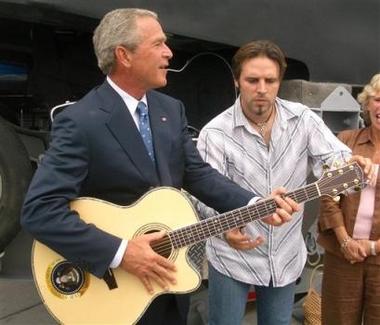
I don't know what good it does to pile on to George Bush at this point - the government botched the aftermath of Hurricane Katrina, a pretty well established fact. But Kevin Drum points out this story - a naval officer criticizing the president. Really? Yes - the navy was on the scene, directly behind the hurricane, ready to send in aid as soon as the hurricane moved on - but the military needs explicit orders from the president to act within the United States. Which they did not get. Some of Bush's supporters like to claim that in this modern day and age, he does not have to be in Washington to run the country - he can be dicking around at his ranch, of hamming it up with some country singer, and still be in charge.
Apparently not.
Friday, September 02, 2005
A Respite
Meanwhile, maybe the Friday icommute can bring some relief to the gloom on this blog:
1. Fairport convention - Sir Patrick Spens
2. Beastie Boys - Something's got to Give
3. O Brother Where Art Thou Soundtrack -Didn't Leave Nobody But the Baby
4. The Byrds - Hungry Planet
5. System of a Down - This Cocaine Makes me Feel Like I'm On this Song
6. Embrace - Money
7. Radiohead - Morning Bell (Kid A version)
8. Grateful Dead - Cosmic Charlie
9. Rage Against the Machine - Township Rebellion
10. Big Star - Dream Lover
1. Pere Ubu - Young Miles in te Basement
12. Mahavishnu Orchestra - A Lotus on Irish Streams
1. Fairport convention - Sir Patrick Spens
2. Beastie Boys - Something's got to Give
3. O Brother Where Art Thou Soundtrack -Didn't Leave Nobody But the Baby
4. The Byrds - Hungry Planet
5. System of a Down - This Cocaine Makes me Feel Like I'm On this Song
6. Embrace - Money
7. Radiohead - Morning Bell (Kid A version)
8. Grateful Dead - Cosmic Charlie
9. Rage Against the Machine - Township Rebellion
10. Big Star - Dream Lover
1. Pere Ubu - Young Miles in te Basement
12. Mahavishnu Orchestra - A Lotus on Irish Streams
September Second
First - another day of ghastly post-hurricane new from New Orleans. Maybe, finally, people are getting out - but the place is hell on earth. It's inconceivably horrible - horrible for obvious reasons, inconceivable because, how could this happen? Not the hurricane and floods themselves, that happens - even the destruction of the city - cities are sometimes destroyed. What's inconceivable is how, in the United States, 5 days after the storm hit, and 4 days after the levees broke and submerged the city, there are still tens of thousands of people in the city, living in utterly desperate circumstances, in a war zone. You can see the relief efforts ramping up - but how did it take this long? Nothing that has happened is a surprise - looting? people living without food or shelter or water? people dying? All of that was predictable - much of it could have been mitigated (more supplies laid in at the Superdome - immediate resources committed to keep the peace) - how did it not happen? I have seen this - a major hurricane hitting New Orleans - listed as one of the three worst case disasters we could face: terrorism in New York - a major earthquake in San Francisco - and this. Of the three - this is the one you have the most time to prepare for. We had 2 or 3 days to prepare for this one - we had a pretty clear idea of what would happen if it hit - and yet - everything about it, from the evacuation planning to the provisions for refugees to the relief efforts have been half-assed. It's horrible.
Meanwhile - unrelated (except so far as getting involved in an unjustified war has drained money and resources that could have been used to deal with domestic problems - especially so far as sending National Guardsmen overseas for extended duty has drawn them away from their primary purpose, which is to deal with events like hurricane Katrina), but horrible - it is the second anniversary of the death of my friend Todd in Iraq. A guardsman, an MP - exactly the kind of person needed at home in case of crisis. I hate to politicize disasters, personal or public - but it's hard. He had no business being there. None of our soldiers had any business being there, but it's adding insult to injury to do it on the cheap. If we were going to fight this war, we would have been far far better doing it honestly - paying as we went - not stripping domestic security, mortgaging the future, stripping money away from preventive measures like work on the levees, to fight it. What we are getting in New Orleans is worse than the taxes would be, worse than the draft, worse than whatever it would have taken to fight the Iraq war honestly. We will end up paying for it directly as well.
It's been a very bad week for America...
Meanwhile - unrelated (except so far as getting involved in an unjustified war has drained money and resources that could have been used to deal with domestic problems - especially so far as sending National Guardsmen overseas for extended duty has drawn them away from their primary purpose, which is to deal with events like hurricane Katrina), but horrible - it is the second anniversary of the death of my friend Todd in Iraq. A guardsman, an MP - exactly the kind of person needed at home in case of crisis. I hate to politicize disasters, personal or public - but it's hard. He had no business being there. None of our soldiers had any business being there, but it's adding insult to injury to do it on the cheap. If we were going to fight this war, we would have been far far better doing it honestly - paying as we went - not stripping domestic security, mortgaging the future, stripping money away from preventive measures like work on the levees, to fight it. What we are getting in New Orleans is worse than the taxes would be, worse than the draft, worse than whatever it would have taken to fight the Iraq war honestly. We will end up paying for it directly as well.
It's been a very bad week for America...
Thursday, September 01, 2005
Hurricane Post #2
While I still doubt that my opinion adds anything to the hurricane news, I can't stop thinking about it. It's hard to get a grasp on the scope of this disaster. It is harder still to get a grasp on how such a thing could have happened in the face of what we have known about its possibility. Kevin Drum links to several discussions of the potential for disaster - such as this one from last year, describing what could happen if Hurricane Ivan hit New Orleans. The last line:
Just watching TV this evening - it's different. The first day or two, seeing the looters and hearing the TV people talk about looting, there was a different tone - that usual smug judgmental toe about the looters, though even then - looking at the footage - everyone they showed seemed to be dragging bags of food and drinks around with them. But tonight - on one of the channels, some cop was being interviewed and the TV person asked him how the cops would distinguish between people taking food and people taking televisions. There's still way more attention to the TV thieves than they deserve - but the focus does seem to be on the real problem - the fact that tens of thousands of people were stuck in the city because they could not get out of the city. And that - what - 3 days later, no one has gotten them out of the city, no one is getting food and water and supplies in to them in the city.
How much of this could have been prevented? By what means? Commandeering buses or planes or boats and evacuating people before the storm hit? Having a contingency plan for this completely foreseeable possible disaster? What?
I'll stop. Blame is - well, sometimes it's useful - knowing why things were this bad might teach us lessons. Though it probably won't... The hardest thing remains just processing the scope of the disaster. Xoverboard has some interesting thoughts on that - on the ways this disaster dwarfs the 9/11 attacks, on the overall importance of this event. And some thoughts on blame - who and why - that I can’t argue with.
Anyway - once more - if you have it, give - The Red Cross is as good a place as any.
"My fear is, if this storm passes (without a major disaster), everybody forgets about it until next year, when it could be even worse because we'll have even less wetlands," van Heerden said.The disaster has been heavily politicized already - given the reports of the Bush administration cutting funding for disaster relief and preventive measures in Louisiana (see Kevin Drum, again); given the administration's rather - odd - reaction to the disaster (Bush playing guitar; Condi Rice buying shoes); the director of Homeland Security blaming the victims - and the rest of the administration lining up behind him: "...to help those who are stranded, who chose not to evacuate, who chose not to leave the city..." - it's going to be hard not to politicize it. This stands a very good chance of being the thing that destroy's Bush's presidency - ironic, since it is a natural disaster, something he had no control over - but it can wake people up. And - after all - he had enough control over the conditions that made this such a nightmare, and he has control over how the government reacts to it. Blaming the victims isn't going to fly.
Just watching TV this evening - it's different. The first day or two, seeing the looters and hearing the TV people talk about looting, there was a different tone - that usual smug judgmental toe about the looters, though even then - looking at the footage - everyone they showed seemed to be dragging bags of food and drinks around with them. But tonight - on one of the channels, some cop was being interviewed and the TV person asked him how the cops would distinguish between people taking food and people taking televisions. There's still way more attention to the TV thieves than they deserve - but the focus does seem to be on the real problem - the fact that tens of thousands of people were stuck in the city because they could not get out of the city. And that - what - 3 days later, no one has gotten them out of the city, no one is getting food and water and supplies in to them in the city.
How much of this could have been prevented? By what means? Commandeering buses or planes or boats and evacuating people before the storm hit? Having a contingency plan for this completely foreseeable possible disaster? What?
I'll stop. Blame is - well, sometimes it's useful - knowing why things were this bad might teach us lessons. Though it probably won't... The hardest thing remains just processing the scope of the disaster. Xoverboard has some interesting thoughts on that - on the ways this disaster dwarfs the 9/11 attacks, on the overall importance of this event. And some thoughts on blame - who and why - that I can’t argue with.
Anyway - once more - if you have it, give - The Red Cross is as good a place as any.
Hurricane Aftermath
As usual, I don't have much to say about the devastation of the gulf coast by hurricane Katrina. There's not much my opinion can do. If you can, give - charities abound - the big portals (Yahoo, Amazon, etc.) usually have a prominant link or page for donations (usually to the Red Cross) - most newspapers have links. The best collection of links, information and discussion (among the blogs I usually read) is probably at Making Light - they offer a collection of links themselves, at this post; and a link to a nice article about emergency preparedness - "jump bags".
Monday, August 29, 2005
A Musical Meme
This is kind of fun. From Rox Populi it's a meme - take the top 100 songs from the year (you can find them at Music Outfitters) you graduated high school, and tell the crowd: good? bad? love it? hate it?
Like Roxanne, I'm an 81 graduate, so I'm saddled with the same bunch of crap she is. I'm going to mark it up with text though, rather than try to format... I will employ stars for quick reference * isgood, ** is great. *** is the best of the litter.
1. Bette Davis Eyes, Kim Carnes - blah
2. Endless Love, Diana Ross and Lionel Richie - I have forgotten this, though te knowledge that it exists makes me tremble.
3. Lady, Kenny Rogers - oh god
*4. (Just Like) Starting Over, John Lennon - kind of lame John Lennon, but passable
5. Jessie's Girl, Rick Springfield - bland but harmless
*6. Celebration, Kool and The Gang - This isn't half bad - it can get irritating, but it's still pretty decent.
7. Kiss On My List, Daryl Hall and John Oates - ghastly
*8. I Love A Rainy Night, Eddie Rabbitt - perfectly acceptable pop
*9. 9 To 5, Dolly Parton - I like Dolly Parton
*10. Keep On Loving You, REO Speedwagon - I should hate this, but don't; I don't like it very much though.
11. Theme From "Greatest American Hero", Joey Scarbury - this keeps getting used in movies, but it sucks.
12. Morning Train (Nine To Five), Sheena Easton - blah
**13. Being With You, Smokey Robinson - Smokey can do no wrong
14. Queen Of Hearts, Juice Newton - lightly likable
**15. Rapture, Blondie - plenty cool...
16. A Woman Needs Love, Ray Parker Jr. and Raydio - this I have forgotten ocmpletely
*17. The Tide Is High, Blondie - this is okay, not great
18. Just The Two Of Us, Grover Washington Jr. - I kind of like this - Bill Withers singing, right?
19. Slow Hand, Pointer Sisters - okay
20. I Love You, Climax Blues Band - I have forgotten this
*21. Woman, John Lennon - more sappy John Lennon, but sappy John Lennon is so far above almost everything else on this list...
22. Sukiyaki, A Taste Of Honey - cute song, though pointless
23. The Winner Takes It All, Abba - I don't remember this one either
24. Medley, Stars On 45 - I should remember this, but I think I'm glad I don't
25. Angel Of The Morning, Juice Newton - 2 Juice Newton songs? sweet Jesus!
26. Love On The Rocks, Neil Diamond - I think I a glad to have forgotten tis
27. Every Woman In The World, Air Supply - before Creed, there was Air Supply - evil incarnate
28. The One That You Love, Air Supply - ditto
29. Guilty, Barbra Streisand and Barry Gibb - gone from the attic of my mind.
30. The Best Of Times, Styx - gone! old age has its benefits.
31. Elvira, Oak Ridge Boys - ugh.
32. Take It On The Run, REO Speedwagon - not great, but I can't hate it
33. No Gettin' Over Me, Ronnie Milsap - oy
34. Living Outside Myself, Gino Vannelli - I know this exists, but can't remember any of it, to my relief
35. Woman In Love, Barbra Streisand - if I remembered this I might have to kill myself
36. Boy From New York City, Manhattan Transfer - cute, pointless
37. Urgent, Foreigner - what a shitty band this was
38. Passion, Rod Stewart - dumb new wave/disco crap. Rod Rod Rod
39. Lady (You Bring Me Up), Commodores - I can't remember it; I probably would not hate it though.
40. Crying, Don Mclean - why bother? the original is fine.
41. Hearts, Marty Balin - bland, but it's not "we built this city"
42. It's My Turn, Diana Ross - no
43. You Make My Dreams, Daryl Hall and John Oates - they could be lame when they wanted to
44. I Don't Need You, Kenny Rogers - and we don't need you, Kenny
45. How 'Bout Us, Champaign - I think I like this, if I remember it right. Probably shouldn't admit that, if I want to keep any credibility - though I could be misremembering it.
46. Hit Me With Your Best Shot, Pat Benatar - make it go away
**47. The Breakup Song, Greg Kihn Band - I love this song; there may be better songs on this list, but this is the one I still listen to and sing along with...
48. Time, Alan Parsons Project - not bad
*49. Hungry Heart, Bruce Springsteen - another fine song, if not the Boss's best
50. Sweetheart, Franke and The Knockouts - long forgotten
51. Someone's Knockin', Terri Gibbs - ditto
52. More Than I Can Say, Leo Sayer - ditto
53. Together, Tierra - good lord - someone's messing with me, I don’t remember this either.
54. Too Much Time On My Hands, Styx - oh, I remember this; Styx really sucked by the time the 80s came - I can't even muster any ironic appreciation of their crap
55. What Are We Doin' In Love, Dottie West - forgotten!
56. Who's Crying Now, Journey - lame, but not horrible
*57. De Do Do Do, De Da Da, Police - palatable
58. This Little Girl, Gary U.S. Bonds - I don't remember it, but I bet I liked it - I had a frien who had this record and loved it.
59. Stop Draggin' My Heart Around, Stevie Nicks With Tom Petty and The Heartbreakers - palatable, though not much more - now Weird Al'sversion...
60. Giving It Up For Your Love, Delbert McClinton - okay
61. A Little In Love, Cliff Richard - what?
62. America, Neil Diamond - I can stand this
63. Ain't Even Done With The Night, John Cougar - lousy as hell
64. Arthur's Theme, Christopher Cross - drive anyone to drink
*65. Another One Bites The Dust, Queen - hey - Queen is more than acceptable
**66. Games People Play, Alan Parsons Project - this is pretty good, actually - I have a soft spot for some of that clever AOR...
67. I Can't Stand It, Eric Clapton - Eric Clapton's solo career is Phil Collins without the songs. He was fine backing Jack Bruce or Steve Winwood, but after that...
**68. While You See A Chance, Steve Winwood - speak of the devil! not a bad song.
69. Master Blaster, Stevie Wonder - I wish I remembered this; I would if I heard it
70. Hello Again, Neil Diamond - yuck.
**71. Don't Stand So Close To Me, Police - better Police...
***72. Hey Nineteen, Steely Dan - another pretty great song; ah, decadence!
73. I Ain't Gonna Stand For It, Stevie Wonder - I wish I remembered this, too
74. All Those Years Ago, George Harrison - bland
75. Step By Step, Eddie Rabbitt - no no no
76. The Stroke, Billy Squier - stoopid, but harmless
77. Feels So Right, Alabama - nope
78. Sweet Baby, Stanley Clarke and George Duke - don't remember it at all
79. Same Old Lang Syne, Dan Fogelberg - nor this
80. Cool Love, Pablo Cruise - nor this, even
81. Hold On Tight, ELO - nor this
82. It's Now Or Never, John Schneider - wait - is this the Duke's of Hazard guy?
83. Treat Me Right, Pat Benatar - go away!
*84. Winning, Santana - Now this I loved back in the day - still holds up okay, I think
85. What Kind Of Fool, Barbra Streisand and Barry Gibb - another one gone from my poor small mind
**86. Watching The Wheels, John Lennon - the best of the John Lennon’s here - in fact, a pretty god song.
87. Tell It Like It Is, Heart - a great song, but the Wilson sisters aren't the Neville Brothers
88. Smoky Mountain Rain, Ronnie Milsap - don’t remember it
89. I Made It Through The Rain, Barry Manilow - would not admit to remembering it if I did
90. You've Lost That Lovin' Feelin', Daryl Hall and John Oates - pointless cover
91. Suddenly, Olivia Newton-John and Cliff Richard - whatever
92. For Your Eyes Only, Sheena Easton - lousy, really
93. The Beach Boys Medley, Beach Boys - probably schlock
**94. Whip It, Devo - where did this come from? When a problem comes along, you must whip it!
95. Modern Girl, Sheena Easton - no
96. Really Wanna Know You, Gary Wright - don't remember this either
97. Seven Year Ache, Rosanne Cash - oddly - nor this - a lot of the country of the day is lost forever
98. I'm Coming Out, Diana Ross - this is kind of stupid, actually
99. Miss Sun, Boz Scaggs - don’t remember it
100. Time Is Time, Andy Gibb - what?
Someone in the comments at Rox Populi said that if you do this for the year you were 13, it comes out a lot better. That's obviously the case for those of us who grew up in the 70s. 81 or 82 is about when pop music went to hell, and it's not my age - it's punk's fault. It split off all the good stuff into the margins, and the crap took over the mainstream. That's my theory. Same as movies.
Like Roxanne, I'm an 81 graduate, so I'm saddled with the same bunch of crap she is. I'm going to mark it up with text though, rather than try to format... I will employ stars for quick reference * isgood, ** is great. *** is the best of the litter.
1. Bette Davis Eyes, Kim Carnes - blah
2. Endless Love, Diana Ross and Lionel Richie - I have forgotten this, though te knowledge that it exists makes me tremble.
3. Lady, Kenny Rogers - oh god
*4. (Just Like) Starting Over, John Lennon - kind of lame John Lennon, but passable
5. Jessie's Girl, Rick Springfield - bland but harmless
*6. Celebration, Kool and The Gang - This isn't half bad - it can get irritating, but it's still pretty decent.
7. Kiss On My List, Daryl Hall and John Oates - ghastly
*8. I Love A Rainy Night, Eddie Rabbitt - perfectly acceptable pop
*9. 9 To 5, Dolly Parton - I like Dolly Parton
*10. Keep On Loving You, REO Speedwagon - I should hate this, but don't; I don't like it very much though.
11. Theme From "Greatest American Hero", Joey Scarbury - this keeps getting used in movies, but it sucks.
12. Morning Train (Nine To Five), Sheena Easton - blah
**13. Being With You, Smokey Robinson - Smokey can do no wrong
14. Queen Of Hearts, Juice Newton - lightly likable
**15. Rapture, Blondie - plenty cool...
16. A Woman Needs Love, Ray Parker Jr. and Raydio - this I have forgotten ocmpletely
*17. The Tide Is High, Blondie - this is okay, not great
18. Just The Two Of Us, Grover Washington Jr. - I kind of like this - Bill Withers singing, right?
19. Slow Hand, Pointer Sisters - okay
20. I Love You, Climax Blues Band - I have forgotten this
*21. Woman, John Lennon - more sappy John Lennon, but sappy John Lennon is so far above almost everything else on this list...
22. Sukiyaki, A Taste Of Honey - cute song, though pointless
23. The Winner Takes It All, Abba - I don't remember this one either
24. Medley, Stars On 45 - I should remember this, but I think I'm glad I don't
25. Angel Of The Morning, Juice Newton - 2 Juice Newton songs? sweet Jesus!
26. Love On The Rocks, Neil Diamond - I think I a glad to have forgotten tis
27. Every Woman In The World, Air Supply - before Creed, there was Air Supply - evil incarnate
28. The One That You Love, Air Supply - ditto
29. Guilty, Barbra Streisand and Barry Gibb - gone from the attic of my mind.
30. The Best Of Times, Styx - gone! old age has its benefits.
31. Elvira, Oak Ridge Boys - ugh.
32. Take It On The Run, REO Speedwagon - not great, but I can't hate it
33. No Gettin' Over Me, Ronnie Milsap - oy
34. Living Outside Myself, Gino Vannelli - I know this exists, but can't remember any of it, to my relief
35. Woman In Love, Barbra Streisand - if I remembered this I might have to kill myself
36. Boy From New York City, Manhattan Transfer - cute, pointless
37. Urgent, Foreigner - what a shitty band this was
38. Passion, Rod Stewart - dumb new wave/disco crap. Rod Rod Rod
39. Lady (You Bring Me Up), Commodores - I can't remember it; I probably would not hate it though.
40. Crying, Don Mclean - why bother? the original is fine.
41. Hearts, Marty Balin - bland, but it's not "we built this city"
42. It's My Turn, Diana Ross - no
43. You Make My Dreams, Daryl Hall and John Oates - they could be lame when they wanted to
44. I Don't Need You, Kenny Rogers - and we don't need you, Kenny
45. How 'Bout Us, Champaign - I think I like this, if I remember it right. Probably shouldn't admit that, if I want to keep any credibility - though I could be misremembering it.
46. Hit Me With Your Best Shot, Pat Benatar - make it go away
**47. The Breakup Song, Greg Kihn Band - I love this song; there may be better songs on this list, but this is the one I still listen to and sing along with...
48. Time, Alan Parsons Project - not bad
*49. Hungry Heart, Bruce Springsteen - another fine song, if not the Boss's best
50. Sweetheart, Franke and The Knockouts - long forgotten
51. Someone's Knockin', Terri Gibbs - ditto
52. More Than I Can Say, Leo Sayer - ditto
53. Together, Tierra - good lord - someone's messing with me, I don’t remember this either.
54. Too Much Time On My Hands, Styx - oh, I remember this; Styx really sucked by the time the 80s came - I can't even muster any ironic appreciation of their crap
55. What Are We Doin' In Love, Dottie West - forgotten!
56. Who's Crying Now, Journey - lame, but not horrible
*57. De Do Do Do, De Da Da, Police - palatable
58. This Little Girl, Gary U.S. Bonds - I don't remember it, but I bet I liked it - I had a frien who had this record and loved it.
59. Stop Draggin' My Heart Around, Stevie Nicks With Tom Petty and The Heartbreakers - palatable, though not much more - now Weird Al'sversion...
60. Giving It Up For Your Love, Delbert McClinton - okay
61. A Little In Love, Cliff Richard - what?
62. America, Neil Diamond - I can stand this
63. Ain't Even Done With The Night, John Cougar - lousy as hell
64. Arthur's Theme, Christopher Cross - drive anyone to drink
*65. Another One Bites The Dust, Queen - hey - Queen is more than acceptable
**66. Games People Play, Alan Parsons Project - this is pretty good, actually - I have a soft spot for some of that clever AOR...
67. I Can't Stand It, Eric Clapton - Eric Clapton's solo career is Phil Collins without the songs. He was fine backing Jack Bruce or Steve Winwood, but after that...
**68. While You See A Chance, Steve Winwood - speak of the devil! not a bad song.
69. Master Blaster, Stevie Wonder - I wish I remembered this; I would if I heard it
70. Hello Again, Neil Diamond - yuck.
**71. Don't Stand So Close To Me, Police - better Police...
***72. Hey Nineteen, Steely Dan - another pretty great song; ah, decadence!
73. I Ain't Gonna Stand For It, Stevie Wonder - I wish I remembered this, too
74. All Those Years Ago, George Harrison - bland
75. Step By Step, Eddie Rabbitt - no no no
76. The Stroke, Billy Squier - stoopid, but harmless
77. Feels So Right, Alabama - nope
78. Sweet Baby, Stanley Clarke and George Duke - don't remember it at all
79. Same Old Lang Syne, Dan Fogelberg - nor this
80. Cool Love, Pablo Cruise - nor this, even
81. Hold On Tight, ELO - nor this
82. It's Now Or Never, John Schneider - wait - is this the Duke's of Hazard guy?
83. Treat Me Right, Pat Benatar - go away!
*84. Winning, Santana - Now this I loved back in the day - still holds up okay, I think
85. What Kind Of Fool, Barbra Streisand and Barry Gibb - another one gone from my poor small mind
**86. Watching The Wheels, John Lennon - the best of the John Lennon’s here - in fact, a pretty god song.
87. Tell It Like It Is, Heart - a great song, but the Wilson sisters aren't the Neville Brothers
88. Smoky Mountain Rain, Ronnie Milsap - don’t remember it
89. I Made It Through The Rain, Barry Manilow - would not admit to remembering it if I did
90. You've Lost That Lovin' Feelin', Daryl Hall and John Oates - pointless cover
91. Suddenly, Olivia Newton-John and Cliff Richard - whatever
92. For Your Eyes Only, Sheena Easton - lousy, really
93. The Beach Boys Medley, Beach Boys - probably schlock
**94. Whip It, Devo - where did this come from? When a problem comes along, you must whip it!
95. Modern Girl, Sheena Easton - no
96. Really Wanna Know You, Gary Wright - don't remember this either
97. Seven Year Ache, Rosanne Cash - oddly - nor this - a lot of the country of the day is lost forever
98. I'm Coming Out, Diana Ross - this is kind of stupid, actually
99. Miss Sun, Boz Scaggs - don’t remember it
100. Time Is Time, Andy Gibb - what?
Someone in the comments at Rox Populi said that if you do this for the year you were 13, it comes out a lot better. That's obviously the case for those of us who grew up in the 70s. 81 or 82 is about when pop music went to hell, and it's not my age - it's punk's fault. It split off all the good stuff into the margins, and the crap took over the mainstream. That's my theory. Same as movies.
Sunday, August 28, 2005
Weekly Movie Update
Okay - here we are. Another week, another - only 3 films? Well - good ones, at least. Still working on a full 2046 review - it's coming. In the meanwhile - this isn't a bad selection.
Batman Begins - ** - better late than never, I guess... a competent, entertaining, well made film, another Batman origin story. Nothing special though, the Tim Burton Batmans and the TV series movie are still the gold standards.
The World - **** - Jia Zhang Ke is one of the best directors in the world. He has been charting China's evolution into the 21st century (and - in Platform - through the 80s as well), from below - petty crooks, disaffected youth, marginal workers - paying special attention to marginal entertainers. That’s what we have here - The World is set in an amusement park in Beijing, where we follow a handful of its workers - a dancer, a security guard, their friends - as they live. People come and go, work, party, steal, suffer, die. Spending their time in a place full of tiny replicas of the rest of the world - the Eiffel Tower, the World Trade Center (China's version are still standing, someone notes), the Taj Mahal - they are reminded daily who they are, what they have done. They have not traveled, most of them have no hope whatsoever of leaving the country - many of them haven't traveled around China - probably taking a train or bus straight from their home town in the sticks to Beijing, sleeping in basements and dangerous apartments while they work at dangerous jobs. Some turn to theft - some marry - some slip into prostitution - some leave the country (the ones with some money) - some die. Jia shows it all with his mostly impassive camera - long takes, complex articulated spaces, and the ubiquity of the park, with its miniature version of the world - interrupting this impassivity from tie to time with titles, and animations, usually inspired by cel phone text messages. It's another impressive entry in on of the strongest bodies of work of the past decade.
The 40 Year Old Virgin - *** - this is, actually, a bit of a mixed bag. On the one hand, it is extremely funny, very likable and generous to its characters, and full of nice little details that give it bite and depth; on the other hand, it stretches plausibility even by the standards of romantic comedies - and most seriously - it's the latest in the line of romantic comedies that are completely one sided - the man's side. It almost gets away with this by making Catherine Keener the female lead - but her presence just emphasizes the fact that she has very little to do. She's an object - she's never a subject. Now - in a movie like Broken Flowers or 2046, that might be understandable, if they did that. If they were about the man - and the women were seen only through his perspective. Those are films about the perceptions of the man. They are films, in a lot of ways, about our distance from other people - a distance the films rightfully illustrate in their style and POV. (Or - they could; in fact, 2046, especially, does a good deal more. But that's its own post, which is coming sooner or later.) But The 40 Year Old Virgin is a romantic comedy - and no, I'm not giving it a pass because it's "not trying to be a romantic comedy" - no: it is a romantic comedy. And it is a romantic comedy where only one side of the couple is given anything special to do.
There are no excuses. Films like this have an obligation to make the women in them have something at stake, as well as the men. That is the point of a romantic comedy - to present the lovers, apart at first, but overcoming obstacles to form a couple. And it is crucial, for a romantic comedy to work, that both lovers be made subjects - that both sides be given an inner life, reasons for the liaison, etc. Keener's character here, wonderful as Keener is, and interesting as her character seems to be, is not, ever, a subject. She is an object... I must also protest that she is never given the chance to be ridiculous. Everyone else is ridiculous: Jane Lynch gets to be ridiculous. Why not Keener? Damned shame....
This film is the latest in a moderately scary trend - The Wedding Crashers, Sideways - romantic comedies told almost completely from the male point of view, with flawed, if amusing, men, and women who - are presented as a kind of abstract grounding agent. It's probably not a new trend: it's probably dominant since the 40s. But these films make it noticeable, through their first rate revival of the form. But a revival that maintains, from 80s teen comedies and the like, the purely male-centered attitude. Of the three (Virgin, Crashers and Sideways), it is interesting that the one doing the best job of escaping this is Wedding Crashers - the one generally considered the least evolved. But the fact is - both the female leads in the film are given personalities - desires, wills of their own. They may be secondary, but they are independent. (Another recent comedy that does this well is Anchorman - Christina Applegate is both the sensible, grounding character - and a willful, obsessive, comic character herself - with a life, desires, will, etc.) Sideways flirts with this, but isn't as convincing as it thinks - and Virgin makes no effort. To its shame, and thus costing what otherwise might have been the best Hollywood film of the year.
Batman Begins - ** - better late than never, I guess... a competent, entertaining, well made film, another Batman origin story. Nothing special though, the Tim Burton Batmans and the TV series movie are still the gold standards.
The World - **** - Jia Zhang Ke is one of the best directors in the world. He has been charting China's evolution into the 21st century (and - in Platform - through the 80s as well), from below - petty crooks, disaffected youth, marginal workers - paying special attention to marginal entertainers. That’s what we have here - The World is set in an amusement park in Beijing, where we follow a handful of its workers - a dancer, a security guard, their friends - as they live. People come and go, work, party, steal, suffer, die. Spending their time in a place full of tiny replicas of the rest of the world - the Eiffel Tower, the World Trade Center (China's version are still standing, someone notes), the Taj Mahal - they are reminded daily who they are, what they have done. They have not traveled, most of them have no hope whatsoever of leaving the country - many of them haven't traveled around China - probably taking a train or bus straight from their home town in the sticks to Beijing, sleeping in basements and dangerous apartments while they work at dangerous jobs. Some turn to theft - some marry - some slip into prostitution - some leave the country (the ones with some money) - some die. Jia shows it all with his mostly impassive camera - long takes, complex articulated spaces, and the ubiquity of the park, with its miniature version of the world - interrupting this impassivity from tie to time with titles, and animations, usually inspired by cel phone text messages. It's another impressive entry in on of the strongest bodies of work of the past decade.
The 40 Year Old Virgin - *** - this is, actually, a bit of a mixed bag. On the one hand, it is extremely funny, very likable and generous to its characters, and full of nice little details that give it bite and depth; on the other hand, it stretches plausibility even by the standards of romantic comedies - and most seriously - it's the latest in the line of romantic comedies that are completely one sided - the man's side. It almost gets away with this by making Catherine Keener the female lead - but her presence just emphasizes the fact that she has very little to do. She's an object - she's never a subject. Now - in a movie like Broken Flowers or 2046, that might be understandable, if they did that. If they were about the man - and the women were seen only through his perspective. Those are films about the perceptions of the man. They are films, in a lot of ways, about our distance from other people - a distance the films rightfully illustrate in their style and POV. (Or - they could; in fact, 2046, especially, does a good deal more. But that's its own post, which is coming sooner or later.) But The 40 Year Old Virgin is a romantic comedy - and no, I'm not giving it a pass because it's "not trying to be a romantic comedy" - no: it is a romantic comedy. And it is a romantic comedy where only one side of the couple is given anything special to do.
There are no excuses. Films like this have an obligation to make the women in them have something at stake, as well as the men. That is the point of a romantic comedy - to present the lovers, apart at first, but overcoming obstacles to form a couple. And it is crucial, for a romantic comedy to work, that both lovers be made subjects - that both sides be given an inner life, reasons for the liaison, etc. Keener's character here, wonderful as Keener is, and interesting as her character seems to be, is not, ever, a subject. She is an object... I must also protest that she is never given the chance to be ridiculous. Everyone else is ridiculous: Jane Lynch gets to be ridiculous. Why not Keener? Damned shame....
This film is the latest in a moderately scary trend - The Wedding Crashers, Sideways - romantic comedies told almost completely from the male point of view, with flawed, if amusing, men, and women who - are presented as a kind of abstract grounding agent. It's probably not a new trend: it's probably dominant since the 40s. But these films make it noticeable, through their first rate revival of the form. But a revival that maintains, from 80s teen comedies and the like, the purely male-centered attitude. Of the three (Virgin, Crashers and Sideways), it is interesting that the one doing the best job of escaping this is Wedding Crashers - the one generally considered the least evolved. But the fact is - both the female leads in the film are given personalities - desires, wills of their own. They may be secondary, but they are independent. (Another recent comedy that does this well is Anchorman - Christina Applegate is both the sensible, grounding character - and a willful, obsessive, comic character herself - with a life, desires, will, etc.) Sideways flirts with this, but isn't as convincing as it thinks - and Virgin makes no effort. To its shame, and thus costing what otherwise might have been the best Hollywood film of the year.
Wars and Who Fights Them
I am not a big fan of the "chickenhawk" insult. It's over-simplistic - it implies that all wars are created equal; that everyone who fights or doesn't fight does it for the same reasons; it opens you up, a bit, to claims that you are saying that only soldiers should make foreign policy decisions (expressed in this Rich Lowry article on National Review Online). If the "chickenhawks" themselves weren't already committed to the far more offensive idea that opposition to the war = treason, they could turn it back around: "if you want to oppose the war, shouldn't you be out there making love not war?" Both are good sentiments, I admit - if you support the war you should do something meaningful about it - if you are against the war, you should do something meaningful about it - but what is meaningful depends a bit on who you are.
But even though I am uncomfortable with it in general, there are quite a few cases where it seems perfectly legitimate. James Wolcott expresses this position very well here:
But even though I am uncomfortable with it in general, there are quite a few cases where it seems perfectly legitimate. James Wolcott expresses this position very well here:
For me, the working definition of a chickenhawk is--a chickenhawk is a cheerleader. A cheerleader for war. And not necessarily just the war in Iraq, or regional war in the Mideast, but war in general. A chickenhawk glorifies war as an enterprise, enjoying the heroics inside his or her head, mocking those less enthusiastic military aggression as pacifists, appeasers (Michael Ledeen's pet word), even traitors. Who patronize anyone with qualms, from the Quakers to the Chuck Hagel, with edgy impatience and disdain. Who treat the destruction of human life as a stupendous flourish as long as it's the US doing the destroying--who, that is, propose "creative destruction" on a geopolitical scale as an instrument of transformation. Not to mention an opportunity to teach those desert folks in sandals a lesson upside the head.
That is close to how I feel. People who mock opponents to the war - people who dismiss the ideas of actual soldiers - people who attack Cindy Sheehan and her supporters - who glorify a war they have no intention of taking part in (despite being of the proper age) - those are chickenhawks. The college kids who rave about how this war is the Great Issue of the Age, then whine that they have every right to hold political opinions without consequences (to themselves) - those are chickenhawks. And - the Vietnam generation - the Dick Cheneys and Tom DeLays and so on, who skipped the war, but feel free to attack veterans, to agitate for new wars that their kids won't have to fight in - they are chickenhawks, and deserve no sympathy.
There is another point here that should be made: in real wars, people serve. People signed up to fight in WWI, in WWII, even if they weren't required. The country, as a whole, supported the draft in those wars - and a draft that was not as patently unfair as it was during Vietnam. You do not hear the supporters of the Iraq war calling for a draft (unless they can find a way to blame it on a democrat). You do not see many of them volunteering, because they think it is the right thing to do - and, despite what Ben Shapiro thinks - it's the right thing to do, if you believe this war is necessary, and you are of a certain age. In fact - another sign of the chickenhawk is their attitude toward people like John Kerry who did just that - signed up for a war they could have ducked. They don't consider military service worthy of praise or respect. They may glorify the military in the abstract, but the left treats actual veterans and the families of veterans with more respect than the right does.
Meanwhile - at Pandagon, Amanda Marcotte writes about John Fogerty and class issues - which again, points up the difference between this war and others. The fortunate sons fought in WWI and WWII - they did not fight so much in Vietnam - and now, they seem to take it for granted that they are not supposed to fight. That's what we have poor people for. The exceptions (poor Pat Tillman) prove the rule, a bit. You just don't hear much about pro-war types joining the army to put their money where their mouths are. Does every single warblogger have to join the marines? No, probably not - but you'd think you'd hear of a few more trying it...
Friday, August 26, 2005
Another Friday Commute
Got a bunch of them in today. I think I like this format better than the traditional Friday Random Ten. Maybe because it reflects the actual daily use of the machine. Anyway - into the void! (what did I do to get 2 Sabbath songs in there? acoustic folk, from the same record even! freaky!)
1. U2 - Trying to throw Your Arms Around the World -
2. Bob Dylan - Love Minus Zero/No Limit
3. Devendra Banhardt - Horseheadedfleshwizard
4. Black Sabbath - Orchid
5. REM - Second Guessing
6. Velvet Underground and Nico - Venus in Furs
7. Charlie Parker - Flat Foot Floogie
8. Shonen Knife - Banana Leaf
9. Bill Frisell - Billy the Kid: Mexican Dance and Finale
10. Black Sabbath - Into the Void
11. Red Crayola - Coconut Hotel
12. Sant 6 - Are you Human?
13. Meat Puppets - Crazy
14. Sleater-Kinney - End of You
15. Sunburned Hand of the Man - Easy Wind
16. The Carter Family - My Native Home
17. Can - Spray
1. U2 - Trying to throw Your Arms Around the World -
2. Bob Dylan - Love Minus Zero/No Limit
3. Devendra Banhardt - Horseheadedfleshwizard
4. Black Sabbath - Orchid
5. REM - Second Guessing
6. Velvet Underground and Nico - Venus in Furs
7. Charlie Parker - Flat Foot Floogie
8. Shonen Knife - Banana Leaf
9. Bill Frisell - Billy the Kid: Mexican Dance and Finale
10. Black Sabbath - Into the Void
11. Red Crayola - Coconut Hotel
12. Sant 6 - Are you Human?
13. Meat Puppets - Crazy
14. Sleater-Kinney - End of You
15. Sunburned Hand of the Man - Easy Wind
16. The Carter Family - My Native Home
17. Can - Spray
Wednesday, August 24, 2005
Glad to be a Liberal
It's been a while since I've put up a political post, so let's try one. Lots of lovely right wing scumbags to comment on.
First, there's one of our scummier mullahs, Pat Robertso, calling for the assassination of Hugo Chavez.
... then denying he did it.
... then weaseling about it. "Oh, I was 'adlibbing' - oh, I didn't mean it!"
Meanwhile, the American Legion disgraced itself: calling "an end to all “public protests” and “media events” against the war" -
Then there's Eugene Volokh, who's supposed to be a lawyer and a wise man (for a conservative) - writing at length about Gays and Lesbians Trying to Convert Others to Homosexual Behavior. The gist of which seems to be, gay people don't mind if bisexuals or straights are willing to sleep with them. But with charts, so it's gotta be serious. Right?
Actually, it's worse than that: apparently, he's put up a whole series of posts about homosexuality. I think Arthur Silber answered best.
First, there's one of our scummier mullahs, Pat Robertso, calling for the assassination of Hugo Chavez.
... then denying he did it.
... then weaseling about it. "Oh, I was 'adlibbing' - oh, I didn't mean it!"
Meanwhile, the American Legion disgraced itself: calling "an end to all “public protests” and “media events” against the war" -
"The American Legion will stand against anyone and any group that would demoralize our troops, or worse, endanger their lives by encouraging terrorists to continue their cowardly attacks against freedom-loving peoples," Thomas Cadmus, national commander, told delegates at the group's national convention in Honolulu.Not a pretty picture.
The delegates voted to use whatever means necessary to "ensure the united backing of the American people to support our troops and the global war on terrorism."
Then there's Eugene Volokh, who's supposed to be a lawyer and a wise man (for a conservative) - writing at length about Gays and Lesbians Trying to Convert Others to Homosexual Behavior. The gist of which seems to be, gay people don't mind if bisexuals or straights are willing to sleep with them. But with charts, so it's gotta be serious. Right?
Actually, it's worse than that: apparently, he's put up a whole series of posts about homosexuality. I think Arthur Silber answered best.
Tuesday, August 23, 2005
A Loss
This is very sad - George Fasel, who ran a movie blog called A Girl and a Gun, has died. Despite being a hopeless movie geek, I've only really started looking for movie blogs in the last 2-3 months - this was one Lance Mannion recommended - it quickly jumped to the top of my list of blogs to read. For some reason, when people I don't know, but have started to know, die, I take it hard - I miss not getting to know people like Mr. Fasel better.
In his honor, I will list some of the better movie blogs I've come across - they are going on the "blogroll" too. (This blog is slowly starting to round into something coherent, too - after 2 years of playing...)
These are all good:
Filmbrain
Girl and a Gun
Culturespace
Girish Shambu
Long Pauses
Cinephiliac
Film Journey
Pullquote
Motion Picture it's Called
Self styled Siren
In his honor, I will list some of the better movie blogs I've come across - they are going on the "blogroll" too. (This blog is slowly starting to round into something coherent, too - after 2 years of playing...)
These are all good:
Monday, August 22, 2005
Randomized Entertainment
Sure, not all of these are strictly random - but... Like most people, I can lose hours on sites like these:
Overheard in New York
Overheard in Philly
Overheard in the Office
...And so on. I imagine everyone has one of those...
Live Journal Pictures - that really is wonderful. The cut up world.
And intentional collaborative/collective efforts: like Learning to Love You More.
Not to mention flipping through blogs...
Overheard in New York
Overheard in Philly
Overheard in the Office
...And so on. I imagine everyone has one of those...
Live Journal Pictures - that really is wonderful. The cut up world.
And intentional collaborative/collective efforts: like Learning to Love You More.
Not to mention flipping through blogs...
Sunday, August 21, 2005
Weekly Movie Post
This time, there are only three entries, and 2 of them repeats - I ended up watching Love Me Tonight a couple more times, and saw 2046 again. That only leaves one new film, which may be the only film covered in this post. The other two I think will require some more detail, especially 2046 (since it is new, and, now that I've seen it in a proper setting, I think it might be one of the best films of the decade.)
Junebug *** - a fine movie about the South, about a Chicago based English gallery owner who marries a man from North Carolina, and visits his family in the process of recruiting an "outsider artist"... It then turns into a kind of city folk in the sticks culture clash film, but without the usual cliches. It's a good film - fascinating, accurate, sympathetic, to everyone - it is interesting about art, especially outsider art (which it links, subtly, to broader habits, of making things, of taking pride in making things - woodworking, cooking, sewing, etc.) - on outsider art, it gets both the ugliness and passion of people like the artist here, with his psychotic civil war. Structurally, it does some notable things as well - the way Alessandro Nivola almost completely disappears when he goes home, turning into his father and brother, silent, mysterious, only emerging in a couple scenes - singing in church, the aftermath of the main plot event in the film... It's right - the way he changes when he's home - keeping his counsel, not wanting to reject them, but not part of them anymore either...
Stylistically, it's a well made indie type film with more than the usual ration of explicit Ozu references. I do mean explicit - credits on burlap, use of transition shots (within scenes even), the little tour Morrison gives of the house - as well as the broader influence of the story, the family dynamics, etc. It's not slavish imitation, and avoids the more obvious (and jolting) elements of Ozu's style - the frontal compositions, 180 degree cuts, the graphic matches and so on (which directors like Wes Anderson have adopted wholesale) - and some of the semantic elements (kids, marriages - though this is about marriage and leaving home, just seen from after the fact instead of before). But it's a clear homage, which Morrison has acknowledged.
Junebug *** - a fine movie about the South, about a Chicago based English gallery owner who marries a man from North Carolina, and visits his family in the process of recruiting an "outsider artist"... It then turns into a kind of city folk in the sticks culture clash film, but without the usual cliches. It's a good film - fascinating, accurate, sympathetic, to everyone - it is interesting about art, especially outsider art (which it links, subtly, to broader habits, of making things, of taking pride in making things - woodworking, cooking, sewing, etc.) - on outsider art, it gets both the ugliness and passion of people like the artist here, with his psychotic civil war. Structurally, it does some notable things as well - the way Alessandro Nivola almost completely disappears when he goes home, turning into his father and brother, silent, mysterious, only emerging in a couple scenes - singing in church, the aftermath of the main plot event in the film... It's right - the way he changes when he's home - keeping his counsel, not wanting to reject them, but not part of them anymore either...
Stylistically, it's a well made indie type film with more than the usual ration of explicit Ozu references. I do mean explicit - credits on burlap, use of transition shots (within scenes even), the little tour Morrison gives of the house - as well as the broader influence of the story, the family dynamics, etc. It's not slavish imitation, and avoids the more obvious (and jolting) elements of Ozu's style - the frontal compositions, 180 degree cuts, the graphic matches and so on (which directors like Wes Anderson have adopted wholesale) - and some of the semantic elements (kids, marriages - though this is about marriage and leaving home, just seen from after the fact instead of before). But it's a clear homage, which Morrison has acknowledged.
EVIL Rears its UGLY Head, 2!
It's the 2005 edition of the Top Ten Most Ridiculous Black Metal Pics! Ooh, it's scary, especially the nudity...
Friday, August 19, 2005
Where I'll be Sometime Next Year
There is no ambiguity here, is there? All you need to know - it's a movie called Snakes on a Plane, and it stars Samuel L. Jackson.
Now - if they end up calling it Pacific Air Flight 121 - fuck that shit!
Snakes on a Plane.
(Via Majikthise.)
Now - if they end up calling it Pacific Air Flight 121 - fuck that shit!
Snakes on a Plane.
(Via Majikthise.)
iRidin' the iRails Again
Or, this week's Friday Random Ten (13)....
1) At the Drive In - One Armed Scissors
2) Sunny Day Real Estate - In circles (live)
3) Fugazi - Blueprint
4) John Lennon - TheLuck of the Irish (live)
5) Feelies - Moscow Nights
6) Johnny Cash - The Old Account was Settled (live at San Quentin)
7) Modest Mouse - Truckers Atlas
8) Linda Ronstadt - Love is a Rose
9) fIREHOSE - Lost Colors
10) Rocket From the Tombs - Final Solution
11) Charlie Freak - Monotony (this is what shuffle is good for; a friend of mine knows a couple of the guys in this band; they're decent, kind of nu-metalish, though not unbearably so... not something I'm likely to pick on purpose, but nice to hear...)
12) Tom Waits - The Black Rider
13) Husker Du - Hanging On (live) - does this come up as often as it seems? Or have I just put this into every playlist I have? It's very cool, though; this is a great version; one of those great little 20 second Bob Mould guitar solos that packs a minute and a half of information in...
1) At the Drive In - One Armed Scissors
2) Sunny Day Real Estate - In circles (live)
3) Fugazi - Blueprint
4) John Lennon - TheLuck of the Irish (live)
5) Feelies - Moscow Nights
6) Johnny Cash - The Old Account was Settled (live at San Quentin)
7) Modest Mouse - Truckers Atlas
8) Linda Ronstadt - Love is a Rose
9) fIREHOSE - Lost Colors
10) Rocket From the Tombs - Final Solution
11) Charlie Freak - Monotony (this is what shuffle is good for; a friend of mine knows a couple of the guys in this band; they're decent, kind of nu-metalish, though not unbearably so... not something I'm likely to pick on purpose, but nice to hear...)
12) Tom Waits - The Black Rider
13) Husker Du - Hanging On (live) - does this come up as often as it seems? Or have I just put this into every playlist I have? It's very cool, though; this is a great version; one of those great little 20 second Bob Mould guitar solos that packs a minute and a half of information in...
Tuesday, August 16, 2005
Useless Blogtrivia
I should know better, but I was bored, so I got to clicking on the "next blog" button up in the corner - and find that blogger has been almost completely taken over by blog-spammers. Something like 7 of the first 10 sites to come up were ad sites... I guess they aren't really spammers, unless they're comment spamming, but that's where I first noticed it, not here - I don't even get comment spam.... Anyway. Pretty bad. Takes away most of the temptation to blogsurf, not that that temptation comes up too often.
Stranger Than Fiction
Here's a story, about "strangelets" - I quote:
Formed in the Big Bang and inside extremely dense stars, strangelets are thought to be made from quarks - the subatomic particles found inside protons and neutrons. Unlike ordinary matter, however, they also contain "strange quarks", particles normally only seen in high-energy accelerators.
Strangelets - sometimes also called strange-quark nuggets - are predicted to have many unusual properties, including a density about ten million million times greater than lead. Just a single pollen-size fragment is believed to weigh several tons.
Very interesting stuff. (Link via Ezra Klein.)
Monday, August 15, 2005
Movies Recapped
I think this feature is starting to evolve: more than a list, though still not quite real reviews - something between. The weather has had a definite effect on this post - the rotten heat all last week kept me from doing much of anything, not even making the terrible effort to switch from cable to the DVD player.... And then yesterday, thunder and lightning knocked out internet access for most of the evening. But that takes away any excuse for not writing up blurbs - so...
One more thing: I am putting stars on these things for convenience, for shorthand, for comparison - but I hate the 0-4 rankings people like Ebert use. That's too narrow a range. I'd rather ignore all the bottom end and stretch the top end. You know - like GPA! 2.0 is passing! (So's 1.0, in some contexts - outside your major, in most places, I think.) So - ** is a passing grade: that's a film worth seeing, without a lot of reservations - though not great. *** is very good, if not great; **** is reserved for the best.... (we've also got ***** for all time greats, one of which turns up in this post!)
So then: last week's movies:
Grizzly Man *** - the story of Timothy Treadwell, a failed actor turned grizzly bear enthusiast who got himself and his girlfriend eaten in 2003 - he had shot video footage in the Alaskan wilderness for five years, and it fell to Werner Herzog to make a film out of this footage. That is a wise choice. Herzog, in his documentaries, often seems to play the voice of reason, a role he may not play as director of fiction - he is able to examine Treadwell, what he did wrong, what he did right what he was like - to show Treadwell's personality, his beliefs, as well as Herzog's own ideas. Both men tend to project their desires onto nature - Treadwell idealizing bears and animals and the wilderness, to the point of incomprehension when he finds evidence of nature's cruelty; but Herzog's response, that nature is all cruelty, murder, chaos, is equally distorting. Just the fact that Treadwell spent 13 summers living very close to grizzly bears (and was eaten when he changed his routine) tells you something - as does his footage, showing himself living very well with bears, foxes - and foxes with bears as well - shows that nature contains both, harmony and mayhem....
It's that kind of film - it tempts you to philosophize about what it means - the film, Treadwell's life, his death, Herzog's career... I will leave instead with the note about plot: this film exists, in any form, because of Treadwell's death. It's the "grandma on the swing" rule from funniest home videos - granny on the swing is just cute video - but granny falls off the swing, it becomes a story. Which, itself, is a pure example of the Formalist rule about "making strange" - the strange, resisting element - the death of Treadwell (or a junkie rock star, coming up in Last Days) - catches our attention - and draws our attention to the rest of the material, to the everyday. Gus Van Sant has made three films in a row that exploit this device - the presence of death makes them into stories, but in doing so, gives the mundane, everydayness of the rest of the films weight. The strange element makes everything strange - makes you notice. Now, Treadwell's footage is gripping enough (I mean, he was petting wild grizzly bears, the idiot!), but his death allowed this film to be made - turned nature video into a meditation on the human soul. Really.
The Aristocrats - **1/2 - Documentary about a joke. The joke goes - a man walks into a talent agency and says, I got a great act for you; the talent agent says, what's the act? The man describes it - a string of obscenity and filth - the agent is shocked - my god, he says, what do you call that act? The aristocrats! The kick is the middle part - describing the act. How bad can you get? The film shows a swarm of comics telling the joke, talking about the joke, or other jokes, or just jokes... it's hilarious at times - it also tends to drag at times. Comedy depends on surprise, and to get a surprise out of this old a joke takes a sure touch. The best versions do that - surprise you, or succeed in the details of the scatology (George Carlin's bits about corn, and peanuts, say, make his version of the joke). The worst just list off atrocities and say fuck and suck a lot.
Last Days - **** - Gus Van Sant follows a junkie rock star around his big crumbling manse. Not much happens - there's a quartet of twits hanging around, misbehaving and annoying the star... Mormons come by, a yellow pages representative, Kim Gordon, Ricky Jay in a great turn as a talkative PI.... That's about all. As with Elephant, the knowledge of how it will end focuses your attention on what is happening - which is mostly banal, but given great gravity, because it is Life, and we know that what is coming is Death - and everything suddenly becomes precious. Macaroni and cheese, sour milk, feedback all play their roles. Another marvelous film.
Love Me Tonight - ***** - Maurice Chevalier and Jeanette MacDonald, directed by Rouben Mamoulian, music by Rogers and Hart. This is very close to the perfect musical - the perfect fairy-tale musical anyway (though it's also anticipating many of the devices of the "folk tale" musical [blame Rick Altman] - making music out of everyday sounds, singing out of talking, dancing out of walking, passalong songs, and so on). MC is a tailor who tries to collect from a deadbeat Vicomte, who passes him off as a baron, to buy time... while MC woos MacDonald, a widowed princess... Class contends with charm, and everything works out in the end - she gets her Prince Charming, who wasn't a prince, but he was charming... A beautiful and completely delightful movie.
One more thing: I am putting stars on these things for convenience, for shorthand, for comparison - but I hate the 0-4 rankings people like Ebert use. That's too narrow a range. I'd rather ignore all the bottom end and stretch the top end. You know - like GPA! 2.0 is passing! (So's 1.0, in some contexts - outside your major, in most places, I think.) So - ** is a passing grade: that's a film worth seeing, without a lot of reservations - though not great. *** is very good, if not great; **** is reserved for the best.... (we've also got ***** for all time greats, one of which turns up in this post!)
So then: last week's movies:
Grizzly Man *** - the story of Timothy Treadwell, a failed actor turned grizzly bear enthusiast who got himself and his girlfriend eaten in 2003 - he had shot video footage in the Alaskan wilderness for five years, and it fell to Werner Herzog to make a film out of this footage. That is a wise choice. Herzog, in his documentaries, often seems to play the voice of reason, a role he may not play as director of fiction - he is able to examine Treadwell, what he did wrong, what he did right what he was like - to show Treadwell's personality, his beliefs, as well as Herzog's own ideas. Both men tend to project their desires onto nature - Treadwell idealizing bears and animals and the wilderness, to the point of incomprehension when he finds evidence of nature's cruelty; but Herzog's response, that nature is all cruelty, murder, chaos, is equally distorting. Just the fact that Treadwell spent 13 summers living very close to grizzly bears (and was eaten when he changed his routine) tells you something - as does his footage, showing himself living very well with bears, foxes - and foxes with bears as well - shows that nature contains both, harmony and mayhem....
It's that kind of film - it tempts you to philosophize about what it means - the film, Treadwell's life, his death, Herzog's career... I will leave instead with the note about plot: this film exists, in any form, because of Treadwell's death. It's the "grandma on the swing" rule from funniest home videos - granny on the swing is just cute video - but granny falls off the swing, it becomes a story. Which, itself, is a pure example of the Formalist rule about "making strange" - the strange, resisting element - the death of Treadwell (or a junkie rock star, coming up in Last Days) - catches our attention - and draws our attention to the rest of the material, to the everyday. Gus Van Sant has made three films in a row that exploit this device - the presence of death makes them into stories, but in doing so, gives the mundane, everydayness of the rest of the films weight. The strange element makes everything strange - makes you notice. Now, Treadwell's footage is gripping enough (I mean, he was petting wild grizzly bears, the idiot!), but his death allowed this film to be made - turned nature video into a meditation on the human soul. Really.
The Aristocrats - **1/2 - Documentary about a joke. The joke goes - a man walks into a talent agency and says, I got a great act for you; the talent agent says, what's the act? The man describes it - a string of obscenity and filth - the agent is shocked - my god, he says, what do you call that act? The aristocrats! The kick is the middle part - describing the act. How bad can you get? The film shows a swarm of comics telling the joke, talking about the joke, or other jokes, or just jokes... it's hilarious at times - it also tends to drag at times. Comedy depends on surprise, and to get a surprise out of this old a joke takes a sure touch. The best versions do that - surprise you, or succeed in the details of the scatology (George Carlin's bits about corn, and peanuts, say, make his version of the joke). The worst just list off atrocities and say fuck and suck a lot.
Last Days - **** - Gus Van Sant follows a junkie rock star around his big crumbling manse. Not much happens - there's a quartet of twits hanging around, misbehaving and annoying the star... Mormons come by, a yellow pages representative, Kim Gordon, Ricky Jay in a great turn as a talkative PI.... That's about all. As with Elephant, the knowledge of how it will end focuses your attention on what is happening - which is mostly banal, but given great gravity, because it is Life, and we know that what is coming is Death - and everything suddenly becomes precious. Macaroni and cheese, sour milk, feedback all play their roles. Another marvelous film.
Love Me Tonight - ***** - Maurice Chevalier and Jeanette MacDonald, directed by Rouben Mamoulian, music by Rogers and Hart. This is very close to the perfect musical - the perfect fairy-tale musical anyway (though it's also anticipating many of the devices of the "folk tale" musical [blame Rick Altman] - making music out of everyday sounds, singing out of talking, dancing out of walking, passalong songs, and so on). MC is a tailor who tries to collect from a deadbeat Vicomte, who passes him off as a baron, to buy time... while MC woos MacDonald, a widowed princess... Class contends with charm, and everything works out in the end - she gets her Prince Charming, who wasn't a prince, but he was charming... A beautiful and completely delightful movie.
Friday, August 12, 2005
Commuting with iTunes
Another Friday Random 10, though this time, it's 14, because this is, instead of the first 10 songs to pop up on the iPod, all the songs that came up on the iPod while I was en route to and from work. Thus:
1) James Carter and the Prisoers - Po Lazarus
2) Dr.Nerve - It's a Tincture (all 11 seconds of it)
3) DNA - Lying on the Sofa of Life
4) The Beatles - Honey Pie
5) Robert Johnson - Stones in my Passway
6) Wipers - Soul's Tongue
7) Godspeed You Black Emperor! - Motherfucker=Redeemer
8) The Clash - Train in Vain (Stand By Me)
9) Minutemen- Political Sog for Michael Jackson to Sig
10) Black Sabbath - Children of the Grave
11) Louvin Brothers - Just Rehearsing
12) The Kinks - (Don't) Forget to Dance
13) Come - Bell
14) Sleater-Kinney - Angry Inch
A nice run. I like the mix of traditional and avant-garde there at the beginning, moving through rather odd Beatles to the epic stylings of Godspeed... with a punk heavy second half, nicely flavored with the Louvin Brothers and some quietish Kinks. A nice mix.
1) James Carter and the Prisoers - Po Lazarus
2) Dr.Nerve - It's a Tincture (all 11 seconds of it)
3) DNA - Lying on the Sofa of Life
4) The Beatles - Honey Pie
5) Robert Johnson - Stones in my Passway
6) Wipers - Soul's Tongue
7) Godspeed You Black Emperor! - Motherfucker=Redeemer
8) The Clash - Train in Vain (Stand By Me)
9) Minutemen- Political Sog for Michael Jackson to Sig
10) Black Sabbath - Children of the Grave
11) Louvin Brothers - Just Rehearsing
12) The Kinks - (Don't) Forget to Dance
13) Come - Bell
14) Sleater-Kinney - Angry Inch
A nice run. I like the mix of traditional and avant-garde there at the beginning, moving through rather odd Beatles to the epic stylings of Godspeed... with a punk heavy second half, nicely flavored with the Louvin Brothers and some quietish Kinks. A nice mix.
Sunday, August 07, 2005
Filmic Round-Up
Only four this week - odd. Watched The Son twice, though - that makes a difference...
Elevator to the Gallows - *** - Jeanne Moreau wandering Paris at night looking for her lover - who's trapped in an elevator... They'd schemed to kill her husband - it worked like a charm - except he left something behind - and when he went back... everything went wrong. Sleek and tense and ironic, with its doubled pair of protagonists (2 kids steal his car and pretend to be the lover ad his wife) getting each other in trouble... And Moreau is just very cool, looking like Bridget Lin in Chungking Express (I don't know if the resemblance is intentional, but it could be.)
Broken Flowers - ***1/2 - Jim Jarmusch directs Bill Murray as an "aging don Juan" (named Don Johnston) who gets a letter from an anonymous old flame warning him that he has a son. His neighbor urges him to find the woman - so he sets off across the country looking for which of the 4 possible lovers sent the letter. Murray plays it in complete deadpan mode, but he makes everything, every twitch, every movement of the eye, every angle count. It's quiet and sad, but very well done...
The Son - **** - The Dardennes brothers have won 2 top prizes at Cannes in 6 years, for Rosetta and L'Enfant - they probably could have won for this as well. Tells the story of a carpentry instructor who takes on a new apprentice - who clearly causes him great stress. Slowly, we learn why... it is about revenge and forgiveness and transference, and probably most of all, about work as redemption, about practicing a trade as a religious act. It is also, in a strange way, a kind of musical - the sounds of carpentry, the band of hammers and whine of saws - the synchronized movement of people working, apart and together, becomes music, and becomes a dance. Certainly the camera dances with the actors - the star, Olivier Gourmet, describes the process as a kind of ballet, during an interview included on the DVD. It is a great film indeed.
East of Borneo - **1/2 - more bad films - but this is a different order of bad film. The source material for Joseph Cornell's surrealist found footage Rose Hobart - the original is no slouch on the weirdness front. Rose plays a woman looking for her husband in the wilds of Borneo - she finds him living with a decadent Prince far up in the jungles - melodrama rears its ugly head for a scene or two, the the crocodiles swarm and volcanos erupt.... Not quite as brilliant as Guy Maddin's review would lead you to believe, but a keeper anyway, with it's off synch editing, stock footage of beasts, bad acting, decadence, symbolism, and the like.
Elevator to the Gallows - *** - Jeanne Moreau wandering Paris at night looking for her lover - who's trapped in an elevator... They'd schemed to kill her husband - it worked like a charm - except he left something behind - and when he went back... everything went wrong. Sleek and tense and ironic, with its doubled pair of protagonists (2 kids steal his car and pretend to be the lover ad his wife) getting each other in trouble... And Moreau is just very cool, looking like Bridget Lin in Chungking Express (I don't know if the resemblance is intentional, but it could be.)
Broken Flowers - ***1/2 - Jim Jarmusch directs Bill Murray as an "aging don Juan" (named Don Johnston) who gets a letter from an anonymous old flame warning him that he has a son. His neighbor urges him to find the woman - so he sets off across the country looking for which of the 4 possible lovers sent the letter. Murray plays it in complete deadpan mode, but he makes everything, every twitch, every movement of the eye, every angle count. It's quiet and sad, but very well done...
The Son - **** - The Dardennes brothers have won 2 top prizes at Cannes in 6 years, for Rosetta and L'Enfant - they probably could have won for this as well. Tells the story of a carpentry instructor who takes on a new apprentice - who clearly causes him great stress. Slowly, we learn why... it is about revenge and forgiveness and transference, and probably most of all, about work as redemption, about practicing a trade as a religious act. It is also, in a strange way, a kind of musical - the sounds of carpentry, the band of hammers and whine of saws - the synchronized movement of people working, apart and together, becomes music, and becomes a dance. Certainly the camera dances with the actors - the star, Olivier Gourmet, describes the process as a kind of ballet, during an interview included on the DVD. It is a great film indeed.
East of Borneo - **1/2 - more bad films - but this is a different order of bad film. The source material for Joseph Cornell's surrealist found footage Rose Hobart - the original is no slouch on the weirdness front. Rose plays a woman looking for her husband in the wilds of Borneo - she finds him living with a decadent Prince far up in the jungles - melodrama rears its ugly head for a scene or two, the the crocodiles swarm and volcanos erupt.... Not quite as brilliant as Guy Maddin's review would lead you to believe, but a keeper anyway, with it's off synch editing, stock footage of beasts, bad acting, decadence, symbolism, and the like.
Friday, August 05, 2005
Another Friday Random Ten
Hee we are, then - first 10 songs to come up on the iPod.... annotated, even. I don't know if this will be a lasting innovation....
I've got my replacement for my (broken) big iPod - I can't say it shows, exactly, since nothing really obscure came up - actually, I had most of the obscure stuff (White Heaven, say) on the emergency iPod - if Sweet or Glenn Gould or Heart had come up, that's probably more due to getting all my music back... Anyway, here goes!
1) Pixies - Gouge Away
2) Pretenders - Tattooed Love Boys - if I were doing coolness audits, this gets a 10 - one of the first punk songs to make me sit up and notice - and one of the great guitar solos....
3) Sly & The Family Stone - Thank You (Falettinme Be Mice Elf Agin) - Sly and company always rank high on the coolness scale. On any scale.
4) The Blank Theory - Sour Times - I don't know anything about this - comes from some compilation. Sounds okay, but I can't say anything else about it.
5) X-Ray Spex - Art-I-Ficial - first rate, this.
6) White Heaven - My Cold Dimention - Michio Kurihara and the boys swipe the riff to War Pigs, Kuri does some wanking... decent stuff, but there's better. The more Kurihara in a song, the better it is, and this is kind of short and conventional.
7) The Band - the Night they Drove OldDixie Down - a classic.
8) Red Crayola - Former Reflections Enduring Doubt - I'll take it, though I tnd to like Red Crayola's albums better than their songs in isolation - the flow of songs, sounds, etc., tends to work better than the songs by themselves. But this is pretty cool.
9) Cream - Swlabr - Cream is palatable. As long as Clapton knows his job is to play guitar he's fairly safe.
10) Wire - Men 2nd - Wire is always welcome.
I've got my replacement for my (broken) big iPod - I can't say it shows, exactly, since nothing really obscure came up - actually, I had most of the obscure stuff (White Heaven, say) on the emergency iPod - if Sweet or Glenn Gould or Heart had come up, that's probably more due to getting all my music back... Anyway, here goes!
1) Pixies - Gouge Away
2) Pretenders - Tattooed Love Boys - if I were doing coolness audits, this gets a 10 - one of the first punk songs to make me sit up and notice - and one of the great guitar solos....
3) Sly & The Family Stone - Thank You (Falettinme Be Mice Elf Agin) - Sly and company always rank high on the coolness scale. On any scale.
4) The Blank Theory - Sour Times - I don't know anything about this - comes from some compilation. Sounds okay, but I can't say anything else about it.
5) X-Ray Spex - Art-I-Ficial - first rate, this.
6) White Heaven - My Cold Dimention - Michio Kurihara and the boys swipe the riff to War Pigs, Kuri does some wanking... decent stuff, but there's better. The more Kurihara in a song, the better it is, and this is kind of short and conventional.
7) The Band - the Night they Drove OldDixie Down - a classic.
8) Red Crayola - Former Reflections Enduring Doubt - I'll take it, though I tnd to like Red Crayola's albums better than their songs in isolation - the flow of songs, sounds, etc., tends to work better than the songs by themselves. But this is pretty cool.
9) Cream - Swlabr - Cream is palatable. As long as Clapton knows his job is to play guitar he's fairly safe.
10) Wire - Men 2nd - Wire is always welcome.
Subscribe to:
Posts (Atom)