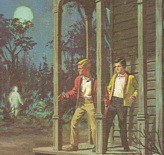
150 years ago today, the battle of Gettysburg began. It started almost by accident - Lee had brought his army north, looking to case trouble, feed his troops, maybe threaten Washington, get the union nervous enough to pull troops away from somewhere else, Vicksburg maybe (fat chance of that happening, though), and eventually get in a fight and try to win, in the north, creating all the more confusion and panic - he had to hope. Marching north strung out his army, strung out the Union army, so both sides were looking for one another, trying to force the other to attack it, really. And Gettysburg was a road hub, and thus a convenient point for Lee's army to assemble. S they started to converge, but the Federals were there - a division of infantry found a division of cavalry blocking the roads to town, and got into a shooting match with them. Lee did not want a full on fight - but the division commander at the front started one anyway. With the cavalry - then infantry started to arrive, and Henry Heth (the division commander) continued to attack. The Union soldiers drove him back; most of the I Corps of the Army of the Potomac came up, opposed by half of A.P. Hill's corps - there was a hard fight in the morning, then it died down - but then Richard Ewell's confederate corps arrived, and attacked on the right of the union lines. By the time the day ended, the South had won a major victory - 2/3 of Lee's army made it up (Hill and Ewell), against about a third of the Union army (the I and XI corps), and the sheer weight of numbers won the day. Casualties were appalling - Hill's corps particularly was shot to pieces, losing far more men killed and wounded than the Yankees, though prisoners evened the total losses out. The Union retreated south of Gettysburg and dug in on a line of hills and waited for the rest of the army. The two sides would go at it for two more days before they were done....
It is the most famous battle of the war, far and away - the biggest battle, the most decisive Union victory, and on northern soil, which gave it additional importance and fame. And of course, it would be the site of Lincoln's greatest speech, in the fall of 1863. It was a crucial battle - and it provided three days of high drama - Warren and Chamberlain on Little Round Top, Pickett's Charge, etc. - stories and images to hang legends on. Now, it might not have been the most important battle of July 1863 - Vicksburg had a good deal more strategic importance - but happening so close to Washington, on northern soil, and, you can say, given the level of risk had Lee won...
So let us remember it today, remember the carnage of the battle, remember the heroism of the men who fought. We can note too that this was probably the last time the Confederates could have won the war - if they had smashed the Army of the Potomac, if they could have taken or seriously threatened Washington, they would have forced a peace. After this, all they could hope for is to run out the clock - still possible, but a hard way to win. I imagine Lee had that in mind, along with everything else - the hope that one big victory in the north could throw everything off, enough to give the south a chance. That didn't happen - it was a very long shot, probably longer than he thought - but it could have been, and wasn't because the union army won.
I will be back to this subject in the next couple days. I know there is a lot more to the Civil War than battles, but I can't help finding the military history endlessly fascinating. Have since I was a boy. So - in the next day or so, I shall belabor you, my readers, with more military details and more opinions on the generals and such... But for now - hold the whole thing in your mind.
And I'll note again Bob Bateman's series at Charles Pierce's blog - a fine place for a variety of stories, from a soldier's perspective.
Monday, July 01, 2013

Friday, June 28, 2013
Friday Weekly Musical Interlude
Friday is here. Today's post will be simple - a random 10. Next week, I hope to get a Gettysburg anniversary post up (maybe more than one: I find I have no difficulty gassing about the big battles of the Civil War)... and another musical top ten. I should write something about politics - it's been a very political month. From Obama's Nixonian side and the continuing adventures of Edward Snowden, boy spy, and Glenn Greenwald's troubles with "journalists" like David Gregory.... to the Supreme Court's inexplicable burst of decency in overturning DOMA - inexplicable, because everything else they did last week diminished the freedom and power of human beings in our great country, most perniciously, gutting the Voting Rights Act - putting an end to Reconstruction Part II... to the local entertainment of a special Senatorial election here in the great Commonwealth of Massachusetts (God save it!, as Charles Pierce would say)... If I get a moment between the hard work of vacation (picking strawberries and eating them; grilling hamburgers and the occasional tuna steak; hanging around beaches and pleasant hillsides; witnessing parades or visiting historical sites; killing mosquitoes and complaining about the humidity) I may try to devote a page or two to some of those subjects...
But not today. Today, let us just enjoy a few musical numbers as selected by the randomizing algorithms of iTunes:
1. Gang of Four - 5.45
2. Minor Threat - Out of Step
3. TV on the Radio - Keep Your Heart
4. Meat Puppets - Vultures
5. Paul McCartney - Too Many People
6. Jonsi - Tornado
7. Keiji Haino - A Secret
8. Neko Case - Dirty Knife
9. Pink Floyd - Fearless
10. Radiohead - Morning Mr. Magpie
Video? It's almost Canada day, so here's a Canadian! Neko Case, live:
And something a little different - Government Mule, covering the Floyd:
Tuesday, June 25, 2013
June Director - Kon Ichikawa
I missed last month's installment of the Director of the Month through a mix of travel, car trouble and monitor trouble. It's a risk in the summer - I spend a lot more time on the wander, and things can drop for a while, especially things that require me to sit in front of a computer for some length of time. We sometimes get nice weather here! This month, though, I am ready (maybe because it rained for half the month, so it was easy to sit in front of the computer), well before the end of the month.
This month, I am going to reverse myself a bit - instead of continuing to count down my favorite Japanese directors, I am going to drop back a bit, to #7 - Kon Ichikawa. He's fairly well known in the states, but doesn't quite seem to have the cachet of the really highly regarded Japanese directors, nor the narrower, but usually more passionate following of people like Oshima and Imamura. But he's not far from any of them. If he stays below the best - it might be because he doesn't seem to commit to things. He is an great aesthete, and a fascinating experimenter, but he has less of the strong identity of the other great Japanese directors. Though it's easy to overstate that - I mentioned before that his eclecticism reminds me of Oshima - and that he shares with Oshima a kind of consistent tone, cool irony in everything. He reminds me, also, of Stanley Kubrick - his irony, distance, analytical, almost clinical style; they share a sense of cruelty, that never quite abandons the characters, an undercurrent of disgust and sympathy.
Though how much of that is Ichikawa and how much was Natto Wada? She was his wife, and his screenwriter, almost from the beginning up through the mid-60s - which is roughly when his films started to lose their way. (At least that is the conventional story - in fact, he still made a fair number of quite solid films after this). Their collaborations, in any case, have the strongest taste of his most characteristic - or most effective - style, that tone I mean. However those collaborations worked, his films are marked throughout the period by that sharp ironic style, and his utter mastery of composition and construction. He was, over all, a master.
Top ten:
1. Fires on the Plain - one of the greatest war movies of all time - I have written it up at length before. I'll add here that it makes a kind of perfect double bill with the Burmese Harp - that film is optimistic and sympathetic to everyone, a film about hope and redemption. This - is not.
2. The Burmese Harp - A lovely, moving film about soldiers going home. It is sometimes criticized for avoiding the Japanese responsibility for the war - but like Fires on the Plains, it is explicitly about the experience of the men on the ground. That is an important tradition - the war is hell on soldiers story, like All Quiet on the Western Front or the Red Badge of Courage. This tradition ignores culpability and portrays everyone as suffering. In this case the suffering is real - the problems are hinted at but not treated - the resolution, the assertion of human possibility is very powerful and convincing. And in any case, we have Fires on the Plains to tell the other side.
3. Kagi - Hitchcock style thriller from a Tanazaki book. An old man spies on his younger wife and a younger doctor who's engaged to their younger still daughter. Plots schemes and betrayals ending with the crowd of them poisoned by the maid, who the cops release, thinking she is trying to protect the mistress from accusations of suicide. The story is nasty piece of work, perverse and strange and observed with an odd mix of distance and ironic identification, a trademark of both Tanizaki and Ichikawa. There's no wonder he kept returning to Tanizaki. As is also common through most of his career, Ichikawa uses cinema to full advantage - the screen is all chopped up, divided, full of blank spaces and odd relationships among the characters; the film generally is full of odd features - an opening monologue addressed to the audience, freeze frames of the main characters, like in a cop show showing the comings and goings of villains - ending with a voiceover by the dead Nakadai - "why? why was I poisoned? I didn't do anything." Great stuff.
4. Makioka Sisters - another Tanizaki adaptation, lavish and gorgeous - the point of which is made at the end. The film is about 4 sisters: one married to a banker, the next to a businessman, the third looking for a husband, the fourth a terror who runs off with a lover. At the end, sinter #2 visits her and says, in proper Japanese fashion, "the seasons come and go, but nothing really changes, does it?" - well,I don't know if she knows better, but the film, and I'd bet the book, is dedicated to refuting that bromide at every point. It is a film about the end of the world. Inside the film, everything is changed: the family is broken up, they all atomize to their individual desires, they accept the end of their dynasty - and outside the film, it ends in 1938, with the world is tottering on the edge of the end. The film itself is ravishingly beautiful, cool and distanced, funny, sharply, and sometimes disruptively edited. Ichikawa's style is on display - overwhelming graphicism, the symbolic and aesthetic use of color and composition, the tendency to favor a series of static compositions, with very little camera movement, and what there is is not used to create the kind of fluid temporalized space Mizoguchi specialized it. There are 180 degree cuts - there are lapses in and out of flashbacks, there is use of sound to link and dissociate images - there are graphic matches, there are games with black and white and color, there is clever use of text.... All of it is sharp and clear. It's a masterpiece, in the old fashioned sense of the word.
5. The Wanderers - 3 Toseinin, wandering thugs, in 1844, having adventures. Mostly they get involved in local feuds and serve as temporary muscle - resulting in wild fights where people try to look mean without hurting each other, though sometimes these get ugly. Ichikawa shows these fights in all their splendor - men hacking away at each other with swords and sticks and farm implements, slipping and sliding, falling into holes, the whole thing. The fight scenes are ridiculous, brutal, sometimes gruesome... Eventually the three of them get involved in a more coherent plot - one of them is compelled to kill his father, then disowned by the boss who made him do it; the three of them, plus a farmgirl the patricide “seduced” then convinced to run away with him head out for home, though things go about as one could expect. They sell the girl to an inn (though promising to redeem her in three months); one gets tetanus; the other two fight over which of two gangsters they will betray, in the course of which one falls over a cliff. The end. It’s a harsh, funny, totally unsentimental film - you can, sort of, feel sorry for the poor devils, but you can’t forget they are in it because they are idiots, though it’s hard to see how anyone else around them isn’t also an idiot.
6. An Actors Revenge - A famous female impersonator exacts revenge on the men who ruined his family. Theatrical and extravagant, the kind of film that just explodes when you see it on a big screen. Gorgeous strange staging, odd structure, a weird perversity, a wildly unconventional and artificial way of depicting things - fights all flashes of swords, a dead person shown as a still photo.... One of the films where Ichikawa lets out all the stylistic stops - and since he was always something of a showoff - this one is pretty stunning to look at.
7. Mr. Pu - Sketch comedy that turns dark, adapted from a manga. Lots of Chaplin; also lots of its manga roots - episodic, built around isolated incidents and sketches. Broadly speaking, follows the ruin of a modest teacher. He's his by a politicians car; he's humiliated by his students; he's demoted - he's lured to a rally by some of the students, and when the rally turns violent, he's hit in the head, photographed, and everything goes to hell. It is very dark - another characteristic of Ichikawa's comedies, in particular. Here, everyone suffers - Mr. Pu's friend is fired, the politician is arrested, the students suffer, the girl Mr. Pu liked takes up with another man, but her mother forbids her from marrying him - they shout and insult both father and teacher. In the end, the girl tries to commit suicide, but fails (the cops fol her), and Mr. Pu gets a job and goes to work. It is a fascinating film, full of vignettes from early 50s Tokyo - unemployment, clinics, schools, intellectuals in all their absurdity - it's really quite extraordinary.
8. Tokyo Olympiad - Documentary about the 1964 games - starts with a shot of the sun filling the screen - cuts to a wrecking ball knocking down a wall - interesting. Focuses on the effort of sports - the athletes preparing, working, waiting - the spectators - the mechanics of the sport - tending to ignore the competition, except in a couple instances; the volleyball finals,say, which Japan won. Some great moments, reaching a kind of peak with the marathon - an Ethiopian running all alone at the front, an English runner kicking in to pass a Japanese at the finish line for 2nd - and the other runners struggling, suffering, creeping in or not making it. Fairly marvellous film - a bit disconcerting to see a film about the Olympics giving 2 seconds to basketball though.
9. I Am Two - Surprisingly wonderful little film, narrated from the POV of a 2 year old. Begins with the child's birth - narrated - shadows and shapes that only later made sense - accompanied by rather marvellous visuals, out fo focus colors and lights, filmed through gauze (out of focus and a kind of fuzz effect) - slowly taking form - the face of a woman, saying the baby is smiling - still ringed with the same fuzzy effect - and here we get the first of many little pricks at the sentimentality of the material - the narration says "I was trying out my muscles - I used some muscles on my face and she thought I was smiling." - it continues from there. The story is loose enough, but not entirely loose - part 1 establishes the household, the relationship between father and mother, their social standing and so on (with nods to Ozu along the way - I WAS BORN BUT... especially) - part ii has them move in with his mother - the grandmother and wife struggle over petty things, but come to understand and like one another - then the old woman dies, leaving the other 2 1/2 alone.... All this is nicely observed, handsomely shot - it is funny and sweet, sometimes delightfully whimsical (there are two or three wonderful bits of animation), but also full of the sharpness Ichikawa is known for. The premise of the child's narration is plenty cute, and there's plenty of cute in it - but it is also usually unsentimental, undercutting the pretensions or worries of the adults - and once in a while, Ichikawa uses the premise to great effect. A serious discussion of life and death, heaven and hell, is ended by the child saying he has to use the potty - that is perfectly characteristic of Ichikawa/Wada...
10. Kokero - Soseki novel - a young man befriends a professor who doesn't have a job - there are psychological quirks invoved - eventually the man tells how he stole his best friend's girl, causing the other man to kill himself - he has hated himself since. Ends with the old villain killing himself - right as the Meiji emporer dies. It's got political subtext, but I can't totally parse it - but the death of fathers, the sense of compromise and betrayal all seem aiemd at a comment on the end of the Maiji era, and perhaps its failure.
Sunday, June 23, 2013
Pre-Gettysburg Post
As we work up to Gettysburg - a few links, and a bit of an essay.
Charles Pierce is running an Anniversary Series, written by Robert Bateman, covering a bunch of things in the run up to the battle - well worth checking out.
This piece by Tony Horwitz, discussing the cost of the war, and the shifts in our assessment of it, is getting some attention. I found it through Ta-Nehisi Coates; I've seen other comments, such as P. Z. Myers'.
Myers takes the anti-war position, the uselessness of war in general, the waste of this one in particular, and the refusal to try to romanticize it. There's a lot to be said for that position - war is hell, and this one was an extremely nasty one. Even wars fought against unambiguous evil, wars that lead to better things, carry mind-boggling costs; and the Civil War's horror was compounded by the fact that, whatever good came out of it, much of it was lost in the aftermath. Slaves were freed, but it took barely a decade for Blacks to be disenfranchised again, for apartheid to be reestablished, for the people who led the rebellion to return to positions of respect and leadership. It's hard to look at the next century without wondering if the war was worth it.
But Coates, as always, keeps bringing us back to the broader context of the war. Reminds us - "we" did not go to war: the South seceded and started the war, attacking the United States. Talking about whether it was worth it is somewhat beside the point when someone else attacks you. He reminds us where it came from - the war did not start for Africans and their descendants in the Americas in 1860 - it started in 1660, and went on from there. He reminds us what the war actually accomplished: that it was legal (for instance) to sell your own children in 1860; not in 1866. And those things - it is true, the North did not fight the war to end slavery at first - but the South certainly fought the war to preserve - and really, to expand - slavery. Fighting for the union at some point probably inevitably would mean fighting for emancipation, because fighting against the union certainly meant fighting for more slavery. And - to speak of the costs of the war, they are appalling, but again - the USA did not choose those costs, the CSA did. And - Coates repeats - the costs of the war represent the shifting of the cost of slavery from African Americans to all Americans. What else could have been done? Coates also puts paid to the idea that we could have ended slavery without the war: the costs would have been prohibitive, and the South wasn't going to do it that way anyway.
And - Coates and Horwitz both point out that the notion of asking if the Civil War was worth the cost was never free of politics - a question originating partly in the aftermath of WWI (which made everyone question the costs of war, but didn't actually seem to stop anyone from starting new ones), but also from the Southern perspective. There's no getting around the fact that the South won the peace - stopping Reconstruction, rolling back what rights were won by African Americans, and even rewriting the story of the war, to make it less about slavery, more about different interpretations of the 10th amendment - and all a terrible misunderstanding.
And so it goes. Coming up on this, the largest battle of the Civil War, it is fitting to ask about the costs, about what was gained and lost. And to do that, and do it fairly, we probably need to learn to hold more than one thing in our minds. The horrors of the war, the evils of warfare, are not something we should ever let out of sight. But we should also not let out of sight the horrors of slavery and the direct connection between that and the war. And we should not forget that the war did accomplish that one great thing, or two great things - preserving the union, and freeing the slaves. Though that too - doesn't undo the fact that the country backed off from the implications of what it did in 1865, it reimposed a harsh form of racism that lasted another century in its open and virulent form, and continues to poison the country today.
Friday, June 21, 2013
Solstice Random Ten
Friday - happy first day of summer! this week, I'll keep to a quick random ten:
1. Yo La Tengo - Last Days of Disco
2. The Pogues - Rainy Night in Soho
3. The Nashville Teens - Widdicombe Fair
4. U2 - I Still Haven't Found What I'm Looking For
5. Tom Waits - The Last Rose of Summer
6. Wire - Moreover
7. Panda Bear - Comfy in Nautica
8. Flaming Lips - See the Leaves
9. Red Crayola - Victory Garden
10. Klaus Nomi - Total Eclipse
Video? Who doesn't love Klaus Nomi?
or Yo La Tengo? (especially augmented with parts of Sonic Youth.)
And off the list - being summer and all - here's Galaxie 500, Summertime:
Wednesday, June 19, 2013
June Film Roundup
Been about a month since the last round-up, so time for another. NOthing fancy, just capsules:
Stories We Tell - 12/15 - story of Sarah Polley and her family. They had a secret: was she really her father's daughter? they treat it as a joke, she pokes around, and finally, almost out of the blue, she finds her biological father. When this, in turn, threatens to come out in public, she has to work it out with her family - and ends up filming it. The film approaches the story through all the people around the story - she uses interviews with her family and people they knew, home movies, fake home movies (presented as real home movies, until the end, when she reveals the crew filming them), and, given a central place, her father's account of his marriage, and their family. The title tells you what the film is: it's about the stories we tell, how we construct the meaning of our lives, and how everyone around you has their own version, and how they are all, somehow, to some extent, brought together. Life itself as a kind of collaborative improvisation. Very clever and moving film.
Deceptive Practices: Mysteries and Mentors of Ricky Jay - 10/15 - very enjoyable documentary about Ricky Jay - his mentors, his connection to the past of magicians, as well as plenty of magic. Might be lightweight in the end, never really digging into the material, but since it consists mostly of Jay talking, it is inherently fascinating and very entertaining, because, in the end, he is.
Frances Ha - 11/15 - Noah Baumbach's latest, co-written with Greta Gerwig. GG is Frances, who lives in NY, is a dancer, though only an apprentice, shares an apt with her best friend, has a boyfriend - and proceeds to shed these impedimenta... She breaks up with the boyfriend rather than move in with him; her friend decides to move to Tribeca, gets engaged, moves to Japan; the dancing business slowly fades. Frances, meanwhile, drifts around New York - spends some time with a pair of rich brats (one beds a string of women, though not her; the other has an odd passive aggressive friendship with her ("undatable")), until the money runs out. She lives with another dancer for a while, who doesn't like her - though Frances manages to get a weekend in Paris out of it. Goes back to her old school for the summer, and then, I suppose, finally, faces the facts a bit... All through - she is flighty and friendly and a bit weird, and not very good at anything, but cheerful and deluded and inclined to lie to cover up her inadequacy, until the end. She takes a plain office job, she manages to stage a piece of choreography, she gets an actual apartment of her own. It is a nice little film, entirely built around Gerwig, and carried by Gerwig, who is, after all, a nearly infinitely charming actress when she gets the chance.
Before Midnight - 11/15 - Linklater, Hawke and Delpy are back, 9 years after the last one. Now, Jesse and Celine are together, with twins, live in Paris, but spending the summer in Greece. Starts with Jesse taking his son to the airport, to fly home - the boy's fate, and Jesse's relationship to him and his mother, becomes the plot engine of the film. They drive back to the place they are staying, have a nice dinner party with friends, who are as talkative as they are - then are sent on a romantic night alone at the hotel. But things unravel.... This one is different from the previous two. Not just that they start the film as a couple; the film is not about this couple, by themselves - from the start, they are plunged into the world. It starts with Jesse and his son; then the family; then with their friends - through the first half of the film, they are constantly surrounded by other people. They are alone in the second half - but not really alone. The boy calls; they start arguing, about the boy, the ex-wife, the twins, jobs and cities and where to live - they are, now, as a couple, completely entangled with the rest of the world, with all those other people, and can't get out of it for love or money.... It is, then, another fine movie, part of a very impressive series of films - so impressive, I'm tempted to note, that Julie Delpy has a parallel franchise of her own running on more or less exactly the same theme... Indeed, this one feels a bit more like Two Days in New York than the other Linklater films - fraught relationships and inescapable relatives....
Post Tenebras Lux - 12/15 - New Carlos Reygadas film, and for me, his best to date. (Though I haven't seen Silent Light, one of those films that got a fleeting screening somewhere and was gone, and seems, somehow, not quite right to watch on DVD.) Very fragmentary, hallucinatory film. The story, roughly, is about a rich family living in the country - man, beautiful wife, 2 adorable kids, a bunch of dogs. They have their troubles - he is addicted to porn, and some other hints of the couple's malaise come out; the man, in particular, interacts with the workers around him in ways that hint at trouble - he acts friendly, but is condescending, and carries a streak of violence and exploitation with him... The family heads off on vacation, but leaves something behind, so he goes back alone, to a Major Plot Point.... Talking about it that way doesn't come close to describing it, of course. The film consists of scenes arranged without obvious connections, isoolated from one another, though usually fairly stable inside them - long takes, usually with a mobile camera; lush scenery - jungles, rain, exteriors shot with a doctored lens that looks like vaseline, though apparently it isn't. We see the family together at different points in their lives; we see the workers in their town, mostly "Seven" who cuts down trees, does handiwork, and runs a kind of AA program; we see a family reunion of appalling rich people, kids playing rugby, and an orgy in a steam bath with things like the Duchamps room and the Hegel room. Throughout, much is made of class differences, class and race; there are many animals of all kinds, and trees, and landscapes and weather; there is, as well, of course, sin and redemption. It flirts, I suppose, with the worst kinds of Art Film Smugness - but it's too beautiful to succumb to it, and stays too close, most of the time, to something solid - the earth, and faces and bodies, and light. I liked it: I don't trust Reygadas, and had to talk myself into seeing this - but was caught up in it. It felt, somehow, like other films - Lisandro Alonso at times; Raoul Ruiz at times - I can't say it's as good as either, but it works.
An Oversimplification of her Beauty - 10/15 - interesting essay, love story, something, directed by Terance Nance. All of it loops around an incident - a young man who likes a young woman, expects to see her one night, but she calls and says she can't come over - "how would you feel?" The story loops around this, expanding the set up, his bad day, his history of love affairs, and so on... And loops around a short film (Called How Would U Feel) that he made of it. A girl he half loves, a friend, an ambiguous relationship; where will it go? With this as an anchor for his musings on his life, his other lovers, also lost, and on his career, his art, and art, memory, what have you.... It is very clever, and might end up being too clever - it does seem to get stuck in that initial conceit, and though the expansion on it is also very well done, it bogs down... Still: a very interesting film, an essay film, of the kind people did on video 25 years ago. A very interesting debut.
Friday, June 14, 2013
Friday Random Music
Pouring rain again; a strange couple weeks here. Not the weather itself so much as the fact that it seems to have settled in - we had a big bad heat wave a couple weeks ago, then it started raining and has barely stopped since. This time of year, in this part of the world, you rather expect to run through three or four seasons a week. You seldom get the chance to get tired of any particular tie of weather.
Anyway - onward: after last week's more ambitious effort, I'm afraid I'm back to more modest devices. Though I like the idea of a big countdown a month - there will be more coming. (Which means I am going to owe you all at least three relatively big posts at the end of this month - a director, a favorite band - and a very big sesquicentennial around the first of the month... All that around a holiday week? I'd better get it done now....)
iTunes says -
1. Radiohead - Dollars & Cents
2. Mudhoney - Crooked and Wide
3. Interpol - The Heinrich Maneuver
4. Times New Viking - I Smell Bubblegum
5. Minutemen - Storm in My House
6. The Residents - Numb Eron
7. Ryan Adams - Tina Toledo's Street Walkin' Blues
8. Blue Oyster Cult - Joan Crawford
9. Pere Ubu - Rounder
10. Social Distortion - Sick Boys
Video? "Policemen are hiding behind the skirts of little girls"...
The Art of Walking, with Pere Ubu:
Friday, June 07, 2013
Beatles Top Ten
I have a new scheme in mind for music Fridays - once a month (we'll make it the first Friday of the month, for simplicity's sake), I will post a list - the 10 best songs by one of my favorite bands. Simple enough, though setting out to do it raises all kinds of new questions - never mind the difficulty of picking just 10 Beatles songs - what order should I post these lists in? Count down the bands? or count up the bands, starting at #1? or alphabetically? or, look for monthly themes? I don't know. I know I can't do some kind of countdown - it's enough trouble coming up with an arbitrary order for songs - for bands? No - that's too much anxiety for one post - I need a different scheme.
I think instead I will try for a loose kind of autobiography - what I listened to over the years. The bands I loved, and love, in the order (roughly) that I came to love them so. This has many merits - it allows me to acknowledge the changes in my tastes, and to hold on to some of the values I've held more at other times. Though my musical tastes haven't changed all that much, at least not since late high school - or rather I should say, while there have been a couple rather dramatic swerves in emphasis over the years, I have never quite abandoned the things I used to like. Rather - hearing new, different (more different than new, since much of it was discovering things that had been around for decades) music sometimes added substantial new types of music to what I liked, I didn't really stop liking what I liked before. Does that make sense? I don't know. Maybe it will make sense as I make my way through this series.
And so to start - starting at the beginning means we are going to start at the top. At the top because to this day, I don't think any band can really measure up to the Beatles, and at the beginning because, even when I was very young and did not listen to the radio on purpose, the Beatles were the one rock group that was an inescapable part of my experience. Ads were on TV all through the 60s when I was too young to know anything about it - I liked them, could sing bunches of their songs ("I wanna hold your ha-a-a-a-and, I wanna hold your hand...."), my parents marveled that such things could exist, but still thought little tykes singing Beatles songs were terribly cute. In the 70s, when I started to listen to the radio deliberately, on my own, the Beatles weren't around - but Paul McCartney and Wings were (and John Lennon, Ringo Starr - some George Harrison), and I suppose like a lot of kids, I was amazed to discover that was the same guy who did Hey Jude... but still, it didn't take that much time to get to know the Beatles as such, and like them - and realize that they were the real deal, that the more you heard of them, the more amazing they got. And by the time I was a more or less complete music lover (which, in its earliest days, meant, I'm a bit sorry to say, a confirmed Kiss fan), I loved the Beatles - and continued to do so through every stage of my education and development as a fan, every step of which, somehow, made them seem a bit deeper and better, and usually, to have gotten there first. So - they are the place to start, I guess. Here goes - I give you - my 10 favorite Beatles songs:
1. A Day in the Life
2. Norwegian Wood
3. Hey Jude
4. Revolution
5. Dear Prudence
6. Tomorrow Never Knows
7. Everybody’s Got Something to Hide But Me and My Monkey
8. A Hard Day’s Night
9. Help!
10. She Said She Said
A completely hopeless exercise, obviously, but there it is. And video? IN the studio...
And on TV...
Friday, May 31, 2013
Friday Five, Post Holiday Edition
I am back. This has been an adventurous week. Visited the kin on Memorial Day - while I was up there, my brother's car died. He was ferrying me back and forth - so he had it fixed, up there, then we came back - but I guess the fix was not so good. Broke down on the offramp from the highway, happily only a mile or so from home. A tow later it was in the garage and he was stuck here waiting to get it back.... Not the end of the world, I guess, though a definite nuisance. Reminds me again why I am glad I don't have one of the infernal things.
Though I have computers - and had a monitor. But now, though it seems to be on and running, it will not stay on - not recognize a signal. It was working Wednesday; we had a nasty set of thunderstorms Wednesday night; it is not working now. I suppose there are other elements in the chain that could be broken (the cable, say), but that's a mighty coincidence there. What fun.
But we shan't let it discourage us from our Friday music posts shall we! though it seems to have put paid to my scheme for an end of the month countdown... (It's also putting my Director of the Month plan on a bit of a hold too - I suppose I still have a day, but those things are a good deal harder to do on a laptop - I like having a host of windows open for that sort of thing, which is why I'd put it off until I got back. Oy.) Anyway - here goes: Random 10!
1. Creedence Clearwater Revival - Suzie Q
2. Six Organs of Admittance - Goodnight
3. PIL - Flowers of Romance
4. Velvet Underground - Lisa Says
5. George Thorogood - Move it on Over
6. Pavement - So Stark (You're A Skyscraper)
7. Alex Harvey and his Soul Band - Elevator Rock
8. The Flying Burrito Brothers - Christine's Tune (Devil in Disguise)
9. Dungen - Glomd Konst Kommer Stundom
10. Spoon - My Little Japanese Cigarette Case
Here's some Creedence for you, to get summer going...
That being latter day CCR (though in fine form) - I am inclined to throw in some vintage stuff - because, yeah, there is something very summery about CCR - though what it is might just be memories of passing out at a fourth of July party listening to the live version of Keep on Chooglin'... well - we'll leave that... Here's born on the bayou, as a bonus.
And finally - from today's list - another old fart not letting it go, every bit as satisfyingly as Mr. Fogerty and co... Mr. Lydon?
Friday, May 24, 2013
Holiday Weekend Friday Music
Well - keep this simple, heading into this weekend -
1. Heavens to Betsy - Intermission 247
2. Stooges - Dirt
3. Heroin - Head Cold
4. Tin Huey - Squirm you Worm
5. PIL - Terra-Gate
6. Tim Buckley - Down by the Borderline
7. Love - Alone Again Or
8. Galaxie 500 - Tell Me
9. Wilco - I'm the Man Who Loves You
10. Gomez - Natural Reaction
First - goodbye to Ray Manzarek - here holding down the fort for Jimbo:
Here singing, after Morrison's departure from this world:
and - here with X, whose first 2 records he produced, which might be even more of a contribution to the world of music than his first:
And - from today's list - Love, from Arthur Lee's comeback period....
Monday, May 20, 2013
1980s WITD Poll Votes
At Wonders in the Dark, voting for the film of the year continues to march through the years, up into the 90s, and so here, I'll repost my votes for the previous decade (with some slight amendment, I have to admit), along with my best of the decade votes. This is the 1980s - an odd stretch, that people seem to remember badly and not too fondly, and that I find - a mixed bag. Though looking through all these films - I find that somewhere in the middle of the decade the number of films I have records of seeing spiked - and stayed spiked ever since. Though this happened before the number of films I went to see in theaters spiked - very odd. Anyway - here it is - my favorites of the 1980s.
The Decade:
PICTURE: City of Sadness
DIRECTOR (single film): Hou Hsiao-Hsien, City of Sadness
DIRECTOR (decade): Hou Hsiao-hsien
LEAD ACTOR (single film): John Hurt, Elephant Man
ACTOR (decade): Chow Yun-fat
LEAD ACTRESS (one film): Brigitte Lin, Peking Opera Blues
ACTRESS (decade): Brigitte Lin?
SUPPORTING ACTOR: Dennis Hopper, Blue Velvet
SUPPORTING ACTRESS: Isabella Rosselini, Blue Velvet
SHORT: Broken Down Film, Osamu Texuka
SCORE: Angelo Badalamenti, Blue Velvet
CINEMATOGRAPHY: Frederick Elmes, Blue Velvet
Plus bonus picks:
Script: City of Sadness (Chu Tien-wen & Wu Nien-jen)
Music: Stop Making Sense has the best music, I have to say. Something Wild, though, has the best use of a song - though over all, Blue Velvet's use of music is on a very rarified level. That sounds like three different votes, and probably is, since they use three different criteria.
Sound: this, though, I think is Ran
Martial Arts: I think the best martial arts film, as a martial arts film - is Project A part II. {eking Opera Blues is a better film as a film, I think - though not in a landslide - but Jackie Chan's virtues are more tightly bound to the actual stunts and acrobatics than Tsui Hark's...
Documentary: The Emperor's Naked Army Marches On
1. City of Sadness
2. Blue Velvet
3. Elephant Man
4. Fitzcarraldo
5. Sans Soleil
6. Dekalog
7. Peking Opera Blues
8. Do the Right Thing
9. Brazil
10. Blind Chance
11. Dust in the Wind
12. This is Spinal Tap
13. Raiders of the Lost Ark
14. The Emperor's Naked Army Matches On
15. Blade Runner
16. Ran
17. Kegemusha
18. Merry Christmas Mr. Laerence
19. The Big Red One
20. Black Rain
(I just noticed how many of the 80s best films are World War II films: City of Sadness (sort of; begins with the emperor's speech announcing the end of the war), Emperor's Naked Army, Nerry Christmas Mr. Lawrence, the Big Red One, Black Rain - and Come and See, which is as good as anything here; shoot, you can make a case for Raiders of the Lost Ark, too. More than one part of the Dekalog too.)
And By Year:
1989:
A fairly extraordinary year, to end the decade...
PICTURE: City of Sadness
DIRECTOR: Hou Hsiao-Hsien
LEAD ACTOR: Chow Yun-fat (sometimes, you just want a Movie Star)
LEAD ACTRESS: Kati Outinen (if Match Factory Girl is 89...)
SUPPORTING ACTOR: Jack Nicholson, Batman
SUPPORTING ACTRESS: Rosy Perez, Do the Right Thing
SHORT: Creature Comforts
SCORE: Danny Elfman, Batman
CINEMATOGRAPHY: Takashi Kawamata, Black Rain
Plus bonus picks:
Script: This is also City of Sadness, the best film of the 80s, one of the all time greats.
Music/Sound: Leningrad Cowboys Go America? No, not really - Do the Right Thing, in a walk.
Martial Arts: Some nice films to choose from, but Jacky Chan's Capra remake, Miracles, takes the prize.
1. City of Sadness
2. Do the Right Thing
3. Black Rain
4. Johanna D'Arc of Mongolia
5. Mystery Train
6. Miracles - Mr. Canton and Lady Rose
7. The Killer
8. Why Has the Bodhi Darma Left for the East
9. Kiki's Delivery Service
10. Batman
1988:
PICTURE: Dekalog
DIRECTOR: Kieslowski
LEAD ACTOR: Forest Whitaker, Bird
LEAD ACTRESS: Carmen Maura, Women on the Verge of a Nervous Breakdown
SUPPORTING ACTOR: Kevin Kline, A Fish Called Wanda
SUPPORTING ACTRESS: Michelle Pfeiffer, Dangerous Liaisons
SHORT:
SCORE: Toru Takemitsu, Wuthering Heights
CINEMATOGRAPHY: Junichiro Hayashi, Wuthering Heights
Plus bonus picks:
Script: The Dekalog, collectively, and individually, they'd come close to being the top 10
Music/Sound: Married to the Mob has the Feelies again... Demme's soundtracks are usually as interesting as his films
Martial Arts: I forgot this last week. This is a good year for it though - Dragons Forever is absolutely thrilling
1. Dekalog
2. Dragons Forever
3. Wuthering Heights
4. Rouge
5. Women on the Verge of a Nervous Breakdown
6. Damnation
7. Family Viewing
8. Chocolat
9. Beetle Juice
10. A Fish Called Wanda
1987:
This is a very strong year. Very strong.
PICTURE: Dust in the Wind
DIRECTOR: Kazuo Hara, Emperor's Naked Army Marches On
LEAD ACTOR: I am tempted to say Kenzo Okuzaki, documentary or not, not least because he is so aware of the camera, and his performance for the camera.
LEAD ACTRESS:
SUPPORTING ACTOR: the choices are overwhelming; Vincent D'Onofrio, though, I suppose has to take it. But Mandy Patinkin, Christopher Guest, Charles Grodin, R. Lee Ermey, etc. - what is there to choose among them?
SUPPORTING ACTRESS: Maggie Cheung, Project A II?
SHORT: The Unnameable Little Broom? if that's the right year...
SCORE:
CINEMATOGRAPHY: Dust in the Wind (Ping-bin Lee)
Plus bonus picks:
Script: The Princess Bride
Music/Sound: Ishtar - if you admit that you play the accordion they won't let you play in a rock and roll band.
Documentary: The Emperor's Naked Army Marches On is among the best ever
Martial Arts: (I forgot to add this during the voting, though I'd already started putting them on the ballots - odd, since this is the year the film I think is the best straight martial arts film came out.) Project A Part II
1. Dust in the Wind
2. The Emperor's Naked Army Marches On
3. Full Metal Jacket
4. Project A II
5. Where is the Friend's House?
6. Evil Dead II
7. Raising Arizona
8. The Princess Bride
9. Ishtar
10. Daughter of the Nile
1986:
THere's a lot of good stuff in 86, and of course, one of the films of the decade at the top... It is also pretty much the beginning of the stretch where the Chinese completely took over my film viewing... And world cinema, for that matter.
PICTURE: Blue Velvet
DIRECTOR: David Lynch
LEAD ACTOR: Richard E.Grant, Withnail and I
LEAD ACTRESS: Bridgitte Lin, Peking Opera Blues
SUPPORTING ACTOR: Dennis Hopper
SUPPORTING ACTRESS: Isabella Rosselini
SHORT: Rocky VI (though isn't Street of Crocodiles a short? or have I only seen part of it?)
SCORE: Angelo Badalamenti, Blue Velvet
CINEMATOGRAPHY: Frederick Elmes, Blue Velvet
Plus bonus picks:
Script: Blue Velvet
Music/Sound: I thought this one would probably be Assayas' Disorder (New Order and Pere Ubu? not likely to beat that...) - but that was because I had the idea that Something Wild came out in 87. That's got the Feelies - now, while they get in range of Pere Ubu, over all, in any sort of general contest, they do fall short... but in these films: it's Slipping (Into Something) vs. Non-Alignment Pact - great as Non-Alignment Pact is, it's not gonna win that comparison. And add in the Feelies doing Fame, and the Demme film wins, even without looking at the way the music is used in the films. But there - the way Demme scores the big turn in Something Wild to the musical turns in Slipping (into Something) - it's no contest. That's one of the great music/film moments ever.
Martial Arts: Peking Opera Blues
1. Blue Velvet
2. Peking Opera Blues
3. Terroriser
4. Something Wild
5. Down by Law
6. Ferris Bueller's Day off
7. Dream Lovers
8. From Beyond
9. Shadows in Paradise
10. Withnail & I
1985:
This is another very strong year, with obvious greatness and a disproportionate number of films that are rather better than they should be. Being particularly definitive of what might be a minor type of film. Teen comedies and jokey horror and the like, that are hard to compare with the Great Films of All Time, but are still infinitely enjoyable.
PICTURE: Brazil
DIRECTOR: Hou Hsiao-Hsien, A Time to Live, A Time to Die
LEAD ACTOR: Jonathan Pryce
LEAD ACTRESS: Sandrine Bonnaire, Vagabonde
SUPPORTING ACTOR: Jeffrey Combs, Re-Animator
SUPPORTING ACTRESS: Kim Darby, Better off Dead (? - though this is not far off - she is so strange and wonderful...)
SHORT: Broken Down Film, Tezuka, which is one of the best short films ever.
SCORE: Toru Takemitsu, Ran
CINEMATOGRAPHY: Takao Saito, Masaharu Ueda, Asaichi Nakai, Ran
Plus bonus picks:
Script: Taipei Story
Music/Sound: Desperately Seeking Susan takes this prize.
Martial Arts: (Added after the fact - I wasn't voting for them regularly then) Police Story
1. Brazil
2. Ran
3. Come and See
4. A Time to Live, a Time to Die
5. Taipei Story
6. Tampopo
7. Reanimator
8. When Father Was Away on Business
9. Vagabond
10. The Sure Thing
1984:
Oddly underwhelming year, despite the very fine films at the top.
PICTURE: This is Spinal Tap
DIRECTOR: Hou Hsiao Hsien, Summer at Grandpa's
LEAD ACTOR: Philip Baker Hall, Secret Honor
LEAD ACTRESS: Gena Rowlands, Love Streams
SUPPORTING ACTOR: Harry Dean Stanton, Repo Man
SUPPORTING ACTRESS: Sigourney Weaver, Ghostbusters (why not? she's funny, she's cool amidst the nonsense, she's game - why not?)
SHORT: Jumping, Osamu Tezuka
SCORE: This is obviously Spinal Tap - not sure why it's not nominated, the songs were written for the movie... or - wait - wasn't the music for Purple Rain original to the movie too? holy crap.
CINEMATOGRAPHY: Zhang Yimou, Yellow Earth
Plus bonus picks:
Script: This is Spinal Tap
Music/Sound: no matter what was original and what wasn't - Prince vs. The Talking Heads offers as great a competition as you could ask.
Martial Arts: (Added after the fact) - Wheels on Meals
1. This is Spinal Tap
2. Twenty-Eight Up
3. Summer at Grandpa's
4. Secret Honor
5. Repo Man
6. Stranger than Paradise
7. Love Streams
8. Ghostbusters
9. The Funeral
10. Stop Making Sense
1983:
PICTURE: San Soleil
DIRECTOR: Chris Marker
LEAD ACTOR: Tom Conti, Merry Christmas Mr. Lawrence
LEAD ACTRESS: Sylvia Chang, That Day on the Beach
SUPPORTING ACTOR: Takeshi Kitano, Merry Christmas Mr. Lawrence
SUPPORTING ACTRESS: Sandra Bernhard, The King of Comedy
SHORT: not yet... (Unless I were to arbitrarily abstract Hou Hsiao Hsien's "Sandwich Man" from the anthology of the same name...)
SCORE: MArk Knopfler, Local Hero
CINEMATOGRAPHY: Kiyoshi Hasegawa, The Makioka Sisters
Plus bonus picks:
Script: Marker again, Sans Soleil
Music/Sound: David Bowie singing Rock of Ages has to get a mention somewhere.
Martial Arts: (Added after the fact) - Project A
1. Sans Soleil
2. Merry Christmas, Mr. Lawrence
3. The Makioka Sisters
4. L'Argent
5. The Boys of Fengkui
6. That Day on the Beach
7. Zelig
8. Local Hero
9. The Green, Green Grass of Home
10. Project A
1982:
This is the thinnest year for me in a long time - I don't know if the year is that bad (probably not, since what I have seen is quite strong, with a handful of stone classics), but I have seen astonishingly few films from this year.
PICTURE: Fitzcarraldo
DIRECTOR: Herzog
LEAD ACTOR: Klaus Kinski
LEAD ACTRESS: Susan Berman, Smithereens
SUPPORTING ACTOR: Rutger Hauer, Blade Runner
SUPPORTING ACTRESS: Karen Black, Come Back to the Five and Dime, Jimmy Dean, Jimmy Dean
SHORT: (I might get around to voting this week... gotta hope, lot of good looking stuff on offer...)
SCORE: Vangelis, Blade Runner
CINEMATOGRAPHY: Thomas Mauch, Fitzcarraldo
Plus bonus picks::
Script: Fast Times at Ridgemont High
Music/Sound: Smithereens, with its Feelies songs - can't beat that....
Martial Arts: (Added after the fact) - this is probably Fantasy Mission Force - another reason for the Best Actress of the decade vote - though an odd one.
1. Fitzcarraldo
2. Blade Runner
3. Fanny & Alexander
4. Burden of Dreams
5. Come Back to the Five and Dime, Jimmy Dean, Jimmy Dean
6. Chan is Missing
7. Forty Deuce
8. Fast Times at Ridgemont High
9. The Draughtsman's Contract
10. In Our Time
1981:
PICTURE: Blind Chance
DIRECTOR: Oliveira, Francisca
LEAD ACTOR: Andre Gregory?
LEAD ACTRESS: Barbara Sukowa, Lola
SUPPORTING ACTOR: Armin Mueller-Stahl, Lola
SUPPORTING ACTRESS: why is this one so hard?
SHORT: alas...
SCORE: Williams, Raiders
CINEMATOGRAPHY: Shinsaku Himeda, Eijanaika
Plus bonus picks:
Script: Blind Chance
Music/Sound: This is a Sound one - Das Boot, which gets as much from the sound as the visuals, really thrilling.
Martial Arts: (Added after the fact) - Prodigal Son
1. Blind Chance
2. Raiders of the Lost Ark
3. Eijenaika
4. Lola
5. Francisca
6. Chan is Missing
7. Prodigal Son
8. Possession
9. Gallipoli
10. Das Boot or My Dinner with Andre
1980:
PICTURE: Elephant Man
DIRECTOR: Kurosawa
LEAD ACTOR: John Hurt
LEAD ACTRESS: Susan Sarandon, Atlantic City
SUPPORTING ACTOR: Peter Boyle, Where the Buffalo Roam
SUPPORTING ACTRESS: Mary Steenbergen
SHORT: not yet...
SCORE: I think this is the Elephant Man, too...
CINEMATOGRAPHY: Freddie Francis, the Elephant Man
Plus bonus picks:
Script: Let's give this to Airplane!
Music/Sound: I'm inclined to be perverse and name Harry Nilsson for Popeye...
1. The Elephant Man
2. Kegemusha
3. The Big Red One
4. Atlantic City
5. Raging Bull
6. Melvin and Howard
7. Return to the 36th Chamber
8. The Last Metro
9. Airplaine!
10. Heaven's Gate
Saturday, May 18, 2013
Vicksburg
Today, May 18, marks the 150th anniversary of the beginning of the seige of Vicksburg. This was the culmination of a long and complicated campaign, that stretched back, really into the middle of 1862.
I sometimes regret that most of my Civil War posts have been about battles and generals - the Civil War is the defining event in United States history, and it encompasses every aspect of American life. I know that, at the very least, I should be writing about politics and about slavery - the war emerged from political conflicts, and specifically, political conflicts over slavery - the war came to be fought over slavery, and its place is utterly central. And I should find ways to talk about all the things that went with the war - the economic developments, the technological changes, the relationship between the war and the west, the war and immigration, the war and - Christ - everything... But - so far, it's been all battles and generals, with the occasional consideration of underwear. Well - there it goes. There will be time - and the anniversaries are on us now...
So Vicksburg. It is generally regarded as U.S. Grant's finest hour - this part, May 1863, especially. But even taking it as a whole, it illustrates one of the things that made him successful. He kept at the thing. He tried a host of schemes over the previous winter - direct assault, marching overland, building canals, trying to use the rivers and bayous to get around behind the city - everything failing, sometimes disastrously. But he kept at it, and the activity didn't stop him from thinking about the problem until he came up with the plan that worked - run ships past the city, gunships and transports, march the army down the western shore of the Mississippi, cross the river, and attack from the south and east. Lee gets credit for dividing his forces and making daring attacks, counting on the passivity of the enemy, maybe - Grant deserves the same credit. And this, with much larger distances and a bloody great river splitting his army in half, is even more audacious. Though it is true - Grant had significant advantages in manpower and equipment - he had all those ships - he could get away with it.
He also had some particularly passive enemies. The North has a bad reputation for generalship, but other than Lee, and Virginia generally, the South was a pretty consistent mess. Not the field commanders - people like Forest and Cleburne and Wheeler were quite superb - but the higher command was a mess. They weren't helped by the central government - Jefferson Davis fancied himself a Military Genius, and meddled quite a bit in western affairs. (Grant is rather fond of mocking him in his memoirs.) Davis' part in the Vicksburg campaign wasn't too helpful - he was very determined to hold Mississippi at all costs - and his pressure kept the confederates in Vicksburg itself beyond what might have been wise. It was a difficult situation, of course - in they lost control of the Mississippi, they were done and they knew it - but they also lacked the resources to hold it. Militarily, they would have been better consolidating their forced, and finding the Union armies and beating them, preferably one at a time.... Bus was that practical? And if they let the Mississippi go, could they have sustained armies in the field? You see the problem...
In any case - the south couldn't decide what to do, so they did everything badly. Davis and Pemberton, commander at Vicksburg, wanted to hold the city, but Joe Johnston, sent to support the city, saw no point in it. He did very little to help, made no effort to reinforce the city, relieve the city, or force the men in the city to join him and fight elsewhere. And when he was attacked, at Jackson, May 14 - he declared defeat and took off. Meanwhile Pemberton waffled - he went out to meet Grant, but late, and so met him after Grant's army had all crossed the Mississippi. He started one way, lost a battle or two and went back to Vicksburg. An altogether uninspired campaign. The results are that Grant did exactly what he wanted - marched up east of Vicksburg. Chased Pemberton back, sent part of his army to drive off Johnston from Jackson, to the east, then gathered the full army and met Pendleton at Champion's Hill. Gave them a beating there, then at the Battle of the Big Black, and so pinned them up in Vicksburg proper. It was very neatly done.
Though it left Grant facing Pendleton's army in Vicksburg, dug in to their eyeballs, able to last god knows how long. So Grant tried to take them by storm, first on the 19th, which was repulsed with heavy casualties, then again on the 22nd, attacking with the whole army, and again, repulsed with heavy casualties. (Lessons there about attacking fortifications in the age of the rifle that he unfortunately did not take to heart before the Virginia campaign of 1864.) And so Grant settled in for a siege, and no one in the South could do anything about it - and on July 4, the garrison surrendered. The father or waters would flow unfettered to the sea. Grant would be lionized. The South was finished, though they still had armies in the field, and wee able to kill a lot of people for not much purpose in the coming 2 years.
Friday, May 17, 2013
Friday Morning
And time for music. Actually listened to music this week - I've been going through one of those stretches where I don't very much... I was listening to new records - Richard Thompson, Nick Cave, Pere Ubu, Atoms for Peace - sort of an all star listing, I guess, which is what happens when I drift away from music for a while; just get the things I know I like... But - in fact, they are all very nice records - I'm sorry I haven't been listening to them as much as I should. What can you do? The habit will come back....
Anyway, today is just another Friday - so here are 10 songs selected by our friendly neighborhood iTunes!
1. Theoretical Girls - Lovin in the Red
2. REO Speedwagon - Back on the Road Again [I wonder how often those two songs come up back to back on anyone's playlist?]
3. Asian Dub Foundation - Change
4. REO Speedwagon - Can't Fight the Feeling [I am being punished for that wise crack at 2]
5. Linda Ronstadt - It Doesn't Matter Anymore
6. Minutemen - June 16th
7. Ryan Adams - Tina Toledo's Street Walkin' Blues
8. Madvillain Featuring MED - Raid
9. Mission of Burma - Einstein's Day
10. Pink Floyd - Eclipse
Well? What about video? No way around it, really - iTunes has spoken... it's REO you're getting:
And - in a vague hope of countering that - here's Mission of Burma:
And unrelated to the random ten, but - Nick Cave and the Bad Seeds, because - well - you know...
Sunday, May 12, 2013
Recent Films - May 2013
In the interests of getting back on track, putting up at least capsule reviews at regular intervals....
The Angel's Share - 10/15 - A comic heist picture from Ken Loach, which not be the first thing I would expect either, but here it is. Not bad, actually - starts with a bunch of kids sentenced to community service for various stupidities, like trespassing onto a train tracks, or climbing a statue, or beating up someone who attacked him... The last one turns out to be the main character, Robbie, a hard case who is trying to change, has a girl, who's having a baby, but the world is against him. The girl's family hates him, he has enemies on the streets, the law has just about given up on him - he has no hope - but he is somewhat taken in my Harry, the man in charge of the community service. Harry toasts him with whiskey, a fine single malt, when Robbie's son is born - and starts Robbie thinking about whiskey. He takes the kids on a tour of a distillery, and Robbie starts to develop a nose for it - he studies it - he goes to tastings - he impresses professionals and meets a collector... And then conceives a plan for stealing a few bottles of a very rare cask of the stuff, likely to sell for a million dollars or so. Well, after that - just say the film's sympathies are with the people likeliest to enjoy the whiskey and least likely to pay $100,000 for a bottle of it. It's all charming, with the steel of the streets in it, though very slight, in the end.
Mud - 11/15 - Jeff Nichols' follow up to Take Shelter. Matthew McConaughey is Mud, hiding on a island, where he's found by two kids who are looking at a boat in a tree. They start helping him, and his story slowly comes out - he loves a girl, they've had trouble all their lives, she probably doesn't love him as much as he loves her - he's ended up shooting a man in Texas. The law is after him, and so is the man's family, who are a hard lot. Well - there's plenty running along wise this - one of the kids, the main one, Ellis, is having trouble at home - his parents are breaking up, they will lose their houseboat - he meets a girl, flirts with her, but she dumps him - he suffers. But he keeps helping Mud, and Mud helps him too, in the end, until things sort of explode.... It is, in any case, a superb film - not as powerful as Take Shelter, but very fine - handsome looking, with an ace cast - Tye Sheridan and Jacob Lofland as the kids, McConaughey augmented by Sam Shepherd, Sarah Paulson, Ray McKinnon, Michael Shannon, Joe Don Baker - all of them among the elite American character actors, and Shannon one of the best actors in the business. Even Reese Witherspoon fits in perfectly, as though she were one of AMerica's elite character actors... And McConaughey these days is becoming almost as sure a guarantee of quality as Shannon.
Renoir - 7/15 - film by Gilles Bourdos about the Renoir family - set in 1915 or so, the old man getting along in years - Jean off to war, Claude wandering around moping.... starts with the old man hiring a model; Jean comes home with a war wound and hangs around. He screws the model, then goes back to war, over the protests of dad and lover - he promises to come back and all - and since we already know he does come back, well, all right. He did come back, he married the girl, they made movies together and (a little poking around tells us), they broke up when he started casting other women in his films, so she disappeared and he stayed Jean Renoir. I guess it's a happy ending anyway. There are a couple flickers of things that might figure in Jean's films (some business with maids and hunters and such), but mostly, it's more interested in the father than the son. Certainly, as a film, it's more attuned to father than son - it is gorgeous, lush and rich and brilliantly lit, a moving painting, shot, as it is, by Mark Ping-bin Lee. Unfortunately, there's not much in the filmmaking to recommend. Not put together with much life, certainly with none of the sense of space and movement Jean Renoir's films had. Nor is there much of a story - it tries to play the part of a straightforward dramatic biopic, but there's not a lot of drama, and they don't tell us all that much about the characters on display - flat and drab. But lovely to look at!
In the House - 10/15 - another French film, from Francois Ozon - tres French indeed. He's back to making subtle metafictional psychodramas, like Swimming Pool - this time, there's a bored high school teacher married to Kristin Scott Thomas who runs a gallery for a pair of twins. The teacher has a student, who starts turning in assignments describing his efforts to infiltrate the house of his friend. The teacher is intrigued and inspired - he starts offering private lessons in plotting and characterization, and the boy keeps going with the story. He has a crush on the woman, the man is in trouble at work, the boy is dull, but with the teacher's encouragement, things get a little more lively. The boy turns out to have a crush on the writer; the kid beds the wife and so on... It does tend to rather swallow itself in the end - though Ozon isn't exactly apologetic about it: the teacher and writer end up sitting on a bench looking into people's windows making up stories about them... It is all very clever, but is, really, Swimming Pool lite.
Something in the Air - 13/15 - Olivier Assayas' latest, on the other hand, is the real deal. Set in 1971, based roughly on his own teenaged years, starting in high school, where the main character, Gilles, is part of a group of high school radicals. The film proceeds in episodes - first, their adventures at the school - they make plans, protest and so on - then cover the school in graffiti, but are chased by guards, and one of them is identified. They then firebomb the guards in retaliation, not really trying to hurt them, though - but one of them is hurt. The first kid is accused, though he was not there - the rest of them get out of town to let things cool down. Some of them go to Italy, then start splitting up - Gilles comes back to Paris to take exams; his girlfriend Christine joins a collective of radical filmmakers; another friend Alain heads off with some American hippies; Jean-Pierre, the kid accused of the attack, radicalizes. And Gilles' other girlfriend, Laure, goes to London with her parents, hanging around rock stars, and taking up older men and drugs. It tends, as it goes, to unravel - from the tight opening, focused on the protests and politics, it starts to diffuse, as characters move away, as the political groups splinter and recombine, as everyone, really, starts to define themselves. All of them do, in some ways - Jean-Pierre in politics, Gilles in film (he works for his father, a TV producer; he goes to London to work at Pinewood), Alain as a painter, even Christine, whose foray into political filmmaking ends up with her serving as housewife to a bunch of ineffectual filmmakers, but who ends it by riding away on her own... All this is made in what is perhaps Assayas' most identifiable style - fast, mobile, everyone always on the run, the camera moving along with them, music everywhere - propulsive, restless filmmaking that is a thrill to watch. This probably, in the end, is not quite as good as Carlos or Cold Water - or for that matter, Philippe Garrel's similarly retrospective Regular Lovers - but it is in their league. Superb film, rivaling Beyond the Hills for best film in theaters this year.
Friday, May 10, 2013
Friday Music Post
With no anniversaries to celebrate (though 150 years ago, Grant's Vicksburg campaign was in full swing, and we will be visiting that when the chance comes), it's back to our regular musical posting this week. I am thinking I may start a similar series to the Director of the Month one, maybe a Group of the Month - counting down favorite songs by favorite bands. That would probably come on a first or last Friday of every month. Or maybe I should randomize it....
Meanwhile, should note - in the wider world - Wonders if the Dark is conducting a Westerns poll - that should be fun. Something to keep me busy I imagine...
And so - Friday it is - iTunes Randomizer! Activate!
1. Mono - Black Rain
2. Spirit - Verushka
3. Yoko Ono - Ask the Dragon
4. Bruce Springsteen - Promised Land
5. Danielson - He Who Flattened Your Flame is Getting Torched
6. Elastica - See that Animal
7. Tin Huey - Pink Berets
8. Rolling Stones - Live With Me (live)
9. Melt Banana - Plasma Gate Quest
10. Six Organs of Admittance - They Fixed the Broken Mirror Today
And for video, this Friday morning? Let's try - Well, Spirit is always a good choice, one of the most underrated bands of all time... Here in a rather nightmarish combination of 70s "psychedelic" video manipulation and bad quality shot-off-the-TV footage - but still:
And a little live Bruce is always good for the soul:
Friday, May 03, 2013
Chancellorsville
Today, Friday music is pre-empted to resume my occasional series on the Civil War by remembering the battle of Chancellorsville, fought this week, 150 years ago. It is an odd battle - it doesn't seem to me to be remembered all that well, even by Civil War nuts like me. It's not so much that people overlook it, though sometimes they do - but that only certain parts of it are remembered.
Everyone remembers Stonewall Jackson's part - caving in the Union right flank, sweeping the south to victory, then being shot by his own men in the confusion of nightfall in a forest. What they don't remember is that as spectacular a victory as that attack was, it didn't really win the battle. The Union still had an overwhelming superiority of numbers, and very little reason to go anywhere. One of the main things people don't remember (or know) about Chancellorsville is that the next day, May 3, the day after Jackson's flank attack, was the second bloodiest day of the war. (Which is to say, the second bloodiest day in American history.) Jackson's attack left the Union in a strange and difficult position, with units exposed to attack from both sides. The next day, the rebels attacked all across the front to break the exposed parts - the Yankees held as long as possible - and both sides shot each other to hell. After the brilliant feat of daring and execution (moving all those men around the Union army in the middle of the day to launch a surprise attack) that led to Jackson's attack, the next day, the fight turned into a brutal stand up and blast the other guy to hell fight. Something that happened a lot in the war - well, the brutality happened a lot; the brilliance wasn't so common. But when you do find it, you almost always find an unimaginative slog on its heels. In any case - by the end of the day on the 3rd of May, the Yankees were sill there, driven back a bit, but dug in, with overwhelming numerical superiority, with much of the army completely fresh, having seen no action.... But the battle was over and they had lost. The army not so much - but the generals were beat.
This is generally taken to be Lee's finest hour - it is. He was badly outnumbered, caught between two large forces of Yankees, one at Fredericksburg under Sedgwick and the main force at Chancellorsville under Hooker. But he went straight to the attack - leaving a skeleton force to hold off Sedgwick while he fought Hooker, then splitting that force again to have Jackson march around the Union army to attack the flank. And - worth noting that when that part of the battle petered out, and Sedgwick finally got moving, he divided the army again, leaving a small force to look after Hooker, while the main force tried to pin down Sedgwick - and did, trapping his force by the river, making its fate a close thing. Lee probably had to do something like that - he couldn't match all the Union forces directly - he had to try to beat them in detail, and he did os masterfully. (Thanks to Jackson.) But boy - when you talk about Lee's luck... It's hard to imagine a more poorly handled battle this side of John Pope - by people who were, actually, fairly competent generals. It's a litany of bad decisions - from Hooker pulling back his advance guard on the first day of the fight, to Howard leaving his right flank completely in the air, to Dan Sickles (who wasn't competent) chasing after phantoms, to the army's abandonment of the high ground that the confederates used as an artillery platform, to Sedgwick's failure to act while the lines around Fredericksburg were thinnest, then getting himself pinned down when he did move - and Hooker, of course, not doing anything to help him, let alone take advantage of Lee moving troops around. And it all, in the end, comes down to Hooker - who lost his nerve - maybe before the battle; most definitely, though, on the 3rd, when he was knocked out by an artillery near miss. From the sounds of it, he had a concussion, and was virtually incapacitated for much of the day - no one else took charge in that time, and when he resumed command,t he fight was completely gone from him. So he never noticed Lee's weaknesses; he left a third of his army out of the battle; and in the end he rather meekly packed up and left. It's the story of the Army of the Potomac, at least before Grant got his hands on it - they constantly stopped fighting before they'd won or lost. They weren't anywhere nearly beaten here, for all the beating they took - but they walked away as if they were.
Finally - it is Friday... poking around YouTube reveals a plethora of Confederate songs - this would be fascinating, if they weren't all fitted to videos made by CSA apologists. The treason in defense of slavery crowd is still going all too strong in this country.... But still: this is a song written, apparently, in 1862 in honor of Stonewall Jackson - and the historical interest is too much for me. Jackson himself, of course, was a damned good general, traitor or not - and, well - he's the central figure of Chancellorsville, both for his success and for his death there. So - here's Bobby Horton, and Stonewall Jackson's Way.
Wednesday, May 01, 2013
May Day
Pete Seeger singing The Internationale in French.
And an English language version....
Finally - in the interests of ecumenical celebration, here's a Japanese performance of Staines Morris.
And an English language version....
Finally - in the interests of ecumenical celebration, here's a Japanese performance of Staines Morris.
Monday, April 29, 2013
April Director - Mikio Naruse
Another month comes to a close, and so it's time for another director. I will continue in the direction I've been taking - counting down my favorite Japanese directors. If Oshima is 6 - and Kurosawa 5 - #4 is Mikio Naruse.
Naruse is probably the least discussed of these, of my favorites, if not of the acknowledged greats of Japanese cinema. He's not very well represented on DVD. Things were much worse in the past - when I started tracking down Japanese films, in the late 90s, it was possible to see a decent selection of Ozu or Mizoguchi - 6 or 8 films anyway - Kurosawa was very well represented, as always... Oshima and Imamura were not so easy to find - but Oshima stuff was around, and Imamura was alive and active, and his new films were being distributed, and he got (in 1998 or so) a full retrospective that toured the states... Naruse did not get that treatment for another decade or so, and even now, is the least available of these filmmakers on DVD, at least region 1. But - there was that retrospective a few years back - and seeing a sweeping selection of his work, in a short time, was, for me, as overwhelming as one could expect. I wrote up most of it at the time - so in place of the capsules here, I will point you to what I wrote then. Part 1 and part 2, and some overflow, here.
You will find most of my general thoughts about him scattered among those reviews - I could offer some generalities. Compared to his most canonical contemporaries - I think where Ozu works with simple setups, and uses editing to put together his stories, and subtly disrupt the surface (which he does - I think he is one of the most radical mainstream filmmakers imaginable), and Mizoguchi moves his camera to shape and exploit space (something Ozu does with editing), Naruse works with composition. That is - Ozu combines shots to create space and meaning; Mizoguchi moves the camer to do it; Naruse builds in in shots on screen. He uses depth, layers, symmetries, positioning characters in the middle of complicated backgrounds, complicated spatial arrangements caught in single shots, single set ups, etc. He uses static compositions to create complex images - a style that I think turns up in a few later directors, sometimes more than the moving camera or montage heavy styles of Ozu or Mizoguchi. Imamura, Ichikawa do this a lot as well - I don't know if they got it from Naruse, it's not exactly unique - but he is a master. Probably not THE master - check out that fish atop this blog! - but he'll do.
That'll do. And so? a more or less straight list - though you can find more, sometimes quite a bit more, at the links above. Finally - is there a filmmaker ever who paid closer attention to money?
1. Late Chrysanthemums
2. When a Woman Ascends the Stairs - worth noting that Hideko Takemine might well be the most beautiful woman ever put on screen, especially in front of Naruse's camera.
3. Wife! Be Like a Rose! - comedy! and masterfully handled, at that...
4. Mother
5. Floating Clouds - an interesting film, because, despite his reputation as a melodramatist, maybe something of a miserablist - this is one of the few films that don't end on at least a stubborn note - I have to quote myself: For good bad or indifferent, Naruse's heroines usually have to keep going at the end - their stories don't really end - some episode ends, the film can end, but they have to get up in the morning and go back to whatever it is they do.... His films usually end with the woman ascending the stairs... This is an exception.
6. Every Night's Dream
7. The Sound of the Mountain
8. Repast
9. Summer Clouds
10. Lightning - almost a comedy!
Friday, April 26, 2013
Friday Random Ten Normal Service Resumed
Things are returning to normal in Boston; the streets are open, the trains are running, with delays for the usual reasons. Yesterday, I saw the power of a puppy on the red line - there was a kid, year or so old in a stroller, screaming her eyes out - then a lady came along with a little dog, and stood beside her - and the kid stopped howling to look at the dog. It was very sweet.
Anyway - let us now go to iTunes for some randomly selected musical numbers:
1. Nick Cave & the Bad Seeds - We Came along this Road
2. Henry Kaiser - The Andy Griffith Show Theme: The Fishin' Pole
3. The Long Ryders - Masters of War
4. Atoms for Peace - Judge, Jury and Executioner
5. Rage Against the Machine - Know Your Enemy
6. Richard Thompson - Let it Blow
7. The Beatles - Don't Pass Me By (go Ringo!)
8. Outkast - Mamacita
9. The Pretenders - The Wait
10. Lift to Experience - Into the Storm
And video: hey, Ringo!
and the Pretenders sounds right:
Wednesday, April 24, 2013
Auteurist Roundup Spring '13
I've slipped back into my worst habits in writing about film - that is, not writing about film. Been ages since I have managed as simple a thing as writing up notes on what I've seen lately. This despite seeing some pretty good films this spring. No answer for that put to write a post, so here goes. These are the films by important directors that have come out this spring. Most of them deserve more, but you have to take what you can get...
To the Wonder - 10/15 - good old Terrence Malick. He managed to get this one made in a year or so instead of the usual 8, but the results are basically the same - gorgeous looking, brilliantly edited, but still fluff. He has somehow acquired a reputation for depth and seriousness, though I can never see why. He makes films that look like advertisements - full of gorgeous photography, beautiful people twirling (my god, do they twirl) with their hair and clothes billowing around them, edited to music, the whole thing flowing along as a kind of image of Beauty and Wonder - all that's lacking is a clear product being sold. Though this time, the product seems a bit more obvious than usual - it seems to be the Catholic Church. Okay - for all the snark, the truth is, I rather liked this film - more than anything of his since Days of Heaven. There is a story of sorts - Ben Affleck in Paris meets a Ukrainian woman with a kid, takes them to Oklahoma (I guess it is), where they don't quite settle, she leaves and they scuffle while apart, then she comes back and marries him for the green card, followed by a marriage with its good and bad moments, etc. Javier Bardem, meanwhile, shuffles around visiting the poor and downtrodden, while afflicted by Malick's voiceovers. And somewhere in here, among the fluff, there are some very fine moments, not just the usual nature photography (which is as ravishing as ever), but some almost documentary looking footage of the town, houses and people, of parades and schools, trees and streets and walls. It is at its best in those moments of documentary detail. It is also, like Tree of Life, a bravura editing performance (as is Upstream Color) - how he puts this stuff together is always breathtaking.
Upstream Color - 11/15 - Shane Carruth comes back with another experimental science fiction film. This one has a clear enough plot: a thief raises worms that he feeds with some kind of hallucinagin that lets him form a psychic bond to people; he uses one on a girl, and steals all her money, and somewhat inadvertently ruins her life along the way. When he is done, she wanders off to a man who makes sound recordings, who extracts the worm from her and puts it into a pig - which allows him to have a psychic bond with both the pig and the girl. She gets on with some kind of life and meets another man who seems to share her memory - he's obviously been in the same situation she's in. They fall in love, somewhat uneasily - and in the end find the sampler.... Like To the Wonder, this is largely an exercise in editing - told in a similar elliptical style, with very little dialogue or conventional narrative - but the underlying story is much stronger, and more convincing, and the style fits the story and its themes, its hallucinatory qualities, its blurring of identities. And, I suppose, I just prefer the tone of this to the mysticism Malick deals in. This does not look like an ad.
Beyond the Hills - 13/15 - latest film from Romanian director Cristian Mungiu; in this one, a girl, Alina, comes back to Romania from Germany to join her friend, Viochita; the latter lives in a monastary. Alina's plan is to convince Voichita to go to Germany with her - Voichita does not want to go; she has turned religious. Alina stays, trying to convince her to leave, but she is a bit crazy, and madly in love with Voichita. She has an episode, they put her in the hospital, but she comes back, as everyone thinks she would be better off with friends - but things go from bad to worse. She tries to go to her foster parents, but like Alex' parents in a Clockwork Orange, they have taken in a boarder... so no matter what everyone wants, she keeps landing back at the monastery, where she cracks again, and they have no answers but to try to exorcize her, which goes very very badly.... It is a fairly magnificent film, really - the best by some margin that I have seen this year. It is very complex. I think you could say there are three stories running parallel: the first is the friendship, which is itself rather complicated - Alina loves Voichita, Voichita has changed, moved on - that creates tension, between love, change, loyalty, obsession, and the fact that both of them seem to need help - Alina seems to know this - they are both in trouble, one going crazy, one torturing herself with crackpot religion... Second is a fairly obvious and straightforward religious allegory: Alina comes to the church like Christ in the guise of one who is naked and hungry - she is a test; how will they react? The answer is clear enough - they treat her like Christ himself was treated, literally - rejected, scorned and finally crucified... And finally - there is a diffuse commentary on the world - the film is set in the modern day, but this is hidden at times, and at other, is clearly important in its ambiguity - the fact that things aren't noticeably different than in communist days is probably to the point. We see the poverty and trouble of society; we see hints of the abusive system the girls grew up in. The politics are subtle, and I can't pretend to know what is going on, but it's there....
Spring Breakers - 7/15 - Harmony Korine is back - I don;t know. 4 college girls decide to go on spring break. Having no money they rob a chicken shack. In Florida they are arrested at a party and bailed out by a skeezy rapper played by James Franco who pulls them into crimes - his war against Gucci Mane, a gangster. A couple of the girls go home, starting with Selena Gomez, who's only willing to go so far in sullying her image after all... Two of them stay and go over completely to the rapper's life of crime. After reenacting Wild Things in the pool, they go to kill his rival - Franco goes down, but the girls wipe out Mane's gang and drive away in his convertable. The American Dream! Despite the exploitation story, it's just Korine - fake outrageousness, moralizing, pop culture references, colors, and artsty talkiness, repetitive voiceovers and forced partying. Dumb, pointless, amusing - Franco is fantastic, the girls are indistinguishable (they're all playing Britney Spears one of the actresses says - sounds right - this is Mr. Lonely Part II). It's got a couple scenes - "look at my shit!" - that almost justify its existence, but that's not really enough.
Like Someone In Love - 12/15 - Kiarostami in Japan. Starts with a girl at a bar arguing with someone on the phone, a man who doesn't believe her. Meanwhile she has to go on a date - she is a prostitute - she argues with her boss, saying her grandmother is in town, but it doesn't help. She goes, though she drives by the station looking at the poor old woman standing by a statue waiting to see her.... So she goes to her date, which is with an old man, a translator, who tries to entertain her, but she falls asleep. The next day he gives her a ride to school and there she runs into her boyfriend - who starts talking to the old man... he assumes the old man is her grandfather, and the old man does not deny it. The boy talks about the girl - when she comes back, he offers to fix the man's car (he's a mechanic) - but they run into an old student of the professor. Later -t he girl calls the old man, panicky - he takes her home, and the boyfriend shows up, ranting and raving - it ends with a brick through a window. That's a lot of plot, I suppose, for Kiarostami - though he moves through it in his customary way. It's the details - he's kind of the opposite of Malick and Carruth and their elliptical rush from image to image - he stays put, letting long scenes play out - some dialogue, but some not; some dialogue with two people on screen, sometimes just one side of the conversation - or one side of a confrontation at the end. These are never static - the scenes evolve, characters evolve, relationships are changed and recreated, worlds are filled in behind the scenes. Something like the boyfriend's conversation with the old man - the boy seems threatening at first, but as he talks, seems increasingly harmless. He loves her - he wants to marry her - but he also says, he wants to marry her to control her, so she can't ignore him. This kind of endlessly shifting understanding of the situation is Kiarostami's bread and butter - this might not be as exhilarating as Certified Copy or some fo the Iranian films, but it's still first rank work.
Night Across the Street - 11/15 - the last film by Raul Ruiz, set in Chile. An old man about to retire seems to be living in his head - taking classes with Jean Giono; remembering childhood adventures; politics (Ibanez, a dictator in the 1920s); walking around with Beethoven - or images of talks with Long John Silver... Along with this, there is a kind of radio show, about his memories, and scenes in a boarding house, where a man turns up to kill him, or to be killed by someone else. Everyone ends up shot, I guess, though - the central images - marbles of time - keeps coming back, and certainly animates the events. Lovely little film in any case.
Stoker - 10/15 - Here is Park Chan-wook working in English, with somewhat underwhelming results. It's somewhere between Shadow of a Doubt and a ghost story - a man dies - his brother turns up at his funeral, and soon moves in. The women of the house are Nocole Kidman and Mia Wasikowska, both more than a little mad. In any case, people start dying - Park plays with the idea of the supernatural without committing to it - then, at the end, switching away to a simple serial killer plot, at which point the eyes roll.... Indeed - the script is crap, but Park gets about as much out of it as is humanly possible - and the actors are very entertaining.
Side Effects - 10/15 - A Steven Soderbergh thriller, slickly made, a bit soulless. A woman's husband gets out of jail (for insider trading) - she is depressed and drives her car into a wall. The psychiatrist evaluates her, sends her home, puts her on drugs - she reacts badly, and continues to be erratic and depressed at home - she finally gets to a drug she likes (recommended by her former doctor, Catherine Zeta Jones channeling a bit of Barbara Bel Geddes) - it makes her alert and healthy, but also makes her sleepwalk - but she wants to stay on it... then - she stabs her husband... while sleepwalking. Much trouble for the shrink, fears of malpractice, he loses everything - then he starts to suspect - something is wrong: the old shrink wrote a story about the drug - things happen - names don't match up, the crazy woman quotes Styron, everyone quotes Styron - everyone tries to stop him, but he finally gets her with a placebo truth serum, and slowly traps her, by convincing her that the shrink/lover sold her out. And so - she turns state's witness - then gets arrested herself, and all is well. It is all very slick, but that's about all. I kept trying to remember if this was the plot of that Raul Ruiz film a few years ago - Isn't this the plot of that Raul Ruiz film a few years ago? (Shattered Image) Is it? I don't know. Either way, it's a Hitchcock pastiche that works well enough, is very nicely made, but is a bit flat...
Sunday, April 21, 2013
More Bombing Comments
Well - I suppose, being a Boston area resident, I have some obligation to say something more about this very interesting week. First thing to say, obviously, is to note that it took the law 4 days to get the guys who apparently did this - that is impressive. And, given the suspects' behavior, it looks pretty good that they got the right guys - so that, while there was a lot of misinformation and noise around this thing, the officials zeroed in on the perps and got them...
How they got them - there is some controversy about that. Tom Watson probably gets at the issues best - the implications of near martial law, imposed because of one guy with a gun and maybe some homemade bombs; the implications of making these things ubiquitous media events. I have to admit - I have mixed feelings about the way the police handled things Friday. It does seem excessive - it's worrisome that one guy can shut down an entire city, a whole metropolitan area. But - well, there's a lot on the other side. There's no escaping the fact that they got the kid. Granted, they got him after they lifted the lockdown - that might be related. But they got him. And more importantly - they got him alive - and they didn't get anyone else.
While I probably do share some of Watson's concerns about this lockdown, I think paranoia about what the government might do is not too different from paranoia about terrorists. You can't live as if terrorists are going to blow stuff up every week; when they do, you have to do something about it. (I am about to quote the Maltese Falcon here - twice, actually... - beams and partners...) I think maybe the officials extended the lockdown too far - Watertown, Cambridge, parts of Boston - quite reasonable; all of Boston? maybe not. But - I can see why they did it, and as far as I can tell, it worked. It was a police action - an active shooter, well armed and desperate, on the loose somewhere - the lockdown served to get everyone else out of the way. Without it, there was always going to be a very real chance of mistakes - mis-identifications, people interfering with the police, people getting caught in the middle of the kid turned up again.
All this happened Friday, April 19 - Patriot's Day proper, and more recently, the 18th anniversary of the Oklahoma City bombings, and the 20th anniversary of Waco. I found it hard not to think of that when this ended - I think the only people the cops hurt in all this episode were the two suspects. Given the nature of events - the potential for arresting the wrong people, or just the danger inherent in getting into shootouts with desperate criminals - getting through this clean is impressive. And now - they have a suspect in custody, taken alive; he will be arraigned and indicted and tried, he will have a lawyer and somewhere along the line give interviews (frigging McVeigh did...), and probably apply for parole like Charles Manson. And all of that, I think, is what will really vindicate our freedom. It's more important than the possible overreactions on Friday.
Finally - read Pierce for the details.
Subscribe to:
Posts (Atom)