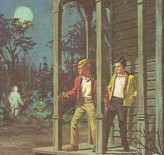
Time to add my two cents to the rest of the internet... I have seen Inglourious Basterds... Uh oh.... I think I should have forced myself to only look at the negative reviews - I would have come out singing a different song.
It is, taken as dispassionately as I can manage, a gripping, sometimes funny, sometimes harrowing, superbly written and made film - that has more or less nothing at stake, probably due to having just about exactly one character in it. Everyone else is a function, a plot point - acted with aplomb (except for a few caricatures that are enacted with the perfect pitch of absurdity - think Eli Roth, Mike Myers, or the people playing the German High Command) - everything is made with great care and energy, but it is all just a machine. The exception? Christoph Waltz, playing a fairly transparent Tarantino stand in (motormouth, omniscient, demiurge, foot fetishist...), overall - I guess maybe not quite a character either - more the Author. Though, one might note, not the only author, or Auteur - heck, it's lousy with auteurs, inventing scenarios, enacting them, stage managing them, editing them - as well as, of course, making actual film... staging bits of actual theater... writing, or carving, things....
All of this, I'd have to say, erases most of the real history involved. I suppose you can argue about what it means to erase the actual history of WWII, especially WWII as a story about Germans and Jews - you could, but I don't think it's worth as much trouble as some of the critics (pro and con) are going to. He isn't denying that history - he isn't telling a story that justifies glossing over what really happened. The holocaust, the final solution, is treated as an inciting incident, a piece of backstory - that may be a loaded thing to do (therein lies Rosenbaum's objections, as I read them) - but it does not deny the holocaust. Maybe it treats the holocaust like any other historical phenomenon - subject, like all history, to absorption into stories, absorption into history - there is some point in resisting this, in treating the holocaust as somehow resistant to history... But it isn't. It is history, in the end, and will move, like everything else has moved, from lived reality to books and stories and signs, which is all there really is of the past.... Tarantino doesn't lie about that past - he just treats it as part of the grand text of history - but I can't say that he says anything terribly important about that past. It's a convention, a plot device - it's not history....
And besides, say the champions, it's more about film (history) than history (history), anyway. Which is fair enough - though even the film references seemed a bit like name dropping - "oh look! Emil Jannings!" - though to be fair, there are some pretty interesting names being dropped (not just Joe May [I think I caught a Joe May reference] - Karl May! Rather prominently, that...) I don't think, that is, one gets anything particularly profound out of the film references - though what you get, you get underlined, starred, bolded, in red. No bit of irony or meaning, no moment of audience manipulation and complicity goes unmarked... He seems very eager to make these points, and make sure no one misses them. You know - Hitler giggles and squeals over Zoller (hero of the film within a film) slaughtering hundreds of Americans - 5 minutes later, the audience in the real theater giggles and squeals in exactly the same way as Hitler and company - etc....
So no - it's not a great film. It's a marvelously well made film - but it doesn't do much with its powerful material, and it doesn't add up to as good a story as Tarantino at his best... But - you know - that's on a curve, set by all those gushing reviews....
...Because under it all run some interesting threads. For example - the role of language, words, accents - even signs, marks - semiotics. "Meta-signs" maybe, "metalanguage" - not what people say, but the language they say it in; not the language but the accents. Not even that - the betrayal of the body (hands; feet)... Or the way people assume other cultural identities - we have Jews hiding as French; Brad Pitt rather implausibly claiming to be Apache (which probably inspires the Karl May reference... Jonathan Rosenbaum brings this up, for instance in the comments at Bright Lights After Dark - Tarantino not only uses the holocaust as a plot device, he brings in references to Native Americans and scalping, but purely as a "movie myth"... But here, I'm not so sure just how dumb Tarantino really is. Yes indeed, he has Brad Pitt claiming to be Apache and using this as an excuse for his scalping routine - but: for heaven's sake - that's a character talking - whether Tarantino should use the myth or not, this is a character in the film invoking the myth... And then there is that Karl May reference - that is, a reference to a German tradition of completely invented American Indian mythology. I don't know - I think maybe all that mythologizing, all the cultural cross-dressing, all the complexities of language and culture and history and mythologies and dehumanizing analogies (Jews and rats, duly evoked) - might just start to rise to the level of content....) We have spies, assuming various identities, out of movies or not - we have clever casting jokes (they have to be jokes), like a German born actor being accused of not speaking proper German... All this gives a bit of a twist to Pitt's determination to make sure no one who serves the Nazis can ever escape that fact...
Finally... as history - I have nothing against alternative history, but there is one thing that is very much a-historical about this film. Though again - it's a strange and maybe haunting kind of ahistoricism. Is it, shall we say, entirely a coincidence that Eli Roth plays someone called the "Bear Jew"? That this Bear Jew and his comrades are murderous, cruel, irregulars operating behind German lines? partisans, basically - not subject to the rules of warfare... and... Because what is missing from this film is most precisely the Bear - and what the Basterds do would probably not seem too out of place behind the lines on the Eastern Front. Where is the Eastern Front? where are the Russians? All this talk about ending the war by killing the German high command is fine and good - but even if that happened - what do you do about Stalin? Even the war movie-in-a-movie, set in Italy, sounds a lot more like something you'd get in Russia somewhere... Eli Roth, at least, has the decency to swipe a few shots from Eisenstein - otherwise, the reds would be completely missing. But - this film, the Basterds especially, plays a lot more like an eastern front movie might - atrocities and horrors on all sides (though played for laughs.) And I suspect some of that is supposed to be there - Tarantino is too attentive to his words not to mean something by calling his most brutal character (played by a Jewish actor with Russian heritage) "The Bear Jew"...
Saturday, August 29, 2009

Thursday, August 27, 2009
The Cost of (Inglourious) Delay
I seem to be the only film fan in America who did not see Inglourious Basterds last week. I had my reasons and I will stick by them - Basterds might turn out to be a better film than the two I saw, but 24 City was only showing that weekend, and I'll bet on Park Chan-wook over Quentin Tarantino any time (not to mention my terror at the short runs Asian films - even great Asians films - get) ... but it's a bit maddening to watch the kinds of conversations it's sparking and not be able to get involved quite yet. Watching the entries from the conversation between Dennis Cozzalio and Bill at The Kind of Face You Hate come across the RSS feed, and not actually read them (let alone jump into them, or any of the other conversations about the film) is very painful. Oh well - 2 more days! Though in the meanwhile, I get to watch my own anticipation about the film go through a fine roller coaster ride. I remember when I first started seeing comments about it - I figured, it's Tarantino, it will be entertaining, but it looks rather pointless... Then people started seeing it - some whining, but a lot of them starting to push it up - Glenn Kenny in particular made it seem very unmissable... but now, alas - the flood of hyperbole is starting to wear on me to the point that the curmudgeons start to sound like they have a point. Or not! I don't know! Terrible!
I admit, even now, I'd put my money on Thirst being the film that holds up... There are the facts: that Tarantino has never really matched his first three films since; that this is taking on History, and History is not always to be trifled with... though there are other facts - that for all his reputation as a fanboy's director, he's always made art films, playing with narrative structure and form, in scenes and whole films, and between films - this sounds like more of the same, maybe even more adventurous and sophisticated than ever; that for all the talk of a slump, he's really (in my opinion) only made one crappy film - Kill Bill I - part 2 was a nice comeback, and Death Proof is as formalized, "parametric" as - I don't know, pick your favorite formalist. And - while History is not to be trifled with, Great Things can emerge from giving it a twist here and there - I'll take Alexandria Why? or Once Upon a Time in China over pretty much any more "responsible" historical filmmaking - if Tarantino can approach those heights (and it's not unthinkable here) - then we could be on to something.
So - 2 more days.... it's been a while since there has been a film getting this much attention in the blogosphere that I actually cared about. I admit I'd be a lot happier if Thirst was getting this much attention - but hey...
I will end with one more comment - Eric Rentschler, who wrote the book on the subject of Nazi cinema, is offering his Nazi cinema class through Harvard's extension school this year... that's something else to look forward to...
I admit, even now, I'd put my money on Thirst being the film that holds up... There are the facts: that Tarantino has never really matched his first three films since; that this is taking on History, and History is not always to be trifled with... though there are other facts - that for all his reputation as a fanboy's director, he's always made art films, playing with narrative structure and form, in scenes and whole films, and between films - this sounds like more of the same, maybe even more adventurous and sophisticated than ever; that for all the talk of a slump, he's really (in my opinion) only made one crappy film - Kill Bill I - part 2 was a nice comeback, and Death Proof is as formalized, "parametric" as - I don't know, pick your favorite formalist. And - while History is not to be trifled with, Great Things can emerge from giving it a twist here and there - I'll take Alexandria Why? or Once Upon a Time in China over pretty much any more "responsible" historical filmmaking - if Tarantino can approach those heights (and it's not unthinkable here) - then we could be on to something.
So - 2 more days.... it's been a while since there has been a film getting this much attention in the blogosphere that I actually cared about. I admit I'd be a lot happier if Thirst was getting this much attention - but hey...
I will end with one more comment - Eric Rentschler, who wrote the book on the subject of Nazi cinema, is offering his Nazi cinema class through Harvard's extension school this year... that's something else to look forward to...
Wednesday, August 26, 2009
Ted Kennedy
Ted Kennedy is dead. He's a complicated figure - he did things that make you cringe; he used his position and family to get away with them - but he also served the country long and honorably. He did as much good as any politician in the last 40 plus years - medicare, immigration reform, health care - it's an impressive record. It would have been a crowning achievement if he could have helped get us out of our current disgraceful health insurance situation - it would be a great monument if it were passed now. He was a politician you could believe actually meant it - he stuck to his political ideas, and they were good political ideas - there was nothing bought and payed for about him. He will be missed.
Sunday, August 23, 2009
Quick Reviews
I need to keep a hand in here... it was a good week for movies. All the talk is about Inglourious Basterds, but that was the odd one out, this weekend. Jia Jiang-ke's 24 City was playing, a handful of shows, only one really convenient, so there was that... and it seems to me, the big release of the week, at least in Boston (some people are getting The Headless Woman, aren't they? Though I've seen the Headless Woman, so...) is Park Chan-wook's latest, Thirst. Tarantino can wait.
Thirst certainly delivers. A vampire film, starring Song Kang-ho as a priest who volunteers for a medical experiment, dies - and then - Vampire! He goes home, rumored to be able to heal the sick, and runs into some old friends, a rotten hypochondriac, and what the priest thought was a sister, but turns out to have been a foundling... and their formidable mother... Before long priest and bullied girl are enacting Zola (or James M. Cain, though it's Zola gets the screen credit...) and sharing diseases... As in all of Park's films, morality and sympathy shift and blur - the priest would do good, but has evil in him - he is, after all, a vampire; the girl has suffered all her life, and now - well... she does not have to suffer quite the same way anymore, and more, she gets to taste all the pleasures long denied.... Park shoots the whole story without committing to any side, quite - or any style, or tone - it veers constantly from horror to comedy to the kind of persistent sadness that appears in all his films I've seen.
And, while I'm here - 24 City is another strong film from Jia Jiang-ke. Set in Chengdu, it's partly a documentary about Factory 420 - which has been sold, and is being leveled, to put up "24 city" - a condo high rise. Workers from the factory are interviewed, telling stories about their lives - about coming to Chengdu from the north (Shanghai, etc.) - about growing up there - about making their way after the factory closed. The twist is - the interviewees are delivered by actors, playing the interviewees... the strangest moment perhaps being Joan Chen playing a woman who was nicknamed "Little Flower" at the plant - because she looked like Joan Chen, in a film called Little Flower... The stories themselves are driven by loss, sometimes recognition (as the final story and shot, a young woman who understands her parents for the first time when she sees them at work - then turns and the camera pans across the city...) - the sense of the old world being replaced, perhaps buy things that are, in fact, better - but without acknowledging what went into the old world... A theme running through Jia's work.
Thirst certainly delivers. A vampire film, starring Song Kang-ho as a priest who volunteers for a medical experiment, dies - and then - Vampire! He goes home, rumored to be able to heal the sick, and runs into some old friends, a rotten hypochondriac, and what the priest thought was a sister, but turns out to have been a foundling... and their formidable mother... Before long priest and bullied girl are enacting Zola (or James M. Cain, though it's Zola gets the screen credit...) and sharing diseases... As in all of Park's films, morality and sympathy shift and blur - the priest would do good, but has evil in him - he is, after all, a vampire; the girl has suffered all her life, and now - well... she does not have to suffer quite the same way anymore, and more, she gets to taste all the pleasures long denied.... Park shoots the whole story without committing to any side, quite - or any style, or tone - it veers constantly from horror to comedy to the kind of persistent sadness that appears in all his films I've seen.
And, while I'm here - 24 City is another strong film from Jia Jiang-ke. Set in Chengdu, it's partly a documentary about Factory 420 - which has been sold, and is being leveled, to put up "24 city" - a condo high rise. Workers from the factory are interviewed, telling stories about their lives - about coming to Chengdu from the north (Shanghai, etc.) - about growing up there - about making their way after the factory closed. The twist is - the interviewees are delivered by actors, playing the interviewees... the strangest moment perhaps being Joan Chen playing a woman who was nicknamed "Little Flower" at the plant - because she looked like Joan Chen, in a film called Little Flower... The stories themselves are driven by loss, sometimes recognition (as the final story and shot, a young woman who understands her parents for the first time when she sees them at work - then turns and the camera pans across the city...) - the sense of the old world being replaced, perhaps buy things that are, in fact, better - but without acknowledging what went into the old world... A theme running through Jia's work.
Tuesday, August 18, 2009
Another Quiz?
It's a scorcher, here in Beantown, hot and humid, and my normal lack of summer ambition is multiplied by the weather... But lo! happy day! another movie quiz! Via Thrilling Days of Yesterday (and at a blog I hadn't been reading... nice!) - some midweek content... The quiz itself is a week or so old, but that can't stop me...
1. Your favourite Humphrey Bogart film in which he doesn't play a gangster or a private eye. (Oh, and not including Casablanca either.)
A. The Treasure of the Sierra Madre, I imagine. Or to Have and Have Not - he's a fisherman there, I guess.
2. Your favourite appearance by a star in drag (boy-girl or girl-boy).
A. In the end, it's Jack Lemmon in Some Like it Hot.
3. Your favourite Laurel & Hardy film; short or feature, or one of each. (This will sort out the men from the boys - or perhaps the men from the girls.)
A. Liberty! Haven’t seen the features in ages, or any of the sound shorts.
4. Your favourite appearance by one star in a role strongly associated with another star. (Eg: Ricardo Cortez as Sam Spade, Grace Kelly as Tracy Lord, Vince Vaughn as Norman Bates...)
A. I should think about this some: Peter Cushing as Sherlock Holmes?
5. The thirties or forties star or stars you most think you'd like, but have yet to really get to know.
A. Jimmy Cagney - don’t have a handle on him yet.
6. Your favourite pre-Petrified Forest Bette Davis film.
A. Not sure. Maybe Three on a Match?
7. Your favourite post-Mildred Pierce Joan Crawford film.
A. Haven’t seen many, if any.
8. Your favourite film that ends with the main character's death.
A: McCabe and Mrs Miller? No - only half the main characters die; Pierrot le Fou? My Life to Live? The Gospel According to Matthew?
9. Your favourite Chaplin talkie.
A: M Verdoux
10. Your favourite British actor and actress.
A: Julie Christie and - Cary Grant? Though I have a soft spot for the bad guys - Basil Rathbone; Alan Rickman.
11. Your favourite post-1960 appearance by a 1930's star.
A: Once Upon a Time in the West?
12. Dietrich or Garbo?
A: Marlene!!!!!
13. Karloff or Lugosi?
A: Karloff.
14. Chaplin or Keaton? (I know some of you will want to say both for all of the above. Me too. But you can't.)
A: Keaton.
15. Your favourite star associated predominantly with the 1950's.
A: Frank Sinatra? Or Toshiro Mifune?
16. Your favourite Melvyn Douglas movie.
A: Probably The Old Dark House...
17. The box-office failure you most think should have been a success.
A: what counts? Vertigo? It's a Wonderful Life?
18. Your favourite performance by an actor or actress playing drunk.
A: Chishu Ryu, in Tokyo Story?
19. Your favourite last scene of any thirties movie.
A: Probably the end of the Awful Truth - though the end of Tabu is nearly perfect horror.
20. Your favourite American non-comedy silent movie.
A: Probably Sunrise? maybe Broken Blossoms, or even Birth of a Nation, for certain values of "favorite".
21. Your favourite Jean Harlow performance.
A: Bombshell
22. Your favourite remake. (Quizmaster's definition: second or later version of a work written as a movie, not a later adaptation of the same novel or play.)
A: Lord, I don't know - the best ones usually turn out to be adaptations, not always of specific works - Batman movies and Vampire stories and the like... so though I'd like to say Jimmy Stewart and Doris Day in The Man Who Knew Too Much - I don't think that quite measures up to the first one. But both versions of Floating Weeds measure up - it's Ozu.
23. Your favourite Orson Welles performance in a film he did not direct, not including The Third Man.
A: Yikes - The Ricotta?
24. Your favourite non-gangster or musical James Cagney film or performance.
A: See question #5.
25. Your favourite Lubitsch movie.
A: Trouble in Paradise
26. Who would win in a fight: Miriam Hopkins or Barbara Stanwyck? (Both in their prime; say in 1934 or so.)
A: Stanwyck - if only because I’d hit anyone who went after her with a chair.
27. Name the two stars you most regret never having co-starred with each other, and - if you want - choose your dream scenario for them. (Quizmaster's qualification: they have to be sufficiently contemporary to make it possible. So, yes to Cary Grant and Lon Chaney Jr as two conmen in a Howard Hawks screwball; no to Clara Bow and Kirsten Dunst as twin sisters on the run from prohibition agents in twenties Chicago, much though that may entice.)
A: Heavens - though in fact it's easy: Stanwyck and Jimmy Stewart in a Frank Capra joint.
28. Your favourite Lionel Barrymore performance.
A: It is Mr. Potter, I guess.
29. Bob Hope and Paulette Goddard or Bob Hope and Dorothy Lamour? (See note on question 14.)
A: haven't seen much but the Lamour films...
30. You won't want to answer this, but: there's been a terrible fire raging in the film libraries of all the major studios. It's far too late to save everything. All you can do is save as much as you can. You've been assigned the thirties. All you'll have time to drag from the obliterating inferno is one 1930's film each from Paramount, MGM, RKO, Columbia, Universal and Warners. Do you stomp around in a film buff's huff saying 'it's too hard, I can't choose just one' and watch them all go up in smoke? Or do you roll your sleeves up and start saving movies?
But if the latter: which ones...?
Paramount - Duck Soup
MGM - Bombshell!!!
RKO - Top Hat
Columbia - Mr Smith Goes to Washington
Universal - Bride of Frankenstein
Warners - I can’t do it. I can’t. I’d break down and cry. I'd dig for gold, pray for blessed event, shuffle off to buffalo and look for a night nurse by the employees entrance... But I'd probably end up with The Adventures of Robin Hood.
1. Your favourite Humphrey Bogart film in which he doesn't play a gangster or a private eye. (Oh, and not including Casablanca either.)
A. The Treasure of the Sierra Madre, I imagine. Or to Have and Have Not - he's a fisherman there, I guess.
2. Your favourite appearance by a star in drag (boy-girl or girl-boy).
A. In the end, it's Jack Lemmon in Some Like it Hot.
3. Your favourite Laurel & Hardy film; short or feature, or one of each. (This will sort out the men from the boys - or perhaps the men from the girls.)
A. Liberty! Haven’t seen the features in ages, or any of the sound shorts.
4. Your favourite appearance by one star in a role strongly associated with another star. (Eg: Ricardo Cortez as Sam Spade, Grace Kelly as Tracy Lord, Vince Vaughn as Norman Bates...)
A. I should think about this some: Peter Cushing as Sherlock Holmes?
5. The thirties or forties star or stars you most think you'd like, but have yet to really get to know.
A. Jimmy Cagney - don’t have a handle on him yet.
6. Your favourite pre-Petrified Forest Bette Davis film.
A. Not sure. Maybe Three on a Match?
7. Your favourite post-Mildred Pierce Joan Crawford film.
A. Haven’t seen many, if any.
8. Your favourite film that ends with the main character's death.
A: McCabe and Mrs Miller? No - only half the main characters die; Pierrot le Fou? My Life to Live? The Gospel According to Matthew?
9. Your favourite Chaplin talkie.
A: M Verdoux
10. Your favourite British actor and actress.
A: Julie Christie and - Cary Grant? Though I have a soft spot for the bad guys - Basil Rathbone; Alan Rickman.
11. Your favourite post-1960 appearance by a 1930's star.
A: Once Upon a Time in the West?
12. Dietrich or Garbo?
A: Marlene!!!!!
13. Karloff or Lugosi?
A: Karloff.
14. Chaplin or Keaton? (I know some of you will want to say both for all of the above. Me too. But you can't.)
A: Keaton.
15. Your favourite star associated predominantly with the 1950's.
A: Frank Sinatra? Or Toshiro Mifune?
16. Your favourite Melvyn Douglas movie.
A: Probably The Old Dark House...
17. The box-office failure you most think should have been a success.
A: what counts? Vertigo? It's a Wonderful Life?
18. Your favourite performance by an actor or actress playing drunk.
A: Chishu Ryu, in Tokyo Story?
19. Your favourite last scene of any thirties movie.
A: Probably the end of the Awful Truth - though the end of Tabu is nearly perfect horror.
20. Your favourite American non-comedy silent movie.
A: Probably Sunrise? maybe Broken Blossoms, or even Birth of a Nation, for certain values of "favorite".
21. Your favourite Jean Harlow performance.
A: Bombshell
22. Your favourite remake. (Quizmaster's definition: second or later version of a work written as a movie, not a later adaptation of the same novel or play.)
A: Lord, I don't know - the best ones usually turn out to be adaptations, not always of specific works - Batman movies and Vampire stories and the like... so though I'd like to say Jimmy Stewart and Doris Day in The Man Who Knew Too Much - I don't think that quite measures up to the first one. But both versions of Floating Weeds measure up - it's Ozu.
23. Your favourite Orson Welles performance in a film he did not direct, not including The Third Man.
A: Yikes - The Ricotta?
24. Your favourite non-gangster or musical James Cagney film or performance.
A: See question #5.
25. Your favourite Lubitsch movie.
A: Trouble in Paradise
26. Who would win in a fight: Miriam Hopkins or Barbara Stanwyck? (Both in their prime; say in 1934 or so.)
A: Stanwyck - if only because I’d hit anyone who went after her with a chair.
27. Name the two stars you most regret never having co-starred with each other, and - if you want - choose your dream scenario for them. (Quizmaster's qualification: they have to be sufficiently contemporary to make it possible. So, yes to Cary Grant and Lon Chaney Jr as two conmen in a Howard Hawks screwball; no to Clara Bow and Kirsten Dunst as twin sisters on the run from prohibition agents in twenties Chicago, much though that may entice.)
A: Heavens - though in fact it's easy: Stanwyck and Jimmy Stewart in a Frank Capra joint.
28. Your favourite Lionel Barrymore performance.
A: It is Mr. Potter, I guess.
29. Bob Hope and Paulette Goddard or Bob Hope and Dorothy Lamour? (See note on question 14.)
A: haven't seen much but the Lamour films...
30. You won't want to answer this, but: there's been a terrible fire raging in the film libraries of all the major studios. It's far too late to save everything. All you can do is save as much as you can. You've been assigned the thirties. All you'll have time to drag from the obliterating inferno is one 1930's film each from Paramount, MGM, RKO, Columbia, Universal and Warners. Do you stomp around in a film buff's huff saying 'it's too hard, I can't choose just one' and watch them all go up in smoke? Or do you roll your sleeves up and start saving movies?
But if the latter: which ones...?
Paramount - Duck Soup
MGM - Bombshell!!!
RKO - Top Hat
Columbia - Mr Smith Goes to Washington
Universal - Bride of Frankenstein
Warners - I can’t do it. I can’t. I’d break down and cry. I'd dig for gold, pray for blessed event, shuffle off to buffalo and look for a night nurse by the employees entrance... But I'd probably end up with The Adventures of Robin Hood.
Saturday, August 15, 2009
Les Paul
Les Paul died Thursday, aged 94 - as a guitar music fan, I can say - he was one of the big ones. Not just a great musician, but central to the development of the instrument, the music industry, the art form.
Here he is playing some Duke Ellington:
And let's not forget the guitar he invented - figuring in the hands of many other great musicians. such as?
Old Neil?
Duane Allman?
Sonny Sharrock:
Peter Green (and Danny Kirwin gets his licks in in this clip):
This Jumping at Shadows has Green front and center, though there's no footage:
And, oh well - Jimmy Page - the business end of Dazed and Confused - skip the crap and play, Jim:
[Had to update - put the first Fleetwood Mac clip in twice, instead of the second one.]
Here he is playing some Duke Ellington:
And let's not forget the guitar he invented - figuring in the hands of many other great musicians. such as?
Old Neil?
Duane Allman?
Sonny Sharrock:
Peter Green (and Danny Kirwin gets his licks in in this clip):
This Jumping at Shadows has Green front and center, though there's no footage:
And, oh well - Jimmy Page - the business end of Dazed and Confused - skip the crap and play, Jim:
[Had to update - put the first Fleetwood Mac clip in twice, instead of the second one.]
Friday, August 07, 2009
Writing the City
(Cross-posted at Film of the Month Club.)

One of the things that struck me about Hands Over the City was the number of representations of the city that appear. So much of the film is structured around ways of describing the city. We see Nottola's model (above) - we see several maps - we see his office, with a map painting on one wall, huge photos of the city on other walls, as well as windows looking at the city, and the model itself. But the city is represented by more than just images - there are words and numbers about the city, reports, statistics. The archive room is as much a representation of the city as the maps are.

But none of these representations are adequate - they are often quite flawed. The episode discussing the common wall of the house that collapsed is a case in point: the officials explain that they had no way of knowing - the scale of the map would make a meter thick wall 1/2mm wide line - their pens have 1 mm nibs - they can't represent the real width with their tools. It's a common theme - the reports are all accurate, in their way - but all miss things. You see the various officials making excuses and avoiding responsibilities - but their information, their maps, records, etc., are all equally ambiguous. The representations of the city tend to hide it as much as reveal it. Da Vita gets at this, with his all too apt metaphor - everything was by the book, but the book needs to be rewritten...

While most of this misreading and ambiguity is unintentional, Nottola emerges as a character who can exert willing control over things. He is determined and focused, he knows what he wants. And he sees - and he promises a view of the bay to everyone.. He can imagine it, and represent it - hreates the big model - his office is lined with maps and pictures. He is a visionary - he imagines the city as it will become, he sees it when it is not there. He will build it - but before he builds it, he imagines it, he is, rather literally, a writer of the city:

Now it is true, he is as apt to see the profits he can get as the biuldings he can build - he still falls into that class of ambiguous villains, the 20th century developer. There was a nice piece in the New York Times about a new book about Jane Jacobs and Robert Moses, her campaign to stop him from bulldozing Greenwich Village for a superhighway, or driving an interstate through Washington Square Park. Nottola is in the same vein as Moses - more of a crook, maybe, but still, someone trying to realize a vision of a city - though a vision that usually forgets about the people living there. Or reduce them to lists of names...

Anyway - it's a good film about a pretty substantial part of 20th century social history - the reinvention of cities. A process still going on - there are echoes of this film in recent films about urban renewal - Pedro Costa's In Vanda's Room and Colossal Youth, or Jose Luis Guerin's Under Construction - complete with the tour of the new buildings - handsome, safe, boring, and priced out of reach of the people who are being displaced...

One of the things that struck me about Hands Over the City was the number of representations of the city that appear. So much of the film is structured around ways of describing the city. We see Nottola's model (above) - we see several maps - we see his office, with a map painting on one wall, huge photos of the city on other walls, as well as windows looking at the city, and the model itself. But the city is represented by more than just images - there are words and numbers about the city, reports, statistics. The archive room is as much a representation of the city as the maps are.

But none of these representations are adequate - they are often quite flawed. The episode discussing the common wall of the house that collapsed is a case in point: the officials explain that they had no way of knowing - the scale of the map would make a meter thick wall 1/2mm wide line - their pens have 1 mm nibs - they can't represent the real width with their tools. It's a common theme - the reports are all accurate, in their way - but all miss things. You see the various officials making excuses and avoiding responsibilities - but their information, their maps, records, etc., are all equally ambiguous. The representations of the city tend to hide it as much as reveal it. Da Vita gets at this, with his all too apt metaphor - everything was by the book, but the book needs to be rewritten...

While most of this misreading and ambiguity is unintentional, Nottola emerges as a character who can exert willing control over things. He is determined and focused, he knows what he wants. And he sees - and he promises a view of the bay to everyone.. He can imagine it, and represent it - hreates the big model - his office is lined with maps and pictures. He is a visionary - he imagines the city as it will become, he sees it when it is not there. He will build it - but before he builds it, he imagines it, he is, rather literally, a writer of the city:

Now it is true, he is as apt to see the profits he can get as the biuldings he can build - he still falls into that class of ambiguous villains, the 20th century developer. There was a nice piece in the New York Times about a new book about Jane Jacobs and Robert Moses, her campaign to stop him from bulldozing Greenwich Village for a superhighway, or driving an interstate through Washington Square Park. Nottola is in the same vein as Moses - more of a crook, maybe, but still, someone trying to realize a vision of a city - though a vision that usually forgets about the people living there. Or reduce them to lists of names...

Anyway - it's a good film about a pretty substantial part of 20th century social history - the reinvention of cities. A process still going on - there are echoes of this film in recent films about urban renewal - Pedro Costa's In Vanda's Room and Colossal Youth, or Jose Luis Guerin's Under Construction - complete with the tour of the new buildings - handsome, safe, boring, and priced out of reach of the people who are being displaced...
Wednesday, August 05, 2009
Summer School for CinemaGeeks
Though summer is supposed to be vacation time, Mr. Dennis Cozzalio of Sergio Leone and the Infield Fly Rule blog insists on assigning home work - blaming it on poor Alan Rickman.... Yes, it's PROFESSOR SEVERUS SNAPE’S SORCERER-TASTIC, MUGGALICIOUS MID-SUMMER MOVIE QUIZ - 38 questions to be answered.... I've certainly been loafing my summer away, but I think I have managed to answer this - so - here goes:
1) Second-favorite Stanley Kubrick film.
A: The Killing
2) Most significant/important/interesting trend in movies over the past decade, for good or evil.
A: I think I have to say, the change in media. The shift from film to digital video; and the shift from film for exhibition to, again, digital forms of exhibition and distribution - from DVDs to digital projection to the internet. In fact - yes - this is what matters most, I think. I don’t know what it is going to do to the art form - but art follows technology, and I expect what emerges from the new systems of production and distribution will have its own value.
3) Bronco Billy (Clint Eastwood) or Buffalo Bill Cody (Paul Newman)?
A: Buffalo Bill - when in doubt, it’s always Altman.
4) Best Film of 1949.
A: Late Spring, easily.
5) Joseph Tura (Jack Benny) or Oscar Jaffe (John Barrymore)?
A: Jaffe - that’s one of the great characters of the 30s.
6) Has the hand-held shaky-cam directorial style become a visual cliché?
A: as much as anything, no more than anything else. It is, but you can say than about almost everything.
7) What was the first foreign-language film you ever saw?
A: I don’t know for sure. Some of the earliest ones I remember were Seven Samurai, the Seventh Seal - I think I saw them on TV somewhere, but I don’t remember when. I definitely saw Ivan the Terrible in 1986 or so, but I was used to subtitles by then, so I must have seen something. Seven Samurai and Seventh Seal were two of the earliest I deliberately sat down to watch, I know that.
8) Charlie Chan (Warner Oland) or Mr. Moto (Peter Lorre)
A: Probably Lorre, though I haven’t seen much of either.
9) Favorite World War II drama (1950-1970).
A: I would say Kon Ichikawa’s Fires on the Plain.
10) Favorite animal movie star.
A: I thought this would be harder, but - a bunch of us were talking about the Thin Man at work - that’s the answer! Asta!
11) Who or whatever is to blame, name an irresponsible moment in cinema.
A: Not sure what this means, exactly. I suppose I might as well take the opportunity to express, for the first time in a couple years, just how godawfully insultingly stupid Life is Beautiful is. It's all right, kiddies, just pretend it didn't happen and it will be like it never happened! hooray!
12) Best Film of 1969.
A: A Touch of Zen?
13) Name the last movie you saw theatrically, and also on DVD or Blu-ray.
A: Since it's taking me most of a month to answer... when I started - 7/17/2009 - the answer was: Tetro in the theater; Happy Feet on DVD... As of 7/25/09: In the Loop in theaters; Lang's Spiders on DVD. Today? 8/5/2009: Hands Over the City on DVD; The Lost World (1925 of course) in a theater; Up new in a theater (though that's almost second run, too...) [Just a coincidence, by the way, seeing Up and the Lost World so close together... a nice one of course. You can work Spiders in there as well - hot air balloons flying to South America?]
14) Second-favorite Robert Altman film.
Nashville
15) What is your favorite independent outlet for reading about movies, either online or in print?
A: CinemaScope? Or Bordwell and Thompson’s blog?
16) Who wins? Angela Mao or Meiko Kaji? (Thanks, Peter!)
A: I can’t really say, I don’t know how many times I have seen one of them (especially Mao) without knowing it - but I remember Meiko Kaji, so I’ll say her.
17) Mona Lisa Vito (Marisa Tomei) or Olive Neal (Jennifer Tilly)?
A: Lean toward Tomei . . . in fact - it’s almost always Tomei, who is gorgeous, and wonderful, in everything she does.
18) Favorite movie that features a carnival setting or sequence.
A: I’ll say some came running, maybe especially since I get to include a picture!

19) Best use of high-definition video on the big screen to date.
A: Zodiac? Che? Both are first rate. Zodiac, I suppose, gets the nod for being more specifically built around DV - the lighting possibilities and so on. Che is just gorgeous, but it would be just as gorgeous or more on 35. Zodiac would kind of have to be a different looking film.
20) Favorite movie that is equal parts genre film and a deconstruction or consideration of that same genre.
A: There are probably lots of these - I might as well say McCabe and Mrs. Miller - which is and subverts everything it is exquisitely.
21) Best Film of 1979.
A: Kieslowski’s Camera Buff
22) Most realistic and/or sincere depiction of small-town life in the movies.
A: Not sure. The art film division probably starts with Hou Hsiao Hsien and Wu Nien-jen - City of Sadness, A Time to Live a Time to Die, A Borrowed Life . . . though if I wanted to be perverse, I could say Satantango . . . American - Some Came Running is in there; so are Preston Sturges’ small town films - Miracle of Morgan Creek, Hail the Conquoring Hero. Or maybe it’s Local Hero . . . Or better - Whiskey Galore?
23) Best horror movie creature (non-giant division).
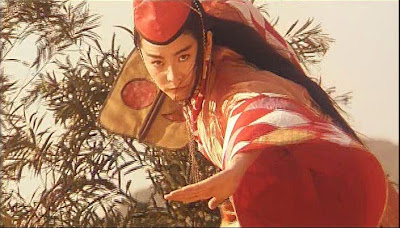
A: A really good question . . . Bridgitte Lin?
24) Second-favorite Francis Ford Coppola film.
A: The Godfather Part I.
25) Name a one-off movie that could have produced a franchise you would have wanted to see.
A: DArkman comes to mind. Though actually - just about any of the Coen brothers’ films would count - Marge? The Dude? Ulysses Everett McGill? Hi and Ed McDunnough? You bet I’d pay to see more of any of them.
26) Favorite sequence from a Brian De Palma film.
A: I can’t really answer this
27) Favorite moment in three-strip Technicolor.
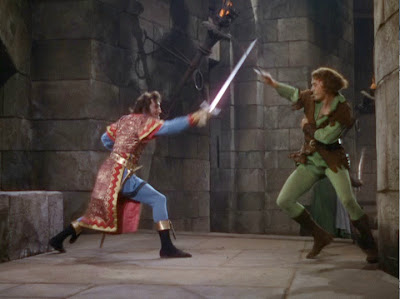
A: Probably something from The Adventures of Robin Hood.
28) Favorite Alan Smithee film. (Thanks, Peter!)
A: I’m not sure how to find this - I don’t think I’ve seen any of the classics listed on IMDB . . .
29) Crash Davis (Kevin Costner) or Morris Buttermaker (Walter Matthau)?
A: Buttermaker, of course.
30) Best post-Crimes and Misdemeanors Woody Allen film.
A: Husbands and Wives is actually pretty good. The only one since then that counts as a genuinely good movie (of those I have seen.)
31) Best Film of 1999.
A: Charisma - Kurosawa’s . . . (where’s 89? City of Sadness, is that answer.)
32) Favorite movie tag line.
A: I can't answer this on demand. I will think of it sometime tomorrow, in the middle of a meeting or walking home...
33) Favorite B-movie western.
A: I'm not sure what counts as a B - but if it is, Seven Men from Now seems like an obvious choice. And 40 Guns, especially given the final question below...
34) Overall, the author best served by movie adaptations of her or his work.
A: Well - why not Dashiell Hammett? The Thin Man films, Maltese Falcon, all the various versions of the Glass Key and Red Harvest - why not?
35) Susan Vance (Katharine Hepburn) or Irene Bullock (Carole Lombard)?
A: I’ll have to say Susan Vance.
36) Favorite musical cameo in a non-musical movie.
A: I could probably come up with more, but it’s hard to beat Ricky Nelson and Dino in Rio Bravo.
37) Bruno (the character, if you haven’t seen the movie, or the film, if you have): subversive satire or purveyor of stereotyping?
A: satire - whether it works or not, I don’t know.
38) Five film folks, living or deceased, you would love to meet. (Thanks, Rick!)
A: Nice question.... Well? 1) Barbara Stanwyck, for I am a groupie. 2) Sam Fuller, of course. 3) Boris Karloff, because not only was he in so many great films - he’s supposed to have been a really nice guy. 4) Speaking of Karloff - Val Lewton. 5) Jean Luc Godard - because - you gotta have Godard. And Jacques Rivette. They’re both alive, so I get the extra one, right?
1) Second-favorite Stanley Kubrick film.
A: The Killing
2) Most significant/important/interesting trend in movies over the past decade, for good or evil.
A: I think I have to say, the change in media. The shift from film to digital video; and the shift from film for exhibition to, again, digital forms of exhibition and distribution - from DVDs to digital projection to the internet. In fact - yes - this is what matters most, I think. I don’t know what it is going to do to the art form - but art follows technology, and I expect what emerges from the new systems of production and distribution will have its own value.
3) Bronco Billy (Clint Eastwood) or Buffalo Bill Cody (Paul Newman)?
A: Buffalo Bill - when in doubt, it’s always Altman.
4) Best Film of 1949.
A: Late Spring, easily.
5) Joseph Tura (Jack Benny) or Oscar Jaffe (John Barrymore)?
A: Jaffe - that’s one of the great characters of the 30s.
6) Has the hand-held shaky-cam directorial style become a visual cliché?
A: as much as anything, no more than anything else. It is, but you can say than about almost everything.
7) What was the first foreign-language film you ever saw?
A: I don’t know for sure. Some of the earliest ones I remember were Seven Samurai, the Seventh Seal - I think I saw them on TV somewhere, but I don’t remember when. I definitely saw Ivan the Terrible in 1986 or so, but I was used to subtitles by then, so I must have seen something. Seven Samurai and Seventh Seal were two of the earliest I deliberately sat down to watch, I know that.
8) Charlie Chan (Warner Oland) or Mr. Moto (Peter Lorre)
A: Probably Lorre, though I haven’t seen much of either.
9) Favorite World War II drama (1950-1970).
A: I would say Kon Ichikawa’s Fires on the Plain.
10) Favorite animal movie star.
A: I thought this would be harder, but - a bunch of us were talking about the Thin Man at work - that’s the answer! Asta!
11) Who or whatever is to blame, name an irresponsible moment in cinema.
A: Not sure what this means, exactly. I suppose I might as well take the opportunity to express, for the first time in a couple years, just how godawfully insultingly stupid Life is Beautiful is. It's all right, kiddies, just pretend it didn't happen and it will be like it never happened! hooray!
12) Best Film of 1969.
A: A Touch of Zen?
13) Name the last movie you saw theatrically, and also on DVD or Blu-ray.
A: Since it's taking me most of a month to answer... when I started - 7/17/2009 - the answer was: Tetro in the theater; Happy Feet on DVD... As of 7/25/09: In the Loop in theaters; Lang's Spiders on DVD. Today? 8/5/2009: Hands Over the City on DVD; The Lost World (1925 of course) in a theater; Up new in a theater (though that's almost second run, too...) [Just a coincidence, by the way, seeing Up and the Lost World so close together... a nice one of course. You can work Spiders in there as well - hot air balloons flying to South America?]
14) Second-favorite Robert Altman film.
Nashville
15) What is your favorite independent outlet for reading about movies, either online or in print?
A: CinemaScope? Or Bordwell and Thompson’s blog?
16) Who wins? Angela Mao or Meiko Kaji? (Thanks, Peter!)
A: I can’t really say, I don’t know how many times I have seen one of them (especially Mao) without knowing it - but I remember Meiko Kaji, so I’ll say her.
17) Mona Lisa Vito (Marisa Tomei) or Olive Neal (Jennifer Tilly)?
A: Lean toward Tomei . . . in fact - it’s almost always Tomei, who is gorgeous, and wonderful, in everything she does.
18) Favorite movie that features a carnival setting or sequence.
A: I’ll say some came running, maybe especially since I get to include a picture!

19) Best use of high-definition video on the big screen to date.
A: Zodiac? Che? Both are first rate. Zodiac, I suppose, gets the nod for being more specifically built around DV - the lighting possibilities and so on. Che is just gorgeous, but it would be just as gorgeous or more on 35. Zodiac would kind of have to be a different looking film.
20) Favorite movie that is equal parts genre film and a deconstruction or consideration of that same genre.
A: There are probably lots of these - I might as well say McCabe and Mrs. Miller - which is and subverts everything it is exquisitely.
21) Best Film of 1979.
A: Kieslowski’s Camera Buff
22) Most realistic and/or sincere depiction of small-town life in the movies.
A: Not sure. The art film division probably starts with Hou Hsiao Hsien and Wu Nien-jen - City of Sadness, A Time to Live a Time to Die, A Borrowed Life . . . though if I wanted to be perverse, I could say Satantango . . . American - Some Came Running is in there; so are Preston Sturges’ small town films - Miracle of Morgan Creek, Hail the Conquoring Hero. Or maybe it’s Local Hero . . . Or better - Whiskey Galore?
23) Best horror movie creature (non-giant division).
A: A really good question . . . Bridgitte Lin?

24) Second-favorite Francis Ford Coppola film.
A: The Godfather Part I.
25) Name a one-off movie that could have produced a franchise you would have wanted to see.
A: DArkman comes to mind. Though actually - just about any of the Coen brothers’ films would count - Marge? The Dude? Ulysses Everett McGill? Hi and Ed McDunnough? You bet I’d pay to see more of any of them.
26) Favorite sequence from a Brian De Palma film.
A: I can’t really answer this
27) Favorite moment in three-strip Technicolor.
A: Probably something from The Adventures of Robin Hood.

28) Favorite Alan Smithee film. (Thanks, Peter!)
A: I’m not sure how to find this - I don’t think I’ve seen any of the classics listed on IMDB . . .
29) Crash Davis (Kevin Costner) or Morris Buttermaker (Walter Matthau)?
A: Buttermaker, of course.
30) Best post-Crimes and Misdemeanors Woody Allen film.
A: Husbands and Wives is actually pretty good. The only one since then that counts as a genuinely good movie (of those I have seen.)
31) Best Film of 1999.
A: Charisma - Kurosawa’s . . . (where’s 89? City of Sadness, is that answer.)
32) Favorite movie tag line.
A: I can't answer this on demand. I will think of it sometime tomorrow, in the middle of a meeting or walking home...
33) Favorite B-movie western.
A: I'm not sure what counts as a B - but if it is, Seven Men from Now seems like an obvious choice. And 40 Guns, especially given the final question below...
34) Overall, the author best served by movie adaptations of her or his work.
A: Well - why not Dashiell Hammett? The Thin Man films, Maltese Falcon, all the various versions of the Glass Key and Red Harvest - why not?
35) Susan Vance (Katharine Hepburn) or Irene Bullock (Carole Lombard)?
A: I’ll have to say Susan Vance.
36) Favorite musical cameo in a non-musical movie.
A: I could probably come up with more, but it’s hard to beat Ricky Nelson and Dino in Rio Bravo.
37) Bruno (the character, if you haven’t seen the movie, or the film, if you have): subversive satire or purveyor of stereotyping?
A: satire - whether it works or not, I don’t know.
38) Five film folks, living or deceased, you would love to meet. (Thanks, Rick!)
A: Nice question.... Well? 1) Barbara Stanwyck, for I am a groupie. 2) Sam Fuller, of course. 3) Boris Karloff, because not only was he in so many great films - he’s supposed to have been a really nice guy. 4) Speaking of Karloff - Val Lewton. 5) Jean Luc Godard - because - you gotta have Godard. And Jacques Rivette. They’re both alive, so I get the extra one, right?
Thursday, July 30, 2009
Oopsies!
Uh oh - more names leaked from that 2003 drug test that got A-Rod earlier this year - this time coming closer to home - cheating swine Manny Ramirez and the sainted David Ortiz are named. Shocking news! Meanwhile, Ortiz wasted little time getting the Boston faithful to put this difficult revelation behind them, hitting a home run to win the afternoon's game....
Personally, I am rather grateful for this revelation. Boston fans were a bit too eager to go after A-Rod or Bonds or Canseco back in the day - local commentary is a bit too willing to sniff at those poor deluded fools in LA who welcomed Manny back with open arms after his suspension. Now - they'll have to find other ways to make fools of themselves. I am happy to report that I have generally not been too stern in my judgments - Manny, getting caught this year, is pretty pathetic - but, he did the time, he's back, there you go... and people like Bonds and such - it was a fact of the game back then. There's no grounds to get self-righteous about it - never was, and every name that comes out just proves it over and over again. There's been a certain amount of talk lately about Bill James' take on steroids - one of the keys of James' argument is that whatever "rules" existed against steroids before 2002 or 3 were openly unenforced, if not simply unenforceable. It was hard, in the 90s, not to see the steroid era as a deliberate policy on the part of major league baseball - home runs put asses in in the seats, most of the promotion of the game was promotion of home runs - not for nothing was the home run contest THE attraction of the all star break in that era. I don't know how to get around this. The plain obviousness of the rampant use of steroids, and the obvious acceptance of this at every level of the game. Maybe not the "purists" - as posturing a bunch of blowhards as you are likely to see - but everyone else. Not that you had to like it - I'm a pitching defense, walks and doubles guy myself, a fan of the national league game stuck in a quintessentially American League city, alas... but it's what it is - or was what it was.
The questions about the hall of fame are coming up, more and more - that's what James is writing about; the other night on one of the Red Sox games, Gordon Edes said almost the same thing - you don't know who used and who didn't - in the end, the odds are almost everyone from 95-05 will have used something - so you probably have to accept it as a fact of the game as it was played and vote for the best players of the era. That is how I feel. Using steroids isn't admirable, but it was done, and done widely, and hall of fame voting (for instance) is always about comparing players to their peers. Now - it might be more of a problem to compare those players to the players who came before - what are the raw totals worth? How much do you have to discount Manny Ramirez to compare him, accurately, to Jim Rice? Personally - I think steroids are already starting to work the other way - I think Jim Rice got into the Hall of Fame mostly as a reaction to the steroid era. I suspect - much as I adored Jim Rice as a ball player - that without the steroid era, Rice would never have made it in. He wasn't getting in before the strike, before McGwire and Sosa and Bonds hitting 60s of home runs, and so on. If they hadn't, even if they had put up the kinds of numbers you would have expected them to - a couple hundred fewer career homers, maybe; topping out around 52-55 in a season, I imagine - I don't think Rice would have gotten in. I don't know if I would have voted for him, for anything except as a home town favorite... I suppose that goes for the juice boys - I don't know if Sosa was really any better than JIm Ed - McGwire was just a power hitter... ON the other hand, steroids or not, I don't see any case for keeping Bonds or Clemens or A Rod out of the hall - if they were cheaters, they were plainly better than all the other cheaters, and probably better than a good many non-cheaters... So...
Baseball. In the end, I expect to treat steroids the way you treat Coors field or the dead ball - one of the conditions of the game at a certain time, that changes the way the stats look.
Meanwhile, to turn to less controversial subjects - I see metro Boston's last big horrendous news item has reached a kind of conclusion, as President Obama's "beer summit" occurs, bringing Henry Louis Gates and police sergeant James Crowley together for a brewski and a few words of wisdom.... I hope those words of wisdom include something to the effect of, "you know, sergeant, while it's true I should not have called you stupid in front of the national media, you really did screw up." It's rather amazing that a significant number of people don't think the cop is essentially to blame. You can't go arresting people for breaking into their own house - or for being pissed off when you show up and investigate them for breaking into their own house... of course, there's some sign the cop knew that, and got Gates to follow him outside in a rage, where he could arrest him for creating a public disturbance - hard to say. But hard to see anything in the story that puts the blame for the arrest anywhere but on the police.
Anyway, it seems to be winding down now. Just as well. Though I hope something more comes out of this than another round of solemn intonations to Never Antagonize An Officer of the Law! Usually from the same people who solemnly intone that Socialized Medicine Will Take Away Your Right to Choose Your Own Health Care! Right. By god, if we've gotta have a police state, let's at least have free health care!
Personally, I am rather grateful for this revelation. Boston fans were a bit too eager to go after A-Rod or Bonds or Canseco back in the day - local commentary is a bit too willing to sniff at those poor deluded fools in LA who welcomed Manny back with open arms after his suspension. Now - they'll have to find other ways to make fools of themselves. I am happy to report that I have generally not been too stern in my judgments - Manny, getting caught this year, is pretty pathetic - but, he did the time, he's back, there you go... and people like Bonds and such - it was a fact of the game back then. There's no grounds to get self-righteous about it - never was, and every name that comes out just proves it over and over again. There's been a certain amount of talk lately about Bill James' take on steroids - one of the keys of James' argument is that whatever "rules" existed against steroids before 2002 or 3 were openly unenforced, if not simply unenforceable. It was hard, in the 90s, not to see the steroid era as a deliberate policy on the part of major league baseball - home runs put asses in in the seats, most of the promotion of the game was promotion of home runs - not for nothing was the home run contest THE attraction of the all star break in that era. I don't know how to get around this. The plain obviousness of the rampant use of steroids, and the obvious acceptance of this at every level of the game. Maybe not the "purists" - as posturing a bunch of blowhards as you are likely to see - but everyone else. Not that you had to like it - I'm a pitching defense, walks and doubles guy myself, a fan of the national league game stuck in a quintessentially American League city, alas... but it's what it is - or was what it was.
The questions about the hall of fame are coming up, more and more - that's what James is writing about; the other night on one of the Red Sox games, Gordon Edes said almost the same thing - you don't know who used and who didn't - in the end, the odds are almost everyone from 95-05 will have used something - so you probably have to accept it as a fact of the game as it was played and vote for the best players of the era. That is how I feel. Using steroids isn't admirable, but it was done, and done widely, and hall of fame voting (for instance) is always about comparing players to their peers. Now - it might be more of a problem to compare those players to the players who came before - what are the raw totals worth? How much do you have to discount Manny Ramirez to compare him, accurately, to Jim Rice? Personally - I think steroids are already starting to work the other way - I think Jim Rice got into the Hall of Fame mostly as a reaction to the steroid era. I suspect - much as I adored Jim Rice as a ball player - that without the steroid era, Rice would never have made it in. He wasn't getting in before the strike, before McGwire and Sosa and Bonds hitting 60s of home runs, and so on. If they hadn't, even if they had put up the kinds of numbers you would have expected them to - a couple hundred fewer career homers, maybe; topping out around 52-55 in a season, I imagine - I don't think Rice would have gotten in. I don't know if I would have voted for him, for anything except as a home town favorite... I suppose that goes for the juice boys - I don't know if Sosa was really any better than JIm Ed - McGwire was just a power hitter... ON the other hand, steroids or not, I don't see any case for keeping Bonds or Clemens or A Rod out of the hall - if they were cheaters, they were plainly better than all the other cheaters, and probably better than a good many non-cheaters... So...
Baseball. In the end, I expect to treat steroids the way you treat Coors field or the dead ball - one of the conditions of the game at a certain time, that changes the way the stats look.
Meanwhile, to turn to less controversial subjects - I see metro Boston's last big horrendous news item has reached a kind of conclusion, as President Obama's "beer summit" occurs, bringing Henry Louis Gates and police sergeant James Crowley together for a brewski and a few words of wisdom.... I hope those words of wisdom include something to the effect of, "you know, sergeant, while it's true I should not have called you stupid in front of the national media, you really did screw up." It's rather amazing that a significant number of people don't think the cop is essentially to blame. You can't go arresting people for breaking into their own house - or for being pissed off when you show up and investigate them for breaking into their own house... of course, there's some sign the cop knew that, and got Gates to follow him outside in a rage, where he could arrest him for creating a public disturbance - hard to say. But hard to see anything in the story that puts the blame for the arrest anywhere but on the police.
Anyway, it seems to be winding down now. Just as well. Though I hope something more comes out of this than another round of solemn intonations to Never Antagonize An Officer of the Law! Usually from the same people who solemnly intone that Socialized Medicine Will Take Away Your Right to Choose Your Own Health Care! Right. By god, if we've gotta have a police state, let's at least have free health care!
Tuesday, July 28, 2009
Memories

July is not a good blogging month for me - there is too much to do: vacations, mine and people visiting me - softball games - baseball to watch, too hot, usually to do a lot of writing... And I suppose I've been a bit burnt out, after taking too classes in the spring, then knocking out a bunch of Japanese film posts in June... not a lot of posts, but longish posts...
Excuses excuses. There are things to do - one thing to do is post a response to Joseph B's Mr. Bernstein Meme. The principal is simple - a memory, with the same kind of disproportionate importance of the girl in white on the ferry, cited by Bernstein in Citizen Kane. Which also puts me in mind of Caveh Zahedi's monologue in Waking Life about Holy Moments... I have been thinking about memory - I have been scanning slides - which create whole webs of associations. The knowledge about who is in the pictures, where, what they are doing - the memories, the sense memories, of the things in the pictures (when I remember them) - and the memories of watching slides themselves. My family had - well, probably thousands of slides. Once a month or so, we would set up a screen, make a big bowl of popcorn, turn off the lights and go through them - grabbing boxes of them blind, going through them almost randomly... An event.
So - that is what I should write about - but it is harder work than it should be. And - I have a lot more slides to go through - making it easy to procrastinate.... Now: I can stick pretty close to Bernstein's memory - a girl, spotted once... In this case - an Asian girl, college aged, throwing a frisbee with some friends in JFK Park, in Harvard Square, 12-15 years ago. Summer - she had short hair, shorts and a tee shirt, she was really good with he frisbee... I don't know what about her stuck - I have spent lots of afternoons in JFK park, eating lunch, reading, whatever - lots of kids throwing frisbees (and playing soccer and volleyball and sunbathing and walking dogs and kids and everything else people do, lazy summer afternoons...) But I remember her.
Though I hope I can write something about this, say:

A train, photographed somewhere on the line from Northern Vermont, NIagara Falls and Toronto, sometime in the summer of 1977 or 78. Nothing spectacular - and honestly, it doesn't really spark any memories. What it does do, though, is remind me of James Bennings' RR - and that film sparks memories. All of it - but especially, starting with shot #4 (the link above has pictures of all the trains in the film), of waiting or trains to cross roads. I had forgotten that - it's rare, now, to have to wait for a long train to cross a road - but when I was a kid, it happened quite a lot. Maybe it happened most when we were traveling in Canada - I remember long trains, trains crossing roads, or running alongside roads. I remember counting the cars of trains, especially when they were crossing the highway. And - some of those big monsters - 100 plus cars - I remember some of those. I remember counting cars on trains - one of the games we played when we were driving (my family) - counting horses, counting snowmobiles, not to mention road bingo - games we played, driving to Vermont, Canada, etc. There's a lot there....
And finally - that train, that trip, to Niagara falls - that's the picture at the top. I haven't come to the rest of the Niagara slides. That's likely to bring back some memories, when I dig them up.
Saturday, July 18, 2009
Distractions

I have nothing much to say here. I have spent this week with a lovely new toy - a little slide scanner, nothing special, but it works. My family took slides - up to the middle of the 80s, maybe - 70%? more? - of the pictures we took were slides. It's been years since anyone bothered to bring out the projector, the screen, all that stuff - they were in danger of disappearing into - nothingness... So this has been a blessing. Quick and simple process getting them on the computer (the machine scans to SD cards) - the quality doesn't seem to be all that good, though it might just be the fact that these are 30 to 50 year old slides, snapshots at that. But it does what it does and does it very well... I've gotten a few hundred done this weekend - god knows how many more there are at the family homestead, but I might get them all in there. I am happy...
Anyway - here is a picture that probably explains a lot. It's hard to see - but that's Johnny West on the arm of the chair; and those are Hardy Boys books on the chair and in hand. That's me at 8 or 9, every inch the nerd I would become...

Now this picture - thankfully, I never became the evil clown I foretold here...

Wednesday, July 08, 2009
This may be scientific, but it's pretty horrible
For of the Spirit of Ed Wood blogathon, literary division.

I know next to nothing about Dr. John Button, but if anyone exemplifies the spirit of Ed Wood, it was Dr. John Button. Who was Dr. John Button? Whatever else he was, he was a ghostwriter for the Stratemeyer syndicate, mass producers of children's literature from the beginning of the 20th century to - well, today, in spirit at least. Now Edward Stratemeyer - that's what people like Ed Wood, enthusiastic purveyors of unabashed pulp fiction, aspired to be - knocking out stories by the score, first whole books, then outlines, that he farmed out to his ghostwriters, all of it written to spec - 25 chapters, 200 or so pages, one after another... all of it immensely popular, and some of it pretty damned good - with a few series that changed the cultural landscape. The Hardy Boys - Nancy Drew - maybe Tom Swift and the Bobbsey Twins... That's Edward Stratemeyer.
I loved the Hardy Boys when I was a kid - yes I did. I think I read the first one in second grade, and was addicted from the start - I read every one of them I could find. I emptied all the libraries I had access to - and since I had access to some old and shabby libraries, I read the original set of books along with the current set of books. (The Syndicate rewrote the early books starting in 1959: they dumbed down the prose, turned the boys squeaky clean, took out the racism [which was pretty bad for a while], and most of the characterization to boot.] Now I wasn't the most discriminating reader when I was 8, but I had my favorites, and there were some head-scratchers in the series - I was pleased to discover on re-reading them that my faves were actually pretty good, and the dubious ones were actually pretty bad... Okay. The fact is, I suppose, the Stratemeyer's techniques were bound to create a very uneven series - only as good as the outliners and the ghostwriters currently employed. It is no surprise that the first 10-11 are the strongest - they were written by Leslie McFarlane, a more than fair writer; the were probably outlined, at least some of them, by old Edward Stratemeyer himself. He died in 1930, and it's the early 30s when things go south - the stories get dumber; the racism gets more pronounced; the characters get more caricatured... And then, in 1938, with McFarlane gone, the syndicate hired our hero, Dr. John Button, to write the books....
He wrote five: The Secret Warning; The Twisted Claw; The Disappearing Floor; The Mystery of the Flying Express; and The Clue of the Broken Blade. Even when I was a kid, I could tell these were a bit - off. Not that the rest of the series is great lit - the first 11 (say) are pretty damned good for what they are; there's a nice renaissance in the 40s and 50s (the stories tend to be sillier, but there's a nice sense of atmosphere to a lot of them, some cool set pieces, and a couple better than average detective stories); but they grow increasingly perfunctory and formulaic in the late 50s and 60s onward, and are near unreadable by the 70s. (An opinion I held in real time...) But the bad books and bad stretches tend to be boring and drab affairs - flat prose and flat stories and predictable action and....
Not the Dr. John Button books. No. They are bad, but they are bad in the finest tradition of Ed Wood. (Though bad a decade or so before Ed Wood started to be bad.) They are bad for all the normal reasons - lazy plots, built on coincidence and caricatured characters, realized in dull, awkward prose, full of implausible events and - more or less uniquely in a property this closely controlled by its owners - jammed full of continuity errors. Like getting characters' names wrong - like the Hardy Boys mother's name wrong. That sort of thing.... They are bad for those reasons - but they are also bad for - well - let's cut to the chase: the Plan 9 From Outer Space of juvenile fiction, and the source of this humble blog's name, and its blogger's screenname - The Disappearing Floor.
If you were to click on that last link, you'd find a couple summaries of this book - both of which give up after 4-5 chapters. Let me give you a partial itinerary for the boys: they start at a train station - go to a place called Great Notch, somewhere in the hills - they hike into the woods - they fall into a cave (and meet their father) - they leave the cave, find a bag of silver dollars, and head off to return it to some place called Wayne City - after driving a cab into the river, precipitating a riot at the bank, and discovering that the bag contains $82,000 (in silver dollars) - they go back to the woods, where Dad has been KO'd - once more into the cave, more trouble there - they haul Dad to a hospital - they go back to Bayport - then up into the woods with a bunch of girls and their Aunt Gertrude. There - Dad turns up and is mauled by a tiger that the boys kill with pointed sticks (no, really!) and a rock - they take him to the hospital again, send the girls back home - go back looking for the bad guys and are attacked by another tiger, and rescued by the villain - they go to thank him, but are worried he'll recognize him so they drag up. Then it's off to the town of Erie, for another bank robbery - they follow the robbers who bury gold in a cemetery - later a crazy old man digs up the gold during a thunder storm - the boys capture the head robber - then get kidnapped - go to an Old Dark House - are frozen solid and set adrift in a rowboat - go back to the house - where most of the rest of the story takes place... Though they do leave a few times, once to fly from Erie to Columbia to buy a book, then back, tailed by the wolfish gangster Weeping Sam himself - they hide at an amusement park, then back to the house, where Fenton Hardy gets electrocuted and frozen solid....
Right. It's like that - constant motion, until they reach the house, and even there they go in and out, up and down, as does the house (the title coming from a room with an elevator in the floor) - contending with a mad scientist who grows plants with electricity, has a device for quick freezing people, immobilizes people with magnetic fields, has a system of electric ghosts to scare off intruders, as well as more prosaic electric traps and locks, has the whole place bugged ("the listening ear"), has a machine that can force you to tell the truth - etc.... What happens in all these places - never mind the science fiction - is wildly absurd: randomly finding bags of money, people turning up and disappearing at will, the boys dressing up as old women to fool Duke Beeson, and later pretending to be Duke Beeson to fool Weeping Sam - and full of extremely strange things. Two Tigers loose in the woods? a group of -sun-worshippers? "Ozonites" - led by Chief Shining Light - an Indian Prince (native of India, that is) - who's really Duke Beeson? I don't know how much of this is the fault of the syndicate's outliners (Edna Stratemeyer Squire, in fact, daughter of old Edward) and how much is Button's, but whoever it is - it's a pretty amazing performance....
It's bad - but it sneaks up on you. It's like those Ed Wood films - however silly the story is, however badly acted, shot, written it is - it has a kind of total, warped commitment. It's ridiculous - but you can't parody it, you can't make fun of it. The Hardy Boys books, over all, are pretty easy to make fun of - the coincidences, the convenient disappearances and reappearances of Fenton Hardy, the frequent blows to the head, Chet and his hobbies, his appetite, his cowardice - everything rolled out like cloclwork... But this one plays like a parody of all that - Button never met a cliche he didn't like, and could execute them with all the obviousness and lack of grace that Ed Wood would have later - so if Fenton Hardy turns up unexpectedly in a cave, Button isn't going to waste any time looking for a way to make it seem plausible - no: he's just there! if the outliner lost track of where the bag of coins was, Button doesn't care - Oh! it fell in a hole! it looks like a rock! And far be it from him to change the dollar amounts - if the outline says it's a bag of coins in the first chapter, he's not going to quibble too much about what 82,000 silver dollars would weigh in the next chapter, nor let carrying that amount of money slow the Hardy boys from swimming out of a sinking taxi cab... And if you are going to set most of the story in an old dark house, you can bet that you get to the old dark house by way of a thunderstorm in a cemetery at midnight with a cackling madman digging up buried loot...
And that - along with the pace and the sheer weirdness of it - makes it a surprisingly fun read. It's a hoot. It doesn't hurt that, compared to most of the series, it contains some really memorable villains. That's something of a Dr. John Button specialty, in all his books. The bad guys in most Hardy Boys books are a pretty bland lot - snarling swarthy brutes, plus the occasional con man or cold eyed pretty boy assassin, who never really do much beyond whack the boys on the head and explain their evil schemes after they've been captured.... Not Button's villains - they sneer and menace and get lines - lots of lines - and names - Dick Tracy type names: Kuntz the deep sea diver (in The Secret Warning); Pierre the French Canadian Pirate (in the Twisted Claw); and in this book - Duke Beeson, alias Chief Shining Light; wolfish Weeping Sam his main henchman; Louis Butts; three stooges named (as they should be) Pudge, Runt and Spike. They carry on, they get in fights, they scheme against one another and the boys - and when Eben Adar (the mad sceintist) points his truth tellign machine at them, they tell their life stories. At least Duke Beeson does: "The first thing I ever stole was my teacher's pocketbook," he said in a drawl.... HIs books as a group do this - make the villains much more prominent, treating them like, well - Dick Tracy, and other comic strips - or the better Hollywood adventure tales, giving the bad guys scenery to chew... it goes a long way toward making these books enjoyable.
And finally - there's the dialogue. This has more than its share of Ed Wood worthy lines. The boys find the bad guys frozen solid - "This may be scientific," concluded Joe, "but it's pretty horrible." Or in re the tiger they have downed, and possibly killed - "Give me your stick. I'll poke him." Or perhaps this exchange: the old madman, Eben Adar, is giving Aunt Gertrude a tour, showing her his electric flowers...
Which I suppose brings us to a final point. You have to start to wonder - all this absurdity - the obvious, unapologetic coincidences and cliches, the heavy handed foreshadowing, and - well - lines like that one? or the inclusion of those sun-worshippers? Given that "sun-worshippers" usually turns up in old books and movies and comics as a reference to nudists... and the boys, dressing up as old women? and - well - maybe - I can't help suspecting that maybe Dr. John Button was in on a bit more of the unintentional comedy than he lets on. But in the end, I suppose it doesn't matter - the book is - utterly ridiculous, but funny as hell anyway, packed full of stuff, completely shameless - and a joy to read. As much fun as an Ed Wood movie, and it would be just as funny if it were all meant as a parody, as it is, thinking it's just ineptitude. There's a fine line between clever and stupid - and sometimes, the line doesn't matter in the least.

I know next to nothing about Dr. John Button, but if anyone exemplifies the spirit of Ed Wood, it was Dr. John Button. Who was Dr. John Button? Whatever else he was, he was a ghostwriter for the Stratemeyer syndicate, mass producers of children's literature from the beginning of the 20th century to - well, today, in spirit at least. Now Edward Stratemeyer - that's what people like Ed Wood, enthusiastic purveyors of unabashed pulp fiction, aspired to be - knocking out stories by the score, first whole books, then outlines, that he farmed out to his ghostwriters, all of it written to spec - 25 chapters, 200 or so pages, one after another... all of it immensely popular, and some of it pretty damned good - with a few series that changed the cultural landscape. The Hardy Boys - Nancy Drew - maybe Tom Swift and the Bobbsey Twins... That's Edward Stratemeyer.
I loved the Hardy Boys when I was a kid - yes I did. I think I read the first one in second grade, and was addicted from the start - I read every one of them I could find. I emptied all the libraries I had access to - and since I had access to some old and shabby libraries, I read the original set of books along with the current set of books. (The Syndicate rewrote the early books starting in 1959: they dumbed down the prose, turned the boys squeaky clean, took out the racism [which was pretty bad for a while], and most of the characterization to boot.] Now I wasn't the most discriminating reader when I was 8, but I had my favorites, and there were some head-scratchers in the series - I was pleased to discover on re-reading them that my faves were actually pretty good, and the dubious ones were actually pretty bad... Okay. The fact is, I suppose, the Stratemeyer's techniques were bound to create a very uneven series - only as good as the outliners and the ghostwriters currently employed. It is no surprise that the first 10-11 are the strongest - they were written by Leslie McFarlane, a more than fair writer; the were probably outlined, at least some of them, by old Edward Stratemeyer himself. He died in 1930, and it's the early 30s when things go south - the stories get dumber; the racism gets more pronounced; the characters get more caricatured... And then, in 1938, with McFarlane gone, the syndicate hired our hero, Dr. John Button, to write the books....
He wrote five: The Secret Warning; The Twisted Claw; The Disappearing Floor; The Mystery of the Flying Express; and The Clue of the Broken Blade. Even when I was a kid, I could tell these were a bit - off. Not that the rest of the series is great lit - the first 11 (say) are pretty damned good for what they are; there's a nice renaissance in the 40s and 50s (the stories tend to be sillier, but there's a nice sense of atmosphere to a lot of them, some cool set pieces, and a couple better than average detective stories); but they grow increasingly perfunctory and formulaic in the late 50s and 60s onward, and are near unreadable by the 70s. (An opinion I held in real time...) But the bad books and bad stretches tend to be boring and drab affairs - flat prose and flat stories and predictable action and....
Not the Dr. John Button books. No. They are bad, but they are bad in the finest tradition of Ed Wood. (Though bad a decade or so before Ed Wood started to be bad.) They are bad for all the normal reasons - lazy plots, built on coincidence and caricatured characters, realized in dull, awkward prose, full of implausible events and - more or less uniquely in a property this closely controlled by its owners - jammed full of continuity errors. Like getting characters' names wrong - like the Hardy Boys mother's name wrong. That sort of thing.... They are bad for those reasons - but they are also bad for - well - let's cut to the chase: the Plan 9 From Outer Space of juvenile fiction, and the source of this humble blog's name, and its blogger's screenname - The Disappearing Floor.
If you were to click on that last link, you'd find a couple summaries of this book - both of which give up after 4-5 chapters. Let me give you a partial itinerary for the boys: they start at a train station - go to a place called Great Notch, somewhere in the hills - they hike into the woods - they fall into a cave (and meet their father) - they leave the cave, find a bag of silver dollars, and head off to return it to some place called Wayne City - after driving a cab into the river, precipitating a riot at the bank, and discovering that the bag contains $82,000 (in silver dollars) - they go back to the woods, where Dad has been KO'd - once more into the cave, more trouble there - they haul Dad to a hospital - they go back to Bayport - then up into the woods with a bunch of girls and their Aunt Gertrude. There - Dad turns up and is mauled by a tiger that the boys kill with pointed sticks (no, really!) and a rock - they take him to the hospital again, send the girls back home - go back looking for the bad guys and are attacked by another tiger, and rescued by the villain - they go to thank him, but are worried he'll recognize him so they drag up. Then it's off to the town of Erie, for another bank robbery - they follow the robbers who bury gold in a cemetery - later a crazy old man digs up the gold during a thunder storm - the boys capture the head robber - then get kidnapped - go to an Old Dark House - are frozen solid and set adrift in a rowboat - go back to the house - where most of the rest of the story takes place... Though they do leave a few times, once to fly from Erie to Columbia to buy a book, then back, tailed by the wolfish gangster Weeping Sam himself - they hide at an amusement park, then back to the house, where Fenton Hardy gets electrocuted and frozen solid....
Right. It's like that - constant motion, until they reach the house, and even there they go in and out, up and down, as does the house (the title coming from a room with an elevator in the floor) - contending with a mad scientist who grows plants with electricity, has a device for quick freezing people, immobilizes people with magnetic fields, has a system of electric ghosts to scare off intruders, as well as more prosaic electric traps and locks, has the whole place bugged ("the listening ear"), has a machine that can force you to tell the truth - etc.... What happens in all these places - never mind the science fiction - is wildly absurd: randomly finding bags of money, people turning up and disappearing at will, the boys dressing up as old women to fool Duke Beeson, and later pretending to be Duke Beeson to fool Weeping Sam - and full of extremely strange things. Two Tigers loose in the woods? a group of -sun-worshippers? "Ozonites" - led by Chief Shining Light - an Indian Prince (native of India, that is) - who's really Duke Beeson? I don't know how much of this is the fault of the syndicate's outliners (Edna Stratemeyer Squire, in fact, daughter of old Edward) and how much is Button's, but whoever it is - it's a pretty amazing performance....
It's bad - but it sneaks up on you. It's like those Ed Wood films - however silly the story is, however badly acted, shot, written it is - it has a kind of total, warped commitment. It's ridiculous - but you can't parody it, you can't make fun of it. The Hardy Boys books, over all, are pretty easy to make fun of - the coincidences, the convenient disappearances and reappearances of Fenton Hardy, the frequent blows to the head, Chet and his hobbies, his appetite, his cowardice - everything rolled out like cloclwork... But this one plays like a parody of all that - Button never met a cliche he didn't like, and could execute them with all the obviousness and lack of grace that Ed Wood would have later - so if Fenton Hardy turns up unexpectedly in a cave, Button isn't going to waste any time looking for a way to make it seem plausible - no: he's just there! if the outliner lost track of where the bag of coins was, Button doesn't care - Oh! it fell in a hole! it looks like a rock! And far be it from him to change the dollar amounts - if the outline says it's a bag of coins in the first chapter, he's not going to quibble too much about what 82,000 silver dollars would weigh in the next chapter, nor let carrying that amount of money slow the Hardy boys from swimming out of a sinking taxi cab... And if you are going to set most of the story in an old dark house, you can bet that you get to the old dark house by way of a thunderstorm in a cemetery at midnight with a cackling madman digging up buried loot...
And that - along with the pace and the sheer weirdness of it - makes it a surprisingly fun read. It's a hoot. It doesn't hurt that, compared to most of the series, it contains some really memorable villains. That's something of a Dr. John Button specialty, in all his books. The bad guys in most Hardy Boys books are a pretty bland lot - snarling swarthy brutes, plus the occasional con man or cold eyed pretty boy assassin, who never really do much beyond whack the boys on the head and explain their evil schemes after they've been captured.... Not Button's villains - they sneer and menace and get lines - lots of lines - and names - Dick Tracy type names: Kuntz the deep sea diver (in The Secret Warning); Pierre the French Canadian Pirate (in the Twisted Claw); and in this book - Duke Beeson, alias Chief Shining Light; wolfish Weeping Sam his main henchman; Louis Butts; three stooges named (as they should be) Pudge, Runt and Spike. They carry on, they get in fights, they scheme against one another and the boys - and when Eben Adar (the mad sceintist) points his truth tellign machine at them, they tell their life stories. At least Duke Beeson does: "The first thing I ever stole was my teacher's pocketbook," he said in a drawl.... HIs books as a group do this - make the villains much more prominent, treating them like, well - Dick Tracy, and other comic strips - or the better Hollywood adventure tales, giving the bad guys scenery to chew... it goes a long way toward making these books enjoyable.
And finally - there's the dialogue. This has more than its share of Ed Wood worthy lines. The boys find the bad guys frozen solid - "This may be scientific," concluded Joe, "but it's pretty horrible." Or in re the tiger they have downed, and possibly killed - "Give me your stick. I'll poke him." Or perhaps this exchange: the old madman, Eben Adar, is giving Aunt Gertrude a tour, showing her his electric flowers...
"-and this species here, Getrude, this is a rare variety of Ch'lienglien, a Chinese flower of exquisite beauty. Ah, but the Orientals have never seen this."
"Gracious, it is huge, Eben..."
Which I suppose brings us to a final point. You have to start to wonder - all this absurdity - the obvious, unapologetic coincidences and cliches, the heavy handed foreshadowing, and - well - lines like that one? or the inclusion of those sun-worshippers? Given that "sun-worshippers" usually turns up in old books and movies and comics as a reference to nudists... and the boys, dressing up as old women? and - well - maybe - I can't help suspecting that maybe Dr. John Button was in on a bit more of the unintentional comedy than he lets on. But in the end, I suppose it doesn't matter - the book is - utterly ridiculous, but funny as hell anyway, packed full of stuff, completely shameless - and a joy to read. As much fun as an Ed Wood movie, and it would be just as funny if it were all meant as a parody, as it is, thinking it's just ineptitude. There's a fine line between clever and stupid - and sometimes, the line doesn't matter in the least.
Monday, July 06, 2009
Summer Vacation

Well, here I am, back from vacation, a week in the rain, with little hints of sun there toward the end. Sun's out today, though - a bit confusing and all. Meanwhile, the blog world rolls along - there are events and blogathons, planned and spontaneous - going on now, or recently concluded...
The blog world rolls along: Cinemastyles celebrates Ed Wood and the 50th anniversary of the release of Plan 9 From Outer Space with The Spirit of Ed Wood blogathon.
Edward Copeland, meanwhile, is watching and writing about the films of another low budget maverick, Werner Herzog.
And - being out of town - I've barely glanced at Radiator Heaven's Michael Mann week, which was, I'm afraid, last week.
There are also a couple posts I need to catch up on for the Film of the Month Club's June film, ...No Lies. And discussion of this month's film, Hands over the City, is underway...
Finally - keeping track of all the film related special events on the blogs is a daunting task - Ed Howard is the latest to take a crack at it, posting a Film Blog Calendar...
Finally: the joys of a month of rain - a hole in the middle of the road: [Updated, since I seem to have left out the hole in the road first time...]

Friday, June 26, 2009
Return of the Friday Ten!
Strange to say this - Michael Jackson never came up in all the time I was posting random ten lists - not that I have a lot of his stuff on iTunes, but I have some - some of it pretty well rated. You'd have thought, somewhere in there, Don't Stop Til you get Enough would have come up - that is a hell of a song. The guitars at the end - damn... Skimming through all the posts about his death - most of the talk is about Thriller - but, while I admit, Thriller is a good record, full of handsome, well crafted pop songs - it's the beginning of his decline, I think. It's so slick, so professional - produced within an inch of its life. It's packaging first, music (good music, yes) second. But not Off The Wall - which remains everything he could be and was. Great songs, slick, but still alive, human - it's one of those records (quite a few of them) I liked more than I would ever have admitted at the time, and in retrospect, without the pressures of being a teenager with a reputation to maintain, I can love the hell out of now...
So let's use that as a departure point - start with Michael, and see where we are led...
0. Jacko - Don't Stop til you Get Enough
1. Jefferson Airplane - How do you Feel - I own this, and I don't think I have ever heard it before...
2. Sonic Youth - Thunderclap for Bobby Pyn - I haven't heard this before either, but at least I have a better reason, having just bought the new Sonic Youth record and loaded it in this week... first impressions, I have to say, are very positive -
3. Wilco - Shot in the Arm (Live) -
4. Gist - Love At First Sight - god only knows what this is - from one of those Mojo compilations...
5. Devendra Banhart - Water May Walk - nice song
6. Brian Eno - Some of them are Old - lovely, odd tune, but that's Eno in a nutshell
7. Tortoise - Tin Cans and Twine - cool, bass driven post-rock, though it kind of sounds like Boston in the 80s - Morphine or one of those groups...
8. The Soft Machine - Pataphysical Introduction Part II - uh oh - guilt! I post twice on Jacko, and let Hugh Hopper's demise go unmarked? I've listened to a lot more Soft Machine in the last few years than Jacko - certainly listened to them on purpose, which I can't say for Michael all that much... Oh well - we can't pretend we don't live in the World....
9. Big Mama Thornton - Hound Dog - an Elvis tie in!
10. Soft Machine - Pig - yeah! my computer is making up for my neglectfulness! with a great little song, too...
Well? Leave you with another Jackson song - from Thriller, Wanna Be Starting Something - but a live video, the Bad tour (oh god, look at the hair! the clothes! oh god!) - and pretty sharp, the raw, human quality that disappeared with the Thriller record....
And for good measure - Soft Machine, 71, with Hopper getting some nice moments....
So let's use that as a departure point - start with Michael, and see where we are led...
0. Jacko - Don't Stop til you Get Enough
1. Jefferson Airplane - How do you Feel - I own this, and I don't think I have ever heard it before...
2. Sonic Youth - Thunderclap for Bobby Pyn - I haven't heard this before either, but at least I have a better reason, having just bought the new Sonic Youth record and loaded it in this week... first impressions, I have to say, are very positive -
3. Wilco - Shot in the Arm (Live) -
4. Gist - Love At First Sight - god only knows what this is - from one of those Mojo compilations...
5. Devendra Banhart - Water May Walk - nice song
6. Brian Eno - Some of them are Old - lovely, odd tune, but that's Eno in a nutshell
7. Tortoise - Tin Cans and Twine - cool, bass driven post-rock, though it kind of sounds like Boston in the 80s - Morphine or one of those groups...
8. The Soft Machine - Pataphysical Introduction Part II - uh oh - guilt! I post twice on Jacko, and let Hugh Hopper's demise go unmarked? I've listened to a lot more Soft Machine in the last few years than Jacko - certainly listened to them on purpose, which I can't say for Michael all that much... Oh well - we can't pretend we don't live in the World....
9. Big Mama Thornton - Hound Dog - an Elvis tie in!
10. Soft Machine - Pig - yeah! my computer is making up for my neglectfulness! with a great little song, too...
Well? Leave you with another Jackson song - from Thriller, Wanna Be Starting Something - but a live video, the Bad tour (oh god, look at the hair! the clothes! oh god!) - and pretty sharp, the raw, human quality that disappeared with the Thriller record....
And for good measure - Soft Machine, 71, with Hopper getting some nice moments....
Claude Chabrol
It's already Friday, but.... I seem to have expended whatever blogathon energy I have on last week's Japanese cinema blogathon, but I need to note that there is another very good series going on now - Flickhead is hosting a Claude Chabrol blogathon. This runs through the 30th - it has already produced a nice body of postings... I've barely seen any Chabrol - 3-4 films maybe - so I'm of no use to this, and don't really know enough to follow what's being written very well... but this looks like one of those sites I'll bookmark and come back to every time I do see one.... Good stuff.
Thursday, June 25, 2009
Farrah and Michael
Strange news - two celebrity deaths... Farrah Fawcett (here eulogized by Nancy Nall) - I was a bit too young, I guess, to really care about Farrah Fawcett when she was really famous.... But now - Michael Jackson, the king of pop, is found dead. Jackson took a lot of abuse through the years - he certainly went very strange somewhere by the 90s - though given his life story, it's not exactly surprising. He deserved better - it's hard not to see his weirdness as a result of some seriously twisting experiences...
His was not my favorite type of music, but in his prime, he was so good that things like that don't matter. He could transcend taste completely. Though that's not putting it right - he mixed styles consistently, doing rock, funk, straight pop, ballads, all pretty convincingly. The longer he went, the more conservative he sounded - the more overproduced and precious his music became... But when he was good, he was about as good as you can get.
And he knew how to move...
His was not my favorite type of music, but in his prime, he was so good that things like that don't matter. He could transcend taste completely. Though that's not putting it right - he mixed styles consistently, doing rock, funk, straight pop, ballads, all pretty convincingly. The longer he went, the more conservative he sounded - the more overproduced and precious his music became... But when he was good, he was about as good as you can get.
And he knew how to move...
Saturday, June 20, 2009
Late, Strange, Ozu
(This is yet another post inspired by and intended for the Japanese Cinema blogathon at Wildgrounds. I've been looking for an excuse to dive into Ozu deep and seem to have found it.)
I want to write about 2 of Ozu's most unusual films, Early Spring and Tokyo Twilight. They tend to be neglected, though they have been released in the states, part of Eclipse's Late Ozu set; they tend to be treated as lesser Ozu, when they are considered. Even David Bordwell can't quite get behind Tokyo Twilight... I suppose it's true - they are lesser Ozu - but compared to almost anyone else, they are extraordinary.
The main case against them is that they are more definitively melodramatic than most of Ozu's films. Early Spring tells the story of a salariman and his wife (Sugiyama, and Masako) - he is restless at work, they are unhappy together, they have lost a child some years back, a common enough cause for marital angst, for Ozu and for everyone else. The salariman has an affair with a woman from work (Goldfish); the rest of their circleof friends and coworkers gossip and make trouble; his wife finds out and leaves him; he is transferred to the provinces. It is unusual for the focus on a young, childless couple; the workplace (though this is a throwback to Ozu in the 30s); the sex - as well as its tone, which combines a certain urban coldness with its melodrama.

Tokyo Twilight is a more convoluted affair - it returns to the family, but this is a very melodramatic family. Chishu Ryu plays the patriarch, with two daughters, Takako and Akiko; he's a miserable, passive bully; Takako (played by Setsuko Hara), has left her drunkard college professor husband; Akiko has fallen for a cad, dropped out of school to learn English shorthand, and now finds herself in a family way. Meanwhile - dad's misery stems from being abandoned by his wife (played by Isuzu Yamada - who is luminous) - she has now turned up running a cheap mahjong parlor where some of Akiko's friends hang out. Soon, Akiko meets her mother - but things don't get better afterwards. Abortion and death follow, as they usually do (though not so much in Ozu's films) - someone goes to Hokkaido, somewhat more common for Ozu, though perhaps no less horrible than death and abortion. All this is played for the melodrama, and looks as grim as it sounds - most of the action occurring at night, and all of it in the dead of winter. And all of it in Tokyo's streets and bars and seedy noodle shops and mahjong parlors, plus a couple middle class houses that come off as forbidding and cruel as the rest.

They are quite a bit different from the films around them - one of the reasons I think they are somewhat discounted is that they don't fit the standard narrative about Ozu. These two films were released in 1956 and 1957 - they are the two films he made directly after Tokyo Story. The story goes - he turned more and more to the Japanese family; he turned to more affluent characters; he told ever more oblique and plotless stories. All of which is a reasonable generalization to make about his films in the 50s - except that right in the middle, here are these two. At the same time - they are not unprecedented for Ozu. His early college comedies, workplace films like Where Now Are the Dreams of Youth?, or the office parts of Tokyo Chorus and I Was Born, But... anticipate the milieu, and some of the story, of Early Spring. Tokyo Twilight picks up themes from several of his older films - the lost parent returning, that is the plot of both Floating Weeds films; the rebellious spoiled child from A Mother Must be Loved; the bad marriage from the Munekata Sisters, maybe. Perhaps more importantly, both films adopt the tone and themes of older films - the social commentary and satire of Early Spring referring back to those early bittersweet college and salariman films; the unabashed melodrama, played for at least some shock value, in Tokyo Twilight, as in The Munekata Sisters, or A Mother Must be Loved, or Women of Tokyo. They both move from the settings of many of the 50s films to a seedier Tokyo, or to the blank modernity of the office sections of the city - again, harking back to the settings of the older films.

I mentioned in the comments below that the more Ozu films you see, the more you see in them. These films are an illustration of that, I think. I saw Tokyo Twilight 8-10 years ago - at the time, I had seen most of the post-war films, and a handful of the prewar films - basically the ones that are available on DVD now (Floating Weeds, and the Eclipse Silent Comedy set.) At the time - it seemed utterly anomalous - a handsome and austere, but rather sloppy attempt at - something... But between then and seeing it again, I saw the full Ozu retrospective - seeing all those older films, seeing the range of films he made, changed how I saw his later films. And watching Tokyo Twilight now, it seems much more comprehensible. And impressive.
The truth is - it seems to me that in these two films, as well as some of the other films Ozu made in the late 50s (Good Morning, notably), Ozu is looking for new ways to make films. He had, by this time, settled on a pretty narrow range of devices and styles - the low camera, the lack of camera movements, the elliptical narration, the understated tone, the oblique transitions, etc. - but within that set of devices, he constantly looked for new ways to use them. What surprised me, watching these films again this month, was just that - the ways he fit these quite different stories, settings, characters, into his customary forms. Or used his forms to create different effects. They do things differently - take his famous "pillow shots" - in Early Spring, these are often shots of buildings - there isn't a lot of nature in this film. The shots even include a bit of an editorializing - zombie salarimen, who could have come from Pulse or Tokyo Sonata:

Tokyo Twilight offers an even odder version of these transitions: here, Ozu often uses shots of minor characters as a kind of pillow shot - along with the usual shots of streets and bars that introduce locations in his late films, he often includes several shots of the people in these places. The hangers on in the Etoile bar; the poor devils at the police station:

Some of these shots go nowhere - they are purely transitional. Some of them develop quite a ways - there are some fairly elaborate conversations among some of the completely incidental denizens of some of the bars. And even when the main characters are on hand, and plot is being advanced - this film is quite consistent in putting off the revelation of the plot point of the scene. It starts from the very beginning - Ryu's character goes into a bar, has a conversation with the woman proprietor and a man drinking at the bar, mostly about oysters and pearls - then, after a few monutes of that, Ryu asks about "Professor Numata", who has been here drinking with his students, it turns out. This is a double delay, of course - since Ozu doesn't tell us who Numata is, or why Ryu's character cares. We find that out in the next scene - though again, after Ryu and Hara have been on screen a while, making small talk. Numata, it turns out, is her husband - a drunkard, possibly violent - she has left him. But we don't get that until the end of the scene. Ozu does this - tucking plot information into the end of a scene - constantly in this film. It is almost an organizing principal. At the same time, the story is a lot more explicit than usual for 50s Ozu - we see the big confrontations and turning points. It is almost as if he needed to compensate for the melodrama of the plot by spending a lot more time on digressions and odd side details.
Though it's also true that he uses those diversions to make points. He spends a lot of time with secondary characters in both films. Some of these are used to create parallels to the main story line, especially in Early Spring. He shows us the couple next door to the main characters - a couple who have also been through adulteries and troubles and come out - together, at least. He also shows us the travails of another salariman - whose wife is having a baby, to their distress. But again, they work through it, and create a counterpoint to the main couple and their lost child. There are also several men who represent different attitudes toward office work: one has risen to power; one exiled to the provinces; one has dropped out and opened a coffee shop; one (getting drunk at the shop) is about to retire without anything to live on; the one who loved his work, is dying of a lung disease; and two of the main character's old army buddies bring in a working class perspective - one makes pots; one fixes things.
The other, nastier function the minor characters fill is to - for lack of a better word - judge the main characters. In Early Spring, we are privy to the office gossip against Goldfish and Sugiyama (who are having the affair) - they even confront her, causing her to confront him, and his wife to find out about the business. This sort of thing is even harsher in Tokyo Twilight. Akiko is judged by everyone - bartenders, noodle shop owners, her boyfriend's cronies - all abuse her behind her back. It's harsh - especially since Ozu never presents her as anything but sympathetic (except with her parents, significantly - though he makes sure we understand that.) He shoots her with sympathy throughout:

In fact, it is notable that in this film (and in Early Spring, really), everyone - almost everyone - comes off well: sympathetically, at least. Everyone has their reasons - the mother who left her family, the father who stayed, the two daughters - everyone is sympathetic, but trapped by their circumstances... It is, after all, a classic melodrama, and Ozu plays up the melodrama as much as he ever did. But - undercut it, at the same time. Most notably in a scene at the mahjongg parlor - as usual, Ozu is delaying the point of the scene (which is really the confrontation between Akiko and her mother) - here, though, he does it by having one of the players tell the sordid tale of Akiko and Kenji. He - and the others - turn it into a joke - they do it in funny voices, turning it into a cliché, a soap opera, with stock characters and situations. This scene parodies the plot, and it is probably not the only place Ozu does so in Tokyo Twilight. But emphasizing the hackneyed plot creates a strange tension between it and the people in the story - Ozu spends a lot more time establishing them as sympathetic, rich characters than with the plot. Though this too is interesting in comparison to his other films - he develops this kind of depth of character more than he usually did at this point in his career. That’s ironic in itself - he makes these denizens of an over the top pot-boiler more conventionally rounded than he does the people in his more characteristic films. (Where what characterization we get, we get through indirection and implication - more than here, where things are often stated and acted and reacted to directly.)

Though I have to add - this is more of a staple of melodrama than is sometimes acknowledged. Melodrama at its best is very self-conscious - however ironic or stylized or sincere - it is shameless - it plays its extreme stories straight, while highlighting all the exaggeration and excess. Melodrama is highly presentationalist, I think - the idea of someone in the story parodying the story, as the mahjong players do, is almost as necessary as the shock cut from Akiko’s abortion to the child, or Hara’s ferocious bawling at the end.

Though even in this film - the shot that precedes that one, of Hara sitting along, in the hallway, with the bundle of flowers her mother has just given her, is much more typical of Ozu's approach. It isn't that it is any less melodramatic - it's restrained, but the restraint is calculated and precise, and expresses her pain and regret and everything else, as powerfully as the more extreme moments. Melodrama comes from the highlighting of emotions: it builds strong emotions, and it expresses them - usually hyperbolically - but it doesn't have to. Ozu did this as well as anyone: getting across an intense emotional moment in the most precise, minimal way. In this scene: her mother has come to pay her farewells to Akiko; Hara sits in the hall and listens, but never speaks. Her mother leaves - and Hara moves her right hand from her hip to where it is in this shot, cradling the flowers her mother gave her for Akiko. It's all there, and it's breathtaking.

I want to write about 2 of Ozu's most unusual films, Early Spring and Tokyo Twilight. They tend to be neglected, though they have been released in the states, part of Eclipse's Late Ozu set; they tend to be treated as lesser Ozu, when they are considered. Even David Bordwell can't quite get behind Tokyo Twilight... I suppose it's true - they are lesser Ozu - but compared to almost anyone else, they are extraordinary.
The main case against them is that they are more definitively melodramatic than most of Ozu's films. Early Spring tells the story of a salariman and his wife (Sugiyama, and Masako) - he is restless at work, they are unhappy together, they have lost a child some years back, a common enough cause for marital angst, for Ozu and for everyone else. The salariman has an affair with a woman from work (Goldfish); the rest of their circleof friends and coworkers gossip and make trouble; his wife finds out and leaves him; he is transferred to the provinces. It is unusual for the focus on a young, childless couple; the workplace (though this is a throwback to Ozu in the 30s); the sex - as well as its tone, which combines a certain urban coldness with its melodrama.

Tokyo Twilight is a more convoluted affair - it returns to the family, but this is a very melodramatic family. Chishu Ryu plays the patriarch, with two daughters, Takako and Akiko; he's a miserable, passive bully; Takako (played by Setsuko Hara), has left her drunkard college professor husband; Akiko has fallen for a cad, dropped out of school to learn English shorthand, and now finds herself in a family way. Meanwhile - dad's misery stems from being abandoned by his wife (played by Isuzu Yamada - who is luminous) - she has now turned up running a cheap mahjong parlor where some of Akiko's friends hang out. Soon, Akiko meets her mother - but things don't get better afterwards. Abortion and death follow, as they usually do (though not so much in Ozu's films) - someone goes to Hokkaido, somewhat more common for Ozu, though perhaps no less horrible than death and abortion. All this is played for the melodrama, and looks as grim as it sounds - most of the action occurring at night, and all of it in the dead of winter. And all of it in Tokyo's streets and bars and seedy noodle shops and mahjong parlors, plus a couple middle class houses that come off as forbidding and cruel as the rest.

They are quite a bit different from the films around them - one of the reasons I think they are somewhat discounted is that they don't fit the standard narrative about Ozu. These two films were released in 1956 and 1957 - they are the two films he made directly after Tokyo Story. The story goes - he turned more and more to the Japanese family; he turned to more affluent characters; he told ever more oblique and plotless stories. All of which is a reasonable generalization to make about his films in the 50s - except that right in the middle, here are these two. At the same time - they are not unprecedented for Ozu. His early college comedies, workplace films like Where Now Are the Dreams of Youth?, or the office parts of Tokyo Chorus and I Was Born, But... anticipate the milieu, and some of the story, of Early Spring. Tokyo Twilight picks up themes from several of his older films - the lost parent returning, that is the plot of both Floating Weeds films; the rebellious spoiled child from A Mother Must be Loved; the bad marriage from the Munekata Sisters, maybe. Perhaps more importantly, both films adopt the tone and themes of older films - the social commentary and satire of Early Spring referring back to those early bittersweet college and salariman films; the unabashed melodrama, played for at least some shock value, in Tokyo Twilight, as in The Munekata Sisters, or A Mother Must be Loved, or Women of Tokyo. They both move from the settings of many of the 50s films to a seedier Tokyo, or to the blank modernity of the office sections of the city - again, harking back to the settings of the older films.

I mentioned in the comments below that the more Ozu films you see, the more you see in them. These films are an illustration of that, I think. I saw Tokyo Twilight 8-10 years ago - at the time, I had seen most of the post-war films, and a handful of the prewar films - basically the ones that are available on DVD now (Floating Weeds, and the Eclipse Silent Comedy set.) At the time - it seemed utterly anomalous - a handsome and austere, but rather sloppy attempt at - something... But between then and seeing it again, I saw the full Ozu retrospective - seeing all those older films, seeing the range of films he made, changed how I saw his later films. And watching Tokyo Twilight now, it seems much more comprehensible. And impressive.
The truth is - it seems to me that in these two films, as well as some of the other films Ozu made in the late 50s (Good Morning, notably), Ozu is looking for new ways to make films. He had, by this time, settled on a pretty narrow range of devices and styles - the low camera, the lack of camera movements, the elliptical narration, the understated tone, the oblique transitions, etc. - but within that set of devices, he constantly looked for new ways to use them. What surprised me, watching these films again this month, was just that - the ways he fit these quite different stories, settings, characters, into his customary forms. Or used his forms to create different effects. They do things differently - take his famous "pillow shots" - in Early Spring, these are often shots of buildings - there isn't a lot of nature in this film. The shots even include a bit of an editorializing - zombie salarimen, who could have come from Pulse or Tokyo Sonata:

Tokyo Twilight offers an even odder version of these transitions: here, Ozu often uses shots of minor characters as a kind of pillow shot - along with the usual shots of streets and bars that introduce locations in his late films, he often includes several shots of the people in these places. The hangers on in the Etoile bar; the poor devils at the police station:

Some of these shots go nowhere - they are purely transitional. Some of them develop quite a ways - there are some fairly elaborate conversations among some of the completely incidental denizens of some of the bars. And even when the main characters are on hand, and plot is being advanced - this film is quite consistent in putting off the revelation of the plot point of the scene. It starts from the very beginning - Ryu's character goes into a bar, has a conversation with the woman proprietor and a man drinking at the bar, mostly about oysters and pearls - then, after a few monutes of that, Ryu asks about "Professor Numata", who has been here drinking with his students, it turns out. This is a double delay, of course - since Ozu doesn't tell us who Numata is, or why Ryu's character cares. We find that out in the next scene - though again, after Ryu and Hara have been on screen a while, making small talk. Numata, it turns out, is her husband - a drunkard, possibly violent - she has left him. But we don't get that until the end of the scene. Ozu does this - tucking plot information into the end of a scene - constantly in this film. It is almost an organizing principal. At the same time, the story is a lot more explicit than usual for 50s Ozu - we see the big confrontations and turning points. It is almost as if he needed to compensate for the melodrama of the plot by spending a lot more time on digressions and odd side details.
Though it's also true that he uses those diversions to make points. He spends a lot of time with secondary characters in both films. Some of these are used to create parallels to the main story line, especially in Early Spring. He shows us the couple next door to the main characters - a couple who have also been through adulteries and troubles and come out - together, at least. He also shows us the travails of another salariman - whose wife is having a baby, to their distress. But again, they work through it, and create a counterpoint to the main couple and their lost child. There are also several men who represent different attitudes toward office work: one has risen to power; one exiled to the provinces; one has dropped out and opened a coffee shop; one (getting drunk at the shop) is about to retire without anything to live on; the one who loved his work, is dying of a lung disease; and two of the main character's old army buddies bring in a working class perspective - one makes pots; one fixes things.
The other, nastier function the minor characters fill is to - for lack of a better word - judge the main characters. In Early Spring, we are privy to the office gossip against Goldfish and Sugiyama (who are having the affair) - they even confront her, causing her to confront him, and his wife to find out about the business. This sort of thing is even harsher in Tokyo Twilight. Akiko is judged by everyone - bartenders, noodle shop owners, her boyfriend's cronies - all abuse her behind her back. It's harsh - especially since Ozu never presents her as anything but sympathetic (except with her parents, significantly - though he makes sure we understand that.) He shoots her with sympathy throughout:

In fact, it is notable that in this film (and in Early Spring, really), everyone - almost everyone - comes off well: sympathetically, at least. Everyone has their reasons - the mother who left her family, the father who stayed, the two daughters - everyone is sympathetic, but trapped by their circumstances... It is, after all, a classic melodrama, and Ozu plays up the melodrama as much as he ever did. But - undercut it, at the same time. Most notably in a scene at the mahjongg parlor - as usual, Ozu is delaying the point of the scene (which is really the confrontation between Akiko and her mother) - here, though, he does it by having one of the players tell the sordid tale of Akiko and Kenji. He - and the others - turn it into a joke - they do it in funny voices, turning it into a cliché, a soap opera, with stock characters and situations. This scene parodies the plot, and it is probably not the only place Ozu does so in Tokyo Twilight. But emphasizing the hackneyed plot creates a strange tension between it and the people in the story - Ozu spends a lot more time establishing them as sympathetic, rich characters than with the plot. Though this too is interesting in comparison to his other films - he develops this kind of depth of character more than he usually did at this point in his career. That’s ironic in itself - he makes these denizens of an over the top pot-boiler more conventionally rounded than he does the people in his more characteristic films. (Where what characterization we get, we get through indirection and implication - more than here, where things are often stated and acted and reacted to directly.)

Though I have to add - this is more of a staple of melodrama than is sometimes acknowledged. Melodrama at its best is very self-conscious - however ironic or stylized or sincere - it is shameless - it plays its extreme stories straight, while highlighting all the exaggeration and excess. Melodrama is highly presentationalist, I think - the idea of someone in the story parodying the story, as the mahjong players do, is almost as necessary as the shock cut from Akiko’s abortion to the child, or Hara’s ferocious bawling at the end.

Though even in this film - the shot that precedes that one, of Hara sitting along, in the hallway, with the bundle of flowers her mother has just given her, is much more typical of Ozu's approach. It isn't that it is any less melodramatic - it's restrained, but the restraint is calculated and precise, and expresses her pain and regret and everything else, as powerfully as the more extreme moments. Melodrama comes from the highlighting of emotions: it builds strong emotions, and it expresses them - usually hyperbolically - but it doesn't have to. Ozu did this as well as anyone: getting across an intense emotional moment in the most precise, minimal way. In this scene: her mother has come to pay her farewells to Akiko; Hara sits in the hall and listens, but never speaks. Her mother leaves - and Hara moves her right hand from her hip to where it is in this shot, cradling the flowers her mother gave her for Akiko. It's all there, and it's breathtaking.

Subscribe to:
Posts (Atom)