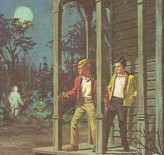
I doubt anyone will really bother to read this post. Can't blame you. Nothing to it. I've added a couple more links: I noticed that I didn't have Andy Horbal's blog listed in the blogroll, since switching to the new blogger template. I can't really explain that. Bloody blogger! yeah - blame google! Added a couple more as well. Added a label, retroactively, to a bunch of posts. "Auteurs" - I feel I must apologize for the name. It's there to connect all the posts I do about specific filmmakers - I don't intend to limit it to directors - I use the word ("auteur") mostly because it is alphabetically distinct, unlike "filmmaker" which conflicts with "film". You gotta let those autocompletes work right!
And sport - hey! Celtics win! whoo hoo! or, Oh No! They just lost Greg Oden! or something... it's trying to lose 18 straight, but it's inevitable when you lose your best three players (and by the time he got hurt, Tony Allen was their second best player). Pierce and Wally are back - they might start winning again. Though probably not too much on their west coast and Texas journeys. I think they'll maintain a nice shot at the top spot in the draft. Another 12-13 wins leaves them with 25 or so on the year - good a shot as any.
And pitchers and catchers are getting close to the time! the happiest time of the year!
Thursday, February 15, 2007
Tuesday, February 13, 2007
A Poliblogging Aside
I know I should leave this kind of nonsense alone, but you know how it goes.... anyone who reads political blogs probably knows about this - I think it might have turned up on TV too: a couple weeks ago John Edwards hired a couple bloggers for his campaign blog - Amanda Marcotte of Pandagon, and Melissa McEwan, aka Shakespeare's Sister. Both are rather aggressive leftist feminist atheists, who, as bloggers do, tend to speak their minds. Well - the right wing clown show immediately sprang to action, led by the particularly ridiculous Michelle Malkin. Well, comedy ensued, but the clowns kept pouring out of the Volkswagon, and before long, out came William Donahue, professional taker-of-offense from an organization called Catholics Against God (or something like that), howling about "anti-Catholic bigotry" from Edwards' new hires. Yeah yeah, they have engaged in some intemperate rhetoric against the Catholic church - they are, after all, 21st century adult women, a group which has a pretty good reason to despise the Catholic church and its policies - if you can't hate the pope, who can you hate? Anyway - John Edwards did not have the option of greeting this clamor with the hearty fuck you it deserves, so he issued a non-apology non-apology, as did the women, and there you go. But you know how those things go - it's been another week and they have both resigned, apparently after Marcotte wrote a review of Children of Men that included the shocking revelation that Christianity is patriarchal, sending the clowns for their noses again....
Anyway. It must mean something, though it's hard to figure out what. It being another year before the primaries actually start, and another 8-9 months before the election. Perfectly sensible people are railing against Edwards for letting Marcotte and McEwan go - but really: they were a pretty small part of the campaign - I suspect this "controversy" is a pretty small issue as well. Who actually cares what a couple bloggers think? Other than bloggers and blog readers? Professional thugs like Donohue will find someone to attack no matter what - if there's nothing there, they'll make it up. Still - there are other dimensions to this. From a blogging perspective - I'm with Yglesias here: I don't quite understand why they were hired in the first place, or why they took jobs with the Edwards campaign. I'm sure both women have skills and talents that would make them valuable to the campaign - but they weren't hired for their skills and talents, they were hired for their online personae. And both of them have rather aggressive, at least "outspoken" personae - especially Marcotte. How does that fit with a political campaign? Edwards isn't trying to raise hell here - maybe if he were - okay. But it still strikes me as odd.
Political bloggers, especially, seem to me to fall into three styles, that I might as well call evangelists, edifiers, and exhorters. Evangelists go out and try to convert people to their positions - they preach to the unconverted. Exhorters preach to the choir - they rally the troops, they build resolve and inspire action. Edifiers argue, explain, analyze - they are the wonks, the pundits - they may address the unconvinced or the convinced - but that's secondary to layign out the positions.... Marcotte, especially, is a classic exhorter type: she preaches to the converted - she stirs them up - she puts them in a fighting mood. She galls the other side - and she may very well turn off the undecided. Which is the problem - political campaigns need evangelists, not exhorters. (Though to be fair: the problem with calling them "evangelists" is that you don't have to be spreading good news: you can preach doom and destruction; you can condemn - it's a similar role, though - you are taking a message to people outside your group, to make them change. Jeremiah and Jonah were evangelists, basically; William Donahue, for all intents and purposes, is an "evangelist" - trying to get people to turn on Edwards. Political campaigns can do that too - the right wing does plenty of it, though not so much through blogs.) But politics needs exhorters - people like her serve their purpose, defining the issues, staking out the limits, and inspiring the "base". It seems to me that hiring her took her away from the role she is most suited for. So, in the end - this might actually be for the best.
It definitely is for the best re Shakespeare's Sister - that is a damned good blog. I'm certainly not going to be reading any politicians' blogs, even when the election campaigns get going for real - so it's just as well that the good bloggers don't disappear down that rabbit hole....
Anyway. It must mean something, though it's hard to figure out what. It being another year before the primaries actually start, and another 8-9 months before the election. Perfectly sensible people are railing against Edwards for letting Marcotte and McEwan go - but really: they were a pretty small part of the campaign - I suspect this "controversy" is a pretty small issue as well. Who actually cares what a couple bloggers think? Other than bloggers and blog readers? Professional thugs like Donohue will find someone to attack no matter what - if there's nothing there, they'll make it up. Still - there are other dimensions to this. From a blogging perspective - I'm with Yglesias here: I don't quite understand why they were hired in the first place, or why they took jobs with the Edwards campaign. I'm sure both women have skills and talents that would make them valuable to the campaign - but they weren't hired for their skills and talents, they were hired for their online personae. And both of them have rather aggressive, at least "outspoken" personae - especially Marcotte. How does that fit with a political campaign? Edwards isn't trying to raise hell here - maybe if he were - okay. But it still strikes me as odd.
Political bloggers, especially, seem to me to fall into three styles, that I might as well call evangelists, edifiers, and exhorters. Evangelists go out and try to convert people to their positions - they preach to the unconverted. Exhorters preach to the choir - they rally the troops, they build resolve and inspire action. Edifiers argue, explain, analyze - they are the wonks, the pundits - they may address the unconvinced or the convinced - but that's secondary to layign out the positions.... Marcotte, especially, is a classic exhorter type: she preaches to the converted - she stirs them up - she puts them in a fighting mood. She galls the other side - and she may very well turn off the undecided. Which is the problem - political campaigns need evangelists, not exhorters. (Though to be fair: the problem with calling them "evangelists" is that you don't have to be spreading good news: you can preach doom and destruction; you can condemn - it's a similar role, though - you are taking a message to people outside your group, to make them change. Jeremiah and Jonah were evangelists, basically; William Donahue, for all intents and purposes, is an "evangelist" - trying to get people to turn on Edwards. Political campaigns can do that too - the right wing does plenty of it, though not so much through blogs.) But politics needs exhorters - people like her serve their purpose, defining the issues, staking out the limits, and inspiring the "base". It seems to me that hiring her took her away from the role she is most suited for. So, in the end - this might actually be for the best.
It definitely is for the best re Shakespeare's Sister - that is a damned good blog. I'm certainly not going to be reading any politicians' blogs, even when the election campaigns get going for real - so it's just as well that the good bloggers don't disappear down that rabbit hole....
Monday, February 12, 2007
No Expectations
I'm still putting off writing some more about Jacques Rivette. It's a poser - whether to knock out quick impressions of the films, or try to work up an essay, or - I don't know - make a list of things: doubles, shadows and ghosts, artists and actors, old houses, the way women walk, conspiracies, cats, park benches, the rooftops of Paris, women who don't need men and men who are willing to live with that, bad fathers, desks and desk drawers, overnight bags - some of the things you will find in his films. We shall see.
In the meanwhile: a film: this, February, is, in film terms, the cruelest month - what you have in the theaters this time of year - man. Once you see the oscar bait, there ain't much left: that is my explanation for seeing Factory Girl. What else is there? Alas... Factory Girl is a sort of biopic about Edie Segdwick, starring Sienna Miller, directed by George Hickenlooper. Hayden Christenson turns up attempting to impersonate (Not) Bob Dylan - Guy Pearce appears in the less thankless role of Andy Warhol. The film as such isn't worth much, though it's harmless enough - a kind of haphazard style, lots of cheesy montage sequences, little tricks with the film stock, some gestures towards fake versions of Warhol's films... The story is ridiculous, with Warhol and crowd as dope fiend vampires, frittering their talents on soup cans and sucking poor Edie dry, while not-Dylan represents all that is pure and good and real, offering Edie a Way Out, but she doesn't take it, alas.... Miller does her best with this nonsense, but there's not much to do, and her best isn't anything special. Christenson is dreadful beyond compare, though whether that should be blamed on him or the script is an open question. (In either case, Dylan did well to stop them using his name - beyond being portrayed wretchedly, not-Dylan comes off not only as an insufferable prick [which Dylan proper might well have been - he certainly liked to take the piss, from what I've heard], but as a self-righteous, self-important tiresome prick. That seems less likely.) This leaves the film ripe pickings for Pearce to steal, and steal it he does.
He has an advantage: Warhol did a fine job of turning himself into one of his art works. He emptied himself of all the usual signs of emotion and personality, made himself blank and bland as his images. Because of this, when actors play him, they have to stick to his presentation of himself - the look, the mannerisms, the voice - the intentional blandness. Dylan, being gnomic and strange, mysterious and secretive, dropping hints and making references to be decoded and all, invites actors and writers to interpret him, to try to parse him out - at least that happens here: not-Dylan has all the signifiers of Dylan, but with all the hints and poses filled in with cliches. Godawful dreck results. But Warhol - and Pearce as Warhol - gets away from that. Even trying to slip the odd humanizing quality to the poor man has to pass through his persona, through his version of himself: whatever you do, you have to do in Warhol's terms, because he took away any other terms to do it with. And because of this - Pearce gives something completely different than the rest of the cast - he gives a kind of collaboration. (Hey! another item for my Rivette list!) With Warhol - his performance feels like a collaboration with Warhol, not with the script or the director of this film.
That's a bit of a lost opportunity: there's a chance, making a film about an artist (or group artists) to make the film collaborative, even if the artist isn't actually around for it. To work off the art, to incorporate it into the film. Hickenlooper tries to show us some of Warhol's art - a few iconic images, and a few recreated clips from the films. This could have been interesting - it isn't. Partly because he screws up the clips - mostly by abandoning their style - that impassive camera, the awkward zooms and focus shifts, and most of all, their duration. Some of it he screws up by shooting the act of shooting - thus freeing the camera to be pointless, and reducing the films to their silly behavior... Some of it he screws up by shooting the film being screened - and moving the camera around, zooming in to create closeups and such that Warhol (and Morrissey later on) stayed away from. It's anti-collaborative: it's trying to assert control over the image, over Warhol's art. (I'd say over not-Dylan's as well, except there isn't any actual Dylan (or not-Dylan) music in the film. There is some not-Velvet Underground music played over a portrayal of VU&N - complete with cymbals! in 1966!! - I mean - he has to know better than that!) The only element of the time that escapes this inanity is Pearce as Warhol.
Now - again I say - it's a missed opportunity. There are some odd moments where things creep in that might have been more interesting. Bits of dialogue - Warhol's remarks about just watching people, letting them be what they were... or the bits referring to his background as a coal miner's son, or his oft-remarked work ethic. That sort of direct, unpretentious work ethic is central to Warhol's value - his art gains power through repetition, through time, through the iteration of it. That, and again - the sense that art was collaborative: a gathering of people, working off one another - which runs through this period of Warhol's work. You get those hints - from scraps of dialogue, and from Pearce, I'd say - of the class dynamics under things: Warhol is strongly associated with work here (a notion common to accounts of the factory), and comes off as tougher, more subversive than the story wants to make him. There are hints - but the film doesn't really develop them. Instead, the words (sometimes), and Pearce, and Warhol himself - haunt it. The ghost of a better film...
In the meanwhile: a film: this, February, is, in film terms, the cruelest month - what you have in the theaters this time of year - man. Once you see the oscar bait, there ain't much left: that is my explanation for seeing Factory Girl. What else is there? Alas... Factory Girl is a sort of biopic about Edie Segdwick, starring Sienna Miller, directed by George Hickenlooper. Hayden Christenson turns up attempting to impersonate (Not) Bob Dylan - Guy Pearce appears in the less thankless role of Andy Warhol. The film as such isn't worth much, though it's harmless enough - a kind of haphazard style, lots of cheesy montage sequences, little tricks with the film stock, some gestures towards fake versions of Warhol's films... The story is ridiculous, with Warhol and crowd as dope fiend vampires, frittering their talents on soup cans and sucking poor Edie dry, while not-Dylan represents all that is pure and good and real, offering Edie a Way Out, but she doesn't take it, alas.... Miller does her best with this nonsense, but there's not much to do, and her best isn't anything special. Christenson is dreadful beyond compare, though whether that should be blamed on him or the script is an open question. (In either case, Dylan did well to stop them using his name - beyond being portrayed wretchedly, not-Dylan comes off not only as an insufferable prick [which Dylan proper might well have been - he certainly liked to take the piss, from what I've heard], but as a self-righteous, self-important tiresome prick. That seems less likely.) This leaves the film ripe pickings for Pearce to steal, and steal it he does.
He has an advantage: Warhol did a fine job of turning himself into one of his art works. He emptied himself of all the usual signs of emotion and personality, made himself blank and bland as his images. Because of this, when actors play him, they have to stick to his presentation of himself - the look, the mannerisms, the voice - the intentional blandness. Dylan, being gnomic and strange, mysterious and secretive, dropping hints and making references to be decoded and all, invites actors and writers to interpret him, to try to parse him out - at least that happens here: not-Dylan has all the signifiers of Dylan, but with all the hints and poses filled in with cliches. Godawful dreck results. But Warhol - and Pearce as Warhol - gets away from that. Even trying to slip the odd humanizing quality to the poor man has to pass through his persona, through his version of himself: whatever you do, you have to do in Warhol's terms, because he took away any other terms to do it with. And because of this - Pearce gives something completely different than the rest of the cast - he gives a kind of collaboration. (Hey! another item for my Rivette list!) With Warhol - his performance feels like a collaboration with Warhol, not with the script or the director of this film.
That's a bit of a lost opportunity: there's a chance, making a film about an artist (or group artists) to make the film collaborative, even if the artist isn't actually around for it. To work off the art, to incorporate it into the film. Hickenlooper tries to show us some of Warhol's art - a few iconic images, and a few recreated clips from the films. This could have been interesting - it isn't. Partly because he screws up the clips - mostly by abandoning their style - that impassive camera, the awkward zooms and focus shifts, and most of all, their duration. Some of it he screws up by shooting the act of shooting - thus freeing the camera to be pointless, and reducing the films to their silly behavior... Some of it he screws up by shooting the film being screened - and moving the camera around, zooming in to create closeups and such that Warhol (and Morrissey later on) stayed away from. It's anti-collaborative: it's trying to assert control over the image, over Warhol's art. (I'd say over not-Dylan's as well, except there isn't any actual Dylan (or not-Dylan) music in the film. There is some not-Velvet Underground music played over a portrayal of VU&N - complete with cymbals! in 1966!! - I mean - he has to know better than that!) The only element of the time that escapes this inanity is Pearce as Warhol.
Now - again I say - it's a missed opportunity. There are some odd moments where things creep in that might have been more interesting. Bits of dialogue - Warhol's remarks about just watching people, letting them be what they were... or the bits referring to his background as a coal miner's son, or his oft-remarked work ethic. That sort of direct, unpretentious work ethic is central to Warhol's value - his art gains power through repetition, through time, through the iteration of it. That, and again - the sense that art was collaborative: a gathering of people, working off one another - which runs through this period of Warhol's work. You get those hints - from scraps of dialogue, and from Pearce, I'd say - of the class dynamics under things: Warhol is strongly associated with work here (a notion common to accounts of the factory), and comes off as tougher, more subversive than the story wants to make him. There are hints - but the film doesn't really develop them. Instead, the words (sometimes), and Pearce, and Warhol himself - haunt it. The ghost of a better film...
Saturday, February 10, 2007
Friday Random Ten on Saturday
My Friday ritual is increasingly turning into a Saturday post. Though most of the responsibility for that lies with Jacques Rivette. (Four more films to go, for those of you in the Boston area.) Not that anyone is holding their breath waiting to see what iTunes coughs up this week...
1. Benny Goodman - Gone with "What" Wind - from the Charlie Christian record
2. High Rise - Pop Sicle (live) - **** - 11 minutes of shameless sludgy guitar wankery - just my kind of thing, as the rating attests
3. Outkast (Big Boi) - In Your Dreams - Idlewild - reminds me I have to get the movie...
4. Charlie Parker - Stupendous - nice day for the jazz. My jazz CDs are woefully under-represented on the iPod: I've gone years listening to almost nothing but jazz, buying almost nothing but jazz - but haven't loaded much of it in the computer. It never really works on the iPod, too much of the subtlety of acoustic instruments gets washed out, I don't know if it's the compression of the music, the quality of the player or headphones, or just the fact that I listen to the iPod in public, noisy places, like the train. Whatever it is - it's never satisfying. So - other than Parker and some Coltrane, and a good deal of fusion (which, being electric, works better - so I have Miles and Mahavishnu Orchestra and the like, and they sound fine...), most of my jazz is still offline.
5. Robert Wyatt - Insensatez
6. Diane CLuck - All I Bring you is Love - from one of those Mojo collections, this one devoted to English folk... nice enough, I guess.
7. Gogol Bordello - Start Wearing Purple - **** - all your sanity and wits they will all vanish, I promise, it's just a matter of time. Indeed.
8. Fleetwood Mac - Coming Your Way (live from the Boston Tea Party) - I'm sure anyone who has actually read these posts over the years, or knows me from elsewhere, has gathered that I like my guitar solos.... I've dropped hints through the years, I think, of my favorites in the art, though not very systematically (though there was that list I posted after Johnny Ramone died). Though linking to that is a kind of mea culpa - what the hell possessed me? My 10 favorite guitar players - with no Peter Green? The plain truth is, other than Richard Thompson, he is probably my favorite: others (Hendrix at least) might be better - but Hendrix is so good he intimidates me - it's hard to connect with his music personally sometimes.... But Peter Green: shoot.... Anyway - this is just another jam, but features some nice work by the band. They were the real deal, when Green was on board....
9. Mockers - God Only Knows - more Mojo, this one from the recent Brian Wilson tribute set.
10. John Lennon - Isolation - nice track from what I think is the third best ex-Beatles record. (What are 1 and 2?) Well - All Things Must Pass really is the best, I think.... #2 is from that other somewhat overlooked Beatle collaborator, backed by John and Ringo at their rockingest - Yoko Ono's Plastic Ono Band record. Why not?
Video? Well - look what I found when I started looking for High Rise video - Jean-Claude Van Damme! that was easy!
1. Benny Goodman - Gone with "What" Wind - from the Charlie Christian record
2. High Rise - Pop Sicle (live) - **** - 11 minutes of shameless sludgy guitar wankery - just my kind of thing, as the rating attests
3. Outkast (Big Boi) - In Your Dreams - Idlewild - reminds me I have to get the movie...
4. Charlie Parker - Stupendous - nice day for the jazz. My jazz CDs are woefully under-represented on the iPod: I've gone years listening to almost nothing but jazz, buying almost nothing but jazz - but haven't loaded much of it in the computer. It never really works on the iPod, too much of the subtlety of acoustic instruments gets washed out, I don't know if it's the compression of the music, the quality of the player or headphones, or just the fact that I listen to the iPod in public, noisy places, like the train. Whatever it is - it's never satisfying. So - other than Parker and some Coltrane, and a good deal of fusion (which, being electric, works better - so I have Miles and Mahavishnu Orchestra and the like, and they sound fine...), most of my jazz is still offline.
5. Robert Wyatt - Insensatez
6. Diane CLuck - All I Bring you is Love - from one of those Mojo collections, this one devoted to English folk... nice enough, I guess.
7. Gogol Bordello - Start Wearing Purple - **** - all your sanity and wits they will all vanish, I promise, it's just a matter of time. Indeed.
8. Fleetwood Mac - Coming Your Way (live from the Boston Tea Party) - I'm sure anyone who has actually read these posts over the years, or knows me from elsewhere, has gathered that I like my guitar solos.... I've dropped hints through the years, I think, of my favorites in the art, though not very systematically (though there was that list I posted after Johnny Ramone died). Though linking to that is a kind of mea culpa - what the hell possessed me? My 10 favorite guitar players - with no Peter Green? The plain truth is, other than Richard Thompson, he is probably my favorite: others (Hendrix at least) might be better - but Hendrix is so good he intimidates me - it's hard to connect with his music personally sometimes.... But Peter Green: shoot.... Anyway - this is just another jam, but features some nice work by the band. They were the real deal, when Green was on board....
9. Mockers - God Only Knows - more Mojo, this one from the recent Brian Wilson tribute set.
10. John Lennon - Isolation - nice track from what I think is the third best ex-Beatles record. (What are 1 and 2?) Well - All Things Must Pass really is the best, I think.... #2 is from that other somewhat overlooked Beatle collaborator, backed by John and Ringo at their rockingest - Yoko Ono's Plastic Ono Band record. Why not?
Video? Well - look what I found when I started looking for High Rise video - Jean-Claude Van Damme! that was easy!
Monday, February 05, 2007
2 War Films
I am way behind in my movie writing - way behind. I've been seeing films - just not writing about them. Unfortunately, they are films I want to write about: the Rivette series; the films I mentioned in my last contemplative cinema post (Honor de Cavelleria, Lights in the Dusk, etc.); the new Korean series I saw last week - more... They deserve attention - they aren't films I can list off with one-liners and stars. ("Time, **1/2 - Kim Ki-duk does Teshigahara." - no, not good enough.) And on top of that - I should try to work something up for the Talkingmoviezzz site - I made indications I would. Fortunately, most of the films I've been seeing aren't going to be making any appearances in the states any time soon. (The odd festival, maybe - not much more.) The Host is supposed to be released - maybe by the time it does, I'll write a review. In fact, I suppose that's the redemption of all of this - none of these films are in release: writing about them in a month is just as good as writing about them today - so better to do em up right.
Now - the exception to all that is the one new, broad release film I have seen recently: Letters From Iwo Jima. Another Oscar nominated film - like the others I have seen (Departed, Babel, Little Miss Sunshine), it seems to me a perfectly acceptable choice - competent, interesting enough, not an embarrassment, but nothing special. Like too many of Eastwood's films, this one has very little going for it beyond Clint - there is nothing in this film, not one second, not one line of dialogue, not one shot, that is not a cliche. Eastwood brings his usual economy and precision, but there's not much more to say for it. Perfectly generic war movie, built to spec, more or less flawlessly, but still, to spec.
Meanwhile: that was Saturday afternoon. Saturday night, I went by the HFA, thinking I was in for a 4 hour Rivette film: no! it was the 6 hour version of Jeanne La Pucelle! in two parts, starting at 7 pm.... Now: I have noticed a strange phenomenon, watching all these Rivette films. After a while - their length seems completely natural. I find myself wondering, how do other people make films that only last 2 hours? and why? This reflection takes another form - one I was particularly aware of after seeing th Eastwood earlier: how is it, I thought, that 6 hours of Rivette flows by without ever seeming padded or tiring, yet Letters, at a bit over 2 hours, dragged? And Eastwood keeps things moving - imagine some hack making that film!
Anyway - Rivette's take on Joan of Arc may be long, but it feels right. He lets scenes build - he lets things happen on screen. He gives you time to get to know his characters. He also keeps you thinking - about the story, about film, about storytelling. He tells the story by alternating between dramatization of the story, and having characters sit and address the camera directly, telling the story. This gives it a rhythm, breaking the story into pieces (which he also does by using long blackouts for transitions), breaking the illusion of the story - the anachronism of the characters telling the story to the camera, as if they were being interviewed - the strangeness of cutting away from moments in the story to someone narrating. It keeps pulling you in - and tells the story in a pretty complete and comprehensible way.
And the film itself - is quite a departure from his more characteristic modern films, but still remarkable. Its unromantic treatment of old spaces - old castles and churches, that look old - and were old, even in 1429. Its unromantic treatment of people - their shabby clothes, their unremarkable hair and faces, their unromantic behavior (people tripping, falling down, dropping things, breaking things; uncooperative horses, the unglamorous operation of machines), the matter of fact rendering of war. I was thinking, watching Letters From Iwo Jima, that I had seen it all before - when the shooting starts, the cameras turn hand held, the cutting gets disjunctive, the sound gets sharper, etc. That's how war movies all look these days. Then seeing Jeanne La Pucelle - you see war rendered in a completely different way. The first "action" sequence - starts with guns being fired - their smoke quickly fills the whole screen, the camera sort of meanders along, waiting for the smoke to clear. The fighting, when it appears, is not spectacular - sure sure, it's a budget constraint - but it still looks right: a lot of aimless dashing around, men (and one woman) laying about them with swords, shooting arrows off screen without aiming much, people ducking and dodging and sometimes falling... All of it, still, organized, as much as war can be, and shown so you can see what they are trying to do and whether they are succeeding. It was most certainly not what you see in every other war movie.
There's little doubt left: Jacques Rivette is one of the great filmmakers of the last 40 years - this series has been a magnificent experience. These films need to be on DVD - people need to see them. There are 4 more to come (and plenty of time tonight to get to part 2 of Jeanne La Pucelle, if you live within 2 hours of Boston and don't mind getting out of the film at 1 AM - they didn't schedule it planning on the 6 hour version), most of which I have seen, though only on DVD, so I am looking forward to it. I hope I can work up a few more notes on the series: there is plenty to say - he is extremely inspirational...
Now - the exception to all that is the one new, broad release film I have seen recently: Letters From Iwo Jima. Another Oscar nominated film - like the others I have seen (Departed, Babel, Little Miss Sunshine), it seems to me a perfectly acceptable choice - competent, interesting enough, not an embarrassment, but nothing special. Like too many of Eastwood's films, this one has very little going for it beyond Clint - there is nothing in this film, not one second, not one line of dialogue, not one shot, that is not a cliche. Eastwood brings his usual economy and precision, but there's not much more to say for it. Perfectly generic war movie, built to spec, more or less flawlessly, but still, to spec.
Meanwhile: that was Saturday afternoon. Saturday night, I went by the HFA, thinking I was in for a 4 hour Rivette film: no! it was the 6 hour version of Jeanne La Pucelle! in two parts, starting at 7 pm.... Now: I have noticed a strange phenomenon, watching all these Rivette films. After a while - their length seems completely natural. I find myself wondering, how do other people make films that only last 2 hours? and why? This reflection takes another form - one I was particularly aware of after seeing th Eastwood earlier: how is it, I thought, that 6 hours of Rivette flows by without ever seeming padded or tiring, yet Letters, at a bit over 2 hours, dragged? And Eastwood keeps things moving - imagine some hack making that film!
Anyway - Rivette's take on Joan of Arc may be long, but it feels right. He lets scenes build - he lets things happen on screen. He gives you time to get to know his characters. He also keeps you thinking - about the story, about film, about storytelling. He tells the story by alternating between dramatization of the story, and having characters sit and address the camera directly, telling the story. This gives it a rhythm, breaking the story into pieces (which he also does by using long blackouts for transitions), breaking the illusion of the story - the anachronism of the characters telling the story to the camera, as if they were being interviewed - the strangeness of cutting away from moments in the story to someone narrating. It keeps pulling you in - and tells the story in a pretty complete and comprehensible way.
And the film itself - is quite a departure from his more characteristic modern films, but still remarkable. Its unromantic treatment of old spaces - old castles and churches, that look old - and were old, even in 1429. Its unromantic treatment of people - their shabby clothes, their unremarkable hair and faces, their unromantic behavior (people tripping, falling down, dropping things, breaking things; uncooperative horses, the unglamorous operation of machines), the matter of fact rendering of war. I was thinking, watching Letters From Iwo Jima, that I had seen it all before - when the shooting starts, the cameras turn hand held, the cutting gets disjunctive, the sound gets sharper, etc. That's how war movies all look these days. Then seeing Jeanne La Pucelle - you see war rendered in a completely different way. The first "action" sequence - starts with guns being fired - their smoke quickly fills the whole screen, the camera sort of meanders along, waiting for the smoke to clear. The fighting, when it appears, is not spectacular - sure sure, it's a budget constraint - but it still looks right: a lot of aimless dashing around, men (and one woman) laying about them with swords, shooting arrows off screen without aiming much, people ducking and dodging and sometimes falling... All of it, still, organized, as much as war can be, and shown so you can see what they are trying to do and whether they are succeeding. It was most certainly not what you see in every other war movie.
There's little doubt left: Jacques Rivette is one of the great filmmakers of the last 40 years - this series has been a magnificent experience. These films need to be on DVD - people need to see them. There are 4 more to come (and plenty of time tonight to get to part 2 of Jeanne La Pucelle, if you live within 2 hours of Boston and don't mind getting out of the film at 1 AM - they didn't schedule it planning on the 6 hour version), most of which I have seen, though only on DVD, so I am looking forward to it. I hope I can work up a few more notes on the series: there is plenty to say - he is extremely inspirational...
Saturday, February 03, 2007
Music Post
Since it's Saturday already - I guess I'll cut to the chase: quick and dirty! iPod, random 10! (Rated where rated.)
1. Blue Cheer - Feathers from your Tree
2. James White and the Blacks - White Devil [a very cool record, that...]
3. James Brown - I Got You (I feel Good) ***** [of course]
4. Gogol Bordello - Avenue B
5. Marvin Gaye - God is Love
6. Yoshimi and Yuka - Elegant Bird
7. Ghost - Live With Me **** [cover of the stones song by Japanese psychedelic folk rockers - very nice]
8. Wire - Qestion of Degree
9. The Kinks - Come Dancing [nice little song, though a ways down through the Kinks' catalogue.]
10. Half Japanese - Fire to Burn *** [throw your evil records on the fire, on the fire to burn - records and sin!]
YouTube? I suppose there are some obvious choices, but I think I'll go a bit out of the way. First - not the same song, but you have to take what YouTube offers, and a little Blue Cheer would go down well. It would be nice to have the summertime blues right about now, instead of freezing my ass off...
And for a bonus, since they have a new record out: a nice bit of noise from Masaki Batoh and company - not the stones, but again - you take what you can get.
1. Blue Cheer - Feathers from your Tree
2. James White and the Blacks - White Devil [a very cool record, that...]
3. James Brown - I Got You (I feel Good) ***** [of course]
4. Gogol Bordello - Avenue B
5. Marvin Gaye - God is Love
6. Yoshimi and Yuka - Elegant Bird
7. Ghost - Live With Me **** [cover of the stones song by Japanese psychedelic folk rockers - very nice]
8. Wire - Qestion of Degree
9. The Kinks - Come Dancing [nice little song, though a ways down through the Kinks' catalogue.]
10. Half Japanese - Fire to Burn *** [throw your evil records on the fire, on the fire to burn - records and sin!]
YouTube? I suppose there are some obvious choices, but I think I'll go a bit out of the way. First - not the same song, but you have to take what YouTube offers, and a little Blue Cheer would go down well. It would be nice to have the summertime blues right about now, instead of freezing my ass off...
And for a bonus, since they have a new record out: a nice bit of noise from Masaki Batoh and company - not the stones, but again - you take what you can get.
Thursday, February 01, 2007
Hippies 1, Paranoid Idiots 0
You know - for a while, watching Mumbles Menino and cronies turn this hair scare, um, this "bomb" scare in Boston into a national punchline, I was feeling really down, ashamed of my city. But now - the suspects, shown here on Fox news, have restored my faith: Boston, Mumbles and company notwithstanding, is a pretty cool place: this press conference is beautiful. Listening to the blowhard reporters trying to badger the 2 guys into taking the press conference "seriously" probably goes far in explaining how this whole thing happened. Watching the 2 guys give it back is absolutely priceless. Thank god, thank god someone being railroaded on some childish absurdity stood up and gave the raspberry to the weasels. (Link from Xoverboard.)
Wednesday, January 31, 2007
Aqua Teen Hunger Force vs. America
Now here's a story that makes me proud of my home town: Boston panics over a TV ad campaign! What am I missing here? Maybe the ads were too small to be seen clearly by commuters, who called the cops, who - then what? You'd think once the cops saw one they'd figure out it was something innocent.
You would think by now that people would sort of get over the worst post-9/11 stupidity.... But today's Globe also had a story about the MBTA's random bag searching program - which has turned up 27 false positives, but - as expected - nothing resembling a threat. This is nonsense. If I were more inclined to paranoia I would wonder how much of this bullshit is in fact aimed at getting people used to a police state - it certainly does it....
Meanwhile, on a completely different subject (though more bitching) - what the hell is wrong with my neighbors? They are listening to very loud music - bad enough - but it's Garth Brooks! Who the hell listens to Garth Brooks? They're a pathetic crew - it's probably a bad sign when you know your neighbors musical tastes as well as I am coming to know. Or can hear quite as many conversations as I can.
I better leave this. Granted - wasn't The Loser Who Lives Upstairs one of the great sites of the early World Wide Web? Yes! it was! (And was it the first blog?) But no, we've moved on since those days - we must remain Calm and Serious here, no matter what kind of crap they are listening to.
You would think by now that people would sort of get over the worst post-9/11 stupidity.... But today's Globe also had a story about the MBTA's random bag searching program - which has turned up 27 false positives, but - as expected - nothing resembling a threat. This is nonsense. If I were more inclined to paranoia I would wonder how much of this bullshit is in fact aimed at getting people used to a police state - it certainly does it....
Meanwhile, on a completely different subject (though more bitching) - what the hell is wrong with my neighbors? They are listening to very loud music - bad enough - but it's Garth Brooks! Who the hell listens to Garth Brooks? They're a pathetic crew - it's probably a bad sign when you know your neighbors musical tastes as well as I am coming to know. Or can hear quite as many conversations as I can.
I better leave this. Granted - wasn't The Loser Who Lives Upstairs one of the great sites of the early World Wide Web? Yes! it was! (And was it the first blog?) But no, we've moved on since those days - we must remain Calm and Serious here, no matter what kind of crap they are listening to.
Tuesday, January 30, 2007
Contemplative Cinema Conclusions (Colossal Youth)
The Contemplative Cinema blogathon is coming to its (official) end. It's been an interesting discussion - intriguing enough on its own merits, but for me, particularly well timed, as the month was full of films that qualify. I've discussed the Bela Tarr series - but I got to see a number of other films that fit the general idea of contemplative cinema: Climates played; I saw Lights in the Dusk, Honor de Cavalleria and Colossal Youth as part of a new European series. Other films - the Rivette series, two Hong Sang-soo films, Belle Toujours, heck - Three Women - hover around the edges, sharing some elements with "contemplative" films, though I don't think I can come up with a definition of contemplative cinema that would include them.
I suppose that begs the question of how I would define "contemplative cinema". My first pass holds up pretty well, I think, to what I've seen - though there's probably a lot more to it. (Girish offers a nice list of characteristics: though I find that the discussion has outdone Jurgen's interpreters - definitions don't equal definers in number - they rather exceed us.) And that didn't really address what kind of phenomenon we were talking about - style? genre? movement? Now? I am inclined to think there are three particularly useful way to think about "contemplative cinema" (see what I mean about definitions exceeding definers?) First - it's a good term to talk about films that aim to create contemplation in the viewer - concentration, absorption of a sort. I would take Philippe Garrel is the exemplary filmmaker of this sort - his films draw us into a near trancelike state, timeless and immediate. Of the films I saw this month, Honor de Cavalleria is probably the purest example of this type of filmmaking - existing almost completely outside its story, in a world of pure experience.... The second way of approaching contemplative cinema seems to me through clusters of films with similar characteristics, similar historical roots - like the Dovshenko/Tarkovsky/Tarr/Dumont grouping I mentioned in my earlier posts; or the minimalist strands in Asian films; or various descendents of neo-realism, like 90s Iranian films.
The most important and wide-ranging use of the ideas associated with contemplative cinema seem to me to be as a description of a filmmaking style. A "systematic and significant use of techniques of the medium." (Per Bordwell.) It's a broad term, I suppose, and I'm not sure where it starts and ends - I like my 4 characteristics (I know I originally listed 5, plus, but I think the first four hold up better): emphasis on duration; images of blankness and blank imagery; backgrounding the plot (though these films may remain quite strongly plotted - Tarr's films are more plotted than they appear; the new Kaurismaki film has a fairly conventional crime story plot - but both filmmakers tell stories in an oblique way, concentrating their attention on other things); backgrounding (or obscuring) psychological characterization (through words, acting, even visual style). One could add several other elements: distance (in terms of camera placement, and other things); certain uses of sound (away from speech, certainly away from conventional musical cues); subdued colors, and so on. It's a set of formal devices that appearing together make a film fit this style - though they can appear along with other elements, to modify other types of films. The style itself, though, does not preclude other devices - and leaves a lot of areas - like story type, political or social content, emotional effect - open. I included politics in my first pass through this - I think I was wrong. Several of these films - Satantango, Colossal Youth, Lights in the Dusk have quite prominent political (or social) themes: I don't think a "contemplative" style requires those themes to be subdued.
So coming to the end - let's take Colossal Youth as a test case. I think it demonstrates what I mean. It fits the aesthetic style I've described: it hits my four characteristics - it's long and slow, and more, it makes the passage of time itself take a major formal role. It makes blankness, emptiness a significant aesthetic element - shots with no people, or one or two people, motionless - shots of blank, featureless walls - lots of time with nothing happening. It buried the plot - there is a story, but it is not the moment to moment concern of the film. And the acting is flat, unexpressive - characters are revealed through their actions (usually described or hinted at rather than shown), or through affectless monologues. It hits most of the items on Girish's list as well: long takes; desaturated colors; empty sets (naturalized, though, because of the poverty of the characters); etc.
At the same time, though - the use of the "contemplative" style does not preclude other stylistic elements - in Costa's films, the severe "contemplative" style of blank walls and motionless actors coexists with a fairly powerful "expressionist" look, full of mysterious passages and doorways, arranged in depth; carefully composed shots of men in dark suits posing against white walls, windows and bits of sky pouring in light; significant objects, splashes of color in a gray background and so on. It also has a fairly complex narrative framework - flashbacks, possibly hallucinations, ghosts, coincide with the endless present of the film. In fact, alongside the obvious comparisons to neo-realism, to Bresson, Ozu, etc., the film contains some rather surprising similarities to David Lynch - it reminded me more strongly than one would suspect of Inland Empire. Some of that is due to the similar use of DV photography - but there is more: the use of mysterious, deceptively complex spaces - doors, hallways, stairs leading into domestic spaces; the use of light and shadow to sculpt space; the emphasis on objects - lamps, flowers, etc. - that have significance, without, quite, meaning. (A characteristic shared with Ozu as well.) Even the structure - Costa, like Lynch, moves back and forth between present and past, between real and (possibly) imaginary events; Ventura, in Colossal Youth, moves like Laura Dern in Inland Empire through a kind of dreamscape, of real and unreal places and things.
I suppose that begs the question of how I would define "contemplative cinema". My first pass holds up pretty well, I think, to what I've seen - though there's probably a lot more to it. (Girish offers a nice list of characteristics: though I find that the discussion has outdone Jurgen's interpreters - definitions don't equal definers in number - they rather exceed us.) And that didn't really address what kind of phenomenon we were talking about - style? genre? movement? Now? I am inclined to think there are three particularly useful way to think about "contemplative cinema" (see what I mean about definitions exceeding definers?) First - it's a good term to talk about films that aim to create contemplation in the viewer - concentration, absorption of a sort. I would take Philippe Garrel is the exemplary filmmaker of this sort - his films draw us into a near trancelike state, timeless and immediate. Of the films I saw this month, Honor de Cavalleria is probably the purest example of this type of filmmaking - existing almost completely outside its story, in a world of pure experience.... The second way of approaching contemplative cinema seems to me through clusters of films with similar characteristics, similar historical roots - like the Dovshenko/Tarkovsky/Tarr/Dumont grouping I mentioned in my earlier posts; or the minimalist strands in Asian films; or various descendents of neo-realism, like 90s Iranian films.
The most important and wide-ranging use of the ideas associated with contemplative cinema seem to me to be as a description of a filmmaking style. A "systematic and significant use of techniques of the medium." (Per Bordwell.) It's a broad term, I suppose, and I'm not sure where it starts and ends - I like my 4 characteristics (I know I originally listed 5, plus, but I think the first four hold up better): emphasis on duration; images of blankness and blank imagery; backgrounding the plot (though these films may remain quite strongly plotted - Tarr's films are more plotted than they appear; the new Kaurismaki film has a fairly conventional crime story plot - but both filmmakers tell stories in an oblique way, concentrating their attention on other things); backgrounding (or obscuring) psychological characterization (through words, acting, even visual style). One could add several other elements: distance (in terms of camera placement, and other things); certain uses of sound (away from speech, certainly away from conventional musical cues); subdued colors, and so on. It's a set of formal devices that appearing together make a film fit this style - though they can appear along with other elements, to modify other types of films. The style itself, though, does not preclude other devices - and leaves a lot of areas - like story type, political or social content, emotional effect - open. I included politics in my first pass through this - I think I was wrong. Several of these films - Satantango, Colossal Youth, Lights in the Dusk have quite prominent political (or social) themes: I don't think a "contemplative" style requires those themes to be subdued.
So coming to the end - let's take Colossal Youth as a test case. I think it demonstrates what I mean. It fits the aesthetic style I've described: it hits my four characteristics - it's long and slow, and more, it makes the passage of time itself take a major formal role. It makes blankness, emptiness a significant aesthetic element - shots with no people, or one or two people, motionless - shots of blank, featureless walls - lots of time with nothing happening. It buried the plot - there is a story, but it is not the moment to moment concern of the film. And the acting is flat, unexpressive - characters are revealed through their actions (usually described or hinted at rather than shown), or through affectless monologues. It hits most of the items on Girish's list as well: long takes; desaturated colors; empty sets (naturalized, though, because of the poverty of the characters); etc.
At the same time, though - the use of the "contemplative" style does not preclude other stylistic elements - in Costa's films, the severe "contemplative" style of blank walls and motionless actors coexists with a fairly powerful "expressionist" look, full of mysterious passages and doorways, arranged in depth; carefully composed shots of men in dark suits posing against white walls, windows and bits of sky pouring in light; significant objects, splashes of color in a gray background and so on. It also has a fairly complex narrative framework - flashbacks, possibly hallucinations, ghosts, coincide with the endless present of the film. In fact, alongside the obvious comparisons to neo-realism, to Bresson, Ozu, etc., the film contains some rather surprising similarities to David Lynch - it reminded me more strongly than one would suspect of Inland Empire. Some of that is due to the similar use of DV photography - but there is more: the use of mysterious, deceptively complex spaces - doors, hallways, stairs leading into domestic spaces; the use of light and shadow to sculpt space; the emphasis on objects - lamps, flowers, etc. - that have significance, without, quite, meaning. (A characteristic shared with Ozu as well.) Even the structure - Costa, like Lynch, moves back and forth between present and past, between real and (possibly) imaginary events; Ventura, in Colossal Youth, moves like Laura Dern in Inland Empire through a kind of dreamscape, of real and unreal places and things.
Friday, January 26, 2007
Friday Music List
Let's see. Winter is in full swing. Yay. Korean film series at the Museum of Fine Arts - go there later for Hong Sang-soo's Woman is the Future of Man. I have heard much about Hong, seen nothing - I am happy. In the next few days, with some luck, this humble blog may feature reviews, or at least comments, on this film, on The Host, on Colossal Youth, more about Jacques Rivette, etc. - there's been a lot to see, and plenty more coming. And - I think I am also goingt o do some tweaking to the template, change some of the settings around. I hope that works out. Things may look different when we are done.
But first - it's Friday! I feel random! I can count to ten! S0 - here goes (with ratings, when rated):
1. Hoodoo Gurus - Bittersweet (*****) (What a great song; as perfect an example of 80s guitar jangle pop as you can come up with.)
2. Sunny Day Real Estate - In Circles (live)
3. Brian Eno - Baby's on Fire (*****) (that's 2 five star songs in the first 3 - rather nice; what more can come up?)
4. Mainliner - Show the Cloven Hoof (not rated, but there are few things better than turning Makoto Kawabata loose on guitar)
5. Funkadelic - What is Soul? (*****) (did I change a setting somewhere? 3 of them? what is soul, anyway? a ham hock in your corn flakes?)
6. Audioslave - I am the highway
7. Peter Laughner - Calvary Cross (***) - um... that's an odd rating; the song, of course, is a 5 star song on the merits; Laughner, though no Richard Thompson on the guitar, is no slouch, and of course one of the great tragic failures of rock - oddly, most of his own songs would have registered 4 or 5 stars; this is a pretty good version, actually, with a violin or cello or something in the background along with his guitar. Anyway: it reveals more about the rating system than the song - 5 stars has more to do with the fact that I would never hit the forward button when they are playing than actual quality - this is good, though the recording quality isn't the best, and that - along with having 3-4 Thompson versions of the song around drops it down a star or two.)
8. Blackilicious - Black Diamonds and Pearls (I don't know what this is exactly, it's from a compilation - it's good though)
9. Peter Gabriel - Jeux sans Frontiers (*****) (well then)
10. REM - Moral Kiosk (I don't know why this isn't rated. 3 stars at least - though again: the stars are more a filter to limit what I hear - which unfairly punishes the best records, since I tend not to rate the whole record the 3 stars it would automatically deserve.)
Video - plenty to choose from, but we might as well go to the top. Soul is the ring around your bathtub. Take it away. Mr. Clinton....
But first - it's Friday! I feel random! I can count to ten! S0 - here goes (with ratings, when rated):
1. Hoodoo Gurus - Bittersweet (*****) (What a great song; as perfect an example of 80s guitar jangle pop as you can come up with.)
2. Sunny Day Real Estate - In Circles (live)
3. Brian Eno - Baby's on Fire (*****) (that's 2 five star songs in the first 3 - rather nice; what more can come up?)
4. Mainliner - Show the Cloven Hoof (not rated, but there are few things better than turning Makoto Kawabata loose on guitar)
5. Funkadelic - What is Soul? (*****) (did I change a setting somewhere? 3 of them? what is soul, anyway? a ham hock in your corn flakes?)
6. Audioslave - I am the highway
7. Peter Laughner - Calvary Cross (***) - um... that's an odd rating; the song, of course, is a 5 star song on the merits; Laughner, though no Richard Thompson on the guitar, is no slouch, and of course one of the great tragic failures of rock - oddly, most of his own songs would have registered 4 or 5 stars; this is a pretty good version, actually, with a violin or cello or something in the background along with his guitar. Anyway: it reveals more about the rating system than the song - 5 stars has more to do with the fact that I would never hit the forward button when they are playing than actual quality - this is good, though the recording quality isn't the best, and that - along with having 3-4 Thompson versions of the song around drops it down a star or two.)
8. Blackilicious - Black Diamonds and Pearls (I don't know what this is exactly, it's from a compilation - it's good though)
9. Peter Gabriel - Jeux sans Frontiers (*****) (well then)
10. REM - Moral Kiosk (I don't know why this isn't rated. 3 stars at least - though again: the stars are more a filter to limit what I hear - which unfairly punishes the best records, since I tend not to rate the whole record the 3 stars it would automatically deserve.)
Video - plenty to choose from, but we might as well go to the top. Soul is the ring around your bathtub. Take it away. Mr. Clinton....
Monday, January 22, 2007
New Films
The last couple weeks I have been eye deep in art films - Bela Tarr, Jacques Rivette - long, difficult films that invite long difficult reactions. I've let the everyday reviews slip. Time to rectify! I'm afraid these will be quick and dirty reviews, but.... I think I will even have recourse to the dreaded STARS, as a way of signalling something without bothering to write it all up.
Pan's Labyrinth (***) - very handsome, haunting film about a young girl in Franco's Spain - her father is a monster - her mother is sickening to die. Young Ofelia is in torment. She meets fairies and monsters, and soon has three tasks to complete... Beautiful film, an elegant, dark, fairy tale, with an interesting style - del Toro loves to hide cuts - shooting long tracks and pans that disappear behind trees, but cut to something else - a gimmicky effect, but one here that gives it a seamlessness that adds to its dreaminess.
The Case of the Grinning Cat (***) - Chris Marker video, in which he goes looking for graffiti of a yellow grinning cat on the roofs and walls of Paris, and finds the streets of Paris in the early years of the millenium. The metro and a series of demonstrations especially - over the election of Chirac over LePen; the Iraq war; for the homeless, to commemmorate the victims of AIDS,a nd so on. Takes a wryly leftist view - waxing sacrastic about the protesters interest in slogans over substance and especially over history - forgetting the Kurds again... But mostly lingers on faces, places, and finds cats in strange places - amusing and sweet, for all the serious underetones..... Shown with several short videos of animals - cats, owls, a zoo, Okinawan bullfights, an elephant dancing a tango...
Belle Toujours (***) - latest film by Manoel de Oliveira, an update of Bunuel's Belle de Jour, with Michel Piccoli returning in his original role, but Catherine Deneuve transformed into Bulle Ogier. Lush and wry and talky, somewhat difficult to reconcile with ones notions of Bunuel, and Ogier, for all her virtues, is a far cry from Deneuve - but pretty engaging on its own merits, and when you're as close to living to celebrate your own centeniary as Oliveira is (born 1908; going strong as a filmmaker), well - I guess you can do what you want.
Climates (***) - latest film by Nuri Bilge Ceylan, Turkish auteur. In this one, he and his wife play a couple - photographer and designer for a TV show (I think) who break up and suffer without one another. Or, in fact, we follow him, after the first part - he mopes, he pines, he is cruel and selfish. It rains a lot. Then it snows, as he goes to the mountains to find his first lover... It's handsome, Antonioni-like in the extreme, including the handsome, unpleasant hero and beautiful, more sympathetic woman, though it is less devoted to the woman's point of view than Antonioni might be.
Curse of the Golden Flower (**) - Gorgeous but pointless melodrama about Tang emperors murdering each other. Or rather - there is the emperor who is poisoning his wife because she has seduced his oldest son, her stepson - she is plotting to overthrow the emporer with her (natural) son, the smartest and best of the family who the emperor is planning to make the successor to the throne (everyone ignores the gentle innocent third son). There's a doctor and daughter who are poisoning the empress - turns out his wife is the emperor's first wife - alas, their daughter is having an affair with the first son (ie, her brother). All this comes out in the end. A bloodbath. Everyone dies, except the stars. Not enough fighting - the attraction of these films is Ching Siu-tung.
Pan's Labyrinth (***) - very handsome, haunting film about a young girl in Franco's Spain - her father is a monster - her mother is sickening to die. Young Ofelia is in torment. She meets fairies and monsters, and soon has three tasks to complete... Beautiful film, an elegant, dark, fairy tale, with an interesting style - del Toro loves to hide cuts - shooting long tracks and pans that disappear behind trees, but cut to something else - a gimmicky effect, but one here that gives it a seamlessness that adds to its dreaminess.
The Case of the Grinning Cat (***) - Chris Marker video, in which he goes looking for graffiti of a yellow grinning cat on the roofs and walls of Paris, and finds the streets of Paris in the early years of the millenium. The metro and a series of demonstrations especially - over the election of Chirac over LePen; the Iraq war; for the homeless, to commemmorate the victims of AIDS,a nd so on. Takes a wryly leftist view - waxing sacrastic about the protesters interest in slogans over substance and especially over history - forgetting the Kurds again... But mostly lingers on faces, places, and finds cats in strange places - amusing and sweet, for all the serious underetones..... Shown with several short videos of animals - cats, owls, a zoo, Okinawan bullfights, an elephant dancing a tango...
Belle Toujours (***) - latest film by Manoel de Oliveira, an update of Bunuel's Belle de Jour, with Michel Piccoli returning in his original role, but Catherine Deneuve transformed into Bulle Ogier. Lush and wry and talky, somewhat difficult to reconcile with ones notions of Bunuel, and Ogier, for all her virtues, is a far cry from Deneuve - but pretty engaging on its own merits, and when you're as close to living to celebrate your own centeniary as Oliveira is (born 1908; going strong as a filmmaker), well - I guess you can do what you want.
Climates (***) - latest film by Nuri Bilge Ceylan, Turkish auteur. In this one, he and his wife play a couple - photographer and designer for a TV show (I think) who break up and suffer without one another. Or, in fact, we follow him, after the first part - he mopes, he pines, he is cruel and selfish. It rains a lot. Then it snows, as he goes to the mountains to find his first lover... It's handsome, Antonioni-like in the extreme, including the handsome, unpleasant hero and beautiful, more sympathetic woman, though it is less devoted to the woman's point of view than Antonioni might be.
Curse of the Golden Flower (**) - Gorgeous but pointless melodrama about Tang emperors murdering each other. Or rather - there is the emperor who is poisoning his wife because she has seduced his oldest son, her stepson - she is plotting to overthrow the emporer with her (natural) son, the smartest and best of the family who the emperor is planning to make the successor to the throne (everyone ignores the gentle innocent third son). There's a doctor and daughter who are poisoning the empress - turns out his wife is the emperor's first wife - alas, their daughter is having an affair with the first son (ie, her brother). All this comes out in the end. A bloodbath. Everyone dies, except the stars. Not enough fighting - the attraction of these films is Ching Siu-tung.
Film Posts, 2007
An index - while tags do some of the work these posts do, I still like to have an index post, because I can classify thing a bit differently - add info to the link, even if most of the info is just the list of films reviewed any given week.
Essays:
Jacques Rivette Retrospective - Rivette 1 and Wrap-Up (1) (parameters and general principals) and Wrap-up (2) (doubles)
Contemplative Cinema entry - Bela Tarr
Second Tarr Post - reviews
Contemplative Cinema Conclusion - plus Colossal Youth, briefly noted
Wilder and Kieslowski blogathons - with Wilder screen shots
Lists: Best of 2006 - Best of the 2000s - Top Ten by Decades, all the way back
Blogathon Placeholder
Misunderstood Blogathon entry: Inland Empire, "explained"
Batman Comments (camp vs. The Dark Knight)
Action Heroines Blogathon - Brigitte Lin in Swordsman II.
John Huston blogathon inspired Beat the Devil post.
Bizarro version of WC Fields.
11/08 - Life of Brian for the Film & Faith blogathon
11/15 - Kurosawa Blogathon Intro
11/18 - Rashomon essay for the blogathon
12/17 - It's a Wonderful Life blogathon entry.
12/31 - end the year with an post on Imamura's Endings - aimed at the Endings blogathon, though I missed the deadline.
Occasional Posts:
2006 Best of List
Contemplative Cinema Blogathon Announcement
Comments - contemplative films, music, Philippe Garrel
Bad Behavior - Huckabees and Bloggingheads
Chase Scenes - with Harold Lloyd video
Roundup post, with Torture porn notes and some housekeeping.
Roundup, noting the passing of Ousmane Sembene, Richard Rorty and Rudolph Arnheim
Thinking Blogger meme
Edward Yang Obit
Response to AFI - 100 Films listed
Top 100 All Time
Ingmar Bergman Obit
Response to the Online Film Community top 100 movies list.
Comedy List.
Various Links for August.
Comments on Rosenbaum vs Bergman, and theater.
Foreign Film List 1: my ballot (and alternative.)
Foreign Film 2: comments on the process.
Foreign Film 3: Complaints
Foreign Film 4: Results and my Ballot
Fall Preview (9/28) - blogathons and such
11/25 - throwaway comments on No Country for Old Men and Southland Tales
Reviews:
Reviews - 1/22/07: Pan's Labyrinth, Case of the Grinning Cat, Belle Toujours, Climates, Curse of the Golden Flower
2 Reviews - Letters from Iwo Jima and Jeanne La Pucelle
Factory Girl (plus some Rivette) - 2/12
Grindhouse - an actual review!
A Heapin' Helpin' of (Mini) Film ReviewMay Day - The Red and the White review
6/2 - Boss of it All review
7/11 - Sicko & Michael Moore
9/7 - Reviews of 3:10 to Yuma and The Bourne Ultimatum (with theory)
9/10 - Two more: Syndromes and a Century and Fallen Angels rerelease
9/16 - Reviews: I Don't Want to Sleep Alone and Across the Universe
10/14 - My Kid Could Paint That plus art comments
10/23 - misc comments, plus Lust, Caution snark and Arnaud Desplechins
11/06 - round up post: Control, Lars and the Real Girl & Wristcutters: A love Story, Exiled, and blogathon previews
11/12 - Two Noirish films: No Country for Old Men and Before the Devil Knows You're Dead.
12/3 - quickies on I'm Not There and Imamura (Vengeance is Mine, A Man Vanishes and Profound Desire of the Gods)
12/5 - longer comments (if not quite reviews) on No Country for Old Men, Southland Tales and Margot at the Wedding.
12/12 - Review and comments on Bergman's Shame.
12/30 - Review of Juno.
Essays:
Jacques Rivette Retrospective - Rivette 1 and Wrap-Up (1) (parameters and general principals) and Wrap-up (2) (doubles)
Contemplative Cinema entry - Bela Tarr
Second Tarr Post - reviews
Contemplative Cinema Conclusion - plus Colossal Youth, briefly noted
Wilder and Kieslowski blogathons - with Wilder screen shots
Lists: Best of 2006 - Best of the 2000s - Top Ten by Decades, all the way back
Blogathon Placeholder
Misunderstood Blogathon entry: Inland Empire, "explained"
Batman Comments (camp vs. The Dark Knight)
Action Heroines Blogathon - Brigitte Lin in Swordsman II.
John Huston blogathon inspired Beat the Devil post.
Bizarro version of WC Fields.
11/08 - Life of Brian for the Film & Faith blogathon
11/15 - Kurosawa Blogathon Intro
11/18 - Rashomon essay for the blogathon
12/17 - It's a Wonderful Life blogathon entry.
12/31 - end the year with an post on Imamura's Endings - aimed at the Endings blogathon, though I missed the deadline.
Occasional Posts:
2006 Best of List
Contemplative Cinema Blogathon Announcement
Comments - contemplative films, music, Philippe Garrel
Bad Behavior - Huckabees and Bloggingheads
Chase Scenes - with Harold Lloyd video
Roundup post, with Torture porn notes and some housekeeping.
Roundup, noting the passing of Ousmane Sembene, Richard Rorty and Rudolph Arnheim
Thinking Blogger meme
Edward Yang Obit
Response to AFI - 100 Films listed
Top 100 All Time
Ingmar Bergman Obit
Response to the Online Film Community top 100 movies list.
Comedy List.
Various Links for August.
Comments on Rosenbaum vs Bergman, and theater.
Foreign Film List 1: my ballot (and alternative.)
Foreign Film 2: comments on the process.
Foreign Film 3: Complaints
Foreign Film 4: Results and my Ballot
Fall Preview (9/28) - blogathons and such
11/25 - throwaway comments on No Country for Old Men and Southland Tales
Reviews:
Reviews - 1/22/07: Pan's Labyrinth, Case of the Grinning Cat, Belle Toujours, Climates, Curse of the Golden Flower
2 Reviews - Letters from Iwo Jima and Jeanne La Pucelle
Factory Girl (plus some Rivette) - 2/12
Grindhouse - an actual review!
A Heapin' Helpin' of (Mini) Film ReviewMay Day - The Red and the White review
6/2 - Boss of it All review
7/11 - Sicko & Michael Moore
9/7 - Reviews of 3:10 to Yuma and The Bourne Ultimatum (with theory)
9/10 - Two more: Syndromes and a Century and Fallen Angels rerelease
9/16 - Reviews: I Don't Want to Sleep Alone and Across the Universe
10/14 - My Kid Could Paint That plus art comments
10/23 - misc comments, plus Lust, Caution snark and Arnaud Desplechins
11/06 - round up post: Control, Lars and the Real Girl & Wristcutters: A love Story, Exiled, and blogathon previews
11/12 - Two Noirish films: No Country for Old Men and Before the Devil Knows You're Dead.
12/3 - quickies on I'm Not There and Imamura (Vengeance is Mine, A Man Vanishes and Profound Desire of the Gods)
12/5 - longer comments (if not quite reviews) on No Country for Old Men, Southland Tales and Margot at the Wedding.
12/12 - Review and comments on Bergman's Shame.
12/30 - Review of Juno.

Friday, January 19, 2007
Music Return!
Been a while since I've managed a Friday Random Ten. I'm thinking, with the new year and all, I have to find a new Friday music schtick - the random ten is getting a bit bland. But I don't have anything yet. So - here you go. To make up for skipping a couple weeks, this will be a Friday random commute list: 15 songs long!
1. Joy Division - Glass
2. Modest Mouse - Gravity Rides Everything (Why do I want to buy a minivan?)
3. Billie Holiday & Lester Young - She's Funny That Way
4. Rage Against the Machine - Take the Power Back
5. The Hives - Declare Guerre Nucleaire (do it again in 2010!)
6. The Velvet Underground - I'm Beginning to See the Light (live)
7. Bad Brains - How Low Can a Punk Get
8. Modest Mouse - Different City
9. REM - Good Advices (if you greet a stranger look at his shoes)
10. Spiritualized - Electricity (you know, with all the talk about contemplative cinema,it's a shame a bit more challenging [call it] music couldn't come up. All that Bela Tarr? ought to call forth, somehow, from the depths of the iPod's mystical empathy with its owner, some Earth or SunnO))), something drony and morose... You would think, wouldn't you? and failing that - something drony and, say, not morose - maybe live Spaceman Three; maybe the Warlocks; maybe Can. That's the music I associate, in my head, with long slow slightly mystical films, especially the dreamier ones [Tarr - that's Earth: I've seen pictures of Dylan Carlson - he looks like he stepped out of one of Tarr's pubs!] - but other than the musical pieces of Last Days, who puts that kind of music in their contemplative films? Well - Warhol and Morrissey sometimes, but... actually - Philippe Garrel, right? Nico; Euro-hippy drones... I think seeing Le Lit de le Vierge [not easy to do: I don't know how often it's played anywhere - not much; thank you afain, Harvard Film Archive!] spoiled me, especially for long, trancy films - I expect the music to match the film - I expect, I don't know - Godspeed You Black Emperor or something...)
11. Rolling Stones - Let's Spend the Night Together
12. Rolling Stones - You Gott Move (what's this? back to back? though I have a lot of Stones on here; this isn't that big a surprise)
13. Alabama 3 and Gary Lucas - Woke Up This Morning (no idea where this came from, but it sure is cool)
14. The Who - Endless Wire (one of the few songs on thge new record that isn't awful. Not bad, really. Not great. Why can't we get I Can See for Miles or something?)
15. Brian Jonestown Massacre - In India You
So, speaking of contemplative cinema, music - here's a clip from Philippe Garrel:
1. Joy Division - Glass
2. Modest Mouse - Gravity Rides Everything (Why do I want to buy a minivan?)
3. Billie Holiday & Lester Young - She's Funny That Way
4. Rage Against the Machine - Take the Power Back
5. The Hives - Declare Guerre Nucleaire (do it again in 2010!)
6. The Velvet Underground - I'm Beginning to See the Light (live)
7. Bad Brains - How Low Can a Punk Get
8. Modest Mouse - Different City
9. REM - Good Advices (if you greet a stranger look at his shoes)
10. Spiritualized - Electricity (you know, with all the talk about contemplative cinema,it's a shame a bit more challenging [call it] music couldn't come up. All that Bela Tarr? ought to call forth, somehow, from the depths of the iPod's mystical empathy with its owner, some Earth or SunnO))), something drony and morose... You would think, wouldn't you? and failing that - something drony and, say, not morose - maybe live Spaceman Three; maybe the Warlocks; maybe Can. That's the music I associate, in my head, with long slow slightly mystical films, especially the dreamier ones [Tarr - that's Earth: I've seen pictures of Dylan Carlson - he looks like he stepped out of one of Tarr's pubs!] - but other than the musical pieces of Last Days, who puts that kind of music in their contemplative films? Well - Warhol and Morrissey sometimes, but... actually - Philippe Garrel, right? Nico; Euro-hippy drones... I think seeing Le Lit de le Vierge [not easy to do: I don't know how often it's played anywhere - not much; thank you afain, Harvard Film Archive!] spoiled me, especially for long, trancy films - I expect the music to match the film - I expect, I don't know - Godspeed You Black Emperor or something...)
11. Rolling Stones - Let's Spend the Night Together
12. Rolling Stones - You Gott Move (what's this? back to back? though I have a lot of Stones on here; this isn't that big a surprise)
13. Alabama 3 and Gary Lucas - Woke Up This Morning (no idea where this came from, but it sure is cool)
14. The Who - Endless Wire (one of the few songs on thge new record that isn't awful. Not bad, really. Not great. Why can't we get I Can See for Miles or something?)
15. Brian Jonestown Massacre - In India You
So, speaking of contemplative cinema, music - here's a clip from Philippe Garrel:
Thursday, January 18, 2007
Bela Tarr Notes
Having now seen three Bela Tarr films - Damnation, Satantango and Werckmeister Harmonies (even saw them in chronological order, now that I think of it) - what do I think? I think I'm looking forward to getting back to Rivette... but that aside - it's an impressive body of work. I'm bloody tired and I did most fo the theoretical heavy lifting last week, so I will keep this fairly sketchy - but some thoughts....
1) Satantango is every bit as good as advertised. Watching it all in a go was undeniably a physical ordeal - but not, in any sense, a mental ordeal. It's rather striking - 8 hours in a chair and my mind did not wander from the screen - the film held my attention, my fascination, for the whole length. Even when things on screen started to drag, I noticed that it just refocused my attention at a different level - at the formal properties of repetition and abstraction and so on. Just as all those blank walls invite the viewer to notice and care about the texture of the surfaces, the slow, repetitive passages invite the viewer to think about the principals of repetition. But even so - most of the time, what was on screen was, in fact, completely engaging. It is a gorgeous film - the Boston Phoenix's review said that every shot could be framed as art - and the style, the long slow grinding tracks and dollies and cranes accumulates dread and sometimes pathos as it goes. It teaches you how to watch it. It is also very funny, in a slow, nasty way - I read someone somewhere calling it the most sarcastic film ever made, though I can't find the quote anywhere - it's great stuff.
2. The other two are very good, but not up to those standards. Damnation is, in fact, a pretty straightforward noir, in the story at least - slowed down with the tension drained off, but still, the story is classic: wife, husband, lover, criminal boss - lover contrives to get hubby out of town, takes advantage, hubby comes back, wife drops both for gangster. The style is there, though it seems Tarr is working it out, and only really gets it fully working in Satantango. Meanwhile, after Satantango, Werckmeister Harmonies, looks like a Spielberg film. Yeah it's long, got hose long takes, sure sure - it's also got real actors, who really act; it's got shots and sequences that bring out the inner self of its characters - hell: it even has music cues! That said, it is also gorgeous, powerful, fascinating - and contains 2-3 sequences of extraordinary power. The riot is justly famous - but the scene with the two brats raising hell might be just as outstanding. Still - it is odd that even this slight move back toward conventional film techniques seems to diminish the film. Gives it an odd sentimentality that seems out of place.
3. A lot of the commentary on these films focuses on their lack of plot - mine included (though I did try to insist on their backgrounding plot - it's not about whether there's a plot of not, it's how its presented.) It is striking, then, how conventional the stories and plots really are. Structurally, especially. The actual telling of the stories is definitely very strange - the moment to moment flow of images and story information - no doubt. But stepping back, to the structure of the plot - there's plenty of story there, and it's told in a fairly straightforward way. Even Satantango - the structure is not uncommon at all: it is split in three: part 1 loops among a number of characters, setting the scene, sketching in the world of the film, suggesting plot elements and so on. It is relatively loose, moving among characters and places and so on without making connections quite. Then - the second part brings characters and the various story threads together, in the pub scenes - itself split in half, with the middle section (the girl) providing the turning point of the film, the event that, indeed, sets the plot proper going. Part three, indeed, is much more linear and closely tied to the storyline - Iremias' scheme; the abandonment of the yard, etc. That's a very common structure - loose, multithreaded opening, a turning point in the middle, and a gathering of the threads at the end - played out here. Slowed down almost past recognition, yes; looping back to retrace the same day several times, rather than cross-cutting (which seesm to be the more common practice), yes; and indeed, telling a story of dissolution (thus scattering everyone in the end), yes. But still.
And Werckmeister Harmonies too follows a reasonably common storyline: apocalypse, experienced by an innocent. Echoes of Herzog are loudest in this film - his Bruno S. films especially (the circus, the whale, the prince, in particular feels like a nod at Herzog - the fact that the word for prince is Herzog (or something very close to it) might be part of that.) Innocence destroyed.
4. Finally - on a similar note - the stories of these films also remain quite readable. Seeing them alongside Rivette emphasizes this point: they stick to an internally consistent world. Rivette's films split their story worlds - into performance and "reality", at the basic level; and often, into multiple notions of reality. What's real and what isn't, the relationship between knowledge of things and the things themselves, is a problem in Rivette. His films are not ontologically stable - they are post-modernist. Tarr is quite modernist. That's a topic more appropriate for the Rivette discussion (which I hope I get to in a couple days) - though it probably has some relation to the whole contemplative cinema discussion. There's a dose of post-modernism there, in films like Tropical Malady, say, with its two halves and two levels of reality (in a sense) - that sort of thing runs back to people like Rivette (and parallels the ontological instability in many of David Lynch's films) - it's absent in Tarr. Which probably doesn't matter that much, but it's interesting - likely to become more important when I do get to talking about Rivette.
1) Satantango is every bit as good as advertised. Watching it all in a go was undeniably a physical ordeal - but not, in any sense, a mental ordeal. It's rather striking - 8 hours in a chair and my mind did not wander from the screen - the film held my attention, my fascination, for the whole length. Even when things on screen started to drag, I noticed that it just refocused my attention at a different level - at the formal properties of repetition and abstraction and so on. Just as all those blank walls invite the viewer to notice and care about the texture of the surfaces, the slow, repetitive passages invite the viewer to think about the principals of repetition. But even so - most of the time, what was on screen was, in fact, completely engaging. It is a gorgeous film - the Boston Phoenix's review said that every shot could be framed as art - and the style, the long slow grinding tracks and dollies and cranes accumulates dread and sometimes pathos as it goes. It teaches you how to watch it. It is also very funny, in a slow, nasty way - I read someone somewhere calling it the most sarcastic film ever made, though I can't find the quote anywhere - it's great stuff.
2. The other two are very good, but not up to those standards. Damnation is, in fact, a pretty straightforward noir, in the story at least - slowed down with the tension drained off, but still, the story is classic: wife, husband, lover, criminal boss - lover contrives to get hubby out of town, takes advantage, hubby comes back, wife drops both for gangster. The style is there, though it seems Tarr is working it out, and only really gets it fully working in Satantango. Meanwhile, after Satantango, Werckmeister Harmonies, looks like a Spielberg film. Yeah it's long, got hose long takes, sure sure - it's also got real actors, who really act; it's got shots and sequences that bring out the inner self of its characters - hell: it even has music cues! That said, it is also gorgeous, powerful, fascinating - and contains 2-3 sequences of extraordinary power. The riot is justly famous - but the scene with the two brats raising hell might be just as outstanding. Still - it is odd that even this slight move back toward conventional film techniques seems to diminish the film. Gives it an odd sentimentality that seems out of place.
3. A lot of the commentary on these films focuses on their lack of plot - mine included (though I did try to insist on their backgrounding plot - it's not about whether there's a plot of not, it's how its presented.) It is striking, then, how conventional the stories and plots really are. Structurally, especially. The actual telling of the stories is definitely very strange - the moment to moment flow of images and story information - no doubt. But stepping back, to the structure of the plot - there's plenty of story there, and it's told in a fairly straightforward way. Even Satantango - the structure is not uncommon at all: it is split in three: part 1 loops among a number of characters, setting the scene, sketching in the world of the film, suggesting plot elements and so on. It is relatively loose, moving among characters and places and so on without making connections quite. Then - the second part brings characters and the various story threads together, in the pub scenes - itself split in half, with the middle section (the girl) providing the turning point of the film, the event that, indeed, sets the plot proper going. Part three, indeed, is much more linear and closely tied to the storyline - Iremias' scheme; the abandonment of the yard, etc. That's a very common structure - loose, multithreaded opening, a turning point in the middle, and a gathering of the threads at the end - played out here. Slowed down almost past recognition, yes; looping back to retrace the same day several times, rather than cross-cutting (which seesm to be the more common practice), yes; and indeed, telling a story of dissolution (thus scattering everyone in the end), yes. But still.
And Werckmeister Harmonies too follows a reasonably common storyline: apocalypse, experienced by an innocent. Echoes of Herzog are loudest in this film - his Bruno S. films especially (the circus, the whale, the prince, in particular feels like a nod at Herzog - the fact that the word for prince is Herzog (or something very close to it) might be part of that.) Innocence destroyed.
4. Finally - on a similar note - the stories of these films also remain quite readable. Seeing them alongside Rivette emphasizes this point: they stick to an internally consistent world. Rivette's films split their story worlds - into performance and "reality", at the basic level; and often, into multiple notions of reality. What's real and what isn't, the relationship between knowledge of things and the things themselves, is a problem in Rivette. His films are not ontologically stable - they are post-modernist. Tarr is quite modernist. That's a topic more appropriate for the Rivette discussion (which I hope I get to in a couple days) - though it probably has some relation to the whole contemplative cinema discussion. There's a dose of post-modernism there, in films like Tropical Malady, say, with its two halves and two levels of reality (in a sense) - that sort of thing runs back to people like Rivette (and parallels the ontological instability in many of David Lynch's films) - it's absent in Tarr. Which probably doesn't matter that much, but it's interesting - likely to become more important when I do get to talking about Rivette.
Saturday, January 13, 2007
Defining Contemplative Cinema (Bela Tarr)
I've been following the contemplative cinema blogathon with great interest, though with reservations - the reservations, however, are one of the thing that makes it so compelling. The main problem is that I can't quite figure out what it is supposed to mean, and I'm having much luck finding definitions of it. Now, true, I don't expect definitions as such - sufficient and necessary conditions - but I'm also not clear on the parameters for "contemplative cinema." Who is involved - what traits they share. Or, since in fact many names and traits have been named and considered, which ones are most useful for creating this category of films.
I suppose one response to this problem would be to say that it's not a useful category of films - I'm not willing to make that claim. It seems to me that this is a genre that doesn't exactly exist - but it's a genre that people notice, a family of films that do seem related. They (or we, since I can see it too) notice that there are films with certain characteristics - slowness, plotlessness, etc. They are looking for what links these films, how they can describe them, how they can describe the links. The problem so far (for me) is that the links are too vague - the category is too broad. In some of the discussions around the blogothan, the "contemplative cinema" category seems in danger of expanding to include everything outside the mainstream - that seems to lose the value of the idea. Demonlover (say) may have something in common with Mother and Son (say), but I'm not sure you can make a meaningful genre (or genre-like thing) out of what they have in common.
S0 - I am going to dive into the thing and say what I think about the term. I'm not sure which direction this is: whether this is what I think contemplative cinema is, or if I see a category of films that could use a name, and this one seems to fit: we'll see. I do see a fairly identifiable group of films, with some fairly identifiable characteristics - so I will name them, and go from there. And this brings us to the title of the post, too: I've just seen my first Bela Tarr film (Damnation) - and it illustrates the devices listed below perfectly. If this is a meaningful category, Damnation is a quintessential example. Most of my examples will relate directly to it. These are notes - unfinished and sketchy. They are a start to thinking about how to define "contemplative cinema"...
1) Duration - perhaps in terms of how long the film lasts (that’s more true of Satantango - Damnation is normal length; on the other hand, many of Sukorov's films are relatively short, and yet duration is crucial to his approach) - but more in terms of the duration of the shots on screen, and the sense of time passing, of the duration of actions (or inactions) in the world. “Real time” as they say - though not exactly, since it could, as well, present a long period of time elliptically. Damnation, though, does it fairly directly - long (very long) takes; scenes unfolding in “real time” - lots of dead space between actions, and so on.
2) Emptiness - or blankness. Emptiness in terms of story, perhaps, in terms of absence of stimuli (nothing happens; there’s nothing to look at; simple, empty, minimalist sets) - but also emptiness shown: images of emptiness, of blankness. I do mean this literally - contemplative cinema seems to me to be marked by these kinds of images - images of blankness: walls; empty, featureless landscapes; close shots of the back of a man’s white trench coat; often surfaces of water; street surfaces. Damnation contains all those elements - walls, backs, empty streets, dirty window panes, featureless hallways and doors. Including several shots of perhaps the perfect blank image: a fairly close shot of a plain white wall, maybe with water running across it.
Now - one of the effects of images like this is to shift our level of attention: we look at a wall, featureless, and we notice the patterns on the wall - we see the grain of the wood or the swirls and bumps in the whitewash. That is almost Tarr’s method - to shift our attention from the levels we usually see in films, to details: faces and bodies, spaces, the textures of walls and floors and tables, the patterns of mud and water and spilled beer on the floor of the bar in the aftermath of a dance. I think this effect, though, is a secondary one - it is what some films do with these images, the function of this type of image. I think that function, while common, is not definitive - the images of emptiness themselves are the characteristic of the “genre”.
3) Backgrounding plot and story, narration and narrativity. Not eliminating it - just moving it to the background. Almost like racking focus - it's as if the story were out of focus. The film's attention is on the moment to moment details - with each scene often split off from the scenes around it. The story is told, but it’s told obliquely - or, sometimes, very simplistically, and very obviously: something in a scene will reveal its place in the story (the plot of Damnation is very simple and easy to follow) - but the scene will continue on another 5 minutes, or might only get around to the plot stuff for the last 30 seconds of a 7 minute shot.
4) Psychology and characterization are also minimalist: we are not given significant access to characters thoughts and feelings and emotions. We may know what they are - but in many cases it is because we are told, either they say what they are feeling, or they reveal it through their place in the story. But we see very little “acting” - very little conventional character development. This is the case in Damnation: all the actors behave like zombies - all the extras behave like zombies - everyone staring, posing, everything static, stiff, blank. Emotions are described - spoken about, not acted out. And other means of handling character and psychology, such as expressionism - the representation of inner states in outer reality - is - problematic., in this film. You can, of course, say that the constant rain, the drab, rotten setting, the stiff behavior, are all expressions of the inner worlds of the characters - it’s probably true - but it’s also overdetermined. There is a remarkable bit at the end where the hero confronts a dog, in a rainstorm - the dog barks at him - he barks at the dog until the dog runs away. Not too hard to see the symbolism there - but it is so obvious a symbol that it works like the speeches - it’s explicit - it’s another description of the man’s inner being, as much as his affectless speeches. Description opposed to depiction.
5) Most social, political, cultural, etc. issues are also backgrounded - not eliminated - but kept in the background, out of focus. This is also true enough here, and in contemplative cinema, though this starts to get sketchy. It isn't hard to see political and social significance in the miserablism of this film - it's just that it's always kept out of the frame, in a sense. This is where my little scheme starts to get messy, I think - but for now... I'll let it stand - and above the line, so to speak - though I am not sure how well it works.
6) [sort of] Along about here, there is a line I think - we start to get into characteristics that are common in the kinds of films I'm thinking of - but that are also common in films I don't think fit. The main one is a kind of mysticism. You see this in Tarkovsky, Sukorov, Dovshenko - a kind of ecstasy in the elements, or a landscape or a face - a kind of religious inflected revery. I have to say - if there is any of this in Tarr, it’s well hidden, and probably parodied. There is a deep sort of reverance for the earth, for water, for smoke - he's got the elements in there - but... he's not doing what the Russians are doing.
Similarly, this mystical revery (missing from Tarr, found in the three named Russians) borders on a general dream state. But I think this is where the contemplative genre clearly stops: when films start to insist, too much, on their likeness to dreams, they have moved away from contemplative cinema into something else. Surrealism, which makes the most of the likeness of dreams and films, and takes the desire to film dreams most seriously, is something different. It is well and solidly removed from the likes of Tarr. And I'm inclined to think the "contemplative cinema" "genre" is more useful if it is more specific. Or - put another way - that the "genre" described here is one it is useful to think about, and to distinguish from surrealism, say...
Anyway - looks like I am ready to post. The real test comes now - the rest of the day, I will be watching Satantango. I think, though, if I revisit the subject (I hope I do), it will be much more specifically about Bela Tarr's work. In the end, genres and types and the like are just useful guides - the films themselves (or filmmakers, though that gets you into some muddy waters sometimes) have to be taken as they are...
I suppose one response to this problem would be to say that it's not a useful category of films - I'm not willing to make that claim. It seems to me that this is a genre that doesn't exactly exist - but it's a genre that people notice, a family of films that do seem related. They (or we, since I can see it too) notice that there are films with certain characteristics - slowness, plotlessness, etc. They are looking for what links these films, how they can describe them, how they can describe the links. The problem so far (for me) is that the links are too vague - the category is too broad. In some of the discussions around the blogothan, the "contemplative cinema" category seems in danger of expanding to include everything outside the mainstream - that seems to lose the value of the idea. Demonlover (say) may have something in common with Mother and Son (say), but I'm not sure you can make a meaningful genre (or genre-like thing) out of what they have in common.
S0 - I am going to dive into the thing and say what I think about the term. I'm not sure which direction this is: whether this is what I think contemplative cinema is, or if I see a category of films that could use a name, and this one seems to fit: we'll see. I do see a fairly identifiable group of films, with some fairly identifiable characteristics - so I will name them, and go from there. And this brings us to the title of the post, too: I've just seen my first Bela Tarr film (Damnation) - and it illustrates the devices listed below perfectly. If this is a meaningful category, Damnation is a quintessential example. Most of my examples will relate directly to it. These are notes - unfinished and sketchy. They are a start to thinking about how to define "contemplative cinema"...
1) Duration - perhaps in terms of how long the film lasts (that’s more true of Satantango - Damnation is normal length; on the other hand, many of Sukorov's films are relatively short, and yet duration is crucial to his approach) - but more in terms of the duration of the shots on screen, and the sense of time passing, of the duration of actions (or inactions) in the world. “Real time” as they say - though not exactly, since it could, as well, present a long period of time elliptically. Damnation, though, does it fairly directly - long (very long) takes; scenes unfolding in “real time” - lots of dead space between actions, and so on.
2) Emptiness - or blankness. Emptiness in terms of story, perhaps, in terms of absence of stimuli (nothing happens; there’s nothing to look at; simple, empty, minimalist sets) - but also emptiness shown: images of emptiness, of blankness. I do mean this literally - contemplative cinema seems to me to be marked by these kinds of images - images of blankness: walls; empty, featureless landscapes; close shots of the back of a man’s white trench coat; often surfaces of water; street surfaces. Damnation contains all those elements - walls, backs, empty streets, dirty window panes, featureless hallways and doors. Including several shots of perhaps the perfect blank image: a fairly close shot of a plain white wall, maybe with water running across it.
Now - one of the effects of images like this is to shift our level of attention: we look at a wall, featureless, and we notice the patterns on the wall - we see the grain of the wood or the swirls and bumps in the whitewash. That is almost Tarr’s method - to shift our attention from the levels we usually see in films, to details: faces and bodies, spaces, the textures of walls and floors and tables, the patterns of mud and water and spilled beer on the floor of the bar in the aftermath of a dance. I think this effect, though, is a secondary one - it is what some films do with these images, the function of this type of image. I think that function, while common, is not definitive - the images of emptiness themselves are the characteristic of the “genre”.
3) Backgrounding plot and story, narration and narrativity. Not eliminating it - just moving it to the background. Almost like racking focus - it's as if the story were out of focus. The film's attention is on the moment to moment details - with each scene often split off from the scenes around it. The story is told, but it’s told obliquely - or, sometimes, very simplistically, and very obviously: something in a scene will reveal its place in the story (the plot of Damnation is very simple and easy to follow) - but the scene will continue on another 5 minutes, or might only get around to the plot stuff for the last 30 seconds of a 7 minute shot.
4) Psychology and characterization are also minimalist: we are not given significant access to characters thoughts and feelings and emotions. We may know what they are - but in many cases it is because we are told, either they say what they are feeling, or they reveal it through their place in the story. But we see very little “acting” - very little conventional character development. This is the case in Damnation: all the actors behave like zombies - all the extras behave like zombies - everyone staring, posing, everything static, stiff, blank. Emotions are described - spoken about, not acted out. And other means of handling character and psychology, such as expressionism - the representation of inner states in outer reality - is - problematic., in this film. You can, of course, say that the constant rain, the drab, rotten setting, the stiff behavior, are all expressions of the inner worlds of the characters - it’s probably true - but it’s also overdetermined. There is a remarkable bit at the end where the hero confronts a dog, in a rainstorm - the dog barks at him - he barks at the dog until the dog runs away. Not too hard to see the symbolism there - but it is so obvious a symbol that it works like the speeches - it’s explicit - it’s another description of the man’s inner being, as much as his affectless speeches. Description opposed to depiction.
5) Most social, political, cultural, etc. issues are also backgrounded - not eliminated - but kept in the background, out of focus. This is also true enough here, and in contemplative cinema, though this starts to get sketchy. It isn't hard to see political and social significance in the miserablism of this film - it's just that it's always kept out of the frame, in a sense. This is where my little scheme starts to get messy, I think - but for now... I'll let it stand - and above the line, so to speak - though I am not sure how well it works.
6) [sort of] Along about here, there is a line I think - we start to get into characteristics that are common in the kinds of films I'm thinking of - but that are also common in films I don't think fit. The main one is a kind of mysticism. You see this in Tarkovsky, Sukorov, Dovshenko - a kind of ecstasy in the elements, or a landscape or a face - a kind of religious inflected revery. I have to say - if there is any of this in Tarr, it’s well hidden, and probably parodied. There is a deep sort of reverance for the earth, for water, for smoke - he's got the elements in there - but... he's not doing what the Russians are doing.
Similarly, this mystical revery (missing from Tarr, found in the three named Russians) borders on a general dream state. But I think this is where the contemplative genre clearly stops: when films start to insist, too much, on their likeness to dreams, they have moved away from contemplative cinema into something else. Surrealism, which makes the most of the likeness of dreams and films, and takes the desire to film dreams most seriously, is something different. It is well and solidly removed from the likes of Tarr. And I'm inclined to think the "contemplative cinema" "genre" is more useful if it is more specific. Or - put another way - that the "genre" described here is one it is useful to think about, and to distinguish from surrealism, say...
Anyway - looks like I am ready to post. The real test comes now - the rest of the day, I will be watching Satantango. I think, though, if I revisit the subject (I hope I do), it will be much more specifically about Bela Tarr's work. In the end, genres and types and the like are just useful guides - the films themselves (or filmmakers, though that gets you into some muddy waters sometimes) have to be taken as they are...
Thursday, January 11, 2007
Rivette 1
The Harvard Film Archive is running a Jacques Rivette retrospective thorugh February. This is a very good thing. I have seen 3 Rivette films, his recent ones: Haut/Bas/Fragile, Va Savoir and Marie and Julien - nothing earlier. This is a golden opportunity, and so far has been a godsend.
I'd always suspected that I would like Rivette. I liked the films I'd seen, though without quite committing to them; I liked their playfulness, the knack he had of getting actors to be glorious in front of a camera. The older ones, with their endless lengths and their tangles of plays in movies in plays in movies and their incessant chatter sounded right up my alley. Now that I've seen a few of them - I see I was right. The early films have the qualities I like in the later ones - a sense of play, of fictionalization of everything - with sharper edges, a greater sense of urgency.
I have seen four (in this series): Paris Belongs to Us; The Nun; Out 1: Spectre; and Celine and Julie Go Boating. The Nun is something of the odd one out (as all the critics will agree): Anna Karina plays Suzanne Simonon, sent to a nunnery by her poor and cheap parents, where she has the misfortune to actually believe in god, and take the call to service seriously - she's there on false pretenses, and unwilling to lie about it. It's not a bad film - it's a fine example of a melodrama of an unknown woman, and seems remiscent of Dreyer, more than anything else by Rivette.
The other three films have a lot more in common, and contain the qualities that drew me to Rivette (when it was all just theory). They have the large casts, the plays within the movie, they have existential mysteries, that may or may not be resolved. They take their time - things happen, characters circulate among the other characters, talking, forming and reforming relationships, that keep expanding as we learn more about them. Inside these relationships, some things are real - some things are fiction - some things are lies - some things are games, jokes, accidents - Rivette doesn't necessarily tell us what is what; we figure it out with the characters. There are hints of darker things - plots and conspiracies, murders? suicides? disappearances? - shadowy secret societies? - that may or may not be real.
These films remind me of what I suppose you could call High American Paranoid Post-Modernist Novels: Pynchon, McElroy, DeLillo. Both Paris Belongs to Us and Out 1: Spectre reminded me especially of McElroy's Lookout Cartridge - the search for missing tapes; the groups of artists mixed up (maybe) in political intrigues, even the style - McElroy's insistent first person narrator matches well with Rivette's endless series' of conversations, his refusal to explain anything - he keeps you inside the story at all times. Rivette suggests a paranoid world where it is all connected, but no one in the films, and not us watching the films, ever gets to where the conspiracy is revealed. Or, really, dispersed, though things may turn out to be coincidences - maybe.
I mentioned these films in relation to contemplative cinema blogathon - they don't really fit that category, I think. Rivette's films are too busy, too talkative, too dense; they are also more like puzzles than anything contemplative. They are like games - they are problems to be solved, codes to be deciphered. There are mysteries, secrets, puzzles to be solved in these films - and the films themselves are puzzles. And as enjoyable as a good puzzle can be.
Anyway: there are a lot more of these films coming. And I have said nothing, here, about Celine and Julie - it deserves some sustained thought, I fear, and I don't have time for that now. But I hope to write up a good deal more on this before it is over.
Though there's also a Bela Tarr retrospective coming up, so JR may have some competition.
I'd always suspected that I would like Rivette. I liked the films I'd seen, though without quite committing to them; I liked their playfulness, the knack he had of getting actors to be glorious in front of a camera. The older ones, with their endless lengths and their tangles of plays in movies in plays in movies and their incessant chatter sounded right up my alley. Now that I've seen a few of them - I see I was right. The early films have the qualities I like in the later ones - a sense of play, of fictionalization of everything - with sharper edges, a greater sense of urgency.
I have seen four (in this series): Paris Belongs to Us; The Nun; Out 1: Spectre; and Celine and Julie Go Boating. The Nun is something of the odd one out (as all the critics will agree): Anna Karina plays Suzanne Simonon, sent to a nunnery by her poor and cheap parents, where she has the misfortune to actually believe in god, and take the call to service seriously - she's there on false pretenses, and unwilling to lie about it. It's not a bad film - it's a fine example of a melodrama of an unknown woman, and seems remiscent of Dreyer, more than anything else by Rivette.
The other three films have a lot more in common, and contain the qualities that drew me to Rivette (when it was all just theory). They have the large casts, the plays within the movie, they have existential mysteries, that may or may not be resolved. They take their time - things happen, characters circulate among the other characters, talking, forming and reforming relationships, that keep expanding as we learn more about them. Inside these relationships, some things are real - some things are fiction - some things are lies - some things are games, jokes, accidents - Rivette doesn't necessarily tell us what is what; we figure it out with the characters. There are hints of darker things - plots and conspiracies, murders? suicides? disappearances? - shadowy secret societies? - that may or may not be real.
These films remind me of what I suppose you could call High American Paranoid Post-Modernist Novels: Pynchon, McElroy, DeLillo. Both Paris Belongs to Us and Out 1: Spectre reminded me especially of McElroy's Lookout Cartridge - the search for missing tapes; the groups of artists mixed up (maybe) in political intrigues, even the style - McElroy's insistent first person narrator matches well with Rivette's endless series' of conversations, his refusal to explain anything - he keeps you inside the story at all times. Rivette suggests a paranoid world where it is all connected, but no one in the films, and not us watching the films, ever gets to where the conspiracy is revealed. Or, really, dispersed, though things may turn out to be coincidences - maybe.
I mentioned these films in relation to contemplative cinema blogathon - they don't really fit that category, I think. Rivette's films are too busy, too talkative, too dense; they are also more like puzzles than anything contemplative. They are like games - they are problems to be solved, codes to be deciphered. There are mysteries, secrets, puzzles to be solved in these films - and the films themselves are puzzles. And as enjoyable as a good puzzle can be.
Anyway: there are a lot more of these films coming. And I have said nothing, here, about Celine and Julie - it deserves some sustained thought, I fear, and I don't have time for that now. But I hope to write up a good deal more on this before it is over.
Though there's also a Bela Tarr retrospective coming up, so JR may have some competition.
Tuesday, January 09, 2007
Blogexiles?
Something in the air in Pennsylvania - two of the blogosphere's finest have announced their departures. Michael Berube is one of the big ones - his blog a source of academic writing, politics, very funny satire, arbitrary but fun music and film blogging, and some of the most exhilerating personal blogging on the internets - he is shutting down. Meanwhile, in the film blogosphere, Andy Horbal, who has quickly risen to become one of the indispensable film blogs, is taking a break. We can take comfort in the promise that he will be back - and that he will hang around the film blogging world in various capacities during his break. I'll miss them both, for as long as they're gone...
Sunday, January 07, 2007
Contemplative Cinema Announcement
A quick note to mention the Contemplative Cinema blogathon, scheduled to begin tomorrow. Should provide plenty of good reading through the coming month. I'm not sure I'll take any part - one reason is, ironically, a surfeit of "contemplative cinema" to watch - a Jacques Rivette series (Celine and Julie at 2 today) - a screening of Satantango in a week - I don't know if I am going to get time to do much writing, if I see as many of these films as I want. But check out the rest of the blogathon - it's planned to go on all month.
Wednesday, January 03, 2007
Health Care Numbers
If I had a New Year's Resolution, it would be to post more. That's a good resolution, but it would have to mean more of this - one liners! politics!
But seriously - I find this story, and the comments on it (Ezra Klein; Lawyers, Guns and Money) - well - fascinating wouldn't be the word, but.... health care in this country is a fascinating subject. You can hear employers whining about their costs - pointintg in horror to a powerpoint slide showing that the medical profession gets paid - employees get the services - and employers pay: how unfair to the employers! time for emplyees to pay for their own prescriptions! Yet should you suggest a fairly obvious answer: universal health care - but lord, the terror that would cause!
But - maybe, seeing numbers like the ones in that story - that the US spends almost twice as much money on health care, per person, than what any of Canada, France or Australia pays (well more than twice what England spends) - that the US government spends more per person on health care than any of those 4 countries - and the US has the lowest life expectancy and highest infant mortality rates of the five - I mean.... anyone but an insurer is going to start to wonder if there might not be a better way.
But seriously - I find this story, and the comments on it (Ezra Klein; Lawyers, Guns and Money) - well - fascinating wouldn't be the word, but.... health care in this country is a fascinating subject. You can hear employers whining about their costs - pointintg in horror to a powerpoint slide showing that the medical profession gets paid - employees get the services - and employers pay: how unfair to the employers! time for emplyees to pay for their own prescriptions! Yet should you suggest a fairly obvious answer: universal health care - but lord, the terror that would cause!
But - maybe, seeing numbers like the ones in that story - that the US spends almost twice as much money on health care, per person, than what any of Canada, France or Australia pays (well more than twice what England spends) - that the US government spends more per person on health care than any of those 4 countries - and the US has the lowest life expectancy and highest infant mortality rates of the five - I mean.... anyone but an insurer is going to start to wonder if there might not be a better way.
Monday, January 01, 2007
Films of the Year That Was
Happy New year! And you know what that means - Lists! There are some - Andy Horbal being one - who are inclined to worry about the role and uses of lists and list making. Me, not so much. I like making lists - sometimes spend a lot of time brooding over them (not as much as I used to, but still) - but try to keep them minimalist. Year end lists are guides, indexes - they draw attention to some films or other, to what people liked or thought in a given year, to the films people think are important. Kind of a sketch of what the writer likes, too, how they think. Which can be fun, might even be useful, but ought to be taken with a grain of salt.
So - what you get here are numbers, titles, maybe a pithy remark or two, maybe a link. For this list, I have rules: these are films released, for the first time, in some kind of commercial theater, in Boston, during calendar year 2006. No festival screenings, nothing that showed twice at the MFA or one night at Harvard, nothing that didn't make it to the city and I saw on DVD. This list, my literal end-of-the-year list, is the only time I care about when (or if) the film got released, commercially - after this list, The Death of Mr. Lazarescu goes back to its proper place among the 2005 films, Army of Shadows back to the 60s. (I should go back and revisit past years. The Ongoing Education of Steven Carlson does that - keeps a retroactive list of lists: you need to do that, to keep track of films as they trickle into the country.) Anyway - time to get to the movies. I give you - the best of 2006, per me.
1. Inland Empire - David Lynch upping the strangeness ante again. An exploration of the look of digital photography - light and shadow and depth of field. Rooms and doorways and lamps and hallways and faces. It's as much art as film. It's quite extraordinary.
2. The Death of Mr. Lazarescu - Christi Puiu's heartbreaking and exhilarating story of an old man lost in the hell of Romania's medical system.
3. Army of Shadows - Jean-Pierre Melville's matter of fact rendering of the French resistance though the eyes of a cell in Lyons.
4. Three Times - Hou Hsiao Hsien exploring love and movies (his own career) through three stories starring Shu Qi and Chang Chen - shifting between styles as he shifts between periods, creating a complex and beautiful work.
5. L'Enfant - The Dardennes' brothers second Cannes winner, the story of a petty thief selling his child, and then repenting of this sin and redeeming himself. They have mastered this kind of story and this kind of filmmaking, to the point of becoming a kind of genre to themselves, which they use to great effect.
6. The Science of Sleep - Charlie Kaufman films have become a bit of a genre unto themselves as well. Here is one without Charlie Kaufman's involvement. Michel Gondry directs Gael Garcia Bernal and Charlotte Gainsbourgh through dreams of love.
7. United 93 - Paul Greengrass uses his documentary inspired style to great effect in showing the events of 9/11, on the ground, and in one of the planes. What happens in the plane is more conventional than it might seem - with fairly carefully constructed plot point snad character arcs, but it is still extraordinary.
8. Children of Men - the last film I saw in 2006.... what V for Vendetta aspired to, a convincing SF dystopian action film; poignant, pointedly political, a believable world, physically and psychologically, well acted, beautifully shot and masterfully directed, with action sequences worthy of Johnny To. First rate - a fitting way to finish the year.
9. Cache - kind of a slow motion Old Boy, about vengeance and surveillance and families... these three films - United 93, Children of men, Cache, start to usher in the apocalypse, a theme rather common these days; death, madness, the collapse of civilization, of the individual - with or without hope of salvation - there's a lot of that going around.
10. Clean - Olivier Assayas directs Maggie Cheung and Nick Nolte, both at the top of their game, in a film about a rock star's widow who is forced to stop fucking up.
Plus: another 15, say, that aren't far off. The miserablism starts to get thick, I notice...
Mutual Appreciation - Andrew Bujawski's minor classic about a minor rock star sinking into minor self-destruction....
Kairo (that's the Kurosawa Pulse) - a quiet apocalypse
A Scanner Darkly - personal apocalypse
Sympathy for Lady Vengeance - in which costs are tallied
La Moustache - what if the apocalypse comes and only one man knows?
Old Joy - apocalypse of a friendship
Volver - though sometimes, things turn and return
Tristram Shandy - birth
Riding Alone for Thousands of Miles - reconciliation
Battle In Heaven - repentence
Breaking News - cranes
Half Nelson - dialectics
Prairie Home Companion - perhaps the world will end not with a bang or a whimper but with a song...
Little Miss Sunshine - ...by Rick James - that works
Temps Qui Reste - it's this or Borat, but this one fits the theme a bit better. (Borat was on the list, of course, until I saw Children of Men at the last minute and pushed things down and started writing comments. This is a lesson in the arbitrariness of lists: I want just 25 titles - no more! - and when I started writing comments - a theme emerged - death, apocalypse - perhaps alongside redemption, rebirth, cycles, etc. - a theme obviously suggested by Children of Men... And so the films on the edge of the 25 get included or omitted because they fit the theme more than whether they were better or worse - though that whole better/worse thing is a bit of a sham - at best, any order of merit is really arranged in chunks of 4-5 films, that could be listed in any order. Bubble? Ten Items or Less? Fast Food Nation? Talledega Nights? Stolen? All perfectly respectable choices too. Anyway, it's time to stop worrying about it.)
And finally - though it is way too early to really even attempt such a thing - a first cut at the best films made in 2006:
1. Inland Empire
2. Children of Men
3. Science of Sleep
4. United 93
5. A Scanner Darkly
6. The Scream of the Ants (might be the only film I saw at a festival this year - the only unreleased film I saw, at least at this level. Mohsen Makhmalbaf goes looking for something in India, probably destroying his career in Iran in the process.)
7. Old Joy
8. Volver
9. Prairie Home Companion
10. Borat (what? I told you this stuff was arbitrary. Leave me alone!)
So - what you get here are numbers, titles, maybe a pithy remark or two, maybe a link. For this list, I have rules: these are films released, for the first time, in some kind of commercial theater, in Boston, during calendar year 2006. No festival screenings, nothing that showed twice at the MFA or one night at Harvard, nothing that didn't make it to the city and I saw on DVD. This list, my literal end-of-the-year list, is the only time I care about when (or if) the film got released, commercially - after this list, The Death of Mr. Lazarescu goes back to its proper place among the 2005 films, Army of Shadows back to the 60s. (I should go back and revisit past years. The Ongoing Education of Steven Carlson does that - keeps a retroactive list of lists: you need to do that, to keep track of films as they trickle into the country.) Anyway - time to get to the movies. I give you - the best of 2006, per me.
1. Inland Empire - David Lynch upping the strangeness ante again. An exploration of the look of digital photography - light and shadow and depth of field. Rooms and doorways and lamps and hallways and faces. It's as much art as film. It's quite extraordinary.
2. The Death of Mr. Lazarescu - Christi Puiu's heartbreaking and exhilarating story of an old man lost in the hell of Romania's medical system.
3. Army of Shadows - Jean-Pierre Melville's matter of fact rendering of the French resistance though the eyes of a cell in Lyons.
4. Three Times - Hou Hsiao Hsien exploring love and movies (his own career) through three stories starring Shu Qi and Chang Chen - shifting between styles as he shifts between periods, creating a complex and beautiful work.
5. L'Enfant - The Dardennes' brothers second Cannes winner, the story of a petty thief selling his child, and then repenting of this sin and redeeming himself. They have mastered this kind of story and this kind of filmmaking, to the point of becoming a kind of genre to themselves, which they use to great effect.
6. The Science of Sleep - Charlie Kaufman films have become a bit of a genre unto themselves as well. Here is one without Charlie Kaufman's involvement. Michel Gondry directs Gael Garcia Bernal and Charlotte Gainsbourgh through dreams of love.
7. United 93 - Paul Greengrass uses his documentary inspired style to great effect in showing the events of 9/11, on the ground, and in one of the planes. What happens in the plane is more conventional than it might seem - with fairly carefully constructed plot point snad character arcs, but it is still extraordinary.
8. Children of Men - the last film I saw in 2006.... what V for Vendetta aspired to, a convincing SF dystopian action film; poignant, pointedly political, a believable world, physically and psychologically, well acted, beautifully shot and masterfully directed, with action sequences worthy of Johnny To. First rate - a fitting way to finish the year.
9. Cache - kind of a slow motion Old Boy, about vengeance and surveillance and families... these three films - United 93, Children of men, Cache, start to usher in the apocalypse, a theme rather common these days; death, madness, the collapse of civilization, of the individual - with or without hope of salvation - there's a lot of that going around.
10. Clean - Olivier Assayas directs Maggie Cheung and Nick Nolte, both at the top of their game, in a film about a rock star's widow who is forced to stop fucking up.
Plus: another 15, say, that aren't far off. The miserablism starts to get thick, I notice...
Mutual Appreciation - Andrew Bujawski's minor classic about a minor rock star sinking into minor self-destruction....
Kairo (that's the Kurosawa Pulse) - a quiet apocalypse
A Scanner Darkly - personal apocalypse
Sympathy for Lady Vengeance - in which costs are tallied
La Moustache - what if the apocalypse comes and only one man knows?
Old Joy - apocalypse of a friendship
Volver - though sometimes, things turn and return
Tristram Shandy - birth
Riding Alone for Thousands of Miles - reconciliation
Battle In Heaven - repentence
Breaking News - cranes
Half Nelson - dialectics
Prairie Home Companion - perhaps the world will end not with a bang or a whimper but with a song...
Little Miss Sunshine - ...by Rick James - that works
Temps Qui Reste - it's this or Borat, but this one fits the theme a bit better. (Borat was on the list, of course, until I saw Children of Men at the last minute and pushed things down and started writing comments. This is a lesson in the arbitrariness of lists: I want just 25 titles - no more! - and when I started writing comments - a theme emerged - death, apocalypse - perhaps alongside redemption, rebirth, cycles, etc. - a theme obviously suggested by Children of Men... And so the films on the edge of the 25 get included or omitted because they fit the theme more than whether they were better or worse - though that whole better/worse thing is a bit of a sham - at best, any order of merit is really arranged in chunks of 4-5 films, that could be listed in any order. Bubble? Ten Items or Less? Fast Food Nation? Talledega Nights? Stolen? All perfectly respectable choices too. Anyway, it's time to stop worrying about it.)
And finally - though it is way too early to really even attempt such a thing - a first cut at the best films made in 2006:
1. Inland Empire
2. Children of Men
3. Science of Sleep
4. United 93
5. A Scanner Darkly
6. The Scream of the Ants (might be the only film I saw at a festival this year - the only unreleased film I saw, at least at this level. Mohsen Makhmalbaf goes looking for something in India, probably destroying his career in Iran in the process.)
7. Old Joy
8. Volver
9. Prairie Home Companion
10. Borat (what? I told you this stuff was arbitrary. Leave me alone!)
Subscribe to:
Posts (Atom)