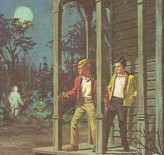
I am sorry to say that a month into my resolution to write Favorite Director post every month, I am already off track. I don't have any good reasons - at least I can come up with a decent substitute though. Donald Richie's death is important to note. He was a giant, obviously, in the process of bringing Japanese films to the United States - opening for this country what I have to consider one of the three truly consistently great film cultures (along with the US and France.) He championed Japanese films, he wrote about them, providing excellent introductions to a number of the most important filmmakers - in the age of DVDs, providing the voice for many commentaries on Japanese films. I am fairly certain that he would have been the first writer I read on Japanese films, and always there as a guide. He was not, I have to admit, the most important critic of Japanese films I read - I was much more influenced by reading Audie Bock and Noel Burch - but he was still very important to me, as well as crucial to the world of film.
My favorite of Richie's books was, in fact, The Japanese Film - I found a used copy of the 1959 edition, and read it with delight. It's a great book, well researched, well written, comprehensive, covering film as art as well as the history of the industry, which was very useful information. It reminded me of Andrew Sarris - sharing Sarris' auteurism, and willing to do the work, seeing the films, tracking down the industrial information (something Sarris did less of, but is a big part of this one.) A very useful reference. And a fascinating document, especially that 1959 edition - that puts it right on the cusp of something. It's right on the edge of the new wave revolution, well into the critical part of the change - by then, the French had established a lot of the premises of the new wave: championing directors, genre films, pictorialism, realism, trash (all at the same time) - elements that seem to be just outside Richie and Anderson's book. You can see too that the critical divisions that would form over Japanese films were appearing. The French had formed opinions by then, based, I fear, on a very scant exposure to Japanese films - they had already taken sides for Mizoguchi and against Kurosawa. Not so Richie and Anderson. They did not share the French passion for taking sides - they praised Mizoguchi and Kurosawa - and of course they had seen more than just the festival films, and knew, for example, that Ozu was in their class as well. But they were also pretty clearly in awe of Kurosawa.
Though what is even stranger to read now, after the fact, is the way they characterize the Japanese film industry in 1959. They lament that no new talents have emerged since Kurosawa and Kinoshita (and their treatment in Kinoshita is interesting itself; he has been somewhat forgotten, surpassed in reputation - certainly availability in the states - by the old guard (even Naruse), by Kobayashi and Ichikawa, by their successors - Oshima and Imamura, even Shinoda, Tesugahara, and Suzuki, are all far more available.) They lament that the system does not seem likely to produce any new talent soon - that it is stagnating - that there have been no more movements lately. All this is in 1959 - and 1960 saw 3 revolutionary Oshima films, a couple Yoshida films, Pigs and Battleships came out in 61, etc. The 60s were a burst of energy - the Ofuna new wave - Imamura, the revitalization of some of the older directors in response to this - an increased sense of command by some of the directors they mention (Ichikawa and Kobayashi especially) - they said things in 1959 that by 1961 would sound insane.
But thinking about this - another superb book on Japanese film, Mitsuhiro Yoshimoto's Kurosawa book, suggests that the discovery of Japanese film in Europe and America begat film studies as a discipline. It showed a mature industry/art that existed outside western culture - that could not be studied along with Welles or Godard without positing a different way of studying film than through culture. This was, you could say, the time when film had to be taken seriously as an art - treated, in fact, as an independent art, the way music or literature or theater were. Japanese film was a surprise - it showed a different way of doing things, though not unrecognizable - it certainly fit the theories of people at the time - Mizoguchi was tailor made for auteurists. So was Ozu, when they found him. But maybe even more than this - the attention given to Japanese films in the west was reciprocated by attention to western films (and theorists) in Japan. These things indicated an exchange of information between Japan and the rest of the world - an exchange going both ways. So while in 1959 the Japanese filmmaking system seemed increasingly static - bureaucratic, commercial, slow to change, with no way out of the cycle it was in - the mere presence of Americans writing about Japan indicates contact with the rest of the world - and Japanese were reading Americans. And while it is true that Ofuna new wave came out of itself, without a lot of push from the west (Oshima and Imamura and others were independent and tough and had their own ideas) - but they were able to piggy back what they did on the French new wave (they stole the word!); they did what the French did - they started theorizing their work. They connected what they were doing to the rest of the world.
And that brings us back to where we started - because Donald Richie was as important as one man could possibly be in making that connection.
And now? in his honor - and since this is, in fact, meant as a kind of series of lists - here is a list - the 10 Best Japanese films... sort of. I limited myself to one per director, to get past Ozu, which is always a challenge....
1. Early Summer - Ozu
2. Seven Samurai - Kurosawa Akira
3. The Pornographers - Imamura
4. Ugetsu Monagatari - Mizoguchi
5. Late Chrysanthemums - Naruse
6. Fires on the Plain - Ichikawa
7. Ceremony - Oshima
8. The Emperor's Naked Army Marches on - Hara
9. Charisma - Kurosawa Kiyoshi
10. Fighting Elegy - Suzuki
Thursday, February 28, 2013

Saturday, February 23, 2013
Oscar Talk and My Category Favorites
I guess the Oscars are here, but since I don't intend to watch them, and barely even think about them, I suppose it best to do as I did last year, and use this as en excuse to offer up my favorites of 2012, in various categories. Though I suppose I could speculate on nominations...
Best Picture - somehow they managed, despite nominating 9 films, not to nominate the two best films of the year, The Master and Moonrise Kingdom. We are off to a bad start. Of the films nominated - Amour is very much the best; Lincoln is the most logical and appropriate pick (since it is the Oscars) - but I rather fear Argo will win. Harmless, but rather inane pick. I've somewhat moved away from my old idea that the worst film nominated will always win - I didn't see Life of Pi or Les Miserables - but the latter sounds like it's the worst film on the slate. Though Silver Linings Playbook annoyed me no end... I don't think it can win though, thank god. Not even sure how it got nominated, even in this context... The other nominations are pretty decent, though missing the two Andersons' pictures is unforgivable. I listed these back at the beginning of the year, though lots of films have come out since, so....
My top 5:
1. Moonrise Kingdom
2. The Master
3. Amour
4. Barbara
5. Oslo: August 31
Director: again, they're missing the Andersons, so who cares what they say? oddly - they are also missing Bigelow and Tarantino, who make very strange absences. Behind Russell and Zeitlin? how? Anyway - I rather assume Spielberg will win, and wouldn't complain if he did. Haneke, obviously, is in another world from this bunch, but what can you do?
My choices:
1. PT Anderson - reversing the usual order of the Andersons...
2. Wes Anderson - not that anyone else is getting between them.
3. the Dardennes, Kid With the Bike
4. Christian Petzold, Barbara
5. Haneke
Actor: I would think Daniel Day-Lewsi will win again; I would rather hope so. Though I will say, here at least, they nominated by favorite of the year - Joaquin Phoenix should win, and while I doubt he will, it is not completely impossible.
My choices:
1. Joaquin Phoenix
2. Denis Lavant
3. Daniel Day-Lewis
4. Anders Danielson Lee (Oslo: August 31)
5. John Hawkes [how did he get forgotten?]
Actress: not a bad set of nominations, though acknowledging the existence of The Impossible causes me pain... of the nominations - I guess I hope Jessica Chastain wins - she is genuinely extraordinary.
My Choices:
1. Greta Gerwig, Damsels in Distress - been a while, but really, she's the best performance in the best role of the year.
2. Isabella Huppert, In Another Country
3. Jessica Chastain
4. Emanuelle Riva
5. Nina Hoss, Barbara
Supporting Actor: this is odd - it is probably possible to make the case that Christophe Waltz is in a supporting role - but Philip Seymour Hoffman? it's a co-lead; how do you get around that? Anyway - it does make a tough choice.... the Academy is probably going to give it to Waltz, and that makes sense, I guess. I do like all the nominees, though, except maybe DeNiro - though he's good, the role is kind of stupid.
1. Philip Seymour Hoffman - though I think this should be a lead...
2. Christophe Waltz
3. Leonardo DiCaprio - hell, Samuel L. Jackson should be on here too maybe...
4. Bruce Willis, in Moonrise Kingdom
5. Edward Norton - or him...
Supporting Actress: I am blessed not to have seen Les Miserables, so I don't know what Anne Hathaway did - she seems to be the favorite though, and who am I to gainsay it? of the nominees - I would probably vote for Jacki Weaver, who's about the only thing I really liked about Silver Linings Playbook...
1. Annaleigh Tipton, Damsels in Distress
2. Jacki Weaver
3. Frances McDormand
4. Amy Adams
5. Tilda Swinton
Original Screenplay: Well, Wes Anderson got a nod here. I don't know who's going to win this - Amour is in French; Django Unchained would be an odd choice - it's amusing, but very weak for Tarantino; Flight - doesn't seem to be getting much attention (I didn't see it); Moonrise Kingdom, though the best film, seems a very long shot - leaving Zero Dark Thirty - which would be a deserving winner (I'd settle for it, that is) - but the backlash against that film is very strange... I don't know.
1. Moonrise Kingdom
2. Damsels in Distress
3. The Master
4. Amour
5. Zero Dark Thirty
Adapted Screenplay: I hope Lincoln wins; it should, though you never can tell...
1. Killing them Softly
2. Oslo: August 31
3. The Deep Blue Sea
4. Lincoln
5. Cosmopolis
Cinematography: I can never figure out what the academy is thinking in this category, so who cares what they think? I think:
1. The Master - this was something of a show stopper - it was a bit mindblowing in 35, and then I saw the 70 mm version...
2. Zero Dark Thirty
3. Moonrise Kingdom
4. This is Not a Film - cinematography should serve the work of art; what you make of it, what you use it for, is as important as the raw beauty or the technical elements of the photography. This is an extraordinary film...
5. Django Unchained
Music or Score: I'm not worried about the academy, partly because I don't want to care about eligibility. So just the votes - though this is hard: I have a harder time holding the music of a film in my head than most other elements... until I have seen it a few times, so - the ones I saw 3 times (plus) each tend to end up on top...
1. The Master (Jonny Greenwood)
2. Moonrise Kingdom
3. Damsels in Distress
And a couple more - I sort of assume Amour will win Foreign Language film - it should. It's rather startling to see a really good and important film nominated here... Documentary Feature - How to Survive a Plague would be a very deserving winner - that was a great film. 56 Up is better than any of them, but of course it's TV... Editing - Moonrise Kingdom, dammit. Animated feature - I even saw most of these. I would vote for Brave, I think - though they all seemed to be decent, but a bit underwhelming, films. Still... I have no idea what's going to win, though.
And now? I will finish up with 10 moments - because - I should... for the moment, I will generally limit myself to one moment per film...
1. The Master - the first processing between Freddy and the Master - though you could say the jail scene, Freddy's processing montage after he gets out of jail, Freddy and the master in England, especially the Master singing to him, Freddy and Doris' mother... there's so much...
2. Moonrise Kingdom - also full of shots and bits, that are maybe less show-stopping than in the Master, but that all connect and intertwine - picking one - might be a simple one - Edward Norton trying to do his audio journal, and too depressed to speak.... or Bill Murray snatching the tent away... or the policeman and Sam bonding over a burnt sausage and beer...
3. Amour - when Emmanuelle Riva refuses to drink, and Jean-Louis Trintingant slaps her - I would prefer to forget that moment.... there's also his shame and horror when his daughter visits, near the end - another moment of almost unbearable devastation.
4. Holy Motors - the accordions, of course
5. Damsels in Distress - another one full of joy - though I think the people jumping off the Ed building might be the peak...
6. The plot summary of the imaginary movie at the end of Argo - I guess it's completely made up, but damn, that's a cool moment...
7. How to Survive a Plague has a moment - a cut, from 1996, when all of the activists in the film thought they were going to die, very shortly - to the present, with all of them still alive. It's quite marvelous...
8. The crab eating scene in Beasts of the Southern Wild...
9. In Another Country - another film full of little moments - the lifeguard singing to Ann... or trying to read her note... the drunken seduction on a beach... though the winner, I think, would be the "something interesting" moment, that goes so hilariously wrong.
10. I'm going to end with two films I disliked quite intensely - but both have moments that almost made them worth seeing: first - the guy singing grand opera in the shower onstage in To Rome with Love - Woody Allen can still make a joke once in a while, a damned good one even.... and "You aren't being ironic?" in Dark Horse - Todd Solondz tries so hard to make you squirm - and once in a while, I admit it, he manages it...
Best Picture - somehow they managed, despite nominating 9 films, not to nominate the two best films of the year, The Master and Moonrise Kingdom. We are off to a bad start. Of the films nominated - Amour is very much the best; Lincoln is the most logical and appropriate pick (since it is the Oscars) - but I rather fear Argo will win. Harmless, but rather inane pick. I've somewhat moved away from my old idea that the worst film nominated will always win - I didn't see Life of Pi or Les Miserables - but the latter sounds like it's the worst film on the slate. Though Silver Linings Playbook annoyed me no end... I don't think it can win though, thank god. Not even sure how it got nominated, even in this context... The other nominations are pretty decent, though missing the two Andersons' pictures is unforgivable. I listed these back at the beginning of the year, though lots of films have come out since, so....
My top 5:
1. Moonrise Kingdom
2. The Master
3. Amour
4. Barbara
5. Oslo: August 31
Director: again, they're missing the Andersons, so who cares what they say? oddly - they are also missing Bigelow and Tarantino, who make very strange absences. Behind Russell and Zeitlin? how? Anyway - I rather assume Spielberg will win, and wouldn't complain if he did. Haneke, obviously, is in another world from this bunch, but what can you do?
My choices:
1. PT Anderson - reversing the usual order of the Andersons...
2. Wes Anderson - not that anyone else is getting between them.
3. the Dardennes, Kid With the Bike
4. Christian Petzold, Barbara
5. Haneke
Actor: I would think Daniel Day-Lewsi will win again; I would rather hope so. Though I will say, here at least, they nominated by favorite of the year - Joaquin Phoenix should win, and while I doubt he will, it is not completely impossible.
My choices:
1. Joaquin Phoenix
2. Denis Lavant
3. Daniel Day-Lewis
4. Anders Danielson Lee (Oslo: August 31)
5. John Hawkes [how did he get forgotten?]
Actress: not a bad set of nominations, though acknowledging the existence of The Impossible causes me pain... of the nominations - I guess I hope Jessica Chastain wins - she is genuinely extraordinary.
My Choices:
1. Greta Gerwig, Damsels in Distress - been a while, but really, she's the best performance in the best role of the year.
2. Isabella Huppert, In Another Country
3. Jessica Chastain
4. Emanuelle Riva
5. Nina Hoss, Barbara
Supporting Actor: this is odd - it is probably possible to make the case that Christophe Waltz is in a supporting role - but Philip Seymour Hoffman? it's a co-lead; how do you get around that? Anyway - it does make a tough choice.... the Academy is probably going to give it to Waltz, and that makes sense, I guess. I do like all the nominees, though, except maybe DeNiro - though he's good, the role is kind of stupid.
1. Philip Seymour Hoffman - though I think this should be a lead...
2. Christophe Waltz
3. Leonardo DiCaprio - hell, Samuel L. Jackson should be on here too maybe...
4. Bruce Willis, in Moonrise Kingdom
5. Edward Norton - or him...
Supporting Actress: I am blessed not to have seen Les Miserables, so I don't know what Anne Hathaway did - she seems to be the favorite though, and who am I to gainsay it? of the nominees - I would probably vote for Jacki Weaver, who's about the only thing I really liked about Silver Linings Playbook...
1. Annaleigh Tipton, Damsels in Distress
2. Jacki Weaver
3. Frances McDormand
4. Amy Adams
5. Tilda Swinton
Original Screenplay: Well, Wes Anderson got a nod here. I don't know who's going to win this - Amour is in French; Django Unchained would be an odd choice - it's amusing, but very weak for Tarantino; Flight - doesn't seem to be getting much attention (I didn't see it); Moonrise Kingdom, though the best film, seems a very long shot - leaving Zero Dark Thirty - which would be a deserving winner (I'd settle for it, that is) - but the backlash against that film is very strange... I don't know.
1. Moonrise Kingdom
2. Damsels in Distress
3. The Master
4. Amour
5. Zero Dark Thirty
Adapted Screenplay: I hope Lincoln wins; it should, though you never can tell...
1. Killing them Softly
2. Oslo: August 31
3. The Deep Blue Sea
4. Lincoln
5. Cosmopolis
Cinematography: I can never figure out what the academy is thinking in this category, so who cares what they think? I think:
1. The Master - this was something of a show stopper - it was a bit mindblowing in 35, and then I saw the 70 mm version...
2. Zero Dark Thirty
3. Moonrise Kingdom
4. This is Not a Film - cinematography should serve the work of art; what you make of it, what you use it for, is as important as the raw beauty or the technical elements of the photography. This is an extraordinary film...
5. Django Unchained
Music or Score: I'm not worried about the academy, partly because I don't want to care about eligibility. So just the votes - though this is hard: I have a harder time holding the music of a film in my head than most other elements... until I have seen it a few times, so - the ones I saw 3 times (plus) each tend to end up on top...
1. The Master (Jonny Greenwood)
2. Moonrise Kingdom
3. Damsels in Distress
And a couple more - I sort of assume Amour will win Foreign Language film - it should. It's rather startling to see a really good and important film nominated here... Documentary Feature - How to Survive a Plague would be a very deserving winner - that was a great film. 56 Up is better than any of them, but of course it's TV... Editing - Moonrise Kingdom, dammit. Animated feature - I even saw most of these. I would vote for Brave, I think - though they all seemed to be decent, but a bit underwhelming, films. Still... I have no idea what's going to win, though.
And now? I will finish up with 10 moments - because - I should... for the moment, I will generally limit myself to one moment per film...
1. The Master - the first processing between Freddy and the Master - though you could say the jail scene, Freddy's processing montage after he gets out of jail, Freddy and the master in England, especially the Master singing to him, Freddy and Doris' mother... there's so much...
2. Moonrise Kingdom - also full of shots and bits, that are maybe less show-stopping than in the Master, but that all connect and intertwine - picking one - might be a simple one - Edward Norton trying to do his audio journal, and too depressed to speak.... or Bill Murray snatching the tent away... or the policeman and Sam bonding over a burnt sausage and beer...
3. Amour - when Emmanuelle Riva refuses to drink, and Jean-Louis Trintingant slaps her - I would prefer to forget that moment.... there's also his shame and horror when his daughter visits, near the end - another moment of almost unbearable devastation.
4. Holy Motors - the accordions, of course
5. Damsels in Distress - another one full of joy - though I think the people jumping off the Ed building might be the peak...
6. The plot summary of the imaginary movie at the end of Argo - I guess it's completely made up, but damn, that's a cool moment...
7. How to Survive a Plague has a moment - a cut, from 1996, when all of the activists in the film thought they were going to die, very shortly - to the present, with all of them still alive. It's quite marvelous...
8. The crab eating scene in Beasts of the Southern Wild...
9. In Another Country - another film full of little moments - the lifeguard singing to Ann... or trying to read her note... the drunken seduction on a beach... though the winner, I think, would be the "something interesting" moment, that goes so hilariously wrong.
10. I'm going to end with two films I disliked quite intensely - but both have moments that almost made them worth seeing: first - the guy singing grand opera in the shower onstage in To Rome with Love - Woody Allen can still make a joke once in a while, a damned good one even.... and "You aren't being ironic?" in Dark Horse - Todd Solondz tries so hard to make you squirm - and once in a while, I admit it, he manages it...
Friday, February 22, 2013
Friday Music
One of these weeks, we might get some variation - there are a bunch of records in the pipeline that I will or have bought - new Nick Cave and the Bad Seeds, new My Bloody Valentine, new stuff from various Radioheads, a new Richard Thompson record (that one I have already) - there's hope! though looking at that list of artists - holy cats, I feel old... But none of that today - today, we're going right back to the old shuffle... enjoy!
1. Harry McClintock - Big Rock Candy Mountain
2. The Germs - The Other Newest One
3. George Michael - I want your Sex
4. The Fall - The Man Whose Head Expanded
5. Meat Puppets - Look at the Rain
6. Jacques Brel - Ces Gens-La
7. Minutemen - Suburban Dialectic
8. Mats Gustafson - Where's the Air?
9. Jimi Hendrix - Love or Confusion
10. Yoko Ono & Yo La Tengo - Hedwig's Lament/Exquisite Corpse
And video? oh what the heck - I swear I won't tease you, won't tell you no lies... who doesn't want a live George Michael clip?
Speaking of the 80s... I probably post this every other month, but here's the Meat Puppets doing a nice version of Look at the Rain...
1. Harry McClintock - Big Rock Candy Mountain
2. The Germs - The Other Newest One
3. George Michael - I want your Sex
4. The Fall - The Man Whose Head Expanded
5. Meat Puppets - Look at the Rain
6. Jacques Brel - Ces Gens-La
7. Minutemen - Suburban Dialectic
8. Mats Gustafson - Where's the Air?
9. Jimi Hendrix - Love or Confusion
10. Yoko Ono & Yo La Tengo - Hedwig's Lament/Exquisite Corpse
And video? oh what the heck - I swear I won't tease you, won't tell you no lies... who doesn't want a live George Michael clip?
Speaking of the 80s... I probably post this every other month, but here's the Meat Puppets doing a nice version of Look at the Rain...
Tuesday, February 19, 2013
Up Up Up
Coming late to the Up films is certainly intimidating - every 7 years, a new one comes out; every 7 years I tell myself I should see it, but should watch them all first - every 7 years I end up not watching the old ones and then skipping the film because I haven't seen them. In between - I see clips, I don't know if I have seen any of the films anywhere on TV, I don't remember ever sitting through any of them, but watching them, there were certainly lots of familiar moments. And, instead of taking advantage of the 7 year reprieve to catch up - I forget about them until the next one comes out.
Well - 56 Up is out - this year I swore, a bit in advance, that I would watch them all - but I managed to wait until a week before the thing opened without doing anything - and then we got 2 feet of snow. And that, my friends, is why they invented Netflix.... And so: 56 Up: it is fairly pointless to try to review these films in isolation (which is why I am not doing so) - this one in particular seems very - what's the word? - static? It's very much a continuation of the last one - most of them are roughly where they were 7 years ago, in their circumstances, in their location. This can be good or bad, obviously. It's not so good for Jackie - it's something of a miracle for Neil. (It's the first time since 14 that he's been in the same place he was 7 years ago...) Jackie has had a hard time of it, with bad health, and misfortune striking her not-quite-in-laws, and austerity doing what austerity does (making grandmothers suffer) - though he sons seem to be doing okay, so maybe things will be all right. Lynn also suffers from the recession, though maybe more from the longer term decline of good government - she had been a librarian for 30 odd years, and then got laid off, even before the crash, I think. I can't resist a bit of politics here - putting librarians out of work is a fine recipe for national decline. England is done and we ain't far behind...
Sorry. This one is most notable for getting 13 of the 14 who started the show back. (Though "started" isn't quite it - the conceit really starts with 7 Plus Seven - Apted took over, he started revisiting the same kids every 7 years - and he narrowed the number down to 14, at age 14, there...) John is still around - he skipped a couple of them, but seems to have settled in as a regular again. And Peter is back - the other Liverpudlian, last scene bitching Thatcher in 28 Up, and catching holy hell from the Murdockoids, and running for cover... He has a band to promote - one is tempted, I suppose, to rolls ones eyes - but I am not really bothered by it. The series demands a lot of its participants - why shouldn't they try to get something back? And maybe more to the point - back at 28, he named, along with the 1977 European cup final, being on stage with his band as the happiest moment of his life. It's like with John and his Bulgarian charity and ancestry - it's a part of their lives. It is what they do, who they are - it probably goes down easier when its Tony talking about his acting work, because Tony is always in the shows, an enthusiastic and charismatic figure - but if it brings them back, then it's more than a fair trade, I think.
All right. The hardest thing to do with these films is write about them in terms other than the people - and that involves, well - 13 different 56 year olds, documented across 8 movies - a cast rather expanded by spouses and kids and such - by now, Susan, Paul's wife, or Debbie, Tony's wife, are almost characters as much as their husbands - and others, Rupert and Jane say, are constant presences in most of them. There's a lot to keep track of, and a lot of stuff going on. Still - it's worth trying to pull out some of what the show is up to, how it works. It started with a political edge - out to show the continued pernicious influence of the English class system; it evolved - into a sociological study (though not systematic enough for scientist Nicholas, you may remember from 21 Up), and into a story about how these people live. Though it is also definitely about How We Live Today.
And it is also a work of art. Apted got lucky in his subjects - many of them turned out to make very interesting case studies; almost all of them have remained fairly appealing television subjects - and a few, I think, have emerged as absolutely compelling dramatic characters or performers. Neil, I guess, is the obvious case - he has had a rather astonishing life - decades of misery that then morphs into local politics, and what seems to be a fair degree of satisfaction. His dramatic arc is paired with his own willingness to talk about his life, to analyze himself and the world. He makes great television, no doubt about it. He's not the only one, though - Tony is a joy to watch - charismatic, funny, ambitious in his way, driven enough to get what he wants, and realistic enough to accept what he is. There is a lot of talk, on the show and about it, about the three rich kids laying out their lives at age 7 and 14 - but so did Tony: he wanted to be a jockey - he did; if he didn't succeed he'd be a cabby - he did; he wanted a pub - he had one; he wanted to act - he acts. Some things he's a major success at - some he's able to tick off the list - but he did them... I think Apted also lucked out with Nick - the farmer boy turned nuclear physicist. With John - who in his youth, at least, was willing to play the upper class twit for the amusement of the viewing public. (And whether he meant ti all or not, you could see him calculating - you could see him taking positions to be perverse, to shock, to play the part.) In his maturity, he's far less irritating or thrilling, but still a fairly interesting character - unlike his fellow twit Andrew, who grows up to be a bore... Finally - in terms of who comes off best in the series -= there is Bruce - a lonely little 7 year hoping he can teach the uncivilized to be "more or less, good." - and growing up to be an inner city teacher, then just a teacher - but always, from 14 on - a smart, thoughtful, fascinating interview subject, who is also, in a very understated way, far and away the funniest person on the show. "The village socialist..."
There is that. And there is Apted's shaping of the show. It is a masterpiece of editing, of course - you notice it more in the early ones, where he was probably still trying to score political points - there's an almost savage transition in 28 Up from Andrew's "I've been lucky" to Neil, at close to his lowest point. But it's not all political, and over time, you come to appreciate his transitions in an almost formal sense - they shape the material, and their occasional explicitness helps to keep that act of shaping visible. It's a very self-conscious show, as it must be - the participants talk about it, quite a bit in the last couple - and Apted's sometimes overt manipulation of imagery serves that purpose too. As does his manipulation of the introductions - watching all these films in a week makes it clearer - the use of familiar clips, their slight reordering or recutting, the occasional recombination of visual and sound, and so on. This is a show about change over time, and over time, it becomes a show about memory, about how we shape and reshape our lives - and Apted makes the point formally, in his shifting use of all that footage, and its connection with the current state of his characters.
And still: when it started, it was meant as a political show - especially by Apted. And though that focus has changed over the years - Apted's original point has been made pretty clearly, I think you'd have to say. His point is that the class system was alive and well, and your life was fairly determined by your station when you were born - and it's hard to argue with that. A couple people have gone far - Nick and Sue, you could say; and Neil, though he's a different case, having been pretty obviously derailed by his health... Some characters have moved up financially (Tony especially), some have moved physically - but for all that - it is most notable how little class mobility there is. A couple things come to mind. Here is one: of the kids on the show - all the rich kids except Suzy went to University (she just ended up marrying well.) None of the poor kids did. The middle class kids went, one passing, one dropping out. Okay. They are all older now, they have kids of their own, all of them - and of those kids - all the rich kids' kids of university age went to university (I think; the ones who talked about it.) One - 1 - of the poor kids' kids has gone.
Here is another thing that comes to mind. Bruce taught in the East End for a long time, in poor schools. Lynn, meanwhile, was working in the libraries of the schools in the East End. Both, that is, working in the same school systems of the same part of London. In 49 Up, Bruce had moved off, to teach at St. Albans; while Lynn was still in Bethnel Green, worrying about her job - which she lost by 56 UP. Now it seems to me that all along, Apted has been very enamored with Bruce - that he has shown him in a very good light. Through most of the series, I think he took Lynn's work for granted - but in 49 Up it felt different. He dwelt on her job, her place in the school system - showed her working with handicapped kids, talking about her work with them. It felt as though he had suddenly noticed - maybe because Bruce had left - that she was doing pretty much what he was doing all those years. But he had his Oxford degree and the chance to go wherever he wanted. When she lost her job - she was done. And there, I imagine, is where the politics lingers - and why the class rigidity the series set out to explore remains, as bad as ever - maybe worse. There is a lot of talk about opportunity in the series - and there you see it. Both in the way he is able to move on to something else - and in the way - well, you don't really have to worry about St. Albans school cutting their librarians.
I could go on about this a while - I maybe should, but I suppose this is not the time. But - England does not seem to be getting better. They seem, in fact, to be getting more American - one of John's lines way back in 21 Up. But opportunity, social mobility, call it what you want is not getting better here - I believe it is declining, relative to mobility in the past; and relative to Europe. What is different in the US from the UK seems to be that here, the classes are not so defined - it might not be so obvious, from your accent or the type of school you went to, what your class is; but that's because class, here, is driven mainly by money. And that comes up in these films - that while the class distinctions they grew up with seem less obvious, the class system based on money is stronger than ever. And - I don't think you could dispute that. I can't dispute it here - most people in the US live roughly the way their parents did. And I think this is more true now than it was 40 or 50 years ago - my parents' generation, I think, had a lot more chance to change their status - to go to college, to increase their financial circumstances, to move, physically - than my generation had - and I think it is probably getting worse for the next generation. Maybe - they are just coming of age now. So - I guess their fates are up in the air. But judging from these films - they better get used to living with mom and dad, cause it's gonna take some doing to move out.
Well - 56 Up is out - this year I swore, a bit in advance, that I would watch them all - but I managed to wait until a week before the thing opened without doing anything - and then we got 2 feet of snow. And that, my friends, is why they invented Netflix.... And so: 56 Up: it is fairly pointless to try to review these films in isolation (which is why I am not doing so) - this one in particular seems very - what's the word? - static? It's very much a continuation of the last one - most of them are roughly where they were 7 years ago, in their circumstances, in their location. This can be good or bad, obviously. It's not so good for Jackie - it's something of a miracle for Neil. (It's the first time since 14 that he's been in the same place he was 7 years ago...) Jackie has had a hard time of it, with bad health, and misfortune striking her not-quite-in-laws, and austerity doing what austerity does (making grandmothers suffer) - though he sons seem to be doing okay, so maybe things will be all right. Lynn also suffers from the recession, though maybe more from the longer term decline of good government - she had been a librarian for 30 odd years, and then got laid off, even before the crash, I think. I can't resist a bit of politics here - putting librarians out of work is a fine recipe for national decline. England is done and we ain't far behind...
Sorry. This one is most notable for getting 13 of the 14 who started the show back. (Though "started" isn't quite it - the conceit really starts with 7 Plus Seven - Apted took over, he started revisiting the same kids every 7 years - and he narrowed the number down to 14, at age 14, there...) John is still around - he skipped a couple of them, but seems to have settled in as a regular again. And Peter is back - the other Liverpudlian, last scene bitching Thatcher in 28 Up, and catching holy hell from the Murdockoids, and running for cover... He has a band to promote - one is tempted, I suppose, to rolls ones eyes - but I am not really bothered by it. The series demands a lot of its participants - why shouldn't they try to get something back? And maybe more to the point - back at 28, he named, along with the 1977 European cup final, being on stage with his band as the happiest moment of his life. It's like with John and his Bulgarian charity and ancestry - it's a part of their lives. It is what they do, who they are - it probably goes down easier when its Tony talking about his acting work, because Tony is always in the shows, an enthusiastic and charismatic figure - but if it brings them back, then it's more than a fair trade, I think.
All right. The hardest thing to do with these films is write about them in terms other than the people - and that involves, well - 13 different 56 year olds, documented across 8 movies - a cast rather expanded by spouses and kids and such - by now, Susan, Paul's wife, or Debbie, Tony's wife, are almost characters as much as their husbands - and others, Rupert and Jane say, are constant presences in most of them. There's a lot to keep track of, and a lot of stuff going on. Still - it's worth trying to pull out some of what the show is up to, how it works. It started with a political edge - out to show the continued pernicious influence of the English class system; it evolved - into a sociological study (though not systematic enough for scientist Nicholas, you may remember from 21 Up), and into a story about how these people live. Though it is also definitely about How We Live Today.
And it is also a work of art. Apted got lucky in his subjects - many of them turned out to make very interesting case studies; almost all of them have remained fairly appealing television subjects - and a few, I think, have emerged as absolutely compelling dramatic characters or performers. Neil, I guess, is the obvious case - he has had a rather astonishing life - decades of misery that then morphs into local politics, and what seems to be a fair degree of satisfaction. His dramatic arc is paired with his own willingness to talk about his life, to analyze himself and the world. He makes great television, no doubt about it. He's not the only one, though - Tony is a joy to watch - charismatic, funny, ambitious in his way, driven enough to get what he wants, and realistic enough to accept what he is. There is a lot of talk, on the show and about it, about the three rich kids laying out their lives at age 7 and 14 - but so did Tony: he wanted to be a jockey - he did; if he didn't succeed he'd be a cabby - he did; he wanted a pub - he had one; he wanted to act - he acts. Some things he's a major success at - some he's able to tick off the list - but he did them... I think Apted also lucked out with Nick - the farmer boy turned nuclear physicist. With John - who in his youth, at least, was willing to play the upper class twit for the amusement of the viewing public. (And whether he meant ti all or not, you could see him calculating - you could see him taking positions to be perverse, to shock, to play the part.) In his maturity, he's far less irritating or thrilling, but still a fairly interesting character - unlike his fellow twit Andrew, who grows up to be a bore... Finally - in terms of who comes off best in the series -= there is Bruce - a lonely little 7 year hoping he can teach the uncivilized to be "more or less, good." - and growing up to be an inner city teacher, then just a teacher - but always, from 14 on - a smart, thoughtful, fascinating interview subject, who is also, in a very understated way, far and away the funniest person on the show. "The village socialist..."
There is that. And there is Apted's shaping of the show. It is a masterpiece of editing, of course - you notice it more in the early ones, where he was probably still trying to score political points - there's an almost savage transition in 28 Up from Andrew's "I've been lucky" to Neil, at close to his lowest point. But it's not all political, and over time, you come to appreciate his transitions in an almost formal sense - they shape the material, and their occasional explicitness helps to keep that act of shaping visible. It's a very self-conscious show, as it must be - the participants talk about it, quite a bit in the last couple - and Apted's sometimes overt manipulation of imagery serves that purpose too. As does his manipulation of the introductions - watching all these films in a week makes it clearer - the use of familiar clips, their slight reordering or recutting, the occasional recombination of visual and sound, and so on. This is a show about change over time, and over time, it becomes a show about memory, about how we shape and reshape our lives - and Apted makes the point formally, in his shifting use of all that footage, and its connection with the current state of his characters.
And still: when it started, it was meant as a political show - especially by Apted. And though that focus has changed over the years - Apted's original point has been made pretty clearly, I think you'd have to say. His point is that the class system was alive and well, and your life was fairly determined by your station when you were born - and it's hard to argue with that. A couple people have gone far - Nick and Sue, you could say; and Neil, though he's a different case, having been pretty obviously derailed by his health... Some characters have moved up financially (Tony especially), some have moved physically - but for all that - it is most notable how little class mobility there is. A couple things come to mind. Here is one: of the kids on the show - all the rich kids except Suzy went to University (she just ended up marrying well.) None of the poor kids did. The middle class kids went, one passing, one dropping out. Okay. They are all older now, they have kids of their own, all of them - and of those kids - all the rich kids' kids of university age went to university (I think; the ones who talked about it.) One - 1 - of the poor kids' kids has gone.
Here is another thing that comes to mind. Bruce taught in the East End for a long time, in poor schools. Lynn, meanwhile, was working in the libraries of the schools in the East End. Both, that is, working in the same school systems of the same part of London. In 49 Up, Bruce had moved off, to teach at St. Albans; while Lynn was still in Bethnel Green, worrying about her job - which she lost by 56 UP. Now it seems to me that all along, Apted has been very enamored with Bruce - that he has shown him in a very good light. Through most of the series, I think he took Lynn's work for granted - but in 49 Up it felt different. He dwelt on her job, her place in the school system - showed her working with handicapped kids, talking about her work with them. It felt as though he had suddenly noticed - maybe because Bruce had left - that she was doing pretty much what he was doing all those years. But he had his Oxford degree and the chance to go wherever he wanted. When she lost her job - she was done. And there, I imagine, is where the politics lingers - and why the class rigidity the series set out to explore remains, as bad as ever - maybe worse. There is a lot of talk about opportunity in the series - and there you see it. Both in the way he is able to move on to something else - and in the way - well, you don't really have to worry about St. Albans school cutting their librarians.
I could go on about this a while - I maybe should, but I suppose this is not the time. But - England does not seem to be getting better. They seem, in fact, to be getting more American - one of John's lines way back in 21 Up. But opportunity, social mobility, call it what you want is not getting better here - I believe it is declining, relative to mobility in the past; and relative to Europe. What is different in the US from the UK seems to be that here, the classes are not so defined - it might not be so obvious, from your accent or the type of school you went to, what your class is; but that's because class, here, is driven mainly by money. And that comes up in these films - that while the class distinctions they grew up with seem less obvious, the class system based on money is stronger than ever. And - I don't think you could dispute that. I can't dispute it here - most people in the US live roughly the way their parents did. And I think this is more true now than it was 40 or 50 years ago - my parents' generation, I think, had a lot more chance to change their status - to go to college, to increase their financial circumstances, to move, physically - than my generation had - and I think it is probably getting worse for the next generation. Maybe - they are just coming of age now. So - I guess their fates are up in the air. But judging from these films - they better get used to living with mom and dad, cause it's gonna take some doing to move out.
Friday, February 15, 2013
Friday Guitars
I believe it is Friday once more. Last week's snow has been steadily melting; there is some threat of more this weekend, but nothing too interesting. What is left is all crusted over; you could probably walk across it. I remember when I was a kid - that always seemed to happen after big storms - you'd get a day of rain and then it would get cold again, and you could walk all over the place on top of the snow... falling through just raised the stakes a bit. Great fun. Great sledding, too, especially when it got really hard and would support you on top....
Enough weather. A satisfactory movie weekend appears in the offing, with Tabu and 56-Up coming. Sooner or later there might be some interesting music too - I keep reading about new Nick Cave and My Bloody Valentine records, though I have yet to see them; I did get a new Richard Thompson record, not that I have opened it yet.... As for today - I think we will stay with our old standby, the Random Ten. iTunes?
1. Nina Simone - Jelly Roll
2. Wilco - Hummingbird
3. Lift to Experience - The Ground too Soft
4. Love - Can't Explain
5. Damon & Naomi - House of Glass
6. Replacements - Shooting Dirty Pool
7. Heroin - Undertaking
8. Meat Puppets - Automatic Mojo
9. Danielson - Hosanna in the Forest
10. PJ Harvey & John Parish - Leaving California
Video? First, let's go off list - here is some vintage live Feelies - noticed a lot more of these old shows on YouTube lately....
And - another band with a strangely truncated career, Lift to Experience - live in Paris...
Enough weather. A satisfactory movie weekend appears in the offing, with Tabu and 56-Up coming. Sooner or later there might be some interesting music too - I keep reading about new Nick Cave and My Bloody Valentine records, though I have yet to see them; I did get a new Richard Thompson record, not that I have opened it yet.... As for today - I think we will stay with our old standby, the Random Ten. iTunes?
1. Nina Simone - Jelly Roll
2. Wilco - Hummingbird
3. Lift to Experience - The Ground too Soft
4. Love - Can't Explain
5. Damon & Naomi - House of Glass
6. Replacements - Shooting Dirty Pool
7. Heroin - Undertaking
8. Meat Puppets - Automatic Mojo
9. Danielson - Hosanna in the Forest
10. PJ Harvey & John Parish - Leaving California
Video? First, let's go off list - here is some vintage live Feelies - noticed a lot more of these old shows on YouTube lately....
And - another band with a strangely truncated career, Lift to Experience - live in Paris...
Sunday, February 10, 2013
Snowy Snow

Yeah, it's been an adventurous weekend. The storm delivered all that it was promised to be, have to say that - couple feet of snow - piled up in quite impressive drifts - huge snowbanks - a mess. I went out into it yesterday, while the snow was still coming down, before much of it was cleared up - the roads were all plowed, but not sidewalks, there was snow everywhere. It was impressive. My front yard for instance - almost bare grass, and what must be a 7 or 8 foot drift...

One effect of all the wind was that there wasn't a lot of the kind of picturesque snow you associate with winter - evergreens laden down with slow. It all blew off - except in a couple neighborhoods with a bit more shelter.... Still:

It was odd. The city shut down early Friday - the streets were nearly empty by noon, though it really didn't start snowing hard until evening. I guess it makes sense to get everyone out of the way for when it did come down - I don't doubt that if they had left the rads and such open until 8, people would have been out driving to 8, probably out to midnight. That probably wouldn't have worked out so well. Things are still shut down (I'm off soon to find out how shut down they are), but in general, in the city at least, things are just - shut down. Nothing really bad seems to be happening. Not here anyway. The plows were out yesterday, and had the roads cleared before the snow stopped, even most of the side roads; by the time I got home, the sidewalks were cleared - you could see the crews out shoveling and snow-blowing around all the apartment buildings all morning. Days like yesterday, I feel a lot better about the rent and taxes I pay. I'd say I got my money's worth.

And so? I wasn't alone out there - people walking around, taking pictures, walking their dogs, skiing, snowshoeing, sledding - might as well enjoy it, right? it's here and it's gonna make the commute a living hell for a few days... might as well have some fun first.

Friday, February 08, 2013
A Blizzard of Music
"Nemo"? Please god... everybody's hoping it's "historic" - what's that, top 10 all time? With heavy winds, up to hurricane strength - brrr!
I should add that that's a fun list to look at. I remember a few of them, some very well. I was in Maine in 1978, and don't remember much about The Blizzard (#2 on the list), except that it obliterated beaches, ruined more than one of the fishermen in our town, and sounded a lot more fun in Boston... I was in Maine in December 2010 (#10), as well, so didn't get the city experience, but that was a big, fun snowstorm - being on vacation made it all quite enjoyable. Hang out with kids, who know how to enjoy snow - all good... Of the ones here: the strangest thing - the February 2003 storm that is listed as the heaviest snowfall in the history of Boston - I have forgotten, almost completely. I found a note somewhere that mentioned it, noting only that, even with 2 feet of snow on the ground, I was expected to go to work. Must have been some blizzard.... now - January 2005 (#5) - I remember well: I spent the storm on the computer, doing work for a class - writing about Samuel L. Delany and editing a collage of video to the tune of "Natural is Not In It." (I see I also found time to make fun of David Brooks and little Bush.) That is to the good. The 90s storms - I don't remember the one in 1994 specifically (#9) - but there was a lot of snow that winter, and I remember that. I remember the other two very well - the other #10, in 1996, I remember because I took a long walk along the beach in the middle of it. Very nice. But the big one - the definitive storm, really, of my days in Boston - was the April fool's blizzard of 1997 (#4).
You remember storms that time of year, obviously, but this one hit all the markers. Lots of snow - and a hard, vigorous snowstorm at that. And the very nature of the beast - a major blizzard overnight and all through the morning, then it stopped - and by afternoon, was sunny and the temperature well into the 40s, maybe the 50s. 2 feet of snow, and spring! And - it was a storm full of anecdote, for me. I saw Rebel Without a Cause Monday night (see? I remember the day of the week!) - remember walking home from that, in howling winds and snow - but very happy to have gone. Tuesday morning, I got up and got dressed and despite all the snow in the ground, went in to work - which, somewhat surprisingly, was closed. (The office had a bad reputation for staying open in all kinds of conditions. Probably not deserved - they closed for the real storms, and there aren't as many of those as you think, but you know how it is...) So I walked home, in the blast of the storm, because - I grew up in Maine and I love snow. So there. I stopped to buy pancake mix on the way, since who doesn't want to eat flapjacks in a blizzard? Home - and then I went out again, after the snow started, and wandered around town in the surreal, and quite wonderful, balmy winter wonderland. It was - a very good couple days.
Not losing power puts you in that kind of mood. In this day and age, really, that's pretty much all there is - if the power stays on, weather isn't going to do me much harm. That is a luxury for which I am grateful. (And, of course, I continue to hope the trees stay up. But they've stayed up through 2 hurricanes and a couple blizzards while I've been here, so I guess I should be all right....
ALl right - music: which, though it is too easy - how often do you get a big snow storm on a Friday? So you're getting snowy music today!
1. Black Sabbath - Snowblind
2. Captain Beefheart - Steal Softly Through Snow
3. Dirty Three - Ashen Snow
4. Frank Zappa - Don't Eat the Yellow Snow
5. Mercury Rev - Snowflake in a Hot World
6. The Pop Group - The Snow Girl
7. Pere Ubu - Snowy Livonia
8. Mono - Ashes in the Snow
9. DAvid Sylvain - Snow White in Appalachia
10. Galaxie 500 - Listen! The Snow is Falling
Video? I will have to settle for Dean and Britta, rather than Galaxie 500 (or Yoko), but I want a live version:
And - I wouldn't be so quick to dismiss diabolical influence, but - I don;t have this on iTunes, but... who can resist a shitty Styx video? not me!
I should add that that's a fun list to look at. I remember a few of them, some very well. I was in Maine in 1978, and don't remember much about The Blizzard (#2 on the list), except that it obliterated beaches, ruined more than one of the fishermen in our town, and sounded a lot more fun in Boston... I was in Maine in December 2010 (#10), as well, so didn't get the city experience, but that was a big, fun snowstorm - being on vacation made it all quite enjoyable. Hang out with kids, who know how to enjoy snow - all good... Of the ones here: the strangest thing - the February 2003 storm that is listed as the heaviest snowfall in the history of Boston - I have forgotten, almost completely. I found a note somewhere that mentioned it, noting only that, even with 2 feet of snow on the ground, I was expected to go to work. Must have been some blizzard.... now - January 2005 (#5) - I remember well: I spent the storm on the computer, doing work for a class - writing about Samuel L. Delany and editing a collage of video to the tune of "Natural is Not In It." (I see I also found time to make fun of David Brooks and little Bush.) That is to the good. The 90s storms - I don't remember the one in 1994 specifically (#9) - but there was a lot of snow that winter, and I remember that. I remember the other two very well - the other #10, in 1996, I remember because I took a long walk along the beach in the middle of it. Very nice. But the big one - the definitive storm, really, of my days in Boston - was the April fool's blizzard of 1997 (#4).
You remember storms that time of year, obviously, but this one hit all the markers. Lots of snow - and a hard, vigorous snowstorm at that. And the very nature of the beast - a major blizzard overnight and all through the morning, then it stopped - and by afternoon, was sunny and the temperature well into the 40s, maybe the 50s. 2 feet of snow, and spring! And - it was a storm full of anecdote, for me. I saw Rebel Without a Cause Monday night (see? I remember the day of the week!) - remember walking home from that, in howling winds and snow - but very happy to have gone. Tuesday morning, I got up and got dressed and despite all the snow in the ground, went in to work - which, somewhat surprisingly, was closed. (The office had a bad reputation for staying open in all kinds of conditions. Probably not deserved - they closed for the real storms, and there aren't as many of those as you think, but you know how it is...) So I walked home, in the blast of the storm, because - I grew up in Maine and I love snow. So there. I stopped to buy pancake mix on the way, since who doesn't want to eat flapjacks in a blizzard? Home - and then I went out again, after the snow started, and wandered around town in the surreal, and quite wonderful, balmy winter wonderland. It was - a very good couple days.
Not losing power puts you in that kind of mood. In this day and age, really, that's pretty much all there is - if the power stays on, weather isn't going to do me much harm. That is a luxury for which I am grateful. (And, of course, I continue to hope the trees stay up. But they've stayed up through 2 hurricanes and a couple blizzards while I've been here, so I guess I should be all right....
ALl right - music: which, though it is too easy - how often do you get a big snow storm on a Friday? So you're getting snowy music today!
1. Black Sabbath - Snowblind
2. Captain Beefheart - Steal Softly Through Snow
3. Dirty Three - Ashen Snow
4. Frank Zappa - Don't Eat the Yellow Snow
5. Mercury Rev - Snowflake in a Hot World
6. The Pop Group - The Snow Girl
7. Pere Ubu - Snowy Livonia
8. Mono - Ashes in the Snow
9. DAvid Sylvain - Snow White in Appalachia
10. Galaxie 500 - Listen! The Snow is Falling
Video? I will have to settle for Dean and Britta, rather than Galaxie 500 (or Yoko), but I want a live version:
And - I wouldn't be so quick to dismiss diabolical influence, but - I don;t have this on iTunes, but... who can resist a shitty Styx video? not me!
Friday, February 01, 2013
Friday Music Post (post post post...)
February - winter's back, after a brief absence - not as bad, I suppose, as last week... Anyway - off we go! Randomly...
1. Radiohead - Bones
2. Six Organs of Admittance - Spirits Abandoned
3. AC/DC - Get it Hot
4. Otis Redding - Mr. Pitiful
5. Xiu Xiu - Pox
6. Echo & The Bunnymen - The Cutter
7. Outkast - a Bad Note
8. Jeff Beck - The Morning Dew
9. Sonic Youth - Quest for the Cup
10. Echo & The Bunnymen - Lips Like Sugar
Video - I think iTunes has sent a clear message there, huh?
And -
And for that matter - Radiohead at the most Echoish, no?
1. Radiohead - Bones
2. Six Organs of Admittance - Spirits Abandoned
3. AC/DC - Get it Hot
4. Otis Redding - Mr. Pitiful
5. Xiu Xiu - Pox
6. Echo & The Bunnymen - The Cutter
7. Outkast - a Bad Note
8. Jeff Beck - The Morning Dew
9. Sonic Youth - Quest for the Cup
10. Echo & The Bunnymen - Lips Like Sugar
Video - I think iTunes has sent a clear message there, huh?
And -
And for that matter - Radiohead at the most Echoish, no?
Tuesday, January 29, 2013
January Director of the Month - Nagisa Oshima
I am going to begin a new series - taking off from this one: A Favorite Directors Blogathon, started at Loren Rosson III's The Busybody, then picked up by others. I can't claim any direct connection, except that I've seen his posts (and some others, like Carson Lund's), and figure it is a good idea. I have been thinking about a way to write about directors - or maybe make some kind of ranking. I did that once, a long time ago - it's not a list that changes all that often, but it would be nice to revisit it...
And so - let us begin. I will start with Nagisa Oshima, partly to celebrate his career on the occasion of his death, though also because he makes a good starting point. To the extend that this is a countdown, he would make sense - he probably lands around 20 or so all time - though it isn't that much of a countdown. I prefer Andrew Sarris' method of lumping them - pantheon, far side of paradise, etc. (Though I've never quite managed to figure out how to make them fit his categories; but the general principal obtains.) Now - this series is obviously devoted to the pantheon - though even in the pantheon, there might be some striation. Up there at the top, there are the greater gods, the inner circle, the holy trinity - Ozu, with Capra and Godard and Mizoguchi right there at his side; then - oh - Hawks and Altman, Imamura, Rivette, Fritz Lang... and so on. I am not going to commit to anything like a list at this point - but I want to sketch in the parameters of what I want to write about....
That is enough preamble. Oshima: it took me a while to warm to him (if "warm" is a word you could ever use for him) - took a while to see enough of his films, and to see them in a proper format - and it was hard to know what to make of him when I did see them. I found him hard to place - it wasn't until I'd seen most of his films that he started to make sense to me. Some of this is because of his characteristic style and subject matter - which is to say - the lack of a characteristic style and subject matter. He changes constantly, in every dimension - content, style, form, tone - think just about the three films he made in 1960: Cruel Story of Youth - a youth behaving badly film; The Sun's Burial, an ensemble piece about a slum; Night and Fog in Japan, another ensemble piece, this time among political types; they are all fairly gorgeous widescreen color films, but the way they are made varies - look at how theatrical, formal, artificial, Night and Fog in Japan is, compared to the others... And move forward - he made black and white films, color films; widescreen and low tech; he adapted books (The Catch) and comics (Band of Ninja), worked with theatrical groups (Diary of a Shinjuku Thief - which remains the one major Oshima I haven't been able to see, to my intense annoyance), made films within films (The Man Who Left His Will On Film); made historical films and contemporary films, made pornographic films, horror films, surrealist comedies, samurai films, made films in English and French as well as Japanese...
It's odd: his eclecticism reminds me of Ichikawa, a comparison that might not go over very well - Oshima did not like Ichikawa, I believe. But they both have an ability to move among many styles, radically different styles, and maintain their identities. They carry their tone, almost everywhere - and it's a similar tone - dark, cool, comic - usually given fairly direct political implications by Oshima, more indirectly so by Ichikawa.... They are also alike in moving among all these styles while maintaining a similar technical mastery - neither one is capable of a bad shot... Oshima distinguishes himself, I think, steps above Ichikawa, in his critical capacity - as a filmmaker, you can never quite forget that he is a critic. He moves among a number of different filmmaking modes, always interested, I think, in how these modes work - he's always exploring film as a form, as a way of making meaning. This is something that links him to Godard, I think - Godard is like that too, an essayist in film. Many of the French New Wave directors had that quality - Rivette, Moullet - of using their films as ways to explore the art form... Oshima shares that. He does, I think, parallel the European filmmakers of the time - affinities appear, especially for Godard, Antonioni, and Pasolini. Though in fact, I think he is more varied and experimental than any of them, other than Godard. He did try damned near everything.
Finally - when I wrote about Merry Christmas, Mr. Lawrence last year, I noted that he was one of the great political filmmakers - he is. The complexity of the power relations in that film - the hierarchies, class divisions, national divisions (Japanese and Korean, English and South African, and Dutch and so on), personal divisions - is common to his films. They all explore power and its distribution, how it works in real society. His interest in the place of Koreans in Japanese society is a recurring example.... I don't think it would be too far off to say that he is the most interesting political filmmaker in the world.
Okay - enough of that... on to the films! I am not going to drag these out, just name and move on, unless something seems like it needs to be said.
1. The Ceremony - A big family saga stretching from the end of WWII to the 1970s, full of Manchurians, war criminals, right wing loons, a token communist, and series of ceremonies - with other activities (baseball, sex, meals) presented as rituals themselves. It reminded me of some of the big epic Oliveira pictures, Doomed Love or Francesca - that kind of absurdity, theatricality, with the gorgeous look of the rest of Oshima's films.
2. The Sun's Burial - plays like a nihilistic version of Pigs and Battleships - nasty criminals in the slums. A woman is buying blood from beggars and threading her way through a variety of obstacles - rival gangs, political; agitators, her junk lord father, various weak men who try to love her. She is a monumental villain, but she is also more or less indestructible. (She might as well be a vampire - immortal, living off the blood of others...) It is a great looking film, though we'll get to say that a lot in this post - understated lighting, all browns and golds, wonderful widescreen compositions, long fluid takes - not as showy as some contemporaries (SUzuki, say), or as detailed as Imamura, but still brilliant.
3. Boy - Story of a family of con men, who work by staging car accidents - seen through the eyes of a boy.... Again - extraordinary looking - no shots less than amazing, and many among the classics: the 2 kids sitting in the snow talking about their snowman/alien; a brawl at an inn in black and white that goes to color at the end. The family at the northernmost tip of Japan in a blizzard. Full of gorgeous off center compositions, oddly balanced, things coming in and out of the frame - some disruptive editing, plenty of sound and color tricks. Japanese flags everywhere...
4. Death by Hanging - R (a Korean) is condemned to be hanged - he is hanged, but doesn't die. This poses a problem - the cops and officials set out to prove to him first that he is R, then, that he is a killer, and third, that he is guilty and should die. They do this by acting out his story - first comically, but then almost seriously (as R starts to get involved) then moving out into the streets. Oshima gets in a number of modes in this one film - hilarious at times, horrifying, politically pointed, finally strange and haunting, and moving.
5. Merry Christmas Mr. Lawrence - Well, I've said my piece on this before - it does not have the reputation some of his others have, but I think it probably should. It is hard to find anything approaching its political complexity in any other war films - especially as it applies its complex view of power to both sides. About seeing the other side from the other side, under pressure....
6. Ai No Corrida - Sada Abe story. She's a maid at an inn - she spies on the master and mistress making love, and soon enough he seduces her, and then it's off to the races. Famous for the sex, I guess, though it's a pretty convincing film - seeing the rest of his films reveals its place better. You can see how it builds on Ceremony or Boy. The satire is toned down, but it's still mordantly funny. And political - that famous scene, where he's passed by a column of soldiers, going the opposite way - they to their doom, he to his... though his seems a lot more admirable.
7. The Man Who Left His Will On Film - Begins with footage of a man with a camera who is immediately chased by someone else. The first man appears to kill himself while the chaser - Motoki - watches. From there it moves to a meeting by a group trying to make political films - then to scenes with Motoki and Yasuko (the dead man's lover? or Motoki's?) talking about film, these films, the other man - who may or may not exist - etc. You are down the rabbit hole in a hurry here. What emerges, though, is a film about Tokyo - documentary footage of riots, a film of landscapes they all argue about, the filmmakers going into the streets themselvesm to try to recreate the testament film - the most memorable, interesting element of the film is the view of the locations - the streets, the highways, the buildings, the neighborhoods. Which is an interesting twist...
8. Night and Fog in Japan - A wedding of a couple who met during the ANPO protests, a reporter and an activist; their friends gather, and old rivalries and such reemerge, mostly around a boy who disappeared during the protests. That, in turn,sets off flashbacks by the score - to 1950 when the groom's generation agitated against an earlier treaty andthe Korean war, as well as to the ANPO protests (which happened, one should note, in June 1960 - the film was released in October 1960 (though not for long...) Oshima uses every trick in the book - it looks like it's inpsired by La Chinoise at times, which is an impressive feat for 7 years earlier - black outs (and white outs), freeze frames, explicit theatrical lighting and other effects, automated camera movements (tracking around the room), hidden cuts, putting different times and places in the same shot, inserted texts (writing on the walls, like Ozu or Godard), books, inserted speeches, long arguments about politics, and very fractured narative. Though for all that, the story itself might not be so extreme - the wedding is a carvival site to bring all these people together - the airing of grievances follows. And while it is politically motivated, the basic story is mostly just a mystery story - how did the "spy" get away? who rang the buzzer? Still - it works - it makes the political factionalism vivid and interesting; individuates the characters to a remarkable extent - and generally retains the post-modern air of the whole thing.
9. Cruel Story of Youth - Story of student and a girl - he rescues her from a lecher, they hang around, he seduces her, they start shaking men down, using her for bait - these two disaffected youths are contrasted with her sister and the man she used to love - he was an idealist, but now he runs an abortion clinic.... In that, it anticipates the generational conflicts of Night and Fog in Japan, without the explicit politics. It skirts the political, though - released in June, 1960, it contains footage from some of the anti-ANPO demonstrations that spring.
10. Violence at Noon - Mostly about a rapist and murderer, with flashbacks to a love confusion at a kind of collective farm that was washed away by a flood. Marked by some very cool weird cuts. This one, like a couple of Oshima's films in the early 60s, feels at times like Imamura - oddly, Oshima tends to go for the shocks more....
There are plenty more worthwhile Oshimas - some of them, at least, on DVD in the states. They are worth seeing, though unless you want to see Charlotte Rampling having an affair with an chimp, you might want to steer around Max Mon Amour.
And so - let us begin. I will start with Nagisa Oshima, partly to celebrate his career on the occasion of his death, though also because he makes a good starting point. To the extend that this is a countdown, he would make sense - he probably lands around 20 or so all time - though it isn't that much of a countdown. I prefer Andrew Sarris' method of lumping them - pantheon, far side of paradise, etc. (Though I've never quite managed to figure out how to make them fit his categories; but the general principal obtains.) Now - this series is obviously devoted to the pantheon - though even in the pantheon, there might be some striation. Up there at the top, there are the greater gods, the inner circle, the holy trinity - Ozu, with Capra and Godard and Mizoguchi right there at his side; then - oh - Hawks and Altman, Imamura, Rivette, Fritz Lang... and so on. I am not going to commit to anything like a list at this point - but I want to sketch in the parameters of what I want to write about....
That is enough preamble. Oshima: it took me a while to warm to him (if "warm" is a word you could ever use for him) - took a while to see enough of his films, and to see them in a proper format - and it was hard to know what to make of him when I did see them. I found him hard to place - it wasn't until I'd seen most of his films that he started to make sense to me. Some of this is because of his characteristic style and subject matter - which is to say - the lack of a characteristic style and subject matter. He changes constantly, in every dimension - content, style, form, tone - think just about the three films he made in 1960: Cruel Story of Youth - a youth behaving badly film; The Sun's Burial, an ensemble piece about a slum; Night and Fog in Japan, another ensemble piece, this time among political types; they are all fairly gorgeous widescreen color films, but the way they are made varies - look at how theatrical, formal, artificial, Night and Fog in Japan is, compared to the others... And move forward - he made black and white films, color films; widescreen and low tech; he adapted books (The Catch) and comics (Band of Ninja), worked with theatrical groups (Diary of a Shinjuku Thief - which remains the one major Oshima I haven't been able to see, to my intense annoyance), made films within films (The Man Who Left His Will On Film); made historical films and contemporary films, made pornographic films, horror films, surrealist comedies, samurai films, made films in English and French as well as Japanese...
It's odd: his eclecticism reminds me of Ichikawa, a comparison that might not go over very well - Oshima did not like Ichikawa, I believe. But they both have an ability to move among many styles, radically different styles, and maintain their identities. They carry their tone, almost everywhere - and it's a similar tone - dark, cool, comic - usually given fairly direct political implications by Oshima, more indirectly so by Ichikawa.... They are also alike in moving among all these styles while maintaining a similar technical mastery - neither one is capable of a bad shot... Oshima distinguishes himself, I think, steps above Ichikawa, in his critical capacity - as a filmmaker, you can never quite forget that he is a critic. He moves among a number of different filmmaking modes, always interested, I think, in how these modes work - he's always exploring film as a form, as a way of making meaning. This is something that links him to Godard, I think - Godard is like that too, an essayist in film. Many of the French New Wave directors had that quality - Rivette, Moullet - of using their films as ways to explore the art form... Oshima shares that. He does, I think, parallel the European filmmakers of the time - affinities appear, especially for Godard, Antonioni, and Pasolini. Though in fact, I think he is more varied and experimental than any of them, other than Godard. He did try damned near everything.
Finally - when I wrote about Merry Christmas, Mr. Lawrence last year, I noted that he was one of the great political filmmakers - he is. The complexity of the power relations in that film - the hierarchies, class divisions, national divisions (Japanese and Korean, English and South African, and Dutch and so on), personal divisions - is common to his films. They all explore power and its distribution, how it works in real society. His interest in the place of Koreans in Japanese society is a recurring example.... I don't think it would be too far off to say that he is the most interesting political filmmaker in the world.
Okay - enough of that... on to the films! I am not going to drag these out, just name and move on, unless something seems like it needs to be said.
1. The Ceremony - A big family saga stretching from the end of WWII to the 1970s, full of Manchurians, war criminals, right wing loons, a token communist, and series of ceremonies - with other activities (baseball, sex, meals) presented as rituals themselves. It reminded me of some of the big epic Oliveira pictures, Doomed Love or Francesca - that kind of absurdity, theatricality, with the gorgeous look of the rest of Oshima's films.
2. The Sun's Burial - plays like a nihilistic version of Pigs and Battleships - nasty criminals in the slums. A woman is buying blood from beggars and threading her way through a variety of obstacles - rival gangs, political; agitators, her junk lord father, various weak men who try to love her. She is a monumental villain, but she is also more or less indestructible. (She might as well be a vampire - immortal, living off the blood of others...) It is a great looking film, though we'll get to say that a lot in this post - understated lighting, all browns and golds, wonderful widescreen compositions, long fluid takes - not as showy as some contemporaries (SUzuki, say), or as detailed as Imamura, but still brilliant.
3. Boy - Story of a family of con men, who work by staging car accidents - seen through the eyes of a boy.... Again - extraordinary looking - no shots less than amazing, and many among the classics: the 2 kids sitting in the snow talking about their snowman/alien; a brawl at an inn in black and white that goes to color at the end. The family at the northernmost tip of Japan in a blizzard. Full of gorgeous off center compositions, oddly balanced, things coming in and out of the frame - some disruptive editing, plenty of sound and color tricks. Japanese flags everywhere...
4. Death by Hanging - R (a Korean) is condemned to be hanged - he is hanged, but doesn't die. This poses a problem - the cops and officials set out to prove to him first that he is R, then, that he is a killer, and third, that he is guilty and should die. They do this by acting out his story - first comically, but then almost seriously (as R starts to get involved) then moving out into the streets. Oshima gets in a number of modes in this one film - hilarious at times, horrifying, politically pointed, finally strange and haunting, and moving.
5. Merry Christmas Mr. Lawrence - Well, I've said my piece on this before - it does not have the reputation some of his others have, but I think it probably should. It is hard to find anything approaching its political complexity in any other war films - especially as it applies its complex view of power to both sides. About seeing the other side from the other side, under pressure....
6. Ai No Corrida - Sada Abe story. She's a maid at an inn - she spies on the master and mistress making love, and soon enough he seduces her, and then it's off to the races. Famous for the sex, I guess, though it's a pretty convincing film - seeing the rest of his films reveals its place better. You can see how it builds on Ceremony or Boy. The satire is toned down, but it's still mordantly funny. And political - that famous scene, where he's passed by a column of soldiers, going the opposite way - they to their doom, he to his... though his seems a lot more admirable.
7. The Man Who Left His Will On Film - Begins with footage of a man with a camera who is immediately chased by someone else. The first man appears to kill himself while the chaser - Motoki - watches. From there it moves to a meeting by a group trying to make political films - then to scenes with Motoki and Yasuko (the dead man's lover? or Motoki's?) talking about film, these films, the other man - who may or may not exist - etc. You are down the rabbit hole in a hurry here. What emerges, though, is a film about Tokyo - documentary footage of riots, a film of landscapes they all argue about, the filmmakers going into the streets themselvesm to try to recreate the testament film - the most memorable, interesting element of the film is the view of the locations - the streets, the highways, the buildings, the neighborhoods. Which is an interesting twist...
8. Night and Fog in Japan - A wedding of a couple who met during the ANPO protests, a reporter and an activist; their friends gather, and old rivalries and such reemerge, mostly around a boy who disappeared during the protests. That, in turn,sets off flashbacks by the score - to 1950 when the groom's generation agitated against an earlier treaty andthe Korean war, as well as to the ANPO protests (which happened, one should note, in June 1960 - the film was released in October 1960 (though not for long...) Oshima uses every trick in the book - it looks like it's inpsired by La Chinoise at times, which is an impressive feat for 7 years earlier - black outs (and white outs), freeze frames, explicit theatrical lighting and other effects, automated camera movements (tracking around the room), hidden cuts, putting different times and places in the same shot, inserted texts (writing on the walls, like Ozu or Godard), books, inserted speeches, long arguments about politics, and very fractured narative. Though for all that, the story itself might not be so extreme - the wedding is a carvival site to bring all these people together - the airing of grievances follows. And while it is politically motivated, the basic story is mostly just a mystery story - how did the "spy" get away? who rang the buzzer? Still - it works - it makes the political factionalism vivid and interesting; individuates the characters to a remarkable extent - and generally retains the post-modern air of the whole thing.
9. Cruel Story of Youth - Story of student and a girl - he rescues her from a lecher, they hang around, he seduces her, they start shaking men down, using her for bait - these two disaffected youths are contrasted with her sister and the man she used to love - he was an idealist, but now he runs an abortion clinic.... In that, it anticipates the generational conflicts of Night and Fog in Japan, without the explicit politics. It skirts the political, though - released in June, 1960, it contains footage from some of the anti-ANPO demonstrations that spring.
10. Violence at Noon - Mostly about a rapist and murderer, with flashbacks to a love confusion at a kind of collective farm that was washed away by a flood. Marked by some very cool weird cuts. This one, like a couple of Oshima's films in the early 60s, feels at times like Imamura - oddly, Oshima tends to go for the shocks more....
There are plenty more worthwhile Oshimas - some of them, at least, on DVD in the states. They are worth seeing, though unless you want to see Charlotte Rampling having an affair with an chimp, you might want to steer around Max Mon Amour.
Friday, January 25, 2013
Torturer's Apprentices
Zero Dark Thirty (11/15) - There is a movie there, a pretty good one, too, a procedural in the vein of Zodiac (though not quite in Zodiac's league), with a more - conclusive - ending.... But the film as film has tended to be obscured by the talk about the torture in the film - and though it's tempting to sigh about that, that is also probably as it should be. It's unfortunate that the talk about torture has tended to make the film itself somewhat less visible than it might have been - you can see parts of the film world shying away from it - it seems to have cost Kathryn Bigelow a best director nomination, and to be making it more of a long shot for best picture than it might have been.... The first thing to note is that, whatever you think the film says about torture, the fact that it is willing to include it, to address it, directly (as directly as it does) is commendable. Torture is a shameful element of our history - and more shameful for our general inability to actually address it. We seem to want it both ways - we did it, we seem relieved not to do it anymore - but we don't quite want to face the consequences of having done it. That is very close to our official position on torture. The unofficial position might be even squishier - you can probably find enough people who would, if they were compelled to consider it, defend it - but these days, the culture seems to prefer forgetting about it. And that tendency leaves this film rather isolated - because it does address it, directly and seriously - whatever you think the film says about torture, it is certainly not eliding it. That, by itself, is something worth praising.
Still, that's just the start - what does the film actually say about torture? It is notable that in fact, there are claims on both sides - there are those who say it defends torture - some who say it condemns torture; some who say it shows torture working - others who say it shows torture not working.... with multiple positions between, and differing notions of how it positions the viewer and - more..... Well - to me, it seems that this multiplicity of interpretation is a feature, not a bug - it is a deliberate result of the film's design. I think Zero Dark Thirty is made in a way that allows you to see what you want to see. If you want to see the Americans as making themselves morally indistinguishable from the terrorists they are torturing - you probably can. If you want to see that torture works and without it Bin Laden would be alive - you probably can; if you want to see that torture is a terrible thing, and made us all a little worse, but ya know, in the end, without it, Bin Laden would be alive - well - you can probably find that, too. Whether you find it or put it there - there's plenty of room for all of these ideas. This openness is a function of the style - the distance, the neutrality, the coolness of the style - and the main character. Chastain does not emote, does not reveal much beyond her professional behavior - Bigelow does likewise, leaving Maya as a blank cipher, someone whose non-CIA life is invisible, whether it exists or not. Bigelow doesn't show it - and when other characters try to find it, Maya deflects it as well. You won't get any humanization here. You get emotion - but it's professional emotion - pride or impatience or disappointment... I think the effect of this strategy is to avoid judgment on the things we see. The film seldom guides us. It trusts us to understand what we see - it challenges us to think about what we see, and interpret it. Though I don't think it's unfair to say it's careful ambiguity is there precisely to avoid responsibility for what it shows - to avoid taking sides, on things where not making moral judgments might just be a moral judgment itself. At least - an unwillingness to commit, in public.
But on balance, I would say its neutrality is more a good thing than a bad one. And - despite it's unwillingness to really commit to a final word on torture, I think the film does make at least one fairly clear judgment about torture. It is, I have said, a procedural, a film about competence, about a task to be completed and the means of completing it, the methods for completing it... and in that context - torture is shown as a shortcut - it's cheating. And what's more, it's a waste of time. Taking it as a procedural - what you see is 7 years of torture that yields nothing, ends, more or less, in failure and frustration - only to start over again, with someone who has gone to the trouble of going through the files - a rather less exciting, or horrifying, piece of work than stuffing a guy into a box - but which works. And maybe all that torture gave them a clue or two, someone to look for - but none of it mattered without the real work of going through the files, tracking down phone numbers, getting wiretaps, putting agents on the ground, looking for him, staking out miles of road, to find out where he lived. There is a pragmatic argument against torture there - that it is time wasted. Anything you got with torture you could have gotten somewhere else, and probably faster.
The thing is - you can get what you want with torture, if what you want is to hurt people and make them beg for mercy. Maybe to intimidate other people - to control them.... Ask the Stasi! It's interesting that Christian Petzold's quite remarkable Barbara (12/15) has a somewhat similar beginning to ZDT. The character types in the opening parts of ZDT are very similar to those in Barbara - the new girl, a hotshot from the city; the charismatic old hand at this sort of thing, who initiates her and guides her... In ZDT he makes her a torturer; in Barbara he's a spy, and operates in a kind of moral half world between her and the Stasi. Barbara's story is this - a doctor comes to a remote part of Germany, from Berlin. She's some kind of political problem - the local secret police and the head doctor at the hospital where she works are keeping an eye on her. She does her job, she tries to help people - she also makes plans to escape. And - the police keep tabs on her - searching her, harassing her, every time she goes out of sight... There are subplots - a girl who keeps running away from a work farm; a boy who tried to kill himself - the doctors treat them, though sometimes the treatment needed isn't medical... Things build, to medical crises and political crises, sacrifices are made, large and small acts of heroism. All of it is shown with consummate care and style, without quite showing off. A great little film.
And one that, if we're thinking about torture, ought to tell us something - it is not ambiguous. It is not sentimental about torture. Torture, the police state, is aimed at intimidation - you can make anyone say anything you want them to. Which the CIA men in ZDT don't seem to realize is not what their job is - they want their prisoners to tell them things they don't know - but torture is designed to make people tell you what you want to hear. The one won't get you to the other. The East Germans didn't seem to have those illusions - they use torture to intimidate - and not just the person being tortured. They are made examples of - they are used to terrify other people into submission. Which works - until it doesn't... all that paranoia builds, and it reaches a point where the intimidation doesn't work anymore - people will do anything, risk death, to leave.
One more film: Central Park Five (11/15) - a documentary about five black and hispanic teenagers accused of a horrific rape in Central Park in 1989. Accused and convicted - but then freed, when the real attacker confessed in 2002. And this film provides what might be an even clearer statement of that half-hidden thesis of Zero Dark Thirty - that torture only gets people to say what you want them to say; that in police work, it is almost always a shortcut, used to avoid the real work of actually catching the perpetrators. The story here is an explicit version of what I said about ZDT - a crime committed - the cops rounded up suspects - went to work on them, using rather harsh and dubious means to get confessions - and as soon as the kids admitted something, the cops shut down everything else. They had reasons to be looking for Matias Reyes, the real attacker, from the start; they ignored evidence from the time that would have led them away from the people they arrested. There was no forensic evidence - how can you have a brutal rape and no trace of the rapist? or - have traces of the rapist, but no traces of the 5 people you arrested for the rape? there was no logic in it - but they got what they wanted, by keeping a bunch of teenagers up all night, berating them - maybe this didn't count as torture, though it's pretty damned close - especially used against 14 year olds.
Still, that's just the start - what does the film actually say about torture? It is notable that in fact, there are claims on both sides - there are those who say it defends torture - some who say it condemns torture; some who say it shows torture working - others who say it shows torture not working.... with multiple positions between, and differing notions of how it positions the viewer and - more..... Well - to me, it seems that this multiplicity of interpretation is a feature, not a bug - it is a deliberate result of the film's design. I think Zero Dark Thirty is made in a way that allows you to see what you want to see. If you want to see the Americans as making themselves morally indistinguishable from the terrorists they are torturing - you probably can. If you want to see that torture works and without it Bin Laden would be alive - you probably can; if you want to see that torture is a terrible thing, and made us all a little worse, but ya know, in the end, without it, Bin Laden would be alive - well - you can probably find that, too. Whether you find it or put it there - there's plenty of room for all of these ideas. This openness is a function of the style - the distance, the neutrality, the coolness of the style - and the main character. Chastain does not emote, does not reveal much beyond her professional behavior - Bigelow does likewise, leaving Maya as a blank cipher, someone whose non-CIA life is invisible, whether it exists or not. Bigelow doesn't show it - and when other characters try to find it, Maya deflects it as well. You won't get any humanization here. You get emotion - but it's professional emotion - pride or impatience or disappointment... I think the effect of this strategy is to avoid judgment on the things we see. The film seldom guides us. It trusts us to understand what we see - it challenges us to think about what we see, and interpret it. Though I don't think it's unfair to say it's careful ambiguity is there precisely to avoid responsibility for what it shows - to avoid taking sides, on things where not making moral judgments might just be a moral judgment itself. At least - an unwillingness to commit, in public.
But on balance, I would say its neutrality is more a good thing than a bad one. And - despite it's unwillingness to really commit to a final word on torture, I think the film does make at least one fairly clear judgment about torture. It is, I have said, a procedural, a film about competence, about a task to be completed and the means of completing it, the methods for completing it... and in that context - torture is shown as a shortcut - it's cheating. And what's more, it's a waste of time. Taking it as a procedural - what you see is 7 years of torture that yields nothing, ends, more or less, in failure and frustration - only to start over again, with someone who has gone to the trouble of going through the files - a rather less exciting, or horrifying, piece of work than stuffing a guy into a box - but which works. And maybe all that torture gave them a clue or two, someone to look for - but none of it mattered without the real work of going through the files, tracking down phone numbers, getting wiretaps, putting agents on the ground, looking for him, staking out miles of road, to find out where he lived. There is a pragmatic argument against torture there - that it is time wasted. Anything you got with torture you could have gotten somewhere else, and probably faster.
The thing is - you can get what you want with torture, if what you want is to hurt people and make them beg for mercy. Maybe to intimidate other people - to control them.... Ask the Stasi! It's interesting that Christian Petzold's quite remarkable Barbara (12/15) has a somewhat similar beginning to ZDT. The character types in the opening parts of ZDT are very similar to those in Barbara - the new girl, a hotshot from the city; the charismatic old hand at this sort of thing, who initiates her and guides her... In ZDT he makes her a torturer; in Barbara he's a spy, and operates in a kind of moral half world between her and the Stasi. Barbara's story is this - a doctor comes to a remote part of Germany, from Berlin. She's some kind of political problem - the local secret police and the head doctor at the hospital where she works are keeping an eye on her. She does her job, she tries to help people - she also makes plans to escape. And - the police keep tabs on her - searching her, harassing her, every time she goes out of sight... There are subplots - a girl who keeps running away from a work farm; a boy who tried to kill himself - the doctors treat them, though sometimes the treatment needed isn't medical... Things build, to medical crises and political crises, sacrifices are made, large and small acts of heroism. All of it is shown with consummate care and style, without quite showing off. A great little film.
And one that, if we're thinking about torture, ought to tell us something - it is not ambiguous. It is not sentimental about torture. Torture, the police state, is aimed at intimidation - you can make anyone say anything you want them to. Which the CIA men in ZDT don't seem to realize is not what their job is - they want their prisoners to tell them things they don't know - but torture is designed to make people tell you what you want to hear. The one won't get you to the other. The East Germans didn't seem to have those illusions - they use torture to intimidate - and not just the person being tortured. They are made examples of - they are used to terrify other people into submission. Which works - until it doesn't... all that paranoia builds, and it reaches a point where the intimidation doesn't work anymore - people will do anything, risk death, to leave.
One more film: Central Park Five (11/15) - a documentary about five black and hispanic teenagers accused of a horrific rape in Central Park in 1989. Accused and convicted - but then freed, when the real attacker confessed in 2002. And this film provides what might be an even clearer statement of that half-hidden thesis of Zero Dark Thirty - that torture only gets people to say what you want them to say; that in police work, it is almost always a shortcut, used to avoid the real work of actually catching the perpetrators. The story here is an explicit version of what I said about ZDT - a crime committed - the cops rounded up suspects - went to work on them, using rather harsh and dubious means to get confessions - and as soon as the kids admitted something, the cops shut down everything else. They had reasons to be looking for Matias Reyes, the real attacker, from the start; they ignored evidence from the time that would have led them away from the people they arrested. There was no forensic evidence - how can you have a brutal rape and no trace of the rapist? or - have traces of the rapist, but no traces of the 5 people you arrested for the rape? there was no logic in it - but they got what they wanted, by keeping a bunch of teenagers up all night, berating them - maybe this didn't count as torture, though it's pretty damned close - especially used against 14 year olds.
Friday in January
Where did this week go? All right - I have a couple posts in the pipeline, so I might make up for the lack of posting with a surfeit of material in the coming week. (Surfeit, in my case, meaning, probably, 2 posts - oy...) Meanwhile, a completely random ten with no special significance whatsoever...
1. Brian Jonestown Massacre - Cold to the Touch
2. Spiral Stairs - Cold Change
3. Stephen Malkmus - Cold Son
4. Janelle Monae - Cold War
5. Klaus Nomi - The Cold Song
6. Husker Du - Ice Cold Ice
7. Public Enemy - Cold Lampin' with Flavor
8. Rocket from the Tombs - So Cold
9. White Heaven - My Cold Dimention
10. The White Stripes - In the Cold Night
Video? Well, who knows cold better than a Minnesotan? Mr. Mould?
Speaking of Minnesota - new Prince song out...
and I guess I'll post this too - audio only, but the world can always use a bit of White Heaven.... they sound cold!
1. Brian Jonestown Massacre - Cold to the Touch
2. Spiral Stairs - Cold Change
3. Stephen Malkmus - Cold Son
4. Janelle Monae - Cold War
5. Klaus Nomi - The Cold Song
6. Husker Du - Ice Cold Ice
7. Public Enemy - Cold Lampin' with Flavor
8. Rocket from the Tombs - So Cold
9. White Heaven - My Cold Dimention
10. The White Stripes - In the Cold Night
Video? Well, who knows cold better than a Minnesotan? Mr. Mould?
Speaking of Minnesota - new Prince song out...
and I guess I'll post this too - audio only, but the world can always use a bit of White Heaven.... they sound cold!
Friday, January 18, 2013
Musical Friday
And - without much ceremony, here is today's Friday Random Ten:
1. Red Crayola - War Sucks
2. Jimmy Reed - Honest I do
3. Elvis Costello - Wednesday Week
4. AC/DC - Beating Around the Bush
5. Lone Justice - Pass It On
6. Elastica - Never Here
7. Melvins - At the Stake
8. Badfinger - Maybe Tomorrow
9. Velvet Underground - Sister Ray (Live)
10. Grateful Dead - China Cat Sunflower
Very good... and video? Let's go topical, with John Cale: when you've begun to think like a gun, the days of the year have suddenly gone...
hey don't you do that, you're gonna stain the carpet... though this is an all Jersey version, Feelies and Yo La Tengo...
1. Red Crayola - War Sucks
2. Jimmy Reed - Honest I do
3. Elvis Costello - Wednesday Week
4. AC/DC - Beating Around the Bush
5. Lone Justice - Pass It On
6. Elastica - Never Here
7. Melvins - At the Stake
8. Badfinger - Maybe Tomorrow
9. Velvet Underground - Sister Ray (Live)
10. Grateful Dead - China Cat Sunflower
Very good... and video? Let's go topical, with John Cale: when you've begun to think like a gun, the days of the year have suddenly gone...
hey don't you do that, you're gonna stain the carpet... though this is an all Jersey version, Feelies and Yo La Tengo...
Tuesday, January 15, 2013
Nagisa Oshima
Nagisa Oshima has died... The period in which he emerged, the Japanese new wave, if you can call it that, is one of the high points, the absolute high points, of film history. I am, fairly obviously, more of an Imamura man - but I guess that's like saying I'm more of an Ozu man than a Mizoguchi man - there's not that big a gap. And Oshima is the director who defines the period for me - his experimentation, overt political engagement, intellectual ambition, and rather all-encompanssing interests - epitomize the era - inventive, challenging, and always beautiful filmmaking. His contemporaries do seem to have found their niches, worked a more particular ground - maybe only Yoshida can approach the variety of film work Oshima did... He was, then, one of the great ones - and I salute him.


Saturday, January 12, 2013
Gaming Imagination
Friday, January 11, 2013
Friday Music Again
Another week gone - another trip through my music collection... which today manages to turn up a rather striking number of very highly rated favorites.
1. Minutemen - Sell or Be Sold [a very cool one]
2. Gogol Bordello - Think Locally, Fuck Globally
3. Lady Sovereign - Random
4. Mission of Burma - 2wice
5. Acid Mothers Temple - Supernatural Infinite Space Waikiki Easy Meat
6. Minutemen - The Big Lounge Scene (always a good day when the minutemen come up twice)
7. Feelies - When Company Comes
8. Scott Walker - It's Raining today [one of the all time greats...]
9. Social Distortion - It Coulda Been Me
10. Richard and Linda Thompson - Shame of Doing Wrong (live) [another of the all time greats; a good week for it.]
Video? not much in the way of video, but a recording of Scott Walker performing It's Raining Today on his TV show...
And - Minutemen, live, 1982, with the odd sight of D Boon playing a Les Paul...
1. Minutemen - Sell or Be Sold [a very cool one]
2. Gogol Bordello - Think Locally, Fuck Globally
3. Lady Sovereign - Random
4. Mission of Burma - 2wice
5. Acid Mothers Temple - Supernatural Infinite Space Waikiki Easy Meat
6. Minutemen - The Big Lounge Scene (always a good day when the minutemen come up twice)
7. Feelies - When Company Comes
8. Scott Walker - It's Raining today [one of the all time greats...]
9. Social Distortion - It Coulda Been Me
10. Richard and Linda Thompson - Shame of Doing Wrong (live) [another of the all time greats; a good week for it.]
Video? not much in the way of video, but a recording of Scott Walker performing It's Raining Today on his TV show...
And - Minutemen, live, 1982, with the odd sight of D Boon playing a Les Paul...
Wednesday, January 09, 2013
1960s WITD Poll Votes
In the continuing yearly polls at Wonders in the Dark, they have reached the 70s - so it's time for me to post my votes for the 60s. This is - along with the 1930s and 1950s - one of the great decades, and one that featured the high point of a few of my all time favorite directors. Godard and Imamura in particular - both of them did work in the 60s that should count among the best decades of work in film history - up there with Kurosawa in the 50s or Keaton in the 20s, Capra in the 30s, almost up there with Ozu in the 30s or the 50s.... They were hardly alone - Oshima and Truffaut and Bresson and Suzuki and Pasolini and Olmi are all superb, Rivette and Rohmer got started - it's a blessed time for films.
The Decade:
PICTURE: The Pornographers
DIRECTOR (single film): Imamura, for The Pornographers
DIRECTOR (decade): Godard - for the sheer productivity - at an almost unmatched level. Imamura holds his own, but Godard made more films.
LEAD ACTOR (film): Toshiro Mifune, in High and Low
LEAD ACTOR (decade): Tatsuya Nakadai - who is in so many great films through the 60s... there's a good deal of competition - though the 60s strike me as a bit of an auteurist decade - at least the films I like the most depend much more on their directors than the actors.
LEAD ACTRESS (film): Hideko Takemine, When a Woman Ascends the Stairs
LEAD ACTRESS (decade): Anna Karina
SUPPORTING ACTOR (film): Tsutomo Yamazaki, High and Low
SUPPORTING ACTRESS (film): Angela Lansbury, Manchurian Candidate
SHORT: The poll itself I think counted TV - which would get the likes of the Charlie Brown Christmas and The Grinch Who Stole Christmas on the ballot. That seems a bit off, though. Sticking to actual films, leaves Chris Marker's La Jetee as the clear winner.
SCORE (film): Ennio Morricone, for The Good, The Bad and the Ugly
SCORE (decade): This is tough - Morricone and others hang around, but for me it comes down to a death match between two Japanese composers - Toru Takemitsu and Toshiro Mayazumi. And though Takemitsu turns up on more films, and gets more attention - I think I have to go with Mayazumi, who is an integral part of all those magnificent Imamura films.
CINEMATOGRAPHY (film): Shinsaku Himeda, The Pornographers - which might be the most eye-popping film I have ever seen.
CINEMATOGRAPHY (decade): Shinsaku Himeda, easily. Coutard's work is also astonishing, and there are a lot of great looking films in the world in the 60s - but those Imamura films are just transcendent. There's a reason for the fish on the banner on this page...
Plus bonus picks:
Script: Dr. Strangelove stands tall.... I'll add the five best not to make the top 20:
1. Lolita
2. The Producers
3. One Fine Day
4. The Servant
5. Night and Fog in Japan
Documentary: A Man Vanishes
Music/Sound: This has to be A Hard Day's Night
1. The Pornographers
2. Pierrot le Fou
3. Vivre Sa Vie
4. Playtime
5. High and Low
6. The Gospel According to St. Matthew
7. The Insect Woman
8. Breathless
9. Pigs and Battleships
10. Intentions of Murder
11. Dr. Strangelove
12. Alphaville
13. Mouchette
14. When a Woman Ascends the Stairs
15. The Sun's Burial
16. A Man Vanishes
17. A Touch of Zen
18. A Hard Days Night
19. L'Amour Fou
20. Two or Three Things I Know About Her
1969:
Template:
PICTURE: A Touch of Zen
DIRECTOR: Rivette, L'Amour Fou
LEAD ACTOR: Rip Torn, Coming Apart
LEAD ACTRESS: Bulle Ogier, L'Amour Fou
SUPPORTING ACTOR: Tetsuo Abe, Boy
SUPPORTING ACTRESS: Akiko Koyama, Boy
SHORT: Not sure; might come back to vote...
SCORE: Toru Takemitsu, for Double Suicide
CINEMATOGRAPHY: Motokichi Hasegawa, Eros + Massacre
Plus bonus picks:
Script: I want to plug Un Certo Giorno, a very fine film by Ermanno Olmi; he seems to slip under the radar, and I wish he didn't.
Music/Sound: I'm going to pick La Lit de la Vierge, Philippe Garrel's Jesus film, with it's Euro-rock and Nico
1. Touch of Zen
2. L'Amour Fou
3. Boy
4. One Fine Day (Olmi)
5. Z
6. Th eSorrow and the Pity
7. Eros + Massacre
8. Antonio das Muertes
9. My Night at Maud's
10. The Cow
1968:
PICTURE: Faces
DIRECTOR: Oshima
LEAD ACTOR: I'm going with Zero Mostel, I think; comedy deserves credit.
LEAD ACTRESS: Mia Farrow
SUPPORTING ACTOR: Seymour Cassel (though I'm tempted to say Keith Richards, who knows how to dominate a room, even a room with Mick Jagger in it, without ever seeming to notice the camera - more than anyone will ever say of Mick...)
SUPPORTING ACTRESS: Ruth Gordon
SHORT: Saute ma Ville, Chantelle Akerman's debut
SCORE: Morricone - though which one? there are like five to choose from... Once Upon a Time in the West, I suppose, is the best choice...
CINEMATOGRAPHY: Sven Nykvist, Shame
Plus bonus picks::
Script: The Producers
Music/Sound: One Plus One, pretty obviously. Not that there isn't plenty of competition, but how do you improve on watching Sympathy for the Devil take form?
1. Faces
2. The Producers
3. Death by Hanging
4. Teorema
5. Planet of the Apes
6. Stolen Kisses
7. Rosemary's Baby
8. The Smugglers
9. 2001: A Space Odyssey
10. Shame
1967
PICTURE: Playtime
DIRECTOR: Tati
LEAD ACTOR: Lee Marvin, Point Blank
LEAD ACTRESS: Catherine Deneuve, Belle du Jour
SUPPORTING ACTOR: Gene Hackman, Bonnie and Clyde
SUPPORTING ACTRESS: Katharine Ross, The Graduate
SHORT: not yet...
SCORE: Toru Takemitsu, Samurai Rebellion
CINEMATOGRAPHY: Tamas Samlo, The Red and the White
Plus bonus picks:
Script: Accident
Music/Sound: Don't Look Back - but not documentary
Documentary: A Man Vanishes - one fo the great docs ever, if it is, in fact, a documentary
1. Playtime
2. Mouchette
3. A Man Vanishes
4. Two or Three Things I know About Her
5. The Red and the White
6. Week End
7. Titicut Follies
8. Branded to Kill
9. Don't Look Back
10. Point Blank
1966
PICTURE: The Pornographers
DIRECTOR: Shohei Imamura
LEAD ACTOR: Eli Wallach, The Good, the Bad and the Ugly
LEAD ACTRESS: Anna Karina, La Religieuse
SUPPORTING ACTOR: Jack Nicholson, The Shooting
SUPPORTING ACTRESS: Charlotte Rampling, Georgy Girl
SHORT: I think Hold Me While I'm Naked would get my vote
SCORE: Ennio Morricone, The Good, the Bad and the Ugly (though it's tempting to load up on the Pornographers even more with another great Mayazumi score.)
CINEMATOGRAPHY: Shinsaku Himeda, The Pornographers
Plus bonus picks:
Script: Luc Moullet, for Bridgitte and Bridgitte
Music/Sound: a good spot to note the Velvet Underground movie...
1. Pornographers
2. Chelsea Girls
3. Masculine Feminine
4. Persona
5. Blow Up
6. Fighting Elegy
7. Tokyo Drifter
8. Violence at Noon
9. The Good the Bad and the Ugly
10. Yesterday Girl
1965:
I am surprised that this year, all the films I'm inclined to vote for, I haven't seen for - 10 years or more. The Godards excepted. It's strange, and makes it difficult.
PICTURE: Pierrot le Fou
DIRECTOR: Godard, Pierrot le Fou
LEAD ACTOR: Jean-Paul Belmondo, Pierrot le Fou
LEAD ACTRESS: Julie Christie, Darling
SUPPORTING ACTOR: John Gielgud, Chimes
SUPPORTING ACTRESS: Kyoko Kagawa, Red Beard
SHORT: Well, if it's eligible, obviously, A Charlie Brown Christmas.
SCORE: I'll go with Vince Guaraldi
CINEMATOGRAPHY: Raoul Coutard - but which one? I think Alphaville...
Plus bonus picks:
Script: I'll say, The Golden Thread, Ritwak Ghatak
Music/Sound: Pierrot le Fou, I think...
1. Pierrot le Fou
2. Alphaville
3. Subara Nekha
4. Tokyo Olympiad
5. Story of a Prostitute
6. Ride the Whirlwind
7. Vinyl
8. Red Beard
9. Simon of the Desert
10. It Happened Here
1964:
This is an interesting year; certainly some stone classics, in the running for best X of all time (script, adaptation, etc.)... Another almost arbitrary choice between the top two, which I've ended up splitting between film and director...
PICTURE: Gospel According to St. Matthew - I think this might well be the lest literary adaptation ever made. Contends with The Maltese Falcon, for many of the same reasons - a kind of explicit faithfulness to the text, but controlled in a way that uses film's resources... really great.
DIRECTOR: Imamura, Intentions of Murder
LEAD ACTOR: Peter Sellers, Dr. Strangelove
LEAD ACTRESS: Catherine Deneuve
SUPPORTING ACTOR: this is a very difficult choice, since both are superb, but great in different ways... I am going to give the nod to Sterling Hayden over George C Scott, though not by much...
SUPPORTING ACTRESS: Jitsuko Yoshimura, Onibaba
SHORT: Scorpio Rising
SCORE: It's a Toro Takemitsu year - I think Kwaidan is the winner
CINEMATOGRAPHY: much competition, but I'll go with Urevsevski
Plus bonus picks:
Script: Dr. Strangelove - in some moods - most moods - I think this is the best script ever written...
Music: We have to revive this category to accommodate those four sweet boys from Liverpool... we are, of course, moving into the era of the use of pre-existing recordings for films, with Kenneth Anger's offering leading the way...
1. Gospel According to Matthew
2. Intentions of Murder
3. Dr. Strangelove
4. I Am Cuba
5. Umbrellas of Cherbourg
6. Charulata
7. Trial of Joan of Arc
8. Kwaidan
9. The Woman in the Dunes
10. Three Outlaw Samurai
1963:
PICTURE: High and Low
DIRECTOR: Shohei Imamura, Insect Woman
LEAD ACTOR: Mifune, High and Low
LEAD ACTRESS: Sachiko Hidari, Insect Woman
SUPPORTING ACTOR: Tsutomo Yamazaki, High and Low
SUPPORTING ACTRESS: Sarah Miles, The Servant
SHORT: Yes, I'd say The House is Black is it...
SCORE: Georges Delerue, Le Mepris
CINEMATOGRAPHY: Coutard, Le Mepris
Plus bonus picks:
Script: I'll go with Pinter and the Servant here,
Song: The Pink Panther theme has to be here somewhere, though I think the Contempt score is better overall...
1. High and Low
2. The Insect Woman
3. Youth of the Beast
4. The Servant
5. Contempt
6. An Actor's Revenge
7. The Fiances
8. The Leopard
9. The Courtship of Eddie's Father
10. Feu Follet
1962:
PICTURE: Vivre sa Vie
DIRECTOR: Godard
LEAD ACTOR: James Mason, Lolita
LEAD ACTRESS: Anna Karina vs. Hideko Takamine vs Corinne Marchand - but I think Takamine takes it for Wanderer's Notebook....
SUPPORTING ACTOR: Peter Sellers, Lolita
SUPPORTING ACTRESS: Angela Lansbury, Manchurian Candidate
SHORT: La Jetee
SCORE: Hikaru Hayashi, Akitsu Springs - probably not the best music in a film, but the use of music is extraordinary - it comes back to me now, that moment when the tone shifts (repeated over and over...)
CINEMATOGRAPHY: Frederick Young, Lawrence of Arabia
Plus bonus picks::
Script: Cleo from 5 to 7
1. Vivre Sa Vie
2. Cleo from 5 to 7
3. Lolita
4. Autumn Afternoon
5. L'Eclisse
6. Lawrence of Arabia
7. The Manchurian Candidate
8. Ivan's Childhood
9. The Wanderer's Notebook
10. Sanjuro
1961:
PICTURE: Pigs and Battleships
DIRECTOR: Imamura
LEAD ACTOR: Mifune, Yojimbo
LEAD ACTRESS: Harriet Anderson, Through a Glass Darkly
SUPPORTING ACTOR: Scott or Clift
SUPPORTING ACTRESS: Rita Moreno, West Side Story
SHORT: Very Nice, Very Nice
SCORE: Toshiro Mayazumi, Pigs and Battleships
CINEMATOGRAPHY: Shinsaku Himeda, Pigs and Battleships
Plus bonus picks::
Script:
1. Pigs and Battleships
2. Yojimbo
3. Paris Belongs to Us
4. West Side Story
5. Viridiana
6. Il Posto
7. Human Condition III: A Soldiers Prayer
8. Alenka
9. E-Flat (Kormal Ghandhar)
10. Two Daughters
1960:
(This year just keeps going...)
PICTURE: Breathless
DIRECTOR: Godard
LEAD ACTOR: Belmondo
LEAD ACTRESS: Takamine, When a Woman Ascends the Stairs
SUPPORTING ACTOR: Fred MacMurray, The Apartment
SUPPORTING ACTRESS: Janet Leigh, Psycho
SHORT: High Note
SCORE: Psycho
CINEMATOGRAPHY: Coutard, Breathless
Plus bonus picks:
Script: When a Woman Ascends the Stairs
1. Breathless
2. When a Woman Ascends the Stairs
3. The Sun's Burial
4. Shoot the Piano Player
5. Psycho
6. Home from the Hill
7. L'Aventura
8. Night and Fog in Japan
9. The Apartment
10. Cloud Tipped Star
The Decade:
PICTURE: The Pornographers
DIRECTOR (single film): Imamura, for The Pornographers
DIRECTOR (decade): Godard - for the sheer productivity - at an almost unmatched level. Imamura holds his own, but Godard made more films.
LEAD ACTOR (film): Toshiro Mifune, in High and Low
LEAD ACTOR (decade): Tatsuya Nakadai - who is in so many great films through the 60s... there's a good deal of competition - though the 60s strike me as a bit of an auteurist decade - at least the films I like the most depend much more on their directors than the actors.
LEAD ACTRESS (film): Hideko Takemine, When a Woman Ascends the Stairs
LEAD ACTRESS (decade): Anna Karina
SUPPORTING ACTOR (film): Tsutomo Yamazaki, High and Low
SUPPORTING ACTRESS (film): Angela Lansbury, Manchurian Candidate
SHORT: The poll itself I think counted TV - which would get the likes of the Charlie Brown Christmas and The Grinch Who Stole Christmas on the ballot. That seems a bit off, though. Sticking to actual films, leaves Chris Marker's La Jetee as the clear winner.
SCORE (film): Ennio Morricone, for The Good, The Bad and the Ugly
SCORE (decade): This is tough - Morricone and others hang around, but for me it comes down to a death match between two Japanese composers - Toru Takemitsu and Toshiro Mayazumi. And though Takemitsu turns up on more films, and gets more attention - I think I have to go with Mayazumi, who is an integral part of all those magnificent Imamura films.
CINEMATOGRAPHY (film): Shinsaku Himeda, The Pornographers - which might be the most eye-popping film I have ever seen.
CINEMATOGRAPHY (decade): Shinsaku Himeda, easily. Coutard's work is also astonishing, and there are a lot of great looking films in the world in the 60s - but those Imamura films are just transcendent. There's a reason for the fish on the banner on this page...
Plus bonus picks:
Script: Dr. Strangelove stands tall.... I'll add the five best not to make the top 20:
1. Lolita
2. The Producers
3. One Fine Day
4. The Servant
5. Night and Fog in Japan
Documentary: A Man Vanishes
Music/Sound: This has to be A Hard Day's Night
1. The Pornographers
2. Pierrot le Fou
3. Vivre Sa Vie
4. Playtime
5. High and Low
6. The Gospel According to St. Matthew
7. The Insect Woman
8. Breathless
9. Pigs and Battleships
10. Intentions of Murder
11. Dr. Strangelove
12. Alphaville
13. Mouchette
14. When a Woman Ascends the Stairs
15. The Sun's Burial
16. A Man Vanishes
17. A Touch of Zen
18. A Hard Days Night
19. L'Amour Fou
20. Two or Three Things I Know About Her
1969:
Template:
PICTURE: A Touch of Zen
DIRECTOR: Rivette, L'Amour Fou
LEAD ACTOR: Rip Torn, Coming Apart
LEAD ACTRESS: Bulle Ogier, L'Amour Fou
SUPPORTING ACTOR: Tetsuo Abe, Boy
SUPPORTING ACTRESS: Akiko Koyama, Boy
SHORT: Not sure; might come back to vote...
SCORE: Toru Takemitsu, for Double Suicide
CINEMATOGRAPHY: Motokichi Hasegawa, Eros + Massacre
Plus bonus picks:
Script: I want to plug Un Certo Giorno, a very fine film by Ermanno Olmi; he seems to slip under the radar, and I wish he didn't.
Music/Sound: I'm going to pick La Lit de la Vierge, Philippe Garrel's Jesus film, with it's Euro-rock and Nico
1. Touch of Zen
2. L'Amour Fou
3. Boy
4. One Fine Day (Olmi)
5. Z
6. Th eSorrow and the Pity
7. Eros + Massacre
8. Antonio das Muertes
9. My Night at Maud's
10. The Cow
1968:
PICTURE: Faces
DIRECTOR: Oshima
LEAD ACTOR: I'm going with Zero Mostel, I think; comedy deserves credit.
LEAD ACTRESS: Mia Farrow
SUPPORTING ACTOR: Seymour Cassel (though I'm tempted to say Keith Richards, who knows how to dominate a room, even a room with Mick Jagger in it, without ever seeming to notice the camera - more than anyone will ever say of Mick...)
SUPPORTING ACTRESS: Ruth Gordon
SHORT: Saute ma Ville, Chantelle Akerman's debut
SCORE: Morricone - though which one? there are like five to choose from... Once Upon a Time in the West, I suppose, is the best choice...
CINEMATOGRAPHY: Sven Nykvist, Shame
Plus bonus picks::
Script: The Producers
Music/Sound: One Plus One, pretty obviously. Not that there isn't plenty of competition, but how do you improve on watching Sympathy for the Devil take form?
1. Faces
2. The Producers
3. Death by Hanging
4. Teorema
5. Planet of the Apes
6. Stolen Kisses
7. Rosemary's Baby
8. The Smugglers
9. 2001: A Space Odyssey
10. Shame
1967
PICTURE: Playtime
DIRECTOR: Tati
LEAD ACTOR: Lee Marvin, Point Blank
LEAD ACTRESS: Catherine Deneuve, Belle du Jour
SUPPORTING ACTOR: Gene Hackman, Bonnie and Clyde
SUPPORTING ACTRESS: Katharine Ross, The Graduate
SHORT: not yet...
SCORE: Toru Takemitsu, Samurai Rebellion
CINEMATOGRAPHY: Tamas Samlo, The Red and the White
Plus bonus picks:
Script: Accident
Music/Sound: Don't Look Back - but not documentary
Documentary: A Man Vanishes - one fo the great docs ever, if it is, in fact, a documentary
1. Playtime
2. Mouchette
3. A Man Vanishes
4. Two or Three Things I know About Her
5. The Red and the White
6. Week End
7. Titicut Follies
8. Branded to Kill
9. Don't Look Back
10. Point Blank
1966
PICTURE: The Pornographers
DIRECTOR: Shohei Imamura
LEAD ACTOR: Eli Wallach, The Good, the Bad and the Ugly
LEAD ACTRESS: Anna Karina, La Religieuse
SUPPORTING ACTOR: Jack Nicholson, The Shooting
SUPPORTING ACTRESS: Charlotte Rampling, Georgy Girl
SHORT: I think Hold Me While I'm Naked would get my vote
SCORE: Ennio Morricone, The Good, the Bad and the Ugly (though it's tempting to load up on the Pornographers even more with another great Mayazumi score.)
CINEMATOGRAPHY: Shinsaku Himeda, The Pornographers
Plus bonus picks:
Script: Luc Moullet, for Bridgitte and Bridgitte
Music/Sound: a good spot to note the Velvet Underground movie...
1. Pornographers
2. Chelsea Girls
3. Masculine Feminine
4. Persona
5. Blow Up
6. Fighting Elegy
7. Tokyo Drifter
8. Violence at Noon
9. The Good the Bad and the Ugly
10. Yesterday Girl
1965:
I am surprised that this year, all the films I'm inclined to vote for, I haven't seen for - 10 years or more. The Godards excepted. It's strange, and makes it difficult.
PICTURE: Pierrot le Fou
DIRECTOR: Godard, Pierrot le Fou
LEAD ACTOR: Jean-Paul Belmondo, Pierrot le Fou
LEAD ACTRESS: Julie Christie, Darling
SUPPORTING ACTOR: John Gielgud, Chimes
SUPPORTING ACTRESS: Kyoko Kagawa, Red Beard
SHORT: Well, if it's eligible, obviously, A Charlie Brown Christmas.
SCORE: I'll go with Vince Guaraldi
CINEMATOGRAPHY: Raoul Coutard - but which one? I think Alphaville...
Plus bonus picks:
Script: I'll say, The Golden Thread, Ritwak Ghatak
Music/Sound: Pierrot le Fou, I think...
1. Pierrot le Fou
2. Alphaville
3. Subara Nekha
4. Tokyo Olympiad
5. Story of a Prostitute
6. Ride the Whirlwind
7. Vinyl
8. Red Beard
9. Simon of the Desert
10. It Happened Here
1964:
This is an interesting year; certainly some stone classics, in the running for best X of all time (script, adaptation, etc.)... Another almost arbitrary choice between the top two, which I've ended up splitting between film and director...
PICTURE: Gospel According to St. Matthew - I think this might well be the lest literary adaptation ever made. Contends with The Maltese Falcon, for many of the same reasons - a kind of explicit faithfulness to the text, but controlled in a way that uses film's resources... really great.
DIRECTOR: Imamura, Intentions of Murder
LEAD ACTOR: Peter Sellers, Dr. Strangelove
LEAD ACTRESS: Catherine Deneuve
SUPPORTING ACTOR: this is a very difficult choice, since both are superb, but great in different ways... I am going to give the nod to Sterling Hayden over George C Scott, though not by much...
SUPPORTING ACTRESS: Jitsuko Yoshimura, Onibaba
SHORT: Scorpio Rising
SCORE: It's a Toro Takemitsu year - I think Kwaidan is the winner
CINEMATOGRAPHY: much competition, but I'll go with Urevsevski
Plus bonus picks:
Script: Dr. Strangelove - in some moods - most moods - I think this is the best script ever written...
Music: We have to revive this category to accommodate those four sweet boys from Liverpool... we are, of course, moving into the era of the use of pre-existing recordings for films, with Kenneth Anger's offering leading the way...
1. Gospel According to Matthew
2. Intentions of Murder
3. Dr. Strangelove
4. I Am Cuba
5. Umbrellas of Cherbourg
6. Charulata
7. Trial of Joan of Arc
8. Kwaidan
9. The Woman in the Dunes
10. Three Outlaw Samurai
1963:
PICTURE: High and Low
DIRECTOR: Shohei Imamura, Insect Woman
LEAD ACTOR: Mifune, High and Low
LEAD ACTRESS: Sachiko Hidari, Insect Woman
SUPPORTING ACTOR: Tsutomo Yamazaki, High and Low
SUPPORTING ACTRESS: Sarah Miles, The Servant
SHORT: Yes, I'd say The House is Black is it...
SCORE: Georges Delerue, Le Mepris
CINEMATOGRAPHY: Coutard, Le Mepris
Plus bonus picks:
Script: I'll go with Pinter and the Servant here,
Song: The Pink Panther theme has to be here somewhere, though I think the Contempt score is better overall...
1. High and Low
2. The Insect Woman
3. Youth of the Beast
4. The Servant
5. Contempt
6. An Actor's Revenge
7. The Fiances
8. The Leopard
9. The Courtship of Eddie's Father
10. Feu Follet
1962:
PICTURE: Vivre sa Vie
DIRECTOR: Godard
LEAD ACTOR: James Mason, Lolita
LEAD ACTRESS: Anna Karina vs. Hideko Takamine vs Corinne Marchand - but I think Takamine takes it for Wanderer's Notebook....
SUPPORTING ACTOR: Peter Sellers, Lolita
SUPPORTING ACTRESS: Angela Lansbury, Manchurian Candidate
SHORT: La Jetee
SCORE: Hikaru Hayashi, Akitsu Springs - probably not the best music in a film, but the use of music is extraordinary - it comes back to me now, that moment when the tone shifts (repeated over and over...)
CINEMATOGRAPHY: Frederick Young, Lawrence of Arabia
Plus bonus picks::
Script: Cleo from 5 to 7
1. Vivre Sa Vie
2. Cleo from 5 to 7
3. Lolita
4. Autumn Afternoon
5. L'Eclisse
6. Lawrence of Arabia
7. The Manchurian Candidate
8. Ivan's Childhood
9. The Wanderer's Notebook
10. Sanjuro
1961:
PICTURE: Pigs and Battleships
DIRECTOR: Imamura
LEAD ACTOR: Mifune, Yojimbo
LEAD ACTRESS: Harriet Anderson, Through a Glass Darkly
SUPPORTING ACTOR: Scott or Clift
SUPPORTING ACTRESS: Rita Moreno, West Side Story
SHORT: Very Nice, Very Nice
SCORE: Toshiro Mayazumi, Pigs and Battleships
CINEMATOGRAPHY: Shinsaku Himeda, Pigs and Battleships
Plus bonus picks::
Script:
1. Pigs and Battleships
2. Yojimbo
3. Paris Belongs to Us
4. West Side Story
5. Viridiana
6. Il Posto
7. Human Condition III: A Soldiers Prayer
8. Alenka
9. E-Flat (Kormal Ghandhar)
10. Two Daughters
1960:
(This year just keeps going...)
PICTURE: Breathless
DIRECTOR: Godard
LEAD ACTOR: Belmondo
LEAD ACTRESS: Takamine, When a Woman Ascends the Stairs
SUPPORTING ACTOR: Fred MacMurray, The Apartment
SUPPORTING ACTRESS: Janet Leigh, Psycho
SHORT: High Note
SCORE: Psycho
CINEMATOGRAPHY: Coutard, Breathless
Plus bonus picks:
Script: When a Woman Ascends the Stairs
1. Breathless
2. When a Woman Ascends the Stairs
3. The Sun's Burial
4. Shoot the Piano Player
5. Psycho
6. Home from the Hill
7. L'Aventura
8. Night and Fog in Japan
9. The Apartment
10. Cloud Tipped Star
Saturday, January 05, 2013
Lincoln & Django Unchained
Well, what am I supposed to do? Given the 150th anniversary of the Civil War, and specifically, this week, the 150th anniversary of the Emancipation Proclamation, how can I not write about these two films together? And how can I not think about the history, and what they do with history, doing it? I know it's a temptation to pull the chin and suck the thumb, but I am not going to fight it... They do make an interesting pair. It's somewhat of a rarity, films about the Civil War, that are directly about slavery, and that treat slavery as the issue of the Civil War - it was, but it's been hard to say so through the years. There have been films that did this, but they are rare - and to have two of them appear at once, major productions to boot - it is a rarity, and an occasion to mark.
Lincoln is the sober one, the serious one - and is, indeed, a fine sprawling epic chamber piece about passing a piece of legislation. Granted, one of the most important pieces of legislation ever passed in this country, the 13th Amendment, abolishing slavery. The moment, maybe, that the Constitution became a document for good in the world, on balance. And this very important thing is given the full force of many great talents - the film is, in fact, a very satisfying thing. It's also classic Spielberg, the good and bad - dynamic and intelligent, especially in the details - though also, alas, bombastic, sentimental, and so much on the nose, in the big moments. And, strangely enough, for a film about the end of slavery, it doesn't have a lot to say about slavery. Or about slaves - or free blacks, for that matter. We see some black soldiers - and the film dwells on a couple White House servants, William Slade and Elizabeth Keckley - but they are there almost exclusively to shadow the Lincolns, to connect the Lincolns to black people. (Something similar happens at the end, when Thaddeus Stevens’ domestic arrangements are revealed.) None of this is unusual, which is part of why it is disconcerting to see it here, in a film about the end of slavery. And then one might be led to read about Elizabeth Keckley herself - her background, her activities while working with the Lincolns, as an organizer and so on - and her passivity in the film becomes very jarring. It seems off that there is nothing here to reveal the rest of her life - the idea that she has a story of her own, outside this one. You get a little more of that with Stevens and his housekeeper/wife, which has the virtue of offering a little shift in your perspective. It can be a powerful effect - I’m reminded of the moment in Imitation of Life when the housekeeper’s life, outside her work, is shown. (And of course her death, where she insists she be buried like general - and can afford to do it.) This film doesn't really do that, and it is a shame - it needs it.
It might be surprising to discover that Django Unchained addresses slavery more directly - and more seriously, to be honest. Tarantino plays up the sensationalism, the horror of slavery - but it’s hard to say that isn’t justified. Read about Elizabeth Keckley - an educated house slave - beaten, raped, abused by her owners - one of whom was her father. Tarantino insists on the casual horror of slavery - you can say it's part and parcel to his usual treatment of violence, and it is - but then again, he has always taken a much more complicated approach to violence than he gets credit for. He jokes about it - but he has always made you feel it, one way or the other. If there is a weakness in his treatment of slavery, it might be that he makes its horrors seem a function of the plot, of this story, maybe not so casual after all. Django and Broomhilda's love story, their attempts to escape, their punishments, set up a lot of the abuse they suffer. That, and the particulars of the “mandingo fighting” might just explain too much - make their treatment seem exceptional. But it is hard to say that they are exceptional - I say again, read about Elizabeth Keckley - who went through most of the same things Broomhilda does, simply because she was property. Though still - everything that happened to every slave happened to an individual person, who had every bit as much a story to their lives as these characters do. Every slave experienced slavery as a human being, and as an affront to their existence. So Tarantino does what a story teller is supposed to do - takes something systemic, and embodies it in specific human beings. Though since he is Quintin Tarantino, he also embodies it in a gunslinger out of an Italian western. (With a friend and ally out of Karl May.)
He isn't trying to fool you. The film starts with a title, announcing it takes place in 1958, 2 years before the beginning of the Civil War - I doubt that's a mistake - it's a signal that this is not the real world, it's Tarantino-world - or maybe that this film is going to be about why the ware started a year earlier than it really did... The story and film itself is certainly entertaining - Django is a slave in Texas, bought by a dentist who turns out to be a bounty hunter - they find the men Django was purchased to find, then the bounty hunter takes him on as a partner - and then they go to find Django's wife. Which brings us to one of Tarantino's patented showdowns, between Django and King Schulz and the slaveowner, a pretentious fool who runs "mandingo fights" - though the real antagonist turns out to be Samuel L. Jackson. It all builds to a showdown -
...Reading about the film, I find a lot of disappointment with the ending - things turn ultra-violent at the end, and all the fairly serious stuff that went before is left behind. The ending is, I won't deny, highly entertaining, but it is also, I won't deny either, disappointing. The blood and guts does not really flow out of the story - and it loses touch with the themes. It really is thematically disappointing that, in the end, Django is treated as if he were genuinely exceptional - as if his story is not really implicated in the system anywhere. The ending gives the uncomfortable feeling that Tarantino wrote himself into a corner - couldn't think of a way out of the situation he'd created, so turned it into a bloodbath.... Of course, that's perfectly congruent with the history - the whole damned country wrote itself into a corner, and couldn't figure a way out of it except through a bloodbath - so maybe it's unfair to ask more of a simple filmmaker. Still...
I think this also indicates the main artistic problem with the film - it isn't all that well realized a story. It is, for one thing, the most straightforward, conventional film Tarantino has ever made. It is episodic and a bit rambling, though mostly chronological, without his usual machinations with time and structure. It has an interesting effect - it is long and rambling and episodic and not always all that well stitched together - but I didn't really care. I could have watched him run variations on these characters, with these actors, for hours without complaint. It's almost a disappointment when they stop talking and start shooting, even aside from the specifics of the ending. It's an odd thing to say, but this might be the first thing Tarantino has done that should have been a TV show instead of a film. He has the characters, the setting, the cast - he has the rudiments of a plot (though nowhere near enough to make a single satisfying story from, though any of the pieces could be expanded to make satisfying mini-stories...) - you could spin it out forever, if you wanted to. But TV is a step down - Tarantino's gift has always been for film scripting. Convoluted time frames, structural games - there is so much pleasure, and significance, in the shape of his stories, that it is a let down to see him start at the beginning and continue to the end, without doing much with the structure of the film.
Though I won't deny it - it's a fine way to spend a few hours.... The usual talk, violence and excitement, even enough serious ideas about the history to keep a history nerd like me happy... Wise too in its approach to the ways blacks were used to control one another - Jackson's Stephen is a nightmare, and answers Candie's question, why don't they kill us? because the one who steps out gets cut down first, usually by one of their own...
And most of all - it is an actor's dream, and everyone in it takes full advantage of it. Waltz and DiCaprio and Jackson devour the scenery, revel in their roles - Foxx smolders - all the bit players dive in with relish... it's nothing groundbreaking, but is very enjoyable and satisfying anyway.
Lincoln is the sober one, the serious one - and is, indeed, a fine sprawling epic chamber piece about passing a piece of legislation. Granted, one of the most important pieces of legislation ever passed in this country, the 13th Amendment, abolishing slavery. The moment, maybe, that the Constitution became a document for good in the world, on balance. And this very important thing is given the full force of many great talents - the film is, in fact, a very satisfying thing. It's also classic Spielberg, the good and bad - dynamic and intelligent, especially in the details - though also, alas, bombastic, sentimental, and so much on the nose, in the big moments. And, strangely enough, for a film about the end of slavery, it doesn't have a lot to say about slavery. Or about slaves - or free blacks, for that matter. We see some black soldiers - and the film dwells on a couple White House servants, William Slade and Elizabeth Keckley - but they are there almost exclusively to shadow the Lincolns, to connect the Lincolns to black people. (Something similar happens at the end, when Thaddeus Stevens’ domestic arrangements are revealed.) None of this is unusual, which is part of why it is disconcerting to see it here, in a film about the end of slavery. And then one might be led to read about Elizabeth Keckley herself - her background, her activities while working with the Lincolns, as an organizer and so on - and her passivity in the film becomes very jarring. It seems off that there is nothing here to reveal the rest of her life - the idea that she has a story of her own, outside this one. You get a little more of that with Stevens and his housekeeper/wife, which has the virtue of offering a little shift in your perspective. It can be a powerful effect - I’m reminded of the moment in Imitation of Life when the housekeeper’s life, outside her work, is shown. (And of course her death, where she insists she be buried like general - and can afford to do it.) This film doesn't really do that, and it is a shame - it needs it.
It might be surprising to discover that Django Unchained addresses slavery more directly - and more seriously, to be honest. Tarantino plays up the sensationalism, the horror of slavery - but it’s hard to say that isn’t justified. Read about Elizabeth Keckley - an educated house slave - beaten, raped, abused by her owners - one of whom was her father. Tarantino insists on the casual horror of slavery - you can say it's part and parcel to his usual treatment of violence, and it is - but then again, he has always taken a much more complicated approach to violence than he gets credit for. He jokes about it - but he has always made you feel it, one way or the other. If there is a weakness in his treatment of slavery, it might be that he makes its horrors seem a function of the plot, of this story, maybe not so casual after all. Django and Broomhilda's love story, their attempts to escape, their punishments, set up a lot of the abuse they suffer. That, and the particulars of the “mandingo fighting” might just explain too much - make their treatment seem exceptional. But it is hard to say that they are exceptional - I say again, read about Elizabeth Keckley - who went through most of the same things Broomhilda does, simply because she was property. Though still - everything that happened to every slave happened to an individual person, who had every bit as much a story to their lives as these characters do. Every slave experienced slavery as a human being, and as an affront to their existence. So Tarantino does what a story teller is supposed to do - takes something systemic, and embodies it in specific human beings. Though since he is Quintin Tarantino, he also embodies it in a gunslinger out of an Italian western. (With a friend and ally out of Karl May.)
He isn't trying to fool you. The film starts with a title, announcing it takes place in 1958, 2 years before the beginning of the Civil War - I doubt that's a mistake - it's a signal that this is not the real world, it's Tarantino-world - or maybe that this film is going to be about why the ware started a year earlier than it really did... The story and film itself is certainly entertaining - Django is a slave in Texas, bought by a dentist who turns out to be a bounty hunter - they find the men Django was purchased to find, then the bounty hunter takes him on as a partner - and then they go to find Django's wife. Which brings us to one of Tarantino's patented showdowns, between Django and King Schulz and the slaveowner, a pretentious fool who runs "mandingo fights" - though the real antagonist turns out to be Samuel L. Jackson. It all builds to a showdown -
...Reading about the film, I find a lot of disappointment with the ending - things turn ultra-violent at the end, and all the fairly serious stuff that went before is left behind. The ending is, I won't deny, highly entertaining, but it is also, I won't deny either, disappointing. The blood and guts does not really flow out of the story - and it loses touch with the themes. It really is thematically disappointing that, in the end, Django is treated as if he were genuinely exceptional - as if his story is not really implicated in the system anywhere. The ending gives the uncomfortable feeling that Tarantino wrote himself into a corner - couldn't think of a way out of the situation he'd created, so turned it into a bloodbath.... Of course, that's perfectly congruent with the history - the whole damned country wrote itself into a corner, and couldn't figure a way out of it except through a bloodbath - so maybe it's unfair to ask more of a simple filmmaker. Still...
I think this also indicates the main artistic problem with the film - it isn't all that well realized a story. It is, for one thing, the most straightforward, conventional film Tarantino has ever made. It is episodic and a bit rambling, though mostly chronological, without his usual machinations with time and structure. It has an interesting effect - it is long and rambling and episodic and not always all that well stitched together - but I didn't really care. I could have watched him run variations on these characters, with these actors, for hours without complaint. It's almost a disappointment when they stop talking and start shooting, even aside from the specifics of the ending. It's an odd thing to say, but this might be the first thing Tarantino has done that should have been a TV show instead of a film. He has the characters, the setting, the cast - he has the rudiments of a plot (though nowhere near enough to make a single satisfying story from, though any of the pieces could be expanded to make satisfying mini-stories...) - you could spin it out forever, if you wanted to. But TV is a step down - Tarantino's gift has always been for film scripting. Convoluted time frames, structural games - there is so much pleasure, and significance, in the shape of his stories, that it is a let down to see him start at the beginning and continue to the end, without doing much with the structure of the film.
Though I won't deny it - it's a fine way to spend a few hours.... The usual talk, violence and excitement, even enough serious ideas about the history to keep a history nerd like me happy... Wise too in its approach to the ways blacks were used to control one another - Jackson's Stephen is a nightmare, and answers Candie's question, why don't they kill us? because the one who steps out gets cut down first, usually by one of their own...
And most of all - it is an actor's dream, and everyone in it takes full advantage of it. Waltz and DiCaprio and Jackson devour the scenery, revel in their roles - Foxx smolders - all the bit players dive in with relish... it's nothing groundbreaking, but is very enjoyable and satisfying anyway.
Friday, January 04, 2013
First Friday
It's the new year, and time for another music post. 2012 was a bad year for me and music - I bought barely a dozen records - 15, it seems. Of which I have listened, from end to end, to 1. (Though I did watch the Led Zeppelin DVD - assuming that counts as a new record - a five year old recording from a 40+ year old band that broke up 30 years ago...) So I guess all I can do, if I want to list my favorite records of 2012, and be truly honest, is -
1. Scott Walker - Bish Bosch
And get back to the Friday Random Ten.
1. Harry Nilsson - Jump Into the Fire
2. Times New Viking - More Rumours
3. James Blood Ullmer - Overtime
4. Abba - Chiquita [sweet lord! what are you doing to me, iTunes?)
5. Modest Mouse - A Different City
6. Frank Zappa - The Return of the Son of Monster Magnet
7. X - SOme other Time
8. Steely Dan - Pearl of the Quarter
9. Thom Yorke - The Clock
10. System of a Down - Atwa [argh! more guilt! I bought this?... though actually, of that particular brand of music, they aren't all that terrible.]
Today's Video: I posted this once before, but - might as well again, since it is the one record I bought and listened to last year.... Scott Walker, the video:
And from the random list - let's go with Harry Nilsson, since that is a very fine song...
1. Scott Walker - Bish Bosch
And get back to the Friday Random Ten.
1. Harry Nilsson - Jump Into the Fire
2. Times New Viking - More Rumours
3. James Blood Ullmer - Overtime
4. Abba - Chiquita [sweet lord! what are you doing to me, iTunes?)
5. Modest Mouse - A Different City
6. Frank Zappa - The Return of the Son of Monster Magnet
7. X - SOme other Time
8. Steely Dan - Pearl of the Quarter
9. Thom Yorke - The Clock
10. System of a Down - Atwa [argh! more guilt! I bought this?... though actually, of that particular brand of music, they aren't all that terrible.]
Today's Video: I posted this once before, but - might as well again, since it is the one record I bought and listened to last year.... Scott Walker, the video:
And from the random list - let's go with Harry Nilsson, since that is a very fine song...
Wednesday, January 02, 2013
Best of 2012
2012 is gone - 2013 is upon us. As usual, time to make a list... These are, as usual, drawn from films that received a commercial release in the Boston area - which as of today does not, I fear, include Zero Dark Thirty - to name a prominent example. That's the problem with doing these things at the beginning of the year. But what can I say.
Like last year, I thought this was a pretty soft year while it was happening. I saw a shockingly low number of films this year, new and old - but looking back at it now, it's not half bad. Look at the list down below - 6 of the top 10 are from this year, as of January 1. That's reverse of the last couple years - usually, for the type of films I like, it takes a while for the best ones to turn up in the theaters. And there are still quite a few highly regarded films to open in Boston - where will Zero Dark Thirty land? Amour? Tabu? By the time it is done, this year could go down as a pretty significant one. And the two at the top - are very solidly the best fo the decade so far... 2010 was a very deep year - but 2012 might come close to it, in the long run.
Enough - here goes:
1. Moonrise Kingdom
2. The Master
...these two are in front by a significant margin
3. Barbara
4. Oslo: August 31
5. The Kid With the Bike
6. This is Not a Film
7. Damsels in Distress
8. Killing them Softly
9. Lincoln
10. Django Unchained
11. Compliance
12. Hara-Kiri Death of a Samurai
13. The Central Park Five
14. Keep the Lights on
15. How to Survive a Plague
16. In Darkness
17. Argo
18. We Need to Talk About Kevin
19. The Deep Blue Sea
20. Beasts of the Southern Wild
21. Alps
22. The Secret World of Arietty
23. Bernie
24. Holy Motors
25. Keyhole
And the made in 2012 first cut:
1. Moonrise Kingdom
2. The Master
3. Barbara
4. Killing them Softly
5. Lincoln
6. Django Unchained
7. Compliance
8. The Central Park Five
9. Keep the Lights On
10. How to Survive a Plague
and 2011 in Retrospect - first, the top 10 from the beginning of last year:
1. Melancholia
2. Le Havre
3. Meek's Cutoff
4. Take Shelter
5. Martha Marcy May Marlene
6. The Skin I Live in
7. Jane Eyre
8. The Descendants
9. Rango
10. Page One: Inside the New York Times
And now, an updated list...
1. Melancholia
2. Oslo: August 31
3. A Separation
4. The Kid With the Bike
5. This is Not a Film
6. Meek’s Cutoff
7. Take Shelter
8. Le Havre
9. Damsels in Distress
10. Martha Marcy May Marlene
11. The Skin That I Live In
12. Jane Eyre
13. Hara Kiri: Death of a Samurai
14. Rango
15. Page One
16. Hugo
17. The Descendants
18. A Dangerous Method
19. In Darkness
20. Cedar Rapids
21. The Guard
22. Weekend
23. Contagion
24. We Need to Talk About Kevin
25. The Deep Blue Sea
Like last year, I thought this was a pretty soft year while it was happening. I saw a shockingly low number of films this year, new and old - but looking back at it now, it's not half bad. Look at the list down below - 6 of the top 10 are from this year, as of January 1. That's reverse of the last couple years - usually, for the type of films I like, it takes a while for the best ones to turn up in the theaters. And there are still quite a few highly regarded films to open in Boston - where will Zero Dark Thirty land? Amour? Tabu? By the time it is done, this year could go down as a pretty significant one. And the two at the top - are very solidly the best fo the decade so far... 2010 was a very deep year - but 2012 might come close to it, in the long run.
Enough - here goes:
1. Moonrise Kingdom
2. The Master
...these two are in front by a significant margin
3. Barbara
4. Oslo: August 31
5. The Kid With the Bike
6. This is Not a Film
7. Damsels in Distress
8. Killing them Softly
9. Lincoln
10. Django Unchained
11. Compliance
12. Hara-Kiri Death of a Samurai
13. The Central Park Five
14. Keep the Lights on
15. How to Survive a Plague
16. In Darkness
17. Argo
18. We Need to Talk About Kevin
19. The Deep Blue Sea
20. Beasts of the Southern Wild
21. Alps
22. The Secret World of Arietty
23. Bernie
24. Holy Motors
25. Keyhole
And the made in 2012 first cut:
1. Moonrise Kingdom
2. The Master
3. Barbara
4. Killing them Softly
5. Lincoln
6. Django Unchained
7. Compliance
8. The Central Park Five
9. Keep the Lights On
10. How to Survive a Plague
and 2011 in Retrospect - first, the top 10 from the beginning of last year:
1. Melancholia
2. Le Havre
3. Meek's Cutoff
4. Take Shelter
5. Martha Marcy May Marlene
6. The Skin I Live in
7. Jane Eyre
8. The Descendants
9. Rango
10. Page One: Inside the New York Times
And now, an updated list...
1. Melancholia
2. Oslo: August 31
3. A Separation
4. The Kid With the Bike
5. This is Not a Film
6. Meek’s Cutoff
7. Take Shelter
8. Le Havre
9. Damsels in Distress
10. Martha Marcy May Marlene
11. The Skin That I Live In
12. Jane Eyre
13. Hara Kiri: Death of a Samurai
14. Rango
15. Page One
16. Hugo
17. The Descendants
18. A Dangerous Method
19. In Darkness
20. Cedar Rapids
21. The Guard
22. Weekend
23. Contagion
24. We Need to Talk About Kevin
25. The Deep Blue Sea
Film Posts 2013
Another yearly index post.
Occasional Pieces:
1/15: Oshima Obituary
1/29: Director of the Month: Oshima
2/28: Donald Richie obit and comments (and a list)
3/31: Director of the Month - Akira Kurosawa
4/4: Roger Ebert Obituary
4/29: April Director - Mikio Naruse.
6/25: June Director - Kon Ichikawa
8/3: July Director (despite the date): Shohei Imamura
8/28: August Director: Kenji Mizoguchi
10/29: Yasujiro Ozu for Director of the Month
12/12: Ozu memorial
Published Elsewhere:
10/1: My review of the Coens' True Grit, at Wonders in the Dark, for the Western Countdown.
10/9: Bend of the River, also for the countdown
11/22: Winchester 73 atWonders in the Dark
Polls, Lists, Memes, etc.
1/2: Best of 2012 - first cut
1/9: WITD Poll - 1960s
2/23: Oscars and Categories
3/10: Spring Quiz - Jean Brodie
3/24: WITD Poll - 1970s
5/20: WITD Poll - 1980s
8/13: WITD Poll - 1990s
10/1: Western Countdown announcement
12/14: Larry Gopnik Quiz from Sergio Leone and the Infield Fly Rule.
Reviews:
1/5: Lincoln & Django Unchained
1/25: Zero Dark Thirty - plus Barbara and the Central Park Five
2/19: Up Series (56 Up released)
4/24: Big Roundup of Auteurist films seen this spring - To The Wonder, Upstream Color, Beyond the Hills, Spring Breakers, Like Someone in Love, Night Across the Street, Stoker and Side Effects
5/12: Roundup: Angel's Share, Mud, Renoir, In the House, Something in the Air.
6/19: Another Roundup: Stories We Tell, Deceptive Practices, Frances Ha, Before Midnight, Post Tenebras Lux, An Oversimplification of her Beauty
9/9: Very big roundup of summer film viewing: Much Ado About Nothing, The Bling Ring, A Band Called Death, Lone Ranger, The Hunt, I'm So Excited, You Ain't Seen Nothing Yet, Computer Chess, Crystal Fairy, The Act of Killing, The Way Way Back, Despicable Me 2, In a World, Prince Avalanche, Ain't Them Bodies Saints, The Grandmaster, Austenland
Occasional Pieces:
1/15: Oshima Obituary
1/29: Director of the Month: Oshima
2/28: Donald Richie obit and comments (and a list)
3/31: Director of the Month - Akira Kurosawa
4/4: Roger Ebert Obituary
4/29: April Director - Mikio Naruse.
6/25: June Director - Kon Ichikawa
8/3: July Director (despite the date): Shohei Imamura
8/28: August Director: Kenji Mizoguchi
10/29: Yasujiro Ozu for Director of the Month
12/12: Ozu memorial
Published Elsewhere:
10/1: My review of the Coens' True Grit, at Wonders in the Dark, for the Western Countdown.
10/9: Bend of the River, also for the countdown
11/22: Winchester 73 atWonders in the Dark
Polls, Lists, Memes, etc.
1/2: Best of 2012 - first cut
1/9: WITD Poll - 1960s
2/23: Oscars and Categories
3/10: Spring Quiz - Jean Brodie
3/24: WITD Poll - 1970s
5/20: WITD Poll - 1980s
8/13: WITD Poll - 1990s
10/1: Western Countdown announcement
12/14: Larry Gopnik Quiz from Sergio Leone and the Infield Fly Rule.
Reviews:
1/5: Lincoln & Django Unchained
1/25: Zero Dark Thirty - plus Barbara and the Central Park Five
2/19: Up Series (56 Up released)
4/24: Big Roundup of Auteurist films seen this spring - To The Wonder, Upstream Color, Beyond the Hills, Spring Breakers, Like Someone in Love, Night Across the Street, Stoker and Side Effects
5/12: Roundup: Angel's Share, Mud, Renoir, In the House, Something in the Air.
6/19: Another Roundup: Stories We Tell, Deceptive Practices, Frances Ha, Before Midnight, Post Tenebras Lux, An Oversimplification of her Beauty
9/9: Very big roundup of summer film viewing: Much Ado About Nothing, The Bling Ring, A Band Called Death, Lone Ranger, The Hunt, I'm So Excited, You Ain't Seen Nothing Yet, Computer Chess, Crystal Fairy, The Act of Killing, The Way Way Back, Despicable Me 2, In a World, Prince Avalanche, Ain't Them Bodies Saints, The Grandmaster, Austenland
Subscribe to:
Comments (Atom)