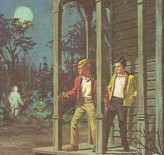
It's taking me forever to write about the Harvard Film Archive's retrospective of films by Jose Luis Guerin - but I'm going to do it, no matter how long it takes. I suppose one of the advantages of writing about films like this, undistributed (mostly), usually only seen in festivals and special showings like this one, is that there is not the sense of timeliness you get with current releases. They'll show here and there, they'll turn up on video formats, and people will be talking about them, here and there, once in a while, for years. They are wonderful films: beautiful, clever, full of ideas and images that stay with you, and tend to get inside your head. You start thinking about other films through them - I do anyway. They create new contexts - for instance - seeing Tren de Sombras, with its reproduced (invented) films puts a twist on not just fake Nietzsche footage, but big budget Hollywood fare. They give me too many things to think about, and I might as well think about it in public.
This post, then, is just an introduction: capsule reviews of the films themselves. Subsequent posts will dive in a bit deeper. Hopefully sooner rather than later, though who knows.
Inisfree - shot in Ireland, on locations John Ford used for the Quiet Man, with extras from the Quiet Man, as well as discussions of the film, reenactments of scenes from the film, and so on. Guerin talked about the myth of the lost paradise, and its application to the Irish in America. But that myth comes up over and over in Guerin’s films, as we shall see. This is a handsome film, consistently interesting in what was on screen, but a bit fragmented and disorganized - it's a very young film, it seems.
Tren de Sombras - recreations of amateur footage from the 20s, at times presented as if real, at others shown explicitly as reproductions. Both are manipulated - the film is distressed, manipulated - slowed down, sped up, reversed, repeated, and so on, sometimes as if it were just the found footage, at other times, explicitly being manipulated for this film. This alternates with footage from the present - shots of the village and castle in Normandy where it was shot, some of them straight documentary, others more ambiguous. Guerin spends a lot of time in the house, shooting the rooms and props - shooting especially at night, the shadows on the wall, which make a visual rhyme to the distressed film: but that’s what a film is, after all - shadows on the wall.
En Construccion - this is the closest to a straight documentary of these films. Film about the destruction of a block of slums in Barcelona, and the erection of a new apartment building in its place. Gentrification, Catalan style! Shot over a year or so (though it took a couple more years of work - Guerin had the luxury of time because he had a student crew to work with - this was their education, three years making this film) - roughly following a group of characters. Juani and Ivan - a pair of lowlifes - he's lazy, does nothing - she's a prostitue, tough and charismatic (and very reminiscent of Vanda Duarte); some of the workers - the man in charge of the bricklaying and his son; another bricklayer and his two Morroccan assistants - one skinny and strong, the other a smart, talkative, communist; an old sailor turned tramp, and a couple of his friends; a couple kids - especially a girl, related to the foreman. Guerin films them as they build the place, start to finish basically, showing them working together, talking together, etc. - and then the place is done, and they are replaced by the finish carpenters putting in fixtures, and real estate agents giving tours, and prospective tenants complaining about the rest of the neighborhood. Though it ends better than that - with a family getting their kid to wave at the old people living across the street. And then we see Juani carrying Ivan down the street as the camera retreats and a crowd follows them - then she puts him down and he picks her up and we cut to credits...
(This film is very similar to Pedro Costa’s Vanda’s Room - story of a slum being razed, shot over a long period of time, etc. - and both of them centered on a dark haired husky voiced drug addicted woman - Juani and Vanda: who not only anchor the film, but were apparently instrumental in getting it made. Vanda’s room was the center of the production as well as the content of the Costa film - and Juani’s room was the center of Guerin’s production, their headquarters, and she was the liaison to the community. Both being made almost simultaneously, as well...)
In the City of Sylvia: 3 days in Strasbourg: a young man, day by day - first he walks around the city with a map, then settles into a café. The next day he comes back, and looks at the people at the café - we look at the people at the café - for a very long time. We watch them, we watch him watching (taking notes, sketching) - then, he sees one particular woman, and sets out to follow her when she leaves. Follows he through the city, at first without her noticing, then with the owman trying to evade him - he finally catches up to her on a tram, and tells her what he is doing. Is she Sylvia? He says he knew her, six years ago. She says no. He keeps trying - she says no. He apologizes and apologizes, and she gets off the tram, no longer angry at him. Later he goes to a bar, tries to talk to one woman, watches people dancing, while a bartender reenacts Manet. The next day, he’s back at the café, then follows another woman to a train station - where he sits all day, looking at people, as we do. And that is all.
Some Photos from the City of Sylvia: Black and white still photos related to the City of Sylvia film. Starts in Strasbourg, telling the same basic story of the fiction film: Guerin (or a narrator) looking for a woman he knew 22 years ago... Going to their old places, looking for her in the streets, riding a bicycle, etc. Starting there, it moves to the broader themes - the woman glimpsed - from Dante and Petrarch to Goethe to Alfred Hitchcock. (Doesn't mention Citizen Kane though that is the basic situation: a woman seen once, the man projecting a whole alternate life on her). Moves to Madrid, Florence, Avignon (where Petrach saw his Laura) - showing the streets again, women, etc. We see hints of the coming film: Manet’s Folies Bergere painting quoted in the fiction film; the graffiti - "Laure, Je T'aime" that occurs throughout the streets of Strasbourg comes from a wall in Florence - "Tiamo Laura" - etc. This is all very much in the vein of Chris Marker: still photos like La Jetee (and shots that are very similar to La Jetee - people on the streets, shots in museums, etc.) - the style of Marker’s essay documentaries, with written titles playing the same role as the voice overs in Marker's films. A travelogue, like Sans Soleil, which itself contains a meditation on Vertigo, among others - as are these two Guerin films. That, I fear, will have to be something I develop later.
And running through all these films is the theme of the lost paradise: the mythical place in Innisfree; the lost time and places in the lost films of Tren de Sombras; the destruction of the old neighborhood in En Construccion (which wasn’t much a paradise - though neither was Ireland, with its wars and unemployment, when you take it as it really was); and the lost women of the two Sylvia films. And that myth, the woman glimpsed who represents another life, suggests another dimension of these myths: the idea of the shadow self - the person you could have been, a life you could have lived. But I will have to come back to that, too.
Monday, February 25, 2008

Sunday, February 24, 2008
There's an Award Show today, isn't there?
If I were going to watch it, this would be the year, I suppose. 2 honest to god outstanding films up for best picture - another very solid achievement in Michael Clayton, and even Juno, whatever its flaws, isn't embarrassing. Which of course means that Atonement will win. Anyway - everyone else will be watching it and writing about it: taking a not quite random sampling - here's The House Next Door's Oscar link page; Edward Copeland and company predict; and if I decide to pay any attention to it, I'm as likely to read Moviezzz' live-blog as to watch it. I have to wrap up - I'm going to see one of the many controversial films not in this year's Oscar race - The Band's Visit starts in 45 minutes: I'd best get going.
And of course the thing itself: the TV page, and the Academy's page.
Anyway, none of this is any fun without predictions and snark, so without further ado, the ones that interest me, at least a little:
Best Picture:
* Atonement - will win, because the worst film with a chance will win, and this has to be the worst of these films, not that I have any intention of testing that theory empirically.
* Juno
* Michael Clayton
* No Country for Old Men - this one could win, and if it does, may portend a laudable shift toward good films being rewarded. But I've thought that before.
* There Will Be Blood - this is what should win; this is a great film - and time may reveal it6 to be even more than that.
Achievement in Directing
* Paul Thomas Anderson, There Will Be Blood
* Joel Coen and Ethan Coen, No Country for Old Men - I think they'll win this one, even if they don't win best picture. Maybe they should, though Anderson and Schnabel more than hold their own.
* Tony Gilroy, Michael Clayton
* Jason Reitman, Juno
* Julian Schnabel, The Diving Bell and the Butterfly
Performance by an Actor in a Leading Role
* George Clooney, Michael Clayton
* Daniel Day-Lewis, There Will Be Blood - I assume he will win, as he probably should
* Johnny Depp, Sweeney Todd
* Tommy Lee Jones, In the Valley of Elah
* Viggo Mortensen, Eastern Promises
Performance by an Actor in a Supporting Role
* Casey Affleck, The Assassination of Jesse James by the Coward Robert Ford
* Javier Bardem, No Country for Old Men - This is a good guess to win, and certainly deserving.
* Philip Seymour Hoffman, Charlie Wilson's War
* Hal Holbrook, Into the Wild
* Tom Wilkinson, Michael Clayton
Performance by an Actress in a Leading Role
* Cate Blanchett, Elizabeth: The Golden Age
* Julie Christie, Away from Her -another good guess, and the best... though this was not a year for the ladies, I'm afraid. The big downside of those 70s channeling genre films...
* Marion Cotillard, La Vie en Rose
* Laura Linney, The Savages
* Ellen Page, Juno
Performance by an Actress in a Supporting Role
* Cate Blanchett, I'm Not There - this is my vote; it's a reasonable guess too, though the talk about it seems to have faded once the film came out.
* Ruby Dee, American Gangster
* Saoirse Ronan, Atonement
* Amy Ryan, Gone Baby Gone
* Tilda Swinton, Michael Clayton
Best Animated Feature Film of the Year
* Persepolis
* Ratatouille - this will win, which is more than fair; this and Persepolis should replace Juno and Atonement in the best picture race.
* Surf's Up
Original Screenplay
* Diablo Cody, Juno - this is going to win, I imagine
* Nancy Oliver, Lars and the Real Girl
* Tony Gilroy, Michael Clayton
* Brad Bird, Ratatouille - this is the one that probably should win
* Tamara Jenkins, The Savages
Adapted Screenplay
* Christopher Hampton, Atonement
* Sarah Polley, Away from Her
* Ronald Harwood, The Diving Bell and the Butterfly
* Joel Coen & Ethan Coen, No Country for Old Men - I don't know if it will win, but it's a fine choice. As are most of the rest - which means Atonement will probably win....
* Paul Thomas Anderson, There Will Be Blood
Best Foreign Language Film of the Year - Ha ha ha ha ha!
* Beaufort (Israel)
* The Counterfeiters (Austria)
* Katyn (Poland)
* Mongol (Kazakhstan)
* 12 (Russia)
Achievement in cinematography
* “The Assassination of Jesse James by the Coward Robert Ford” (Warner Bros.) Roger Deakins
* “Atonement” (Focus Features) Seamus McGarvey
* “The Diving Bell and the Butterfly” (Miramax/Pathé Renn) Janusz Kaminski
* “No Country for Old Men” (Miramax and Paramount Vantage) Roger Deakins
* “There Will Be Blood” (Paramount Vantage and Miramax) Robert Elswit - another strong slate, but this is probably where I'd vote. It was a good year for the cameramen, and no mistake.
And of course the thing itself: the TV page, and the Academy's page.
Anyway, none of this is any fun without predictions and snark, so without further ado, the ones that interest me, at least a little:
Best Picture:
* Atonement - will win, because the worst film with a chance will win, and this has to be the worst of these films, not that I have any intention of testing that theory empirically.
* Juno
* Michael Clayton
* No Country for Old Men - this one could win, and if it does, may portend a laudable shift toward good films being rewarded. But I've thought that before.
* There Will Be Blood - this is what should win; this is a great film - and time may reveal it6 to be even more than that.
Achievement in Directing
* Paul Thomas Anderson, There Will Be Blood
* Joel Coen and Ethan Coen, No Country for Old Men - I think they'll win this one, even if they don't win best picture. Maybe they should, though Anderson and Schnabel more than hold their own.
* Tony Gilroy, Michael Clayton
* Jason Reitman, Juno
* Julian Schnabel, The Diving Bell and the Butterfly
Performance by an Actor in a Leading Role
* George Clooney, Michael Clayton
* Daniel Day-Lewis, There Will Be Blood - I assume he will win, as he probably should
* Johnny Depp, Sweeney Todd
* Tommy Lee Jones, In the Valley of Elah
* Viggo Mortensen, Eastern Promises
Performance by an Actor in a Supporting Role
* Casey Affleck, The Assassination of Jesse James by the Coward Robert Ford
* Javier Bardem, No Country for Old Men - This is a good guess to win, and certainly deserving.
* Philip Seymour Hoffman, Charlie Wilson's War
* Hal Holbrook, Into the Wild
* Tom Wilkinson, Michael Clayton
Performance by an Actress in a Leading Role
* Cate Blanchett, Elizabeth: The Golden Age
* Julie Christie, Away from Her -another good guess, and the best... though this was not a year for the ladies, I'm afraid. The big downside of those 70s channeling genre films...
* Marion Cotillard, La Vie en Rose
* Laura Linney, The Savages
* Ellen Page, Juno
Performance by an Actress in a Supporting Role
* Cate Blanchett, I'm Not There - this is my vote; it's a reasonable guess too, though the talk about it seems to have faded once the film came out.
* Ruby Dee, American Gangster
* Saoirse Ronan, Atonement
* Amy Ryan, Gone Baby Gone
* Tilda Swinton, Michael Clayton
Best Animated Feature Film of the Year
* Persepolis
* Ratatouille - this will win, which is more than fair; this and Persepolis should replace Juno and Atonement in the best picture race.
* Surf's Up
Original Screenplay
* Diablo Cody, Juno - this is going to win, I imagine
* Nancy Oliver, Lars and the Real Girl
* Tony Gilroy, Michael Clayton
* Brad Bird, Ratatouille - this is the one that probably should win
* Tamara Jenkins, The Savages
Adapted Screenplay
* Christopher Hampton, Atonement
* Sarah Polley, Away from Her
* Ronald Harwood, The Diving Bell and the Butterfly
* Joel Coen & Ethan Coen, No Country for Old Men - I don't know if it will win, but it's a fine choice. As are most of the rest - which means Atonement will probably win....
* Paul Thomas Anderson, There Will Be Blood
Best Foreign Language Film of the Year - Ha ha ha ha ha!
* Beaufort (Israel)
* The Counterfeiters (Austria)
* Katyn (Poland)
* Mongol (Kazakhstan)
* 12 (Russia)
Achievement in cinematography
* “The Assassination of Jesse James by the Coward Robert Ford” (Warner Bros.) Roger Deakins
* “Atonement” (Focus Features) Seamus McGarvey
* “The Diving Bell and the Butterfly” (Miramax/Pathé Renn) Janusz Kaminski
* “No Country for Old Men” (Miramax and Paramount Vantage) Roger Deakins
* “There Will Be Blood” (Paramount Vantage and Miramax) Robert Elswit - another strong slate, but this is probably where I'd vote. It was a good year for the cameramen, and no mistake.
Tuesday, February 19, 2008
Philosophers on Film?
While I continue to procrastinate in writing about last week's Jose Luis Guerin retrospective (I will, I promise) - I see some interesting footage making the rounds (though it seems to have been around a while), purporting to be of Frederich Nietzsche, on his sickbed. It's not, of course - as Brian Leiter notes - it's digitally altered photos. It's pretty easy to spot - the pictures are famous; the animation isn't all that good (the morphing is obvious in most of the shots) - and the cinematography itself is quite impossible in 1899 - camera movement, zooms - no, no, no. On the other hand, there is this footage - which is a good deal more believable. For one thing, Nietzsche (or the actor playing him, if this is staged - which is always a possibility) moves - really and actually. The film itself looks about right: the camera is stable, the shots relatively brief; and it looks beat up in a convincing way. Splotchy, scraped up, with flashes of white - even on YouTube's crappy video, you can get an idea of what the actual damage looks like - even if it's not authentic, it's been accurately damaged.
That may prove relevant to some Guerin films...
That may prove relevant to some Guerin films...
Friday, February 15, 2008
Friday Guitar Gods
As it happens, two different blogs I read posted mp3's of guitar playing magnificence this week - Girish offers Robben Ford on a Joni Mitchell song, and Bill Frisell backing up the Ambitious Lovers (Arto Lindsey's post DNA group); and Neddie Jingo posts songs and videos featuring Django Reinhardt. Much inspiration and happiness to be found there....
Now I'm not going to try to match that... instead, inspired mostly by Girish's title (Short Sharp Solos), and the fact that the record his post called to mind - the upcoming collaboration between Bill Frisell and Earth, is very unlikely to feature much in the way of short anything - here is a list, not scientific by any means, of songs with short sharp solos - guitar solos (or parts) that don't last long, but that feel (to me anyway) Epic. These songs have short, or just normal solos, but they feel like friggin' Dazed and Confused. (In fact, I'm tempted to include Dazed and Confused, the original version - which though the solo isn't particularly short is quite sharp - it's dense and compact and thrilling, an effect lost when Jimmy and co. started stretching out toward the half hour mark... [though to be honest, other than the violin bow crap, D&C never bothered me much - even the long versions are structured more like medleys, with the segments fairly well constructed, each part a separate solo, which mostly work... it's the "boogies" - their live versions of Whole Lotta Love, crap like that, that makes me want to burn my zep records....]) That digression lasted longer than it should have: much like Dazed and Confused! Anyway - here is a list - 10 short (rock) solos that feel like epics:
1. The Byrd's Clarence White on the version of So You Want to Be A Rock and Roll Star from Live at the Fillmore - actually, while everything White plays is great, it's that one note he plays at the 1:35 point that does it... you could put that 2-3 seconds on permanent loop, and I would be happy...
2. Eddie Phillips' on Makin' Time (Creation) - speaking of dazed and confused... bringing out the violin bow, and putting it to far better use than Jimmy Page did. It's a cool song, but the solo jumps out of it...
3. Johnny Ramone's bit of Black Sabbath riffing on Now I Wanna Sniff Some Glue...
4. Almost everything Bob Mould or D Boon ever played would count: both of them could fit more into their 12-15 second solos than most guitar players get in a minute. If I were choosing one example each - I'd point to the version of Hanging On on the live Husker Du record (The Living End)...
5. ...and Sell of Be Sold on the Minutemen's What Makes a Man Start Fires? - it's a simple bit, but perfectly cool, and, like everything they played, built out of the band dynamic, the interplay of bass and guitar, the rhythm.... who was better in the 80s?
6. Jim Jones of Pere Ubu on Memphis, from Raygun Suitcase: it's nothing fancy, just a snarly little riff, but it slices into the song....
7. Tom Morello on Shadow on the Sun (the first Audioslave record) - I almost feel guilty putting an acknowledged guitar god on here (not that Boon or Mould or White [as under-appreciated as they come] aren't guitar gods) - but this solo, some helicopter noises, then 8-10 seconds of soaring sounds - is too good not to mention. Those two audioslave records are mostly disposable, except for Morello's parts - probably RATM for that matter too...
8. Paul McCartney's solos on Tax Man - and Tomorrow Never Knows...
9. Wire's Sand in My Joints - some of my old AOL cronies used to cite this as the greatest anti-guitar solo ever - I can't deny it... and it fits perfectly here....
10. and finally - there are a few notes at the end of the Replacement's Within Your Reach, a little pattern Paul Westerberg (I assume - I think that's all him) plays as it fades... that are perfect. All you need right there. Just enough.
Video - not much way to beat the Reinhardt video and links Neddie Jingo has, but I'll put up something - maybe a fine performance by one of the masters of understatement - Luther Perkins!
Now I'm not going to try to match that... instead, inspired mostly by Girish's title (Short Sharp Solos), and the fact that the record his post called to mind - the upcoming collaboration between Bill Frisell and Earth, is very unlikely to feature much in the way of short anything - here is a list, not scientific by any means, of songs with short sharp solos - guitar solos (or parts) that don't last long, but that feel (to me anyway) Epic. These songs have short, or just normal solos, but they feel like friggin' Dazed and Confused. (In fact, I'm tempted to include Dazed and Confused, the original version - which though the solo isn't particularly short is quite sharp - it's dense and compact and thrilling, an effect lost when Jimmy and co. started stretching out toward the half hour mark... [though to be honest, other than the violin bow crap, D&C never bothered me much - even the long versions are structured more like medleys, with the segments fairly well constructed, each part a separate solo, which mostly work... it's the "boogies" - their live versions of Whole Lotta Love, crap like that, that makes me want to burn my zep records....]) That digression lasted longer than it should have: much like Dazed and Confused! Anyway - here is a list - 10 short (rock) solos that feel like epics:
1. The Byrd's Clarence White on the version of So You Want to Be A Rock and Roll Star from Live at the Fillmore - actually, while everything White plays is great, it's that one note he plays at the 1:35 point that does it... you could put that 2-3 seconds on permanent loop, and I would be happy...
2. Eddie Phillips' on Makin' Time (Creation) - speaking of dazed and confused... bringing out the violin bow, and putting it to far better use than Jimmy Page did. It's a cool song, but the solo jumps out of it...
3. Johnny Ramone's bit of Black Sabbath riffing on Now I Wanna Sniff Some Glue...
4. Almost everything Bob Mould or D Boon ever played would count: both of them could fit more into their 12-15 second solos than most guitar players get in a minute. If I were choosing one example each - I'd point to the version of Hanging On on the live Husker Du record (The Living End)...
5. ...and Sell of Be Sold on the Minutemen's What Makes a Man Start Fires? - it's a simple bit, but perfectly cool, and, like everything they played, built out of the band dynamic, the interplay of bass and guitar, the rhythm.... who was better in the 80s?
6. Jim Jones of Pere Ubu on Memphis, from Raygun Suitcase: it's nothing fancy, just a snarly little riff, but it slices into the song....
7. Tom Morello on Shadow on the Sun (the first Audioslave record) - I almost feel guilty putting an acknowledged guitar god on here (not that Boon or Mould or White [as under-appreciated as they come] aren't guitar gods) - but this solo, some helicopter noises, then 8-10 seconds of soaring sounds - is too good not to mention. Those two audioslave records are mostly disposable, except for Morello's parts - probably RATM for that matter too...
8. Paul McCartney's solos on Tax Man - and Tomorrow Never Knows...
9. Wire's Sand in My Joints - some of my old AOL cronies used to cite this as the greatest anti-guitar solo ever - I can't deny it... and it fits perfectly here....
10. and finally - there are a few notes at the end of the Replacement's Within Your Reach, a little pattern Paul Westerberg (I assume - I think that's all him) plays as it fades... that are perfect. All you need right there. Just enough.
Video - not much way to beat the Reinhardt video and links Neddie Jingo has, but I'll put up something - maybe a fine performance by one of the masters of understatement - Luther Perkins!
Wednesday, February 13, 2008
Kon Ichikawa
I was sad to read today about the death of Kon Ichikawa, director of films like Harp of Burma and Fires on the Plain, Tokyo Olympiad, The Key, An Actor's Revenge, etc. - while he wasn't exactly neglected in this country, he has never been counted in the upper echelon of Japanese directors (not that being in the upper echelon ensures having their films available: Naruse is usually rated among the best, but very few of his films are circulating in the US in any form). And while he may not be quite the equal of the best - Ozu and Mizoguchi, Naruse and Imamura, Kurosawa - he's not far off. And that is very heady company.
It's depressing to see this is my first post in a week. I wish I had more to offer just now... I should have more to offer in the next few days. One thing keeping me off line was a Jose Luis Guerin retrospective at the Harvard Film Archive - that was very inspiring. I hope to get back to thinking about it, and write something up. And Ichikawa deserves some attention. So I can hope to have some content in the next couple days...
It's depressing to see this is my first post in a week. I wish I had more to offer just now... I should have more to offer in the next few days. One thing keeping me off line was a Jose Luis Guerin retrospective at the Harvard Film Archive - that was very inspiring. I hope to get back to thinking about it, and write something up. And Ichikawa deserves some attention. So I can hope to have some content in the next couple days...
Tuesday, February 05, 2008
Super Tuesday
Politics? don't have much to say. Did my bit for democracy - always a neat experience. The ordinariness of it makes me very happy... I suppose it's not always so simple and low tech (the paper voter rolls, the paper ballots and felt tip pens, the nice retirees running the affair), though it seems hard to beat the low tech version.... I haven't said much about politics - Massachusetts is not the most interesting place to have a vote most of the time - we're pretty predictable.... this year - it's an interesting primary race: I won't mourn either of the big dems winning, though I suppose, given a choice, I'd rather not see Hillary Clinton nominated. Since I did have a choice, I chose. If Edwards had still been around, it might have been a tougher choice - as it is, I took Obama.
I don't think I will do much more political writing this year. It's hard to talk politics: there's not much that can actually get done until Bush is out of office; every other issue pales next to the simple necessity of getting a Democratic president and as many democrats in congress as is humanly possible. The republican party does not deserve to hold any power at all: they have blown it, doing this country terrible damage... Someday, hopefully, we can get around to pushing for important useful things - some kind of decent health care system, more sensible tax and spend policies (instead of sending out rebates as a stimulus, why not try to create some jobs? fix a bridge, whatever...). Get the hell out of Iraq, and try to undo the damage that's caused... But first things first.
And - since god knows how much I'll post in the next day or so - non-politics: Burt Reynolds gets his due at Welcome to LA. And Edward Copeland's Best Best Actor poll is up - all sliced and diced...
I don't think I will do much more political writing this year. It's hard to talk politics: there's not much that can actually get done until Bush is out of office; every other issue pales next to the simple necessity of getting a Democratic president and as many democrats in congress as is humanly possible. The republican party does not deserve to hold any power at all: they have blown it, doing this country terrible damage... Someday, hopefully, we can get around to pushing for important useful things - some kind of decent health care system, more sensible tax and spend policies (instead of sending out rebates as a stimulus, why not try to create some jobs? fix a bridge, whatever...). Get the hell out of Iraq, and try to undo the damage that's caused... But first things first.
And - since god knows how much I'll post in the next day or so - non-politics: Burt Reynolds gets his due at Welcome to LA. And Edward Copeland's Best Best Actor poll is up - all sliced and diced...
Monday, February 04, 2008
Oops!
Well, I guess I'll post about the Super Bowl - probably my first, and hopefully my last, football post at this blog. I suppose it's a sad day, the local 11 going down to defeat - worse, failing to complete a perfect season. That's more disappointing than the locals losing - perfection is worth chasing. For someone to make it - would be impressive. A lot more impressive and admirable than another boring upset. On the other hand - that was a pretty lame outing from the Pats, so they hardly deserved to win - though they did have the game pretty much won. Make that one sack, and it's 19-0 and Don Shula can shut up already. But that play - the catch Tyree made on that play - that was a thing of beauty. You make plays like that, you deserve to win. If the Pats weren't going for perfection, I'd have been pulling for the Giants after that catch. Especially if your opponent can't make a sack when they have the guy in hand, twice....
Anyway - the bigger point is that thank god the football crap is done! now we can get back to the important sports news - Celtics! Red Sox! Pitchers and catchers, pitchers and catchers, soon, soon...
On another note - Bobby Knight resigned. Good riddance - about 20 years too late, probably. He's a strange figure - in a lot of ways - his commitment to graduating players, notably - he was a very admirable figure. And he was obviously a hell of a coach. But he was also a dick,a nd got worse and worse as the years passed, to the point where his presence spoiled the game. Years I paid no attention whatsoever to college basketball, I would make a point of cheering against Bobby Knight's teams. I certainly won't miss him...
Finally - one good thing about the Patriot's losing is that congress is not likely to try to investigate "spygate". Leaving them more time to deal with the important problems facing the country - like Roger Clemens' steroid regimen! whoo hoo! good lord, we are run by imbeciles.
Anyway - the bigger point is that thank god the football crap is done! now we can get back to the important sports news - Celtics! Red Sox! Pitchers and catchers, pitchers and catchers, soon, soon...
On another note - Bobby Knight resigned. Good riddance - about 20 years too late, probably. He's a strange figure - in a lot of ways - his commitment to graduating players, notably - he was a very admirable figure. And he was obviously a hell of a coach. But he was also a dick,a nd got worse and worse as the years passed, to the point where his presence spoiled the game. Years I paid no attention whatsoever to college basketball, I would make a point of cheering against Bobby Knight's teams. I certainly won't miss him...
Finally - one good thing about the Patriot's losing is that congress is not likely to try to investigate "spygate". Leaving them more time to deal with the important problems facing the country - like Roger Clemens' steroid regimen! whoo hoo! good lord, we are run by imbeciles.
Friday, February 01, 2008
Friday Music Notes
Been a while since I've pulled out this trick... the Friday Random Ten! But that alone is excuse enough.
1. Of Montreal - Gronlandic Edit
2. Kings of Leon - Genius
3. Beatles - Polythene Pam
4. Mars Volta - A. Part I
5. Johnny Cash - Long Black Veil
6. Ramones - Cretin Hop
7. Dinosaur Jr. - Cats in a Bowl
8. Replacements - Mr. Whirly
9. Merle Haggard - Mama Tried
10. fIREHOSE - Too Long
Meanwhile, on the broader music front - I did indeed attend the second concert in three months, seeing 6 Organs of Admittance, along with Thalia Zadek and Mick Turner. An enjoyable evening. Zadek was good - I've seen her a few times through the years, with Live Skull back in the day, with Come - this time, she had a piano player and violinist along, which gave her act a decided Nick Cave flavor - not a bad thing... Mick Turner played an improvised set, playing along with a slide show of paintings and landscape movies shot from the windows of buses and off the decks of boats: playing little guitar figures over loops and such... he's good at it, though it seemed to me to fall between the audio-visual poles... the projections were blank and repetitive, there, it seemed, to give the musicians something to play against - except the music felt like it was there to support the visuals... both sound and vision seemed to be pointing to the other, with neither quite clicking.... Though it was well done....
And Six organs of Admittance: Ben Chasny played a handful of songs alone, acoustic, then brought Elisa Ambrogio out to abuse an electric guitar. She can make a dreadful noise, no doubt - I don't know if she can actually play a lick on the guitar, but she knows how to get a racket out of it. Chasny stuck to singing and playing fairly straight, leaving the noise to her... in some ways, they're a bit less interesting than they are on record - Ambrogio's brand of guitar wanking is a bit flatter and less interesting than what gets put on his records, and the songs definitely miss the arrangements - the acoustic raga sounds, the percussion, with the occasional electric wigout... But I must also say - I like bands that reinvent themselves, and Chasny's performances seem to reinvent his material constantly... playing 1000 Birds, say, as an almost straight garage rocker.... it's good: they were quite enjoyable.
Anyway - here's Chasny droning out - we didn't get much of this: he left the noise to Ambrogio...
And the two of them, doing 1000 Birds (in a completely different style to how they did it in Boston) - you can't see much, but it sounds good:
1. Of Montreal - Gronlandic Edit
2. Kings of Leon - Genius
3. Beatles - Polythene Pam
4. Mars Volta - A. Part I
5. Johnny Cash - Long Black Veil
6. Ramones - Cretin Hop
7. Dinosaur Jr. - Cats in a Bowl
8. Replacements - Mr. Whirly
9. Merle Haggard - Mama Tried
10. fIREHOSE - Too Long
Meanwhile, on the broader music front - I did indeed attend the second concert in three months, seeing 6 Organs of Admittance, along with Thalia Zadek and Mick Turner. An enjoyable evening. Zadek was good - I've seen her a few times through the years, with Live Skull back in the day, with Come - this time, she had a piano player and violinist along, which gave her act a decided Nick Cave flavor - not a bad thing... Mick Turner played an improvised set, playing along with a slide show of paintings and landscape movies shot from the windows of buses and off the decks of boats: playing little guitar figures over loops and such... he's good at it, though it seemed to me to fall between the audio-visual poles... the projections were blank and repetitive, there, it seemed, to give the musicians something to play against - except the music felt like it was there to support the visuals... both sound and vision seemed to be pointing to the other, with neither quite clicking.... Though it was well done....
And Six organs of Admittance: Ben Chasny played a handful of songs alone, acoustic, then brought Elisa Ambrogio out to abuse an electric guitar. She can make a dreadful noise, no doubt - I don't know if she can actually play a lick on the guitar, but she knows how to get a racket out of it. Chasny stuck to singing and playing fairly straight, leaving the noise to her... in some ways, they're a bit less interesting than they are on record - Ambrogio's brand of guitar wanking is a bit flatter and less interesting than what gets put on his records, and the songs definitely miss the arrangements - the acoustic raga sounds, the percussion, with the occasional electric wigout... But I must also say - I like bands that reinvent themselves, and Chasny's performances seem to reinvent his material constantly... playing 1000 Birds, say, as an almost straight garage rocker.... it's good: they were quite enjoyable.
Anyway - here's Chasny droning out - we didn't get much of this: he left the noise to Ambrogio...
And the two of them, doing 1000 Birds (in a completely different style to how they did it in Boston) - you can't see much, but it sounds good:
Thursday, January 31, 2008
January Films
Wow - it's been 2 weeks since I posted anything, other than a space filler... I shall try to make up for that. I have seen some nice films in that time (and all through this month) - not as many as I thought I was going to, but still... so to get back in the swing, here's a kind of round up-new-movies-seen-post, covering most of the month.
I don't know where to start, so start at the top: There Will Be Blood arrives trailing hype and accolades and delivers. It took a couple viewings to completely sell me, but it did sell me. More than just an allegory of the modern republican party - oil men and religious freaks in a poisonous alliance, taking turn abusing each other: god-botherers subjecting the oil men to bizarre ritual humiliations - in exchange for which the oil men rob them and their followers and everybody else blind.... For all the epic scope of the thing, it's almost a chamber drama, fathers and sons and brothers, real, imagined, symbolic - watching it the second time, though, the themes, the parallels, the underlying methods and patternings come forth - details, in the filmmaking, in the story, come out - it delivers on all that PT Anderson has been promising. The Andersons - Paul Thomas and Wes - have, for the last decade or so - been clearly to the champions of this generation of American filmmakers, and this film solidifies that once again.
The Assassination of Jesse James by the Coward Robert Ford: why did I skip this when it came out? Was I just so disappointed with 3:10 to Yuma that I figured another artsy western would be a waste of time? was it just the length? were there bad reviews? It was a mistake, whatever it was. Thank goodness it came around again, a recap of some touted films from last year, and I got to see it - it's really good. It's long, not much seems to happen, sure, but it does happen - it makes you wait, as the characters wait - it's structured around the delay of the inevitable: the title lays it out, and you wait for it - the characters wait for it - everyone, it seems, quite aware of what is going to happen, just a matter of how. (Though the how - basically a series of people getting shot in the back of the head.)... A fine, elegant looking film, with some slick performances - Pitt playing off his star power, Affleck weird and squirrelly, and Paul Schneider giving a fascinating supporting bit as someone who's dumb as a board, but a tick smarter than the rest of them... Maybe not quite on par with Zodiac and There Will be Blood and No Country for Old Men - but another excellent genre film given an art film twist....
Sweeney Todd: The Demon Barber of Fleet Street: a nice adaptation - some interesting choices. Depp can hold the screen with anyone, and here he has Rickman for balance (who makes a better villain?) Bonham Carter and Spall make fine second bananas, and the juvenile and ingenue are cute and bland as one expects. The music is fantastic, of course.... When it came out, I saw a few comments calling it "inert," complaining about the lack of movement... That's not far off - though it shouldn't exactly be criticism. First - because of the way Burton shoots it - he uses static shots - it looks like he's shooting storyboards. He does that a lot - his style, in most of his films, is more like a comic book than a film - the shots seem to have a kind of self-contained quality: they do what they do because of what they look like, rather than what happens in them, or how they link together, exactly... Second - and this is criticism - the "third act" ("development" as Bordwell and Thompson might have it, corresponding, I think, to the first half of the second act of the musical itself) - is inert. The rest (parts 1, 2 and 4 - the "setup", "complication" and "climax") is dramatic - the story is enacted; but this part is not - it is all summary. "Todd became a murderer and Mrs. Lovett baked the bodies into pies." There are three or four songs - but this part of the film does nothing but make an excuse for those songs. It's plot role is summed up in the summary. The film sags, until the boy finds the girl and things start moving again...
Persepolis - handsomely animated adaptation of Marjane Satrapi's autobiographical comic. Great looking - beautiful black and white, silhouettes and cutouts that are handled with great subtlety and flexibility - nice to see a full length animated feature that uses the art to expressive effects. The story is about what you would expect - a feisty girl growing up in Iran before during and after the revolution - the themes, of liberal hopes for change dashed by the mullahs, and the continued efforts to civilize the place, to maintain one's dignity and self-respect in the face of various forms of oppression - are fairly common in Iranian films... This being made in France, they are perhaps more explicit than in films by people like Jafar Panahi or Darius Merhjui...
Charlie Wilson's War - amusing, hilip Seymour Hoffman is spectacular - not sure what more to say about it.
Walk Hard: the Dewey Cox Story - thoroughly silly music movie spoof, probably only a couple jokes, though they stay funny throughout... there are a few outstanding moments - the Beatles bit, say - and all of it is diverting... probably nothing special, but I still find myself quoting it, though no one else seems to have seen it. "It's called Karate!"
I don't know where to start, so start at the top: There Will Be Blood arrives trailing hype and accolades and delivers. It took a couple viewings to completely sell me, but it did sell me. More than just an allegory of the modern republican party - oil men and religious freaks in a poisonous alliance, taking turn abusing each other: god-botherers subjecting the oil men to bizarre ritual humiliations - in exchange for which the oil men rob them and their followers and everybody else blind.... For all the epic scope of the thing, it's almost a chamber drama, fathers and sons and brothers, real, imagined, symbolic - watching it the second time, though, the themes, the parallels, the underlying methods and patternings come forth - details, in the filmmaking, in the story, come out - it delivers on all that PT Anderson has been promising. The Andersons - Paul Thomas and Wes - have, for the last decade or so - been clearly to the champions of this generation of American filmmakers, and this film solidifies that once again.
The Assassination of Jesse James by the Coward Robert Ford: why did I skip this when it came out? Was I just so disappointed with 3:10 to Yuma that I figured another artsy western would be a waste of time? was it just the length? were there bad reviews? It was a mistake, whatever it was. Thank goodness it came around again, a recap of some touted films from last year, and I got to see it - it's really good. It's long, not much seems to happen, sure, but it does happen - it makes you wait, as the characters wait - it's structured around the delay of the inevitable: the title lays it out, and you wait for it - the characters wait for it - everyone, it seems, quite aware of what is going to happen, just a matter of how. (Though the how - basically a series of people getting shot in the back of the head.)... A fine, elegant looking film, with some slick performances - Pitt playing off his star power, Affleck weird and squirrelly, and Paul Schneider giving a fascinating supporting bit as someone who's dumb as a board, but a tick smarter than the rest of them... Maybe not quite on par with Zodiac and There Will be Blood and No Country for Old Men - but another excellent genre film given an art film twist....
Sweeney Todd: The Demon Barber of Fleet Street: a nice adaptation - some interesting choices. Depp can hold the screen with anyone, and here he has Rickman for balance (who makes a better villain?) Bonham Carter and Spall make fine second bananas, and the juvenile and ingenue are cute and bland as one expects. The music is fantastic, of course.... When it came out, I saw a few comments calling it "inert," complaining about the lack of movement... That's not far off - though it shouldn't exactly be criticism. First - because of the way Burton shoots it - he uses static shots - it looks like he's shooting storyboards. He does that a lot - his style, in most of his films, is more like a comic book than a film - the shots seem to have a kind of self-contained quality: they do what they do because of what they look like, rather than what happens in them, or how they link together, exactly... Second - and this is criticism - the "third act" ("development" as Bordwell and Thompson might have it, corresponding, I think, to the first half of the second act of the musical itself) - is inert. The rest (parts 1, 2 and 4 - the "setup", "complication" and "climax") is dramatic - the story is enacted; but this part is not - it is all summary. "Todd became a murderer and Mrs. Lovett baked the bodies into pies." There are three or four songs - but this part of the film does nothing but make an excuse for those songs. It's plot role is summed up in the summary. The film sags, until the boy finds the girl and things start moving again...
Persepolis - handsomely animated adaptation of Marjane Satrapi's autobiographical comic. Great looking - beautiful black and white, silhouettes and cutouts that are handled with great subtlety and flexibility - nice to see a full length animated feature that uses the art to expressive effects. The story is about what you would expect - a feisty girl growing up in Iran before during and after the revolution - the themes, of liberal hopes for change dashed by the mullahs, and the continued efforts to civilize the place, to maintain one's dignity and self-respect in the face of various forms of oppression - are fairly common in Iranian films... This being made in France, they are perhaps more explicit than in films by people like Jafar Panahi or Darius Merhjui...
Charlie Wilson's War - amusing, hilip Seymour Hoffman is spectacular - not sure what more to say about it.
Walk Hard: the Dewey Cox Story - thoroughly silly music movie spoof, probably only a couple jokes, though they stay funny throughout... there are a few outstanding moments - the Beatles bit, say - and all of it is diverting... probably nothing special, but I still find myself quoting it, though no one else seems to have seen it. "It's called Karate!"
Saturday, January 26, 2008
I Return, Sort of
Let me try this. It has been a long week. A good friend of mine lost his father (who I also vbery much liked) last week, and that has had all my attention. It certainly changes how one might react to something like Heath Ledger's death - sad and disturbing as it might be, it's too remote to register when you're mourning someone yourself. Still a shame. He was young, he was good, he seemed to be on the way to something like greatness.
Otherwise, there's not a lot going on. I owe Piper a dinner with someone - I'll get back to it, someday, I swear. I had an idea - my dinner with Joe Breen? I could blame him for Eli Roth and American Pie and feed him a ration of crow and lament the taming of Warren William. That might still work, though I missed most of the series, in the end...
Larry Aydlette is gearing up for a whole month of Burt Reynolds - 29 posts in 29 days! woo hoo! [which reminds me of my neighbors, who are raising hell - there's a party going on! way too much thumping and stomping and whooping and hollaring. That's neither here nor there, but it explains the hour of this post, for it would be the acme of folly to try to sleep. Instead I'll type away while I wait for the fun to end, listening to Six Organs of Admittance in anticipation of tomorrow night: looks like the second concert I'll attend in less them three months! it's like it's 1988 all over again!]
So back to the post - don't forget - Edward Copeland is running another poll - best acting Oscar winners. I have to do that, too... I have a lot to do, actually. Hopefully, I'll get some posts up in the next few days...
Otherwise, there's not a lot going on. I owe Piper a dinner with someone - I'll get back to it, someday, I swear. I had an idea - my dinner with Joe Breen? I could blame him for Eli Roth and American Pie and feed him a ration of crow and lament the taming of Warren William. That might still work, though I missed most of the series, in the end...
Larry Aydlette is gearing up for a whole month of Burt Reynolds - 29 posts in 29 days! woo hoo! [which reminds me of my neighbors, who are raising hell - there's a party going on! way too much thumping and stomping and whooping and hollaring. That's neither here nor there, but it explains the hour of this post, for it would be the acme of folly to try to sleep. Instead I'll type away while I wait for the fun to end, listening to Six Organs of Admittance in anticipation of tomorrow night: looks like the second concert I'll attend in less them three months! it's like it's 1988 all over again!]
So back to the post - don't forget - Edward Copeland is running another poll - best acting Oscar winners. I have to do that, too... I have a lot to do, actually. Hopefully, I'll get some posts up in the next few days...
Wednesday, January 16, 2008
Val Lewton Notice
Stopping in mid-week to note the ongoing Val Lewton blogathon, being hosted by Michael Guillen at The Evening Class. There is a wealth of material there and throughout the blogosphere, devoted to one of the undersung masters of film.
I have to admit, I came late to Lewton's iflms. People talked about them, they sounded good, but I hadn't seen any of them until the middle of last year, when I found a cheap copy of Cat People - very impressive. And later, I got the I Walked With A Zombie/Body Snatcher DVD, and that really did it. They're the type of films you can live with - stripped down and simple, in some ways, but with ever shot, every detail infused with intellegence and mystery, revealing something new every time you watch them. And thematically sophisticated - with complex patterns of guilt and innocence, interesting, ambiguous, motivations and results. Look at the way culpability is passed along from character to character in the Leopard Man, or the way good comes out of evil (Karloff the Body Snatcher directly leading to the cure of the little girl, etc.) in other films....
Coming at the end of the second contemplative cinema blogathon, it's intriguing how well the Lewton films fit. The stripped down style, the atmospheric style, working through suggestion and indirection, their treatment of plot (shifting protagonists, delaying revelations of characters' or events' significance, and so on), even some of the specific devices - mutism and silence; use of shadows, etc.... The links are pretty straightforward, too - Pedro Costa speaks of remaking I Walked With a Zombie in Casa de Lava; Tropical Malady draws heavily on Cat People. You can see the influence, and certainly, filmmakers are clear about the influence of Lewton and Tourneur (in particular.) They are wonderful films, and it's great fun reading about them.
I have to admit, I came late to Lewton's iflms. People talked about them, they sounded good, but I hadn't seen any of them until the middle of last year, when I found a cheap copy of Cat People - very impressive. And later, I got the I Walked With A Zombie/Body Snatcher DVD, and that really did it. They're the type of films you can live with - stripped down and simple, in some ways, but with ever shot, every detail infused with intellegence and mystery, revealing something new every time you watch them. And thematically sophisticated - with complex patterns of guilt and innocence, interesting, ambiguous, motivations and results. Look at the way culpability is passed along from character to character in the Leopard Man, or the way good comes out of evil (Karloff the Body Snatcher directly leading to the cure of the little girl, etc.) in other films....
Coming at the end of the second contemplative cinema blogathon, it's intriguing how well the Lewton films fit. The stripped down style, the atmospheric style, working through suggestion and indirection, their treatment of plot (shifting protagonists, delaying revelations of characters' or events' significance, and so on), even some of the specific devices - mutism and silence; use of shadows, etc.... The links are pretty straightforward, too - Pedro Costa speaks of remaking I Walked With a Zombie in Casa de Lava; Tropical Malady draws heavily on Cat People. You can see the influence, and certainly, filmmakers are clear about the influence of Lewton and Tourneur (in particular.) They are wonderful films, and it's great fun reading about them.
Sunday, January 13, 2008
Notes on Variations, Mostly
As the second contemplative cinema blogathon comes to a close, I want to write up some thoughts on "parametric" explorations in contemplative cinema. I am not sure what this means, if it means anything. I suppose I start from the notion (outlined in my previous post on this) that "contemplative" cinema is a refinement of the "art film" - that it derives its style mostly from that tradition, and shares most of its concerns, and its orientation toward reality, human subjectivity, expressiveness, and so on, with the art film. That is - style and content are, usually, aligned - silence and stillness and ambiguity in contemplative films, like in art films, are meaningful - they express either the subjective experience of their characters, or of the filmmaker. This is one of the points where they differ from the "parametric" film - the "modernist", or maybe "formalist" film. These are films where elements of the style function on their own - the style still conveys the experience of the characters and ideas of the filmmaker, but they take on other functions as well.
So how do these kinds of formal play work in contemplative films? I can't pretend to answer that - but I will offer some observations on a couple films that do play with those kinds of ideas. Particularly Apichatpong Weerasethakul's Syndromes and a Century...
Syndromes does some parametric things. It is split in half, and the two halves are related in a number of ways: same actors, playing the same (or similar) characters; both set in hospitals; the second one starts in a new, modern hospital but later moves into the basement, which uses the sets from the first half. It's structured as two sides of a love affair (or anticipated love affair) - in the first half we follow a woman doctor, her affairs, or non-affairs; in the second, a man, and the end of an affair, rendered with great subtlety. The plot turns on this continuity - both stories are about one of these characters not falling in love, or falling out of love, with someone else. And the two halves echo images and ideas - repeating or reversing them. The most powerful, probably, the pairing of a solar eclipse in the first half with a long strange shot of a piece of machinery, a hose or lamp or something, which, like the eclipsed sun, fills the screen with a huge black circle....
Repetition and parallelism are common in art films - and contemplative films. Hong Sang-soo, for instance, usually builds his films around repeated scenes and stories. But Weerasethakul seems to be handling this a bit differently, here and in Tropical Malady (the two of his I've seen so far - though with luck, I'll see Blissfully Yours next week). Hong naturalizes the repetitions - he tends to repeat scenes as they are experienced by different characters: so in Virgin Stripped Bare by her Bachelors, for example, we see the same story from the two main characters' points of view. Syndromes and a Century may be doing something like that, but not exactly - because it is creating a different story world, where different things happen. It is not the same story seen two different ways, with differences that can be attributed to varying memories and attitudes: it is a different story.
This moves it closer to what Bordwell calls "parametric" films. It highlights the act of telling a story even more than usual for art films. It is not presented as multiple versions of the same story, but of multiple stories with a related purpose. It plays, then, like two passes through the same material, running the changes on the basic stuff of the story. In this, it recalls Ozu's films - the way he kept reusing his actors, his story situations (a daughter marrying, usually), character names, family relationships - but arranged differently, as if trying out all the possible permutations. This begins to suggest a way of considering these films different from Bordwell's. Bordwell focuses on narration, on how the story is told, on the relationship, in a film, between the telling and the story world being created. But while there are stylistic variations in Syndromes and a Century, the main changes are to the story world - the "fabula". This creates a different dynamic - one that calls to mind Brian McHale's characterization of post-modern fiction as being driven by ontological concerns. McHale argues that modernism was driven by epistemological questions - what can be known about the world? how does ones subjective experience of the world shape it? Post-modernism, though, is driven by ontological questions - what is real? The distinction is neatly illustrated by comparing Hong's double narratives to Weerasethakul's. Hong's films show a stable ontology from multiple points of view - his films are about point of view, memory, individual interpretation of events. Syndromes, though, shows two different possible worlds, linked by various elements - characters, actors, situations - but they don't create the same story from two angles. They create different stories.
Bordwell, as it happens, covers something similar to this in his new book. One of the chapters discusses forking path films: Run Lola Run - Too Many Ways to be Number One - Sliding Doors - Blind Chance.... films that explicitly pose varying possible futures. Syndromes and a Century doesn't present itself explicitly as an alternative future film, but it is similar. In some ways, it might be more radical - it doesn't rationalize its style as fantasy or science fiction or explicit options or allegories. It just tells 2 similar, but not identical stories about similar, but not necessarily identical characters, in similar, but not identical worlds, populated by similar, but not identical people. Using similar, but not identical locations, images, conversations and so on. Which if you're a bit of as formalist like me is just endlessly fascinating....
Getting back to the question of contemplative cinema - this sort of formal game play may seem to be at odds with the expectation for muted narrative, blankness, silence and so on, but it's not unknown. Divided stories turn up quite often in films of this sort. Some, possibly most, follow the fairly conventional art film patterns of Hong Sang-soo's films: exploring different points of view, following different characters in turn, etc. is common enough. But this can be linked to some degree and type of parametric storytelling as well. Sometimes safely within the "fabula" - Kiarostami's A Taste of Cherry, say, is structured around three variations of one conversation... Sometimes by imposing formal strangeness on a relatively stable story world - as in Tsai Ming-liang's I Don't Want to Sleep Alone, with its parallel stories, each centered on a different Lee Kang-sheng character.... And sometimes, films push the variations quite far into the realm of style. In Vanda's Room, Pedro Costa alternates between scenes shot with Vanda and her family and friends, and scenes shot with a group of men, living (mostly) in a condemned, abandoned, room. All of them share the basic look - digital camera, natural light, long takes, etc. - but there are significant stylistic differences as well. He has said that he looks at the scenes with Vanda as theater - the men as cinema: he films her in her room, usually on her bed, holding forth, quite often, with her family or friends, fairly vocal, very performative. The bed is a stage - he frames and shoots to emphasize the stage, the frontality of the room. The men, though, are cinema - which emerges in the way he shoots them. While the camera is fixed in any given shot, he shoots from a much greater variety of placements; the room has much more of a sense of 360 degree space. There is a stronger sense of offscreen space as well, with sounds coming from the street, with visible doors, people coming and going, and so on. Vanda's room tends to be closed in: it is what you see (though not always what you can hear.) I'd even say that the variation extends to the type of drugs they use: the women smoke heroin - the men shoot it. I don't know what that means - but in the film, it serves to create a kind of structural, formal pattern. Its meaninglessness, in fact, emphasizes its formal functionality - it slides toward being a purely formal device. Which, again, pushes the film toward "parametric" filmmaking....
So how do these kinds of formal play work in contemplative films? I can't pretend to answer that - but I will offer some observations on a couple films that do play with those kinds of ideas. Particularly Apichatpong Weerasethakul's Syndromes and a Century...
Syndromes does some parametric things. It is split in half, and the two halves are related in a number of ways: same actors, playing the same (or similar) characters; both set in hospitals; the second one starts in a new, modern hospital but later moves into the basement, which uses the sets from the first half. It's structured as two sides of a love affair (or anticipated love affair) - in the first half we follow a woman doctor, her affairs, or non-affairs; in the second, a man, and the end of an affair, rendered with great subtlety. The plot turns on this continuity - both stories are about one of these characters not falling in love, or falling out of love, with someone else. And the two halves echo images and ideas - repeating or reversing them. The most powerful, probably, the pairing of a solar eclipse in the first half with a long strange shot of a piece of machinery, a hose or lamp or something, which, like the eclipsed sun, fills the screen with a huge black circle....
Repetition and parallelism are common in art films - and contemplative films. Hong Sang-soo, for instance, usually builds his films around repeated scenes and stories. But Weerasethakul seems to be handling this a bit differently, here and in Tropical Malady (the two of his I've seen so far - though with luck, I'll see Blissfully Yours next week). Hong naturalizes the repetitions - he tends to repeat scenes as they are experienced by different characters: so in Virgin Stripped Bare by her Bachelors, for example, we see the same story from the two main characters' points of view. Syndromes and a Century may be doing something like that, but not exactly - because it is creating a different story world, where different things happen. It is not the same story seen two different ways, with differences that can be attributed to varying memories and attitudes: it is a different story.
This moves it closer to what Bordwell calls "parametric" films. It highlights the act of telling a story even more than usual for art films. It is not presented as multiple versions of the same story, but of multiple stories with a related purpose. It plays, then, like two passes through the same material, running the changes on the basic stuff of the story. In this, it recalls Ozu's films - the way he kept reusing his actors, his story situations (a daughter marrying, usually), character names, family relationships - but arranged differently, as if trying out all the possible permutations. This begins to suggest a way of considering these films different from Bordwell's. Bordwell focuses on narration, on how the story is told, on the relationship, in a film, between the telling and the story world being created. But while there are stylistic variations in Syndromes and a Century, the main changes are to the story world - the "fabula". This creates a different dynamic - one that calls to mind Brian McHale's characterization of post-modern fiction as being driven by ontological concerns. McHale argues that modernism was driven by epistemological questions - what can be known about the world? how does ones subjective experience of the world shape it? Post-modernism, though, is driven by ontological questions - what is real? The distinction is neatly illustrated by comparing Hong's double narratives to Weerasethakul's. Hong's films show a stable ontology from multiple points of view - his films are about point of view, memory, individual interpretation of events. Syndromes, though, shows two different possible worlds, linked by various elements - characters, actors, situations - but they don't create the same story from two angles. They create different stories.
Bordwell, as it happens, covers something similar to this in his new book. One of the chapters discusses forking path films: Run Lola Run - Too Many Ways to be Number One - Sliding Doors - Blind Chance.... films that explicitly pose varying possible futures. Syndromes and a Century doesn't present itself explicitly as an alternative future film, but it is similar. In some ways, it might be more radical - it doesn't rationalize its style as fantasy or science fiction or explicit options or allegories. It just tells 2 similar, but not identical stories about similar, but not necessarily identical characters, in similar, but not identical worlds, populated by similar, but not identical people. Using similar, but not identical locations, images, conversations and so on. Which if you're a bit of as formalist like me is just endlessly fascinating....
Getting back to the question of contemplative cinema - this sort of formal game play may seem to be at odds with the expectation for muted narrative, blankness, silence and so on, but it's not unknown. Divided stories turn up quite often in films of this sort. Some, possibly most, follow the fairly conventional art film patterns of Hong Sang-soo's films: exploring different points of view, following different characters in turn, etc. is common enough. But this can be linked to some degree and type of parametric storytelling as well. Sometimes safely within the "fabula" - Kiarostami's A Taste of Cherry, say, is structured around three variations of one conversation... Sometimes by imposing formal strangeness on a relatively stable story world - as in Tsai Ming-liang's I Don't Want to Sleep Alone, with its parallel stories, each centered on a different Lee Kang-sheng character.... And sometimes, films push the variations quite far into the realm of style. In Vanda's Room, Pedro Costa alternates between scenes shot with Vanda and her family and friends, and scenes shot with a group of men, living (mostly) in a condemned, abandoned, room. All of them share the basic look - digital camera, natural light, long takes, etc. - but there are significant stylistic differences as well. He has said that he looks at the scenes with Vanda as theater - the men as cinema: he films her in her room, usually on her bed, holding forth, quite often, with her family or friends, fairly vocal, very performative. The bed is a stage - he frames and shoots to emphasize the stage, the frontality of the room. The men, though, are cinema - which emerges in the way he shoots them. While the camera is fixed in any given shot, he shoots from a much greater variety of placements; the room has much more of a sense of 360 degree space. There is a stronger sense of offscreen space as well, with sounds coming from the street, with visible doors, people coming and going, and so on. Vanda's room tends to be closed in: it is what you see (though not always what you can hear.) I'd even say that the variation extends to the type of drugs they use: the women smoke heroin - the men shoot it. I don't know what that means - but in the film, it serves to create a kind of structural, formal pattern. Its meaninglessness, in fact, emphasizes its formal functionality - it slides toward being a purely formal device. Which, again, pushes the film toward "parametric" filmmaking....
Saturday, January 12, 2008
Vampira
I see the news is going around that Vampira, the great horror movie hostess and sometimes star, has died, ae 86. Nice tributes are starting to appear, not all from the film blogging world - this one from PZ Myers at Pharyngula is where I first saw the news. One notices such things - an iconic figure who played a part in an iconic film... I can't say I paid much attention to her otherwise, until I started seeing the tributes to Plan 9 and Ed Wood - where she was invariably the most charismatic and interesting figure to be seen. May she rest in peace...
Tuesday, January 08, 2008
Contemplative Films as Art Films
The second annual contemplative cinema blogathon is up and running, with some good reading already up. I have to say - I like this idea: I like the chance to go back to something every now and then. Especially big, open ended topics, like this one, or things like the recent film endings or opening credits blogathons - things that are likely to hit you at intervals.... It's nice to swing back a couple times.
But now... there's no lack of things to write about contemplative cinema - the poetics, the history, the individual films - the criticism, which is getting some attention this year. What catches my interest, though, is pretty much the same as last year - the question of what "contemplative cinema" is - where it came from, how it relates to other kinds of films: the questions of style and history that I usually end up with, when I start trying to be serious... I keep coming back to them, because I really don't know the answers. That may be my point - that defining CC may be impossible - it has too many sources and lines of descent, the formal and stylistic devices that mark it are neither exclusive to it nor adequate to define it. Which isn't to say that there aren't identifiable films we can describe this way - it's just that we can't find one line of descent for them, or a completely stable set of features...
The fact that I'm reading David Bordwell's latest, The Poetics of Cinema, certainly encourages those questions. One chapter reprints an essay from the late 70s on the "art film", with new comments, bringing some of the arguments up to date. (He also extends this, with examples, in Narration in the Fiction Film.) I think it's reasonable to consider "contemplative cinema" as a refinement of Bordwell's "art film." These films (per Bordwell) emphasize realism (both external and subjective) and authorial expression: they operate through ambiguity (both in what happens, and how it is presented), psychological exploration; they are usually loosely plotted, deemphasizing causal connections, character motivations - they often have drifting, observing, passive protagonists (lots of journalists and prostitutes) who encounter events and whose story is more their perceptions and experiences than their goals, met and missed. Art films downplay the tight explanations and strings of causality that classical cinema emphasizes, both in what they tell (what a good Russian would call the syuzhet), and what happens (the fabula - the story world).
Contemplative films follow that pattern pretty closely. They are, perhaps, an "intensified" version - the art film's tendencies and structures extended: ambiguity, passive characters, emphasis on mood and tone, etc., lack of obvious story, elision of the plot at the level of the telling, all taken that much further. The new material in Poetics of Cinema discusses developments of the art film since 1980 or so, describing many of the stylistic features of contemplative films: long takes, longer shots, quietness, planimetric compositions (arrangements of people or objects in a row, along a plane parallel to the picture plane, often against a neutral flat background), etc. Bordwell also considers the history of art films: the development of art films out of neo-realism, first in Europe in the 40s and 50s, then, following similar patterns, in several other areas - notably Iran, China and Taiwan, Africa, Turkey, etc. It's still a valid question how to characterize CC's development of the art film: is it an extension? a refinement? a branch of the art film? a departure? I'm inclined to look at it as an extension and refinement - a tendency within art films that has evolved and thrived...
The wild card in this, though, is another type of film Bordwell discusses - the "modernist" film, or the "parametric" film. I'm tempted to call it the "formalist" film - though that might require another post or two to define. (It's got it's own chapter in Narration in the Fiction Film.) This type of film is marked by a split between the style and the storytelling - the style and the meaning. It is a film that gives style, structure, formal elements non-signifying functions - functions that do not mean anything. The classic examples are who you would expect, I suppose - Ozu, Bresson, Dreyer, Tati - Godard and Eisenstein in some modes - the tradition today is continued most obviously in Wes Anderson (all those frontal compositions and odd cuts and angles, none of which has any obvious meaning - it doesn't convey anyone's perception of the world, it doesn't really comment on the world or the stories - it's an arbitrary, graphic patterning meant to be enjoyed for its own sake). Bordwell contrasts art cinema with both classical, narrative cinema, and "modernist" or parametric cinema - not exactly splitting them into three types of films - more positing them as three modes of films, that might combine in different ways, in given films. (My Life to Live, say, might be read as an art film, if you concentrate on the story, on Nana's passage through life - or as parametric, if you concentrate instead on Godard's methods of staging and shooting and editing scenes, as he passes through a series of possibilities, that are not directly related to the story and its psychological meaning.)
Now: it seems to me, that given this scheme, contemplative cinema is mostly firmly within the tradition of the art film. Firmly enough that most examples of CC are more than adequately described as "art cinema" - as adequately as L'Avventura or Breathless or Shame might be. They might represent a particular type of art film, but they don't depart from the model in any fundamental ways.
Except when they do - or - when elements from CC start to migrate into more classical narrative films, or to parametric films. Or - when what are mostly "art films" incorporate elements of parametric film-making. This is when things get really interesting. But I think this is where I have to start a second post, maybe a third. Because there seem to me to be quite a few interesting examples of both types of film - "classical" films that have incorporated devices from contemplative cinema; contemplative films working with "parametric" devices. The former - take any of several excellent 2007 films: the way No Country for Old Men or There Will be Blood, say, both strip down the dialog, eliminating it, or reducing it to formula (Plainview's repeated sales pitches).... or the way those films, or Zodiac as well, dissipate their plots - moving significant events off screen, leaving things unresolved, and so on. They are, then, art films, in the older sense - but often through devices seen in contemplative films.
On the other side - this definitely will require a further post - but consider the parametric structures of Apichatpong Weerasethakul's films - specifically their bifurcations - their repetition of stories, events, etc. in different registers... this seems to me to change the way the films work, somewhat - complicating the idea of what a contemplative film might be...
But now... there's no lack of things to write about contemplative cinema - the poetics, the history, the individual films - the criticism, which is getting some attention this year. What catches my interest, though, is pretty much the same as last year - the question of what "contemplative cinema" is - where it came from, how it relates to other kinds of films: the questions of style and history that I usually end up with, when I start trying to be serious... I keep coming back to them, because I really don't know the answers. That may be my point - that defining CC may be impossible - it has too many sources and lines of descent, the formal and stylistic devices that mark it are neither exclusive to it nor adequate to define it. Which isn't to say that there aren't identifiable films we can describe this way - it's just that we can't find one line of descent for them, or a completely stable set of features...
The fact that I'm reading David Bordwell's latest, The Poetics of Cinema, certainly encourages those questions. One chapter reprints an essay from the late 70s on the "art film", with new comments, bringing some of the arguments up to date. (He also extends this, with examples, in Narration in the Fiction Film.) I think it's reasonable to consider "contemplative cinema" as a refinement of Bordwell's "art film." These films (per Bordwell) emphasize realism (both external and subjective) and authorial expression: they operate through ambiguity (both in what happens, and how it is presented), psychological exploration; they are usually loosely plotted, deemphasizing causal connections, character motivations - they often have drifting, observing, passive protagonists (lots of journalists and prostitutes) who encounter events and whose story is more their perceptions and experiences than their goals, met and missed. Art films downplay the tight explanations and strings of causality that classical cinema emphasizes, both in what they tell (what a good Russian would call the syuzhet), and what happens (the fabula - the story world).
Contemplative films follow that pattern pretty closely. They are, perhaps, an "intensified" version - the art film's tendencies and structures extended: ambiguity, passive characters, emphasis on mood and tone, etc., lack of obvious story, elision of the plot at the level of the telling, all taken that much further. The new material in Poetics of Cinema discusses developments of the art film since 1980 or so, describing many of the stylistic features of contemplative films: long takes, longer shots, quietness, planimetric compositions (arrangements of people or objects in a row, along a plane parallel to the picture plane, often against a neutral flat background), etc. Bordwell also considers the history of art films: the development of art films out of neo-realism, first in Europe in the 40s and 50s, then, following similar patterns, in several other areas - notably Iran, China and Taiwan, Africa, Turkey, etc. It's still a valid question how to characterize CC's development of the art film: is it an extension? a refinement? a branch of the art film? a departure? I'm inclined to look at it as an extension and refinement - a tendency within art films that has evolved and thrived...
The wild card in this, though, is another type of film Bordwell discusses - the "modernist" film, or the "parametric" film. I'm tempted to call it the "formalist" film - though that might require another post or two to define. (It's got it's own chapter in Narration in the Fiction Film.) This type of film is marked by a split between the style and the storytelling - the style and the meaning. It is a film that gives style, structure, formal elements non-signifying functions - functions that do not mean anything. The classic examples are who you would expect, I suppose - Ozu, Bresson, Dreyer, Tati - Godard and Eisenstein in some modes - the tradition today is continued most obviously in Wes Anderson (all those frontal compositions and odd cuts and angles, none of which has any obvious meaning - it doesn't convey anyone's perception of the world, it doesn't really comment on the world or the stories - it's an arbitrary, graphic patterning meant to be enjoyed for its own sake). Bordwell contrasts art cinema with both classical, narrative cinema, and "modernist" or parametric cinema - not exactly splitting them into three types of films - more positing them as three modes of films, that might combine in different ways, in given films. (My Life to Live, say, might be read as an art film, if you concentrate on the story, on Nana's passage through life - or as parametric, if you concentrate instead on Godard's methods of staging and shooting and editing scenes, as he passes through a series of possibilities, that are not directly related to the story and its psychological meaning.)
Now: it seems to me, that given this scheme, contemplative cinema is mostly firmly within the tradition of the art film. Firmly enough that most examples of CC are more than adequately described as "art cinema" - as adequately as L'Avventura or Breathless or Shame might be. They might represent a particular type of art film, but they don't depart from the model in any fundamental ways.
Except when they do - or - when elements from CC start to migrate into more classical narrative films, or to parametric films. Or - when what are mostly "art films" incorporate elements of parametric film-making. This is when things get really interesting. But I think this is where I have to start a second post, maybe a third. Because there seem to me to be quite a few interesting examples of both types of film - "classical" films that have incorporated devices from contemplative cinema; contemplative films working with "parametric" devices. The former - take any of several excellent 2007 films: the way No Country for Old Men or There Will be Blood, say, both strip down the dialog, eliminating it, or reducing it to formula (Plainview's repeated sales pitches).... or the way those films, or Zodiac as well, dissipate their plots - moving significant events off screen, leaving things unresolved, and so on. They are, then, art films, in the older sense - but often through devices seen in contemplative films.
On the other side - this definitely will require a further post - but consider the parametric structures of Apichatpong Weerasethakul's films - specifically their bifurcations - their repetition of stories, events, etc. in different registers... this seems to me to change the way the films work, somewhat - complicating the idea of what a contemplative film might be...
Sunday, January 06, 2008
Moments of 2007
I am getting to the end of my Year in Review Posts. I'll have to start coming up with real content again... Hopefully, the second annual Contemplative Cinema blogathon will inspire - it should... Anyway, in honor of the old Film Comment "moments in time" feature, currently living at MSN movies, here are a few of mine - I'll stick to a simple list of 10 or so...
1. The little kids rolling a tire in the background of the shot of the brothers chasing a train in Darjeeling Limited. Though of course Wes Anderson makes films that come as close to being one long moment of the year....
2. Anton Chigurh flips an ordinary quarter in No Country for Old Men.
3. The Beatles in Walk Hard: the Dewey Cox Story.
4. The end of Syndromes and a Century - a lamp, then a cut outside, to a city full of people - a kind of inversion of the end of Antonioni's L'Eclisse: the characters gone, but the city alive and well...
5. Anton Ego's flashback in Ratatouille
6. Margot chasing the bus at the end of Margot at the Wedding.
7. Pretty much every minute Philip Seymour Hoffman is on screen in either Before the Devil Knows You're Dead or Charlie Wilson's War. I couldn't work up the courage to see The Savages, but guessing from the trailers, he's just as good in that. If I had to single something out - the way he goes in and out of the room the first time he meets Wilson...
8. "I'm Finished" - There Will Be Blood.
9. Zoe Bell hanging on for dear life in Grindhouse.
10. "why don't you do some of your older stuff?" in I'm Not There.
Meanwhile - great moments don't all come from good films: consider - Peter Dinklage signaling his intention to blackmail in Death at a Funeral; or Jesus Christ, living it up in Mexico in The Ten (bet you all forgot that existed, didn't you? unless you saw it, in which case you probably just wished you could forget it) - Justin Theroux demonstrating his comedic chops. Or John Malcovich making Colour Me Kubrick worth seeing, or Eddie Izzard doing his thing in Across the Universe...
And finally, as a bonus - some particular moments from older films I saw for the first time in 2007. It was a really good year for that - bunches of Bela Tarr films, Rivette, Pedro Costa, etc. I'll try to keep myself to one per filmmaker, so this doesn't turn into a shot by shot description of Satantango or Vanda's Room.
1. Celine and Julie disrupting the old melo and saving the girl in Celine and Julie Go Boating.
2. The Dance in Satantango.
3. Alberto Sordi, paying back his debts to the mafia in Mafioso - meeting Hugh Hurd on the street in New York.
4. The African western, with Danny Glover, in the middle of Bamako.
5. The execution of the Hungarian who was talking with the nurse in The Red and the White - the most intense of the long takes, with their depth of field, multiplane compositions and stagings, people moving between planes, and so on.
6. The not quite dying paterfamilias, getting up from his sick bed to go to the bathroom, trailing farts, in Ozu's End of Summer.
7. "You aren't a man - you aren't even a very good sample!" - Barbara Stanwyck telling off her useless husband in Ten Cents a Dance.
8. In Douglas Sirk's There's Always Tomorrow - a particularly magnificent shot after Barbara Stanwyck leaves Fred MacMurray, Fred staring out a rain streaked window while Rex the walking talking robot boy tramps across the frame.
9. Vanda offering medical advice in Vanda's Room.
10. Karloff seduces/murders Lugosi in The Body Snatcher (one of a bunch of Val Lewton films I finally got around to watching this year. In time for next week's blogathon!)
And I suppose I should note one more thing - a long immersion in WC Fields films providing more quotable lines than I know what to do with: from all the names, to the phrases he builds routines around ("stand back and keep your eye on the ball" or "ain't a fit night out for man nor beast!") to the dialogue ("is this a game of chance?" - "Not the way I play it") - right up to the great catch phrases: "You can't cheat an honest man - never give a sucker an even break, never wisen up a chump." I had a good year of movie watching...
1. The little kids rolling a tire in the background of the shot of the brothers chasing a train in Darjeeling Limited. Though of course Wes Anderson makes films that come as close to being one long moment of the year....
2. Anton Chigurh flips an ordinary quarter in No Country for Old Men.
3. The Beatles in Walk Hard: the Dewey Cox Story.
4. The end of Syndromes and a Century - a lamp, then a cut outside, to a city full of people - a kind of inversion of the end of Antonioni's L'Eclisse: the characters gone, but the city alive and well...
5. Anton Ego's flashback in Ratatouille
6. Margot chasing the bus at the end of Margot at the Wedding.
7. Pretty much every minute Philip Seymour Hoffman is on screen in either Before the Devil Knows You're Dead or Charlie Wilson's War. I couldn't work up the courage to see The Savages, but guessing from the trailers, he's just as good in that. If I had to single something out - the way he goes in and out of the room the first time he meets Wilson...
8. "I'm Finished" - There Will Be Blood.
9. Zoe Bell hanging on for dear life in Grindhouse.
10. "why don't you do some of your older stuff?" in I'm Not There.
Meanwhile - great moments don't all come from good films: consider - Peter Dinklage signaling his intention to blackmail in Death at a Funeral; or Jesus Christ, living it up in Mexico in The Ten (bet you all forgot that existed, didn't you? unless you saw it, in which case you probably just wished you could forget it) - Justin Theroux demonstrating his comedic chops. Or John Malcovich making Colour Me Kubrick worth seeing, or Eddie Izzard doing his thing in Across the Universe...
And finally, as a bonus - some particular moments from older films I saw for the first time in 2007. It was a really good year for that - bunches of Bela Tarr films, Rivette, Pedro Costa, etc. I'll try to keep myself to one per filmmaker, so this doesn't turn into a shot by shot description of Satantango or Vanda's Room.
1. Celine and Julie disrupting the old melo and saving the girl in Celine and Julie Go Boating.
2. The Dance in Satantango.
3. Alberto Sordi, paying back his debts to the mafia in Mafioso - meeting Hugh Hurd on the street in New York.
4. The African western, with Danny Glover, in the middle of Bamako.
5. The execution of the Hungarian who was talking with the nurse in The Red and the White - the most intense of the long takes, with their depth of field, multiplane compositions and stagings, people moving between planes, and so on.
6. The not quite dying paterfamilias, getting up from his sick bed to go to the bathroom, trailing farts, in Ozu's End of Summer.
7. "You aren't a man - you aren't even a very good sample!" - Barbara Stanwyck telling off her useless husband in Ten Cents a Dance.
8. In Douglas Sirk's There's Always Tomorrow - a particularly magnificent shot after Barbara Stanwyck leaves Fred MacMurray, Fred staring out a rain streaked window while Rex the walking talking robot boy tramps across the frame.
9. Vanda offering medical advice in Vanda's Room.
10. Karloff seduces/murders Lugosi in The Body Snatcher (one of a bunch of Val Lewton films I finally got around to watching this year. In time for next week's blogathon!)
And I suppose I should note one more thing - a long immersion in WC Fields films providing more quotable lines than I know what to do with: from all the names, to the phrases he builds routines around ("stand back and keep your eye on the ball" or "ain't a fit night out for man nor beast!") to the dialogue ("is this a game of chance?" - "Not the way I play it") - right up to the great catch phrases: "You can't cheat an honest man - never give a sucker an even break, never wisen up a chump." I had a good year of movie watching...
Thursday, January 03, 2008
Music 2007 records
And tonight, continuing the end/beginning of the year roundup, we turn to music. Music top ten lists are a different matter than films. While I could never see all the films in a given year, even all the films I ought to see - I usually have a pretty good idea what I have missed. My favorites of the year bear some resemblance to what was actually there to see. But music? I can't even begin to crack what's available. And that's assuming I get around to listening to everything I buy... The iPod (for all its benefits) has made that even worse - I put everything on there and hope for the best - I barely play CDs at all anymore. So what it means? this is a really tentative list, and while I'll stand by the quality of what I like, this is very explicitly a list of favorites. Any resemblance to the best of the year is pure coincidence. But will that stop me? will it even slow me down? What do you think?
1. Boris & Kurihara - Rainbow: Boris' usual thundering din, married to songs, and Kurihara, the world's best guitarist right now, in a setting that lets him rip. Probably a contender for the best of the decade.
2. Grinderman - Grinderman: Nick Cave's stripped down outfit - howling and throbbing and thrashing. The older I get the more I like Nick Cave and everything he does.
3. Sigur Rus - Hvarf/Heim: This is one of the main beneficiaries of my project to listen to only 2007 music over the last month or so. Every time one of the songs from this record comes up on the iPod, it surprises and delights me. Beautiful soaring melodies, fine musicianship, and I have grown to love Jonsi's vocals. They've been around a while, I've half accepted them over the years, but not quite. This record, for some reason, has convinced me.
4. White Stripes - Icky Thump: What can you say? For all the hype and rock nonsense around them, they never seem to disappoint. This is another great record - probably their best since White Blood Cells (which is a contender for best of the decade.) This may not be a contender for best of the decade, but it's first rate anyway. Never gets old. If records you plan to listen to in the future are a criteria of value - this is a given.
5. Six Organs of Admittance - Shelter from the Ash: Just got this, so I'm not sure how well it will really turn out to be - but so far, it seems to be a fine piece of work by one of my favorite artists. Coming soon to a club near me! I might see my second concert in less than 3 months (instead of the usual 3 years.)
6. Of Montreal - Hissing Fauna, Are you the Destroyer?: This came out early, and I have been listening to it almost all year. At first, trying to figure out how much I liked it, but now, I think I know - the more I hear it, the more impressed I have been, by more of the songs on it than I imagined at first. I don't know if featuring a 12 minute song that name drops Bataille is a recommendation or not, but it's damned impressive.
7. Son Volt - The Search: Another major beneficiary of the all 2007 program on the iPod. I didn't listen to it much at all before that - lately I have, and have been impressed. Jay Farrar makes an odd comparison with Jeff Tweedy: Tweedy has continuously changed, styles, sounds, personnel - while Farrar has basically worked the same style for the last 18, 20 years. Yet everything Tweedy does sounds old and worn out - been there, done that - while everything Farrar does sounds fresh. Originality is overrated sometimes - better to do something right than to do a bunch of things less than right.
8. M.I.A. - Kala: I don't know if I like the whole record or just a handful of songs from it - but some of the songs from it (Bamboo Banga, Paper Planes, Mango Pickle Down the River) I can't get enough of. Maybe not as much as from her first record (a near classic) but still, really good.
9. PJ Harvey - White Chalk: This one will grow on you - ethereal songs, vocals and pianos, stripped down and haunting, PJ's voice strange and keening. I suspect, though, this will suffer a bit from the iPod - if I were ever to get back to listening to whole records, I think this might be served better. You need to immerse yourself into records like this, to really get them.
10. Ghost - In Stormy Nights: I am always happy to have a new Ghost record to listen to. This one has a couple really great rave ups - Caledonia, notably - and some long form freakouts. Not as good as their previous record, but still working at a high level.
And - using, Will I ever listen to this again, as a criteria: most records have a song or two, promoted in iTunes (3, 4 5 stars) - the following (plus the ones above) are records I'm likely to listen to whole, down through the years...
Devendra Banhart - Smokey Rolls Down the Thunder Canyon [hit or miss, but great when it's on]
Bishop Allen - Broken String [the 2007 shuffle has sold me on this, even if Atrios keeps promoting it]
Dungen - Tio Batar [not far off the top 10]
Earth - Hibernaculum [very reliable at what they do]
The Fall - Reformation Post TLC [still quite fine - I haven't followed them regularly through the years, but maybe I should]
Iron and Wine - the Shepherd's Dog
New Pornographers - Challengers [pretty close tot he top 10, probably]
Interpol - Our Love to Admire [I still haven't done this justice, though when songs come up I like them...]
Boris & Merzbow - Rock Dreams [fulfilling the noise requirements for the year]
Wilco - Sky Blue Sky [though I'll probably fast forward to the guitar solos]
Linda Thompson - Versatile Heart [still in marvelous voice]
Damon & Naomi - Within These Walls [that's three Kurihara records in the top 20 - no accident...]
Spoon - Ga ga ga ga ga [I can't entirely buy them, but they are pretty reliably interesting]
That's not all - I like the Thurston Moore record, Einsturzende Neubauten - the only thing wrong with the Liars, Melt Banana, Deerhoof, Richard Thompson records is that their other stuff is better, and I have plenty of it...
Anyway - there's no point denying the power of the iPod and its effects: songs make more impression than albums these days - so here are 10 songs, one per artist, that I will keep in rotation in the coming years...
1. Rainbow - Boris & Kurihara
2. Bamboo Banga - MIA
3. Grinderman - Grinderman
4. Hafsol - Sigur Ros
5. Caledonia - Ghost
6. Prickly Thorn but Sweetly Worn - White Stripes (it's not all guitar wanking on this list - sometimes, it's bagpipe wanking)
7. Mon Amour - Dungen (but there is a lot of guitar wanking)
8. Systematic Abuse - The Fall
9. Parting of the Sensory - Modest Mouse (about the only thing worth repeating - not a bad record, but a huge disappointment - what's the point?)
10. Tonado Yanomaninista - Devendra Banhart
Leaving out Mutiny, I promised You (New Pornographers), A Plague of Angels (Earth), Dad's Gonna Kill me (Richard Thompson), The Past is a Grotesque Animal (of Montreal), Keep the Car Running (Arcade Fire), Coming to Get You (6 Organs), Circadian Rhythm (Son Volt), Impossible Germany (Wilco), Mexican Guy (the Stooges), This Song (Meat Puppets), and quite a few more... But that's enough for now.
The video choice is obvious: Rainbow, live:
1. Boris & Kurihara - Rainbow: Boris' usual thundering din, married to songs, and Kurihara, the world's best guitarist right now, in a setting that lets him rip. Probably a contender for the best of the decade.
2. Grinderman - Grinderman: Nick Cave's stripped down outfit - howling and throbbing and thrashing. The older I get the more I like Nick Cave and everything he does.
3. Sigur Rus - Hvarf/Heim: This is one of the main beneficiaries of my project to listen to only 2007 music over the last month or so. Every time one of the songs from this record comes up on the iPod, it surprises and delights me. Beautiful soaring melodies, fine musicianship, and I have grown to love Jonsi's vocals. They've been around a while, I've half accepted them over the years, but not quite. This record, for some reason, has convinced me.
4. White Stripes - Icky Thump: What can you say? For all the hype and rock nonsense around them, they never seem to disappoint. This is another great record - probably their best since White Blood Cells (which is a contender for best of the decade.) This may not be a contender for best of the decade, but it's first rate anyway. Never gets old. If records you plan to listen to in the future are a criteria of value - this is a given.
5. Six Organs of Admittance - Shelter from the Ash: Just got this, so I'm not sure how well it will really turn out to be - but so far, it seems to be a fine piece of work by one of my favorite artists. Coming soon to a club near me! I might see my second concert in less than 3 months (instead of the usual 3 years.)
6. Of Montreal - Hissing Fauna, Are you the Destroyer?: This came out early, and I have been listening to it almost all year. At first, trying to figure out how much I liked it, but now, I think I know - the more I hear it, the more impressed I have been, by more of the songs on it than I imagined at first. I don't know if featuring a 12 minute song that name drops Bataille is a recommendation or not, but it's damned impressive.
7. Son Volt - The Search: Another major beneficiary of the all 2007 program on the iPod. I didn't listen to it much at all before that - lately I have, and have been impressed. Jay Farrar makes an odd comparison with Jeff Tweedy: Tweedy has continuously changed, styles, sounds, personnel - while Farrar has basically worked the same style for the last 18, 20 years. Yet everything Tweedy does sounds old and worn out - been there, done that - while everything Farrar does sounds fresh. Originality is overrated sometimes - better to do something right than to do a bunch of things less than right.
8. M.I.A. - Kala: I don't know if I like the whole record or just a handful of songs from it - but some of the songs from it (Bamboo Banga, Paper Planes, Mango Pickle Down the River) I can't get enough of. Maybe not as much as from her first record (a near classic) but still, really good.
9. PJ Harvey - White Chalk: This one will grow on you - ethereal songs, vocals and pianos, stripped down and haunting, PJ's voice strange and keening. I suspect, though, this will suffer a bit from the iPod - if I were ever to get back to listening to whole records, I think this might be served better. You need to immerse yourself into records like this, to really get them.
10. Ghost - In Stormy Nights: I am always happy to have a new Ghost record to listen to. This one has a couple really great rave ups - Caledonia, notably - and some long form freakouts. Not as good as their previous record, but still working at a high level.
And - using, Will I ever listen to this again, as a criteria: most records have a song or two, promoted in iTunes (3, 4 5 stars) - the following (plus the ones above) are records I'm likely to listen to whole, down through the years...
Devendra Banhart - Smokey Rolls Down the Thunder Canyon [hit or miss, but great when it's on]
Bishop Allen - Broken String [the 2007 shuffle has sold me on this, even if Atrios keeps promoting it]
Dungen - Tio Batar [not far off the top 10]
Earth - Hibernaculum [very reliable at what they do]
The Fall - Reformation Post TLC [still quite fine - I haven't followed them regularly through the years, but maybe I should]
Iron and Wine - the Shepherd's Dog
New Pornographers - Challengers [pretty close tot he top 10, probably]
Interpol - Our Love to Admire [I still haven't done this justice, though when songs come up I like them...]
Boris & Merzbow - Rock Dreams [fulfilling the noise requirements for the year]
Wilco - Sky Blue Sky [though I'll probably fast forward to the guitar solos]
Linda Thompson - Versatile Heart [still in marvelous voice]
Damon & Naomi - Within These Walls [that's three Kurihara records in the top 20 - no accident...]
Spoon - Ga ga ga ga ga [I can't entirely buy them, but they are pretty reliably interesting]
That's not all - I like the Thurston Moore record, Einsturzende Neubauten - the only thing wrong with the Liars, Melt Banana, Deerhoof, Richard Thompson records is that their other stuff is better, and I have plenty of it...
Anyway - there's no point denying the power of the iPod and its effects: songs make more impression than albums these days - so here are 10 songs, one per artist, that I will keep in rotation in the coming years...
1. Rainbow - Boris & Kurihara
2. Bamboo Banga - MIA
3. Grinderman - Grinderman
4. Hafsol - Sigur Ros
5. Caledonia - Ghost
6. Prickly Thorn but Sweetly Worn - White Stripes (it's not all guitar wanking on this list - sometimes, it's bagpipe wanking)
7. Mon Amour - Dungen (but there is a lot of guitar wanking)
8. Systematic Abuse - The Fall
9. Parting of the Sensory - Modest Mouse (about the only thing worth repeating - not a bad record, but a huge disappointment - what's the point?)
10. Tonado Yanomaninista - Devendra Banhart
Leaving out Mutiny, I promised You (New Pornographers), A Plague of Angels (Earth), Dad's Gonna Kill me (Richard Thompson), The Past is a Grotesque Animal (of Montreal), Keep the Car Running (Arcade Fire), Coming to Get You (6 Organs), Circadian Rhythm (Son Volt), Impossible Germany (Wilco), Mexican Guy (the Stooges), This Song (Meat Puppets), and quite a few more... But that's enough for now.
The video choice is obvious: Rainbow, live:
Wednesday, January 02, 2008
Blogathon List - 2008 Onward
As we move into the new year, it is time to start a new list of blogathons. Maybe I will start breaking these out by year. Added as I find them. This is mostly for my own use, to keep track of them (even if after the fact), but I hope this is useful to people...
October 26: 1984 Blogathon - in honor of the 25th anniversary of the release of Terminator. Entries collected here.
OCtober 19-31: Italian Horror blogathon at Hugo Stiglitz Makes Movies. Contributions collected here.
October 5-9: Double Bill Blogathon at Broken Projector.
September 7-16: Brian De Palma blogathon, at Cinema Viewfinder.
July 6-12: Sprit of Ed Wood blogathon at Cinema Styles. In action, here.
June 28-July 4: Michael Mann week at Radiator Heaven.
June 21-30: Claude Chabrol blogathon, hosted by Flickhead. Main page here.
June 15-21: Wildgrounds hosts a Japanese Cinema Blogathon. Main page.
June 15-19: Pauline Kael week, at The Cooler. Index here.
January 12-23, 2009: Early Hawks, hosted by Ed Howard at Only the Cinema. I suppose that's a 2009 blogathon, but there you go.
Dec 28-31: second annual Endings Blogathon, at JD's Valley Dreaming.
November 4-9: Politics and Movies blogathon, at The Cooler.
November 5-7: James Bond blogathon at Piper's.
October 24-November 16: Another James Bond blogathon at Dr. Mabuse's Kaleido-scope. Bonds everywhere!
October 3-6: Tension and Suspense, examined, at Mystery Man on Film.
August 22-24: Goatdogblog hosts a Movies about Movies blogathon. Home Page here. And my contribution, on King Kong (mostly).
July 20-26: X-Files blogathon at South Dakota Dark.
July 25-August 1: Kiyoshi Kurosawa honored at The Evening Class. Starting here, and continuing. My (premature contribution is here.
July 14: Celebrate Bastille Day at Vinyl Is Heavy!
July 9-13: Self-involvement blogathon from Culture Snob.
July 7-14 (approximately): outside the film world - John Holbo at the Valve hosts a discussion of Douglas Wolk's excellent Reading Comics.
June 29-July 3: a New York Films blogathon, at 12 Grand In Checking. And here it is.
June 23-25: I don't know why I even link to this idiocy, but here's another Bizarro World Blogathon from Lazy Eye Theater - bound to be dull, humorless and mean to great and significant Artists like Michael Bay and Rob Schneider. Somewhere, Doug Piranha is smiling.
June 12-15: RC hosts a Dads in Media blogathon at Strange Culture. Main page.
June 12: though not precisely a blogathon, this is Brian Darr's date for beginning this month's Film of the Month Club discussion, on Cecil B. DeMille's 1915 film, The Golden Chance. Collected here.
May 16-23: How did I miss this exactly? Ali Arikan hosts an Indiana Jones Blogathon. Already underway!
May 19-25: Production Design Blogathon at Jeremy Bushnell's Too Many Projects Film Club.
May 19: the starting date for the Film of the Month Club discussion of The Emperor's Naked Army Marches On.
May 4-10: Ferdy on Films hosts a Dance Movie Blogathon. It's Here!
April 14: Film at 11 Hosts a blogathon devoted to Andrew Sarris and The American Cinema. Here is the Home Page for this blogathon.
February 1-8: Celebrate the bright lights and shiny colors, at the Deeply Superficial Blogathon at South Dakota Dark. And here's the blogathon proper.
February is also Black History month, being celebrated by Odienator at Big Media Vanadalism with Black History Mumf.
February is Burt Reynolds month, at Welcome to LA.
January 14, 2008: Michael Guillen at the Evening Class hosts a blogathon dedicated to the great Val Lewton. It begins on the 14th, and runs all week to match TCM's Lewton programming and new documentary from Kent Jones and Martin Scorsese. The festivities are underway - with a wrap up post here.
January 6-13: At Unspoken Cinema, the blogathon that never really went away returns - another go at considering Contemplative Cinema - the continued consideration of the plotless, minimalist branch of art cinema. Opening announcement is up.
January 1-5, 2008: Start the year with the Opening Credits Blogathon, at Evan Burchfield's Continuity. Already in progress!
For previous blogathons - here my list; there's also a fine compilation at Unspoken Cinema. A lot of other people keep track of these tings - I will link to them as I find them. This is one of those constantly updated posts...
October 26: 1984 Blogathon - in honor of the 25th anniversary of the release of Terminator. Entries collected here.
OCtober 19-31: Italian Horror blogathon at Hugo Stiglitz Makes Movies. Contributions collected here.
October 5-9: Double Bill Blogathon at Broken Projector.
September 7-16: Brian De Palma blogathon, at Cinema Viewfinder.
July 6-12: Sprit of Ed Wood blogathon at Cinema Styles. In action, here.
June 28-July 4: Michael Mann week at Radiator Heaven.
June 21-30: Claude Chabrol blogathon, hosted by Flickhead. Main page here.
June 15-21: Wildgrounds hosts a Japanese Cinema Blogathon. Main page.
June 15-19: Pauline Kael week, at The Cooler. Index here.
January 12-23, 2009: Early Hawks, hosted by Ed Howard at Only the Cinema. I suppose that's a 2009 blogathon, but there you go.
Dec 28-31: second annual Endings Blogathon, at JD's Valley Dreaming.
November 4-9: Politics and Movies blogathon, at The Cooler.
November 5-7: James Bond blogathon at Piper's.
October 24-November 16: Another James Bond blogathon at Dr. Mabuse's Kaleido-scope. Bonds everywhere!
October 3-6: Tension and Suspense, examined, at Mystery Man on Film.
August 22-24: Goatdogblog hosts a Movies about Movies blogathon. Home Page here. And my contribution, on King Kong (mostly).
July 20-26: X-Files blogathon at South Dakota Dark.
July 25-August 1: Kiyoshi Kurosawa honored at The Evening Class. Starting here, and continuing. My (premature contribution is here.
July 14: Celebrate Bastille Day at Vinyl Is Heavy!
July 9-13: Self-involvement blogathon from Culture Snob.
July 7-14 (approximately): outside the film world - John Holbo at the Valve hosts a discussion of Douglas Wolk's excellent Reading Comics.
June 29-July 3: a New York Films blogathon, at 12 Grand In Checking. And here it is.
June 23-25: I don't know why I even link to this idiocy, but here's another Bizarro World Blogathon from Lazy Eye Theater - bound to be dull, humorless and mean to great and significant Artists like Michael Bay and Rob Schneider. Somewhere, Doug Piranha is smiling.
June 12-15: RC hosts a Dads in Media blogathon at Strange Culture. Main page.
June 12: though not precisely a blogathon, this is Brian Darr's date for beginning this month's Film of the Month Club discussion, on Cecil B. DeMille's 1915 film, The Golden Chance. Collected here.
May 16-23: How did I miss this exactly? Ali Arikan hosts an Indiana Jones Blogathon. Already underway!
May 19-25: Production Design Blogathon at Jeremy Bushnell's Too Many Projects Film Club.
May 19: the starting date for the Film of the Month Club discussion of The Emperor's Naked Army Marches On.
May 4-10: Ferdy on Films hosts a Dance Movie Blogathon. It's Here!
April 14: Film at 11 Hosts a blogathon devoted to Andrew Sarris and The American Cinema. Here is the Home Page for this blogathon.
February 1-8: Celebrate the bright lights and shiny colors, at the Deeply Superficial Blogathon at South Dakota Dark. And here's the blogathon proper.
February is also Black History month, being celebrated by Odienator at Big Media Vanadalism with Black History Mumf.
February is Burt Reynolds month, at Welcome to LA.
January 14, 2008: Michael Guillen at the Evening Class hosts a blogathon dedicated to the great Val Lewton. It begins on the 14th, and runs all week to match TCM's Lewton programming and new documentary from Kent Jones and Martin Scorsese. The festivities are underway - with a wrap up post here.
January 6-13: At Unspoken Cinema, the blogathon that never really went away returns - another go at considering Contemplative Cinema - the continued consideration of the plotless, minimalist branch of art cinema. Opening announcement is up.
January 1-5, 2008: Start the year with the Opening Credits Blogathon, at Evan Burchfield's Continuity. Already in progress!
For previous blogathons - here my list; there's also a fine compilation at Unspoken Cinema. A lot of other people keep track of these tings - I will link to them as I find them. This is one of those constantly updated posts...
Tuesday, January 01, 2008
My 2008 Movie Posts
Index of film posts at this blog for the year. This allows a bit more classification and commentary than tags.
Essays and Long form:
Two for the Contemplative cinema blogathon: contemplative cinema as art films; and parametric variations in contemplative films
Jose Luis Guerin retrospective notes.
3/25: Manoel De Oliveira retrospective.
5/14: Comments on Blogs and Criticism.
5/20: Production design blogathon post - Princess Raccoon screen shots.
5/24: More production design - a number of favorites: The Pornographers, The Apartment, a couple Ed Wood films (Ed Wood?), and Inland Empire.
5/25: in association with the Film of the Month Club, discussion of some of the themes and devices in Kazuo Hara's films.
5/28: And authorship in Hara's films. (Cross posted to Film of the Month Club.)
6/15: Make Way For Tomorrow and Tokyo Story essay.
7/19: Essay on Kiyoshi Kurosawa's Retribution. A week early for the blogathon - another link.
8/7: Double Bills.
8/24: For movies about movies blogathon - King Kong (mostly) - and spectacle...
8/30: Dr. Smith's Back to School Quiz. (Original quiz here.)
9/8: Holy Grail Meme. (Original, and continuing commentary at The Dancing Image.)
10/4: Ozu's camera movements - geometry, the Crane shot.
11/7: Alphabetical list meme.
11/16: Poetry as film, featuring Ozymandias.
11/22: Things I love about Old Movies photo-post.
12/30: Professor Kingsfield quiz, from SLIFR.
Occasional Posts:
Best of 2007.
Blogathons of 2008.
Moments of 2007.
Vampira obituaries
Val Lewton Blogathon notice.
Kon Ichikawa obit.
Oscar picks and guesses.
Funny Games controversy.
4/6: Charlton Heston obit.
4/14: Sarris blogathon begins.
4/14: Links and so on - Cannes, etc
5/4: Links, blogathons (dance movies, production design), etc.
5/6: 2007 Retrospective top 25. 5/7: Top Tens by decade (revised from last year); 2000s Top Tens by year.
5/10: More in a similar vein - the 1990s, by year, and overall.
5/11: West Side Story clip.
5/17: Links - blogathons, Film of the Month Club notes, Speed Racer.
6/9: Spring Quiz, from Sergio Leone and the Infield Fly Rule.
7/16: Links, a mid-year list, etc.
7/24: Chahine Obit.
8/5: Parallel Universe Film Guide link.
9/27: Paul Newman in the Hudsucker Proxy.
10/27: Minelli announcement.
10/30: Links, Ebert's 8 minute review, Bordwell on political narratives, and more Minelli.
12/9: Oshima series note.
12/11: Oliveira turns 100.
12/18: Lots of notes and links - Oshima teasers, Alison Bechdel's film rule; Absolute Beginners, Cairns n Brazil, etc.
Reviews:
1/31 - Roundup for January: There Will be Blood, Assassination of Jesse James, Sweeney Todd, Persepolis, Charlie Wilson's War, Walk Hard
3/11 - DVD review of Adventures of Robin Hood.
3/24: Big Roundup - 4 months, 3 weeks, 2 days; Michael Clayton; Diary of the Dead; Witnesses; Be Kind Rewind; Band's Visit; Taxi to the Dark Side; Still Life; Paranoid Park; CJ7.
4/2: another roundup of reviews: Don't Touch the Axe; Abraham's Valley; Princess Raccoon; The Black Pirate.
4/9: More mini-reviews: Married Life; Leatherheads; Monkey Warfare,; The Bank Job; Sea Hawk.
4/14: Short reviews: Contempt, All For Free & Fairbanks X 2: Mark of Zorro and Don Q.
4/29: 3 Reviews: Flight of the Red Balloon, My Blueberry Nights and The Visitor
7/19: Retribution on DVD.
9/3: Vicky Cristina Barcelona disappoints.
9/16: Edward Yang/Wu Nien-jen comments, part 1.
9/28: Yang/Wu Part 2.
10/12: Ohayo at the Brattle.
12/1: Synecdoche, NY review.
12/11: Rachel Getting Marries and A Christmas Tale, reviewed.
Essays and Long form:
Two for the Contemplative cinema blogathon: contemplative cinema as art films; and parametric variations in contemplative films
Jose Luis Guerin retrospective notes.
3/25: Manoel De Oliveira retrospective.
5/14: Comments on Blogs and Criticism.
5/20: Production design blogathon post - Princess Raccoon screen shots.
5/24: More production design - a number of favorites: The Pornographers, The Apartment, a couple Ed Wood films (Ed Wood?), and Inland Empire.
5/25: in association with the Film of the Month Club, discussion of some of the themes and devices in Kazuo Hara's films.
5/28: And authorship in Hara's films. (Cross posted to Film of the Month Club.)
6/15: Make Way For Tomorrow and Tokyo Story essay.
7/19: Essay on Kiyoshi Kurosawa's Retribution. A week early for the blogathon - another link.
8/7: Double Bills.
8/24: For movies about movies blogathon - King Kong (mostly) - and spectacle...
8/30: Dr. Smith's Back to School Quiz. (Original quiz here.)
9/8: Holy Grail Meme. (Original, and continuing commentary at The Dancing Image.)
10/4: Ozu's camera movements - geometry, the Crane shot.
11/7: Alphabetical list meme.
11/16: Poetry as film, featuring Ozymandias.
11/22: Things I love about Old Movies photo-post.
12/30: Professor Kingsfield quiz, from SLIFR.
Occasional Posts:
Best of 2007.
Blogathons of 2008.
Moments of 2007.
Vampira obituaries
Val Lewton Blogathon notice.
Kon Ichikawa obit.
Oscar picks and guesses.
Funny Games controversy.
4/6: Charlton Heston obit.
4/14: Sarris blogathon begins.
4/14: Links and so on - Cannes, etc
5/4: Links, blogathons (dance movies, production design), etc.
5/6: 2007 Retrospective top 25. 5/7: Top Tens by decade (revised from last year); 2000s Top Tens by year.
5/10: More in a similar vein - the 1990s, by year, and overall.
5/11: West Side Story clip.
5/17: Links - blogathons, Film of the Month Club notes, Speed Racer.
6/9: Spring Quiz, from Sergio Leone and the Infield Fly Rule.
7/16: Links, a mid-year list, etc.
7/24: Chahine Obit.
8/5: Parallel Universe Film Guide link.
9/27: Paul Newman in the Hudsucker Proxy.
10/27: Minelli announcement.
10/30: Links, Ebert's 8 minute review, Bordwell on political narratives, and more Minelli.
12/9: Oshima series note.
12/11: Oliveira turns 100.
12/18: Lots of notes and links - Oshima teasers, Alison Bechdel's film rule; Absolute Beginners, Cairns n Brazil, etc.
Reviews:
1/31 - Roundup for January: There Will be Blood, Assassination of Jesse James, Sweeney Todd, Persepolis, Charlie Wilson's War, Walk Hard
3/11 - DVD review of Adventures of Robin Hood.
3/24: Big Roundup - 4 months, 3 weeks, 2 days; Michael Clayton; Diary of the Dead; Witnesses; Be Kind Rewind; Band's Visit; Taxi to the Dark Side; Still Life; Paranoid Park; CJ7.
4/2: another roundup of reviews: Don't Touch the Axe; Abraham's Valley; Princess Raccoon; The Black Pirate.
4/9: More mini-reviews: Married Life; Leatherheads; Monkey Warfare,; The Bank Job; Sea Hawk.
4/14: Short reviews: Contempt, All For Free & Fairbanks X 2: Mark of Zorro and Don Q.
4/29: 3 Reviews: Flight of the Red Balloon, My Blueberry Nights and The Visitor
7/19: Retribution on DVD.
9/3: Vicky Cristina Barcelona disappoints.
9/16: Edward Yang/Wu Nien-jen comments, part 1.
9/28: Yang/Wu Part 2.
10/12: Ohayo at the Brattle.
12/1: Synecdoche, NY review.
12/11: Rachel Getting Marries and A Christmas Tale, reviewed.
Best of 2007 (Films)
Happy New Year! Time to post a list! I'm not one to post a best of the year list in the middle of December - it's barely soon enough now. Certainly too soon to do justice to films made in 2007 - just in the next week or so, There Will be Blood and Persepolis and 4 Months, 3 Weeks, 2 Days will be coming out - I'm too dependent on commercial releases, I'm afraid, to get any head start on those lists... so for now, stick to what got released, in a commercial theater, for the first time (as far as I know) in Boston in 2007, whether I'd seen it before or not. Which is why the #1 film is 30 years old, and has been a fixture on my all time lists since I saw it, 8-10 years ago at some art house or other.... Without further ceremony:
1. Killer of Sheep - Charles Burnett - not that it got a very good release - but it did appear in theaters, finally, and I am going to put it where it belongs. A masterpiece.
2. Syndromes and a Century - Apichatpong Weerasethakul - this didn't get the best release either, but did play here and there - haunting and beautiful, telling stories with the subtlest of indications.
3. No country for Old Men - Coen Brothers - a fine return to form; a genre picture that in some ways might be as radical and strange as the two films ahead of it on this list - the way everything at the end is indicated and not shown, though it's clear enough what is happening. How people decide to face death...
4. Zodiac - David Fincher - Somehow, this has been forgotten already - how can that be? as inventive and surprising and great looking as No Country for Old Men, working, like the Coens' film, completely within an established, mainstream genre.
5. The Diving Bell and the Butterfly - Julian Schnabel - what threatened to be uplifting schlock (an inspirational story of a paralyzed man triumphing over the odds to write a book), turns out to be something genuinely wonderful - Schnabel finds a really amazing formal means of telling the story; and shows complete control over the medium, using it to tell the story, to communicate Bauby's point of view and first person narration, and to inflect the story with emotional detail: like the way the camera moves outside his body, moves to integrate him into the environment as his ability to communicate integrates him into the environment and his imagination comes to encompass the world around him.
6. Brand Upon the Brain - Guy Maddin - somehow managing to get weirder than the usual Maddin fare, with terrible family secrets, polymorphous perversity, distressed film and all manner of montage tricks, voiceover narration by Isabella Rossellini, a symphonic score, orphan choirs and a boy soprano... that's the distributed version - the original version, with the music and narration done live, might be too much...
7. I Don't Want to Sleep Alone - Tsai Ming Liang - Lee Kang-sheng turns up in Malaysia, playing two people, a homeless guy and a paralyzed guy, attended by a Malaysian worker and a girl;all suffer terribly - this might be Tsai's most depressing film - until the end, when the homeless guy, the girl and the worker end up floating together on a mattress, in their own little utopia.
8. Triad Election - Johnny To - Louis Koo and Simon Yam compete for head of the triad societies in the usual ways - murder, torture, kidnapping and the like. Rather elegant and restrained for To, underplaying even the nastiness (which is extremely nasty).
9. Into Great Silence - Philip Groning - contemplative cinema in the most literal sense, a long slow meditative film about meditation and the flow of time.
10. Darjeeling Limited - Wes Anderson - Armand White said in a world with Wes Anderson, Sidney Lumet should be put in jail - the problem is, if that's your standard, most directors should be doing time. Even a lot of films that might actually be better films than Darjeeling Ltd seem infinitely smaller than anything Anderson does. He is distinctive, has a sensibility, and even the criticism of his films is aimed so much higher than anything anyone to the mainstream side of him is doing (except maybe the Coens and, this year - finally - David Fincher) that it just proves the point, again - that he is one of the great directors. If this is the worst he's likely to do, and maybe it is - he's competing with David Lynch and Tsai Ming-liang and Claire Denis and Kiyoshi Kurosawa - he's up with the big boys. Even more than the Coens. Overall, I suppose this is a modest, rather generic film, pleasant enough, but nothing all that new, in the story - but it is made with such assurance and skill, even as a story, but especially as a work of filmmaking, that it utterly transcends the great mass of films made - knowing that it exists in the world makes watching films like Juno or Lars and the Real Girl or 3:10 to Yuma - perfectly well made, entertaining pictures - almost painful. Why do they bother? can't they give me something to look at? You will note the films ahead of it on this list are, in fact, all extraordinary looking - in different ways, to different purposes, but they all do something with the form.
And now , that out of the way - here's another, say, 15 films, to give us 25: all very good films - this won't exhaust the decent films released this year. I don't know what order these are in; it's not important.
Tears of a Black Tiger - Wisit Sasanatieng
Offsides - Jafar Panahi
Bamako - Abderrahmane Sissako
The Wind that Shakes the Barley - Ken Loach
12:08 East of Bucharest - Corneliu Porumboiu
Eastern Promises - David Cronenberg
Election - Johnny To
The Host - Bong Joon-ho
Away From Her - Sarah Polley
The Case of the Grinning Cat - Chris Marker
Grindhouse - Robert Rodriguez and Quentin Tarantino
Red Road - Andrea Arnold
Climates - Nuri Blige Ceylan
Margot at the Wedding - Noah Baumbach
Vanaja - Rajnesh Domalpalli
As for performances and such - keeping the list short:
Actor - Christian Bale, Rescue Dawn
Actress - Nicole Kidman, Margot at the Wedding (though a close run from Amy Adams in Enchanted)
Supporting Actor - Javier Bardem, I suppose, is the default winner, though that's a kind of 1A role... Jeremy Davis and Steve Zahn in Rescue Dawn have more conventional supporting parts, and keep up with Bale, no easy task. And James Marsden ought to be a dark horse for Enchanted.
Supporting Actress - Cate Blanchett, again, is the obvious choice, getting Dylan down pat - Alison Janney in Juno is the more conventional supporting choice...
Ensemble - Darjeeling Limited
Script - Guy Maddin and George Toles, Brand Upon the Brain - why not? stranger is sometimes better. Though Charles Burnett probably deserves it more...
DP - while mildly tempted to pick the "automavision" nonsense Lars von Trier was touting for Boss of it All - I'll go for Harris Savides for his DV work on Zodiac
Director - I have to say that it was a director heavy year - all the high films are director's films: there aren't all that many films that sneak in on their scripts or performances... making singling out the best direction harder than usual. I think I'll take the Coen brothers, though, since they brought in everything to make No Country for Old Men the success it is - they are auteurs in the fullest sense (even if it is an adaptation), creating the script, directing the film, getting the outstanding performances they got, making it look the way it did - a first rate effort, so why deny it?
And now - an early cut at the best films made this year. This will be greatly eroded as early as the end of this month, so we will have to revisit it over time. But now:
1. California Dreamin' (Endless) - Christian Remescu - I've heard rumors of a regular release for this film, an unfinished posthumous Romanian effort - if so, look for it again in 2008.
2. No Country for Old Men
3. Zodiac
4. The Diving Bell and the Butterfly
5. Darjeeling Limited
6. Eastern Promises
7. Away From Her
8. Grindhouse
9. Margot at the Wedding
10. Vanaja - in a year full of unwanted pregnancy films - this and Waitress were far and away the best. They should have gotten the attention that Knocked Up and Juno get....
A decent crop, even for now. And finally - what was the worst film of the year? Well, I'm sure there were quite a few worse, but for my money - 2 films stood out: Southland Tales was a long silly boring mess, though there were some fine moments - I won't give up on Richard Kelly quite yet. But the real stinker was Across the Universe - again, it had moments, and even in its bad moments, you could glimpse something thrilling hiding behind it - but that thrilling film isn't on the screen, except during the second half of the trailer.... I'm a bit more likely to give up on Julie Taymor, though I don't want to...
[if anyone notices: I've come back and corrected the more egregious spelling and typo problems - never hurts to proof-read.]
1. Killer of Sheep - Charles Burnett - not that it got a very good release - but it did appear in theaters, finally, and I am going to put it where it belongs. A masterpiece.
2. Syndromes and a Century - Apichatpong Weerasethakul - this didn't get the best release either, but did play here and there - haunting and beautiful, telling stories with the subtlest of indications.
3. No country for Old Men - Coen Brothers - a fine return to form; a genre picture that in some ways might be as radical and strange as the two films ahead of it on this list - the way everything at the end is indicated and not shown, though it's clear enough what is happening. How people decide to face death...
4. Zodiac - David Fincher - Somehow, this has been forgotten already - how can that be? as inventive and surprising and great looking as No Country for Old Men, working, like the Coens' film, completely within an established, mainstream genre.
5. The Diving Bell and the Butterfly - Julian Schnabel - what threatened to be uplifting schlock (an inspirational story of a paralyzed man triumphing over the odds to write a book), turns out to be something genuinely wonderful - Schnabel finds a really amazing formal means of telling the story; and shows complete control over the medium, using it to tell the story, to communicate Bauby's point of view and first person narration, and to inflect the story with emotional detail: like the way the camera moves outside his body, moves to integrate him into the environment as his ability to communicate integrates him into the environment and his imagination comes to encompass the world around him.
6. Brand Upon the Brain - Guy Maddin - somehow managing to get weirder than the usual Maddin fare, with terrible family secrets, polymorphous perversity, distressed film and all manner of montage tricks, voiceover narration by Isabella Rossellini, a symphonic score, orphan choirs and a boy soprano... that's the distributed version - the original version, with the music and narration done live, might be too much...
7. I Don't Want to Sleep Alone - Tsai Ming Liang - Lee Kang-sheng turns up in Malaysia, playing two people, a homeless guy and a paralyzed guy, attended by a Malaysian worker and a girl;all suffer terribly - this might be Tsai's most depressing film - until the end, when the homeless guy, the girl and the worker end up floating together on a mattress, in their own little utopia.
8. Triad Election - Johnny To - Louis Koo and Simon Yam compete for head of the triad societies in the usual ways - murder, torture, kidnapping and the like. Rather elegant and restrained for To, underplaying even the nastiness (which is extremely nasty).
9. Into Great Silence - Philip Groning - contemplative cinema in the most literal sense, a long slow meditative film about meditation and the flow of time.
10. Darjeeling Limited - Wes Anderson - Armand White said in a world with Wes Anderson, Sidney Lumet should be put in jail - the problem is, if that's your standard, most directors should be doing time. Even a lot of films that might actually be better films than Darjeeling Ltd seem infinitely smaller than anything Anderson does. He is distinctive, has a sensibility, and even the criticism of his films is aimed so much higher than anything anyone to the mainstream side of him is doing (except maybe the Coens and, this year - finally - David Fincher) that it just proves the point, again - that he is one of the great directors. If this is the worst he's likely to do, and maybe it is - he's competing with David Lynch and Tsai Ming-liang and Claire Denis and Kiyoshi Kurosawa - he's up with the big boys. Even more than the Coens. Overall, I suppose this is a modest, rather generic film, pleasant enough, but nothing all that new, in the story - but it is made with such assurance and skill, even as a story, but especially as a work of filmmaking, that it utterly transcends the great mass of films made - knowing that it exists in the world makes watching films like Juno or Lars and the Real Girl or 3:10 to Yuma - perfectly well made, entertaining pictures - almost painful. Why do they bother? can't they give me something to look at? You will note the films ahead of it on this list are, in fact, all extraordinary looking - in different ways, to different purposes, but they all do something with the form.
And now , that out of the way - here's another, say, 15 films, to give us 25: all very good films - this won't exhaust the decent films released this year. I don't know what order these are in; it's not important.
Tears of a Black Tiger - Wisit Sasanatieng
Offsides - Jafar Panahi
Bamako - Abderrahmane Sissako
The Wind that Shakes the Barley - Ken Loach
12:08 East of Bucharest - Corneliu Porumboiu
Eastern Promises - David Cronenberg
Election - Johnny To
The Host - Bong Joon-ho
Away From Her - Sarah Polley
The Case of the Grinning Cat - Chris Marker
Grindhouse - Robert Rodriguez and Quentin Tarantino
Red Road - Andrea Arnold
Climates - Nuri Blige Ceylan
Margot at the Wedding - Noah Baumbach
Vanaja - Rajnesh Domalpalli
As for performances and such - keeping the list short:
Actor - Christian Bale, Rescue Dawn
Actress - Nicole Kidman, Margot at the Wedding (though a close run from Amy Adams in Enchanted)
Supporting Actor - Javier Bardem, I suppose, is the default winner, though that's a kind of 1A role... Jeremy Davis and Steve Zahn in Rescue Dawn have more conventional supporting parts, and keep up with Bale, no easy task. And James Marsden ought to be a dark horse for Enchanted.
Supporting Actress - Cate Blanchett, again, is the obvious choice, getting Dylan down pat - Alison Janney in Juno is the more conventional supporting choice...
Ensemble - Darjeeling Limited
Script - Guy Maddin and George Toles, Brand Upon the Brain - why not? stranger is sometimes better. Though Charles Burnett probably deserves it more...
DP - while mildly tempted to pick the "automavision" nonsense Lars von Trier was touting for Boss of it All - I'll go for Harris Savides for his DV work on Zodiac
Director - I have to say that it was a director heavy year - all the high films are director's films: there aren't all that many films that sneak in on their scripts or performances... making singling out the best direction harder than usual. I think I'll take the Coen brothers, though, since they brought in everything to make No Country for Old Men the success it is - they are auteurs in the fullest sense (even if it is an adaptation), creating the script, directing the film, getting the outstanding performances they got, making it look the way it did - a first rate effort, so why deny it?
And now - an early cut at the best films made this year. This will be greatly eroded as early as the end of this month, so we will have to revisit it over time. But now:
1. California Dreamin' (Endless) - Christian Remescu - I've heard rumors of a regular release for this film, an unfinished posthumous Romanian effort - if so, look for it again in 2008.
2. No Country for Old Men
3. Zodiac
4. The Diving Bell and the Butterfly
5. Darjeeling Limited
6. Eastern Promises
7. Away From Her
8. Grindhouse
9. Margot at the Wedding
10. Vanaja - in a year full of unwanted pregnancy films - this and Waitress were far and away the best. They should have gotten the attention that Knocked Up and Juno get....
A decent crop, even for now. And finally - what was the worst film of the year? Well, I'm sure there were quite a few worse, but for my money - 2 films stood out: Southland Tales was a long silly boring mess, though there were some fine moments - I won't give up on Richard Kelly quite yet. But the real stinker was Across the Universe - again, it had moments, and even in its bad moments, you could glimpse something thrilling hiding behind it - but that thrilling film isn't on the screen, except during the second half of the trailer.... I'm a bit more likely to give up on Julie Taymor, though I don't want to...
[if anyone notices: I've come back and corrected the more egregious spelling and typo problems - never hurts to proof-read.]
Subscribe to:
Posts (Atom)